Proceedings of the 2nd Clinical Natural Language Processing Workshop, pages 28–34 28
Hierarchical Nested Named Entity Recognition
Zita Marinho†∗ Afonso Mendes† Sebasti˜ao Miranda† David Nogueira† [email protected], [email protected], [email protected], [email protected]
†
Priberam Labs, Alameda D. Afonso Henriques, 41, 2o, 1000-123 Lisboa, Portugal ∗
Instituto de Sistemas e Rob´otica, Instituto Superior T´ecnico, 1049-001 Lisboa, Portugal
Abstract
In the medical domain and other scientific ar-eas, it is often important to recognize differ-ent levels of hierarchy in differ-entity mdiffer-entions, such as those related to specific symptoms or dis-eases associated with different anatomical re-gions. Unlike previous approaches, we build a transition-based parser that explicitly models an arbitrary number of hierarchical and nested mentions, and propose a loss that encourages correct predictions of higher-level mentions. We further propose a set of modifier classes which introduces certain concepts that change the meaning of an entity, such as absence, or uncertainty about a given disease. Our model achieves state-of-the-art results in medical en-tity recognition datasets, using both nested and hierarchical mentions.
1 Introduction
One of the most common studied tasks in NLP lies in extracting semantic information from unstruc-tured text in the form of entities and detecting en-tity mentions across a single document, in partic-ular where the mention is located (its span) and its corresponding classification or entity semantic type, such as person (PER), location (LOC), orga-nization (ORG), etc. The task of entity recogni-tion has long been studied and applied to different higher level tasks such as question answering (Ab-ney et al.,2000), coreference resolution (Fragkou, 2017), relation extraction (Mintz et al., 2009; Miwa and Bansal, 2016; Liu et al., 2017), en-tity linking (Gupta et al.,2017;Guo and Barbosa, 2014) and event extraction (Feng et al., 2016). Most of the existing work in Named Entity Recog-nition and Classification focuses on flat mentions, usually corresponding to the longest outer men-tion (Ling and Weld, 2012; Marcinczuk, 2015; Leaman and Lu,2016), or using nested mentions that can capture overlapping mentions within dif-ferent nested levels (Finkel and Manning, 2009;
Lu and Roth, 2015; Wang et al., 2018;Ju et al., 2018). One of the main disadvantages of using simple independent classes to model different hi-erarchies is that there is no information that con-veys an explicit hierarchical nature, in a way that lower level classes help to disambiguate the nature of higher level classes.
makes the following contributions:
•we introduce a novel Hierarchical and Nested Named Entity Recognition (HNNER) model based on a neural transition based approach (Dyer et al.,2015), that is able to handle different levels of nested mentions and hierarchy,
• we further propose a model that can learn from modifier classes, allowing to model more complex and fine grained relations, such as degree of importance/variants of each class.
• we obtain state-of-the-art performance when compared with existing nested models with lower level projected labels (corresponding to the same hierarchical levels).
2 Related Work
Named entity recognition and classification has long been a popular task in NLP (Zhou and Su, 2002;McDonald et al., 2005;Ratinov and Roth, 2009;Wang et al., 2013). The first contribution on detecting nested mentions was proposed by Shen et al.(2003);Zhang et al.(2004);GuoDong (2004) and relied mostly on rule-based models. Later Finkel and Manning (2009) introduced a constituency parser as the first model-based ap-proach for nested recognition, followed by work ofAlex et al.(2007) using models based on linear-Conditional Random Fields (CRFs). Lu and Roth (2015);Muis and Lu(2017) handcrafted features to extract nested mentions without modelling their hidden dependencies using mention hypergraphs, that can capture nested dependencies with un-bounded lengths.
With the success of neural based approaches for NER (Collobert et al., 2011; Chiu and Nichols, 2016; Ma and Hovy, 2016), several work has been done in classifying nested mentions: Ju et al. (2018) dynamically modeled each nested layer as a Long-Short-Term-Memory (LSTM)-CRF layer (Lample et al., 2016), requiring the knowledge of the number of nested overlapps to be known a priori.Katiyar and Cardie(2018) pro-posed a recurrent neural network to extract fea-tures to learn an hypergraph structure of nested mentions, using a BILOU encoding scheme. This required the creation of additional hyperarcs whenever a nested mention is encountered. More recently Wang et al. (2018) used a model based on a shift reduce parser that builds a forest struc-ture for nested mentions. This neural approach can only be applied to classify nested mentions of dif-ferent spans, meaning a single span cannot corre-spond to different mentions.
All of the proposed approaches so far, allow nested mentions classification but have never at-tempted to model explicit hierarchical and nested structures. Furthermore, our proposed model ar-chitecture is more expressive since it allows the same sequence of words to correspond to distinct mentions possibly with different hierarchical or nested levels.
3 Hierarchical Nested Named Entity Recognition (HNNER)
For a given input sequence of words {w1, w2,
. . . , wn} our model generates a sequence of
ac-tions that identifies nested and hierarchical men-tions simultaneously.
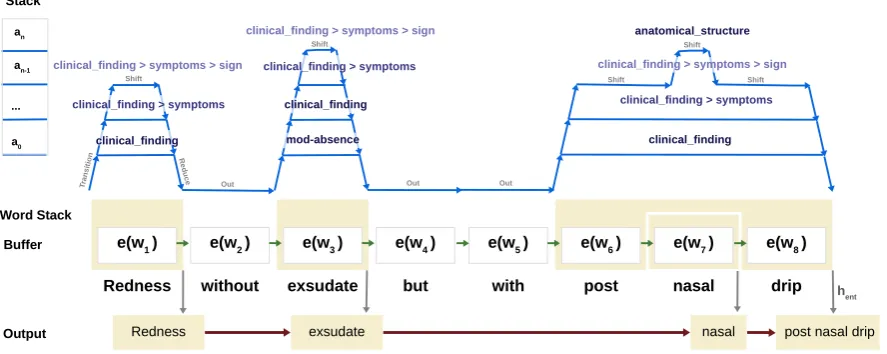
Our transition-based model allows for several mentions to start and end at a given location in the sequence. We make use of an additional stack to store temporarily the terms corresponding to each mention, which we denote asword stack. The sys-tem state sis represented by a stack of words S
containing all the temporary words pertaining to a mention (the word stack), a buffer of words to be parsed B, and a stack of actions correspond-ing to all mentions to be parsedM (the mention stack) and an output buffer that encode the entity mentions and other wordsO. Initially, we define the starting state as s0 = [M = ∅, S = ∅, B =
{w1, . . . , wn}], O=∅.
At each state, we apply an actionanand change the state of the systemsn: by adding elements or resetting the word stack and moving the resulting mention to the output buffer, popping the top most word of the buffer and adding or popping actions from the mention stack. We consider four types of possible system actionsa∈ A:
• OUT pops the top element of the buffer, and moves it to the output unaltered,
• SHIFTshifts the top element of the buffer to the word stack,
• TRANSITION(a) indicates the start of a men-tion, adds action labelato the mention stack,
•REDUCE(a) indicates the end of a mention and pops all elements of the mention stack until the last recorded transition and inserts the resulting men-tion (encoded as the output of an LSTM) in the output buffer. Since we only allow reductions of actions that remain in the top of the mention stack, we transition first to longer mentions, whenever more than one mention starts at the same point in the word sequence.
clinical_finding > symptoms > sign
clinical_finding > symptoms
Shift Shift
e(w1 ) e(w2 ) e(w3 )
Redness without exsudate
e(w4 )
but
e(w5 )
with
e(w6 )
post
e(w7 )
nasal
e(w8 )
drip
clinical_finding
Tran siti o
n R
edu ce Mention
Stack
Out
mod-absence
clinical_finding > symptoms
clinical_finding > symptoms > sign
clinical_finding
an
an-1
...
a0 clinical_finding
clinical_finding > symptoms
Out Out
Shift Shift
anatomical_structure
Shift
clinical_finding > symptoms > sign
exsudate
Redness nasal post nasal drip
Buffer
Output
hent
[image:3.595.79.523.76.253.2]Word Stack
Figure 1: Transition-shift-reduce mechanism for hierarchical nested mention recognition. Transitionis indicated by arrows pointing upwards,Reduceby downward arrows,Out horizontal arrows when mention stack is empty, andShiftaction when non-empty. Different levels of the mention stack indicate the number of nested layers, while mention color indicates the hierarchical level (darker blue for level 0 and lighter as we go up in the hierarchy).
that depends on the previous action generated and the current parser state, in particular the mention stack. We consider a simple set of rules: for hi-erarchical mentions we only allow transitions to lower levels in the hierarchy if the upper levels ex-ist in the mention buffer, meaning transitions of the form TRANSITION(a > b) where the symbol
>indicates thatbis a lower level hierarchy of class
aand is only admitted if TRANSITION(a) exists in the mention stack. Our model allows an arbitrary number of hierarchies since, without knowing this number beforehand; we only allow reductions of the top most element in the mention stack, this step requires an ordering of nested mentions from longer to shorter spanning windows; we also only allow SHIFTactions if the mention stack is non-empty.
A mention containing a single word requires three actions to be considered: TRANSITION(a), SHIFT and REDUCE(a). Using this approach, we can model consecutive transitions of different mentions, multiple hierarchical as well as nested mentions, as long as they remain without over-laps.1 For modifier classes, we model each indi-vidual modifier as a top level class. Figure2 pro-vides an example of a sequence of hierarchical and nested mentions. The terminal state is achieved when the word buffer is empty and all the elements of the mention stack have been reduced.
1We consider only non overlapping mentions disregarding
any occurrences of the form TRANSITION(a)- SHIFT- TRAN
-SITION(b)- SHIFT- REDUCE(a)- SHIFT- REDUCE(b).
4 HNNER Model
Our transition-based model draws inspiration from the transition based parser proposed byDyer et al. (2015). For a given sequence of input wordsW =
{w1, . . . , wN}we represent each word as a low di-mensional vectore(wn) ∈ Rdw for each word in
the vocabularywn ∈ [V]. To better capture mor-phological and orthographic features of words, we consider each word vector the product of con-catenating a fixed word lookup embeddingl(wn) with its learned character sequence representation
c(wn), such that e(wn) = [l(wn);c(wn)]. We compute the character embeddings using a bidi-rectional LSTM following work of Ma and Hovy (2016); Lample et al.(2016). We initialize char-acter embeddings randomly, while each word em-bedding is retrieved from a pretrained look-up rep-resentation. For words out-of-vocabulary we con-sider the word’s character based representation and we train a representation of the unknown word embedding.
We associate an LSTM with the word stack LSTMS({e(wj)}wj∈S) whose inputs correspond
to the words shifted from the buffer, another with the mention stack LSTMM({an}an∈M) with
in-puts from mentions that the system initialized, and a last LSTM that models the output of the sys-tem LSTMO({e(on)}on∈O), whose inputs
Models GENIA flat NER
P R F1
[image:4.595.98.262.60.118.2]Finkel et al.(2004) 71.62 68.56 70.06 GuoDong(2004) 75.99 69.42 72.55 HNNER 76.11 69.43 72.62
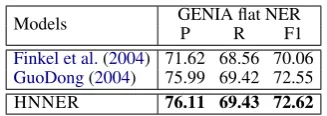
Table 1: Results on JNLPBA with flat mentions.
to be parsed in reverse order, and leave the first word at the top of the buffer. For a given state of the systemsi = [M, S, B, O]we compute the sys-tem state representation pi for each action ias a nonlinear transformation of the last LSTM state of the word stackhw ∈Rdw, the last LSTM state of
the mention stackhm∈Rdm and the top most
el-ement of the bufferbn∈Rdw and the last element
of the output LSTMon∈Rdo:
pi =tanh(W[hw;hm;bn;on] +b),
with the bias b ∈ Rk and linear weights W ∈
R(2dw+dm+do)×k.
The system state pi contains all the informa-tion required to make predicinforma-tions about the cur-rent action of the parser ai ∈ A, according to a set of possible valid actions that we compute with simple rules V(an−1, sn). Namely, we consider only as viable actions: SHIFT actions if it fol-lows after a TRANSITION; REDUCE actions can only be applied in the reverse order of the pre-viously applied TRANSITIONS; OUT actions are only allowed if there is no action to be reduced, and hierarchies must respect their parent transi-tions, meaning TRANSITION(a¿b) is not allowed if TRANSITION(a) has not been created first. Modi-fier classes are considered as a separate class of la-bels that may be applied in any hierarchical level.
The system greedily decides the current action based on:
p(an=a|pn) =
expα>apn
P
a0∈Vexpα>a0pn We train our model to maximize the log-likelihood of each action in a batch of M sequences:
L=−
M
X
i=1
N
X
n=1
βH−L(an)logp(a
n|pn),
weighted by a different value for each hierarchi-cal level β < 1, where the level of each action
L(an) = 0for the top levels and decreases as we go down in the hierarchy, andHdenotes the total number of levels.
Datasets GENIA MED18
train dev test train dev test vocabulary 74,560 51,879 pretrained vocab. 23,813 49,782 sentences 13,416 3,147 1,656 73,099 4,216 4,018 mentions 35,506 8738 4,492 495,148 29,522 28,458
hier. L0 17,753 4,369 2,246 230,912 13,702 13,271 hier. L1 17,753 4,369 2,246 139,665 8,353 7,933 hier. L2 – – – 123,291 7,372 7,132 hier. L3 – – – 1,200 95 122
flat actions 5 26
hier. actions 23 531
hier. L0 5 66
hier. L1 18 126
hier. L2 – 325
[image:4.595.308.528.61.223.2]hier. L3 – 14
Table 2: Dataset description: total number of mentions, sentences, words and actions. Number of mentions and types of actions per hierarchical layer
5 Experimental Results
Datasets: We compare our HNNER model
us-ing different nested and hierarchical scenarios. First, we compare against standard baselines for flat NER using the splits and the JNLPBA dataset (Gridach,2017), considering only flat and the topmost entities in the GENIA dataset (Ohta et al.,2002), following the same splits and entity types used by Finkel and Manning (2009). We used the GENIA dataset (Ohta et al.,2002), con-sisting of 2000 MEDLINE abstracts with 36 fine-grained entity categories. We also employed the same conversion to the main 5 entity types (and left the DNA and RNA subtypes the hierarchical experiments). We used pretrained word embed-dings for GENIA using PUBMED dataset.2 We further tested on a more complex medical dataset MED18, 3 comprising 3000 documents of anno-tated clinical reports in Portuguese. We consider 4 levels of hierarchy and 531 fine-grained entity categories. We trained word embeddings for this dataset using word2vec (Mikolov et al.,2013) on over around 10M documents of clinical records.
Table2in5shows a description of the datasets. The MED18 dataset is larger and more complex than GENIA, containing a total of 509869 men-tions, 531 different hierarchical classes with 4 lev-els of hierarchy, while GENIA altough initialy contains 36 fine-grained classes, we only report on 23 different classes with 2 levels of hierarchy.
Models and Baselines: We evaluate our
HN-NER model against state-of-the-art models for
2
Embeddings available in http://bio.nlplab. org/#source-data
Nested Models Nested GENIA P R F1 Finkel and Manning(2009) 75.4 65.9 70.3 Lu and Roth(2015) 72.5 65.2 68.7 Muis and Lu(2017) 75.4 66.8 70.8 Wang et al.(2018) 76.0 69.4 71.6
[image:5.595.89.270.60.137.2]HNNER 74.0 72.0 73.0
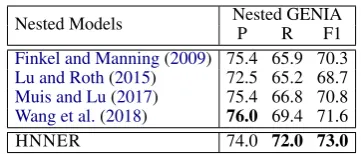
Table 3: Results on GENIA with nested mentions.
nested mentions: a CRF-based constituency parser (Finkel and Manning,2009); a nested NER model using mention hypergraphs (Lu and Roth, 2015); a multigraph representation with mention sepa-rators for overlapping mentions (Muis and Lu, 2017); a neural layered model for each nested layer (Ju et al., 2018); and a neural shift-reduce neural parser for nested mentions (Wang et al., 2018). We also, evaluated HNNER against the non-hierarchical nested version with the same number of hierarchical levels projected as a differ-ent independdiffer-ent class (HNNER+SUB). We train our model using Adam gradient updates (Kingma and Ba,2014) using a learning rate of0.001and a batch size of32sentences. We employed dropout of 0.1 on all input layers (Srivastava et al.,2014). We used β = 0.8 for GENIA and β = 1.0 for MED18. For higher level datasets this value should be closer to one in order to not overshadow the effect of lower hierarchies, which are often the most frequent ones.
Results Our HNNER model obtains
state-of-the-art results when compared with other flat (Ta-ble1) and nested NER models (Table3).
Learning hierarchical mentions explicitly using our model (HNNER) achieves better performance than using a set of projected subcategories inde-pendently, (HNNER+SUB) in Table 4. The pro-posed approach is still able to perform well when we deal with higher levels of hierarchy and more nested classes, which we can observe in the results using the MED18 dataset. As we progress towards higher level hierarchies the gap performance in-creases between projected subclasses and explicit hierarchical modeling. The performance of level
L3drops when compared with lower level levels, because of the scarce number of existing mentions for this level (see§5).
6 Conclusions and Future Work
We propose a hierarchical model based on a transition-based parser that is able to recognize hierarchical and nested mentions with undefined levels of complexity. We tested the performance
Hierarchical Models L2-GENIA L3-MED18
P R F1 P R F1
HNNER+SUB 69.3 64.5 66.8 73.2 71.7 72.5 HNNER+SUB-L0 73.5 68.4 70.9 74.4 71.3 72.8 HNNER+SUB-L1 65.1 60.6 62.8 72.7 72.7 72.7 HNNER+SUB-L2 - - - 72.1 72.1 72.1 HNNER+SUB-L3 - - - 37.5 36.9 37.2 HNNER 69.5 68.5 70.0 73.7 72.7 73.2
HNNER-L0 73.6 72.6 73.1 74.2 73.1 73.6
HNNER-L1 65.3 64.4 64.8 73.8 72.8 73.3
HNNER-L2 - - - 73.3 72.3 72.8
HNNER-L3 - - - 38.9 40.2 39.5
Table 4: Results on GENIA and MED18 with nested mentions with all the subcategories, and performance per hierarchical layer.
of our model using two medical datasets GENIA and MED18, and reported state-of-the-art results on flat, nested and hierarchical datasets. We leave as future work extending this approach to more general overlapping mentions with non projective overlaps and exploiting schedule sampling tech-niques to make the algorithm less prone to errors during test-time.
References
Steven Abney, Michael Collins, and Amit Singhal. 2000. Answer extraction. In Proceedings of the Sixth Conference on Applied Natural Language Pro-cessing. Association for Computational Linguistics, Stroudsburg, PA, USA, ANLC ’00, pages 296–301.
https://doi.org/10.3115/974147.974188.
Beatrice Alex, Barry Haddow, and Claire Grover. 2007. Recognising nested named entities in biomedical text. In Proceedings of the Workshop on BioNLP 2007: Biological, Translational, and Clinical Lan-guage Processing. Association for Computational Linguistics, Stroudsburg, PA, USA, BioNLP ’07, pages 65–72.
Jason Chiu and Eric Nichols. 2016. Named entity recognition with bidirectional lstm-cnns. Transac-tions of the Association for Computational Linguis-tics 4:357–370. http://aclweb.org/anthology/Q16-1026.
Ronan Collobert, Jason Weston, L´eon Bottou, Michael Karlen, Koray Kavukcuoglu, and Pavel Kuksa. 2011. Natural language processing (almost) from scratch. J. Mach. Learn. Res.12:2493–2537.
http://dl.acm.org/citation.cfm?id=1953048.2078186.
[image:5.595.306.528.61.184.2]Xiaocheng Feng, Bing Qin, and Ting Liu. 2016.
A language-independent neural network for event detection. Science China Information Sciences
61(9):092106. https://doi.org/10.1007/s11432-017-9359-x.
Jenny Rose Finkel, Shipra Dingare, Huy Nguyen, Malvina Nissim, Christopher D. Manning, and Gail Sinclair. 2004. Exploiting context for biomedical entity recognition: From syntax to the web. In
Proceedings of the International Joint Workshop on Natural Language Processing in Biomedicine and its Applications, NLPBA/BioNLP 2004, Geneva, Switzerland, August 28-29, 2004.
Jenny Rose Finkel and Christopher D. Manning. 2009. Nested named entity recognition. InProceedings of the 2009 Conference on Empirical Methods in Nat-ural Language Processing: Volume 1 - Volume 1. Association for Computational Linguistics, Strouds-burg, PA, USA, EMNLP ’09, pages 141–150.
Pavlina Fragkou. 2017. Applying named entity recog-nition and co-reference resolution for segmenting english texts. Progress in Artificial Intelligence6.
https://doi.org/10.1007/s13748-017-0127-3.
Mourad Gridach. 2017. Character-level neural network for biomedical named entity recognition. Journal of Biomedical Informatics70:85 – 91.
Zhaochen Guo and Denilson Barbosa. 2014. Robust entity linking via random walks. InProceedings of the 23rd ACM International Conference on Confer-ence on Information and Knowledge Management. ACM, New York, NY, USA, CIKM ’14, pages 499– 508. https://doi.org/10.1145/2661829.2661887.
Zhou GuoDong. 2004. Recognizing names in biomedical texts using hidden markov model and svm plus sigmoid. In Proceedings of the Inter-national Joint Workshop on Natural Language Processing in Biomedicine and Its Applica-tions. Association for Computational Linguistics, Stroudsburg, PA, USA, JNLPBA ’04, pages 1–7.
http://dl.acm.org/citation.cfm?id=1567594.1567596.
Nitish Gupta, Sameer Singh, and Dan Roth. 2017.
Entity linking via joint encoding of types, de-scriptions, and context. In Proceedings of the 2017 Conference on Empirical Methods in Natural Language Processing. Association for Computational Linguistics, pages 2681–2690.
https://doi.org/10.18653/v1/D17-1284.
Meizhi Ju, Makoto Miwa, and Sophia Ananiadou. 2018. A neural layered model for nested named en-tity recognition. InProceedings of the 2018 Con-ference of the North American Chapter of the Asso-ciation for Computational Linguistics: Human Lan-guage Technologies, Volume 1 (Long Papers). Asso-ciation for Computational Linguistics, pages 1446– 1459.https://doi.org/10.18653/v1/N18-1131.
Arzoo Katiyar and Claire Cardie. 2018.Nested named entity recognition revisited. In Proceedings of the 2018 Conference of the North American Chapter of the Association for Computational Linguistics: Hu-man Language Technologies, Volume 1 (Long Pa-pers). Association for Computational Linguistics, pages 861–871. https://doi.org/10.18653/v1/N18-1079.
Diederik P. Kingma and Jimmy Ba. 2014. Adam: A method for stochastic optimization. CoRR
abs/1412.6980. http://arxiv.org/abs/1412.6980.
Guillaume Lample, Miguel Ballesteros, Sandeep Sub-ramanian, Kazuya Kawakami, and Chris Dyer. 2016. Neural architectures for named entity recognition.
CoRRabs/1603.01360.
Robert Leaman and Zhiyong Lu. 2016. Taggerone: joint named entity recognition and normaliza-tion with semi-markov models. Bioinformatics
32(18):2839–2846.
Xiao Ling and Daniel S. Weld. 2012. Fine-grained en-tity recognition. InIn Proc. of the 26th AAAI Con-ference on Artificial Intelligence.
Liyuan Liu, Xiang Ren, Qi Zhu, Shi Zhi, Huan Gui, Heng Ji, and Jiawei Han. 2017. Heterogeneous su-pervision for relation extraction: A representation learning approach. Proceedings of the 2017 Con-ference on Empirical Methods in Natural Language Processinghttps://doi.org/10.18653/v1/d17-1005.
Wei Lu and Dan Roth. 2015. Joint mention extrac-tion and classificaextrac-tion with menextrac-tion hypergraphs. In
Proceedings of the 2015 Conference on Empirical Methods in Natural Language Processing. Associa-tion for ComputaAssocia-tional Linguistics, pages 857–867.
https://doi.org/10.18653/v1/D15-1102.
Xuezhe Ma and Eduard Hovy. 2016. End-to-end sequence labeling via bi-directional lstm-cnns-crf. In Proceedings of the 54th Annual Meet-ing of the Association for Computational Lin-guistics (Volume 1: Long Papers). Association for Computational Linguistics, pages 1064–1074.
https://doi.org/10.18653/v1/P16-1101.
Michal Marcinczuk. 2015. Automatic construction of complex features in conditional random fields for named entities recognition. InRecent Advances in Natural Language Processing, RANLP 2015, 7-9 September, 2015, Hissar, Bulgaria. pages 413–419.
Tomas Mikolov, Ilya Sutskever, Kai Chen, Greg S Corrado, and Jeff Dean. 2013. Distributed representations of words and phrases and their compositionality. In C. J. C. Burges, L. Bottou, M. Welling, Z. Ghahramani, and K. Q. Wein-berger, editors, Advances in Neural Information Processing Systems 26, Curran Associates, Inc., pages 3111–3119. http://papers.nips.cc/paper/5021- distributed-representations-of-words-and-phrases-and-their-compositionality.pdf.
Mike Mintz, Steven Bills, Rion Snow, and Dan Jurafsky. 2009. Distant supervision for relation extraction without labeled data. In Proceed-ings of the Joint Conference of the 47th Annual Meeting of the ACL and the 4th International Joint Conference on Natural Language Pro-cessing of the AFNLP: Volume 2 - Volume 2. Association for Computational Linguistics, Stroudsburg, PA, USA, ACL ’09, pages 1003–1011.
http://dl.acm.org/citation.cfm?id=1690219.1690287.
Makoto Miwa and Mohit Bansal. 2016. End-to-end relation extraction using lstms on sequences and tree structures. In Proceedings of the 54th An-nual Meeting of the Association for Computational Linguistics (Volume 1: Long Papers). Association for Computational Linguistics, pages 1105–1116.
https://doi.org/10.18653/v1/P16-1105.
Aldrian Obaja Muis and Wei Lu. 2017. Label-ing gaps between words: RecognizLabel-ing overlappLabel-ing mentions with mention separators. In Proceed-ings of the 2017 Conference on Empirical Meth-ods in Natural Language Processing. Association for Computational Linguistics, pages 2608–2618.
https://doi.org/10.18653/v1/D17-1276.
T. Ohta, Y. Tateisi, and J.D. Kim. 2002. The genia corpus: An annotated research abstract corpus in molecular biology domain. Inthe Human Language Technology Conference.
Lev Ratinov and Dan Roth. 2009. Design challenges and misconceptions in named entity recognition. In Proceedings of the Thirteenth Conference on Computational Natural Language Learn-ing. Association for Computational Linguistics, Stroudsburg, PA, USA, CoNLL ’09, pages 147–155.
http://dl.acm.org/citation.cfm?id=1596374.1596399.
Dan Shen, Jie Zhang, Guodong Zhou, Jian Su, and Chew-Lim Tan. 2003. Effective adapta-tion of a hidden markov model-based named en-tity recognizer for biomedical domain. In Pro-ceedings of the ACL 2003 Workshop on Natu-ral Language Processing in Biomedicine - Vol-ume 13. Association for Computational Linguistics, Stroudsburg, PA, USA, BioMed ’03, pages 49–56.
https://doi.org/10.3115/1118958.1118965.
Nitish Srivastava, Geoffrey Hinton, Alex Krizhevsky, Ilya Sutskever, and Ruslan Salakhutdinov. 2014. Dropout: A simple
way to prevent neural networks from overfit-ting. J. Mach. Learn. Res. 15(1):1929–1958.
http://dl.acm.org/citation.cfm?id=2627435.2670313.
Bailin Wang, Wei Lu, Yu Wang, and Hongxia Jin. 2018. A neural transition-based model for nested mention recognition. In Proceedings of the 2018 Conference on Empirical Methods in Natural Lan-guage Processing. Association for Computational Linguistics, pages 1011–1017.
Mengqiu Wang, Wanxiang Che, and Christopher D. Manning. 2013. Effective bilingual constraints for semi-supervised learning of named entity recogniz-ers. In Proceedings of the Twenty-Seventh AAAI Conference on Artificial Intelligence. AAAI Press, AAAI’13, pages 919–925.
Jie Zhang, Dan Shen, Guodong Zhou, Jian Su, and Chew-Lim Tan. 2004. Enhancing
hmm-based biomedical named entity
recog-nition by studying special phenomena. J. of Biomedical Informatics 37(6):411–422.
https://doi.org/10.1016/j.jbi.2004.08.005.
GuoDong Zhou and Jian Su. 2002. Named en-tity recognition using an hmm-based chunk tag-ger. In Proceedings of the 40th Annual Meet-ing on Association for Computational LMeet-inguis- Linguis-tics. Association for Computational Linguistics, Stroudsburg, PA, USA, ACL ’02, pages 473–480.