61
SpatialNet: A Declarative Resource for Spatial Relations
Morgan Ulinski and Bob Coyne and Julia Hirschberg Department of Computer Science
Columbia University New York, NY, USA
{mulinski,coyne,julia}@cs.columbia.edu
Abstract
This paper introduces SpatialNet, a novel re-source which links linguistic expressions to
actual spatial configurations. SpatialNet is
based on FrameNet (Ruppenhofer et al.,2016) and VigNet (Coyne et al.,2011), two resources which use frame semantics to encode lexical
meaning. SpatialNet uses a deep semantic
representation of spatial relations to provide a formal description of how a language ex-presses spatial information. This formal rep-resentation of the lexical semantics of spatial language also provides a consistent way to represent spatial meaning across multiple lan-guages. In this paper, we describe the structure of SpatialNet, with examples from English and German. We also show how SpatialNet can be combined with other existing NLP tools to cre-ate a text-to-scene system for a language.
1 Introduction
Spatial language understanding is a research area in NLP with applications from robotics and nav-igation to paraphrase and image caption genera-tion. However, most work in this area has been focused specifically on English. While there is a rich literature on the realization of spatial relations in different languages, there is no comprehensive resource which can represent spatial meaning in a formal manner for multiple languages. The de-velopment of formal models for the expression of spatial relations in different languages is a largely uninvestigated but relevant problem.
By way of motivation, consider the following translation examples. We use an NP in which we have a PP modifier, and we complete the sentence with a copula and an adjective to obtain a full sen-tence. The prepositions are marked inboldface. The English sentence is a word-for-word gloss of the German sentence except for the preposition.
In our first example, English on is correctly translated to Germanan:1
(1) a. The paintingonthe wall is abstract. b. Correct translation: Das Gem¨aldeander
Mauer/Wand ist abstrakt.
c. Google Translate/Bing Translator (cor-rect): Das Gem¨aldeander Wand ist ab-strakt.
However, the correct translation changes if we are relating a cat to a wall:
(2) a. The catonthe wall is grey.
b. Correct translation: Die Katze auf der Mauer ist grau.
c. Google Translate/Bing Translator (incor-rect): Die Katzeander Wand ist grau.
The problem here is that the English preposition
on describes two different spatial configurations: ‘affixed to’, in the case of the painting, and ‘on top of’, in the case of the cat.2
Similar problems appear when we translate from German to English. The painting again trans-lates correctly:
(3) a. Das Gem¨aldeander Mauer ist abstrakt. b. Correct translation: The paintingonthe
wall is abstract.
c. Google Translate/Bing Translator (cor-rect): The painting on the wall is ab-stract.
1Note that English
wallshould be translated toWandif it is a wall which has a ceiling attached to it, andMauerif it is freestanding and does not help create an enclosed three-dimensional space. We ignore this particular issue in this dis-cussion.
But when we replace the painting with the house, we no longer obtain the correct translation:
(4) a. Das Hausander Mauer ist groß.
b. Correct translation: The house at the wall is large/big.
c. Google Translate (incorrect): The house
onthe wall is large.
Bing Translator (incorrect): The house
onthe wall is big.
The problem is again that the German preposition
ancorresponds to two different spatial configura-tions, ‘affixed to’ (painting) and ‘at/near’ (house). We address the issue of modeling cross-linguistic differences in the expression of spatial language by developing a deep semantic represen-tation of spatial relations called SpatialNet. Spa-tialNet is based on two existing resources: Frame-Net (Baker et al.,1998;Ruppenhofer et al.,2016), a lexical database linking semantic frames to man-ually annotated text, and VigNet (Coyne et al.,
2011), a resource extending FrameNet by ground-ing abstract lexical semantics with concrete graph-ical relations. VigNet was developed as part of the WordsEye text-to-scene system (Coyne and Sproat,2001). SpatialNet builds on both these re-sources to provide a formal description of the lex-ical semantics of spatial relations by linking lin-guistic expressions both to semantic frames and to actual spatial configurations. Because of the link to VigNet and WordsEye, SpatialNet can also be used to create a text-to-scene system for a lan-guage. This text-to-scene system can be used to verify the accuracy of a SpatialNet resource with native speakers of a language.
SpatialNet is divided into two modules:
Spatio-graphic primitives (SGPs) represent possible
graphical (spatial) relations. The ontology repre-sents physical objects and their classification into semantic categories. Both are based on physical properties of the world and do not depend on a particular language. Spatial framesare language-specific (though, like the frames of FrameNet, may be shared among many languages) and represent the lexical meanings a language expresses.
Spa-tial vignettesgroup together lexical items, spatial
frames, and SGPs with spatial and graphical con-straints from the ontology, grounding the meaning in a language-independent manner.
In Section2, we discuss related work. In Sec-tion 3, we provide background information on
FrameNet and VigNet. In Section4, we describe the SpatialNet structure, with English and German examples. In Section5, we show how the Spatial-Net for a language can be used in conjunction with the WordsEye text-to-scene system to generate 3D scenes from input text in that language. We con-clude in Section6and discuss future work.
2 Related Work
Spatial relations have been studied in linguistics for many years. One study for English by Her-skovits(1986) catalogs fine-grained distinctions in the interpretation of prepositions. For example, she distinguishes among the uses of on to mean ‘on the top of a horizontal surface’ (the cup is on the table) or ‘affixed to a vertical surface’ (the
pic-ture is on the wall). Likewise, Feist and Gentner
(1998) describe user perception experiments that show that the shape, function, and animacy of the figure and ground objects are factors in the percep-tion of spatial relapercep-tions asinoron.
Other work looks at how the expression of spa-tial relations varies across languages. Bowerman and Choi (2003) describe how Korean linguisti-cally differentiates between putting something in a loose-fitting container (nehta, e.g. fruit in a bag) vs. in a tight fitting wrapper (kkita, e.g. hand in glove). Other languages (English included) do not make this distinction. Levinson (2003) and col-leagues have also catalogued profound differences in the ways different languages encode relations between objects in the world. Our work differs from linguistic efforts such as these in that we are building a formal representation of how a language expresses spatial information, which can be ap-plied to a variety of NLP problems and applica-tions. Since the representation is human- as well as machine-readable, it can also be used in more traditional linguistics.
Another area of research focuses on computa-tional processing of spatial language. Pustejovsky
de-scription and also a semantic grounding that tells us the actual spatial configuration denoted by a set of spatial roles. Also, our work extends to lan-guages other than English.
Petruck and Ellsworth (2018) advocate using FrameNet (Ruppenhofer et al.,2016) to represent spatial language. FrameNet uses frame seman-tics to encode lexical meaning. VigNet (Coyne et al., 2011) is an extension of FrameNet used in the WordsEye text-to-scene system (Coyne and Sproat,2001). SpatialNet builds on both Frame-Net and VigFrame-Net; we will describe FrameFrame-Net and VigNet in more detail in the next section.
3 Background on FrameNet and VigNet
FrameNet encodes lexical meaning using a frame-semantic conceptual framework. In FrameNet, lexical items are grouped together in frames ac-cording to shared semantic structure. Every frame contains a number of frame elements (seman-tic roles) which are par(seman-ticipants in this structure. Words that evoke a frame are calledlexical units. A lexical unit is also linked to sentences that have been manually annotated to identify frame ele-ment fillers and their grammatical functions. This results in a set ofvalence patterns that represent possible mappings between syntactic functions and frame elements for the lexical unit. Frame-Net already contains a number of frames for spa-tial language. Spaspa-tial language frames in Frame-Net inherit fromLOCATIVE-RELATION, which de-fines core frame elements FIGURE andGROUND, as well as non-core frame elements includingDIS -TANCEandDIRECTION. Examples of spatial lan-guage frames are SPATIAL-CONTACT, CONTAIN -MENTandADJACENCY.
VigNet, a lexical resource inspired by and based on FrameNet, was developed as part of the Words-Eye text-to-scene system. VigNet extends Frame-Net in several ways. It adds much more fine-grained frames, primarily based on differences in graphical realization. For example, the verb “wash” can be realized in many different ways, depending on whether one is washing dishes or one’s hair or a car; VigNet therefore has several different wash frames. VigNet also adds graph-ical semantics to frames. It does this by adding primitive graphical (typically, spatial) relations be-tween frame element fillers. These graphical rela-tions can represent the position, orientation, size, color, texture, and poses of objects in the scene.
The graphical semantics can be thought of as a se-mantic grounding; it is used by WordsEye to con-struct and render a 3D scene. Frames augmented with graphical semantics are calledvignettes.
The descriptions of the graphical semantics in vignettes make use of object-centric properties calledaffordances(Gibson,1977;Norman,1988). Affordances include any functional or physical property that allows an object to participate in ac-tions and relaac-tions with other objects. For exam-ple, a SEAT of a chair is used to support a sitter and theINTERIORof a box is used to hold the con-tents. VigNet has a rich set of spatial affordances. Some examples areCUPPED REGIONSfor objects to be in, CANOPIES for objects to beunder, and TOP SURFACESfor objects to beon.
Information about the 3D objects in WordsEye is organized in VigNet into anontology. The on-tology is a hierarchy of semantic types with mul-tiple inheritance. Types include both 3D objects and more general semantic concepts. For exam-ple, a particular 3D rocking chair is a sub-type of ROCKING-CHAIR.N. Every 3D object has a semantic type and is inserted into the ontology. WordsEye also includes lexicalized concepts (e.g.
chairtied toCHAIR.N) in the ontology. The
ontol-ogy includes a knowledge base of assertions that provide more information about semantic cepts. Assertions include sizes of objects and con-cepts, their parts, their colors, what they typically contain, what affordances they have, and informa-tion about their funcinforma-tion. Spatial affordances and other properties can be applied to both 3D graph-ical objects and to more general semantic types. For example, the general semantic typeCUP.Nhas a CUPPED REGION affordance, since this affor-dance is shared by all cups. A particular 3D graph-ical object of a cup might have aHANDLE affor-dance, while another might have aLIDaffordance, but these spatial affordances are not tied to the super-typeCUP.N.
self-motion-from-front.r
animate-being.n
agent
physical-entity.n source
number distance
pose.n
pose
in-pose.r entity
orientation-away-from.r fig
in-front-of.r fig gnd gnd dist pose
self-motion-from-portal.r
animate-being.n
agent
entity-with-door-gate-affordance.n
source
number distance
pose.n
pose
in-pose.r entity
orientation-away-from.r fig
distance-from.r fig
gnd gnd dist
pose
door-gate-affordance.n
gnd-part gnd-part
outward.n
[image:4.595.81.526.65.171.2]dir
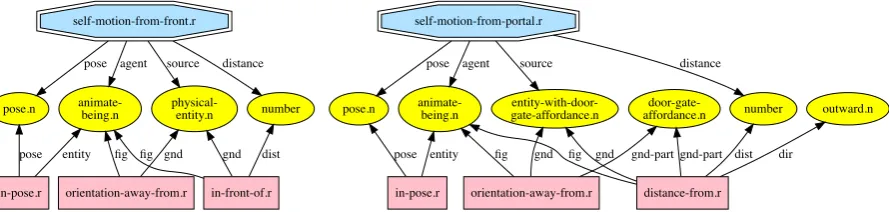
Figure 1: Two frames augmented with primitive graphical relations. The high-level semantics ofSELF-MOTION
-FROM-FRONT.RandSELF-MOTION-FROM-PORTAL.Rare decomposed into semantic types and graphical relations.
DOOR-GATE-AFFORDANCE.Nas a part.
4 Structure of SpatialNet
SpatialNet provides a formal description of spa-tial semantics by linking linguistic expressions to semantic frames and linking semantic frames to actual spatial configurations. To do this, we adopt some conventions from FrameNet and Vig-Net, making some changes to address some of the shortcomings of these resources.
FrameNet provides semantic frames including frames for spatial language. However, the syn-tactic information provided in the valence patterns is often insufficient for the purpose of automati-cally identifying frame elements in new sentences. One example is frames where the target word is a preposition, which includes many of the frames for spatial language. According to the Frame-Net annotation guidelines for these (Ruppenhofer et al.,2016, page 50), the GROUNDis assigned the grammatical function Obj(ect), and the FIGUREis tagged as an Ext(ernal) argument. Given a pre-viously unseen sentence, automatic methods can identify the object of the preposition and therefore the GROUND, but the sentence may contain sev-eral noun phrases outside the prepositional phrase, making the choice of FIGUREambiguous. Frame-Net also does not provide a semantic grounding. To create SpatialNet, we adopt the concept of a FrameNetframe, including the definition offrame
elements andlexical units. However, we modify
the valence patterns to more precisely define syn-tactic patterns in a declarative format. In addi-tion, to facilitating the use of SpatialNet across dif-ferent languages, we specify syntactic constraints in valence patterns using labels from the Univer-sal Dependencies project (Universal Dependen-cies,2017).
VigNet does provide a grounding in graphical
semantics, but presents other problems. First, Vig-Net does not currently include a mapping from syntax to semantic frames. Although vignettes provide a framework for linking semantic frames to primitive graphical relations, the VigNet re-source does not include frames for spatial prepo-sitions, but only for higher-level semantic con-structs. Finally, since VigNet has been developed specifically for English, some parts of the exist-ing resource do not generalize easily to other lan-guages. To create SpatialNet, we adopt from Vig-Net the concept of avignetteand thesemantic
on-tology. However, we make the resource more
ap-plicable across languages by (a) formalizing the set of primitive graphical relations and constraints used in vignettes into what we callspatio-graphic
primitives (SGPs), and (b) moving the
language-specific mapping of lexical items to semantic cat-egories out of the VigNet ontology and into a sep-arate database. The SGPs and semantic ontology are used to define a language-independent seman-tic grounding for vignettes.
A SpatialNet for a particular language consists of a set ofspatial frames, which link surface lan-guage to lexical semantics using valence patterns, and a set of spatial vignettes, which link spatial frames and lexical units to SGPs based on seman-tic/functional constraints. We are developing Spa-tialNet resources for English and German.
4.1 Ontology of Semantic Categories
de-veloped for English, it may need to be extended or modified in the future to be relevant for other languages and cultures. VigNet also includes lex-icalized concepts (e.g. chair tied to CHAIR.N) in the ontology. For SpatialNet, we store this language-dependent lexical information in a sep-arate database.
The mapping from lexical items to semantic concepts is important for the decomposition of text into semantics. For English SpatialNet, we use the lexical mapping extracted from VigNet. To facilitate creation of lexical mappings for other languages, we mapped VigNet concepts to entries in the Princeton WordNet of English (Princeton University, 2019). An initial mapping was con-structed as follows: For each lexicalized concept in VigNet, we looked up each of its linked lexical items in WordNet. If the word (with correct part of speech) was found in WordNet, we added map-pings between the VigNet concept and each Word-Net synset for that word. This resulted in a many-to-many mapping of VigNet concepts to WordNet synsets. We are currently working on manually correcting this automatically-created map.
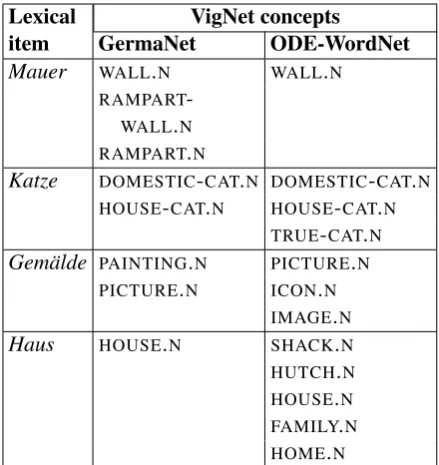
To obtain a lexical mapping for German, we use the VigNet–WordNet map in conjunction with GermaNet (Henrich and Hinrichs, 2010; Hamp and Feldweg, 1997). GermaNet includes map-pings to Princeton WordNet 3.0. For a given Ger-man lexical item, we use the GermaNet links to Princeton WordNet to obtain a set of possible Vig-Net concepts from the VigVig-Net–WordVig-Net mapping. We are also experimenting with the Open German WordNet (Siegel, 2019), although in general we have found it to be less accurate. Open German WordNet includes links to the EuroWordNet In-terlingual Index (ILI) (Vossen, 1998), which are in turn mapped to the Princeton English WordNet. Table 1 shows the VigNet concepts for German words used in the sentences in Figure2, obtained using GermaNet and Open German WordNet.
4.2 Spatio-graphic Primitives
To create the set of spatio-graphic primitives used in SpatialNet, we began with relations already in VigNet. VigNet contains a range of semantic re-lations, from high-level abstract relations origi-nating in FrameNet, such as ABANDONMENT.R, to low-level graphical relations, such as RGB -VALUE-OF.R. We extracted from VigNet a list of relations representing basic spatial configurations
Lexical item
VigNet concepts
GermaNet ODE-WordNet
Mauer WALL.N WALL.N
RAMPART -WALL.N RAMPART.N
Katze DOMESTIC-CAT.N DOMESTIC-CAT.N
HOUSE-CAT.N HOUSE-CAT.N TRUE-CAT.N
Gem¨alde PAINTING.N PICTURE.N
PICTURE.N ICON.N
IMAGE.N
Haus HOUSE.N SHACK.N
HUTCH.N HOUSE.N FAMILY.N
[image:5.595.306.526.61.294.2]HOME.N
Table 1: Mapping from German lexical items to Vig-Net semantic categories, obtained using two different German WordNet resources.
and graphical properties, separating these from the higher-level relations in VigNet which may be English-specific.
We also wanted to ensure that our list of spatio-graphic primitives was as comprehensive as possi-ble, and not limited to the graphical capabilities of WordsEye. To that end, we annotated each picture in the Topological Relations Picture Series ( Bow-erman and Pederson, 1992) and the Picture Se-ries for Positional Verbs (Ameka et al.,1999) with the spatial and graphical primitives it represents. When an appropriate spatial primitive did not ex-ist in VigNet, we created a new one. These new SGPs have also been added it to a list of “pend-ing” graphical relations that the WordsEye devel-opers plan to implement in the future. In total, we have about 100 SGPs.
(a)
ON-TOP-SURFACE.SGP
HOUSE-CAT.N figure
WALL.N ground
(b)
ON-FRONT-SURFACE.SGP
PAINTING.N figure
WALL.N ground
(c)
NEXT-TO.SGP
HOUSE.N figure
WALL.N ground
(a)
(b) (c)
(a) (b) (c)
English The cat isonthe wall. The painting isonthe wall. The house isatthe wall.
[image:6.595.74.525.60.281.2]German Die Katze istaufder Mauer. Das Gem¨alde istander Mauer. Das Haus istander Mauer.
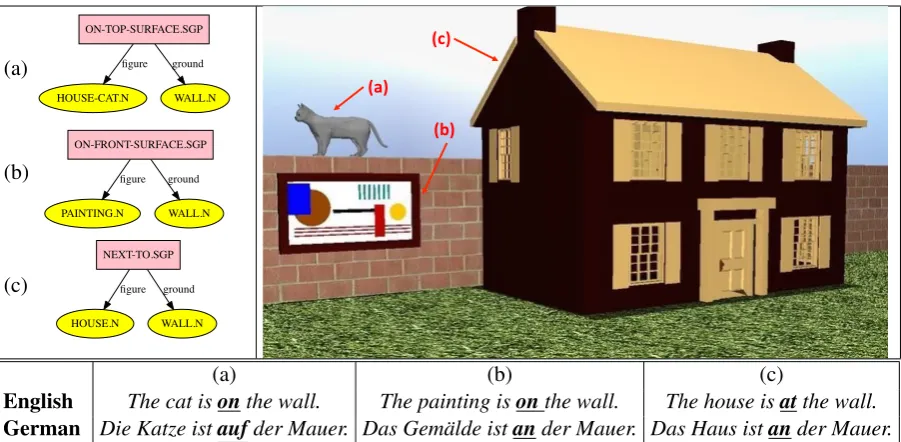
Figure 2: Examples of spatio-graphic primitives: (a)ON-TOP-SURFACE, (b)ON-FRONT-SURFACE, and (c)NEXT
-TOand English/German descriptions.
SGP is not yet supported by WordsEye. For exam-ple, WordsEye currently cannot graphically repre-sent a FITTED-ON relation, e.g. a hat on a head or a glove on a hand. When WordsEye encoun-ters a relation that it cannot decompose into sup-ported graphical primitives, the relation is ignored and not included in the 3D graphics. The entities referenced by the relations will be displayed in a default position (side-by-side). Figure 2shows a scene created in WordsEye that demonstrates the spatio-graphic primitivesON-TOP-SURFACE,ON -FRONT-SURFACE, andNEXT-TO.
4.3 Spatial Frames
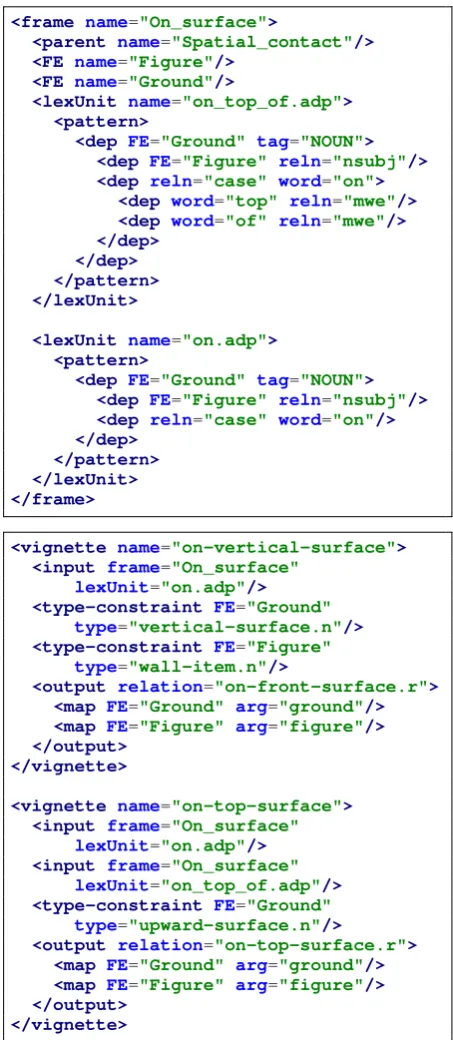
Spatial frames represent the lexical meanings a language can express. The structure of spatial frames is closely based on FrameNet frames. We have incorporated many of the FrameNet spatial language frames into SpatialNet, adding to these as needed. For example, for English we have added an ON-SURFACE frame that inherits from SPATIAL-CONTACT. The main difference between SpatialNet frames and FrameNet frames is in the definition of the valence patterns. SpatialNet de-fines valence patterns by precisely specifying lex-ical and syntactic constraints, which can be based on the syntactic dependency tree structure, gram-matical relations, parts of speech, or lexical items. Figure4, which provides examples of spatial vi-gnettes, includes a valence pattern for the English lexical uniton.adp. This pattern specifies a
syntac-tic structure consisting of a root (which must have part of speechNOUN), annsubjdependent, and a
casedependent (which must be the word “on”). The declarative format used to define this spatial frame is shown in Figure3(top).
4.4 Spatial Vignettes
Spatial vignettes use spatial frames, SGPs, and the ontology to interpret prepositions and other lex-ical information in a language. They relate lin-guistic realization (e.g. a preposition with its ar-gument structure) to a spatial frame (such asON -SURFACE), and at the same time to a graphical semantics expressed in terms of SGPs and addi-tional constraints. This lexical information is of-ten ambiguous. Consider the English and German descriptions in Figure 2. In English, the prepo-sition on is ambiguous; it can mean either ON -TOP-SURFACE or ON-FRONT-SURFACE. In Ger-man, the prepositionanis ambiguous; it can mean either ON-FRONT-SURFACE or NEXT-TO. To re-solve such ambiguities, vignettes place selectional restrictions on frame elements that require fillers to have particular spatial affordances, spatial prop-erties (such as the object size, shape, and orienta-tion), or functional properties (such as whether the object is a vehicle or path). This information is found in the ontology.
Consider the spatial vignettes that would be used to disambiguate the meanings of Englishon
de-<frame name="On_surface">
<parent name="Spatial_contact"/> <FE name="Figure"/>
<FE name="Ground"/>
<lexUnit name="on_top_of.adp"> <pattern>
<dep FE="Ground" tag="NOUN"> <dep FE="Figure" reln="nsubj"/> <dep reln="case" word="on">
<dep word="top" reln="mwe"/> <dep word="of" reln="mwe"/> </dep>
</dep> </pattern> </lexUnit>
<lexUnit name="on.adp"> <pattern>
<dep FE="Ground" tag="NOUN"> <dep FE="Figure" reln="nsubj"/> <dep reln="case" word="on"/> </dep>
</pattern> </lexUnit> </frame>
<vignette name="on-vertical-surface"> <input frame="On_surface"
lexUnit="on.adp"/> <type-constraint FE="Ground"
type="vertical-surface.n"/> <type-constraint FE="Figure"
type="wall-item.n"/>
<output relation="on-front-surface.r"> <map FE="Ground" arg="ground"/> <map FE="Figure" arg="figure"/> </output>
</vignette>
<vignette name="on-top-surface"> <input frame="On_surface"
lexUnit="on.adp"/> <input frame="On_surface"
lexUnit="on_top_of.adp"/> <type-constraint FE="Ground"
type="upward-surface.n"/>
<output relation="on-top-surface.r"> <map FE="Ground" arg="ground"/> <map FE="Figure" arg="figure"/> </output>
[image:7.595.67.294.60.581.2]</vignette>
Figure 3: Declarative format for spatial frames (top) and spatial vignettes (bottom)
fine these spatial vignettes is shown in Figure 3
(bottom). A visual representation of the vignettes is shown in Figure 4 (top). The vignettes link the spatial frame ON-SURFACE to different SGPs based on features of the frame element fillers.
The first vignette, ON-FRONT-SURFACE, adds semantic type constraints to both the FIGURE and the GROUND. The Figure must be of type WALL-ITEM.N and the Ground must be of type
VERTICAL-SURFACE.N. If these constraints are met, the vignette produces the SGP ON-FRONT -SURFACE as output, mappingFIGURE to the SGP argumentfigure, and GROUNDto the SGP ar-gumentground. The second vignette, ON-TOP -SURFACE, has a semantic type constraint only that
GROUNDbe of typeUPWARD-SURFACE.N. If this constraint is met, the vignette produces the SGP ON-TOP-SURFACE. Note that, while in this case the frame elements and SGP arguments have the same names, this is not necessarily true for all vi-gnettes (cf. the vivi-gnettes in Figure1). Note also that in English, paintingon wall is actually am-biguous, since a painting can technically be bal-anced on the top of a wall rather than hanging on its front surface. The spatial vignettes allow for either interpretation.
Figure 4 also shows the two vignettes which would be used to disambiguate the meanings of Germananfrom Figure2. The German vignettes link the spatial frameADJACENCY to SGPs. The first vignette,ON-FRONT-SURFACE, is identical to the English vignette of the same name, except for the input frame and lexical unit. The semantic type constraints, SGPs, and frame element to SGP ar-gument mappings are the same. The second vi-gnette,NEXT-TO, does not have any semantic type constraints and thus outputs the SGP NEXT-TO with the familiarFIGURE–figureandGROUND–
groundargument mappings. In the next section,
we provide a complete example of using spatial vignettes to interpret these German sentences.
5 Using SpatialNet for Text-to-Scene Generation
SpatialNet can be used in conjunction with the graphics generation component of the WordsEye text-to-scene system to produce a 3D scene from a spatial description which can be used to verify the spatial frames and vignettes defined in Spatial-Net. Figure 5 shows an overview of our system for text-to-scene generation. Although Spatial-Net focuses on semantics, the system also requires modules for morphological analysis and syntac-tic parsing. For English and German, we use the Stanford CoreNLP Toolkit (Manning et al.,2014). In this section, we describe how we use Stanford CoreNLP, SpatialNet, and WordsEye to convert text into a 3D scene. We illustrate using German sentences (b) and (c) from Figure2.
X [NN]
Y nsubj
Z ["on"] case
ON-SURFACE.SF
Y
[WALL-ITEM.N] Figure
X
[VERTICAL-SURFACE.N]
Ground
ON-FRONT-SURFACE.SGP
Y figure
X ground
X [NN]
Y nsubj
Z ["on"] case
ON-SURFACE.SF
Y Figure
X
[UPWARD- SURFACE.N]
Ground
ON-TOP-SURFACE.SGP
Y figure
X ground
X [NN]
Y nsubj
Z ["an"] case
ADJACENCY.SF
Y
[WALL-ITEM.N] Figure
X
[VERTICAL-SURFACE.N]
Ground
ON-FRONT-SURFACE.SGP
Y figure
X ground
X [NN]
Y nsubj
Z ["an"] case
ADJACENCY.SF
Y Figure
X
Ground
NEXT-TO.SGP
Y figure
X ground
Figure 4: Spatial vignettes for different meanings of Englishon(top) and Germanan(bottom). Vignettes resolve the spatial relation given the spatial and functional object features. Spatial frames are represented by blue octagons, and SGPs by pink rectangles.
lemmatization, part-of-speech tagging, and depen-dency parsing. Figure 6 shows the resulting de-pendency structures. The dede-pendency structures are matched against the valence patterns in spa-tial frames. Sentences (b) and (c) both match the
Spatial
Vignettes Spatio-graphic primitives Ontology
Morphological Analysis
Input Text
Graphical Realization
Syntactic Parsing
[image:9.595.77.522.77.192.2]Semantic Analysis
Figure 5: Pipeline for text-to-scene generation with SpatialNet
Das/ART Gemälde/NN
det
ist/VAFIN an/APPR der/ART
Mauer/NN
nsubj cop case det
(b)
Das/ART Haus/NN
det
ist/VAFIN an/APPR der/ART Mauer/NN
nsubj cop case det
(c)
Figure 6: Results of morphological and syntactic anal-ysis for German sentences (b) and (c)
mapping from Section 4.1. We refer to Table 1
to obtain the semantic concepts for the German lexical items. For the purposes of this example, we select the first semantic concept from the Ger-maNet mapping, which mapsGem¨aldeto PAINT
-ING.N,MauertoWALL.N, andHaustoHOUSE.N.
The system then identifies the spatial vignettes which accept the frame and lexical unit as in-put. The features of the semantic concepts ob-tained for each frame element are checked against the semantic constraints in these spatial vignettes. For German sentence (b), since a WALL.N has a VERTICAL-SURFACE and a PAINTING.N is a WALL-ITEM, the ON-FRONT-SURFACE vignette is a possible match. Since a WALL.N also has anUPWARD-SURFACE, theON-TOP-SURFACE
vi-gnette is also a possible match. For now, we select the first matching vignette, which produces the SGP ON-FRONT-SURFACE with figurePAINT
-ING.N and ground WALL.N. For German
sen-tence (c), since HOUSE.N is not a WALL-ITEM, only theNEXT-TO vignette is matched. This pro-duces the SGPNEXT-TO, withfigureHOUSE.N andgroundWALL.N. The entities and SGPs for each sentence are then converted into a semantic representation compatible with the WordsEye web API, which is used to generate a 3D scene.
6 Summary and Future Work
We have described our development of a novel re-source, SpatialNet, which provides a formal repsentation of how a language expresses spatial lations. We have discussed the structure of the re-source, including examples from the English and German SpatialNets we are developing. We have also introduced a text-to-scene generation pipeline for using SpatialNet to convert text into 3D scenes. In future, we will extend our semantic represen-tation to handle motion as well as static spatial re-lations. Amotion vignettecould be represented by a labeled sequence of SGPs associated with key stages of the action, e.g. INITIAL-STATE, START -OF-ACTION, MIDDLE-STATE, END-OF-ACTION,
FINAL-STATE. For example,The dog jumped off
the logcould be represented by the dog standing
on the log, the dog leaping off with legs still on the log, the dog in mid air, the front paws touching the ground, and the dog on the ground.
In addition, we hope to extend SpatialNet to other languages, particularly low-resource and endangered languages, by incorporating it into the WordsEye Linguistics Tools (Ulinski et al.,
[image:9.595.82.281.242.492.2]References
Felix Ameka, Carlien de Witte, and David P. Wilkins. 1999. Picture series for positional verbs: Eliciting the verbal component in locative descriptions. In David P. Wilkins, editor,Manual for the 1999 Field Season, pages 48–54. Max Planck Institute for Psy-cholinguistics, Nijmegen.
Collin F. Baker, Charles J. Fillmore, and John B. Lowe.
1998. The Berkeley FrameNet Project. In
Pro-ceedings of the 36th Annual Meeting of the Associ-ation for ComputAssoci-ational Linguistics and 17th Inter-national Conference on Computational Linguistics, Volume 1, pages 86–90, Montreal, Quebec, Canada.
Melissa Bowerman and Soonja Choi. 2003. Space un-der Construction: Language-Specific Spatial
Cate-gorization in First Language Acquisition. In
Lan-guage in Mind: Advances in the Study of LanLan-guage and Thought, pages 387–428. MIT Press, Cam-bridge, MA, US.
Melissa Bowerman and Eric Pederson. 1992.
Topolog-ical relations picture series. In Stephen C. Levin-son, editor,Space Stimuli Kit 1.2, volume 51. Max Planck Institute for Psycholinguistics, Nijmegen.
Bob Coyne, Daniel Bauer, and Owen Rambow. 2011.
VigNet: Grounding Language in Graphics using Frame Semantics. InProceedings of the ACL 2011 Workshop on Relational Models of Semantics, pages 28–36, Portland, Oregon, USA.
Bob Coyne and Richard Sproat. 2001. WordsEye:
An Automatic Text-to-scene Conversion System. In
Proceedings of the 28th Annual Conference on Com-puter Graphics and Interactive Techniques, SIG-GRAPH ’01, pages 487–496, New York, NY, USA.
Michele I. Feist and Dedre Gentner. 1998. On Plates, Bowls, and Dishes: Factors in the Use of English
IN and ON. In Proceedings of the Twentieth
An-nual Meeting of the Cognitive Science Society, pages 345–349, Hillsdale, NJ. Erlbaum.
James J. Gibson. 1977. The Theory of Affordances. In
The Ecological Approach to Visual Perception. Erl-baum.
Birgit Hamp and Helmut Feldweg. 1997. GermaNet
-a Lexic-al-Sem-antic Net for Germ-an. InAutomatic Information Extraction and Building of Lexical Se-mantic Resources for NLP Applications.
Verena Henrich and Erhard Hinrichs. 2010. GernEdiT
- The GermaNet Editing Tool. InProceedings of the Seventh Conference on International Language Re-sources and Evaluation (LREC’10), Valletta, Malta.
Annette Herskovits. 1986.Language and Spatial
Cog-nition: An Interdisciplinary Study of the Preposi-tions in English. Cambridge University Press.
Stephen C. Levinson. 2003. Space in Language and
Cognition: Explorations in Cognitive Diversity. Cambridge University Press, Cambridge, UK.
Christopher Manning, Mihai Surdeanu, John Bauer, Jenny Finkel, Steven Bethard, and David McClosky.
2014. The Stanford CoreNLP Natural Language
Processing Toolkit. InProceedings of 52nd Annual Meeting of the Association for Computational Lin-guistics: System Demonstrations, pages 55–60, Bal-timore, Maryland.
Donald A Norman. 1988. The Psychology of
Every-day Things. Basic Books, New York. OCLC: 874159470.
Miriam R L Petruck and Michael J Ellsworth. 2018.
Representing Spatial Relations in FrameNet. In Pro-ceedings of the First International Workshop on Spa-tial Language Understanding, pages 41–45, New Orleans. Association for Computational Linguistics.
Princeton University. 2019. WordNet: A
Lexi-cal Database for English. https://wordnet. princeton.edu/.
James Pustejovsky. 2017. ISO-Space: Annotating
Static and Dynamic Spatial Information. In Nancy
Ide and James Pustejovsky, editors, Handbook of
Linguistic Annotation, pages 989–1024. Springer Netherlands, Dordrecht.
James Pustejovsky, Parisa Kordjamshidi,
Marie-Francine Moens, Aaron Levine, Seth Dworman,
and Zachary Yocum. 2015. SemEval-2015 Task 8:
SpaceEval. InProceedings of the 9th International Workshop on Semantic Evaluation (SemEval 2015), pages 884–894, Denver, Colorado.
Josef Ruppenhofer, Michael Ellsworth, Miriam R. L Petruck, Christopher R. Johnson, Collin F. Baker,
and Jan Scheffczyk. 2016. FrameNet II: Extended
Theory and Practice.
Melanie Siegel. 2019.Open German WordNet.
Morgan Ulinski, Anusha Balakrishnan, Daniel Bauer, Bob Coyne, Julia Hirschberg, and Owen Rambow.
2014a. Documenting Endangered Languages with
the WordsEye Linguistics Tool. In Proceedings of the 2014 Workshop on the Use of Computational Methods in the Study of Endangered Languages, pages 6–14, Baltimore, Maryland, USA.
Morgan Ulinski, Anusha Balakrishnan, Bob Coyne,
Ju-lia Hirschberg, and Owen Rambow. 2014b. WELT:
Using Graphics Generation in Linguistic Fieldwork. In Proceedings of 52nd Annual Meeting of the As-sociation for Computational Linguistics: System Demonstrations, pages 49–54, Baltimore, Mary-land.
Universal Dependencies. 2017. Universal
Dependen-cies. https://universaldependencies. org/.
Piek Vossen, editor. 1998. EuroWordNet: A