147
SNAP-BATNET: Cascading Author Profiling and Social Network Graphs
for Suicide Ideation Detection on Social Media
Rohan Mishra∗
Delhi Technological University
Pradyumna Prakhar Sinha∗
Delhi Technological University
pradyumna [email protected]
Ramit Sawhney
Netaji Subhas Institute of Technology
Debanjan Mahata
Bloomberg
Puneet Mathur
MIDAS, IIIT-Delhi
Rajiv Ratn Shah
MIDAS, IIIT-Delhi
Abstract
Suicide is a leading cause of death among youth, and the use of social media to detect suicidal ideation is an active line of research. While it has been established that these users share a common set of properties, the current state-of-the-art approaches utilize only text-based (stylistic and semantic) cues. We con-tend that the use of information from networks in the form of condensed social graph embed-dings and author profiling using features from historical data can be combined with an exist-ing set of features to improve the performance. To that end, we experiment on a manually an-notated dataset of tweets created using a three-phase strategy and propose SNAP-BATNET, a deep learning based model to extract text-based features and a novel Feature Stacking approach to combine other community-based information such as historical author profil-ing and graph embeddprofil-ings that outperform the current state-of-the-art. We conduct a compre-hensive quantitative analysis with baselines, both generic and specific, that presents the case for SNAP-BATNET, along with an er-ror analysis that highlights the limitations and challenges faced paving the way to the future of AI-based suicide ideation detection.
1 Introduction
Suicide is among the top three causes of death among youth worldwide. According to a WHO report1, almost one million people die from sui-cide annually and 20 times more people attempt
* Denotes equal contribution.
1https://www.who.int/mental_health/
prevention/suicide/suicideprevent/
suicide. Therefore, suicide causes a global mor-tality rate of 16 per 100,000, and there is one at-tempt every 3 seconds on average (Radhakrishnan and Andrade, 2012). Moreover, the effect of it on friends and family members are often devastat-ing (E. Clark and D. Goldney,2000). What com-pounds the issue is that while it is preventable and, early detection is crucial in effective treatment, there is a lot of social stigma related to it which prevents people from disclosing their thoughts and seeking professional help. It has been found that people suffering from suicidal ideation make use of social media networks to share information about their mental health online (Park et al.,2012) with many having disclosed their suicidal thoughts and plans (Prieto et al., 2014). Therefore it is a pressing issue to be able to utilize the signals available on social media in order to identify indi-viduals who suffer fromsuicide ideationin an au-tomated manner and offer them the required help and treatment.
There exists an active field of research in the field of suicidal ideation detection (O’Dea et al.,
which we hypothesize would help us in being able to detect suicidal behavior better. Since the inter-action of a person with their social surrounding in the form of author profiling from historical tweets and social graph based information can give us a plethora of information about their mental health (Luxton et al.,2012), we explore the usage of au-thor profiling and other features to detect the pres-ence of suicide ideation in tweets better.
Our contributions to the field are as follows
-1. Creation of a significantly large manually annotated dataset for detection of patterns in suicidal behavior in social media along with historical tweet data and social network graphs which will be made publicly available after anonymization keeping all ethical con-siderations in mind.
2. Proposing SNAP-BATNET (Social Network Author Profiling - BiLSTM Attention
NET-work), a feature stacking based architecture
that uses novel handcrafted features: author profiling, historical stylistic features, social
network graph embeddingsand tweet
meta-datawith an ablation study for validation.
3. Conducted an extensive quantitative compar-ison with several traditional and state-of-the-art baselines along with an in-depth error analysis to highlight the challenges faced.
2 Related Work
2.1 Suicidal Ideation Detection
There have been certain advances in the usage of social media to automatically detect cases of sui-cidal ideation in the past (Sawhney et al., 2018a;
De Choudhury et al., 2013;Benton et al.,2017).
Cavazos-Rehg et al. (2016) performed a content-based analysis on a small number of depression related tweets to derive certain qualitative insights into the behavior of users displaying suicidal be-havior but did not propose any automated solu-tion for the task of detecsolu-tion. Sawhney et al.
(2018a) prepared a manually annotated dataset of tweets and proposed a set of features to be used to improve classifier performance but included only text-based features which limits the performance of the classifiers. De Choudhury et al.(2013) de-veloped a crowd-sourced set of patients diagnosed with Major Depressive Disorder(MDD) and used their social media posting through the course of a
year to establish a set of signals to help predict de-pression before its onset. Benton et al.(2017) uti-lized a novel multitask learning framework to pre-dict atypical mental health conditions with a scope of predicting suicidal behavior but included only text-based features for their multi-task framework. Furthermore, there have been several forays into tweet classification that utilize a similar set of signals for other applications such as detec-tion of abuse, cyberbullying and hate speech (Mathur et al., 2018b), (Mathur et al., 2018a).
Waseem and Hovy (2016) used a public dataset and used a collection of features to show the use-fulness of gender-based and location-based infor-mation in improving the effectiveness of classi-fiers. Gamb¨ack and Sikdar (2017) developed a CNN model that used both character n-grams and word2vec features in order to improve the classi-fier performance greatly. Badjatiya et al. (2017) made use of the same benchmarking dataset, pro-vided a set of baselines and used a combination of randomly initialized embeddings along with LSTM and Gradient Boosting Decision Trees to achieve state of the art performance.
2.2 Author Profiling
The inclusion of author based information has been explored in some tasks related to natural lan-guage processing. Waseem and Hovy(2016) uti-lized gender and location-based information along with text-based features to achieve superior perfor-mance. Johannsen et al. (2015) used similar fea-tures for syntactic parsing. While it is accepted that such demographic features may improve per-formance, it is often not possible to extract such features from social media websites like Twitter since this information is often unavailable and un-reliable. This has spawned an exciting line of re-search that makes use of a social graph of inter-action between users to derive information about the user. Applications extract information about each user by representing each user as a node in a social graph and creating low dimensional repre-sentations usually induced by neural architecture (Grover and Leskovec,2016;Qiu et al.,2018).
The application of such graph-based features overcomes the limitation caused by unavailability.
using such features(Amir et al.,2016).
3 Data
The unavailability of a public dataset for perform-ing benchmark tests, motivated us to develop our own dataset of considerable size in order to vali-date our hypothesis. We would like to make our dataset, lexicon, and embeddings public to the re-search community after making it anonymous and keeping all ethical considerations in mind to im-prove AI-based suicide prevention and analysis2.
The dataset generation was a two-phase pro-cess: (i) A lexicon of suicidal phrases was gen-erated (ii) Tweets were scraped using the lexicon and, historic tweets and social engagement data was gathered for each of the users.
3.1 Developing a Lexicon of Suicidal Phrases
In order to scrape tweets to create the dataset, a lexicon of phrases which could indicate sui-cidal ideation was created. The top posts, most of which are much larger than tweets, were scraped from three different forums which have an abundance of posts with suicidal ideation. These arer/suicidalthoughts3(top 100),
r/suicidewatch4(top 100) and takethislife.com 5
(top 200). Pytextrank6is a python module which implements a ranking model for text processing (Mihalcea and Tarau,2004). This was used to rank and gather the list of the most prominent phrases from these posts. A manual filtering pass was also done to remove posts with little or no suicidal ideation information. The resulting list had 143 phrases such ashit life, think suicide, wanting to die, suicide times, last day, feel pain point,
alter-nate life, time to go, beautiful suicide, hate life.
Furthermore, the lexicon was extended by using the lexicon shared in (Sawhney et al.,2018a).
3.2 Data Collection
Collecting tweets: For each phrase in the cu-rated lexicon, tweets were scraped using the Twit-ter REST API7. A total of 48,887 tweets were
2
https://github.com/ramitsawhney27/ NAACLSRW19Suicide
3https://www.reddit.com/r/
suicidalthoughts/
4https://www.reddit.com/r/
SuicideWatch/ 5
https://www.takethislife.com
6https://pypi.org/project/pytextrank/ 7https://developer.twitter.com/en/
docs.html
tweet id text
[image:3.595.320.517.142.207.2]hashtags user mentions user id retweet count favorite count
Table 1: Dataset fields.
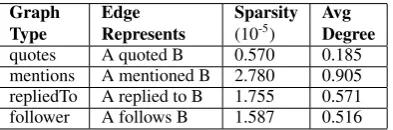
Graph Edge Sparsity Avg
Type Represents (10-5) Degree
quotes A quoted B 0.570 0.185 mentions A mentioned B 2.780 0.905 repliedTo A replied to B 1.755 0.571 follower A follows B 1.587 0.516
Table 2: Graph comparisons(A and B represent users along an edge in the graph).
obtained. Furthermore, retweets and non-English language tweets were removed. A manual check was done to remove the tweets (around 3000) which were trivially non-suicidal. The final dataset has 34,306 tweets. Each tweet in the dataset is described by the fields given in Table 1.
Data for Author Profiling: For the 34,306 tweets in the dataset, there are 32,558 unique users. For each of these users, the tweet timeline (previous 100 tweets or as many available) was scraped. Texts from historical tweets were com-bined for each of the users to generate the histori-cal corpus for author profiling.
Social Graphs: The engagement between the users from the dataset was captured in the form of social graphs where the users were represented as vertices and edges denoted the relationships. Ta-ble 2shows the different graphs constructed cor-responding to four different relationships and also the statistical comparisons between them.
For the Follower Graph, follower lists were scraped for each of the users while for the other three graphs, tweets from the dataset and the his-torical collection were crawled through.
3.3 Data Annotation
Two annotators, who are students in clinical psy-chology adept in using social media on a daily ba-sis, were provided with the guidelines to label the tweets as used in (Sawhney et al., 2018b). The guidelines were based on the following classification system
-1. Suicidal intent present
• Text conveys a serious display of suici-dal ideation.
• Posts where suicide risk is not condi-tional unless some event is a clear risk factor eg:depression, bullying, etc. • Tone of text is sombre and not flippant.
2. Suicidal intent absent
• Posts emphasizing on suicide related news or information.
• Posts containing no reasonable evidence that the risk of suicide is present; in-cludes posts containing song lyrics, etc. • Condolences and awareness posts.
An acceptable Cohen’s Kappa score was found be-tween the two annotations (0.72). In cases of am-biguity in labeling or conflicts in merging, the de-fault class 0 (non-suicidal) was assigned. The re-sulting dataset had 3984 suicidal tweets (12% of the entire dataset).
4 Methodology
The overall methodology is split into three phases:
preprocessing of data, extraction of features and
finallyevaluation of models and feature sets.
4.1 Preprocessing
Due to the unstructured format of the text used in social media, a set of filters were employed to re-duce the noise while not losing useful information.
1. A tweet-tokenizer was used 8 to parse the tweet and replace every username mentions, hashtags, and urls with<mention>,< hash-tag>and<url>respectively.
2. The tokenized text then underwent stopword removal and was used as an input to Word-Net Lemmatizer provided by nltk(Bird and Loper,2004).
3. Using Lancaster Stemmer, provided by nltk(Bird and Loper,2004) stemmed text was also generated to be used as inputs for some feature extraction methods.
4.2 Feature Extraction
The features extracted from the data set can be broadly classified into four types: Text-based fea-tures, tweet metadata feafea-tures, User Historical
tweets features and Social Graph-based features.
8https://pypi.org/project/
tweet-preprocessor/
Text Based Features
• TF-IDF: Term Frequency-Inverse Document
Frequency was used with the unigrams and bigrams from the stemmed text, using a total of 2000 features chosen by the tf-idf scores across the training dataset. The tf-idf scores were l2 normalized.
• POS: Parts of Speech counts for each lemma-tized text using The Penn Tree Bank(Marcus et al., 1993) from the Averaged Perceptron Tagger in nltk is used to extract 34 features.
• GloVe Embeddings: The word embeddings
for each word present in the pre-trained GloVe embeddings trained on Twitter ( Pen-nington et al.,2014) were extracted, and for each tweet, the average of these is taken.
• NRC Emotion: The NRC Emotion Lexicon
(Mohammad and Turney,2013) is a publicly available lexicon that contains commonly oc-curring words along with their affect category (anger, fear, anticipation, trust, surprise, sad-ness, joy, or disgust) and two polarities (neg-ative or positive). The score along these 10 features was computed for each tweet.
• LDA: Topic Modelling using the probabil-ity distribution over the most commonly oc-curring 100 topics was used as a feature for each tweet. LDA features were extracted by using scikit-learn’s Latent Dirichlet Alloca-tion module (Pedregosa et al., 2011). Only those tokens were considered which occurred at least 10 times in the entire corpus.
Tweet Metadata Features: The count of hash-tags, mentions, URLs, and emojis along with the retweet count and favorite count of every tweet was extracted and used as a feature to gain infor-mation about the tweets response by the authors environment.
User Historical tweets: To gain information about the behavior of the author and their stylistic choices, a collection of their tweets were prepro-cessed, and stylistic and semantic features such as the averaged GloVe embeddings, NRC sentiment scores and Parts of Speech counts were extracted.
Social Graph Features: Grover and Leskovec
employed by Mishra et al. (2018) in the task of abuse detection in tweets. node2vecvectors were generated for each of the graphs as introduced in Section 3.2.
5 Baselines
A set of baselines that reflect the current state-of-the-art approaches in short text classification were established. These include methods that use tradi-tional learning algorithms as well as deep learning based models.
• Character n-gram + Logistic Regression: Character n-gram with Logistic Regression in the range (1,4) has often been used effec-tively for classification and works as a strong baseline (Waseem and Hovy,2016;Badjatiya et al.,2017;Mishra et al.,2018).
• Bag of Words + GloVe + GBDT: A Bag of Words(BoW) corpus was generated with un-igram and bun-igram features, the averaged pre-trained GloVe embeddings were then used on a Gradient Boosting Decision Tree which in-crementally builds in stage-wise fashion. It is used as a baseline in (Badjatiya et al.,2017).
• GloVe + CNN: A CNN architecture inspired from (Kim,2014;Badjatiya et al.,2017) was used with filter sizes (3,4,5).
• GloVe + LSTM: An LSTM with 50 cells was used along with dropout layers (p= 0.25and 0.5, preceding and following, respectively).
• ELMo: Tensorflow Hub 9 was used to get ELMo(Peters et al.,2018) embeddings which are known to have an excellent performance in several fields including sentiment analysis and text classification.
• USE- The Universal Sentence Encoder (Cer et al., 2018) encodes text into high dimen-sional vectors that can be used for tasks like text classification, semantic similarity, and clustering. Tensorflow Hub was used to get sentence encoding. Each tweet was converted encoded onto a dense 512 feature space.
• Sawhney C-LSTM: We replicated the C-LSTM architecture used in (Sawhney et al.,
9https://tfhub.dev/
2018a) which uses CNN to capture local fea-tures of phrases and RNN to capture global and temporal sentence semantics.
• R-CNN: Recurrent Convolutional Neural Networks as proposed by (Lai et al., 2015) make use of a recurrent structure to cap-ture contextual information as far as possible when learning word representations.
6 Methodology: SNAP-BATNET
6.1 Graph Embeddings
As discussed in the previous sections, social graphs were constructed for author profiling which could capture demographic features and improve the performance of the classifier. Four such weighted and undirected graphs were constructed:
Follower Graph, Mentions Graph, RepliedTo
GraphandQuotes Graph. All the self-loops were
removed from the graphs, as they do not contribute to suicide-related communication features.
To obtain the author profiles, the nodes in the graphs were converted into feature representa-tion usingnode2vec(Grover and Leskovec,2016).
node2vecworks on the lines of word2vec and
de-termines the context of the nodes by looking into their neighborhoods in the graph. It constructs a fixed number of random walks of constant length for each of the nodes to define the neighborhood of the nodes. The random walks are governed by the parametersp (return parameter)andq
(in-out parameter)which have the ability to fluctuate
the sampling between a depth-first strategy and a breadth-first strategy.
node2vec by itself does not generate
embed-dings for solitary nodes which comprised about 2/3rdof the total nodes. As per the empirical rule of normal distribution, 99.73% of the values lie within three standard deviations of the mean. To isolate the solitary nodes from the remaining ones, a random vector was generated three standard de-viations away from the mean and was assigned to them.
Embeddings were generated for both weighted and unweighted graphs and were individually studied for the classification task. The number of dimensions and the number of epochs was set to 200 and 10 respectively. A stratified 5-fold grid search was carried out on the hyperparameters
-p, q, walk-length, window-size. It was found that
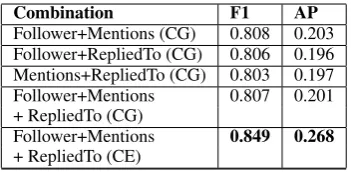
Combination F1 AP
Follower+Mentions (CG) 0.808 0.203 Follower+RepliedTo (CG) 0.806 0.196 Mentions+RepliedTo (CG) 0.803 0.197 Follower+Mentions 0.807 0.201 + RepliedTo (CG)
Follower+Mentions 0.849 0.268
[image:6.595.309.526.58.221.2]+ RepliedTo (CE)
Table 3: Graph combination results(CG-Combining graphs, CE-Combining embeddings) with weighted F1 and area under precision recall curve.
the combination of walk length 10 and window-size 5 performed best. This performance of short walks can be attributed to the sparse nature of the graphs. It was determined that unweighted graphs performed better and were used for gen-erating combined social graph embeddings.
Combining Graph Embeddings: Quotes
Graph was discarded from any further study
ow-ing to its individual performance in contrast with the other graphs. Its poor performance can be at-tributed to its statistics as given in the table 2. The rest of the graphs were combined followed two methods: by combining graphs or by combining embeddings using a deep learning approach. The resulting embeddings were trained using a Bal-anced Random Forest classifier. These results are shown in Table3.
For generating these combined embeddings, a deep learning model as shown in Figure1was de-signed to be trained on the dataset. After the train-ing, the concatenation layer was picked up as the embedding for the combination, and this was gen-erated for all the users. These embeddings were then used in an LR classifier and a balanced ran-dom forest classifier. The results from the bal-anced random forest classifier were superior and were further used for feature stacking as men-tioned in Section 6.2. SNAP-BATNET uses Fol-lower, Mention and RepliedTo embeddings com-bined using the deep learning approach to generate social graph based features.
6.2 Feature Stacking
The competing systems make use of the text based features for classification. To leverage the avail-ability of different kinds of information in form of tweet metadata, historical author profiling and social graph based embeddings so as to overcome the unavailability of a predefined lexico-semantic pattern in the text, methods of combining
[image:6.595.94.270.61.147.2]infor-Figure 1: Combining graph embeddings.
Figure 2: Feature Stacking: A meta-learning approach (figure taken from (Lui,2012)).
mation were explored. While tweet metadata is sparse, social graph based embeddings are dense in nature.
Initially, concatenation was used, and several models were tried by performing ablation studies. It was observed that the performance of the clas-sifiers did not change significantly and in some cases deteriorated as features were concatenated. Therefore, it was reasoned that the feature sets should be combined in a way that would have the ability to join them related to their relative impor-tance and also allow learning of non-linear rela-tionships between them. Instead of using concate-nation which proved to be ineffective or relative weighing, which is cumbersome, we used a meta learning approach inspired from (Lui,2012).
[image:6.595.312.520.262.438.2]F1 AP F1 AP F1 AP F1 AP
Model Text + Tweet + Author + Graph
Based Metadata Profiling
FeatStackLR .891 .641 .893 .640 .894 .643 .896 .671
Char ngram+ LR .892 .646 .910 .653 .912 .647 .915 .679
BoWV+GloVe+GBDT .897 .567 .896 .534 .897 .542 .899 .584
GloVe+CNN .908 .619 .910 .619 .910 .623 .913 .644
GloVe+LSTM .908 .612 .906 .613 .907 .617 .910 .642
USE .915 .669 .916 .667 .916 .666 .914 .663
ELMo .913 .650 .894 .629 .909 .629 .911 .623
Sawhney-C-LSTM .915 .662 .915 .662 .916 .661 .912 .687
RCNN .921 .704 .919 .705 .920 .706 .923 .726
[image:7.595.88.512.61.248.2]SNAP-BATNET .923 .709 .925 .707 .925 .708 .926 .726
Table 4: Results with weighted F1 and area under precision recall curve.
baseline models were employed in our approach. The weak learners were chosen by using grid search over{Logistic Regression, Balanced
Ran-dom Forest Classifier, SVM }. For each of the
baselines, features from tweet metadata, histori-cal author profiling, and social graph embeddings were combined using Feature Stacking. Logistic Regression was used as L1 learner since stacked LR is theoretically closer to a neural network and can help introduce non-linearity between the fea-tures (Dreiseitl and Ohno-Machado,2002).
Our model SNAP-BATNET uses feature stack-ing with different L0 learners to combine the feature sets pertaining to text-based informa-tion(BiLSTM+Attention), tweet metadata infor-mation(Logistic Regression), historical author profiling(Logistic Regression) and social graph embeddings(Balanced Random Forest Classifier). Furthermore, a simple architecture(FeatStackLR) is proposed that uses Logistic Regression as both L0 and L1 learners. An ablation study of the hand-crafted feature sets was carried out using
Feat-StackLR, which is shown in Table 5. The
addi-tion of GloVe based embedding leads to an im-provement in results as these embeddings encode semantic information that is missing from statisti-cal features.
7 Experiments and Results
7.1 Experimental Setup
All the experiments were conducted with a train-test split of 0.2. The hyperparameters for each learner were calculated by using a 5-fold strati-fied cross-validation grid search. The CNN and
Features F1 AP
TF-IDF + EMB
+ POS + LDA + NRC 0.891 0.641
TF-IDF + EMB
+ POS + LDA 0.891 0.640 TF-IDF + EMB
+POS 0.890 0.641 TF-IDF + EMB 0.890 0.641 TF - IDF 0.888 0.618
Table 5: Ablation study (measured using weighted F1 score and area under Precision-Recall curve).
LSTM architectures used 200-dimensional GloVe embeddings pre-trained on Twitter corpus using the Adam optimizer and were run for 10 epochs. The models were implemented in Keras with a Tensorflow Backend. In CNN and LSTM models, 0.1 of the training data was held out as validation data to prevent the model from overfitting. Each baseline model uses Feature Stacking and is used as a L0 learner to extract text-based features to be combined with other feature sets such as tweet metadata, historical author profiling and finally so-cial graph embeddings.
7.2 Results
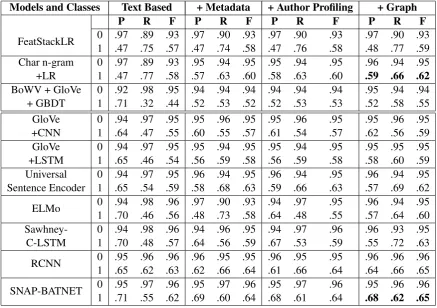
[image:7.595.337.496.291.387.2]Models and Classes Text Based + Metadata + Author Profiling + Graph
P R F P R F P R F P R F
FeatStackLR 0 .97 .89 .93 .97 .90 .93 .97 .90 .93 .97 .90 .93
1 .47 .75 .57 .47 .74 .58 .47 .76 .58 .48 .77 .59
Char n-gram 0 .97 .89 .93 .95 .94 .95 .95 .94 .95 .96 .94 .95
+LR 1 .47 .77 .58 .57 .63 .60 .58 .63 .60 .59 .66 .62
BoWV + GloVe 0 .92 .98 .95 .94 .94 .94 .94 .94 .94 .95 .94 .94
+ GBDT 1 .71 .32 .44 .52 .53 .52 .52 .53 .53 .52 .58 .55
GloVe 0 .94 .97 .95 .95 .96 .95 .95 .96 .95 .95 .96 .95
+CNN 1 .64 .47 .55 .60 .55 .57 .61 .54 .57 .62 .56 .59
GloVe 0 .94 .97 .95 .95 .94 .95 .95 .94 .95 .95 .95 .95
+LSTM 1 .65 .46 .54 .56 .59 .58 .56 .59 .58 .58 .60 .59
Universal 0 .94 .97 .95 .96 .94 .95 .96 .94 .95 .96 .94 .95
Sentence Encoder 1 .65 .54 .59 .58 .68 .63 .59 .66 .63 .57 .69 .62
ELMo 0 .94 .98 .96 .97 .90 .93 .94 .97 .95 .96 .94 .95
1 .70 .46 .56 .48 .73 .58 .64 .48 .55 .57 .64 .60
Sawhney- 0 .94 .98 .96 .94 .96 .95 .94 .97 .96 .96 .93 .95
C-LSTM 1 .70 .48 .57 .64 .56 .59 .67 .53 .59 .55 .72 .63
RCNN 0 .95 .96 .96 .96 .95 .95 .96 .95 .95 .96 .96 .96
1 .65 .62 .63 .62 .66 .64 .61 .66 .64 .64 .66 .65
SNAP-BATNET 0 .95 .97 .96 .95 .97 .96 .95 .97 .96 .95 .96 .96
[image:8.595.80.518.62.370.2]1 .71 .55 .62 .69 .60 .64 .68 .61 .64 .68 .62 .65
Table 6: Results with precision, recall and F1 score on a per class basis.
Precision-Recall Curve.
It was observed that adding features such as so-cial graph embeddings, historical author profiling, and tweet metadata led to a considerable improve-ment in the performance of the classifiers since each feature set encodes a different kind of infor-mation that gives the resulting models more adept at the task of classification. As per our hypothe-sis, the addition of social graph embeddings led to significant improvement in performance across all baseline models. There was an increase in the re-call value which is desirable because the reduction of false negatives was more important than the re-duction of false positives. Among the traditional classifiers, character n-gram with Logistic Regres-sion performed the best. Moreover, the use of LSTMs in the model such as Sawhney-C-LSTM, RCNN, and SNAP-BATNET improved the clas-sifier performance. This can be reasoned by the effectiveness of LSTM in capturing long term de-pendencies. Among all the deep learning models, SNAP-BATNET, when combined with all other feature sets using Feature Stacking, performed the best outperforming the current state-of-the-art, i.e., Sawhney-C-LSTM.
7.3 Error Analysis
Here we go through some examples posed chal-lenges to highlight limitations and future scope.
1. Subtle indication: ”Death gives meaning to life” contains subtle indications of suicidal behavior but caused ambiguity between an-notators and was not detected by the model.
2. Sarcasm: ”I want to f**king kill myself lol xD” is one of the several examples where the frivolity of the tweet couldn’t be determined.
3. Quotes and Lyrics: ”Better off Dead ˜
Sleeping With Sirens; I’m as mad, and I’m
not going to take this anymore!” are song
lyrics and movie dialogues which the annota-tors were able to identify but the model could not as it lacked real-world knowledge.
8 Conclusion
manually annotated dataset on detection of suici-dal ideation in tweets, a set of handcrafted features were extracted which were utilized by a set of tra-ditional and state of the art deep learning based models and a quantitative comparison was carried out which validated the hypothesis of the effec-tiveness of social graph based features and author profiling in suicidal behavior detection with our proposed SNAP-BATNET model, particularly in improving recall. An extensive error analysis and comparison with baselines presents the case for our methodology.
In the future, this work can be extended by ex-ploiting multi-modalities in the data in the form of images, videos, and hyperlinks. Multi-modal approaches have extensively been used for vari-ous tasks like predicting social media popularity (Meghawat et al., 2018;Shah and Zimmermann,
2017). Another interesting aspect would be to adapt the pipeline described in this paper to differ-ent problems like iddiffer-entifying mdiffer-entions of personal intake of medicine in social media (Mahata et al.,
2018b,a).
References
Silvio Amir, Byron C Wallace, Hao Lyu, and Paula Carvalho M´ario J Silva. 2016. Modelling context with user embeddings for sarcasm detection in so-cial media.arXiv preprint arXiv:1607.00976.
Pinkesh Badjatiya, Shashank Gupta, Manish Gupta, and Vasudeva Varma. 2017. Deep learning for hate speech detection in tweets. In Proceedings of the 26th International Conference on World Wide Web Companion, pages 759–760. International World Wide Web Conferences Steering Committee.
Adrian Benton, Margaret Mitchell, and Dirk Hovy. 2017. Multi-task learning for mental health using social media text. arXiv preprint arXiv:1712.03538.
Steven Bird and Edward Loper. 2004. Nltk: the nat-ural language toolkit. In Proceedings of the ACL 2004 on Interactive poster and demonstration ses-sions, page 31. Association for Computational Lin-guistics.
Patricia A Cavazos-Rehg, Melissa J Krauss, Shaina Sowles, Sarah Connolly, Carlos Rosas, Meghana Bharadwaj, and Laura J Bierut. 2016. A content analysis of depression-related tweets. Computers in human behavior, 54:351–357.
Daniel Cer, Yinfei Yang, Sheng-yi Kong, Nan Hua, Nicole Limtiaco, Rhomni St John, Noah Constant, Mario Guajardo-Cespedes, Steve Yuan, Chris Tar, et al. 2018. Universal sentence encoder. arXiv preprint arXiv:1803.11175.
Munmun De Choudhury, Michael Gamon, Scott Counts, and Eric Horvitz. 2013. Predicting depres-sion via social media.ICWSM, 13:1–10.
Stephan Dreiseitl and Lucila Ohno-Machado. 2002. Logistic regression and artificial neural network classification models: a methodology review. Jour-nal of biomedical informatics, 35(5-6):352–359.
Sheila E. Clark and Robert D. Goldney. 2000. The im-pact of suicide on relatives and friends. The inter-national handbook of suicide and attempted suicide, pages 467–484.
Bj¨orn Gamb¨ack and Utpal Kumar Sikdar. 2017. Us-ing convolutional neural networks to classify hate-speech. In Proceedings of the First Workshop on Abusive Language Online, pages 85–90.
Aditya Grover and Jure Leskovec. 2016. node2vec: Scalable feature learning for networks. In Proceed-ings of the 22nd ACM SIGKDD international con-ference on Knowledge discovery and data mining, pages 855–864. ACM.
Anders Johannsen, Dirk Hovy, and Anders Søgaard. 2015. Cross-lingual syntactic variation over age and gender. In Proceedings of the Nineteenth Confer-ence on Computational Natural Language Learning, pages 103–112.
Yoon Kim. 2014. Convolutional neural net-works for sentence classification. arXiv preprint arXiv:1408.5882.
Siwei Lai, Liheng Xu, Kang Liu, and Jun Zhao. 2015. Recurrent convolutional neural networks for text classification. In AAAI, volume 333, pages 2267– 2273.
Marco Lui. 2012. Feature stacking for sentence classi-fication in evidence-based medicine. InProceedings of the Australasian Language Technology Associa-tion Workshop 2012, pages 134–138.
David D Luxton, Jennifer D June, and Jonathan M Fairall. 2012. Social media and suicide: a pub-lic health perspective. American journal of public health, 102(S2):S195–S200.
Debanjan Mahata, Jasper Friedrichs, Rajiv Ratn Shah, and Jing Jiang. 2018a. Detecting personal intake of medicine from twitter. IEEE Intelligent Systems, 33(4):87–95.
Debanjan Mahata, Jasper Friedrichs, Rajiv Ratn Shah, et al. 2018b. # phramacovigilance-exploring deep learning techniques for identifying mentions of medication intake from twitter. arXiv preprint arXiv:1805.06375.
Puneet Mathur, Ramit Sawhney, Meghna Ayyar, and Rajiv Shah. 2018a. Did you offend me? classifi-cation of offensive tweets in hinglish language. In
Proceedings of the 2nd Workshop on Abusive Lan-guage Online (ALW2), pages 138–148.
Puneet Mathur, Rajiv Shah, Ramit Sawhney, and De-banjan Mahata. 2018b. Detecting offensive tweets in hindi-english code-switched language. In Pro-ceedings of the Sixth International Workshop on Natural Language Processing for Social Media, pages 18–26.
Mayank Meghawat, Satyendra Yadav, Debanjan Ma-hata, Yifang Yin, Rajiv Ratn Shah, and Roger Zim-mermann. 2018. A multimodal approach to pre-dict social media popularity. In 2018 IEEE Con-ference on Multimedia Information Processing and Retrieval (MIPR), pages 190–195. IEEE.
Rada Mihalcea and Paul Tarau. 2004. Textrank: Bring-ing order into text. InProceedings of the 2004 con-ference on empirical methods in natural language processing.
Pushkar Mishra, Marco Del Tredici, Helen Yan-nakoudakis, and Ekaterina Shutova. 2018. Author profiling for abuse detection. In Proceedings of the 27th International Conference on Computational Linguistics, pages 1088–1098.
Saif M Mohammad and Peter D Turney. 2013. Nrc emotion lexicon. National Research Council, Canada.
Bridianne O’Dea, Stephen Wan, Philip J Batterham, Alison L Calear, Cecile Paris, and Helen Chris-tensen. 2015. Detecting suicidality on twitter. In-ternet Interventions, 2(2):183–188.
Minsu Park, Chiyoung Cha, and Meeyoung Cha. 2012. Depressive moods of users portrayed in twitter. In Proceedings of the ACM SIGKDD Workshop on healthcare informatics (HI-KDD), volume 2012, pages 1–8. ACM New York, NY.
Fabian Pedregosa, Ga¨el Varoquaux, Alexandre Gram-fort, Vincent Michel, Bertrand Thirion, Olivier Grisel, Mathieu Blondel, Peter Prettenhofer, Ron Weiss, Vincent Dubourg, et al. 2011. Scikit-learn: Machine learning in python. Journal of machine learning research, 12(Oct):2825–2830.
Jeffrey Pennington, Richard Socher, and Christopher Manning. 2014. Glove: Global vectors for word representation. InProceedings of the 2014 confer-ence on empirical methods in natural language pro-cessing (EMNLP), pages 1532–1543.
Matthew E. Peters, Mark Neumann, Mohit Iyyer, Matt Gardner, Christopher Clark, Kenton Lee, and Luke Zettlemoyer. 2018. Deep contextualized word rep-resentations. InProc. of NAACL.
V´ıctor M Prieto, Sergio Matos, Manuel Alvarez, Fidel Cacheda, and Jos´e Lu´ıs Oliveira. 2014. Twitter: a good place to detect health conditions. PloS one, 9(1):e86191.
Jing Qian, Mai ElSherief, Elizabeth M Belding, and William Yang Wang. 2018. Leveraging intra-user and inter-intra-user representation learning for au-tomated hate speech detection. arXiv preprint arXiv:1804.03124.
Jiezhong Qiu, Yuxiao Dong, Hao Ma, Jian Li, Kuansan Wang, and Jie Tang. 2018. Network embedding as matrix factorization: Unifying deepwalk, line, pte, and node2vec. InProceedings of the Eleventh ACM International Conference on Web Search and Data Mining, pages 459–467. ACM.
Rajiv Radhakrishnan and Chittaranjan Andrade. 2012. Suicide: an indian perspective. Indian journal of psychiatry, 54(4):304.
Ramit Sawhney, Prachi Manchanda, Puneet Mathur, Rajiv Shah, and Raj Singh. 2018a. Exploring and learning suicidal ideation connotations on social me-dia with deep learning. In Proceedings of the 9th Workshop on Computational Approaches to Subjec-tivity, Sentiment and Social Media Analysis, pages 167–175.
Ramit Sawhney, Prachi Manchanda, Raj Singh, and Swati Aggarwal. 2018b. A computational approach to feature extraction for identification of suicidal ideation in tweets. InProceedings of ACL 2018, Stu-dent Research Workshop, pages 91–98.
Rajiv Shah and Roger Zimmermann. 2017. Multi-modal analysis of user-generated multimedia con-tent. Springer.
Zeerak Waseem and Dirk Hovy. 2016. Hateful sym-bols or hateful people? predictive features for hate speech detection on twitter. In Proceedings of the NAACL student research workshop, pages 88–93.