Linguistic realisation as machine translation:
Comparing different MT models for AMR-to-text generation
Thiago Castro Ferreira1 and Iacer Calixto2 and Sander Wubben1 and Emiel Krahmer1 1Tilburg center for Cognition and Communication (TiCC), Tilburg University, The Netherlands
2ADAPT Centre, Dublin City University, School of Computing, Ireland {tcastrof,e.j.krahmer,s.wubben}@tilburguniversity.edu
{iacer.calixto}@adaptcentre.ie
Abstract
In this paper, we study AMR-to-text genera-tion, framing it as a translation task and com-paring two different MT approaches (Phrase-based and Neural MT). We systematically study the effects of 3 AMR preprocess-ing steps (Delexicalisation, Compression, and Linearisation) applied before the MT phase. Our results show that preprocessing indeed helps, although the benefits differ for the two MT models. The implementation of the mod-els are publicly available1.
1 Introduction
Natural Language Generation (NLG) is the process of generating coherent natural language text from non-linguistic data (Reiter and Dale, 2000). While there is broad consensus among NLG scholars on the output of NLG systems (i.e., text), there is far less agreement on what the input should be; see Gatt and Krahmer (2017) for a recent review. Over the years, NLG systems have taken a wide range of in-puts, including for example images (Xu et al., 2015), numeric data (Gkatzia et al., 2014) and semantic representations (Theune et al., 2001).
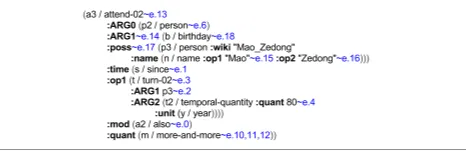
This study focuses on generating natural lan-guage based on Abstract Meaning Representations (AMRs) (Banarescu et al., 2013). AMRs encode the meaning of a sentence as a rooted, directed and acyclic graph, where nodes represent concepts, and labeled directed edges represent relations among these concepts. The formalism strongly relies on the PropBank notation. Figure 1 shows an example.
1https://github.com/ThiagoCF05/LinearAMR
AMRs have increased in popularity in recent years, partly because they are relatively easy to pro-duce, to read and to process automatically. In addi-tion, they can be systematically translated into first-order logic, allowing for a well-specified model-theoretic interpretation (Bos, 2016). Most earlier studies on AMRs have focused on text understand-ing, i.e. processing texts in order to produce AMRs (Flanigan et al., 2014; Artzi et al., 2015). However, recently the reverse process, i.e. the generation of texts from AMRs, has started to receive scholarly attention (Flanigan et al., 2016; Song et al., 2016; Pourdamghani et al., 2016; Song et al., 2017; Kon-stas et al., 2017).
We assume that in practical applications, con-ceptualisation models or dialogue managers (mod-els which decide “what to say”) output AMRs. In this paper we study different ways in which these AMRs can be converted into natural lan-guage (deciding “how to say it”). We approach this as a translation problem—automatically translating from AMRs into natural language—and the key-contribution of this paper is that we systematically compare different preprocessing strategies for two different MT systems: Phrase-based MT (PBMT) and Neural MT (NMT).
We look at potential benefits of three preprocess-ing steps on AMRs before feedpreprocess-ing them into an MT system: delexicalisation,compression, and lineari-sation. Delexicalisation decreases the sparsity of an AMR by removing constant values, compression re-moves nodes and edges which are less likely to be aligned to any word on the textual side and lineari-sation ‘flattens’ the AMR in a specific order.
Figure 1: Example of an AMR
bining all possibilities gives rise to 23 = 8 AMR
preprocessing strategies, which we evaluate for two different MT systems: PBMT and NMT.
Following earlier work in AMR-to-text genera-tion and the MT literature, we evaluate the sys-tem outputs in terms of fluency, adequacy and post-editing effort, using BLEU (Papineni et al., 2002), METEOR (Lavie and Agarwal, 2007) and TER (Snover et al., 2006) scores, respectively. We show that preprocessing helps, although the extent of the benefits differs for the two MT systems.
2 Related Studies
To the best of our knowledge, Flanigan et al. (2016) was the first study that introduced a model for nat-ural language generation from AMRs. The model consists of two steps. First, the AMR-graph is con-verted into a spanning tree, and then, in a second step, this tree is converted into a sentence using a tree transducer.
In Song et al. (2016), the generation of a sentence from an AMR is addressed as an asymmetric gen-eralised traveling salesman problem (AGTSP). For sentences shorter than 30 words, the model does not beat the system described by Flanigan et al. (2016). However, Song et al. (2017) treat the AMR-to-text task using a Synchronous Node Replacement Gram-mar (SNRG) and outperform Flanigan et al. (2016). Although AMRs do not contain articles and do not represent inflectional morphology for tense and number (Banarescu et al., 2013), the formalism is relatively close to the (English) language. Motivated by this similarity, Pourdamghani et al. (2016) pro-posed an AMR-to-text method that organises some of these concepts and edges in a flat representation, commonly known as Linearisation. Once the lin-earisation is complete, Pourdamghani et al. (2016) map the flat AMR into an English sentence using
a Phrase-Based Machine Translation (PBMT) sys-tem. This method yields better results than Flanigan et al. (2016) on development and test set from the LDC2014T12 corpus.
Pourdamghani et al. (2016) train their system us-ing a set of AMR-sentence pairs obtained by the aligner described in Pourdamghani et al. (2014). In order to decrease the sparsity of the AMR formal-ism caused by the ratio of broad vocabulary and rel-atively small amount of data, this aligner drops a considerable amount of the AMR structure, such as role edges :ARG0, :ARG1, :mod, etc. However, in-spection of the gold-standard alignments provided in the LDC2016E25 corpus revealed that this rule-based compression can be harmful for the genera-tion of sentences, since such role edges can actually be aligned to function words in English sentences. So having these roles available arguably could im-prove AMR-to-text translation. This indicates that a better comparison of the effects of different prepro-cessing steps is called for, which we do in this study. In addition, Pourdamghani et al. (2016) use PBMT, which is devised for translation but also utilised in other NLP tasks, e.g. text simplification (Wubben et al., 2012; ˇStajner et al., 2015). However, these systems have the disadvantage of having many different feature functions, and finding optimal set-tings for all of them increases the complexity of the problem from an engineering point of view.
proce-dure, incorporating 20M English sentences which do not have a gold-standard AMR, thus overcoming the limited amount of data available. They report state-of-the-art results for the task, which suggests that NMT is a promising alternative for AMR-to-text.
3 Models
We describe our AMR-to-text generation models, which rely on 3 preprocessing steps ( delexicalisa-tion,compression, and/orlinearisation) followed by a machine translation and realisation steps.
3.1 Delexicalisation
Inspection of the LDC2016E25 corpus reveals that on average 22% of the structure of an AMR are AMR constant values, such as names, quantities, and dates. This information increases the sparsity of the data, and makes it arguably more difficult to map an AMR into a textual format. To address this, Pourdamghani et al. (2016) look for special reali-sation component for names, dates and numbers in development and test sets and add them on the train-ing set. On the other hand, similar to Konstas et al. (2017), we delexicalised these constants, replacing the original information for tags (e.g., name1 ,
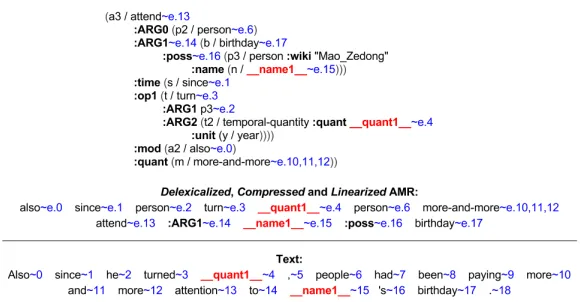
quant1 ). A list of tag-values is kept, aiming to identifying the position and to insert the original in-formation in the sentence after the translation step is completed. Figure 2 shows a delexicalised AMR.
3.2 Compression
Given the alignment between an AMR and a sen-tence, the nodes and edges in the AMR can either be aligned to words in the sentence or not. So before the linearisation step, we would like to know which elements of an AMR should actually be part of the ‘flattened’ representation.
Following the aligner of Pourdamghani et al. (2014), Pourdamghani et al. (2016) clean an AMR by removing some nodes and edges independent of the context. Instead, we are using alignments that may relate a given node or edge to an English word according to the context. In Figure 1 for instance, the first edge :ARG1 is aligned to the prepositionto
from the sentence, whereas the second edge with a similar value is not aligned to any word in the sen-tence. Therefore, we need to train a classifier to
de-cide which parts of an AMR should be in the flat-tened representation according to the context.
To solve the problem, we train a Conditional Ran-dom Field (CRF) which determines whether a node or an edge of an AMR should be included in the flat-tened representation. The classification process is sequential over a flattened representation of an AMR obtained by depth first search through the graph. Each element is represented by their name and par-ent name. We useCRFSuite(Okazaki, 2007) to im-plement our model.
3.3 Linearisation
After Compression, we flatten the AMR to serve as input to the translation step, similarly as proposed in Pourdamghani et al. (2016). We perform a depth-first search through the AMR, printing the elements according to their visiting order. In a second step, also following Pourdamghani et al. (2016), we im-plemented a version of the 2-Step Classifier from Lerner and Petrov (2013) to preorder the elements from an AMR according to the target side.
2-Step Classifier We implement the preordering method proposed by Lerner and Petrov (2013) in the following way. We define the order among a head node and its subtrees in two steps. In the first, we use a trained maximum entropy classifier to predict for each subtree whether it should occur before or after the head node. As features, we represent the head node by its frameset, whereas the subtree is repre-sented by its head node frameset and parent edge.
Figure 2: Example of aDelexicalised,CompressedandLinearisedAMR
3.4 Translation models
To map a flat AMR representation into an English sentence, we use phrase-based (Koehn et al., 2003) and neural machine translation (Bahdanau et al., 2015) models.
3.4.1 Phrase-Based Machine Translation These models use Bayes rule to formalise the problem of translating a text from a source language f to a target language e. In our case, we want to translate a flat amr into an English sentence e as Equation 1 shows.
P(e|amr) =argmax P(amr|e)P(e) (1) Thea priorifunctionP(e)usually is represented by a language model trained on the target language. The a posteriori equation is calculated by the log-linear model described at Equation 2.
P(amr|e) =argmax XJ j=1
λjhj(amr, e) (2)
Each hj(amr, e) is an arbitrary feature function over AMR-sentence pairs. To calculate it, the flat amr is segmented into I phrases amr¯ I
1, such that
each phrase amr¯ i is translated into a target phrase
¯
eias described by Equation 3.
hj(amr, e) =argmax hj( ¯amrIi,¯eIi) (3) As feature functions, we used direct and inverse phrase translation probabilities and lexical weight-ing; word, unknown word and phrase penalties.
We also used models to reorder a flatamr accord-ing to the target sentenceeat decoding time. They work on the word-level (Koehn et al., 2003), at the level of adjacent phrases (Koehn et al., 2005) and beyond adjacent phrases (hierarchical-level) (Gal-ley and Manning, 2008). Phrase- and hierarchical level models are also known as lexicalized reorder-ing models.
As Koehn et al. (2003), givensi the start position of the source phraseamr¯ itranslated into the English phrase ¯ei, and fi−1 the end position of the source
phrase amr¯ i−1 translated into the English phrase ¯
ei−1, a distortion model α|si−fi−1−1| is defined as
a distance-based reordering model. α is chosen by tunning the model.
Lexicalised models are more complex than distance-based ones, but usually help the system to obtain better results (Koehn et al., 2005; Galley and Manning, 2008). Given a possible set of target phrases e = (¯e1, ...,¯en) based on a source amr, and a set of alignmentsa= (a1, ..., an)that maps a source phraseamr¯ ai into a target phrasee¯i, a lex-icalised model aims to predict a set of orientations o= (o1, ... , on)as Equation 4 shows.
P(o|e, amr) =
n
Y
i=1
oi =
M, ifai−ai−1 = 1
S, ifai−ai−1 =−1
D, if|ai−ai−1| 6= 1
(5)
In the hierarchical model, we distinguished the discontinuous operation by the direction: discontin-uous right (ai −ai−1 < 1) and discontinuous left
(ai −ai−1 > 1). These models are important for
our task, since the preordering method used in the Linearisation step can be insufficient to adequate it to the target sentence order.
3.4.2 Neural Machine Translation
Following the attention-based Neural Ma-chine Translation (NMT) model introduced by Bahdanau et al. (2015), given a flat amr= (amr1, amr2,· · ·, amrN) and its En-glish sentence translation e= (e1, e2,· · · , eM), a single neural network is trained to translate amr intoeby directly learning to modelp(e|amr). The network consists of oneencoder, onedecoder, and oneattention mechanism.
The encoder is a bi-directional RNN with gated recurrent units (GRU) (Cho et al., 2014), where one forward RNN −→Φenc reads the amr from left
to right and generates a sequence of forward an-notation vectors (−→h1,−→h2,· · · ,−→hN) at each en-coder time step i∈[1, N], and a backward RNN
←−
Φenc reads the amr from right to left and
gen-erates a sequence of backward annotation vectors (←h−N,←h−N−1,· · · ,←h−1). The final annotation vector
is the concatenation of forward and backward vec-tors hi = −→hi;←h−i, and C = (h1,h2,· · ·,hN) is the set of source annotation vectors.
The decoder is a neural LM conditioned on the previously emitted words and the source sentence via an attention mechanism over C. A multilayer perceptron is used to initialise the decoder’s hidden states0, where the input to this network is the
con-catenation of the last forward and backward vectors
−→ hN;←h−1.
At each time steptof the decoder, we compute a
time-dependentcontext vectorctbased on the anno-tation vectorsC, the decoder’s previous hidden state
st−1 and the target English word ˜et−1 emitted by
the decoder in the previous time step. A single-layer feed-forward network computes an expected
align-mentat,i between each source annotation vectorhi and the target word to be emitted at the current time stept, as in (6):
at,i =vaTtanh(Uast−1+Wahi). (6)
In Equation (7), these expected alignments are normalised and converted into probabilities:
αt,i = PNexp (at,i) j=1exp (at,j)
, (7)
whereαt,i are called the model’sattention weights, which are in turn used in computing the time-dependent context vectorct=PNi=1αt,ihi. Finally, the context vector ct is used in computing the de-coder’s hidden statestfor the current time stept, as shown in Equation (8):
st= Φdec(st−1,We[˜et−1],ct), (8)
where st−1 is the decoder’s previous hidden state, We[˜et−1]is the embedding of the word emitted in
the previous time step, andct is the updated time-dependent context vector. Given a hidden statest, the probabilities for the next target word are com-puted using one projection layer followed by a soft-max, as illustrated in eq. (9), where the matricesLo,
Ls,LwandLcare transformation matrices andctis the time-dependent context vector.
3.5 Realisation
Since we delexicalise names, dates, quantities and values from AMRs, we need to textually realise this information once we obtain the results from the translation step. As we kept all the original informa-tion and their relainforma-tion with the tags, we just need to replace one for the other.
We implement some rules to adequate our gener-ated texts to the ones we saw in the training set. Dif-ferent from the AMRs, we represent months nom-inally, and not numerically - month 5 will beMay
for example. Values and quantities bigger than a thousand are also part realised nominally. The value
p(et=k|e<t,ct)∝exp(Lotanh(Lsst+LwEe[ˆet−1] +Lcct)). (9)
4 Evaluation
4.1 Data
We used the corpus LDC2016E25 provided by the SemEval 2017 Task 9 in our evaluation. This cor-pus consists of aligned AMR-sentence pairs, mostly newswire. We considered the train/dev/test sets splitting proposed in the original setting, totaling 36,521, 1,368 and 1,371 AMR-sentence pairs, re-spectively. Compression and Linearisation methods, as well as Phrase-based Machine Translation models were trained over the gold-standard alignments be-tween AMRs and sentences on the training set of the corpus.
4.2 Evaluated Models
We test models with and without the Delexicalisa-tion/Realisation (-Delex and +Delex) and Compres-sion (-Compress and +Compress) steps. In models without the Compression step, we include all the el-ements from an AMR in the flattened representation. For the Linearisation step, we flatten the AMR struc-ture based on a depth-first search (-Preorder) or pre-order it with our 2-step classifier (+Prepre-order). Fi-nally, we translate a flattened AMR into text using a Phrase-based (PBMT) and a Neural Machine Trans-lation model (NMT). In total, we evaluated 16 mod-els.
Phrase-based Machine Translation We used a standard PBMT system built using Moses toolkit (Koehn et al., 2007). At training time, we extract and score phrase sentences up to the size of 9 to-kens. All the feature functions were trained using the gold-standard alignments from the training set and their weights were tuned on the development data usingk-batch MIRA withk = 60(Cherry and Foster, 2012) with BLEU as the evaluation metric. A distortion limit of 6 was used for the reordering models. Lexicalised reordering models were bidi-rectional. At decoding time, we use a stack size of 1000.
Our language modelP(e)is a 5-gram LM trained on the Gigaword Third Edition corpus using KenLM (Heafield et al., 2013). For the models with the Delexicalisation step, we trained the language model
with a delexicalised version of Gigaword by parsing the corpus using the Stanford Named Entity Recog-nition tool (Finkel et al., 2005). All the entities la-beled as LOCATION, PERSON, ORGANISATION
or MISC were replaced by the tag nameX . Entities labeled as NUMBER or MONEY were re-placed by the tag quantX . Finally, entities la-beled asPERCENTorORDINALwere replaced by
valueX . In the tags,Xis replaced by the ordinal position of the entity in the sentence.
Neural Machine Translation The encoder is a bidirectional RNN with GRU, each with a 1024D hidden unit. Source and target word embeddings are 620D each and are both trained jointly with the model. All non-recurrent matrices are initialised by sampling from a Gaussian(µ= 0, σ= 0.01), recur-rent matrices are random orthogonal and bias vec-tors are all initialised to zero. The decoder RNN also uses GRU and is a neural LM conditioned on its previous emissions and the source sentence by means of the source attention mechanism.
We apply dropout with a probability of 0.3 in both source and target word embeddings, in the en-coder and deen-coder RNNs inputs and recurrent con-nections, and before the readout operation in the de-coder RNN. We follow Gal and Ghahramani (2016) and apply dropout to the encoder and decoder RNNs using the same mask in all time steps.
Models are trained using stochastic gradient de-scent with Adadelta (Zeiler, 2012) and minibatches of size 40. We apply early stopping for model selec-tion based on BLEU scores, so that if a model does not improve on the validation set for more than 20 epochs, training is halted.
4.3 Models for Comparison
use the version available on GitHub2.
For Pourdamghani et al. (2016), we use the ver-sion available at the first author’s website3. The
rules used for the preordering model and the feature functions from the PBMT system are trained using alignments over AMR–sentence pairs from the train-ing set obtained with the aligner described by Pour-damghani et al. (2014). We do not use lexicalised reordering models as Pourdamghani et al. (2016). Moreover, we tune the weights of the feature func-tions with MERT (Och, 2003).
Both models make use of a 5-gram language model trained on Gigaword Third Edition corpus with KenLM.
4.4 Metrics
To evaluate fluency, adequacy and post-editing ef-fort of the models, we use BLEU (Papineni et al., 2002), METEOR (Lavie and Agarwal, 2007) and TER (Snover et al., 2006), respectively.
5 Results
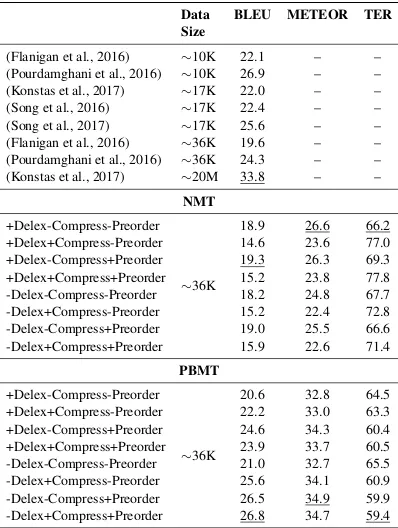
Table 1 depicts the scores of the different mod-els by the size of the data they were trained on. For illustration, we depicted the BLEU scores of all the AMR-to-text systems described in the litera-ture. The models of Flanigan et al. (2016) and Pour-damghani et al. (2016) were officially trained with 10,313 AMR-sentence pairs from the LDC2014T12 corpus, and with 36,521 AMR-sentence pairs from the LDC2016E25 in our study (as our models). The ones of Song et al. (2016) and Song et al. (2017) were trained with 16,833 pairs from the LDC2015E86 corpus. Konstas et al. (2017), which presents the highest quantitative result in the task so far, also used the LDC2015E86 corpus plus 20 million English sentences from the Gigaword corpus with a semi-supervised approach. We report the re-sults when their model were trained only with AMR-sentence pairs from the corpus, and when improved with more 20 million sentences.
Among the PBMT models, the Delexicalisation step (+Delex) does not seem to play a role in obtain-ing better sentences from AMRs. All the models with the preordering method in Linearisation
2http://github.com/jflanigan/jamr/tree/
Generator
3http://isi.edu/˜damghani/papers/amr2eng.zip
Data BLEU METEOR TER Size
(Flanigan et al., 2016) ∼10K 22.1 – – (Pourdamghani et al., 2016) ∼10K 26.9 – – (Konstas et al., 2017) ∼17K 22.0 – –
(Song et al., 2016) ∼17K 22.4 – –
(Song et al., 2017) ∼17K 25.6 – –
(Flanigan et al., 2016) ∼36K 19.6 – – (Pourdamghani et al., 2016) ∼36K 24.3 – – (Konstas et al., 2017) ∼20M 33.8 – –
NMT
+Delex-Compress-Preorder
∼36K
18.9 26.6 66.2 +Delex+Compress-Preorder 14.6 23.6 77.0 +Delex-Compress+Preorder 19.3 26.3 69.3 +Delex+Compress+Preorder 15.2 23.8 77.8 -Delex-Compress-Preorder 18.2 24.8 67.7 -Delex+Compress-Preorder 15.2 22.4 72.8 -Delex-Compress+Preorder 19.0 25.5 66.6 -Delex+Compress+Preorder 15.9 22.6 71.4
PBMT
+Delex-Compress-Preorder
∼36K
[image:7.612.327.526.54.318.2]20.6 32.8 64.5 +Delex+Compress-Preorder 22.2 33.0 63.3 +Delex-Compress+Preorder 24.6 34.3 60.4 +Delex+Compress+Preorder 23.9 33.7 60.5 -Delex-Compress-Preorder 21.0 32.7 65.5 -Delex+Compress-Preorder 25.6 34.1 60.9 -Delex-Compress+Preorder 26.5 34.9 59.9 -Delex+Compress+Preorder 26.8 34.7 59.4 Table 1: MT scores for the evaluated models by the size of the training data. Best baseline, PBMT and NMT results were underlined.
(+Preorder) introduce better results than Flanigan et al. (2016) and Song et al. (2016), whereas only the lexicalised models with the preordering method (PBMT+Delex[+|-]Compress+Preorder) outper-form Song et al. (2017) and introduce competitive results with Pourdamghani et al. (2016).
In our NMT models, apparently the Compression step is harmful to the task, whereas Delexicalisation and preordering in Linearisation lead to better re-sults. However, none of the NMT models outper-form neither the PBMT models nor the baselines.
6 Discussion
pro-cessing AMRs helps, although the effects differ for the different systems.
Phrase-based MT Delexicalisation (+Delex) does not seem to play a role in obtaining better sentences from AMRs using PBMT. Our best model (PBMT-Delex+Compress+Preorder) presents com-petitive results to Pourdamghani et al. (2016) with the advantage that no technique is necessary to overcome data sparsity.
Compressing an AMR graph with a classifier shows improvements over a comparable model with-out compression, but not as strong as preordering the elements in the Linearisation step. In fact, pre-ordering seems to be the most important prepro-cessing step across all three MT preproprepro-cessing met-rics. We note that the preordering success was ex-pected, based on previous results (Pourdamghani et al., 2016).
Neural MT The first impression from our NMT experiments is that using Compression consistently deteriorates translations according to all metrics evaluated. Delexicalisation seems to improve re-sults, corroborating the findings from Konstas et al. (2017). While Delexicalisation is harmful and Com-pression is beneficial for PBMT, we see the opposite in NMT models. Besides the differences between these two MT architectures, applying preordering in the Linearisation step improves results in both cases. This seems to contradict the finding in Konstas et al. (2017) regarding neural models. We conjecture that the additional training data used by Konstas et al. (2017) may have decreased the gap between using and not using preordering (see also below). More research is necessary to settle this point.
PBMT vs. NMT PBMT models generate much
better sentences from AMRs than NMT models in terms of fluency, adequacy and post-editing effort. We believe that the lower performance of NMT models is due to the small size of the training set (36,521 AMR-sentence pairs). Neural models are known to perform well when trained on much larger data sets, e.g. in the order of millions of entries, as exemplified by Konstas et al. (2017). PBMT models trained on small data sets clearly outperform NMT ones, e.g. Konstas et al. (2017) reported22.0BLEU, whereas Pourdamghani et al. (2016)’s best model
achieved26.9BLEU, and our best model performs comparably (26.8BLEU).
Model comparison While the best PBMT mod-els are comparable to the state-of-the-art AMR-to-text systems, the current best results are reported by Konstas et al. (2017), showing the potential of ap-plying deep learning onto large amounts of train-ing data with a 33.8 BLEU-score. However, this result crucially relies on the existence of a very large dataset. Interestingly, when applied in a sit-uation with limited amounts of data, Konstas et al. (2017) report substantially lower performance scores. In such situations, our PBMT models, like Pourdamghani et al. (2016), look appear to be a good alternative option.
7 Conclusion
In this work, we systematically studied different MT models to translate AMRs into natural language. We observed that the Delexicalisation, Compres-sion, and Linearisation steps have different impacts on AMR-to-text generation depending on the MT architecture used. We observed that delexicalising AMRs yields the best results in NMT models, in contrast to PBMT models. On the other hand, for both PBMT models and NMT models, preordering the AMR in Linearisation introduces better results.
Among our models, PBMT generally outperforms NMT. Finally, the literature suggests that the im-provements obtained by having more data are larger than those obtained with improved preprocessing strategies. Nonetheless, combining the right prepro-cessing strategy with large volumes of training data should lead to further improvements.
Acknowledgments
References
Yoav Artzi, Kenton Lee, and Luke Zettlemoyer. 2015. Broad-coverage ccg semantic parsing with amr. In
Proceedings of the 2015 Conference on Empiri-cal Methods in Natural Language Processing, pages 1699–1710, Lisbon, Portugal, September. Association for Computational Linguistics.
Dzmitry Bahdanau, Kyunghyun Cho, and Yoshua Ben-gio. 2015. Neural Machine Translation by Jointly Learning to Align and Translate. InInternational Con-ference on Learning Representations, ICLR 2015, San Diego, California.
Laura Banarescu, Claire Bonial, Shu Cai, Madalina Georgescu, Kira Griffitt, Ulf Hermjakob, Kevin Knight, Philipp Koehn, Martha Palmer, and Nathan Schneider. 2013. Abstract meaning representation for sembanking. InProceedings of the 7th Linguistic Annotation Workshop and Interoperability with Dis-course, pages 178–186, Sofia, Bulgaria, August. As-sociation for Computational Linguistics.
Ondˇrej Bojar, Rajen Chatterjee, Christian Federmann, Barry Haddow, Matthias Huck, Chris Hokamp, Philipp Koehn, Varvara Logacheva, Christof Monz, Matteo Negri, Matt Post, Carolina Scarton, Lucia Specia, and Marco Turchi. 2015. Findings of the 2015 Workshop on Statistical Machine Translation. InProceedings of the Tenth Workshop on Statistical Machine Transla-tion, pages 1–46, Lisbon, Portugal, September. Asso-ciation for Computational Linguistics.
Johan Bos. 2016. Expressive power of abstract meaning representations. Comput. Linguist., 42(3):527–535, September.
Colin Cherry and George Foster. 2012. Batch tuning strategies for statistical machine translation. In Pro-ceedings of the 2012 Conference of the North Amer-ican Chapter of the Association for Computational Linguistics: Human Language Technologies, NAACL HLT ’12, pages 427–436, Stroudsburg, PA, USA. As-sociation for Computational Linguistics.
Kyunghyun Cho, Bart van Merrienboer, Dzmitry Bah-danau, and Yoshua Bengio. 2014. On the Proper-ties of Neural Machine Translation: Encoder–Decoder Approaches. InProceedings of SSST-8, Eighth Work-shop on Syntax, Semantics and Structure in Statistical Translation, pages 103–111, Doha, Qatar, October. Jenny Rose Finkel, Trond Grenager, and Christopher
Manning. 2005. Incorporating non-local information into information extraction systems by gibbs sampling. In Proceedings of the 43rd Annual Meeting of the Association for Computational Linguistics (ACL’05), pages 363–370, Ann Arbor, Michigan, June. Associa-tion for ComputaAssocia-tional Linguistics.
Jeffrey Flanigan, Sam Thomson, Jaime Carbonell, Chris Dyer, and Noah A. Smith. 2014. A discriminative graph-based parser for the abstract meaning represen-tation. In Proceedings of the 52nd Annual Meeting of the Association for Computational Linguistics (Vol-ume 1: Long Papers), pages 1426–1436, Baltimore, Maryland, June. Association for Computational Lin-guistics.
Jeffrey Flanigan, Chris Dyer, Noah A. Smith, and Jaime Carbonell. 2016. Generation from abstract mean-ing representation usmean-ing tree transducers. In Proceed-ings of the 2016 Conference of the North American Chapter of the Association for Computational Linguis-tics: Human Language Technologies, pages 731–739, San Diego, California, June. Association for Compu-tational Linguistics.
Yarin Gal and Zoubin Ghahramani. 2016. A Theo-retically Grounded Application of Dropout in Recur-rent Neural Networks. In Advances in Neural Infor-mation Processing Systems, NIPS, pages 1019–1027, Barcelona, Spain.
Michel Galley and Christopher D. Manning. 2008. A simple and effective hierarchical phrase reordering model. In Proceedings of the 2008 Conference on Empirical Methods in Natural Language Processing, pages 848–856, Honolulu, Hawaii, October. Associa-tion for ComputaAssocia-tional Linguistics.
A. Gatt and E. Krahmer. 2017. Survey of the State of the Art in Natural Language Generation: Core tasks, applications and evaluation.ArXiv e-prints, March. Dimitra Gkatzia, Helen Hastie, and Oliver Lemon. 2014.
Comparing multi-label classification with reinforce-ment learning for summarisation of time-series data. InProceedings of the 52nd Annual Meeting of the As-sociation for Computational Linguistics (Volume 1: Long Papers), pages 1231–1240, Baltimore, Mary-land, June. Association for Computational Linguistics. Kenneth Heafield, Ivan Pouzyrevsky, Jonathan H. Clark, and Philipp Koehn. 2013. Scalable modified kneser-ney language model estimation. InProceedings of the 51st Annual Meeting of the Association for Compu-tational Linguistics (Volume 2: Short Papers), pages 690–696, Sofia, Bulgaria, August. Association for Computational Linguistics.
Philipp Koehn, Franz Josef Och, and Daniel Marcu. 2003. Statistical phrase-based translation. In Pro-ceedings of the 2003 Conference of the North Ameri-can Chapter of the Association for Computational Lin-guistics on Human Language Technology - Volume 1, NAACL ’03, pages 48–54, Stroudsburg, PA, USA. As-sociation for Computational Linguistics.
IWSLT Speech Translation Evaluation. In Interna-tional Workshop on Spoken Language Translation. Philipp Koehn, Hieu Hoang, Alexandra Birch, Chris
Callison-Burch, Marcello Federico, Nicola Bertoldi, Brooke Cowan, Wade Shen, Christine Moran, Richard Zens, Chris Dyer, Ondˇrej Bojar, Alexandra Con-stantin, and Evan Herbst. 2007. Moses: Open source toolkit for statistical machine translation. In Proceed-ings of the 45th Annual Meeting of the ACL on Inter-active Poster and Demonstration Sessions, ACL ’07, pages 177–180, Stroudsburg, PA, USA. Association for Computational Linguistics.
I. Konstas, S. Iyer, M. Yatskar, Y. Choi, and L. Zettle-moyer. 2017. Neural AMR: Sequence-to-Sequence Models for Parsing and Generation. ArXiv e-prints, April.
Alon Lavie and Abhaya Agarwal. 2007. Meteor: An Au-tomatic Metric for MT Evaluation with High Levels of Correlation with Human Judgments. InProceedings of the Second Workshop on Statistical Machine Trans-lation, StatMT ’07, pages 228–231, Prague, Czech Re-public.
Uri Lerner and Slav Petrov. 2013. Source-side classifier preordering for machine translation. InProceedings of the 2013 Conference on Empirical Methods in Natural Language Processing, pages 513–523, Seattle, Wash-ington, USA, October. Association for Computational Linguistics.
Franz Josef Och. 2003. Minimum error rate training in statistical machine translation. InProceedings of the 41st Annual Meeting of the Association for Compu-tational Linguistics, pages 160–167, Sapporo, Japan, July. Association for Computational Linguistics. Naoaki Okazaki. 2007. Crfsuite: a fast implementation
of conditional random fields (crfs).
Kishore Papineni, Salim Roukos, Todd Ward, and Wei-Jing Zhu. 2002. Bleu: a method for automatic eval-uation of machine translation. InProceedings of 40th Annual Meeting of the Association for Computational Linguistics, pages 311–318, Philadelphia, Pennsylva-nia, USA, July. Association for Computational Lin-guistics.
Nima Pourdamghani, Yang Gao, Ulf Hermjakob, and Kevin Knight. 2014. Aligning english strings with ab-stract meaning representation graphs. InProceedings of the 2014 Conference on Empirical Methods in Nat-ural Language Processing (EMNLP), pages 425–429, Doha, Qatar, October. Association for Computational Linguistics.
Nima Pourdamghani, Kevin Knight, and Ulf Hermjakob. 2016. Generating english from abstract meaning rep-resentations. InProceedings of the 9th International Natural Language Generation conference, pages 21–
25, Edinburgh, UK, September 5-8. Association for Computational Linguistics.
Ehud Reiter and Robert Dale. 2000. Building natural language generation systems. Cambridge University Press, New York, NY, USA.
Matthew Snover, Bonnie Dorr, Richard Schwartz, Lin-nea Micciulla, and John Makhoul. 2006. A study of translation edit rate with targeted human annotation. InProceedings of Association for Machine Translation in the Americas, AMTA, pages 223–231, Cambridge, MA, USA.
Linfeng Song, Yue Zhang, Xiaochang Peng, Zhiguo Wang, and Daniel Gildea. 2016. Amr-to-text gener-ation as a traveling salesman problem. InProceedings of the 2016 Conference on Empirical Methods in Nat-ural Language Processing, pages 2084–2089, Austin, Texas, November. Association for Computational Lin-guistics.
L. Song, X. Peng, Y. Zhang, Z. Wang, and D. Gildea. 2017. AMR-to-text Generation with Synchronous Node Replacement Grammar. ArXiv e-prints, Febru-ary.
M. Theune, E. Klabbers, J. R. De Pijper, E. Krahmer, and J. Odijk. 2001. From data to speech: A general approach.Nat. Lang. Eng., 7(1):47–86, March. Sanja ˇStajner, Iacer Calixto, and Horacio Saggion. 2015.
Automatic text simplification for spanish: Compar-ative evaluation of various simplification strategies. In Proceedings of the International Conference Re-cent Advances in Natural Language Processing, pages 618–626, Hissar, Bulgaria, September.
Sander Wubben, Antal van den Bosch, and Emiel Krah-mer. 2012. Sentence simplification by monolingual machine translation. In Proceedings of the 50th An-nual Meeting of the Association for Computational Linguistics: Long Papers - Volume 1, ACL ’12, pages 1015–1024, Stroudsburg, PA, USA. Association for Computational Linguistics.
Kelvin Xu, Jimmy Ba, Ryan Kiros, Kyunghyun Cho, Aaron Courville, Ruslan Salakhudinov, Rich Zemel, and Yoshua Bengio. 2015. Show, attend and tell: Neu-ral image caption generation with visual attention. In David Blei and Francis Bach, editors,Proceedings of the 32nd International Conference on Machine Learn-ing (ICML-15), pages 2048–2057. JMLR Workshop and Conference Proceedings.