Bootstrapping Semantic Role Labelers from Parallel Data
Mikhail Kozhevnikov Ivan Titov
Saarland University, Postfach 15 11 50 66041 Saarbr¨ucken, Germany
{mkozhevn|titov}@mmci.uni-saarland.de
Abstract
We present an approach which uses the sim-ilarity in semantic structure of bilingual par-allel sentences to bootstrap a pair of seman-tic role labeling (SRL) models. The setting is similar to co-training, except for the inter-mediate model required to convert the SRL structure between the two annotation schemes used for different languages. Our approach can facilitate the construction of SRL models for resource-poor languages, while preserving the annotation schemes designed for the tar-get language and making use of the limited re-sources available for it. We evaluate the model on four language pairs, English vs German, Spanish, Czech and Chinese. Consistent im-provements are observed over the self-training baseline.
1 Introduction
The success of statistical modeling methods in a va-riety of natural language processing (NLP) tasks in the last decade depended crucially on the availability of annotated resources for their training. And while sizable resources for most standard tasks are only available for a few languages, the human effort re-quired to achieve reasonable performance on such tasks for other languages may be significantly re-duced by leveraging existing resources and the sim-ilarities between languages.
This idea has lead to the development of cross-lingual annotation projection approaches, which make use of parallel corpora (Pad´o and Lapata, 2009), as well as attempts to adapt models directly
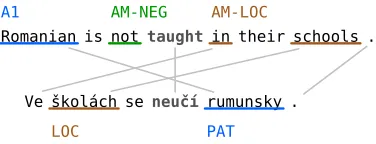
to other languages (McDonald et al., 2011). In this paper we consider correspondences between SRL structures in translated sentences from a different perspective. Most cross-lingual annotation projec-tion approaches transfer the source language anno-tation scheme to the target language without modifi-cation, which makes it hard to combine their output with existing target language resources, as annota-tion schemes may vary significantly. We instead ad-dress the problem of information transfer between twoexistingannotation schemes (figure 1) for a pair of languages using an intermediate model of role correspondence (RCM). An RCM models the prob-ability of a pair of corresponding arguments being assigned a certain pair of roles. We then use it to guide a pair of monolingual models toward compat-ible predictions on parallel data in order to extend the coverage and/or accuracy of one or both models.
Romanian is nottaughtin their schools .
Ve školách se neučí rumunsky .
A1
PAT
AM-LOC
LOC
[image:1.612.334.522.493.565.2]AM-NEG
Figure 1: Role correspondence in parallel sentences, an example.
The notion of compatibility here is highly non-trivial, even for sentences translated as close to the original as possible. Zhuang and Zong (2010), for example, observe that in the English-Chinese paral-lel PropBank (Palmer et al., 2005b) corresponding arguments often bear different labels, even though the same inventory of semantic roles is used for both
languages and the annotation guidelines are similar. When different annotation schemes are considered, the problem is further complicated by the difference in the granularity of semantic roles used and varying notions of what is an argument and what is not.
Manually annotated training data for such a model is hard to come by. Instead, we propose an itera-tive procedure similar to bootstrapping, where the parameters of the RCM are initially estimated from a parallel corpus automatically annotated with se-mantic roles using the monolingual models indepen-dently, and then the RCM is used to refine these an-notations via a joint inference procedure, serving to enforce consistency on the predictions of monolin-gual models on parallel sentences. The obtained an-notations on the parallel corpus are expected to be of higher quality than the independent predictions of the models, so they can be used to improve the SRL models’ performance and/or coverage. We evalu-ate this approach by augmenting the original train-ing data with the annotations obtained on parallel data and observing the change in the model’s perfor-mance. This is especially useful if one of the lan-guages is relatively poor in resources, in which case the proposed procedure will help propagate infor-mation from the stronger model to the weaker one. Even if the two models are comparable in their pre-dictive power, we may be able to benefit from the fact that certain semantic roles are realized less am-biguously in one language than in another. We will henceforth refer to these two alternatives as the pro-jectionandsymmetricsetups.
The paper is structured as follows. In the next sec-tion we present our approach and discuss the issues of role correspondence modeling, then describe the implementation and datasets used in evaluation in section 3, present the evaluation and results in sec-tion 4 and conclude with the discussion of related work in section 5.
2 Approach
We consider bootstrapping a pair of SRL models on a parallel corpus, using the correspondence between their predictions on parallel sentences to guide the learning. The models are forced toward compatible predictions, where the notion of compatibility is de-fined by a (statistical) role correspondence model.
Let us consider a pair of languages, α and β, and their corresponding datasets Tα0 andTβ0, anno-tated with semantic roles (the upper indices here de-note the iteration number). We will refer to these as the initial training sets. We also assume that a word-aligned parallel corpus is available for the pair of languages, which we denote P, with the pred-icates and their respective arguments identified on both sides.
The procedure is then as follows: we train mono-lingual modelsMα0 andMβ0 onTα0 andTβ0, respec-tively, apply them to the two sides of the parallel corpus, resulting in a labelingP0. We collect the se-mantic role co-occurrence information and train the role correspondence modelC0on it, then proceed to
the joint inference step involvingMα0, Mβ0 andC0, resulting in a refined labelingP1of the parallel cor-pus. The two sides of theP1 are then used to
aug-ment the initial training sets, yielding Tα1 and Tβ1, and new modelsMβ1 and Mβ1 are trained on these. The process can then be repeated usingMα1andMβ1
instead of the initial models.
We report the model’s performance on a held-out test set, drawn from the same corpus as the corre-sponding initial training set.
The procedure can be seen as a form of co-training (Blum and Mitchell, 1998) of a pair of monolingual SRL models. In our case, however, the question of the models’ agreement is not as trivial as in most applications of co-training, requiring a sta-tistical model of its own (Ci).
In the low-resource (projection) setup our ap-proach is also similar to self-training with weak su-pervision coming from the stronger model.
Note that although the approach is iterative, we have observed no significant improvements from re-peating the procedure, possibly owing to the noise introduced by the errors in preprocessing. In the evaluation we run only one iteration. In the notation introduced above, the self-training baseline model (SELF) is trained onPβ0, the joint model (JOINT) – onPβ1and the combined model (COMB) – onTβ1.
2.1 Modeling Role Correspondence
ways, depending on the formalism used. In case of FrameNet (Baker et al., 1998), for example, the in-terpretation of a semantic role (frame element) is ex-plicitly provided for each separate frame, so a frame and a frame element label together describe the se-mantics of an argument. PropBank (Palmer et al., 2005a) follows a mixed strategy – the labels for a relatively small set of core rolesare numbered and their interpretations are provided separately for each predicate (although those of the first two roles, A0
andA1, consistently denote what is known as Proto-Agent and Proto-Patient), while modifiers (Merlo and Leybold, 2001) bear labels that are interpreted consistently across all predicates. Other resources, such as Prague Dependency Treebank (Hajiˇc et al., 2006), use a single set of semantic roles (functors), which are interpretable across different predicates.
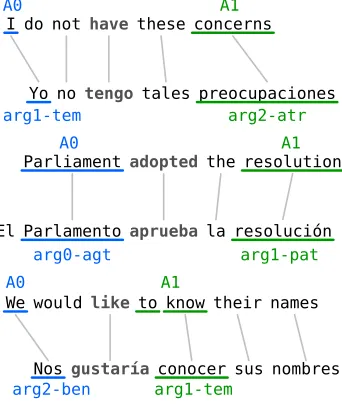
From the standpoint of defining the semantic sim-ilarity of parallel sentences, the important implica-tion is that we cannot assume that the corresponding arguments should bear the same label, even if the annotation schemes used are compatible (Zhuang and Zong, 2010). Nor can we write down a single mapping between the roles that will be valid across different predicates (figure 2), which motivates the need for a statistical model of semantic role corre-spondence.
I do not have these concerns
Yo notengo tales preocupaciones
A0
arg1-tem
A1
arg2-atr
Parliamentadopted the resolution
El Parlamento aprueba la resolución
A0
arg0-agt
A1
arg1-pat
We would like to know their names
Nos gustaría conocer sus nombres A0
arg2-ben
A1
[image:3.612.100.271.433.635.2]arg1-tem
Figure 2: Predicate-specific role mapping. Note thatA0 corresponds toart0-agt,art1-temorart2-ben, depending on the predicate.
We assume the existence of a one-to-one
map-ping between semantic roles for a given predicate pair. As the mappings are not completely indepen-dent – at least some roles have the same interpre-tation across different predicate pairs, – we choose to build a single model, which relies on features de-rived from the pair of predicates in question, rather than create a separate model for each predicate pair. The model can then make decisions specific to par-ticular predicates or predicate pairs, where sufficient data has been observed or back off to a generic map-ping where there is not enough data.
For the purpose of this study, we choose to sep-arately model the probability of a target role, given the source one and the necessary contextual infor-mation and vice versa. These two components are referred to as projection models and realized as a pair of linear classifiers.
Training such a model in a conventional fash-ion would require a rather specific kind of dataset, namely a parallel corpus annotated with semantic roles, and assuming the availability of such data would severely limit the applicability of the ap-proach proposed, as, to our knowledge, it is cur-rently only available for two language pairs, namely Chinese (Palmer et al., 2005b) and English-Czech (Hajiˇc et al., 2012). We instead use the auto-matically produced annotations on a parallel corpus, effectively enforcing consistency on the role corre-spondence in the monolingual models’ predictions.
2.2 Joint Inference
The joint inference would have been simplest if the arguments were classified independently. This as-sumption is too restrictive, though, since the inter-dependencies between the arguments can be used to improve the accuracy of semantic role label-ing (Roth and Yih, 2005).
2.2.1 Projection Setup
In the projection setup we assume that the model for one of the languages, which we will henceforth refer to as source, is much better informed than the one for the other language, referred to as tar-get, so we only have to propagate the information one way. The scoring functions of these two mod-els will be denotedfs andft, respectively, and that
and aligned predicates in these sentences – ps and
pt. The task is then to identify the target language role assignment rt that would maximize the
objec-tiveL(rt) =λtft(rt, St, pt) +λstfst(rt, rs, ps, pt), where rs = argmaxrfs(rs, Ss, ps) is the role as-signment of the source-side arguments as predicted by the monolingual model andλare the weights as-sociated with the models.
The exact maximization of this objective is com-putationally expensive, so we resort to an approx-imation. We chose to use the dual decomposition
method primarily because it fits the structure of the objective particularly well (in that it is a sum of the objectives of two independent models) and since it allows a wide range of monolingual models to be used in this setup. The only requirement here is that the monolingual model must be able to incorporate a bias toward or away from a certain prediction.
To apply this approximation, we decouple the
rt variables into rt and rst and get L1(rt, rst) = λtft(rt, St, pt) + λstfst(rst, rs, ps, pt) under the
condition that rt = rst. Applying the Lagrangian
relaxation, we replace the hard equality constraint onrtandrstwith a soft one, using slack variablesδ,
which results in the following objective:
minδmaxrt,rstL01(rt, rst, δ) =
λtft(rt, St, pt) +λstfst(rst, rs, ps, pt)+ (1) X
i
X
r∈Rt
δi,r I(rti =r)−I(rsti =r)
,
whereiindexes aligned argument pairs andI is an indicator function. This is equivalent to
minδmaxrt,rstL01(rt, rst, δ) =
minδ
maxrtgt(rt, St, pt, δ)+ (2)
maxrstgst(rst, rs, ps, pt, δ)
,
where
gt(rt, St, pt, δ) =
λtft(rt, St, pt) +X i
X
r∈Rt
δi,rI(rit=r)
gstp(rst, rs, ps, pt, δ) = (3)
λstfst(rst, rs, ps, pt)−
X
i
X
r∈Rt
δi,rI(rsti =r)
are the augmented objectives of the two component models, incorporating bias factors on various possi-ble predictions.
The minimization with respect to δ is per-formed using a subgradient descent algorithm fol-lowing Sontag et al. (2011). Whenever the method converges, it converges to the global maximum of the sum of the objectives. We found that in our case it reaches a solution within the first 1000 iterations over 99% of the time.
2.2.2 Symmetric Setup
If the models have comparable accuracy, the above inference procedure can be extended to per-form projection both ways. Formulating this as a dual decomposition problem would require using three separate components, two for the monolingual models and one for the RCM, which would have to make its own predictions for the semantic roles on both sides without conditioning on the predictions of the monolingual models. This calls for a different kind of model than the one we use – a model that will rely on a (possibly simplified) feature represen-tation of the source and target arguments to jointly predict their labels. Instead, we perform the pro-jection setup inference procedure in both directions simultaneously, interleaving gradient descent steps and allowing the projection models to access the up-dated predictions of the monolingual models. This results in a block gradient descent algorithm with the following updates:
rtn+1 =argmaxrtgt(rt, St, pt, δtn)
rsn+1 =argmaxrtgs(rs, Ss, ps, δsn)
rstn+1 =argmaxrstgst(rst, rns, ps, pt, δtn)
rtsn+1 =argmaxrtsgts(rts, rnt, pt, ps, δsn) (4)
∀i∀r∈Rsδsn+1,i,r =δsn,i,r+
γs(n)(I(rtsn,i=r)−I(rsn,i=r))
∀i∀r∈Rtδtn+1,i,r =δ n,i,r
t +
γt(n)(I(rstn,i=r)−I(r n,i t =r)),
whereγs(n) =γt(n) = γ0
n+1 is the update rate
func-tion for stepn, andgsandgts are defined as in (3), but with the direction reversed.
a special case of this one with γs(n) set to0. The algorithm also demonstrates convergence similar to that of the projection version, although it lacks the optimality guarantees.
3 Experimental Setup
We evaluate our approach on four language pairs, namely English vs German, Spanish, Czech and Chinese, which we will denote en-de, en-es,
en-czanden-zhrespectively.
3.1 Parallel Data
The parallel data for the first three language pairs is drawn from Europarl v6 (Koehn, 2005) and from MultiUN (Eisele and Chen, 2010) for English-Chinese. We applied Stanford Tokenizer for En-glish, tokenizer scripts (Koehn, 2005) provided with the Europarl corpus to German, Spanish and Czech, and Stanford Chinese Segmenter (Chang et al., 2008) to Chinese, then performed POS-tagging, morphology tagging (where applicable) and depen-dency parsing using MATE-tools (Bohnet, 2010).
Word alignments were acquired using GIZA++ (Och and Ney, 2003) with its stan-dard settings. Predicate identification on the parallel data was done using the supervised classifiers of the monolingual SRL systems, except for German, where a simple heuristic had to be used instead, as only some of the predicates are marked in the training data, which makes it hard to train a supervised classifier. Following van der Plas et al. (2011), we then retain only those sentences where all identified predicates were aligned.
In the experiments we used 50 thousand predicate pairs in each case, as increasing the amount further did not yield noticeable benefits, while increasing the running time.
3.2 Annotated Data
The CoNLL’09 (Hajiˇc et al., 2009) datasets were used as a source of annotated data for all languages. Only verbal predicates were considered and pre-dicted syntax was used in evaluation.
We consider subsets of the training data in order to emulate the scenario with a resource-poor lan-guage. Due to the different sources the datasets were derived from, sentences contain different pro-portions of annotated predicates depending on the
language. The German corpus, for example, con-tains about 6 times fewer argument labels per sen-tence than the English one. We will therefore in-dicate the sizes of the datasets used in the number of argument labels they contain, referred to as in-stances, rather than the number of predicates or sen-tences. The corpus for English, for example, con-tains 6.2 such instances per sentence on average.
We use the 20 thousand instances of the available data as the training corpus for each language and split the rest equally between the development and the test set. The secondary (“out-of-domain”) test sets are preserved as they are.
In dependency-based SRL, only heads of syntac-tic constituents are marked with semansyntac-tic roles. The heads of corresponding arguments may or may not align, however, even if the arguments are lexically very similar, because their syntactic structure may differ. In general, one would have to identify the whole phrase for each argument and take into ac-count the links between constituents, rather than sin-gle words (Pad´o and Lapata, 2005). As reconstruct-ing the constituents from the dependency tree is non-trivial (Hwang et al., 2010), we are using a heuristic to address the most common version of this problem, i.e. a preposition or an auxiliary verb being an argu-ment head. In such a case we also take into account any alignment links involving the head’s immediate descendants.
3.3 Implementation
Our system is based on that of Bj¨orkelund et al. (2009). It is a pipeline system comprised of a set of binary or multiclass linear classifiers. Both here and in the projection model, the classifiers are trained using Liblinear (Fan et al., 2008).
3.4 The Projection Model
Each projection model is realized by a single lin-ear classifier applied to each argument pair indepen-dently. It relies on features derived from the source semantic role and source and target predicates, and predicts the semantic role for the argument in the target sentence.
The features include the source semantic role and its conjunctions with (lowercased) forms and lem-mata of the source and target predicates. For ex-ample, assuming the source semantic role isA3and the source and target predicates arewentandging
(past tense of “gehen”, German), the features would be as shown in figure 3.
FORMPAIR=A3-went-ging LEMMAPAIR=A3-go-gehen FORMSRC=A3-went
FORMTGT=A3-ging LEMMASRC=A3-go LEMMATGT=A3-gehen LABEL=A3
Figure 3: Projection model features example.
3.5 Parameters
In case of projection there are two parameters,λst
andλt, – the weights of the component models in the objective. Only their relative values matter (except in the choice ofγ0), so we setλtto 1 and only tune
the weight of the role correspondence model. In the symmetric setup, the objective takes the form L(rt, rs) = λtft(rt, St, pt) + λstfst(rt, rs, ps, pt) + λsfs(rs, Ss, ps) + λtsfts(rs, rt, pt, ps). Since we assume that the
two monolingual models here have comparable performance, we do not tune their relative weights, setting bothλsandλtto 1.
We also use the same weight for both projection models,λst=λts, and this value plays an important role – it basically indicates how strongly we insist on the role correspondence models’ correctness. If this weight is set to 0, the RCM will accept the ini-tial predictions the monolingual models make, and if it is set to a sufficiently large value, the predictions of the monolingual models will be biased until they match the mapping suggested by the RCM. The op-timal weight will therefore depend on the language
pair, the sizes of the initial training sets and the RCM used. We use the value of 0.7 in all projection ex-periments and0.5in the symmetric setup, however, as excessive tuning may be undesirable in the low-resource setting.
3.6 Domains
One important factor in the understanding of the evaluation figures presented is the fact that sources of annotated and parallel data belong to different do-mains. The former usually contains some sort of newswire text – Wall Street Journal in case of En-glish, Xinhua newswire, Hong Kong news and Sino-rama news magazine for Chinese, etc. Parallel data, on the other hand, comes from the proceedings of European Parliament and United Nations, which are quite different. For example, the sentences in the latter domain often start with someone being ad-dressed, either by name or by title, which can hardly be expected to occur as often in a newspaper or a magazine article.
As is well-known, the performance of many sta-tistical tools drops significantly outside the domain they were trained on (Pradhan et al., 2008), and the preprocessing and SRL models used here are no ex-ception, which results in relatively low quality of the initial predictions on the parallel text. The low argument identification performance, in particular, is presumably due to inaccurate dependency parses, on which it heavily relies. Several approached have been proposed to improve the accuracy of depen-dency parsers and other tools on out-of-domain data, but this is beyond the scope of this paper. In some cases (though seldom), sources of parallel data be-longing to the same domain as the annotated training data can be obtained.
Another concern is that the performance of a model trained on automatically labeled parallel data as measured on a test set we use may not reflect the quality of these annotations. To assess the resulting model’s coverage, it would be interesting to evaluate it on data outside the original domain, so we con-sider the out-of-domain (OOD) test sets as provided for the CoNLL Shared Task 2009 where available.
se-mantic structure in the SALSA format (Burchardt et al., 2006) for Pad´o and Lapata (2005), and then converted into a PropBank-like form for the CoNLL Shared Task 2009 (Hajiˇc et al., 2009). The OOD test set for English is drawn from the Brown cor-pus (Francis and Kucera, 1967) and the one for Czech – from a Czech translation of Wall Street Journal articles (Hajiˇc et al., 2012).
4 Evaluation
The first question we are interested in is how the joint inference affects the quality of the automati-cally obtained annotations on the parallel data. To answer this, we will run the monolingual models in-dependently and jointly, then train models on the output of these two procedures and compare their performance on a test set. Note that we do not add the initial training data at this point, so the initial model scores are provided for reference, rather than as a baseline.
4.1 Projection Setup
A small initial training set of 600 instances was used here for the target language here and the full training set (20000 instances) for the source one.λstwas set
to0.7in all experiments in this section.
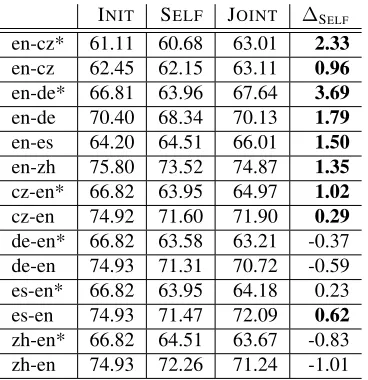
INIT SELF JOINT ∆SELF
[image:7.612.95.279.421.611.2]en-cz* 61.11 60.68 63.01 2.33 en-cz 62.45 62.15 63.11 0.96 en-de* 66.81 63.96 67.64 3.69 en-de 70.40 68.34 70.13 1.79 en-es 64.20 64.51 66.01 1.50 en-zh 75.80 73.52 74.87 1.35 cz-en* 66.82 63.95 64.97 1.02 cz-en 74.92 71.60 71.90 0.29 de-en* 66.82 63.58 63.21 -0.37 de-en 74.93 71.31 70.72 -0.59 es-en* 66.82 63.95 64.18 0.23 es-en 74.93 71.47 72.09 0.62 zh-en* 66.82 64.51 63.67 -0.83 zh-en 74.93 72.26 71.24 -1.01
Table 1: Projection setup results: self-training baseline, refined model and the difference in their performance. Asterisk indicates out-of-domain test set, statistically sig-nificant improvements are highlighted in bold.
In table 1, we present the accuracy of the model trained on the output of the joint inference (JOINT)
against that of the self-training baseline (SELF). The
∆SELF column contains the difference between the two. Note that the SELF model is trained on the
parallel data automatically annotated using mono-lingual SRL models (not mixed with the initial train-ing set), since we are interested in the effect of joint inference on the quality of the annotation obtained. Where the improvement is positive and statistically significant withp <0.005according to the permuta-tion test (Good, 2000), they are highlighted in bold.
We can see that the refined model (JOINT) outper-forms the self-training baseline in most cases by a moderate, but statistically significant margin, which indicates that the joint inference does improve the quality of annotations on the parallel corpus.
The slightly higher improvement on the German OOD test set supports our hypothesis that the proce-dure enhances the performance of the model on par-allel data, as the data for this test set is also drawn from the Europarl corpus. The improvement over the initial model (∆INIT) in this case is statistically
[image:7.612.320.528.476.642.2]significant withp < 0.05. Higher p-value may be attributed to the smaller test set size.
Figure 4 shows how the performance of the JOINT
model changes with the size of the initial training set. The improvements are smaller for cz, en-de and en-zh, but they are also statistically signifi-cant for initial training sets of up to 2000 instances. Projection to English from other languages performs worse.
4.2 Combining
In practice, automatically obtained annotations are usually combined with the existing labeled data. For this purpose, the initial training set is replicated so as to constitute0.3(an empirically chosen value that appears to work well in most experiments) of the size of the automatically labeled dataset. We com-pare the performance of the model trained on the re-sulting dataset (COMB) with that of the JOINTmodel
[image:8.612.334.519.54.244.2]and the initial models. The results are presented in table 2. We omit projection from other languages to English, since the JOINTmodel there fails to outper-form the initial model and we do not expect to ben-efit from adding the automatically annotated data to the initial training set in this case.
INIT JOINT COMB ∆JOINT ∆INIT
en-cz* 61.11 63.01 62.98 -0.03 1.87 en-cz 62.45 63.11 63.30 0.19 0.85 en-de* 66.81 67.64 67.64 0.00 0.84 en-de 70.39 70.19 70.53 0.34 0.15 en-es 64.20 66.01 66.01 0.00 1.81 en-zh 75.80 74.87 75.03 0.16 -0.77
Table 2: The effect of adding automatically obtained an-notation to the initial training set. Asterisk indicates out-of-domain test set, statistically significant improvements are highlighted in bold.
4.3 Symmetric Setup
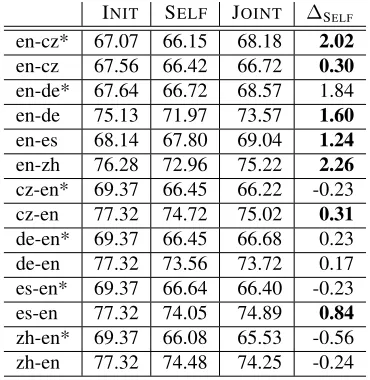
In the symmetric setup evaluation, we use a slightly larger initial training set of 1400 instances for both source and target language. The projection model weight is set to0.5. Table 3 shows the accuracy of the JOINTmodel and the SELFbaseline.
Note that here, unlike section 4.1, the joint in-ference is run once and then a model is trained for each language and evaluated on the corresponding test set(s).
The results support our intuition that joint infer-ence helps improve the quality of the resulting an-notations, at least in some cases.
4.4 Oracle RCM
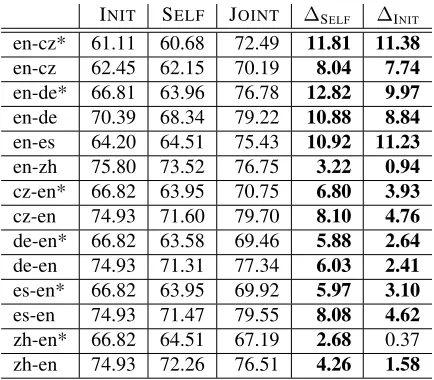
It would be useful to know to what extent the per-formance of the role correspondence model affects the quality of the output (and thus the performance of the resulting model). The RCM we use is rather
INIT SELF JOINT ∆SELF
en-cz* 67.07 66.15 68.18 2.02 en-cz 67.56 66.42 66.72 0.30 en-de* 67.64 66.72 68.57 1.84 en-de 75.13 71.97 73.57 1.60 en-es 68.14 67.80 69.04 1.24 en-zh 76.28 72.96 75.22 2.26 cz-en* 69.37 66.45 66.22 -0.23 cz-en 77.32 74.72 75.02 0.31 de-en* 69.37 66.45 66.68 0.23 de-en 77.32 73.56 73.72 0.17 es-en* 69.37 66.64 66.40 -0.23 es-en 77.32 74.05 74.89 0.84 zh-en* 69.37 66.08 65.53 -0.56 zh-en 77.32 74.48 74.25 -0.24
Table 3: Comparing JOINT model against the self-training baseline in symmetric setup. Asterisk indicates out-of-domain test set, statistically significant improve-ments are highlighted in bold.
simplistic, and we believe it can be substantially im-proved for any given language pair by incorporat-ing prior knowledge and/or usincorporat-ing external sources of information. In order to estimate the potential impact of such improvements, we simulate a better informed projection model, giving it access to the predictions of more accurate monolingual models on the parallel data – those trained on the full training set, rather than the initial training set used in this par-ticular experiment. We refer to the resulting RCM as
oracleand assess the difference it makes, compared to a regular one (table 4).
5 Related Work
INIT SELF JOINT ∆SELF ∆INIT
[image:9.612.77.294.53.243.2]en-cz* 61.11 60.68 72.49 11.81 11.38 en-cz 62.45 62.15 70.19 8.04 7.74 en-de* 66.81 63.96 76.78 12.82 9.97 en-de 70.39 68.34 79.22 10.88 8.84 en-es 64.20 64.51 75.43 10.92 11.23 en-zh 75.80 73.52 76.75 3.22 0.94 cz-en* 66.82 63.95 70.75 6.80 3.93 cz-en 74.93 71.60 79.70 8.10 4.76 de-en* 66.82 63.58 69.46 5.88 2.64 de-en 74.93 71.31 77.34 6.03 2.41 es-en* 66.82 63.95 69.92 5.97 3.10 es-en 74.93 71.47 79.55 8.08 4.62 zh-en* 66.82 64.51 67.19 2.68 0.37 zh-en 74.93 72.26 76.51 4.26 1.58
Table 4: Oracle RCM performance, projection setup: ini-tial model, self-training baseline, refined model and its improvement over the other two. Asterisk indicates out-of-domain test set, statistically significant improvements are highlighted in bold.
the availability of some amount of training data for the target language, possibly using a different inven-tory of semantic roles.
As mentioned previously, from the training point of view this approach can be seen as similar to co-training (Blum and Mitchell, 1998), other applica-tions of which to NLP are too numerous to list here. Most closely related is the joint inference in Zhuang and Zong (2010), the main difference being that it relies on a manually annotated parallel corpus, aligned on the argument level, and evaluates only the inference procedure and only on in-domain data.
Other related approaches include Kim et al. (2010), where a cross-lingual transfer of relations is performed (which basically represent parts of the predicate-argument structure considered by SRL methods), and Frermann and Bond (2012), where semantic structure matching is used to rank HPSG parses for parallel sentences.
Unsupervised semantic role labeling meth-ods (Lang and Lapata, 2010; Lang and Lapata, 2011; Titov and Klementiev, 2012a; Lorenzo and Cerisara, 2012) present an alternative to the cross-lingual information propagation approaches such as ours, and at least one the methods in this area also makes use of parallel data (Titov and Klementiev, 2012b).
Conclusions
We have presented an approach to information trans-fer between SRL systems for diftrans-ferent language pairs using parallel data. The task proves challeng-ing due to non-trivial mappchalleng-ing between the role la-bels used in different SRL annotation schemes and the nature of parallel data – the difference in do-mains and the limited accuracy of the preprocess-ing tools. We observe consistent improvements over self-training baseline from using joint inference and the experiments suggest that improving the role cor-respondence model, for example using language-specific prior knowledge or external data sources, may dramatically increase the performance of the re-sulting system.
Acknowledgments
The authors acknowledge the support of the MMCI Cluster of Excellence and thank Alexandre Klemen-tiev and Manfred Pinkal for valuable suggestions.
References
Paolo Annesi and Roberto Basili. 2010. Cross-lingual alignment of framenet annotations through hidden markov models. InProceedings of the 11th interna-tional conference on Computainterna-tional Linguistics and Intelligent Text Processing, CICLing’10, pages 12–25, Berlin, Heidelberg. Springer-Verlag.
Collin F. Baker, Charles J. Fillmore, and John B. Lowe. 1998. The Berkeley FrameNet project. In Pro-ceedings of the Thirty-Sixth Annual Meeting of the Association for Computational Linguistics and Sev-enteenth International Conference on Computational Linguistics (ACL-COLING’98), pages 86–90, Mon-treal, Canada.
Anders Bj¨orkelund, Love Hafdell, and Pierre Nugues. 2009. Multilingual semantic role labeling. In Pro-ceedings of the Thirteenth Conference on Computa-tional Natural Language Learning (CoNLL 2009): Shared Task, pages 43–48, Boulder, Colorado, June. Association for Computational Linguistics.
Avrim Blum and Tom Mitchell. 1998. Combining la-beled and unlala-beled data with co-training. In Proceed-ings of the Workshop on Computational Learning The-ory (COLT 98).
Lin-guistics (Coling 2010), pages 89–97, Beijing, China, August. Coling 2010 Organizing Committee.
Aljoscha Burchardt, Katrin Erk, Anette Frank, Andrea Kowalski, Sebastian Pado, and Manfred Pinkal. 2006. The SALSA corpus: a German corpus resource for lexical semantics. In Proceedings of LREC 2006, Genoa, Italy.
M.W. Chang, L. Ratinov, and D. Roth. 2007. Guiding semi-supervision with constraint-driven learning. Ur-bana, 51:61801.
Pi-Chuan Chang, Michel Galley, and Christopher D. Manning. 2008. Optimizing chinese word segmen-tation for machine translation performance. In Pro-ceedings of the Third Workshop on Statistical Machine Translation, StatMT ’08, pages 224–232, Stroudsburg, PA, USA. Association for Computational Linguistics. Greg Durrett, Adam Pauls, and Dan Klein. 2012.
Syntac-tic transfer using a bilingual lexicon. InProceedings of the 2012 Joint Conference on Empirical Methods in Natural Language Processing and Computational Natural Language Learning, pages 1–11, Jeju Island, Korea, July. Association for Computational Linguis-tics.
Andreas Eisele and Yu Chen. 2010. MultiUN: A multi-lingual corpus from united nation documents. In Nico-letta Calzolari (Conference Chair), Khalid Choukri, Bente Maegaard, Joseph Mariani, Jan Odijk, Stelios Piperidis, Mike Rosner, and Daniel Tapias, editors,
Proceedings of the Seventh International Conference on Language Resources and Evaluation (LREC’10), Valletta, Malta, May. European Language Resources Association (ELRA).
Rong-En Fan, Kai-Wei Chang, Cho-Jui Hsieh, Xiang-Rui Wang, and Chih-Jen Lin. 2008. LIBLINEAR: A li-brary for large linear classification. Journal of Ma-chine Learning Research, 9:1871–1874.
S. Francis and H. Kucera. 1967. Computing Analysis of Present-day American English. Brown University Press, Providence, RI.
Lea Frermann and Francis Bond. 2012. Cross-lingual parse disambiguation based on semantic correspon-dence. In Proceedings of the 50th Annual Meeting of the Association for Computational Linguistics (Vol-ume 2: Short Papers), pages 125–129, Jeju Island, Ko-rea, July. Association for Computational Linguistics. Hagen F¨urstenau and Mirella Lapata. 2009. Graph
alignment for semi-supervised semantic role labeling. In Proceedings of the 2009 Conference on Empirical Methods in Natural Language Processing, pages 11– 20, Singapore.
D. Goldwasser, R. Reichart, J. Clarke, and D. Roth. 2011. Confidence driven unsupervised semantic pars-ing. InACL.
P. Good. 2000. Permutation Tests: A Practical Guide to Resampling Methods for Testing Hypotheses. Springer.
J. Hajiˇc, J. Panevov´a, E. Hajiˇcov´a, P. Sgall, P. Pajas, J. ˇStˇep´anek, J. Havelka, M. Mikulov´a, Z. ˇZabokrtsk`y, and M. ˇSevˇc´ıkov´a-Raz´ımov´a. 2006. Prague depen-dency treebank 2.0.LDC.
Jan Hajiˇc, Massimiliano Ciaramita, Richard Johans-son, Daisuke Kawahara, Maria Ant`onia Mart´ı, Llu´ıs M`arquez, Adam Meyers, Joakim Nivre, Sebastian Pad´o, Jan ˇStˇep´anek, Pavel Straˇn´ak, Mihai Surdeanu, Nianwen Xue, and Yi Zhang. 2009. The CoNLL-2009 shared task: Syntactic and semantic dependen-cies in multiple languages. InProceedings of the Thir-teenth Conference on Computational Natural Lan-guage Learning (CoNLL 2009): Shared Task, pages 1–18, Boulder, Colorado.
Jan Hajiˇc, Eva Hajiˇcov´a, Jarmila Panevov´a, Petr Sgall, Ondˇrej Bojar, Silvie Cinkov´a, Eva Fuˇc´ıkov´a, Marie Mikulov´a, Petr Pajas, Jan Popelka, Jiˇr´ı Semeck´y, Jana ˇSindlerov´a, Jan ˇStˇep´anek, Josef Toman, Zdeˇnka Ureˇsov´a, and Zdenˇek ˇZabokrtsk´y. 2012. Announc-ing prague czech-english dependency treebank 2.0. In Nicoletta Calzolari (Conference Chair), Khalid Choukri, Thierry Declerck, Mehmet Uˇgur Doˇgan, Bente Maegaard, Joseph Mariani, Jan Odijk, and Ste-lios Piperidis, editors, Proceedings of the Eight In-ternational Conference on Language Resources and Evaluation (LREC’12), Istanbul, Turkey, May. Euro-pean Language Resources Association (ELRA). Shan He and Daniel Gildea. 2006. Self-training and
co-training for semantic role labeling: Primary report. Technical report, University of Rochester.
Jena D. Hwang, Rodney D. Nielsen, and Martha Palmer. 2010. Towards a domain independent semantics: Enhancing semantic representation with construction grammar. InProceedings of the NAACL HLT Work-shop on Extracting and Using Constructions in Com-putational Linguistics, pages 1–8, Los Angeles, Cali-fornia, June. Association for Computational Linguis-tics.
Seokhwan Kim, Minwoo Jeong, Jonghoon Lee, and Gary Geunbae Lee. 2010. A cross-lingual annota-tion projecannota-tion approach for relaannota-tion detecannota-tion. In Pro-ceedings of the 23rdInternational Conference on Com-putational Linguistics, COLING ’10, pages 564–571, Stroudsburg, PA, USA. Association for Computational Linguistics.
Philipp Koehn. 2005. Europarl: A Parallel Corpus for Statistical Machine Translation. In Conference Proceedings: the tenth Machine Translation Summit, pages 79–86, Phuket, Thailand. AAMT, AAMT. Joel Lang and Mirella Lapata. 2010. Unsupervised
Tech-nologies: The 2010 Annual Conference of the North American Chapter of the Association for Computa-tional Linguistics, pages 939–947, Los Angeles, Cal-ifornia, June. Association for Computational Linguis-tics.
Joel Lang and Mirella Lapata. 2011. Unsupervised se-mantic role induction via split-merge clustering. In
Proc. of Annual Meeting of the Association for Com-putational Linguistics (ACL).
Adam Lopez, Daniel Zeman, Michael Nossal, Philip Resnik, and Rebecca Hwa. 2008. Cross-Language Parser Adaptation between Related Languages. In
IJCNLP-08 Workshop on NLP for Less Privileged Languages, pages 35–42, Hyderabad, India, January. Alejandra Lorenzo and Christophe Cerisara. 2012.
Un-supervised frame based semantic role induction: ap-plication to french and english. InProceedings of the ACL 2012 Joint Workshop on Statistical Parsing and Semantic Processing of Morphologically Rich Lan-guages, pages 30–35, Jeju, Republic of Korea, July 12. Association for Computational Linguistics.
Ryan McDonald, Slav Petrov, and Keith Hall. 2011. Multi-source transfer of delexicalized dependency parsers. In Proceedings of the Conference on Em-pirical Methods in Natural Language Processing, EMNLP ’11, pages 62–72, Stroudsburg, PA, USA. As-sociation for Computational Linguistics.
Paola Merlo and Matthias Leybold. 2001. Automatic distinction of arguments and modifiers: the case of prepositional phrases. In Proceedings of the Fifth Computational Natural Language Learning Workshop (CoNLL-2001), pages 121–128, Toulouse, France. Tahira Naseem, Regina Barzilay, and Amir Globerson.
2012. Selective sharing for multilingual dependency parsing. In Proceedings of the 50th Annual Meeting of the Association for Computational Linguistics (Vol-ume 1: Long Papers), pages 629–637, Jeju Island, Ko-rea, July. Association for Computational Linguistics. Franz Josef Och and Hermann Ney. 2003. A
system-atic comparison of various statistical alignment mod-els. Computational Linguistics, 29(1).
Sebastian Pad´o and Mirella Lapata. 2005. Cross-linguistic projection of role-semantic information. In
Proceedings of Human Language Technology Confer-ence and ConferConfer-ence on Empirical Methods in Natu-ral Language Processing, pages 859–866, Vancouver, British Columbia, Canada.
Sebastian Pad´o and Mirella Lapata. 2009. Cross-lingual annotation projection for semantic roles. Journal of Artificial Intelligence Research, 36:307–340.
Martha Palmer, Daniel Gildea, and Paul Kingsbury. 2005a. The Proposition Bank: An annotated corpus of semantic roles. Computational Linguistics, 31:71– 105.
Martha Palmer, Nianwen Xue, Olga Babko-Malaya, Jiny-ing Chen, and Benjamin Snyder. 2005b. A parallel Proposition Bank II for Chinese and English. In Pro-ceedings of the Workshop on Frontiers in Corpus An-notations II: Pie in the Sky, CorpusAnno ’05, pages 61–67, Stroudsburg, PA, USA. Association for Com-putational Linguistics.
Sameer S. Pradhan, Wayne Ward, and James H. Martin. 2008. Towards robust semantic role labeling. Compu-tational Linguistics, 34(2):289–310.
Dan Roth and Wen-tau Yih. 2005. Integer linear pro-gramming inference for conditional random fields. In
ICML, pages 736–743.
Anders Søgaard. 2011. Data point selection for cross-language adaptation of dependency parsers. In Pro-ceedings of the 49th Annual Meeting of the
Associa-tion for ComputaAssocia-tional Linguistics: Human Language Technologies: short papers - Volume 2, HLT ’11, pages 682–686, Stroudsburg, PA, USA. Association for Computational Linguistics.
David Sontag, Amir Globerson, and Tommi Jaakkola. 2011. Introduction to dual decomposition for in-ference. In Suvrit Sra, Sebastian Nowozin, and Stephen J. Wright, editors,Optimization for Machine Learning. MIT Press.
Ivan Titov and Alexandre Klementiev. 2012a. A Bayesian approach to unsupervised semantic role in-duction. InProc. of European Chapter of the Associa-tion for ComputaAssocia-tional Linguistics (EACL).
Ivan Titov and Alexandre Klementiev. 2012b. Crosslin-gual induction of semantic roles. In Proceedings of the 50th Annual Meeting of the Association for Com-putational Linguistics, Jeju Island, South Korea, July. Association for Computational Linguistics.
Lonneke van der Plas, Paola Merlo, and James Hender-son. 2011. Scaling up automatic cross-lingual seman-tic role annotation. InProceedings of the 49thAnnual
Meeting of the Association for Computational Linguistics: Human Language Technologies: short papers -Volume 2, HLT ’11, pages 299–304, Stroudsburg, PA, USA. Association for Computational Linguistics. Tao Zhuang and Chengqing Zong. 2010. Joint inference