103
MCScript2.0: A Machine Comprehension Corpus Focused on Script
Events and Participants
Simon Ostermann1 Michael Roth1,2 Manfred Pinkal1
1Saarland University 2Stuttgart University
{simono|pinkal}@coli.uni-saarland.de [email protected]
Abstract
We introduce MCScript2.0, a machine
comprehension corpus for the end-to-end evaluation ofscriptknowledge. MCScript2.0 contains approx. 20,000 questions on approx. 3,500 texts, crowdsourced based on a new collection process that results in challenging questions. Half of the questions cannot be answered from the reading texts, but require the use of commonsense and, in particular, script knowledge. We give a thorough analysis of our corpus and show that while the task is not challenging to humans, existing machine comprehension models fail to perform well on the data, even if they make use of a commonsense knowledge base. The dataset is available at http://www.sfb1102. uni-saarland.de/?page_id=2582
1 Introduction
People have access to a wide range of common-sense knowledge that is naturally acquired during their lifetime. They make frequent use of such knowledge while speaking to each other, which makes communication highly efficient. The con-versation in Example1illustrates this: For Max, it is natural to assume that Rachel paid during her restaurant visit, even if this fact was not mentioned by Rachel.
(1) Rachel: “Yesterday, I went to this new Ar-gentinian restaurant to have dinner. I en-joyed a tasty steak.”
Max: “What did you pay?”
Script knowledgeis one of the most important types of commonsense knowledge and subsumes such information (Schank and Abelson,1977). It is defined as knowledge about everyday situations, also referred to asscenarios. It subsumes informa-tion about the acinforma-tions that take place during such situations, and their typical temporal order, referred
to asevents, as well as the persons and objects that typically play a role in the situation, referred to asparticipants. In the example, script knowledge subsumes the fact that thepayingevent is a part of theeating in a restaurantscenario.
Recent years have seen different approaches to learning script knowledge, centered around two strands: Work around narrative chains that are learned from large text collections (Chambers and Jurafsky,2008, 2009), and the manual induction of script knowledge via crowdsourcing (Regneri et al.,2010;Wanzare et al.,2016). Script knowl-edge has been represented both symbolically (Jans et al.,2012;Pichotta and Mooney,2014;Rudinger et al., 2015) and with neural models (Modi and Titov,2014;Pichotta and Mooney,2016). Scripts have been evaluated mostly intrinsically (Wanzare et al.,2017;Ostermann et al.,2017). An exception isMCScript(Ostermann et al.,2018a), a reading comprehension corpus with a focus on script knowl-edge, and a predecessor to the data set presented in this work. Previous work has shown, however, that script knowledge is not required for perform-ing well on the data set (Ostermann et al.,2018b). Hence, to date, there exists no evaluation method that allows one to systematically assess the contri-bution of models of script knowledge to the task of automated text understanding.
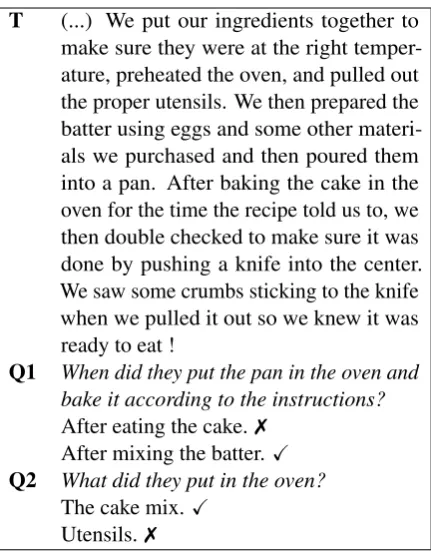
T (...) We put our ingredients together to make sure they were at the right temper-ature, preheated the oven, and pulled out the proper utensils. We then prepared the batter using eggs and some other materi-als we purchased and then poured them into a pan. After baking the cake in the oven for the time the recipe told us to, we then double checked to make sure it was done by pushing a knife into the center. We saw some crumbs sticking to the knife when we pulled it out so we knew it was ready to eat !
Q1 When did they put the pan in the oven and bake it according to the instructions?
After eating the cake.7
After mixing the batter.X Q2 What did they put in the oven?
The cake mix.X
[image:2.595.74.290.59.335.2]Utensils.7
Figure 1: Example text fragment from MCScript2.0
also harder to answer, even for a model that makes use of a commonsense database. Thus, we argue that MCScript2.0 is the first resource which makes it possible to evaluate how far models are able to exploit script knowledge for automated text under-standing.
Figure1shows a text snippet from a text in MC-Script2.0, together with two questions with answer alternatives1. To find an answer for question 1, information about the temporal order of the steps for baking a cake is required: The cake is put in the oven after mixing the batter, and not after eat-ing it—a piece of information not given in the text, since the event of putting the cake in the oven is not explicitly mentioned. Similarly, one needs script knowledge about which participants are typically involved in which events to know that the cake mix rather than the utensils is put into the oven. Both incorrect answer candidates are distractive: The utensils as well as the action of eating the cake are mentioned in the text, but wrong answers to the question. Our contributions are as follows:
• We present a new collecting method for chal-lenging questions whose answers require com-monsense knowledge and in particular script knowledge, as well as a new resource that was created with this method.
1More text samples are given in the Supplemental Material.
• We show that the task is simple for humans, but that existing benchmark models, includ-ing a top-scorinclud-ing machine comprehension model that utilizes a resource for common-sense knowledge, struggle on the questions in MCScript2.0; especially on questions that require commonsense knowledge.
• We compare MCScript2.0 to MCScript, the first machine comprehension resource for eval-uating models of script knowledge. We show that in comparison to MCScript, the number of questions that require script knowledge is increased by a large margin and that such ques-tions are hard to answer. Consequently, we argue that our dataset provides a more robust basis for future research on text understanding models that use script knowledge.
2 Why another Machine Comprehension
Dataset on Script Knowledge?
MCScript (Ostermann et al.,2018a) is the first ma-chine comprehension dataset designed to evaluate script knowledge in an end-to-end machine com-prehension application, and to our knowledge the only other existing extrinsic evaluation dataset for script knowledge. Recent research has shown, how-ever, that commonsense knowledge is not required for good performance on the dataset (Ostermann et al.,2018b;Merkhofer et al.,2018).
We argue that this is due to the way in which questions were collected. During the collection process, workers were not shown a text, but only a very short description of the text scenario. As a result, many questions ask about general aspects of the scenario, without referring to actual details. This leads to the problem that there are many ques-tions with standardized answers, i.e. quesques-tions that can be answered irrespective of a concrete read-ing text. Examples2and3show two such cases, where the correct answer is almost exclusivelyin the shower andon the stove, independent of the text or even scenario.
(2) Where did they wash their hair?
(3) Where did they make the scrambled eggs?
Also, many questions require vague inference over general commonsense knowledge rather than script knowledge. Example4illustrates this: The simple fact that planting a tree gets easier if you have help is not subsumed by script knowledge about planting a tree, but a more general type of commonsense knowledge.
(4) Text: Once you know where to dig , select what type of tree you want. (...) Dig a hole large enough for the tree and roots . Place the tree in the hole and then fill the hole back up with dirt . (...)
Q: Would it have been easier to plant the tree if they had help?
yesX
no7
We inspected a random sample of 50 ques-tions from the publicly available development set that were misclassified by the logistic model of
Merkhofer et al.(2018). We found that for over 90% of the inspected questions, the use of script knowledge would be only marginally relevant.
We present a new data collection method and corpus that results in a larger number of challeng-ing questions that require script knowledge. In particular, we define a revised question collection procedure, which ensures a large proportion of non-trivial commonsense questions.
3 Corpus Creation
Texts, questions, and answer candidates are re-quired for a multiple choice machine comprehen-sion dataset. Our data collection process for texts and answers is based on the MCScript data and the methods developed there, but with several crucial differences. LikeOstermann et al.(2018a), we cre-ate the data set via crowdsourcing. The question collection is revised to account for the shortcom-ings found with MCScript.
Similarly toOstermann et al. (2018a), we are interested in questions that require inference over script knowledge for finding a correct answer. Cre-ating such questions is challenging: When ques-tions are collected by showing a reading text and asking crowdsourcing workers to write questions, their answer can usually be read off the text. The authors of MCScript thus decided to not show a reading text at all, but only a short summary of the text scenario. This resulted in too general ques-tions, so we decided for a third option: We
identi-fied a number oftarget sentencesin the reading text and guided workers to formulate questions about script-related details in these sentences. The target sentences were then hidden from the text, meaning that relevant information would have to be inferred from common sense during the answer collection and also in the task itself. In the following sections, we describe the three data collection steps in detail.
3.1 Text Collection
As a starting point, we reused all texts from MC-Script (2,119 texts on 110 scenarios) for our data set. To increase the topical coverage and diver-sity of the data set, we added texts for 90 new scenarios to our collection. As for MCScript, we selected topically different and plausible everyday scenarios of varying complexity, which were not too fine-grained (such asopening a window). The scenarios were taken from 3 sources: First, we extracted scenarios from several script collections (Wanzare et al.,2016;Regneri et al.,2010;Singh et al.,2002) that are not part of MCScript. Second, we inspected thespinn3rblog story corpus (Burton et al.,2009), a large corpus of narrative blog stories and identified additional scenarios in these stories. Third, we added new scenarios that are related to existing ones or that extend them.
We collected 20 texts per new scenario, using the same text collection method asOstermann et al.
(2018a): We asked workers to tell a story about a certain everyday scenario “as if talking to a child”. This instruction ensures that the resulting stories are simple in language and clearly structured. Texts collected this way have been found to explicitly mention many script events and participants (Modi et al.,2016;Ostermann et al.,2018a). They are thus ideal to evaluate script-based inference.
3.2 Question Collection
For the question collection, we followed Oster-mann et al.(2018a) in telling workers that the data are collected for a reading comprehension task for children, in order to get linguistically simple and explicit questions. However, as mentioned above, we guide workers towards asking questions about target sentences rather than a complete text.
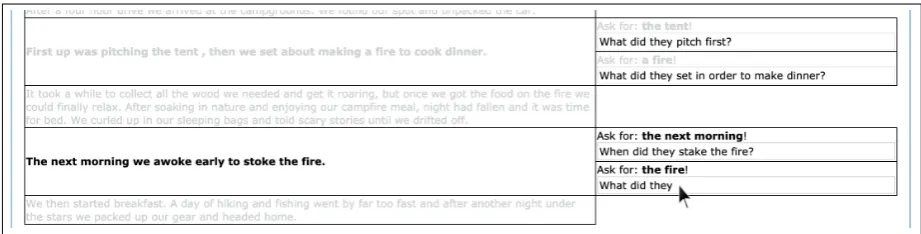
Figure 2: Screenshot of an item in the participant question collection experiment.
but that contained 2 or more noun phrases.2 In a series of pilot studies, we then showed the texts with highlighted target sentences to workers and asked them to write questions about these sen-tences. We however found, that in many cases, the written questions were too general or nonsensical. We concluded that an even more structured task was required and decided to concentrate on ques-tions of two types: (1) quesques-tions that ask about participants, and (2) questions about the tempo-ral event structure of a scenario. Participants are usually instantiated by noun phrases (NPs), while events are described by verb phrases (VPs). We thus usedStanford CoreNLP(Manning et al.,2014) to extract both NPs and VPs in the target sentences and split up the experiment into two parts: In the first part, workers were required to write questions that ask about the given noun phrase. Figure 2
shows a screenshot of an item from the first part. The first column shows the reading text with the target sentence highlighted. The second columns shows all extracted phrases with a field for one question per phrase.3 Full details of the experiment instructions are given in the Supplemental Material. In the second part, we then asked workers to write a temporal question (when, how long, etc.)
using the given verb phrase. We found that an exact repetition of the NP instructions for the second part (“ask about the given verb phrase”) resulted in unnatural questions, so we adapted the instructions. A screenshot of the VP experiment is given in the Supplemental Material.
We showed each text to two workers and asked
2All parameters were selected empirically, by testing dif-ferent values and analyzing samples of the resulting data.
3
If the noun phrase was part of a prepositional phrase or a construction of the form “NPofNP”, we took the whole phrase instead, because it is more natural to ask for the com-plete phrase. In order to avoid redundancy, we only looked at NPs that had no other NPs as parents. We also excluded noun phrases that referred to the narrator (I,meetc.).
them to write one question per VP or NP. Workers were only allowed to work on either the VP or the NP part, since the instructions could easily be confused. In order to exclude yes/no questions, we did not accept inputs starting with an auxiliary or modal verb. Also, all questions needed to contain at least 4 words. We asked workers to usetheyto refer to the protagonist of the story and other types of mentions (e.g. pronouns likeI,you, weor the wordnarrator) were not accepted.
3.3 Answer Collection
For collecting answer candidates we hid the target sentences from the texts and showed them with up to 12 questions, to keep the workload at an acceptable level. If there were more questions for a text, we selected 12 questions at random.
Since the target sentences are hidden in the texts, it can be expected that some questions cannot be an-swered from the text anymore. However, the neces-sary information for finding an answer might be in-ferred from script knowledge, so workers were ex-plicitly told that they might need commonsense to find an answer. Some answers can still be read off the text, if other parts of the texts contain the same information as the hidden target sentences. For other questions, neither the text nor script knowl-edge provides sufficient information for finding an answer.
As for the creation of MCScript, workers first had to conduct a 4-way classification for each ques-tion to account for these cases:text-based(answer is in the text),script-based(answer can be inferred from script knowledge),unfitting(question doesn’t make sense),unknown(answer is not known). Hav-ing such class annotations is not only useful for evaluation, but it also sensitizes workers for the fact that they are explicitly allowed to use back-ground knowledge.
text-based script-based text-or-script unfitting unknown
9,357 12,433 2,403 3,240 6,457
[image:5.595.127.465.66.113.2]total answerable: 24,193 total not answerable:9,397
Table 1: Distribution of question labels, before validation.
to write both a correct and a plausible incorrect answer for questions labeled astext-basedof script-based. We follow (Ostermann et al.,2018a) and require workers to write an alternative question if the labelsunfittingorunknownare used, in order to level out the workload.
We presented each question to 5 workers, result-ing in 5 judgements and up to 5 incorrect and cor-rect answer candidates per question. For the final data set, we considered questions with a majority vote (3 out of 5) ontext-basedorscript-based. We also included questions without a majority vote, but for which at least 3 workers assigned one of text-basedorscript-based. In that case, we assigned the new labeltext-or-scriptand also accepted the question for the final data set. This seemed rea-sonable, since at least 3 workers wrote answers for the question, meaning it could still be used in the final data collection. The remaining questions were discarded.
3.4 Answer Candidate Selection
In a last step, we selected one correct and one incor-rect answer from all possible candidates per ques-tion for the data set. To choose the most plausible correct answer candidate, we adapt the procedure fromOstermann et al.(2018a): We normalize all correct answers (lowercasing, normalizing num-bers4, deleting stopwords5) and then merge candi-dates that are contained in another candidate, and candidate pairs with aLevenshtein(1966) distance of less than 3. The most frequent candidate is then selected as correct answer. If there was no clear majority, we selected a candidate at random.
To select an incorrect answer candidate, we adapt the adversarial filtering algorithm from
Zellers et al. (2018). Our implementation uses a simple classifier that utilizes shallow surface fea-tures. The algorithm selects the incorrect answer candidate from the set of possible candidates that is most difficult for the classifier, i.e. an incorrect answer that is hard to tell apart from the correct
4
We used text2num, https://github.com/ ghewgill/text2num.
5and,or,to,the,a
answer (e.g. the incorrect answers in Figure1: eat-ingandutensilsare also mentioned in the text). By picking incorrect answers with the adversarial fil-tering method, the dataset becomes robust against surface-oriented methods.
Practically, the algorithm starts with a random as-signment, i.e. a random incorrect answer candidate per question. This assignment is refined iteratively, such that the most difficult candidate is selected. In each iteration, the algorithm splits the data into a random training part and a test part. The classi-fier is trained on the training part and then used to classifyallpossible candidates in the test part. The assignment of answer candidates in the test data is then changed such that the most difficult incorrect answer candidate per question is picked as incorrect answer. After several iterations through the whole dataset, the number of changed answer candidates usually stagnates and the algorithm converges.
For MCScript2.0, we use the logistic classifier mentioned in Section2, which only uses surface features and is thus well suited for the filtering algorithm. Implementation details and pseudocode are given in the Supplemental Material.
4 Corpus Analysis
4.1 General Statistics
In total, MCScript2.0 comprises 19,821 questions on 3,487 texts, i.e. 5.7 questions on average per text. The average length of texts, questions and answers is 164.4 tokens, 8.2 tokens and 3.4 tokens, respectively.
In the data collection process, we crowdsourced 1,800 new texts, resulting in a total of 3,919 texts for 200 scenarios. On average, there are 1.98 target sentences per text. In the question collection, we gathered 42,132 questions that were then used for the answer collection. For 8,242 questions, there was no clear majority on the question label. Ta-ble1shows the label distribution on the remaining 33,890 questions. 24,193 of these could be an-swered, i.e. 71%.
re-100%
6%
5%
8% 11%
28%
42%
[image:6.595.148.452.60.305.2]what when where who how Rest
Figure 3: Distribution of question types
what when where who how Rest
0 % 25 % 50 % 75 % 100 % 11 %
8 % 9 % 11 % 11 % 9 %
39 % 32 % 40 % 40 %
28 % 49 %
50 % 61 % 50 % 50 %
61 % 42 %
[image:6.595.197.404.63.145.2]script text text-script
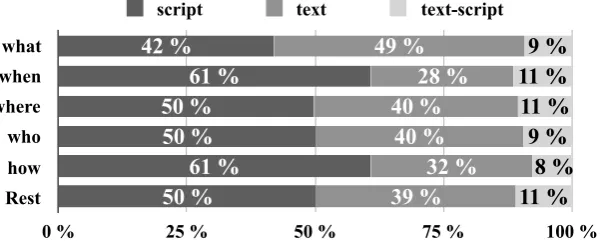
Figure 4: Proportion of labels per question type.
placed erroneous answers and deleted nonsensical questions, question duplicates and incoherent texts.
During validation, 152 texts were found to be incoherent and discarded (along with all questions). Additionally, 3,388 questions were deleted because they were nonsensical or duplicates. 1,620 correct and 2,977 incorrect answers were exchanged, resp., because they were inappropriate. If a question dele-tion resulted in texts without any quesdele-tions, or if a text did not have any answerable questions, the text was discarded, too.
After question validation, the final dataset com-prises 9,935 questions that are labeled as script-based, 7,908 as text-script-based, and 1,978 as text-or-script.
4.2 Questions
Figure3gives the distribution over question types, which we extracted by looking at the first word in the question. The largest number of questions arewhatquestions, most of which ask about par-ticipants of a script.Whenquestions make up the second largest group, asking for temporal event structure. During the VP question experiment, some workers ignored that we asked for tempo-ral questions only, which resulted in a number of
howquestions.
MCScript2.0 contains 50% questions labeled as script-based, which is a notably larger amount as compared to the approximately 27% of questions in MCScript labeled as script-based. The number of
script-based questions varies between the question types, as can be seen in Figure4. Whilewhenand
howquestions require script knowledge for finding an answer in more than 60% of cases, less than half ofwhatquestions do so. A simple explanation for this could be thatwhenorhowquestions typically ask for events, whilewhatquestions ask for par-ticipants. Events are usually referred only once in a text, i.e. with the hiding of the respective event mention, the needed information has to be inferred. Participants in contrast tend to appear more often throughout a story.
Example 5 below illustrates this. Question 1 was originally asked about a sentence in which the plates are set for the dinner guests. The guests still appear in another sentence, so the answer can be inferred from the text. For question 2, in contrast, script knowledge is required for finding an answer: The event ofbringing the items to the tableis not mentioned anymore, so the information that this happens typically after counting plates and silver-ware needs to be inferred.
(5) T:(...) I was told that there would be 13 or 14 guests. First I counted out 14 spoons, then the same number of salad forks, dinner forks, and knives. (...) I set each place with one napkin, one dinner fork, one salad fork, one spoon, and one knife. (...)
Q1:Who are the plate and cup for? dinner guestsX the neighbor7
[image:6.595.151.452.178.299.2]the table?
after counting themX
after placing them on the table7
5 Experiments
We test three benchmark models on MCScript2.0 that were also evaluated on MCScript, so a direct comparison is possible. For the experiments, we split the data into a training set (14,191 questions on 2,500 texts), a development set (2,020 questions on 355 texts) and a test set (3,610 questions on 632 texts). All texts of 5 randomly chosen scenarios were assigned completely to the test set, so a part of the test scenarios are unseen during training.
5.1 Models
Logistic Regression Classifier
As first model, we reimplemented the logistic re-gression classifier proposed by Merkhofer et al.
(2018), which was also used in the adversarial fil-tering algorithm. The classifier employs 3 types of features: (1) Length features, encoding the length of the text, answer and questions on the word and character level, (2) overlap features, encoding the amount of literal overlap between text, question, and answers, and (3) binary lexical patterns encod-ing the presence or absence of words or combina-tions of words in answer, text and question.
Attentive Reader
As second model, we implement an attentive reader (Hermann et al.,2015). We adopt the formulation byOstermann et al.(2018a) (originally byChen et al. (2016)). All tokens in text, question and answers are represented with word embeddings. Bi-directional gated recurrent units (GRUs,Cho et al.
(2014)) process the text, question and answers and transform them into sequences of contextualized hidden states. The text is represented as a weighted average of the hidden states with a bilinear attention formulation, and another bilinear weight matrix is used to compute a scalar as score for each answer. For a formalization, we refer toOstermann et al.
(2018a) andChen et al.(2016).
Three-way Attentive Network (TriAN)
As third model, we use a three-way attentive net-work (Wang et al.,2018), the best-scoring model of the shared task on MCScript6. Various types of
in-6Code available at https://github.com/
intfloat/commonsense-rc
formation are employed to represent tokens: Word embeddings, part of speech tags, named entity em-beddings, and word count/overlap features, similar to the logistic classifier. Three bidirectional LSTM (Hochreiter and Schmidhuber,1997) modules are used to encode text, question and answers. The re-sulting hidden representations are reweighted with three attention matrices and then summed into vec-tors using three self-attention layers.
Additionally, token representations are enhanced with ConceptNet (Speer et al., 2017) relations as a form of induced commonsense knowledge. ConceptNet is a large database of commonsense facts, represented as triples of two entities with a predicate. Relevant ConceptNet relations between words in the answer and the text are queried from the database and represented with relation embed-dings, which are learned end-to-end during training and appended to the text token representations.
In contrast toWang et al.(2018), we use the non-ensemble version of TriAN without pretraining on
RACE(Lai et al.,2017), for better comparability to the other models.
5.2 Human Upper Bound
To assess human performance, 5 student assistants performed the reading comprehension task on 60 texts each. To assess agreement, 20 texts were an-notated by all students. The annotators reached averaged pairwise agreement of 96.3% and an av-erage accuracy of 97.4%, which shows that this is a simple task for humans.
5.3 Results
Overall Performance.Table2gives details about the performance of the 3 benchmark models on the test set, and on script-based (accscr) and text-based
(acctxt) questions in the test set. As can be seen, the
0.5 0.6 0.7 0.8 0.9
what when where who how rest
0.73 0.80
0.73 0.71
0.65 0.75
0.65 0.73
0.66 0.62
0.58 0.70
0.60 0.68
0.66 0.57
0.55 0.64
[image:8.595.119.485.64.152.2]Logistic Attentive Reader TriAN
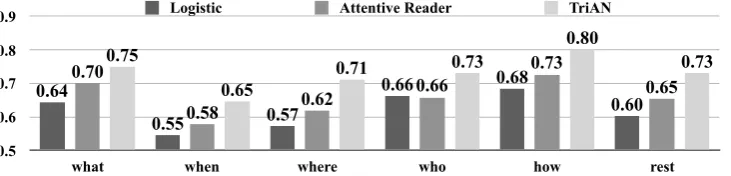
Figure 5: Performance of the models on question types.
acc accscr acctxt
Logistic Model 0.61 0.56 0.67
Attentive Reader 0.65 0.63 0.68
TriAN 0.72 0.67 0.78
Humans 0.97
Table 2: Accuracy on test set, and on script/text-based questions (accscr, acctxt) onMCScript2.0. The maxi-mum per column is printed inbold.
Comparison to MCScript. Since the same models were used for MCScript, a comparison of their performance on both datasets is possible. Re-sults on MCScript are given in Table3.7 As can be
seen, the performance of all three models is worse on MCScript2.0, showing that the dataset is gen-erally more challenging. In contrast to MCScript, script-based questions in MCScript2.0 are clearly harder to answer than text-based questions: All models perform worse on script-based questions as compared to text-based questions. In compar-ison to MCScript, the performance of TriAN is
12%lower. This indicates that the new mode of question collection and the answer selection via adversarial filtering resolve some of the difficulties with MCScript.
To assess whether the performance difference to MCScript is due to the 90 new scenarios being more challenging, we additionally evaluated the models on these scenarios only. We found no per-formance difference on the new vs. old scenarios.
Influence of Adversarial Filtering.To find out how large the influence of the new question collec-tion method and the answer seleccollec-tion via adversar-ial filtering is, we conducted an additional experi-ment: We applied the answer selection method of
Ostermann et al.(2018a) to our data set to create
7For the attentive reader, numbers were taken from (
Oster-mann et al.,2018b). The other models were retrained (and in the case of the logistic model re-implemented), since no exact numbers on script/text-based questions were published.
acc accscr acctxt
Logistic Model 0.79 0.76 0.81 Attentive Reader 0.72 0.75 0.71
TriAN 0.80 0.79 0.81
Humans 0.98
Table 3: Accuracy on the test set and on script/text-based questions (accscr, acctxt) on MCScript. The maximum per column is printed inbold.
an alternative version of the data that is not based on adversarial filtering. Correct answers were se-lected to have the lowest possible overlap with the reading text. Incorrect answers were selected using the majority voting technique described in Section
3.4.
We found that the adversarial filtering accounts for around two thirds of the total accuracy differ-ence of TriAN as compared to MCScript, i.e. one third of the difference can be attributed to the new question collection. This means that both mod-ifications together add to the larger difficulty of MCScript2.0.
Question Types. Figure 5 shows the perfor-mance of the models on single question types, as identified in Section 4. It is clear thatwhen ques-tions are most challenging for all models. The logistic classifier performs almost at chance level. As far as TriAN is concerned, we found that many cases of errors ask for the typical temporal order of events, as Example6illustrates:
(6) Q:When did they put the nozzle in their tank?
before filling up with gas.X
after filling up with gas.7
Howquestions are the least difficult questions. This can be explained with the fact that manyhow
questions ask for numbers that are mentioned in the text (e.g.How long did they stay in the sauna?
orHow many slices did they place onto the paper plate?). The answer to such questions can often be found with a simple text lookup. Another part of how questions asks for the typical duration of an activity. These questions often have similar an-swers irrespective of the scenario, since most of the narrations in MCScript2.0 span a rather short time period. Such answers can easily be memorized by the models.
Especially for TriAN,whatandwhoquestions seem to be easy. This could be explained with the fact that ConceptNet contains lots of informa-tion about entities and their relainforma-tions to each other, apparently also covering some information about script participants, which seems to be useful for these question types.
6 Related Work
Recent years have seen a number of datasets that evaluate commonsense inference. Like our corpus, most of these data sets choose a machine com-prehension setting. The data sets can be roughly classified along their text domain:
News Texts. Two recently published machine comprehension data sets that require commonsense inference are based on news texts. First,NewsQA
(Trischler et al.,2017) is a dataset of newswire texts from CNN with questions and answers written by crowdsourcing workers. During data collection, full texts were not shown to workers as a basis for question formulation, but only the text’s title and a short summary, to avoid literal repetitions and support the generation of non-trivial questions re-quiring background knowledge. Second,ReCoRD
(Zhang et al.,2018) contains cloze-style questions on newswire texts that were not crowdsourced, but automatically extracted by pruning a named entity in a larger passage from the text.
Web Texts.Other corpora use web documents. An example isTriviaQA(Joshi et al.,2017), a cor-pus that contains automatically collected question-answer pairs from 14 trivia and quiz-league web-sites, together with web-crawled evidence docu-ments from Wikipediaand Bing. While a major-ity of questions require world knowledge for find-ing the correct answer, it is mostly factual knowl-edge.CommonsenseQA(Talmor et al.,2018)
con-tains a total of over 9000 multiple-choice questions that were crowdsourced based on knowledge base triples extracted from ConceptNet. Texts were only added post-hoc, by querying a web search engine based on the formulated question, and by adding the retrieved evidence texts to the questions and answers.
Fictional Texts. NarrativeQA (Koˇcisk´y et al.,
2018) is a reading comprehension dataset that largely differs from other corpora by means of text length. Instead of providing short reading texts, models have to process complete books or movie scripts and answer very complex questions.
Because of their domains, the aforementioned data sets evaluate a very broad notion of com-monsense, including e.g. physical knowledge (for trivia texts) and knowledge about political facts (for newswire texts). However, none of them explicitly tackle script knowledge.
7 Conclusion
We presented MCScript2.0, a new machine com-prehension dataset with a focus on challenging in-ference questions that require script knowledge or commonsense knowledge for finding the correct answer. Our new question collection procedure re-sults in about half of the questions in MCScript2.0 requiring such inference, which is a much larger amount compared to a previous dataset.
We evaluate several benchmark models on MC-Script2.0 and show that even a model that makes use of ConceptNet as a source for commonsense knowledge struggles to answer many question in our corpus. MCScript2.0 forms the basis of a shared task organized at the COIN workshop.8
Acknowledgments
We thank our student assistants Leonie Harter, David Meier, Christine Sch¨afer and Georg Seiler for the help with data validation, and Kathryn Chap-man, Srestha Ghosh, Trang Hoang, Ben Posner and Miriam Schulz for help with assessing the human upper bound. We also thank the numerous workers on MTurk for their good work and Carina Silberer and the reviewers for their helpful comments on the paper. This research was funded by the German Research Foundation (DFG) as part of SFB 1102 Information Density and Linguistic Encoding.
References
Kevin Burton, Akshay Java, Ian Soboroff, et al. 2009. The ICWSM 2009 Spinn3r Dataset. InThird Annual Conference on Weblogs and Social Media (ICWSM 2009).
Nathanael Chambers and Dan Jurafsky. 2008. Unsu-pervised Learning of Narrative Event Chains. In Proceedings of the 46th Annual Meeting of the Asso-ciation for Computational Linguistics: Human Lan-guage Technologies, pages 789–797. Association for Computational Linguistics.
Nathanael Chambers and Dan Jurafsky. 2009. Unsuper-vised Learning of Narrative Schemas and their Par-ticipants. InProceedings of the Joint Conference of the 47th Annual Meeting of the ACL and the 4th In-ternational Joint Conference on Natural Language Processing of the AFNLP, pages 602–610. Associa-tion for ComputaAssocia-tional Linguistics.
Danqi Chen, Jason Bolton, and Christopher D. Man-ning. 2016. A Thorough Examination of the CNN/Daily Mail Reading Comprehension Task. In Proceedings of the 54th Annual Meeting of the As-sociation for Computational Linguistics (Volume 1: Long Papers), volume 1, pages 2358–2367.
Kyunghyun Cho, Bart Van Merri¨enboer, Caglar Gul-cehre, Dzmitry Bahdanau, Fethi Bougares, Holger Schwenk, and Yoshua Bengio. 2014. Learning phrase representations using rnn encoder-decoder for statistical machine translation. arXiv preprint arXiv:1406.1078.
Karl Moritz Hermann, Tomas Kocisky, Edward Grefen-stette, Lasse Espeholt, Will Kay, Mustafa Suleyman, and Phil Blunsom. 2015. Teaching machines to read and comprehend. In Advances in Neural Informa-tion Processing Systems, pages 1693–1701.
Sepp Hochreiter and J¨urgen Schmidhuber. 1997. Long short-term memory. Neural computation, 9(8):1735–1780.
Bram Jans, Steven Bethard, Ivan Vuli´c, and Marie Francine Moens. 2012. Skip N-grams and Ranking Functions for Predicting Script Events. In Proceedings of the 13th Conference of the Euro-pean Chapter of the Association for Computational Linguistics, EACL ’12, pages 336–344. Association for Computational Linguistics.
Mandar Joshi, Eunsol Choi, Daniel S. Weld, and Luke Zettlemoyer. 2017. TriviaQA: A Large Scale Dis-tantly Supervised Challenge Dataset for Reading Comprehension. InProceedings of the 55th Annual Meeting of the Association for Computational Lin-guistics, pages 1601–1611. Association for Compu-tational Linguistics.
Tom´aˇs Koˇcisk´y, Jonathan Schwarz, Phil Blunsom, Chris Dyer, Karl Moritz Hermann, G´aabor Melis, and Edward Grefenstette. 2018. The NarrativeQA Reading Comprehension Challenge. Transactions
of the Association of Computational Linguistics, 6:317–328.
Guokun Lai, Qizhe Xie, Hanxiao Liu, Yiming Yang, and Eduard Hovy. 2017. RACE: Large-scale ReAd-ing Comprehension Dataset From Examinations. In Proceedings of the 2017 Conference on Empirical Methods in Natural Language Processing, pages 785–794.
Vladimir I. Levenshtein. 1966. Binary codes capable of correcting deletions, insertions, and reversals. In Soviet Physics Doklady, volume 10, pages 707–710.
Christopher D. Manning, Mihai Surdeanu, John Bauer, Jenny Rose Finkel, Steven Bethard, and David Mc-Closky. 2014. The Stanford CoreNLP Natural Lan-guage Processing Toolkit. InACL (System Demon-strations), pages 55–60.
Elizabeth M. Merkhofer, John Henderson, David Bloom, Laura Strickhart, and Guido Zarrella. 2018. MITRE at SemEval-2018 Task 11: Commonsense Reasoning without Commonsense Knowledge. In Proceedings of the 12th International Workshop on Semantic Evaluations (SemEval-2018), pages 1078– 1082.
Ashutosh Modi, Tatjana Anikina, Simon Ostermann, and Manfred Pinkal. 2016. InScript: Narrative texts annotated with script information. InProceedings of the Tenth International Conference on Language Re-sources and Evaluation (LREC 2016), pages 3485– 3493. European Language Resources Association (ELRA).
Ashutosh Modi and Ivan Titov. 2014. Inducing Neu-ral Models of Script Knowledge. In Proceedings of the Conference on Computational Natural Lan-guage Learning (CoNLL), pages 49–57.
Simon Ostermann, Ashutosh Modi, Michael Roth, Ste-fan Thater, and Manfred Pinkal. 2018a. MCScript: A Novel Dataset for Assessing Machine Comprehen-sion Using Script Knowledge. In Proceedings of the 11th International Conference on Language Re-sources and Evaluation (LREC 2018), pages 3567– 3574.
Simon Ostermann, Michael Roth, Ashutosh Modi, Ste-fan Thater, and Manfred Pinkal. 2018b. SemEval-2018 Task 11: Machine Comprehension using Com-monsense Knowledge. InProceedings of The 12th International Workshop on Semantic Evaluation, pages 747–757.
Simon Ostermann, Michael Roth, Stefan Thater, and Manfred Pinkal. 2017. Aligning Script Events with Narrative Texts. Proceedings of the 6th Joint Con-ference on Lexical and Computational Semantics (*SEM 2017), pages 128–134.
Karl Pichotta and Raymond J. Mooney. 2016. Learning Statistical Scripts with LSTM Recurrent Neural Net-works.Proceedings of the 30th AAAI Conference on Artificial Intelligence (AAAI-16), pages 2800–2806.
Michaela Regneri, Alexander Koller, and Manfred Pinkal. 2010. Learning Script Knowledge with Web Experiments. In Proceedings of the 48th Annual Meeting of the Association for Computational Lin-guistics, pages 979–988. Association for Computa-tional Linguistics.
Rachel Rudinger, Pushpendre Rastogi, Francis Ferraro, and Benjamin Van Durme. 2015. Script induction as language modeling. Proceedings of the 2015 Con-ference on Empirical Methods in Natural Language Processing, pages 1681–1686.
Roger C. Schank and Robert P. Abelson. 1977. Scripts, Plans, Goals, and Understanding. Lawrence Erl-baum Associates.
Push Singh, Thomas Lin, Erik T. Mueller, Grace Lim, Travell Perkins, and Wan Li Zhu. 2002. Open Mind Common Sense: Knowledge Acquisition from the General Public. InOn the move to Meaningful In-ternet Systems 2002: CoopIS, DOA, and ODBASE, pages 1223–1237. Springer.
Robyn Speer, Joshua Chin, and Catherine Havasi. 2017. Conceptnet 5.5: An open multilingual graph of gen-eral knowledge. InProceedings of the Thirty-First AAAI Conference on Artificial Intelligence (AAAI-17), pages 4444–4451.
Alon Talmor, Jonathan Herzig, Nicholas Lourie, and Jonathan Berant. 2018. CommonsenseQA: A Ques-tion Answering Challenge Targeting Commonsense Knowledge. arXiv preprint arXiv:1811.00937.
Adam Trischler, Tong Wang, Xingdi Yuan, Justin Har-ris, Alessandro Sordoni, Philip Bachman, and Ka-heer Suleman. 2017. NewsQA: A Machine Compre-hension Dataset. In Proceedings of the 2nd Work-shop on Representation Learning for NLP, pages 191–200.
Liang Wang, Meng Sun, Wei Zhao, Kewei Shen, and Jingming Liu. 2018. Yuanfudao at SemEval-2018 Task 11: Three-way Attention and Relational Knowledge for Commonsense Machine Comprehen-sion. In Proceedings of the 12th International Workshop on Semantic Evaluations (SemEval-2018), pages 758–762.
Lilian Wanzare, Alessandra Zarcone, Stefan Thater, and Manfred Pinkal. 2016. DeScript: A Crowd-sourced Database for the Acquisition of High-quality Script Knowledge. In Proceedings of the Tenth International Conference on Language Re-sources and Evaluation (LREC 2016), pages 3494– 3501. European Language Resources Association (ELRA).
Lilian Wanzare, Alessandra Zarcone, Stefan Thater, and Manfred Pinkal. 2017. Inducing Script Struc-ture from Crowdsourced Event Descriptions via Semi-Supervised Clustering. InProceedings of the 2nd Workshop on Linking Models of Lexical, Sen-tential and Discourse-level Semantics, pages 1–11. Association for Computational Linguistics.
Rowan Zellers, Yonatan Bisk, Roy Schwartz, and Yejin Choi. 2018. SWAG: A Large-Scale Adversarial Dataset for Grounded Commonsense Inference. In Proceedings of the 2018 Conference on Empirical Methods in Natural Language Processing, pages 93– 104.
A Supplemental Material
A.1 Additional Data Sample
(7) T:I am at work . I have a guest sit at the bar . The ordered themselves a beer . I check that he is of age , and that his license is valid . I then go to the beer cooler , and grab a nice cold mug , and fill it up with beer . I place a napkin down and set the beer on top in front of the bar guest . I present him the check and tell him no rush , whenever he is ready . He then places his cash with the receipt . I go to cash him out , offer to be right back with his change , and he responds with , ” Keep the change ” . I like nights like this .
Q:Why did they receive a nice tip? the customer was happy with the serviceX
the customer was in a rush7 Q:When was the check printed? after the orderX
before the order7
Q:What did they create at the computer and print?
the checkX
change7
(8) T:I wanted to throw a Bachelorette Party for my best friend . She lives in Dallas , but she wants to have her party in New Orleans for a girls weekend . The first thing we did was talk about the theme of the party . We decided on the theme of “ Something Blue ” . We would have all colors of blue and activities that have titles with the word blue for the whole weekend . She gave me a list of 20 girls . I created an invitation that had blue and included a picture of her . I also included an itinerary of our weekend activities with all of our fun “ blue ” titles , to set the fun mood . I sealed them before hand writing the addresses and adding a stamp . Next , they were off to the post office , so everyone could be invited to our fun weekend .
Q:What was printed out? itineraryX
invitations to a weddingy7
Q:When was each invitation placed into their blue envelope?
Before handwriting addressesX
After adding stamps7
Q:Where did she place the invitations? Post officeX
Dallas7
(9) T:The restaurant was terrible again and I probably should not have given it another chance . The management at the store level is obviously not paying attention to me so it is time to right to headquarters . I opened the word processing program on my computer and opened a new document . I went all the way to the right side and entered my street address on one line and the city , state and zip code below that . Next I entered the date and then moved all the way to the left and entered the street address of the restaurant headquarters and the city , state and zip code of the headquarters . I started the letter with Dear Sir and on the next lines , proceeded to explain the problems I had been having with this particular location , it ’s service and food . I explained that I had tried to resolve it at store level but had been unsuccessful . On the final line , I went all the way to right and entered ‘ Sincerely ’ and hit return a couple times , then added my name below that . I folded it and put it an addressed and stamped envelope , and mailed it to the company headquarters .
Q:What did they print out? The letterX
The receipt from the restaurant7
Q:When did they sign above their printed name?
After the letter was printedX
After putting the letter in the envelope.7 Q:What they did they sign?
The letterX
The receipt at the restaurant7
A.2 Crowdsourcing Details
All data were collected using Amazon Mechani-cal Turk9. We paid $0.50 for each item in the text and answer collection experiment. For the ques-tion collecques-tion experiment, we paid $0.50 per item, if the text contained 4 or more target sentences,
and $0.30 per item if fewer target sentences were highlighted.
A.3 Implementation Details
For implementation details and preprocessing of the logistic model and TriAN, we follow (Merkhofer et al.,2018) and (Wang et al.,2018), respectively. NLTK10was used as preprocessing tool for the Attentive Reader.
The learning rate was tuned to 0.002 and 0.1 for TriAN and the attentive reader, resp. and the hidden size for both models to 64. As in the original formulation, dropout was set to 0.5 for the attentive reader and to 0.4 for TriAN. Batch size was set to 32 and both models were trained for 50 epochs. The model with the best accuracy on the dev data was used for testing.
A.4 Adversarial Filtering
Data: data setD, a randomly initialized assignmentS, and a classifierC
Result:Sˆ
repeat
split the data into test batches of sizeb, such that each batch contains all questions forbtexts;
forDtestin batchesdo
Dtrain ←−D\Dtest;
Dtrain ←−compile(Dtrain);
trainConDtrain;
forall instances
< Ti, Qi, a+i , < a
−
i,0...a
−
i,j >inDtest do
useCto classify all incorrect answer candidatesa−i,0...a−i,j; setsi,jto the index of the answer
candidate with the highest probability of being correct;
end end
untilnumber of changed assignments stagnates or increases;
Algorithm 1: Adversarial Filtering for MC-Script2.0
Formally, let a dataset be defined as a list of tu-pleshti, qi, a+i ,ha
−
i,0...a
−
i,jii, wheretiis a reading
text,qiis a question on the text,a+i is the correct
an-swer (as selected via majority vote, s. last Section)
10https://www.nltk.org
andha−i,0...a−i,jiis a list of 3 to 5 incorrect answer candidates11. The aim of the algorithm is to find an assignmentSˆ={s0,0...si,j}, where eachsi,j is
the index of the most difficult answer candidate in
ha−i,0...a−i,ji.
A dataset that iscompiledwith the assignment Sis a list of instances< ti, qi, a+i , a
−
i >, such that
there is only one incorrect answer candidate per question, according to the indices given byS.
Once the algorithm converges,Sˆis used to com-pile the final version of the dataset,Dˆ, which con-tains incorrect answer candidates that are most likely to be correct.
For the batch size we tried values in
{50,100,250,500}, but we found that for all val-ues, the performance of the classifier would drop close to chance level after one iteration only. We setb= 250, since the performance was closest to chance after convergence with that setting. Also, we defined that the algorithm converges if the num-ber of changed assignments since the last iteration is≤50.