
Original Article
Effect of the long non-coding
RNA AC007392.4 on growth, invasion
and migration for tongue squamous cell carcinoma
Hui Zhou1, Zhaoqiang Zhang2, Ying Wu3, Jianjiang Zhao1
1Department of Oral and Maxillofacial Surgery, Guangdong Provincial Stomatological Hospital, Southern
Medical University, Guangzhou, China; 2Department of General Dentistry, Guangdong Provincial Stomatological
Hospital, Southern Medical University, Guangzhou, China; 3Department of Periodontics, Stomatology Hospital of
Guangzhou Medical University, Guangzhou, China
Received November 25, 2015; Accepted February 13, 2016; Epub March 15, 2016; Published March 30, 2016
Abstract: Objectives: Long non-coding RNAs (LncRNA) have been reported to affect the development of many types of tumors. However, the research for relationship between LncRNA AC007392.4 and tongue squamous cell carci-noma cells (TSCC) has not been revealed. In this study, we aim to explore the contribution of LncRNA AC007392.4 to growth, invasion and migration in TSCC cells. Methods: To detect LncRNA AC007392.4 expression with QRT-PCR in 20 patients in TSCC tissue and adjacent normal tissue. Then construct pcDNA3.1 (+) expression vector of LncRNA AC007392.4 and transfected into the Cal-27 cell line. By using MTT, transwell migration/invasion assay and apop-tosis analysis, we tested the role of LncRNA AC007392.4 on tongue cancer cell growth, migration and invasion. Results: The results indicated that LncRNA AC007392.4 was lower expression in TSCCs tissue than adjacent normal tissue via QRT-PCR (P<0.05). And overexpression of LncRNA AC007392.4 in Cal-27 cells can promote cell growth (P<0.05) and decrease the cell apoptosis rate (P<0.05), but no effect on cell migration and invasion (P>0.05). Conclusion: We suggest that LncRNA AC007392.4 can influence on TSCC cells growth, but not on invasion and migration, may be an important and useful therapeutic biomarker for TSCC patients in future but need more study.
Keywords: LncRNA AC007392.4, growth, invasion, migration, apoptosis
Introduction
Tongue squamous cell carcinoma (TSCC) is the most common oral squamous cell carcinoma. Its morbidity presents a gradual upward trend in recent years and its five-year survival rate is maintained at about 50% [1]. However, the five-year survival rate of advanced cases is only 27%. At present, its main treatment method is a multidisciplinary integrated sequence thera-py focusing on surgical treatment, but surgical treatment often leads to patients’ dysfunction of language, eating and breath etc. and facial deformity with a high recurrence rate and easy metastasis. Invasion and metastasis are impor-tant biological properties of tongue squamous carcinoma. The mechanism of tumor infiltration and lymphatic metastasis is a complex process consisting of multiple steps and its concrete mechanism is not clear yet. To seek for a meth-od that not only can cure tumors effectively, but
also maintain normal physiological functions of facial appearance, chew and language etc. is a difficult problem that needs to be solved urgent-ly now. At the same time, in practical work, clini-cians hope to find out biological indicators which are closely related to occurrence and development of tongue squamous carcinoma and can conduct accurate and objective evalu-ation on prognosis of tongue squamous cell carcinoma patients to enhance the survival rate and living quality of patients with tongue squamous carcinoma.
microR-NA in genomes of multiple animals and plants has been reported. However, genomes of mam-mals can code a great quantity of non-coding long-fragment RNA (LncRNA) which is endoge-nous RNA which lacks a specific complete open reading frame and has no protein-coding func-tion with a length of more than 200 nucleo-tides. Originally, LncRNA was considered as a by-product of transcription of RNA polymerase II that had no biological function [2, 3] and was the “noise” of genome transcription. However, research in recent years showed that LncRNA took part in multiple important cell regulation processes. For example, LncRNA participates in x-chromosome silence, genomic imprinting, chromatin modification, transcriptional activa-tion, transcriptional interference and intranu-clear transport etc. In addition, in 2011, ‘Cancer Research’ reported that LncRNA was in favor of early diagnosis, prognosis and molecular tar-geting treatment of tumors with good value of clinical application [4]. Now it is regarded that functions of non-coding long-fragment RNA are as follows [5, 6]: (1) To interfere expression of downstream genes by transcription in the upstream promoter region of protein coding genes; (2) To form complementary double chains with transcript of protein coding genes to interfere shearing of mRNA leading to differ-ent shear forms. (3) To affect expression of downstream genes by inhibiting RNA poly-merase II or mediate chromatin remodeling and histone modification. (4) To form complemen-tary double chains with transcript of protein coding genes, further generate endogenous shRNA under the action of Dicer for gene expression level regulation. (5) To be a com-pound of nucleic acid protein formed by struc-tural constituent and proteins. (6) By bonding to special proteins, the LncRNA transcript can regulate activity of corresponding proteins; (7) By bonding to special proteins, to change cyto-plasm localization of proteins; (8) To be precur-sor molecule transcription of micromolecule RNA etc. Research in recent years showed that LncRNA played an important regulating role in occurrence and development of multiple tumors such as liver cancer, lung cancer and breast cancer [7-9]. In the field of tongue squa-mous carcinoma research, some researchers found low expression of LncMEG3 in tongue squamous carcinoma with bad clinical progno-sis, and it could inhibit the cell proliferation and cycle which result in cell apoptosis by overex-pression of LncMEG3 in vitro [10]. In addition,
by studying UCA1, Fang found high expression of UCA1 in tongue squamous carcinoma and discovered that high expression of UCA1 in can-cer indicated metastasis but has nothing to do with hyperplasia [11]. All of these studies indi-cated that LncRNA might play a closely regulat-ing role in occurrence and development of tongue cancer. Therefore, in this experiment, LncRNA AC007392.4 expression testing was firstly carried out on tongue cancer tissue and corresponding para-carcinoma tissue (20 cases) by QRT-PCR technology and found that there were expression differences in these two types of tissue. Thus, it was determined that AC007392.4 was treated as LncRNA and thera-peutic targets of main function research. Moreover, by up-regulating its expression in cell strains of tongue squamous carcinoma, its effects on cell strains of tongue squamous car-cinoma were observed.
Materials and methods
Human tissue specimens
Paired primary TSCC samples and adjacent his-tological normal tissues of the tongue were obtained from 20 patients who were admitted to the Department of Oral and Maxillofacial Surgery of Guangzhou Medical University of Stomatology between May 2012 and August 2013. None of the patients received radiother-apy or chemotherradiother-apy or any other treatment prior to surgery.
Quantitative reverse transcription polymerase chain reaction (QRT-PCR)
Total mRNA samples of tongue cancer tissue and adjacent histological normal tissues were prepared with Trizol reagent (Invitrogen, Grand Island, NY 14072, USA) according to the manu-facturer’s instructions. First-strand cDNA was synthesized using the GeneAmp® PCR System 9700 (Life Technologies Corporation, USA) with random hexamer primers. The resulting cDNA was amplified by using the SYBR-Green Master PCR Mix (Applied Biosystem, Grand Island, NY 14072, USA) in triplicates. The primer set for amplifying lncRNAs AC007392.4 were in Table 1.
Construction of expression vectors
then inserted into the pcDNA3.1 expression vector (Invitrogen, kpnI and EcoRI as restri- ction enzyme sites) at a position downstream of the CMV promoter. The cDNA of 293 cell line is used for the template of PCR ampli- fication. The primers used to amplify this fragment are as follows: AC007392.4-F: 5’CGGGGTACCCCCAAGAAGGGTGGTCTTCC- AG3’; AC007392.4-R: 5’CCGGAATTCGAAGACA- AATGACTTTGTGTGTTGC3’. The product size is 765 bps. Then, they were joined together to construct vectors expressing LncRNA AC007392.4.
Cell cultures
TSCC cell lines, Cal-27 and Scc-9 cell lines were obtained from the Department of Oral and Maxillofacial Surgery, Sun Yat-sen Memorial Hospital, Sun Yat-sen University, Guangzhou, China. 293 cell line is purchased from ATCC. The cells were cultured on with 10% fetal bovine serum (FBS, Gibco), incubated at 37°C and supplemented with 5% CO2 in a humidified chamber.
Transient transfection of the Cal-27 cell line
Cal-27 cells were seed onto 24-well plates the day before transfection to ensure 90% confluence at the time of transfection. Tran- sient transfection with 4 μg of pcDNA3.1 or pcDNA3.1-LncRNA AC007392.4 using Tur- boFect (Life Technologies Corporation, USA) according to the manufacturer’s instructions. Moreover, cells transfected with a negative control pcDNA3.1 named “NC” group and cells left untreated as a control named “Blank” group. The mRNA expression of LncRNA AC007392.4 after transfection was detected by QRT-PCR. The cultures were harvested according to the following experiment design.
Cell proliferation assay
The effects of LncRNA AC007392.4 overex-pression on Cal-27 cells proliferation were assessed by using the Cell Proliferation Reagent Kit I (MTT) (Roche, USA). Briefly, the
cells were seeded into 96-well plates (5000 cells/ml, 200 μL media per well). After transfec-tion with pcDNA3.1, pc- DNA3.1-AC007392.4 was Table 1. Sequence of QRT-PCR primers
Gene Forward (5’-3’) Reverse (5’-3’)
β-actin ACAGAGCCTCGCCTTTGCCGAT CTTGCACATGCCGGAGCCGTT AC007392.4 TCAGACACACCAATCTGCAAC CGTAAGGGGGTCAGGACTGTATATT
added to each well and documented every 24 h following the manufacturer’s protocol. An MTT solution (5 mg/mL, 20 μL per well) was then added to the cells, and the cells were incubated for 4 h at 37°C. DMSO (150 μL per well) was then added, and the plates were read on an automated microplate spectrophotometer (Bio-Rad, CA, USA) at 492 nm.
Cell migration and invasion assays
To explore the role of LncRNA AC007392.4 on Cal-27 cells migration and invasion, we per-formed a transwell assay in a 24-well culture plate. For the migration assay, at 24 h after transfection, 1×10⁴ cells in serum-free media were seeded on a fibronectin-coated polycar-bonate membrane insert in a transwell appara-tus (Costar, Cambridge, MA, USA) and cultured in 1640 media. FBS was added to the lower chamber. For the invasion assays, 1×10⁵ cells in serum-free media were seeded on an insert coated with Matrigel (BD, USA). 1640 Media containing 5% PBS were added into the lower chamber. After 24 h incubation, the cells remaining on the upper membrane were removed with cotton wool, whereas the cells that had migrated and invaded through the membrane were stained with 95% alcohol and 0.1% crystal violet, then imaged and counted using an inverted microscope.
Cell apoptosis analysis
Cal-27 cells transiently transfected with pcDNA3.1 or pcDNA3.1-LncRNA AC007392.4 were harvested at 48 h after transfection. For cell apoptosis analysis, the fixed cells were washed and stained with propidium iodide (PI) and Annexin V-FITC, the cells were analyzed through flow cytometry using the Guava Easy- Cyte MiniSystem (Keygen, Nanjing, China). All the groups were performed in triplet and statis-tically analyzed.
Statistical analysis
Student’s t-test. All statistical analyses were performed using the SPSS (SPSS Inc., Chicago, IL, USA). P-value <0.05 was considered statisti-cally significant.
Results
LncRNA AC007392.4 expression was reduced in TSCC versus adjacent histological normal tissues
QRT-PCR analysis was performed on twenty paired samples of TSCC versus matched adja-cent histological normal tissues to analyze dif-ferential expression of LncRNA AC007392.4.
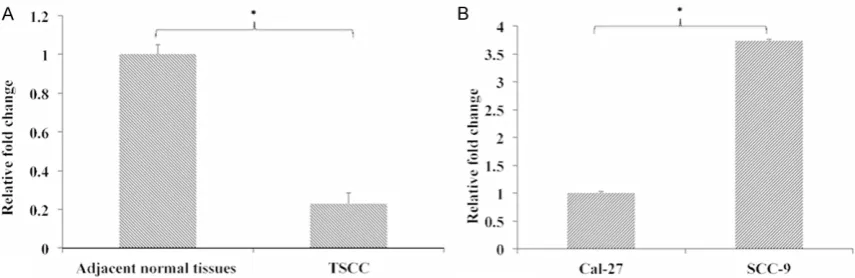
The average expression level of LncRNA AC007392.4 was significantly reduced in TSCC versus adjacent histological normal tissues (Figure 1A, *P<0.05). Furthermore, we tested the differential expres-sion of LncRNA AC007392.4 between Cal-27 and Scc-9 cell lines and found LncRNA AC007392.4 mRNA expres-sion in the Cal-27 cell line was significantly decreased com-pared with Scc-9 cell line (Figure 1B, *P<0.05).
The mRNA expression of LncRNA AC007392.4 after transfection
[image:4.629.101.529.80.219.2]To determine the effect of transfection on the expre- ssion of LncRNA AC007392.4 Figure 1. LncRNA AC007392.4 expression was reduced in TSCC versus adjacent histological normal tissues visa QRT-PCR analysis. A. The average expression level of LncRNA AC007392.4 was significantly reduced in TSCC versus adjacent histological normal tissues (*P<0.05). B. LncRNA AC007392.4 mRNA expression in the Cal-27 cell line was significantly decreased compared with Scc-9 cell line (*P<0.05).
Figure 2. The mRNA expression of LncRNA AC007392.4 after transfection was performed by QRT-PCR analysis. The cells transduced with LncRNA AC007392.4 showed higher expression of LncRNA AC007392.4 than NC and Blank groups (*P<0.05).
in Cal-27 cells, the mRNA levels of LncRNA AC007392.4 were analyzed after transfection via QRT-PCR. The cells transduced with LncRNA AC007392.4 showed higher expression of LncRNA AC007392.4 than NC and Blank groups (Figure 2, *P<0.05).
Effect of LncRNA AC007392.4 overexpression on Cal-27 cells proliferation
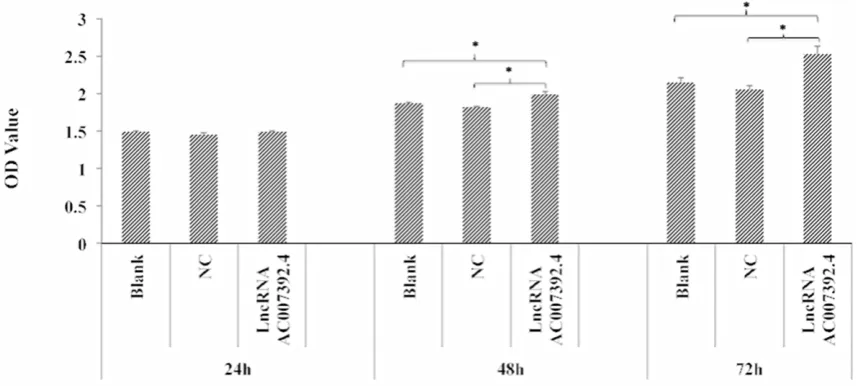
[image:4.629.105.380.296.491.2]48 h and 72 h after transfection. LncRNA AC007392.4 overexpression showed higher growth rate compared with the NC and Blank groups at 48 h and 72 h (Figure 3, *P<0.05). These results revealed that LncRNA AC- 007392.4 overexpression in tongue cancer cells did have a positive effect on cell proliferation.
Effects of LncRNA AC007392.4 overexpres-sion on Cal-27 cells migration and invaoverexpres-sion
To explore whether tongue cancer cell migra-tion and invasion were affected by LncRNA AC007392.4 overexpression, a transwell assay was performed. Figure 4A showed the pictures of crystal violet staining cells in different groups. Moreover, there were no significant dif-ferences in the LncRNA AC007392.4, NC and Blank groups (Figure 4B, P>0.05). In this part, we could conclude that possibly LncRNA AC007392.4 do not play any role in the migra-tion and invasion of tongue cancer cell.
Effect of LncRNA AC007392.4 overexpression on Cal-27 cells apoptosis
To investigate the effect of LncRNA AC0073- 92.4 overexpression on Cal-27 cell apoptosis, cells from LncRNA AC007392.4, NC and Blank groups were subjected to Annexin V/PI staining. The apoptosis rate in the LncRNA AC007392.4 group was significantly lower
compared with the NC and Blank groups (Figure 5, *P<0.05).
Discussion
The transcribed ucRNAs (T-UCRs) were first described several years ago and they are relevant to some diseases, such as tumor, car-diovascular diseases, et al. Moreover, it has been found that T-UCRs could be regulated by microRNAs [12]. Some reports have been demonstrated that some LncRNAs play impor-tant roles in the in TSCC biology [10]. LncRNAs cannot code proteins, but it plays an important role in high order chromosome dynamics, telo-mere biology and subcellular structure organi-zation [13]. Evidences showed that LncRNAs could regulate gene expression by chromo-some modifications and regulation of gene transcription levels and post-transcriptional level through epigenetics to influence biolo- gical behaviour of tumor cells [14-16]. There- fore, this experiment intended to explore and study biological behavior, including prolifera-tion, migraprolifera-tion, infiltration and apoptosis, of tongue squamous cell carcinoma by expression of LncRNAs AC007392.4.
[image:5.629.101.534.85.278.2]AC007392.4 could act as an oncogene in TSCC and study the function of LncRNA AC007392.4 by the overex-pression. First of all, we test-ed the differential expression of LncRNA AC007392.4 be- tween Cal-27 and Scc-9 cell lines and found LncRNA AC007392.4 mRNA expres-sion in the Cal-27 cell line was significantly decreased compared with Scc-9 cell line. So we chose Cal-27 cell line for the transfection on the expression of LncRNA AC007392.4 in order to ex- amine and understand the role of LncRNA AC007392.4 directly.
Figure 4. Effects of LncRNA AC007392.4 overex-pression on Cal-27 cells migration and invasion
were performed by transwell assay. A. The pictures of crystal violet staining cells in different groups. B. There were no significant differences in the Ln-cRNA AC007392.4, NC and Blank groups (P>0.05).
Our results showed that overexpression of LncRNA AC007392.4 in Cal-27 cells can pro-mote cell growth (through MTT analysis) and decrease the cell apoptosis rate, but no effect on cell migration and invasion. Above all, we could conclude that LncRNA AC007392.4 has influent on the TSCC growth visa apoptosis pathway, however, the relation between them, the possible molecular mechanisms or the related downstream genes need further study. Some studies have confirmed that LncRNAs maybe involved in the process of cancer cell proliferation, migration and invasion, et al [11, 17, 18]. However, the expression changes of LncRNA AC007392.4 have no effect on TSCC cells migration and invasion in the present study. Maybe LncRNA AC007392.4 is not involved in the migration and invasion process of TSCC cells.
In conclusion, our study revealed that the different expression of LncRNA AC007392.4 between TSCC and normal tissues and a pos-sible role of LncRNA AC007392.4 in regulating the growth and apoptosis of TSCC cells, but not involved in the in the process of TSCC cells migration and invasion. Based on these find-ings, we suggest that LncRNA AC007392.4 may be an important and useful therapeutic biomarker for TSCC patients in future but need more study.
Acknowledgements
This publication was supported by grant of Science and Technology Planning Project of Guangzhou City, China (2014Y2-00109), Science and Technology Planning Project of Guangdong Province, China (2013B021800- 153), Natural Science Foundation of Guang- dong Province, China (2015A030313787).
Disclosure of conflict tof interest
None.
Address correspondence to: Jianjiang Zhao, De- partment of Oral and Maxillofacial Surgery, Guangdong Provincial Stomatological Hospital, Southern Medical University, Guangzhou 510280, China. Tel: +860284439500; Fax: +86028443- 3177; E-mail: [email protected]; jianjiangzhao123@ sina.com
References
[1] Neville BW, Day TA. Oral cancer and precancer-ous lesions. CA Cancer J Clin 2002; 52: 195-215.
[2] Ponting CP, Oliver PL, Reik W. Evolution and functions of long nodcoding RNAs. Cell 2009; 136: 629-641.
[3] Strum K. Transcriptional noise and the fidelity of initiation by RNA polymerase II. Nat Struct Mol Biol 2007; 14: 103-105.
[4] Tsai MC, Spitale RC, Chang HY. Long intergenic noncoding RNAs: new links in cancer progres-sion. Cancer Res 2011; 71: 3-7.
[5] Wilusz JE, Sunwoo H, Spector DL. Long non-coding RNAs: functional surprises from the RNA world. Genes Dev 2009; 23: 1494-1504. [6] Dong L, Kang CS. Review on long non-coding
RNA in tumor. International Journal of Surgery 2011; 38: 349-352.
[7] Tripathi V, Ellis JD, Shen Z, Song DY, Pan Q, Watt AT, Freier SM, Bennett CF, Sharma A, Bubulya PA, Blencowe BJ, Prasanth SG, Prasanth KV. The nuclear-retained noncoding RNA MALAT1 regulates alternative splicing by modulating SR splicing factor phosphorylation. Mol Cell 2010; 39: 925-938.
[8] Wang J, Liu X, Wu H, Ni P, Gu Z, Qiao Y, Chen N, Sun F, Fan Q. CREB up-regulates long non-cod-ing RNA, HULC expression through interaction with microRNA-372 in liver cancer. Nucleic Acids Res 2010; 38: 5366-5383.
[9] Gupta RA, Shah N, Wang KC, Kim J, Horlings HM, Wong DJ, Tsai MC, Hung T, Argani P, Rinn JL, Wang Y, Brzoska P, Kong B, Li R, West RB, van de Vijver MJ, Sukumar S, Chang HY. Long non-coding RNA HOTAIR reprograms chromatin state to promote cancer metastasis. Nature 2010; 464: 1071-1076.
[10] Jia LF, Wei SB, Gan YH, Guo Y, Gong K, Mitchelson K, Cheng J, Yu GY. Expression, Regulation and Roles of AC007392.4 and MEG3 in Tongue Squamous Cell Carcinoma. Int J Cancer 2014; 135: 2282-2293.
[11] Fang Z, Wu L, Wang L, Yang Y, Meng Y, Yang H. Increased expression of the long non-coding RNA UCA1 in tongue squamous cell carcino-mas: a possible correlation with cancer metas-tasis. Oral Surg Oral Med Oral Pathol Oral Radiol 2014; 117: 89-95.
[13] Amaral PP, Mattick JS. Noncoding RNA in de-velopment. Mamm Genome 2008; 19: 454-492.
[14] Mercer TR, Dinger ME, Mattick JS. Long non-coding RNAs: insights into functions. Nat Rev Genet 2009; 10: 155-159.
[15] Rinn JL, Kertesz M, Wang JK, Squazzo SL, Xu X, Brugmann SA, Goodnough LH, Helms JA, Farnham PJ, Segal E, Chang HY. Functional de-marcation of active and silent chromatin do-mains in human HOX loci by noncoding RNAs. Cell 2007; 129: 1311-1323.
[16] Sleutels F, Zwart R, Barlow DP. The non-coding Air RNA is required for silencing autosomal im-printed gene. Nature 2002; 415: 810-813.
[17] Shi Y, Lu J, Zhou J, Tan X, He Y, Ding J, Tian Y, Wang L, Wang K. Long non-coding RNA Loc554202 regulates proliferation and migra-tion in breast cancer cells. Biochem Biophys Res Commun 2014; 446: 448-453.

![Bis[4 (2 hydroxy 3 methoxybenzylideneamino)phenyl] ether](data:image/gif;base64,R0lGODlhAQABAIAAAP///wAAACH5BAEAAAAALAAAAAABAAEAAAICRAEAOw==)