Engineering and Technology Journal ISSN: 2456-3358 Impact Factor: 4.449
Light Weight Concrete
Er. Arvind Singh Gaur 1, Er. Vikas kumar 2 , Er. R P Singh3 1,3
Department of Civil Engineering, ACERC, Jaipur 2
M.Tech Scholar KITE, Jaipur.
ARTICLE INFO ABSTRACT
corresponding Author:
Er. Arvind Singh Gaur
Department of Civil Eng., ACERC, Jaipur
We can prepare lightweight concrete either by injecting air in its mass mixture or it can be achieved by omitting the finer sizes of the aggregate or even replacing them by a hollow, cellular or porous aggregate. Particularly, lightweight concrete can be categorized into three groups:
i) No-Fines Concrete
ii) Light Weight Aggregate Concrete iii) Aerated Concrete
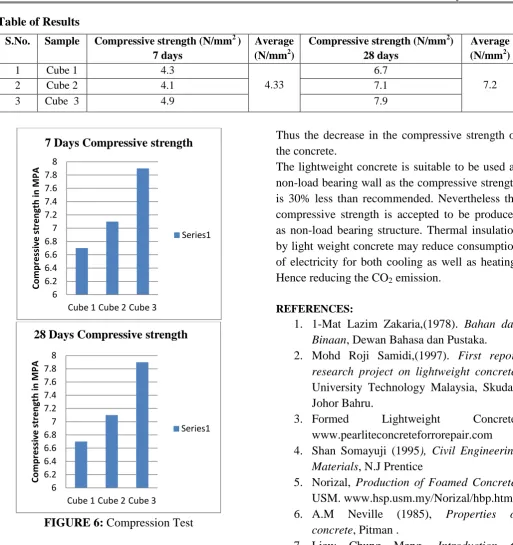
In light weight concrete prepared using Thermocol beans the coarse aggregate is replaced by thermocol beans, so lot of weight is reduced due to coarse aggregate and weight is reduced more than 50%.
KEYWORDS: Thermocol beans, Light weight, Cement, Aggregate, Compressive strength.
INTRODUCTION:
We can be defined lightweight concrete as a type of concrete which comprise an expanding agent in that it increases the volume of the mixture while giving additional qualities such as stability and lessened the dead weight. It is lighter than the conventional concrete with a dry density of 300 kg/m3 up to 1840 kg/m3; 87 to 23% lighter. Lightweight concrete contain its large voids and not forming layers or films of cement when placed on the wall. This research was based on the performance of aerated lightweight concrete. However, sufficient water cement ratio is required to produce adequate cohesion between cement and water. Insufficient water can cause lack of cohesion between particles, thus loss in strength of concrete. In the same way more water can cause cement to leach away to form laitance layers, subsequently weakens in strength.
This research report is prepared to show the activities and progress of the lightweight concrete research project. The strength of aerated lightweight concrete such as compressive strength, water absorption was carried out.
It was first introduced by the Romans in the second century where ‘The Pantheon’ has been constructed using pumice, the most common type of aggregate used in that particular year . Light weight concrete was used widely spread across other countries such as USA, United Kingdom and Sweden.
LITERATURE REVIEW:
analysed. Finally, the results obtained are going to be published.
S. Suryani: Structural Behaviour of Precast Lightweight Foamed, The results from previous research related with sandwich panel bring a lot of benefit to others which is the usage of material, manpower and cost were decreases. This proves that this material is capable and suitable to be applied in the construction industry.
P.S. Bhandar: Cellular Lightweight Concrete Using Fly Ash, The purpose of this experiment study is to identify the performance of cellular light weight concrete in term of density and compressive strength. s a result, compressive strength also decreases with the increment of those voids. Compressive strength of 53 grade cement is slightly higher than 43 grade cement, but as strength increases its density also increases. Cellular light weight concrete is acceptable for framed structure. Cellular light weight concrete can be suitable for earthquake areas.
T. Divya Bhavana: study of light weight concrete, the compressive strength of light weight concrete is lower than the ordinary conventional concrete. Therefore this light weight concrete can be used in places where the external force acting on the structure is minimum. This light weight concrete is only capable to carry its self weight. The light weight concrete provides heat insulation and has an ability to absorb sound. So, it can be used for acoustic structures.
LIGHT WEIGHT AGGREGATE CONCRETE:
Porous lightweight aggregate of low specific gravity is used in this lightweight concrete instead of ordinary concrete. The lightweight aggregate can be natural aggregate such as pumice, scoria and all of those of volcanic origin and the artificial aggregate such as expanded blast-furnace slag, vermiculite and clinker aggregate. It is high porosity which results in a low specific gravity main characteristic of this lightweight aggregate.
The lightweight aggregate concrete can be divided into two types according to its application. One is partially compacted lightweight aggregate concrete and the other is the structural lightweight aggregate concrete. The lightweight aggregate concrete is majorly used for two purposes that are for precast concrete blocks or panels and cast in-situ roofs and walls. The main requirement for this type of concrete is that it should have adequate strength and a low density to obtain the best thermal insulation and a low drying shrinkage to avoid cracking.
The lightweight aggregate concrete is densely vibrated similar to that of the normal reinforced concrete of dense aggregate. It can be used with steel reinforcement as to have a good bond between the steel and the concrete. The concrete should provide adequate protection against the corrosion of the steel. The shape and the texture of the aggregate particles and the coarse nature of the fine aggregate tend to produce harsh concrete mixes. Only the denser varieties of lightweight aggregate are suitable for use in structural concrete.
Figure1: Shows the feature of lightweight aggregate concrete.
AERATED CONCRETE:
Aerated concrete does not contain coarse aggregate, and can be regarded as an aerated mortar. The porous concrete is made by inserting air or other gas into a cement slurry and fine sand. In commercial practice, the sand is replaced by pulverized-fuel ash or other siliceous material, and lime maybe used instead of cement.
mixing during its plastic condition by means of a chemical reaction. The second method, air is introduced either by mixing-in stable foam or by whipping-in air, using an air-entraining agent. The first method is usually used in precast concrete factories where the precast units are subsequently autoclaved in order to produce concrete with a reasonable high strength and low drying shrinkage. The second method is mainly used for in-situ concrete, suitable for insulation roof screeds or pipe lagging. Figure 3 shows the aerated concrete. For making aerated concrete generally foaming agents are not used which are quite costly for small scale construction process.
Hence the method to inject gas is generally more prompted in construction practice.
Figure:2 Aerated concrete
Advantages and Disadvantages of Lightweight Concrete :
Advantages Disadvantages
i) rapid and relatively simple i) Very sensitive with water content
construction in the mixtures
ii) Economical in terms of ii) Difficult to place and finish transportation as well as reduction because of the porosity and in manpower angularity of the aggregate. In some mixes the cement mortar may
iii) Significant reduction of overall separate the aggregate and float weight results in saving structural towards the surface
frames, footing or piles iii) Mixing time is longer than
iv) Most of lightweight concrete have conventional concrete to assure better nailing and sawing properties proper mixing
than heavier and stronger conventional concrete
MATERIALS & EQUIPMENTS USED:
For the purpose of construction of light weight concrete blocks on a small scale we used locally available materials.
1. Cement 2. Fine Sand 3. Thermocol
4. Concrete Cubical Mould 5. Trowel
PREPRATION OF MATERIALS:
First of all the components are cleaned and separated from impurities. The thermocol beans fine aggregate is sieved through IS 4.75 sieve. Finally all the materials are volume batched.
volume batching. After proper proportioning of all the materials they are ready to be mixed.
Mixing
Individual materials are placed on metal sheet or a cleaned floor. If the construction is on a large basis then the mixing will be done in a rotary mixer. As for small scale the mixing is done in a clean area for proper mixing of materials.
Volume Batch Materials:
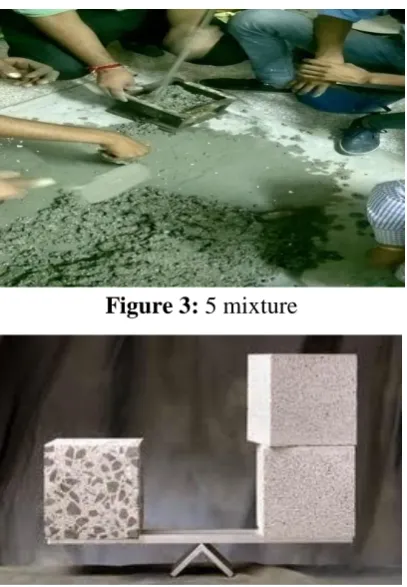
The mixing is carried out with the help of trowels. The thermocol is placed at the bottom then the sand & finally on top cement is placed, thus forming a mountain of materials. Water cement ratio of 40 % is maintained throughout the mixing process. All the materials are thoroughly mixed as to prevent the separation of materials later. Water is added in the centre of the mountain created with materials so that all the water is properly utilized & to prevent the flow of water on the floor. At the end of mixing the material, the trowels are properly cleaned and the mixture sticked on it is removed.
Figure 3: 5 mixture
Figure 4: Weight comparison
TESTING PROGRAM OF LIGHTWEIGHT
CONCRETE:
We can study the characteristics properties of light weight concrete as normal concrete testing was done to determine the material and structural properties of lightweight concrete and how will these properties differ according to a different type of mixture and its composition.
While the concrete got its strength it can be subjected to a wide range of tests to prove its ability to perform as planned or to discover its characteristics. For new concrete this usually involves casting specimens from fresh concrete and testing them for various properties as the concrete matures.
The tests are carried out at various days of curing. Generally tests are done on 7th & 28th day of curing the specimen.
COMPRESSIVE STRENGTH:
Three trial mixes have been prepared during the research and from the results; the mixture with the highest compressive strength with low density will be used for further investigation.
Compressive strength of thermocol lightweight concrete is determined on the 7 and 28 days for each sample. There are 3-3 samples & the results would be taken as the average of these three. Fewer variables had been set for different mixture; this variable would be changed accordingly while the others were fixed to forecast their effect on the mixture.
Table of Results
FIGURE 6: Compression Test
CONCLUSIONS:
The initial findings have shown that the lightweight concrete prepared with thermocol beans has a desirable strength to be an alternative construction material for construction partition walls.
The strength of aerated lightweight concrete is little higher. This resulted in the increment of voids throughout the sample caused by the foam.
Thus the decrease in the compressive strength of the concrete.
The lightweight concrete is suitable to be used as non-load bearing wall as the compressive strength is 30% less than recommended. Nevertheless the compressive strength is accepted to be produced as non-load bearing structure. Thermal insulation by light weight concrete may reduce consumption of electricity for both cooling as well as heating. Hence reducing the CO2 emission.
REFERENCES:
1. 1-Mat Lazim Zakaria,(1978). Bahan dan
Binaan, Dewan Bahasa dan Pustaka.
2. Mohd Roji Samidi,(1997). First report
research project on lightweight concrete,
University Technology Malaysia, Skudai, Johor Bahru.
3. Formed Lightweight Concrete. www.pearliteconcreteforrorepair.com 4. Shan Somayuji (1995), Civil Engineering
Materials, N.J Prentice
5. Norizal, Production of Foamed Concrete. USM. www.hsp.usm.my/Norizal/hbp.htm 6. A.M Neville (1985), Properties of
concrete, Pitman .
7. Liew Chung Meng, Introduction to
Lightweight Concrete.
www.maxpages.com.
8. Cellular Lightweight Concrete Plan City/NCS LLC. www. Neoporsystem.com
6 6.2 6.4 6.6 6.8 7 7.2 7.4 7.6 7.8 8
Cube 1 Cube 2 Cube 3
Co
m
p
re
ssi
ve
str
e
n
gth
in
M
PA
7 Days Compressive strength
Series1
6 6.2 6.4 6.6 6.8 7 7.2 7.4 7.6 7.8 8
Cube 1 Cube 2 Cube 3
Com
p
ressi
ve
str
en
gth
in
M
P
A
28 Days Compressive strength
Series1
S.No. Sample Compressive strength (N/mm2 )
7 days
Average (N/mm2)
Compressive strength (N/mm2)
28 days
Average (N/mm2)
1 Cube 1 4.3
4.33
6.7
7.2
2 Cube 2 4.1 7.1