To Memorize or to Predict: Prominence Labeling in Conversational Speech
A. Nenkova, J. Brenier, A. Kothari, S. Calhoun†, L. Whitton, D. Beaver, D. Jurafsky
Stanford University
{anenkova,jbrenier,anubha,lwhitton,dib,jurafsky}@stanford.edu
†University of Edinburgh
Abstract
The immense prosodic variation of natural con-versational speech makes it challenging to pre-dict which words are prosodically prominent in
this genre. In this paper, we examine a new fea-ture, accent ratio, which captures how likely it is that a word will be realized as prominent or not.
We compare this feature with traditional accent-prediction features (based on part of speech and
N-grams) as well as with several linguistically mo-tivated and manually labeled information structure
features, such as whether a word is given, new, or
contrastive. Our results show that the linguistic
fea-tures do not lead to significant improvements, while accent ratio alone can yield prediction performance almost as good as the combination of any other
sub-set of features. Moreover, this feature is useful even across genres; an accent-ratio classifier trained only on conversational speech predicts prominence with
high accuracy in broadcast news. Our results sug-gest that carefully chosen lexicalized features can outperform less fine-grained features.
1 Introduction
Being able to predict the prominence or pitch accent status of a word in conversational speech is impor-tant for implementing text-to-speech in dialog sys-tems, as well as in detection of prosody in conversa-tional speech recognition.
Previous investigations of prominence prediction from text have primarily relied on robust surface tures with some deeper information structure fea-tures. Surface features like a word’s part-of-speech (POS) (Hirschberg, 1993) and its unigram and bi-gram probability (Pan and McKeown, 1999; Pan and
0
Thanks to the Edinburgh-Stanford Link and ONR (MURI award N000140510388) for generous support.
Hirschberg, 2000) are quite useful; content words are much more likely to be accented than function words, and words with higher probability are less likely to be prominent. More sophisticated linguis-tic features have also been used, generally based on information-structural notions of contrast, focus, or
given-new. (Hirschberg, 1993).
For example, in the Switchboard utterance be-low, there is an intrinsic contrast between the words “women” and “men”, making both terms more salient (words in all capital letters represent promi-nent tokens):
you SEE WOMENcGOING off to WARS as WELL as
MENc.
Similarly the givenness of a word may help deter-mine its prodeter-minence. The speaker needs to focus the hearer’s attention on new entities in the discourse, so these are likely to be realized as prominent. Old en-tities, on the other had, need not be prominent; these tendencies can be seen in the following example.
theyoldhave all the WATERnewtheyoldWANT. theyold
can ACTUALLY PUMP waterold.
While previous models have attempted to cap-ture global properties of words (via POS or unigram probability), they have not in general used word identity as a predictive feature, assuming either that current supervised training sets would be too small or that word identity would not be robust across gen-res (Pan et al., 2002). In this paper, we show a way to capture word identity in a feature, accent ratio, that works well with current small supervised train-ing sets, and is robust to genre differences.
We also use a corpus which has been hand-labeled for information structure features (including given/new and contrast information) to investigate the relative usefulness of both linguistic and shallow features, as well as how well different features com-bine with each other.
2 Data and features
For our experiments we use 12 Switchboard (God-frey et al., 1992) conversations, 14,555 tokens in to-tal. Each word was manually labeled for presence or absence of pitch accent1 , as well as additional features including information status (or givenness), contrast and animacy distinctions, (Nissim et al., 2004; Calhoun et al., 2005; Zaenen et al., 2004), fea-tures that linguistic literature suggests are predictive of prominence (Bolinger, 1961; Chafe, 1976).
All of the features described in detail below have been shown to have statistically significant correla-tion with prominence (Brenier et al., 2006).
Information status The information status (IS),
or givenness, of discourse entities is important for choosing appropriate reference form (Prince, 1992; Gundel et al., 1993) and possibly plays a role in prominence decisions as well (Brown, 1983). No previous studies have examined the usefulness of information status in naturally occurring conversa-tional speech. The annotation in our corpus is based on the givenness hierarchy of Prince: first mentions of entities were marked as new and subsequent tions as old. Entities that are not previously men-tioned, but that are generally known or semantically related to other entities in the preceding context are marked as mediated. Obviously, the givenness an-notation applies only to referring expressions, i.e. noun phrases the semantic interpretation of which is a discourse entity. This restriction inherently limits the power of the feature for prominence prediction, which has to be performed for all classes of words. Complete details of the IS annotation can be found in (Nissim et al., 2004).
Kontrast One reason speakers make entities in
an utterance prominence is because of information structure considerations (Rooth, 1992; Vallduv´ı and Vilkuna, 1998). That is, parts of an utterance which distinguish the information the speaker actually says from the information they could have said, are made salient, e.g. because that information answers a question, or contrasts with a similar entity in the context. Several possible triggers of this sort of salience were marked in the corpus, with words that were not kontrastive (in this sense) being marked as
background:
1
Of all tokens, 8,429 (or 58%) were not accented.
• contrastive if the word is directly differentiated
from a previous topical or semantically-related word;
• subset if it refers to a member of a more general
set mentioned in the surrounding context; • adverbial if a focus-sensitive adverb such as
“only” or “even” is associated with the word being annotated;
• correction if the speaker intended to correct or
clarify a previous word or phrase;
• answer if the word completes a question by the
other speaker;
• nonapplic for filler phrases such as “in fact”, “I
mean”, etc.
Note that only content words in full sentences were marked for kontrast, and filler phrases such as “in fact” and “I mean” were excluded. A com-plete description of the annotation guidelines can be found in (Calhoun et al., 2005).
Animacy Each noun and pronoun is labeled for the
animacy of its referent (Zaenen et al., 2004). The categories include concrete, non-concrete, human,
organizations, place, and time.
Dialog act Specifies the function of the utterance
such as statement, opinion, agree, reject, abandon; or type of question (yes/no, who, rhetoric)
In addition to the above theoretically motivated features, we used several automatically derivable word measures.
Part-of-speech Two such features were used, the
full Penn Treebank tagset (called POS) , and a col-lapsed tagset (called BroadPOS) with six broad cat-egories (nouns, verbs, function words, pronouns, ad-jectives and adverbs).
Unigram and bigram probability These features
are defined as log(pw) and log(pwi|pwi
−1)
respec-tively and their values were calculated from the Fisher corpus (Cieri et al., 2004). High probability words are less likely to be prominent.
TF.IDF This measure captures how central a word is
for a particular conversation. It is a function of the frequency of occurrence of the word in the conver-sation (nw), the number of conversations that con-tain the word in a background corpus (k) and the number of all conversations in the background cor-pus (N). Formally, TF.IDF1= nw ×log(N
also used a variant, TF.IDF2, computed by normal-izing TF.IDF1 by the number of occurrences of the most frequent word in the conversation. TF.IDF2 =
TF.IDF1/max(nw∈conv). Words with high TF.IDF values are important in the conversation and are more likely to be prominent.
Stopword This is a binary feature indicating if the
word appears in a high-frequency stopword list from the Bow toolkit (McCallum, 1996). The list spans both function and content word classes, though nu-merals and some nouns and verbs were removed.
Utterance length The number of words.
Length The number of characters in the words. This
feature is correlated with phonetic features that have been shown to be useful for the task, such as the number of vowels or phones in the word.
Position from end/beginning The position of the
word in the utterance divided by the number of words that precede the current word.
Accent ratio This final (new) feature takes the
“memorization” of previous productions of a given word to the extreme, measuring how likely it is that a word belongs to a prominence class or not. Our feature extends an earlier feature proposed by (Yuan et al., 2005), which was a direct estimate of how likely it is for the word to be accented as observed in some corpus. (Yuan et al., 2005) showed that the original accent ratio feature was not included in the best set of features for accent prediction. We believe the reason for this is the fact that the original ac-cent ratio feature was computed for all words, even words in which the value was indistinguishable from chance (.50). Our new feature incorporates the sig-nificance of the prominence probability, assuming a default value of 0.5 for those words for which there is insufficient evidence in the training data. More specifically,
AccentRatio(w) = k
n if B(k, n,0.5) ≤0.05
0.5 otherwise
where k is the number of times word w appeared accented in the corpus, n is the total number of times the word w appeared, and B(k, n,0.5) is the probability (under a binomial distribution) that there are k successes in n trials if the probabil-ity of success and failure is equal. Simply put, the accent ratio of a word is equal to the esti-mated probability of the word being accented if this
probability is significantly different from 0.5, and equal to 0.5 otherwise. For example,
AccentRa-tio(you)=0.3407, AccentRatio(education)=0.8666,
and AccentRatio(probably)=0.5.
Many of our features for accent prediction are based only on the 12 training conversations. Other features, such as the unigram, bigram, and TF*IDF features, are computed from larger data sources. Ac-cent ratio is also computed over a larger corpus, since the binomial test requires a minimum of six occurrences of a word in the corpus in order to get significance and assign an accent ratio value differ-ent from 0.5. We thus used 60 Switchboard conver-sations (Ostendorf et al., 2001), annotated for pitch accent, to computekandnfor each word.
3 Results
For our experiments we used the J48 decision trees in WEKA (Witten and Frank, 2005). All the results that we report are from 10-fold cross-validation on the 12 Switchboard conversations.
Some previous studies have reported results on prominence prediction in conversational speech with the Switchboard corpus. Unfortunately these studies used different parts of the corpus or different label-ings (Gregory and Altun, 2004; Yuan et al., 2005), so our results are not directly comparable. Bear-ing this difference in mind, the best reported results to our knowledge are those in (Gregory and Altun, 2004), where conditional random fields were used with both textual, acoustic, and oracle boundary fea-tures to yield 76.36% accuracy.
3.1 Combining features
We would expect that a combination of features would lead to better prediction when compared to a classifier based on a single feature. Several past studies have examined classes of features. In order to quantify the utility of different specific features, we ran exhaustive experiments producing classifiers with all possible combinations of two, three, four and five features.
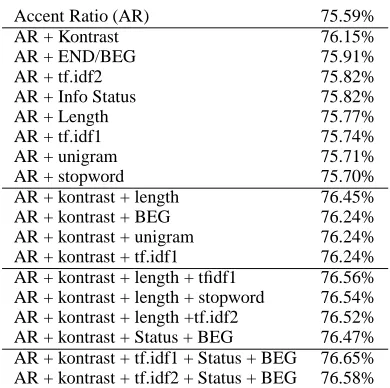
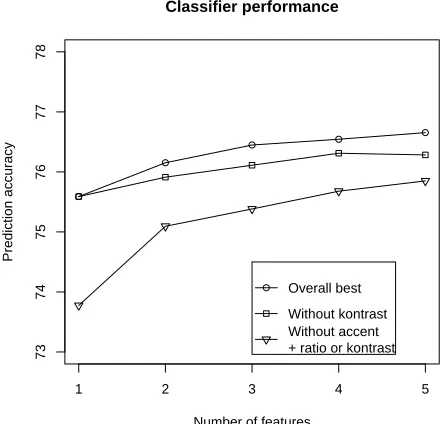
As we can see from figure 1 and table 2, the clas-sifiers using accent ratio as a feature perform best, for all sizes of feature sets. Moreover, the increase of performance compared to a single-feature classi-fier is very slight when accent ratio is used as fea-ture. Kontrast seems to combine well with accent ratio and all of the best classifiers with more than one feature use kontrast in addition to accent ratio. This indicates that automatic detection of kontrast can potentially help in prominence prediction. But the gains are small, the best classifiers without kon-trast but still including accent ratio perform within 0.2 percent of the classifiers that use both.
On the other hand, classifiers that do not use ac-cent ratio perform poorly compared to those that do, and even a classifier using five features (unigram, broad POS, token length, position from beginning and bigram) performs about as well as a classifier using solely accent ratio as a feature. Also, when accent ratio is not used, the overall improvement of the classifier grows faster with the addition of new features. This suggest that accent ratio provides rich information about words beyond that of POS class and general informativeness.2
Table 2 gives the specific features in (n + 1) -feature classifiers that lead to better results than the best n-classifier. The figures are for the classifiers performing best overall. Interestingly, none of these best classifiers for all feature set sizes uses POS or unigram as a feature. We assume that accent ratio captures all the relevant information that is present in the unigram and POS features. The best classifier with five features uses, in addition to accent ratio, kontrast, tf.idf, information status and distance from the beginning of the utterance. All of these features convey somewhat orthogonal information:
seman-2
To verify this we will examine the accent ratio dictionary in closer detail in the next section.
Accent Ratio (AR) 75.59%
AR + Kontrast 76.15%
AR + END/BEG 75.91%
AR + tf.idf2 75.82%
AR + Info Status 75.82%
AR + Length 75.77%
AR + tf.idf1 75.74%
AR + unigram 75.71%
AR + stopword 75.70%
AR + kontrast + length 76.45%
AR + kontrast + BEG 76.24%
AR + kontrast + unigram 76.24%
AR + kontrast + tf.idf1 76.24%
AR + kontrast + length + tfidf1 76.56% AR + kontrast + length + stopword 76.54% AR + kontrast + length +tf.idf2 76.52%
AR + kontrast + Status + BEG 76.47%
[image:4.612.328.523.54.248.2]AR + kontrast + tf.idf1 + Status + BEG 76.65% AR + kontrast + tf.idf2 + Status + BEG 76.58%
Table 2: Performance increase augmenting the ac-cent ratio classifier.
tic, topicality, discourse and phrasing information respectively. Still, all of them in combination im-prove the performance over accent ratio as a single feature only by one percent.
Figure 1 shows the overall improvement of clas-sifiers with the addition of new features in three sce-narios: overall best, best when kontrast is not used as a feature and best with neither kontrast nor ac-cent ratio. The best classifier with five features that do not include kontrast has accent ratio, broad POS, word length, stopword and bigram as features and has accuracy of 76.28%, or just 0.27% worse than the overall best classifier that uses kontrast and in-formation status. This indicates that while there is some benefit to using the two features, they do not lead to any substantial boost in performance. Strik-ingly, the best classifier that uses neither accent ra-tio nor kontrast performs very similarly to a classi-fier using accent ratio as the only feature: 75.82% for the classifier using unigram, POS, tf.idf1, word length and position from end of the utterance.
3.2 The power of linguistic features
AccentRatio unigram stopword POS tf.idf2 tf.idf1 BroadPos Length Kontrast bigram Info Stat
[image:5.612.73.295.163.375.2]75.59 73.77 70.77 70.28 70.14 69.50 68.64 67.64 67.57 65.87 64.13
Table 1: Single feature classifier performance. Features not in the table (position from end, animacy, utter-ance length and dialog act) all achieve lower accuracy of around 60%
1 2 3 4 5
73
74
75
76
77
78
Classifier performance
Number of features
Prediction accuracy
Overall best
Without kontrast Without accent + ratio or kontrast
Figure 1: Performance increase with the addition of new features.
as individual features (table 1) and were never in-cluded in a model that was best for a given feature set size (table 2).
Information status is somewhat useful and ap-pears in the overall best classifier with five features (table 2). But when compared with other classifiers with the same number of features, the benefits from adding information status to the model are small. For example, the accent ratio + information status classifier performs 0.23% better than accent ratio alone, but so does the classifier using accent ratio and tf.idf. There are two reasons that can explain why the givenness of the referent is not as helpful as we might have hoped. First of all, the informa-tion status distincinforma-tion applies only to referring ex-pressions and has undefined values for words such as verbs, adjectives or function words. Second, in-formation status of an entity influences the form of referring expression that is used, with old items
be-ing more likely to be pronominalized. In the numer-ous cases where pronominalization of old informa-tion does occur, features such as POS, unigram or accent ratio will be sensitive to the change of infor-mation status simply based on the lexical item.
Kontrast is by far the most useful linguistic fea-ture. It is used in all of the best classifiers for any feature set size (table 2). It applies to more words than givenness does, since salience distinctions can be made for any part-of-speech class. Still, not all words were annotated for kontrast either, and more-over kontrast only captures one kind of semantic salience. This is particularly true of discourse mark-ers like “especially” or “definitely”: these would ei-ther be in sentence fragments that weren’t marked for kontrast, or would probably be marked as ’back-ground’ since they are not salience triggers in a se-mantic sense. As we can see from figure 1, clas-sifiers that use kontrast perform only slightly better than others that use only “cheaper” features.
4 The accent ratio dictionary
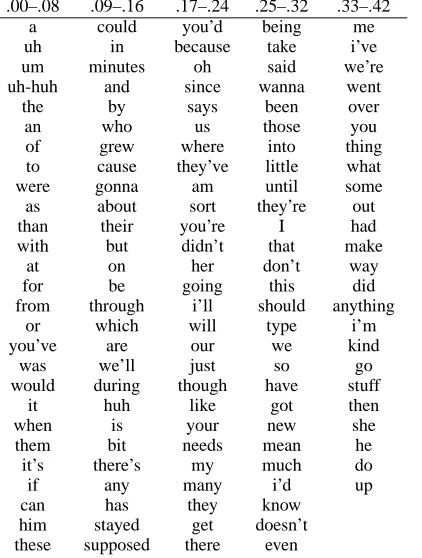
Contrary to our initial expectations, both classes in the accent ratio dictionary (for both low and high probability of being prominent) cover the full set of possible POS categories. Tables 3 and 4 list words in both classes (with words sorted by increasing accent ratio in each column). The “no accent” class is dom-inated by function words, but also includes nouns and verbs. One of the drawbacks of POS as a fea-ture for prominence prediction is that normally aux-iliary verbs will be tagged as “VB”, the same class as other more contentful verbs. The informativeness (unigram probability) of a word would distinguish between these types of verbs, but so does the accent ratio measure as well.
in-.00–.08 .09–.16 .17–.24 .25–.32 .33–.42
a could you’d being me
uh in because take i’ve
um minutes oh said we’re
uh-huh and since wanna went
the by says been over
an who us those you
of grew where into thing
to cause they’ve little what
were gonna am until some
as about sort they’re out
than their you’re I had
with but didn’t that make
at on her don’t way
for be going this did
from through i’ll should anything
or which will type i’m
you’ve are our we kind
was we’ll just so go
would during though have stuff
it huh like got then
when is your new she
them bit needs mean he
it’s there’s my much do
if any many i’d up
can has they know
him stayed get doesn’t
[image:6.612.314.509.56.318.2]these supposed there even
Table 3: Accent ratio entries with low prominence probability.
formativeness, POS, or even information structure features. Another class like that is words like “yes”, “okay”, “sure” that are mostly accented by virtue of being the only word in the phrase.
Some rather common words, “not” for example, are not included in the accent ratio dictionary be-cause they do not exhibit a statistically strong pref-erence for a prominence class. The accent ratio clas-sifier would thus assign class “accented” to the word “not”, which is indeed the class this word occurs in more often.
Another fact that becomes apparent with the in-spection of the accent ratio dictionary is that while certain words have a statistically significant prefer-ence for deaccenting, there is also a lot of variation in their observed realization. For example, personal pronouns such as “I” and “you” have accent ratios near 0.33. This means that every third such pronoun was actually realized as prominent by the speaker. In a conversational setting there is an implicit con-trast between the two speakers, which could partly explain the phenomenon, but the situations which prompt the speaker to realize the distinction in their
.58–.74 .75–.79 .80–.86 .87–1.0
lot both sometimes half
time no change topic
now seems child else
kids life young obviously
old tell Texas themselves
too ready town wow
really easy room gosh
three heard pay anyway
work isn’t interesting Dallas
nice again true outside
yeah first mother mostly
two right problems yes
person children agree great
day married war exactly
working may needed especially
job happen told definitely
talking business finally lately
usually still neat thirty
rather daughter sure higher
places gone house forty
government guess okay hey
ten news seven Iowa
parents major best poor
paper fact also glad
[image:6.612.75.286.59.338.2]actually five older basic
Table 4: Accent ratio values for words with high probability for being accented.
speech will be the focus of a future linguistic inves-tigation.
Kontrast is helpful in predicting “accented” class for some generally low ratio words. However, even with its help, production variation in the conversa-tions cannot be fully explained. The following ex-amples from our corpus show low accent ratio words (that, did, and, have, had) that were produced as prominent.
so i did THAT. and then i, you know, i DID that for SIX years. AND then i stayed HOME with my SON.
i HAVE NOT, to be honest, HAD much EXPERIENCE with CHILDREN in that SITUATION.
they’re going to HAVE to WORK it OUT to WORKING
part TIME.
5 Robustness of accent ratio
While accent ratio works well for our data (Table 2), a feature based so strongly on memorizing the status of each word in the training data might lead to problems. One potential problem, suggested by Pan et al. (2002) for lexicalized features in general, is whether a lexical feature like accent ratio might be less robust across genres. Another question is whether our definition of accent ratio is better than one that does not use the binomial test: we need to investigate whether these statistical tests indeed im-prove performance. We focus on these two issues in the next two subsections.
Binomial test cut-off
As discussed above, the original accent ratio feature (Yuan et al., 2005) was based directly on the frac-tion of accented occurrences in the training set. We might expect such a use of raw frequencies to be problematic. Given what we know about word dis-tributions in text (Baayen, 2001), we would expect about half of the words in a big corpus to appear only once. In an accent ratio dictionary without binomial test cut-off, all such words will have accent ratio of either exactly 1 or 0, but one or even few occurrences of a word would not be enough to determine statis-tical significance. By contrast, our modified accent ratio feature uses binomial test cut-off to make the accent ratio more robust to small training sets.
To test if the binomial test cut-off really improved the accent ratio feature, we compared the perfor-mance on Switchboard of classifiers using accent ratio with and without cut-off. The binominal test improved the performance of the accent ratio fea-ture from 73.49% (Yuan et al. original version) to 75.59% (our version).
Moreover, Yuan et al. report that their version of the feature did not combine well with other features, while in our experiments best performance was al-ways achieved by the classifiers that made use of the accent ratio feature in addition to others.
A cross-genre experiment: broadcast news
In a systematic analysis of the usefulness of differ-ent informativeness, syntactic and semantic features for prominence prediction, Pan et al. (2002) showed that word identity is a powerful feature. But they
hy-pothesized that this would not be a useful feature in a domain independent pitch accent prediction task. Their hypothesis that word identity cannot be a ro-bust across genres would obviously carry over to ac-cent ratio. In order to test the hypothesis, we used the accent ratio dictionary derived from the Switch-board corpus to predict prominence in the Boston University Radio corpus of broadcast news. Using an accent ratio dictionary from Switchboard and as-signing class “not accented” to words with accent ra-tio less than 0.38 and “accented” otherwise leads to 82% accuracy of prediction for this broadcast news corpus. If the accent ratio dictionary is built from the BU corpus itself, the performance is 83.67%.3 These results indicate that accent ratio is a robust enough feature and is applicable across genres.
6 Conclusions and future work
In this paper we introduced a new feature for promi-nence prediction, accent ratio. The accent ratio of a word is the (maximum likelihood estimate) prob-ability that a word is accented if there is a signifi-cant preference for a class, and 0.5 otherwise. Our experiments demonstrate that the feature is power-ful both by itself and in combination with other fea-tures. Moreover, the feature is robust to genre, and accent ratio dictionaries can be used for prediction of prominence in read news with very good results.
Of the linguistic features we examined, kontrast is the only one that is helpful beyond what can be gained using shallow features such as n-gram prob-ability, POS or tf.idf. While the improvements from kontrast are relatively small, the consistency of these small improvements suggest that developing auto-matic methods for approximating the gold-standard annotation we used here, similar to what has been done for information status in (Nissim, 2006), may be worthwhile. An automatic predictor for kontrast may also be helpful in other applications such as question answering or textual entailment.
All of the features in our study were text-based. There is a wide variety of research investigating phonological or acoustic features as well. For exam-ple Gregory and Altun (2004) used acoustic features
3
such as duration and energy, and phonological fea-tures such as oracle (hand-labeled) intonation phrase boundaries, and the number of phones and sylla-bles in a word. Although acoustic features are not available in a text-to-speech scenario, we hypothe-size that in a task where such features are available (such as in speech recognition applications), acous-tic or phonological features could improve the per-formance of our text-only features. To test this hy-pothesis, we augmented our best 5-feature classifier which did not include kontrast with hand-labeled in-tonation phrase boundary information. The resulting classifier reached an accuracy of 77.45%, more than one percent net improvement over 76.28% accuracy of the model based solely on text features and not cluding kontrast. Thus in future work we plan to in-corporate more acoustic and phonological features.
Finally, prominence prediction classifiers need to be incorporated in a speech synthesis system and their performance should be gauged via listening experiments that test whether the incorporation of prominence leads to improvement in synthesis.
References
R. H. Baayen. 2001. Word Frequency Distributions.
Kluwer Academic Publishers.
D.L. Bolinger. 1961. Contrastive Accent and Contrastive Stress. Language, 37(1):83–96.
J. Brenier, A. Nenkova, A. Kothari, L. Whitton, D. Beaver, and D. Jurafsky. 2006. The (non)utility of linguistic features for predicting prominence in spon-taneous speech. In IEEE/ACL 2006 Workshop on
Spo-ken Language Technology.
G. Brown. 1983. Prosodic structure and the given/new distinction. Prosody: Models and Measurements,
pages 67–77.
S. Calhoun, M. Nissim, M. Steedman, and J.M. Brenier. 2005. A framework for annotating information struc-ture in discourse. Pie in the Sky: Proceedings of the
workshop, ACL, pages 45–52.
W. Chafe. 1976. Givenness, contrastiveness, definite-ness, subjects, topics, and point of view. Subject and
Topic, pages 25–55.
C. Cieri, D. Graff, O. Kimball, D. Miller, and Kevin Walker. 2004. Fisher English training speech part 1 transcripts. LDC.
J. Godfrey, E. Holliman, and J. McDaniel. 1992. SWITCHBOARD: Telephone speech corpus for re-search and development. In IEEE ICASSP-92.
M. Gregory and Y. Altun. 2004. Using conditional ran-dom fields to predict pitch accents in conversational speech. Proceedings of ACL, 2004.
J. Gundel, N. Hedberg, and R. Zacharski. 1993. Cog-nitive status and the form of referring expressions in discourse. Language, 69:274–307.
J. Hirschberg. 1993. Pitch Accent in Context: Predicting Intonational Prominence from Text. Artificial
Intelli-gence, 63(1-2):305–340.
A. McCallum. 1996. Bow: A toolkit for statistical lan-guage modeling, text retrieval, classification and clus-tering. http://www.cs.cmu.edu/ mccallum/bow.
M. Nissim, S. Dingare, J. Carletta, and M. Steedman. 2004. An annotation scheme for information status in dialogue. In LREC 2004.
M. Nissim. 2006. Learning information status of dis-course entities. In Proceedings of EMNLP 2006.
M. Ostendorf, I. Shafran, S. Shattuck-Hufnagel, L. Carmichael, and W. Byrne. 2001. A prosodically labeled database of spontaneous speech. Proc. of the
ISCA Workshop on Prosody in Speech Recognition and Understanding, pages 119–121.
S. Pan and J. Hirschberg. 2000. Modeling local context for pitch accent prediction. In Proceedings of ACL-00.
S. Pan and K. McKeown. 1999. Word informativeness and automatic pitch accent modeling. In Proceedings
of EMNLP/VLC-99.
S. Pan, K. McKeown, and J. Hirschberg. 2002. Ex-ploring features from natural language generation in prosody modeling. Computer speech and language, 16:457–490.
E. Prince. 1992. The ZPG letter: subject, definiteness, and information status. In S. Thompson and W. Mann, editors, Discourse description: diverse analyses of a
fund raising text, pages 295–325. John Benjamins.
Mats Rooth. 1992. A theory of focus interpretation.
Nat-ural Language Semantics, 1(1):75–116.
E. Vallduv´ı and M. Vilkuna. 1998. On rheme and kon-trast. Syntax and Semantics, 29:79–108.
I. H. Witten and E. Frank. 2005. Data Mining: Practical
machine learning tools and techniques. 2nd Edition,
Morgan Kaufmann, San Francisco.
J. Yuan, J. Brenier, and D. Jurafsky. 2005. Pitch Accent Prediction: Effects of Genre and Speaker.
Proceed-ings of Interspeech.