Munich Personal RePEc Archive
Bitcoin and hyperdeflation : an
optimizing monetary approach
Sokic, Alexandre
ESCE International Business School
November 2018
Online at
https://mpra.ub.uni-muenchen.de/90603/
Bitcoin and hyperdeflation : an optimizing monetary approach
Alexandre Sokic
ESCE International Business School, Paris Contact: [email protected]
First draft : November 2018
Abstract : This paper is deeply motivated by the need to explore the impressive Bitcoin price development by addressing Bitcoin as money in its essential attribute as a medium of exchange. We adopt a monetary economics viewpoint and resort to a representative agent modelling strategy within a money-in-the-utility function (MIUF) framework. First, we show that the impressive Bitcoin price development observed since its inception can be interpreted as a hyperdeflation when we focus on Bitcoin role as a medium of exchange. Second, we show that specific monetary features of Bitcoin, its asymptotical fixed nominal stock and divisibility down to eight decimal places, account for a strong possibility of speculative hyperdeflationary paths. It is shown that those paths are fully consistent with the medium of exchange monetary role of Bitcoin and the representative agent optimizing behavior.
Keywords: Cryptocurrencies, Bitcoin, hyperdeflation, medium of exchange
JEL classification numbers: E31, E41, E42
1 Introduction
During the last decade, cryptocurrencies, that is purely digital currencies based on cryptographic proof, have become increasingly popular. Bitcoin is currently the most prominent purely digital currency among more than 2080 existing cryptocurrencies1. Its market
capitalization in terms of US dollars represents more than 54% of the total estimated cryptocurrency capitalization (Coinmarketcap.com accessed on November 1st, 2018). From its inception in 2009, its price in terms of US dollars has grown by more than 8 million-fold in nine years of existence (Ammous, 2018; Coinmarketcap.com as of November 1st, 2018). This
impressive price development and the related huge volatility have attracted a growing interest both in the media and the academic literature. Most research has addressed Bitcoin as a speculative asset (Cheah and Fry, 2015; Baeck and Elbeck, 2015), investigating the patterns (Ciaian et al., 2016; Blau, 2018) and properties of its market prices (Urquhart, 2016, 2017; Bariviera, 2017; Katsiampa, 2017; Gkillas and Katsiampa, 2018; Philipp et al., 2018; Wei, 2018). Questioning whether Bitcoin could be considered as money, McCallum (2015) resorts to the traditional contributions of Jevons (1875), Wicksell (1935) and Clower (1967) to emphasize that the medium-of-exchange property is the essential one to define money. To the best of our knowledge, no academic research has thus far explored Bitcoin price dynamics by addressing Bitcoin as money in its essential role as a medium of exchange.
This short paper attempts to close this research gap by adopting a monetary economics point of view and accounting for the impressive Bitcoin price development as a possible hyperdeflationary path in an optimizing monetary framework where Bitcoin is the medium of exchange. We consider Bitcoin as money in a money-in-the-utility function (MIUF) model originally due to Sidrauski (1967) and Brock (1974). The MIUF approach has been widely used in the representative agent modelling strategy of monetary economics to capture the role of money to facilitate transactions (Walsh, 2017). The framework is completed by taking into account two specific properties of Bitcoin. According to the current algorithm the nominal stock of Bitcoin will asymptotically approach a fixed level of 21 million units by 2140 and its high divisibility is down to eight decimal places (McCallum, 2015). The paper shows that the
1
impressive Bitcoin price development observed since its inception can be interpreted as a hyperdeflation. We find that hyperdeflationary paths are a strong possibility in a money-in-the-utility function model where Bitcoin is the medium-of-exchange.
The paper is structured as follows. Section 2 provides empirical evidence and interprets Bitcoin price development as a hyperdeflationary path. Section 3 presents the theoretical framework of a money-in-the-utility function optimizing model and shows the possible monetary equilibria paths for Bitcoin value. Section 4 concludes.
2 Evidence of deflationary paths for Bitcoin
According to Ammous (2018) the first recorded exchange rate was $0.000764 per bitcoin in October 2009. On May 22, 2010 the first transaction involving bitcoin as the medium-of-exchange was recorded at a rate of $0.0025 per bitcoin (Ammous, 2018). Since then many more millions transactions have been taking place and the rate reached $19343 per bitcoin at its peak on December 16, 2017 and $6370 per bitcoin on November 1, 2018 (Coinmarketcap.com as of November 1st, 2018). From its inception in 2009 with its first recorded exchange rate of $0.000764 to its peak at the end of 2017 bitcoin price in terms of US dollar has increased more than 25 million-fold in 8 years and more than 8 million-fold in 9 years considering bitcoin price on November 1, 2018.
Considering bitcoin as money in its primary attribute as a medium of exchange this impressive price development can be interpreted as a hyperdeflation. Denoting p( $)b the price of one bitcoin in terms of US dollar, p(bit) the price of the aggregate good in terms of bitcoin, and p($)
the price of aggregate good in terms of US dollar we can write the following relationship
($) ( )
( $) bit
b
p p
p
= . (1)
($)
p , the price of the aggregate good in terms of US dollar, has increased by 16.27% (IMF-WEO database accessed in October 2018) on the period 2009-2018 which is negligible compared to the variation of p( $)b , the price of one bitcoin in terms of US dollar on the same period. Then, it follows that the impressive increase in p( $)b can be interpreted as a huge decline of p(bit), the price of the aggregate good in terms of bitcoin, on the period 2009-2018. We qualify that huge decline in prices as a hyperdeflation. Interestingly, McCallum (2015), Dwyer (2015) or Ammous (2018) have raised the possibility of deflation in a bitcoin monetary system with fixed nominal supply. Next section attempts to account for that possibility.
3 An optimizing monetary model to account for the bitcoin deflationary paths
consumption good per unit of time. We do not introduce any government and bond holdings in order to focus on the bitcoin as the medium-of-exchange.
The representative household maximizes at time 0 the present discounted value of his utility stream,
( ) ( )
0
t
t t
u c v m e ρdt ∞
−
+
∫
, (2)where ρ >0is a subjective rate of discount. We assume an instantaneous utility function
additive and separable in consumption
t
c , the household’s consumption at time t, and t t t M m p =
his holdings of real monetary bitcoin balances. M is the nominal stock of bitcoin holdings which is assumed to be constant at 21 million units according to the bitcoin protocol. p is the price of the aggregate consumption good in bitcoin terms. The functions u and v are continuous, increasing in their respective arguments, strictly concave, and twice differentiable on the open interval
(
0,+∞)
.The household’s budget constraint is
t t t t t
mɺ = − −y c π m , (3)
whereπtis the inflation rate.
Taking into account that the divisibility of bitcoin is down to eight decimal places (McCallum, 2015) we can write formally a lower bound for the price level as
8
10
t
p ≥ − , (4)
leading to the following upper bound on real bitcoin balances ˆm
8
ˆ 10
t
m ≤ =m M⋅ . (5)
Denoting by ˆt the time when real bitcoin holdings reach ˆm, this household’s optimization problem with a bounded control leads to the following first-order condition for anyt<tˆ:
( )
( )
tt
t
v m u c ρ π+ = ′
′ . (6)
The optimum solution is completed by the transversality condition:
( )
lim t 0
t t
t e u c m
ρ −
→∞ ′ = . (7)
The setup is completed by considering the equilibrium condition in the goods market:
t
y=c . (8)
( )
( )
tt t
v m
m m
u y ρ
′
= −
′
ɺ . (9)
For computational and graphical purpose we assume the following functional form for the utility function
( ) ln
u c =α c and v m( )=βlnm ,
with α and β positive parameters. Then, omitting index t for convenience, the law of motion for real bitcoin balances becomes
1
mɺ = −α β− y+ρm . (10)
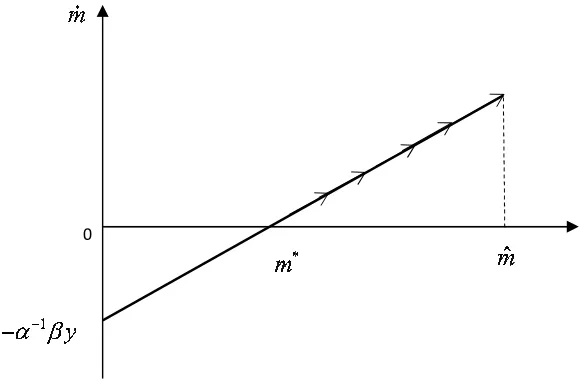
[image:5.595.97.388.341.536.2]Differential equations (9) and (10) provide a complete characterization of real bitcoin balances dynamics which is studied by using the technique of the phase diagram. The phase diagram associated to the law of motion given by (10) can be plotted in Figure 1 as follows
Figure 1
According to the law of motion (10) there is only one steady state where bitcoin is valued such
that m* βy αρ
= . Moreover, the only steady state m*is unstable. All paths starting to the left of
the steady state are speculative hyperinflationary paths. As shown by Obstfeld and Rogoff (1983) in a similar model, these hyperinflationary paths can be ruled out on the grounds that they are not feasible as they would eventually lead to negative real bitcoin holdings. By contrast, all paths originating to the right of m* involve increasing real bitcoin balances leading to the upper bound ˆm at finite time ˆt. Since the nominal stock of bitcoins is constant such paths for
m are speculative hyperdeflationary paths involving a decreasing price level in bitcoin terms. Once real bitcoin balances reaches ˆm the price level reaches its lower bound given by (4) and the deflationary process cannot continue. So the economy may find itself in an equilibrium that does not violate any transversality condition. Increasing the divisibility of bitcoin would allow
0
the deflationary process to continue up to the newer lower bound for the price level in bitcoin terms. Speculative hyperdeflationary paths are a strong possibility if bitcoin is considered as money in its essential role as a medium-of-exchange.
4 Conclusion
This paper is deeply motivated by the need to explore the impressive Bitcoin price development by addressing Bitcoin as money in its essential attribute as a medium of exchange. We adopt a monetary economics viewpoint and resort to a representative agent modelling strategy within a MIUF framework. The first finding is that the impressive Bitcoin price development observed since its inception can be interpreted as a hyperdeflation when we focus on Bitcoin role as a medium of exchange. Considering the asymptotical fixed nominal stock of Bitcoin and its divisibility down to eight decimal places, the second result is that speculative hyperdeflationary paths are a strong possibility for Bitcoin monetary equilibria fully consistent with the medium of exchange role of Bitcoin and the representative agent optimizing behavior.
References
Ammous S. (2018), “Can cryptocurrencies fulfil the functions of money”, Quaterly Review of Economics and Finance, https://doi.org/10.1016/j.qref.2018.05.010
Baeck C. and Elbeck M. (2015), “Bitcoins as an investment or speculative vehicle? A first look”, Applied Economics Letters, 22, pp. 30-34.
Bariviera A.F. (2017), “The inefficiency of Bitcoin revisited: a dynamic approach”, Economics Letters, 161, pp. 1-4.
Blau B.M. (2018), “Price dynamics and speculative trading in Bitcoin”, Research in International Business and Finance, 43, pp. 15-21.
Brock W. (1974), “Money and Growth: the Case of Long Run Perfect Foresight”, International Economic Review, 15, no. 3, pp. 750-777.
Ciaian P., Rajcaniova M., and Kancs D. (2016), “The economics of Bitcoin price formation”,
Applied Economics, 48 (19), pp. 1799-1815.
Cheah E.T. and Fry J. (2015), “Speculative bubbles in Bitcoin markets? An empirical investigation into the fundamental value of Bitcoin”, Economics Letters, 130, pp. 32-36. Clower R.W. (1967), “A Reconsideration of the Microfoundations of Monetary Theory”,
Western Economic Journal, 6, pp. 1-9.
Dwyer G.P. (2015), “The economics of Bitcoin and similar private digital currencies”, Journal of Financial Stability, 17, pp. 81-91.
Gkillas K. and Katsiampa P. (2018), “An application of extreme value theory to cryptocurrencies”, Economics Letters, 164, pp. 109-111.
Jevons W.S. (1875), Money and the Mechanism of Exchange, London: H.S. King
Katsiampa P. (2017), “Volatility estimation for bitcoin: acomparison of GARCH models”,
Economics Letters, 158, pp. 3-6.
McCallum B.T. (2015), “The Bitcoin revolution”, Cato Journal, 35 (2), pp. 347-356.
Obstfeld, M., and K. Rogoff (1983), “Speculative Hyperinflations in Maximizing Models: Can We Rule Them Out”, Journal of Political Economy, 91, pp. 675-687.
Phillip A., Chan J.S.K., Peiris S. (2018), “A new look at cryptocurrencies“, Economics Letters, 163, pp. 6-9.
Sidrauski M. (1967), “Rational Choice and Patterns of Growth in a Monetary Economy”,
American Economic Review Papers and Proceedings, 57, pp. 534-544.
Urquart A. (2016), “The inefficiency of Bitcoin”, Economics Letters, 148, pp. 80-82. Urquart A. (2017), “Price clustering in Bitcoin”, Economics Letters, 159, pp. 145-148.
Wei W.C. (2018), “Liquidity and market efficiency in cryptocurrencies”, Economics Letters, 168, pp. 21-24.