Proceedings of the 55th Annual Meeting of the Association for Computational Linguistics, pages 1436–1446 Vancouver, Canada, July 30 - August 4, 2017. c2017 Association for Computational Linguistics Proceedings of the 55th Annual Meeting of the Association for Computational Linguistics, pages 1436–1446
Vancouver, Canada, July 30 - August 4, 2017. c2017 Association for Computational Linguistics
Leveraging Knowledge Bases in LSTMs for Improving Machine Reading
Bishan Yang
Machine Learning Department Carnegie Mellon University
Tom Mitchell
Machine Learning Department Carnegie Mellon University [email protected]
Abstract
This paper focuses on how to take advan-tage of external knowledge bases (KBs) to improve recurrent neural networks for machine reading. Traditional methods that exploit knowledge from KBs en-code knowledge as discrete indicator fea-tures. Not only do these features gener-alize poorly, but they require task-specific feature engineering to achieve good per-formance. We propose KBLSTM, a novel neural model that leverages continuous representations of KBs to enhance the learning of recurrent neural networks for machine reading. To effectively inte-grate background knowledge with infor-mation from the currently processed text, our model employs an attention mecha-nism with a sentinel to adaptively decide whether to attend to background knowl-edge and which information from KBs is useful. Experimental results show that our model achieves accuracies that surpass the previous state-of-the-art results for both entity extraction and event extraction on the widely used ACE2005 dataset.
1 Introduction
Recurrent neural networks (RNNs), a neural archi-tecture that can operate over text sequentially, have shown great success in addressing a wide range of natural language processing problems, such as parsing (Dyer et al.,2015), named entity recogni-tion (Lample et al.,2016), and semantic role label-ing (Zhou and Xu,2015)). These neural networks are typically trained end-to-end where the input is only text or a sequence of words and a lot of back-ground knowledge is disregarded.
The importance of background knowledge in natural language understanding has long been rec-ognized (Minsky, 1988;Fillmore, 1976). Earlier NLP systems mostly exploited restricted linguistic knowledge such as manually-encoded morpholog-ical and syntactic patterns. With the advanced de-velopment of knowledge base construction, large amounts of semantic knowledge become avail-able, ranging from manually annotated semantic networks like WordNet1to semi-automatically or
automatically constructed knowledge graphs like DBPedia 2 and NELL 3. While traditional
ap-proaches have exploited the use of these knowl-edge bases (KBs) in NLP tasks (Ratinov and Roth,2009;Rahman and Ng,2011;Nakashole and Mitchell,2015), they require a lot of task-specific engineering to achieve good performance.
One way to leverage KBs in recurrent neural networks is by augmenting the dense representa-tions of the networks with the symbolic features derived from KBs. This is not ideal as the sym-bolic features have poor generalization ability. In addition, they can be highly sparse, e.g., using WordNet synsets can easily produce millions of indicator features, leading to high computational cost. Furthermore, the usefulness of knowledge features varies across contexts, as general KBs in-volve polysemy, e.g., “Clinton” can refer to a per-son or a town. Incorporating KBs irrespective of the textual context could mislead the machine reading process.
Can we train a recurrent neural network that learns to adaptively leverage knowledge from KBs to improve machine reading? In this paper, we propose KBLSTM, an extension to
bidirec-1https://wordnet.princeton.edu 2http://wiki.dbpedia.org/
3http://rtw.ml.cmu.edu/rtw/kbbrowser/
tional Long Short-Term Memory neural networks (BiLSTMs) (Hochreiter and Schmidhuber, 1997; Graves et al., 2005) that is capable of leverag-ing symbolic knowledge from KBs as it processes each word in the text. At each time step, the model retrieves KB concepts that are potentially related to the current word. Then, an attention mechanism is employed to dynamically model their semantic relevance to the reading context. Furthermore, we introduce a sentinel component in BiLSTMs that allows flexibility in deciding whether to attend to background knowledge or not. This is crucial be-cause in some cases the text context should over-ride the context-independent background knowl-edge available in general KBs.
In this work, we leverage two general, readily available knowledge bases: WordNet (WordNet, 2010) and NELL (Mitchell et al., 2015). Word-Net is a manually created lexical database that organizes a large number of English words into sets of synonyms (i.e. synsets) and records con-ceptual relations (e.g., hypernym, part of) among them. NELL is an automatically constructed web-based knowledge base that stores beliefs about entities. It is organized based on an ontology of hundreds of semantic categories (e.g., person, fruit, sport) and relations (e.g., personPlaysInstru-ment). We learn distributed representations (i.e., embeddings) of WordNet and NELL concepts us-ing knowledge graph embeddus-ing methods. We then integrate these learned embeddings with the state vectors of the BiLSTM network to enable knowledge-aware predictions.
We evaluate the proposed model on two core in-formation extraction tasks: entity extraction and event extraction. For entity extraction, the model needs to recognize all mentions of entities such as person, organization, location, and other things from text. For event extraction, the model is re-quired to identify event mentions or event triggers4
that express certain types of events, e.g., elections, attacks, and travels. Both tasks are challenging and often require the combination of background knowledge and the text context for accurate pre-diction. For example, in the sentence “Maigret left viewers in tears.”, knowing that “Maigret” can refer to a TV show can greatly help disam-biguate its meaning. However, knowledge bases
4An event also consists of participants whose types de-pend on the event triggers. In this work, we focus on pre-dicting event triggers and leave the prediction of event partic-ipants for future work.
may hurt performance if used blindly. For ex-ample, in the sentence “Santiago is charged with murder.”, methods that rely heavily on KBs are likely to interpret “Santiago” as a location due to the popular use of Santiago as a city. Similarly for events, the same word can trigger different types of events, for example, “release” can be used to de-scribe different events ranging from book publish-ing to parole. It is important for machine learnpublish-ing models to learn to decide which knowledge from KBs is relevant given the context.
Extensive experiments demonstrate that our KBLSTM models effectively leverage background knowledge from KBs in training BiLSTM net-works for machine reading. They achieve signifi-cant improvement on both entity and event extrac-tion compared to tradiextrac-tional feature-based meth-ods and LSTM networks that disregard knowledge in KBs, resulting in new state-of-the-art results for entity extraction and event extraction on the widely used ACE2005 dataset.
2 Related Work
Essential to RNNs’ success on natural language processing is the use of Long Short-Term Mem-ory neural networks (Hochreiter and Schmidhu-ber,1997) (LSTMs) or Gated Recurrent Unit (Cho et al.,2014) (GRU) as they are able to handle long-term dependencies by adaptively memorizing val-ues for either long or short durations. Their bidi-rectional variants BiLSTM (Graves et al., 2005) or BiGRU further allow the incorporation of both past and future information. Such ability has been shown to be generally helpful in various NLP tasks such as named entity recognition (Huang et al., 2015; Chiu and Nichols, 2016; Ma and Hovy, 2016), semantic role labeling (Zhou and Xu,2015), and reading comprehension (Hermann et al.,2015;Chen et al., 2016). In this work, we also employ the BiLSTM architecture.
context of knowledge base completion (Lao et al., 2011;Gardner et al.,2014;Toutanova et al.,2015), relation extraction (Weston et al., 2013; Chang et al.,2014;Riedel et al.,2013), and question an-swering (Miller et al.,2016). However, these ap-proaches model text using shallow representations such as subject/relation/object triples or bag of words. More recently,Ahn et al.(2016) proposed a neural knowledge language model that leverages knowledge bases in RNN language models, which allows for better representations of words for lan-guage modeling. Unlike their work, we leverage knowledge bases in LSTMs and applies it to infor-mation extraction.
The architecture of our KBLSTM model draws on the development of attention mechanisms that are widely employed in tasks such as machine translation (Bahdanau et al.,2015) and image cap-tioning (Xu et al.,2015). Attention allows the neu-ral networks to dynamically attend to salient fea-tures of the input. With a similar motivation, we employ attention in KBLSTMs to allow for dy-namic attention to the relevant knowledge given the text context. Our model is also closely related to a recent model of caption generation introduced byLu et al. (2017), where a visual sentinel is in-troduced to allow the decoder to decide whether to attend to image information when generating the next word. In our model, we introduce a sentinel to control the tradeoff between background knowl-edge and information from the text.
3 Method
In this section, we present our KBLSTM model. We first describe several basic recurrent neu-ral network frameworks for machine reading, in-cluding basic RNNs, LSTMs, and bidirectional LSTMs (Sec. §3.1). We then introduce our ex-tension to bidirectional LSTMs that allows for the incorporation of KB information at each time step of reading (Sec.§3.2). The KB information is en-coded using continuous representations (i.e., beddings) which are learned using knowledge em-bedding methods (Sec.§3.3).
3.1 RNNs, LSTMs, and Bidirectional LSTMs
RNNs are a class of neural networks that take a se-quence of inputs and compute a hidden state vector at each time step based on the current input and the entire history of inputs. The hidden state vector can be computed recursively using the following
equation (Elman,1990):
ht=F(Wht−1+Uxt)
wherextis the input at time stept,ht is the hid-den state at time stept,UandW are weight
ma-trices, andF is a nonlinear function such as tanh
or ReLu. Depending on the applications, RNNs can produce outputs based on the hidden state of each time step or just the last time step.
A Long Short-Term Memory network (Hochre-iter and Schmidhuber,1997) (LSTM) is a variant of RNNs which was design to better handle cases where the output at timetdepends on much
ear-lier inputs. It has a memory cell and three gating units: an input gate that controls what information to add to the current memory, a forget gate which controls what information to remove from the pre-vious memory, and an output gate which controls what information to output from the current mem-ory. Each gate is implemented as a logistic func-tionσthat takes as input the previous hidden state
and the current input, and outputs values between 0 and 1. Multiplication with these values controls the flow of information into or out of the memory. In equations, the updates at each time steptare:
it=σ(Wiht−1+Uixt)
ft=σ(Wfht−1+Ufxt)
ot=σ(Woht−1+Uoxt)
ct=ftct−1+ittanh(Wcht−1+Ucxt)
ht=ottanh(ct)
whereitis the input gate,ftis the forget gate,ot is the output gate,ctis the memory cell, andhtis the hidden state.denotes element-wise multipli-cation. Wi,Ui,Wf,Uf,Wo,Uo,Wc,Uc are weight matrices to be learned.
Bidirectional LSTMs (Graves et al., 2005) (BiLSTMs) are essentially a combination of two LSTMs in two directions: one operates in the for-ward direction and the other operates in the back-ward direction. This leads to two hidden states −
→
ht and ←h−t at time step t, which can be viewed as a summary of the past and the future respec-tively. Their concatenationht= [−→ht;←h−t]provides a whole summary of the information about the in-put around time stept. Such property is attractive
Figure 1: Architecture of the KBLSTM model. As each time step t, the knowledge module
re-trieves a set of candidate KB conceptsV(xt)that are related to the current inputxt, and then com-putes a knowledge state vectormt that integrates the embeddings of the candidate KB concepts
v1,v2, ...,vL and the current context vector st. See Section§3.2for details.
3.2 Knowledge-aware Bidirectional LSTMs
Our model (referred to as KBLSTM) extends BiL-STMs to allow flexibility in incorporating sym-bolic knowledge from KBs. Instead of encoding knowledge as discrete features, we encode it using continuous representations. Concretely, we learn embeddings of concepts in KBs using a knowl-edge graph embedding method. (We will describe the details in Section§3.3). The KBLSTM model then retrieves the embeddings of candidate con-cepts that are related to the current word being pro-cessed and integrates them into its state vector to make knowledge-aware predictions. Figure1 de-picts the architecture of our model.
The core of our model is the knowledge module, which is responsible for transferring background knowledge into the BiLSTMs. The knowledge at time step tconsists of candidate KB concepts V(xt)for inputxt. (We will describe how to ob-tain the candidate KB concepts from NELL and WordNet in Section §3.3). Each candidate KB concepti∈V(xt)is associated with a vector em-beddingvi. We compute an attention weightαti for concept vectorvivia a bilinear operator, which reflects how relevant or important conceptiis to
the current reading contextht:
αti∝exp(vTi Wvht) (1)
whereWvis a parameter matrix to be learned.
Note that the candidate concepts in some cases are misleading. For example, a KB may store the fact that “Santiago” is a city but miss the fact that it can also refer to a person. Incorporating such knowledge in the sentence “Santiago is charged with murder.” could be misleading. To address this issue, we introduce a knowledge sentinel that records the information of the current context and use a mixture model to allow for better tradeoff between the impact of background knowledge and information from the context. Specifically, we compute a sentinel vectorstas:
bt=σ(Wbht−1+Ubxt) (2)
st=bttanh(ct) (3)
where Wb and Ub are weight parameters to be learned. The weight on the local context is com-puted as:
βt∝exp(sTtWsht) (4)
where Ws is a parameter matrix to be learned. The mixture model is defined as:
mt=
X
i∈V(xt)
αtivi+βtst (5)
wherePi∈V(xt)αti+βt= 1.mtcan be viewed as a knowledge state vector that encodes external KB information with respect to the input at timet. We
combine it with the state vectorhtof BiLSTMs to obtain a knowledge-aware state vectorˆht:
ˆ
ht=ht+mt (6)
IfV(xt) =∅, we setmt = 0. hˆtcan be used for predictions in the same way as the original state vectorht(see Section§4for details).
3.3 Embedding Knowledge Base Concepts
Now we describe how to learn embeddings of con-cepts in KBs. We consider two KBs: WordNet and NELL, which are both knowledge graphs that can be stored in the form of RDF5 triples. Each
triple consists of a subject entity, a relation, and an object entity. Examples of triples in WordNet are (location,hypernym of,city), and (door,has part, lock), where both the subject and object entities are synsets in WordNet. Examples of triples in NELL are (New York, located in, United States)
and (New York, is a, city), where the subject en-tity is a noun phrase that can refer to a real-world entity and the object entity can be either a noun phrase entity or a concept category.
In this work, we refer to the synsets in WordNet and the concept categories in NELL as KB con-cepts. They are the key components of the ontolo-gies and provide generally useful information for language understanding. As our KBLSTM model reads through each word in a sentence, it retrieves knowledge from NELL by searching for entities with the current word and collecting the related concept categories as candidate concepts; and it retrieves knowledge from WordNet by treating the synsets of the current word as candidate concepts. We employ a knowledge graph embedding ap-proach to learn the representations of the candidate concepts. Denote a KB triple as (e1, r, e2), we
want to learn embeddings of the subject entitye1,
the object entitye2, and the relationr, so that the
relevance of the triple can be measured by a scor-ing function based on the embeddscor-ings. We employ the BILINEAR model described in (Yang et al., 2015).6 It computes the score of a triple(e
1, r, e2)
via a bilinear function: S(e1,r,e2) = vTe1Mrve2,
where ve1 andve2 are vector embeddings fore1
ande2 respectively, and Mr is a relation-specific embedding matrix. We train the embeddings using the max-margin ranking objective:
X
q=(e1,r,e2)∈T
X
q0=(e1,r,e0 2)∈T0
max{0,1−Sq+Sq0}
(7) whereT denotes the set of triples in the KB andT0 denotes the “negative” triples that are not observed in the KB.
For WordNet, we train the concept embeddings using the preprocessed data provided by (Bordes et al.,2013), which contains 151,442 triples with 40,943 synsets and 18 relations. We use the same data splits for training, development, and testing. During training, we use AdaGrad (Duchi et al., 2011) to optimize objective7with an initial learn-ing rate of 0.05 and a mini-batch size of 100. At each gradient step, we sample 10 negative object entities with respect to the positive triple. Our implementation of the BILINEAR model achieves top-10 accuracy of 91% for predicting missing
ob-6We also experimented with TransE (Bordes et al.,2013) and NTN (Socher et al.,2013), and found that they perform significantly worse than the Bilinear method, especially on predicting the “is a” facts in NELL.
ject entities on the WordNet test set, which is com-parable with previous work (Yang et al.,2015).
For NELL, we train the concept embeddings us-ing a subset of the NELL data7. We filter noun
phrases with annotation confidence less than 0.9 in order to remove erroneous labels introduced dur-ing the automatic construction of NELL (Wijaya, 2016). This results in 180,107 noun phrases and 258 concept categories in total. We randomly split 80% of the data for training, 10% for develop-ment and 10% for testing. For each training exam-ple, we enumerate all the unobserved concept cat-egories as negative labels. Instead of treating each entity as a unit, we represent it as an average of its constituting word vectors concatenated with its head word vector. The word vectors are initialized with pre-trained paraphrastic embeddings (Wiet-ing et al., 2015) and fine-tuned during training. Using the same optimization parameters as be-fore, the BILINEARmodel achieves 88% top-1 ac-curacy for predicting concept categories of given noun phrases on the test set.
4 Experiments 4.1 Entity Extraction
We first apply our model to entity extraction, a task that is typically addressed by assigning each word/token BIO labels (Begin,Inside, and
Outside) (Ratinov and Roth,2009) indicating the
token’s position within an entity mention as well as its entity type.
To allow tagging over phrases instead of words, we address entity extraction in two steps. The first step detects mention chunks, and the second step assigns entity type labels to mention chunks (in-cluding an O type indicatingothertypes). In the first stage, we train a BiLSTM network with a conditional random field objective (Huang et al., 2015) using gold-standard BIO labels regardless of entity types, and only predict each token’s po-sition within an entity mention. This produces a sequence of chunks for each sentence. In the sec-ond stage, we train another supervised BiLSTM model to predict type labels for the previously ex-tracted chunks. Each chunk is treated as a unit input to the BiLSTMs and the input vector is com-puted by averaging the input vectors of individ-ual words within the chunk concatenated with its head word vector. The BiLSTMs can be trained
with a softmax objective that minimizes the cross-entropy loss for each individual chunk. It com-putes the probability of the correct type for each chunk:
pyt =
exp(wTytht)
P
y0
texp(w
T y0
tht)
(8)
The BiLSTMs can also be trained with a CRF ob-jective (referred to as BiLSTM-CRF) that mini-mizes the negative log-likelihood for the entire se-quence. It computes the probability of the correct types for a sequence of chunks:
py=
exp(g(x,y))
P
y0exp(g(x,y0))
(9)
where g(x,y) = Plt=1Pt,yt +
Pl
t=0Ayt,yt+1,
Pt,yt = wTytht is the score of assigning thet-th
chunk with tagytandAyt,yt+1is the score of
tran-sitioning from tagyttoyt+1. By replacinght in Eq. 8 and Eq. 9 with the knowledge-aware state vector ˆht (Eq. 6), we can compute the objective
for KBLSTM and KBLSTM-CRF respectively.
4.1.1 Implementation Details
We evaluate our models on the ACE2005 cor-pus (LDC, 2005) and the OntoNotes 5.0 cor-pus (Hovy et al.,2006) for entity extraction. Both datasets consist of text from a variety of sources such as newswire, broadcast conversations, and web text. We use the same data splits and task settings for ACE2005 as inLi et al.(2014) and for OntoNotes 5.0 as inDurrett and Klein(2014).
At each time step, our models take as input a word vector and a capitalization feature (Chiu and Nichols,2016). We initialize the word vectors us-ing pretrained paraphrastic embeddus-ings (Wietus-ing et al.,2015), as we find that they significantly out-performs randomly initialized embeddings. The word embeddings are fine-tuned during training. For the KBLSTM models, we obtain the embed-dings of KB concepts from NELL and WordNet as described in Section§3.3. These embeddings are kept fix during training.
We implement all the models using Theano on a single GPU. We update the model parameters on every training example using Adam with default settings (Kingma and Ba,2014) and apply dropout to the input layer of the BiLSTM with a rate of 0.5. The word embedding dimension is set to 300 and the hidden vector dimension is set to 100. We train models on ACE2005 for about 5 epochs and
Model P R F1
BiLSTM 83.5 86.4 84.9
BiLSTM-CRF 87.3 84.7 86.0 BiLSTM-Fea 86.1 84.7 85.4 BiLSTM-Fea-CRF 87.7 86.1 86.9
KBLSTM 87.8 86.6 87.2
[image:6.595.330.502.62.150.2]KBLSTM-CRF 88.1 87.8 88.0∗
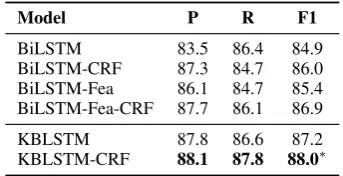
Table 1: Entity extraction results on the ACE2005 test set with gold-standard mention boundaries.
on OntoNotes 5.0 for about 10 epochs with early stopping based on development results.
For each experiment, we report the average re-sults over 10 random runs. We also apply the Wilcoxon rank sum test to compare our models with the baseline models.
4.1.2 Results
We compare our KBLSTM and KBLSTM-CRF models with the following baselines: BiLSTM, a vanilla BiLSTM network trained using the same input, and BiLSTM-Fea, a BiLSTM network that combines its hidden state vector with discrete KB features (i.e., indicators of candidate KB concepts) to produce the final state vector. We also in-clude their variants CRF and BiLSTM-Fea-CRF, which are trained using the CRF objec-tive instead of the standard softmax objecobjec-tive.
We first report results on entity extraction with gold-standard boundaries for multi-word men-tions. This allows us to focus on the perfor-mance of entity type prediction without consider-ing mention boundary errors and the noise they in-troduce in retrieving candidate KB concepts. Ta-ble 1 shows the results.8 We find that the CRF
objective generally outperforms the softmax ob-jective. Our KBLSTM-CRF model significantly improves over its counterpart BiLSTM-Fea-CRF. This demonstrates the effectiveness of KBLSTM architecture in leveraging KB information.
Table 2 breaks down the results of the KBLSTM-CRF and the BiLSTM-Fea-CRF using different KB settings. We find that the KBLSTM-CRF outperforms the BiLSTM-Fea-KBLSTM-CRF in all the settings and that incorporating both KBs leads to the best performance.
Next, we evaluate our models on entity ex-traction with predicted mention boundaries. We first train a BiLSTM-CRF to perform mention
Model KB P R F1
BiLSTM-Fea-CRF WordNetNELL 87.286.4 86.186.0 86.686.2 Both 87.7 86.1 86.9
KBLSTM-CRF WordNetNELL 87.487.1 87.687.4 87.587.3 Both 88.1 87.8 88.0
Table 2: Ablation results with different KBs.
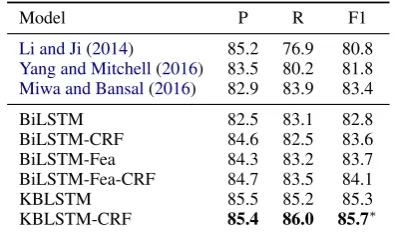
chunking using the same setting as described in Section 4.1.1. We then treat the predicted chunks as units for entity type labeling. Table 3 reports the full entity extraction results on the ACE2005 test set. We compare our models with the state-of-the-art feature-based linear modelsLi et al. (2014),Yang and Mitchell (2016), and the recently proposed sequence- and tree-structured LSTMs (Miwa and Bansal, 2016). Interestingly, we find that using BiLSTM-CRF without any KB information already gives strong performance compared to previous work. The KBLSTM-CRF model demonstrates the best performance among all the models and achieves the new state-of-the-art performance on the ACE2005 dataset.
We also report the entity extraction results on the OntoNotes 5.0 test set in Table4. We compare our models with the existing feature-based mod-elsRatinov and Roth(2009) andDurrett and Klein (2014), which both employ heavy feature engi-neering to bring in external knowledge. BiLSTM-CNN (Chiu and Nichols, 2016) employs a hy-brid BiLSTM and Convolutional neural network (CNN) architecture and incorporates rich lexicon features derived from SENNA and DBPedia. Our KBLSTM-CRF model shows competitive results compared to their results. It also presents sig-nificant improvements compared to the BiLSTM and BiLSTM-Fea models. Note that the benefit of adding KB information is smaller on OntoNotes compared to ACE2005. We believe that there are two main reasons. One is that NELL has a lower coverage of entity mentions in OntoNotes than in ACE2005 (57% vs. 65%). Second, OntoNotes has a significantly larger amount of training data, which allows for more accurate models without much help from external resources.
4.2 Event Extraction
We now apply our model to the task of event ex-traction. Event extraction is concerned with
de-Model P R F1
Li and Ji(2014) 85.2 76.9 80.8
Yang and Mitchell(2016) 83.5 80.2 81.8
Miwa and Bansal(2016) 82.9 83.9 83.4
BiLSTM 82.5 83.1 82.8
BiLSTM-CRF 84.6 82.5 83.6
BiLSTM-Fea 84.3 83.2 83.7
BiLSTM-Fea-CRF 84.7 83.5 84.1
KBLSTM 85.5 85.2 85.3
[image:7.595.317.515.62.179.2]KBLSTM-CRF 85.4 86.0 85.7∗
Table 3: Entity extraction results on the ACE2005 test set.
Model P R F1
Ratinov and Roth(2009) 82.0 84.9 83.4
Durrett and Klein(2014) 85.2 82.8 84.0
BiLSTM-CNN 82.5 82.4 82.5
BiLSTM-CNN+emb 85.9 86.3 86.1 BiLSTM-CNN+emb+lexicon 86.0 86.5 86.2
BiLSTM 84.9 86.3 85.6
BiLSTM-CRF 85.3 86.6 85.9
BiLSTM-Fea 85.2 86.4 85.8
BiLSTM-Fea-CRF 85.2 86.8 86.0
KBLSTM 86.3 86.2 86.2
KBLSTM-CRF 86.1 86.8 86.4∗
Table 4: Entity extraction results on the OntoNotes 5.0 test set.
tectingevent triggers, i.e., a word that expresses the occurrence of a pre-defined type of event. Event triggers are mostly verbs and eventive nouns but can occasionally be adjectives and other con-tent words. Therefore, the task is typically ad-dressed as a classification problem where the goal is to label each word in a sentence with an event type or an O type if it does not express any of the defined events. It is straightforward to apply the BiLSTM architecture to event extraction. Simi-larly to the models for entity extraction, we can train the BiLSTM network with both the softmax objective and the CRF objective.
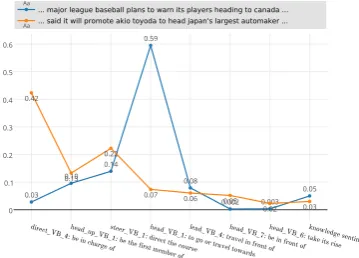
[image:7.595.77.288.63.150.2](a) The X-axis represents relevant NELL concepts for the entity mentionclinton. The Y-axis represents the concept weights and the knowledge sentinel weight.
[image:8.595.338.518.75.204.2](b) The X-axis represents relevant WordNet concepts for the event triggerhead. The Y-axis represents the concept weights and the knowledge sentinel weight.
Figure 2: Visualization of the attention weights for KB features learned by KBLSTM-CRF. Higher weights imply higher importance.
Model P R F1
JOINTBEAM 74.0 56.7 64.2
JOINTEVENTENTITY 75.1 63.3 68.7
DMCNN 71.8 63.8 69.0
JRNN 66.0 73.0 69.3
BiLSTM 71.3 59.3 64.7
BiLSTM-CRF 64.2 66.6 65.4 BiLSTM-Fea 68.4 62.7 65.5 BiLSTM-Fea-CRF 65.5 66.7 66.1
KBLSTM 70.1 67.3 68.7
[image:8.595.90.269.75.198.2]KBLSTM-CRF 71.6 67.8 69.7∗
Table 5: event extraction results on the ACE2005 test set.
4.2.1 Results
We compare our models with the prior state-of-the-art approaches for event extraction, including neural and non-neural ones: JOINTBEAM refers to the joint beam search approach with local and global features (Li et al., 2013); JOINTENTI -TYEVENT refers to the graphical model for joint entity and event extraction (Yang and Mitchell, 2016); DMCNN is the dynamic multi-pooling CNNs in Chen et al. (2015); and JRNN is an RNN model with memory introduced byNguyen et al.(2016). The first block in Table5shows the results of the feature-based linear models (taken from Yang and Mitchell (2016)). The second block shows the previously reported results for the neural models. Note that they both make use of gold-standard entity annotations. The third block shows the results of our models. We can see that our KBLSTM models significantly outperform the
BiLSTM and BiLSTM-Fea models, which again confirms their effectiveness in leveraging KB in-formation. The KBLSTM-CRF model achieves the best performance and outperforms the previous state-of-the-art methods without having access to any gold-standard entities.
4.3 Model Analysis
In order to better understand our model, we vi-sualize the learned attention weights α for KB concepts and the sentinel weightβ that measures
5 Conclusion
In this paper, we introduce the KBLSTM net-work architecture as one approach to incorporat-ing background KBs for improvincorporat-ing recurrent neu-ral networks for machine reading. This archi-tecture employs an adaptive attention mechanism with a sentinel that allows for learning an ap-propriate tradeoff for blending knowledge from the KBs with information from the currently pro-cessed text, as well as selecting among relevant KB concepts for each word (e.g., to select the cor-rect semantic categories for “clinton” as a town or person in figure 2a). Experimental results show that our model achieves state-of-the-art perfor-mance on standard benchmarks for both entity ex-traction and event exex-traction.
We see many additional opportunities to in-tegrate background knowledge with training of neural network models for language processing. Though our model is evaluated on entity extrac-tion and event extracextrac-tion, it can be useful for other machine reading tasks. Our model can also be ex-tended to integrate knowledge from a richer set of KBs in order to capture the diverse variety and depth of background knowledge required for ac-curate and deep language understanding.
Acknowledgments
This research was supported in part by DARPA under contract number FA8750-13-2-0005, and by NSF grants IIS-1065251 and IIS-1247489. We also gratefully acknowledge the support of the Mi-crosoft Azure for Research program and the AWS Cloud Credits for Research program. In addition, we would like to thank anonymous reviewers for their helpful comments.
References
Sungjin Ahn, Heeyoul Choi, Tanel P¨arnamaa, and Yoshua Bengio. 2016. A neural knowledge lan-guage model.arXiv preprint arXiv:1608.00318.
Dzmitry Bahdanau, Kyunghyun Cho, and Yoshua Ben-gio. 2015. Neural machine translation by jointly learning to align and translate. In Proceedings of the International Conference on Learning Represen-tations (ICLR).
Antoine Bordes, Nicolas Usunier, Alberto Garcia-Duran, Jason Weston, and Oksana Yakhnenko. 2013. Translating embeddings for modeling multi-relational data. InAdvances in Neural Information Processing Systems (NIPS). pages 2787–2795.
Antoine Bordes, Jason Weston, Ronan Collobert, and Yoshua Bengio. 2011. Learning structured embed-dings of knowledge bases. In Proceedings of the Twenty-Fifth AAAI Conference on Artificial Intelli-gence.
Kai-Wei Chang, Wen-tau Yih, Bishan Yang, and Christopher Meek. 2014. Typed tensor decompo-sition of knowledge bases for relation extraction. In
Empirical Methods in Natural Language Processing (EMNLP).
Danqi Chen, Jason Bolton, and Christopher D Man-ning. 2016. A thorough examination of the cnn/daily mail reading comprehension task. In Pro-ceedings of the 54th Annual Meeting of the Associa-tion for ComputaAssocia-tional Linguistics (ACL).
Yubo Chen, Liheng Xu, Kang Liu, Daojian Zeng, and Jun Zhao. 2015. Event extraction via dynamic multi-pooling convolutional neural networks. In
Proceedings of the Annual Meeting of the Associ-ation for ComputAssoci-ational Linguistics (ACL). pages 167–176.
Jason PC Chiu and Eric Nichols. 2016. Named entity recognition with bidirectional lstm-cnns. Transac-tions of the Association for Computational Linguis-tics4:357–370.
Kyunghyun Cho, Bart Van Merri¨enboer, Caglar Gul-cehre, Dzmitry Bahdanau, Fethi Bougares, Holger Schwenk, and Yoshua Bengio. 2014. Learning phrase representations using rnn encoder-decoder for statistical machine translation. InProceedings of the 2014 Conference on Empirical Methods in Nat-ural Language Processing (EMNLP).
John Duchi, Elad Hazan, and Yoram Singer. 2011. Adaptive subgradient methods for online learning and stochastic optimization. Journal of Machine Learning Research12(Jul):2121–2159.
Greg Durrett and Dan Klein. 2014. A joint model for entity analysis: Coreference, typing, and linking.
Transactions of the Association for Computational Linguistics2:477–490.
Chris Dyer, Miguel Ballesteros, Wang Ling, Austin Matthews, and Noah A. Smith. 2015. Transition-based dependency parsing with stack long short-term memory. InProceedings of the Annual Meet-ing of the Association for Computational LMeet-inguistics (ACL).
Jeffrey L Elman. 1990. Finding structure in time. Cog-nitive science14(2):179–211.
Charles J Fillmore. 1976. Frame semantics and the na-ture of language. Annals of the New York Academy of Sciences280(1):20–32.
Alex Graves, Santiago Fern´andez, and J¨urgen Schmid-huber. 2005. Bidirectional lstm networks for im-proved phoneme classification and recognition. In
International Conference on Artificial Neural Net-works. Springer, pages 799–804.
Kelvin Guu, John Miller, and Percy Liang. 2015. Traversing knowledge graphs in vector space. In
Proceedings of the 2015 Conference on Empir-ical Methods in Natural Language Processing (EMNLP).
Karl Moritz Hermann, Tomas Kocisky, Edward Grefenstette, Lasse Espeholt, Will Kay, Mustafa Su-leyman, and Phil Blunsom. 2015. Teaching ma-chines to read and comprehend. InAdvances in Neu-ral Information Processing Systems (NIPS). pages 1693–1701.
Sepp Hochreiter and J¨urgen Schmidhuber. 1997. Long short-term memory. Neural computation
9(8):1735–1780.
Eduard Hovy, Mitchell Marcus, Martha Palmer, Lance Ramshaw, and Ralph Weischedel. 2006. Ontonotes: the 90% solution. InProceedings of the human lan-guage technology conference of the NAACL, Com-panion Volume: Short Papers. pages 57–60.
Zhiheng Huang, Wei Xu, and Kai Yu. 2015. Bidirec-tional lstm-crf models for sequence tagging. arXiv preprint arXiv:1508.01991.
Diederik Kingma and Jimmy Ba. 2014. Adam: A method for stochastic optimization. Proceedings of the International Conference on Learning Represen-tations (ICLR).
Guillaume Lample, Miguel Ballesteros, Sandeep Sub-ramanian, Kazuya Kawakami, and Chris Dyer. 2016. Neural architectures for named entity recognition. InProceedings of the 2016 Conference of the North American Chapter of the Association for Computa-tional Linguistics (NAACL).
Ni Lao, Tom Mitchell, and William W Cohen. 2011. Random walk inference and learning in a large scale knowledge base. InProceedings of the Conference on Empirical Methods in Natural Language Pro-cessing (EMNLP). pages 529–539.
LDC. 2005. The ace 2005 evaluation plan. InNIST.
Qi Li and Heng Ji. 2014. Incremental joint extraction of entity mentions and relations. InProceedings of the Annual Meeting of the Association for Computa-tional Linguistics (ACL). pages 402–412.
Qi Li, Heng Ji, Yu Hong, and Sujian Li. 2014. Con-structing information networks using one single model. InEmpirical Methods in Natural Language Processing (EMNLP). pages 1846–1851.
Qi Li, Heng Ji, and Liang Huang. 2013. Joint event extraction via structured prediction with global fea-tures. InProceedings of the Annual Meeting of the
Association for Computational Linguistics (ACL). pages 73–82.
Jiasen Lu, Caiming Xiong, Devi Parikh, and Richard Socher. 2017. Knowing when to look: Adaptive at-tention via a visual sentinel for image captioning. In
Proceedings of the 30th IEEE Conference on Com-puter Vision and Pattern Recognition (CVPR). Xuezhe Ma and Eduard Hovy. 2016. End-to-end
se-quence labeling via bi-directional lstm-cnns-crf. In
Proceedings of the 54th Annual Meeting of the As-sociation for Computational Linguistics (ACL).
Alexander Miller, Adam Fisch, Jesse Dodge, Amir-Hossein Karimi, Antoine Bordes, and Jason We-ston. 2016. Key-value memory networks for directly reading documents. InEmpirical Methods in Natu-ral Language Processing (EMNLP).
Marvin Minsky. 1988. Society of mind. Simon and Schuster.
T. Mitchell, W. Cohen, E. Hruschka, P. Talukdar, J. Betteridge, A. Carlson, B. Dalvi, M. Gardner, B. Kisiel, J. Krishnamurthy, N. Lao, K. Mazaitis, T. Mohamed, N. Nakashole, E. Platanios, A. Rit-ter, M. Samadi, B. Settles, R. Wang, D. Wijaya, A. Gupta, X. Chen, A. Saparov, M. Greaves, and J. Welling. 2015. Never-ending learning. In Pro-ceedings of the Twenty-Ninth AAAI Conference on Artificial Intelligence (AAAI).
Makoto Miwa and Mohit Bansal. 2016. End-to-end re-lation extraction using lstms on sequences and tree structures. Proceedings of the 54th Annual Meet-ing of the Association for Computational LMeet-inguistics (ACL).
Ndapandula Nakashole and Tom M Mitchell. 2015. A knowledge-intensive model for prepositional phrase attachment. In Proceedings of the Annual Meet-ing of the Association for Computational LMeet-inguistics (ACL). pages 365–375.
Thien Huu Nguyen, Kyunghyun Cho, and Ralph Gr-ishman. 2016. Joint event extraction via recurrent neural networks. InNorth American Chapter of the Association for Computational Linguistics (NAACL-HLT). pages 300–309.
Altaf Rahman and Vincent Ng. 2011. Coreference res-olution with world knowledge. In Proceedings of the 49th Annual Meeting of the Association for Com-putational Linguistics (ACL). pages 814–824.
Lev Ratinov and Dan Roth. 2009. Design challenges and misconceptions in named entity recognition. In
Proceedings of the Thirteenth Conference on Com-putational Natural Language Learning (CoNLL). pages 147–155.
Richard Socher, Danqi Chen, Christopher D Manning, and Andrew Ng. 2013. Reasoning with neural ten-sor networks for knowledge base completion. In
Advances in Neural Information Processing Systems (NIPS). pages 926–934.
Kristina Toutanova, Danqi Chen, Patrick Pantel, Pallavi Choudhury, and Michael Gamon. 2015. Represent-ing text for joint embeddRepresent-ing of text and knowledge bases. InAssociation for Computational Linguistics (ACL).
Jason Weston, Antoine Bordes, Oksana Yakhnenko, and Nicolas Usunier. 2013. Connecting language and knowledge bases with embedding models for re-lation extraction. In Proceedings of the 2013 Con-ference on Empirical Methods in Natural Language Processing (EMNLP).
John Wieting, Mohit Bansal, Kevin Gimpel, and Karen Livescu. 2015. Towards universal paraphrastic sen-tence embeddings. Proceedings of the International Conference on Learning Representations (ICLR). Derry Tanti Wijaya. 2016. VerbKB: A Knowledge
Base of Verbs for Natural Language Understanding. Ph.D. thesis, Carnegie Mellon University.
WordNet. 2010. About wordnet. http://wordnet.princeton.edu.
Kelvin Xu, Jimmy Ba, Ryan Kiros, Kyunghyun Cho, Aaron Courville, Ruslan Salakhutdinov, Richard S Zemel, and Yoshua Bengio. 2015. Show, attend and tell: Neural image caption generation with visual at-tention. In International Conference for Machine Learning (ICML).
Bishan Yang and Tom Mitchell. 2016. Joint extrac-tion of events and entities within a document con-text. InNorth American Chapter of the Association for Computational Linguistics (NAACL-HLT). pages 289–299.
Bishan Yang, Wen-tau Yih, Xiaodong He, Jianfeng Gao, and Li Deng. 2015. Embedding entities and relations for learning and inference in knowledge bases. International Conference on Learning Rep-resentations (ICLR).