2717
Object-oriented Neural Programming (OONP)
for Document Understanding
Zhengdong Lu1 Xianggen Liu2,3,4,∗ Haotian Cui2,3,4,∗
{liuxg16,cht15,yanyk13}@mails.tsinghua.edu.cn, [email protected]
1 DeeplyCurious.ai
2Department of Biomedical Engineering, School of Medicine, Tsinghua University 3 Beijing Innovation Center for Future Chip, Tsinghua University
4 Laboratory for Brain and Intelligence, Tsinghua University
Yukun Yan2,3,4,∗ Daqi Zheng1
Abstract
We proposeObject-oriented Neural
Program-ming (OONP), a framework for
semanti-cally parsing documents in specific
do-mains. Basically, OONP reads a
doc-ument and parses it into a predesigned object-oriented data structure that reflects the domain-specific semantics of the
doc-ument. AnOONPparser models semantic
parsing as a decision process: a neural net-based Reader sequentially goes through the document, and builds and updates an intermediate ontology during the process to summarize its partial understanding of
the text. OONPsupports a big variety of
forms (both symbolic and differentiable) for representing the state and the docu-ment, and a rich family of operations to
compose the representation. An OONP
parser can be trained with supervision of different forms and strength, includ-ing supervised learninclud-ing (SL) , reinforce-ment learning (RL) and hybrid of the two. Our experiments on both synthetic and real-world document parsing tasks have
shown thatOONPcan learn to handle fairly
complicated ontology with training data of modest sizes.
1 Introduction
Mapping a document into a structured “machine readable” form is a canonical and probably the most effective way for document understanding. There are quite some recent efforts on designing neural net-based learning machines for this pur-pose, which can be roughly categorized into two groups: 1) sequence-to-sequence model with the
[image:1.595.307.533.222.341.2]* The work was done when these authors worked as in-terns at DeeplyCurious.ai.
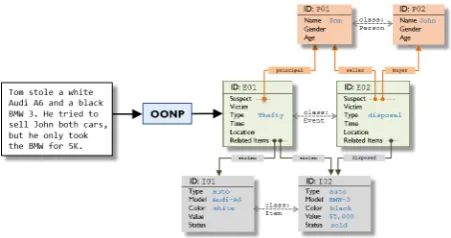
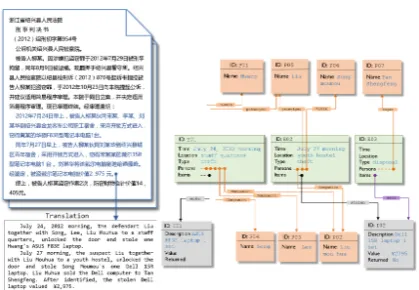
Figure 1: Illustration ofOONPon a parsing task.
neural net as the black box (Liang et al.,2017), and
2) neural net as a component in a pre-designed
sta-tistical model (Zeng et al.,2014). Both categories
are hindered in tackling document with compli-cated structures, by either the lack of effective rep-resentation of knowledge or the flexibility in fus-ing them in the model.
Towards solving this problem, we proposed
Object-oriented Neural Programming (OONP), a framework for semantically parsing in-domain
documents (illustrated in Figure1). OONP
main-tains an object-oriented data structure, where ob-jects from different classes are to represent entities (people, events, items etc) which are connected through links with varying types. Each object en-capsulates internal properties (both symbolic and differentiable), allowing both neural and symbolic reasoning over complex structures and hence mak-ing it possible to represent rich semantics of
docu-ments. AnOONPparser is neural net-based, but
it has sophisticated architecture and mechanism designed for taking and yielding discrete struc-tures, hence nicely combining symbolism (for in-terpretability and formal reasoning) and connec-tionism (for flexibility and learnability).
For parsing,OONPreads a document and parses
it into this object-oriented data structure through a series of discrete actions along reading the
fam-ily of operations for composing the ontology, and flexible hybrid forms for knowledge
representa-tion. AnOONPparser can be trained with
super-vised learning (SL), reinforcement learning (RL) and hybrid of the two.
OONPin a nutshell The key properties ofOONP
can be summarized as follows
1. OONPmodels parsing as a decision process:
as the “reading and comprehension” agent goes through the text it gradually forms the ontology as the representation of the text through its action;
2. OONPuses a symbolic memory with graph
structure as part of the state of the parsing process. This memory will be created and updated through the sequential actions of the decision process, and will be used as the se-mantic representation of the text at the end
3. OONPcan blend supervised learning (SL) and
reinforcement learning (RL) in tuning its pa-rameters to suit the supervision signal in dif-ferent forms and strength.
2 Related Works
2.1 Semantic Parsing
Semantic parsing is concerned with translating language utterances into executable logical forms and plays a key role in building conversational
interfaces (Jonathan and Percy, 2014).
Dif-ferent from common tasks of semantic pars-ings, such as parsing the sentence to dependency
structure (Buys and Blunsom, 2017) and
exe-cutable commands (Herzig and Berant, 2017),
OONPparses documents into a predesigned
object-oriented data structure which is easily readable for both human and machine. It is related to
seman-tic web (Berners-Lee et al.,2001) as well as frame
semantics (Charles J,1982) in the way semantics
is represented, so in a sense,OONPcan be viewed
as a neural-symbolic implementation of semantic parsing with similar semantic representation.
2.2 State Tracking
OONP is inspired by Daum´e III et al. (2009)
on modeling parsing as a decision process, and the work on state-tracking models in dialogue
system (Henderson et al., 2014) for the
mix-ture of symbolic and probabilistic
representa-tions of dialogue state. For modeling a
docu-ment with entities, Yang et al. (2017) use
[image:2.595.308.529.66.208.2]coref-erence links to recover entity clusters, though they
Figure 2: The overall diagram ofOONP, where
S stands for symbolic representation, D for dis-tributed representation, and S+D for a hybrid of symbolic and distributed parts.
only model entity mentions as containing a sin-gle word. However, entities whose names consist of multiple words are not considered. Entity
Net-works (Henaff et al.,2017) andEntityNLM(Ji et al.,
2017) have addressed above problem and are the
pioneers to model on tracking entities, but they have not considered the properties of the entities. In fact, explicitly modeling the entities both with their properties and contents is important to under-stand a document, especially a complex document. For example, if there are two persons named ‘Av-ery’, it is vital to know their genders or last names
to avoid confusion. Therefore, we proposeOONP
to sketch objects and their relationships by build-ing a structured graph for document parsbuild-ing.
3 OONP:Overview
AnOONPparser ( illustrated in Figure2) consists
of aReaderequipped with read/write heads,Inline Memorythat represents the document, andCarry-on Memorythat summarizes the current understanding of the document at each time step. For each
docu-ment to parse,OONPfirst preprocesses it and puts
it into theInline Memory, and thenReadercontrols
the read-heads to sequentially go through theInline
Memoryand at the same time update the Carry-on Memory. We will give a more detailed description of the major components below.
3.1 Memory
we have two types of memory, Carry-on Memory
andInline Memory. Carry-on Memoryis designed to save the state in the decision process and summa-rize current understanding of the document based
on the text that has been “read”, whileInline
Mem-oryis designed to save location-specific
tion about the document. In a sense, the
informa-tion inInline Memoryis low-level and unstructured,
waiting forReaderto fuse and integrate into more
structured representation.
• Object Memory: denoted Mobj, the object-oriented data structure constructed during the parsing process;
• Matrix Memory: denoted Mmat, a matrix-type memory with fixed size, for differen-tiable read/write by the controlling neural
net (Graves et al.,2014). In the simplest case,
it could be just a vector as the hidden state of conventional RNN;
• Action History: symbolic memory to save the entire history of actions made during the parsing process.
Intuitively, Object Memory stores the extracted
knowledge of the document with defined structure
and strong evidence, whileMatrix Memorykeeps the
knowledge that is fuzzy, uncertain or incomplete, waiting for further information to confirm, com-plete or clarify.
Object Memory
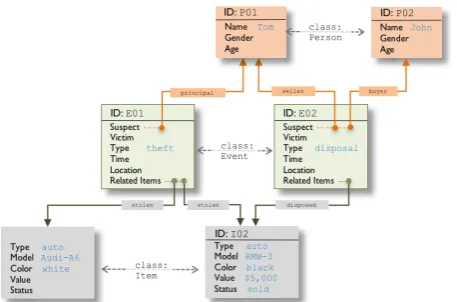
Object Memorystores an object-oriented
represen-tation of document, as illustrated in Figure3. Each
object is an instance of a particular class∗, which
specifies the innate structure of the object, includ-ing internal properties, operations, and how this object can be connected with others. The inter-nal properties can be of different types, for exam-ple string or category, which usually correspond to different actions in specifying them: the string-type property is usually “copied” from the original
text inInline Memory, while the category properties
need to be rendered by a classifier. The links are in general directional and typed, resembling a spe-cial property viewing from the “source object”. In
Figure 3, there are six “linked” objects of three
classes (namely, PERSON, EVENT, and ITEM) .
Taking ITEM-object I02for example, it has five
internal properties (Type, Model, Color, Value,
Status), and is linked with two EVENT-objects
throughstolenanddisposedlink respectively.
In addition to the symbolic properties and links,
each object had also its object-embedding as the
distributed interface withReader. For description
simplicity, we will refer to the symbolic part of
this hybrid representation of objects as the
Ontol-ogy, with some slight abuse of this word.
Object-embedding is complementary to the symbolic part
∗
[image:3.595.307.536.62.213.2]We only consider flat structure of classes, but it is pos-sible to have a hierarchy of classes with different levels of abstractness, and to allow an object to go from abstract class to its child during parsing with more information obtained.
Figure 3: An example of objects of three classes.
of the object, recording all the relevant informa-tion associated with it but not represented in the
Ontology, e.g., the contextual information when the
object is created. Both Ontology and the object
embeddings will be updated in time by the class-dependent operations driven by the actions issued
by thePolicy-netinReader.
According to the way theOntologyevolves with
time, the parsing task can be roughly classified
into two categories: 1)Stationary: there is a
fi-nal ground truth that does not change with time,
and 2)Dynamical: the truth changes with time.
For stationaryOntology, see Section 5.2 and 5.3 for
example, and for dynamical Ontology, please see
Section 5.1.
Inline Memory
Inline Memory stores the relatively raw represen-tation of the document with the sequential
struc-ture. Basically,Inline Memoryis an array of
mem-ory cells, each corresponding to a pre-defined lan-guage unit (e.g., word) in the same order as they are in the original text. Each cell can have dis-tributed part and symbolic part, designed to save the result of preprocessing of text, e.g., plain word embedding, hidden states of RNN, or some sym-bolic processing.
Inline Memoryprovides a way to represent locally encoded “low level” knowledge of the text, which will be read, evaluated and combined with the
global semantic representation inCarry-on Memory
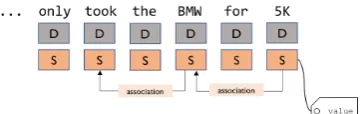
byReader. One particular advantage of this setting is that it allows us to incorporate the local deci-sions of some other models, including “higher or-der” ones like local relations across multiple
lan-guage units, as illustrated in Figure4.
3.2 Reader
Readeris the control center ofOONP, coordinating
Figure 4:Inline Memorywith symbolic knowledge.
Figure 5: The overall digram ofOONP
specifically, it takes the input of different forms (reading), processes it (thinking), and updates the
memory (writing). As shown in Figure5,Reader
contains Neural Net Controller (NNC) and multiple
symbolic processors, andNNC also has Policy-net
as its sub-component. Similar to the controller
in Neural Turing Machine (Graves et al., 2014),
NNC is equipped with multiple read-heads and
write-heads for differentiable read/write over
Ma-trix Memoryand (the distributed part of)Inline
Mem-ory, with a variety of addressing strategies (Graves
et al., 2014). Policy-net however issues discrete
outputs (i.e.,actions), which gradually builds and
updates theObject Memoryin time. The symbolic
processors are designed to handle information in
symbolic form fromObject Memory,Inline Memory,
Action History, andPolicy-net, while that fromInline Memoryand Action Historyis eventually generated byPolicy-net. In Appendix.A†, we give a particular
implementation ofReaderwith more details.
4 OONP: Actions
The actions issued by Policy-net can be generally
categorized as the following
• New-Assign: determine whether to create an
new object for the information at hand or as-sign it to a certain existed object;
• Update.X : determine which internal
prop-erty or link of the selected object to update;
• Update2what: determine the content of the
updating, which could be about string, cate-gory or links;
The typical order of actions is New-Assign →
Update.X → Update2what, but it is common
to have New-Assignaction followed by nothing,
when, for example, an object is mentioned but no
†
The appendix is also available at
https://arxiv.org/abs/1709.08853
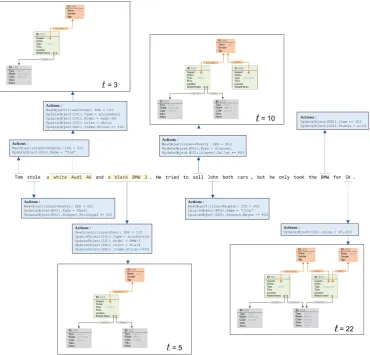
substantial information is provided. As shown in
Figure6, we give an example of the entire episode
of OONPparsing on the short text given in
Fig-ure 1, to show that a sequence of actions
gradu-ally forms the complete representation of the doc-ument.
5 An examples of actions
5.1 New-Assign
With any information at hand (denoted as St) at
time t, the choices of New-Assign include the
following three categories of actions: 1) creating
(New) an object of a certain type, 2) assigningSt
to an existed object, and 3) doing nothing forSt
and moving on. ForPolicy-net, the stochastic
pol-icy is to determine the following probabilities:
prob(c,new|St), c= 1,2,· · ·,|C|
prob(c, k|St), forOc,kt ∈M t
obj
prob(none|St)
where |C|stands for the number of classes, Otc,k
stands for thekthobject of classcat timet.
Deter-mining whether to new an object always relies on the following two signals
1. The information at hand cannot be contained by any existed objects;
2. Linguistic hints that suggest whether a new object is introduced.
Based on those intuitions, we take a score-based approach to determine the above-mentioned
prob-ability. More specifically, for a given St, Reader
forms a “temporary” object with its own
struc-ture (denoted Oˆt) with both symbolic and
dis-tributed sections. We also have a virtual object for
the New action for each classc, denotedOtc,new,
which is typically a time-dependent vector formed byReaderbased on information inMatrix Memory.
For a givenOˆt, we can then define the following
|C|+|Mtobj|+ 1types of score functions:
New: score(newc)(O c,new t ,Otˆ;θ
(c)
new), c= 1,2,· · ·,|C|
Assign: score(assignc) (Oc,kt ,Otˆ;θassign(c) ),forOc,kt ∈Mtobj
Do nothing: scorenone( ˆOt;θnone).
to measure the level of matching between the in-formation at hand and existed objects, as well as the likeliness for creating an object or doing noth-ing. This process is pictorially illustrated in
Fig-ure7. We therefore can define the following
[image:4.595.109.251.152.216.2]Figure 6: A pictorial illustration of a full episode ofOONPparsing, where we assume the description of cars (highlighted with shadow) are segmented in preprocessing.
prob(c,new|St) =
escore(newc)(Oc,tnew,Oˆt;θ(newc))
Z(t) (1)
prob(c, k|St) =
escore
(c)
assign(O c,k
t ,Oˆt;θassign(c) )
Z(t) (2)
prob(none|St) =
escorenone( ˆOt;θnone)
Z(t) (3)
where Z(t) = P
c0 ∈Ce score(c
0)
new(Oc
0,new
t ,Oˆt;θ(c
0)
new) +
P
(c00,k0)∈idx(Mtobj)e
score(c
00)
assign(O c00,k t ,Oˆt;θ(c
00)
assign) +escorenone( ˆOt;θnone) is the normalizing factor.
5.2 Updating Objects
In Update.X step, Policy-net needs to choose the
property or external link (or none) to update for the
selected object determined by New-Assign step.
If Update.X chooses to update an external link,
Policy-netneeds to further determine which object
it links to. After that, Update2whatupdates the
chosen property or links. In task with static
[image:5.595.317.504.462.602.2]On-tology, most internal properties and links will be “locked” after they are updated for the first time, with some exception on a few semi-structured
Figure 7: A pictorial illustration of what the
Readersees in determining whether toNewan
ob-ject and the relevant obob-ject when the read-head on
Inline Memory reaches the last word in the text in
Figure2. The color of the arrow line stands for
dif-ferent matching functions for object classes, where the dashed lines are for the new object.
properties (e.g., the Descriptionproperty in the
experiment in Section7.2). For dynamical
Ontol-ogy, on the contrary, some properties and links are
6 Learning
The parameters of OONPmodels (denotedΘ)
in-clude that for all operations and that for
compos-ing the distributed sections inInline Memory. They
can be trained with supervised learning (SL) , re-inforcement learning (RL), and a hybrid of the two in different ways. With pure SL, the oracle gives the ground truth about the “right action” at each time step during the entire decision process, with which the parameter can be tuned to maximize the likelihood of the truth, with the following objec-tive function
JSL(Θ) =−
1 N
N
X
i Ti X
t=1
log(πt(i)[a ?
t]) (4)
where N stands for the number of instances, Ti
stands for the number of steps in decision process for theithinstance,πt(i)[·]stands for the
probabil-ities of the actions attfrom the stochastic policy,
anda?
t stands for the ground truth action in stept.
With RL, the supervision is given as rewards during the decision process, for which an extreme case is to give the final reward at the end of the
decision process by comparing the generated
On-tologyand the ground truth, e.g.,
r(ti)=
(
0, ift6=Ti
match(MTi
obj,Gi), ift=Ti
(5)
where thematch(MTi
obj,Gi)measures the consistency
between theOntologyof in theObject Memory MTi
obj
and the ground truthG?. We can use policy search
algorithm to maximize the expected total reward,
e.g. the commonly used REINFORCE (Williams,
1992) for training, with the gradient
∇ΘJRL(Θ) =−Eπθ
h
∇ΘlogπΘ
ait|s i t
r(t:iT)i (6)
≈ − 1
N Ti N
X
i T
X
t=1
∇ΘlogπΘ
ait|s i t
rt(i:T)
i. (7)
WhenOONPis applied to real-world tasks, there
is often quite natural supervision signals for both
SL and RL. More specifically, for static Ontology
one can infer some actions from the final ontology based on some basic assumption, e.g.,
• the system shouldNewan object the first time
it is mentioned;
• the system should put an extracted string (say,
that forName) into the right property of right
object at the end of the string.
For those that can not be fully inferred, say the
categorical properties of an object (e.g.,Typefor
event objects), we have to resort to RL to
deter-mine thetimeof decision, while we also need SL
to train Policy-net on the content of the decision.
Fortunately it is quite straightforward to combine the two learning paradigms in optimization. More specifically, we maximize this combined objective
J(Θ) =JSL(Θ) +λJRL(Θ), (8)
whereJSLandJRLare over the parameters within
their own supervision mode andλcoordinates the
weight of the two learning mode on the parameters
they share. Equation (8) actually indicates a deep
coupling of supervised learning and reinforcement learning, since for any episode the samples of ac-tions related to RL might affect the inputs to the models under supervised learning.
For dynamicalOntology(see Section7.1for
ex-ample), it is impossible to derive most of the
de-cisions from the final Ontology since they may
change over time. For those we have to rely mostly on the supervision at the time step to train the action (supervised mode) or count on OONP to learn the dynamics of the ontology evolution by fitting the final ground truth. Both scenarios are
discussed in Section7.1on a synthetic task.
7 Experiments
We applied OONP on three document parsing
tasks, to verify its efficacy on parsing documents with different characteristics and investigate
dif-ferent components ofOONP.
7.1 Task-I: bAbI Task
Data and Task
We implemented OONP on enriched version of
bAbI tasks (Johnson,2017) with intermediate
rep-resentation for history of arbitrary length. In this experiment, we considered only the original bAbi
task-2 (Weston et al., 2015), with an instance
shown in the left panel Figure 8. The ontology
has three types of objects: PERSON-object, ITEM
-object, and LOCATION-object, and three types of
links specifying relations between them (see
Fig-ure8for an illustration). All three types of objects
haveNameas the only internal property.
The task forOONPis to read an episode of story
Figure 8: One instance of bAbI (6-sentence episode) and the ontology of two snapshots.
Action Description
NewObject(c) New an object of class-c.
AssignObject(c, k) Assign the current information to existed object(c, k)
Update(c, k).AddLink(c0, k0, `) Add an link of type-`from object-(c, k)to object-(c0, k0) Update(c, k).DelLink(c0, k0, `) Delete the link of type-`from object-(c, k)to object-(c0, k0)
Table 1: Actions for bAbI.
Implementation Details
For preprocessing, we have a trivial NER to find the names of people, items and locations (saved
in the symbolic part of Inline Memory) and
word-level bi-directional GRU for the distributed
rep-resentations of Inline Memory. In the parsing
pro-cess, Reader goes through the inline
word-by-word in the temporal order of the original text,
makesNew-Assignaction at every word, leaving
Update.X and Update2what actions to the time
steps when the read-head onInline Memoryreaches
a punctuation (see more details of actions in
Ta-ble 1). For this simple task, we use an almost
fully neuralReader(with MLPs forPolicy-net) and
a vector for Matrix Memory, with however a
Sym-bolic Reasonerto maintain the logical consistency after updating the relations with the actions (see Appendx.B for more details).
Results and Analysis
For training, we use 1,000 episodes with length evenly distributed from one to six. We use just REINFORCE with only the final reward defined as the overlap between the generated ontology and the ground truth, while step-by-step supervision on actions yields almost perfect result (result
omit-ted). For evaluation, we use the F1 (Rijsbergen,
1979) between the generated links and the ground
truth averaged over all snapshots of all test in-stances, since the links are sparse compared with all the possible pairwise relations between objects,
with which we get F1= 94.80% without Symbolic
Reasonerand F1= 95.30% with it.
Clearly OONPcan learn fairly well on
recover-ing the evolvrecover-ing ontology with such a small train-ing set and weak supervision (RL with the final reward), showing that the credit assignment over
Figure 9: Example of police report & its ontology.
to earlier snapshots does not cause much difficulty
in the learning ofOONPeven with a generic
pol-icy search algorithm. It is not so surprising to
ob-serve thatSymbolic Reasonerhelps to improve the
results on discovering the links, while it does not improve the performance on identifying the ob-jects although it is taken within the learning.
7.2 Task-II: Parsing Police Report
Data & Task
We implement OONPfor parsing Chinese police
report (brief description of criminal cases written by policeman), as illustrated in the left panel of
Figure 9. We consider a corpus of 5,500 cases
with a variety of crime categories, including theft, robbery, drug dealing and others. Although the language is reasonably formal, the corpus cov-ers a big variety of topics and language styles, and has a high proportion of typos. The ontol-ogy we designed for this task mainly consists of
a number of PERSON-objects and ITEM-objects
connected through an EVENT-object with several
types of relations, as illustrated in the right panel
of Figure 9. A PERSON-object has three
inter-nal properties: Name (string), Gender
(categori-cal) and Age (number), and two types of
exter-nal links (suspect and victim) to an EVENT
-object. An ITEM-object has three internal
prop-erties:Name(string),Quantity(string) andValue
(string), and six types of external links (stolen,
drug,robbed,swindled, damaged,andother) to
an EVENT-object. On average, a sample has 95.24
Chinese words and the ontology has 3.35 objects, 3.47 mentions and 5.02 relationships. Compared
with bAbI in Section7.1, the police report
ontol-ogy has less pairwise links but much richer inter-nal properties for objects of all three objects.
Implementation Details
TheOONPmodel is to generate the ontology as
il-lustrated in Figure 9 through a decision process
with actions in Table 2. As pre-processing, we
[image:7.595.80.279.58.160.2]peo-ple names, locations, item etc. For the distributed
part of Inline Memory, we used dilated CNN with
different choices of depth and kernel size (Yu and
Koltun,2016), all of which will be jointly learned
during training. In updating objects with its
string-type properties (e.g., Name for a PERSON-object
), we use Copy-Paste strategy for extracted string (whose NER tag already specifies which property
in an object it goes to) asReadersees it. For
un-determined category properties in existed objects,
Policy-net will determine the object to update (a
New-Assignaction withoutNewoption), its
prop-erty to update (anUpdate.Xaction), and the
up-dating operation (anUpdate2whataction) at
mile-stones of the decision process , e.g., when reaching an punctuation. For this task, since all the relations
are between the single by-default EVENT-object
and other objects, the relations can be reduced to category-type properties of the corresponding ob-jects in practice. For category-type properties, we
cannot recoverNew-AssignandUpdate.Xactions
from the label (the final ontology), so we resort RL for learning to determine that part, which is mixed
with the supervised learning forUpdate2whatand
other actions for string-type properties.
Action Description
NewObject(c) New an object of class-c.
AssignObject(c, k) Assign the current information to existed object(c, k)
UpdateObject(c, k).Name Set the name of object-(c, k)with the extracted string.
UpdateObject(PE R S O N, k).Gender Set the name of a PERSON-object indexedkwith the extracted string.
UpdateObject(IT E M, k).Quantity Set the quantity of an ITEM-object indexedkwith the extracted string.
UpdateObject(IT E M, k).Value Set the value of an ITEM-object indexedkwith the extracted string.
UpdateObject(EV E N T,1).Items.x Set the link between the EVENT-object and an ITEM-object, where
x∈{stolen,drug,robbed,swindled,damaged,other}
UpdateObject(EV E N T,1).Persons.x Set the link between the EVENT-object and an PERSON-object, andx∈{victim,suspect}
Table 2: Actions for parsing police report.
Results & Discussion
We use 4,250 cases for training, 750 for validation an held-out 750 for test. We consider the follow-ing four metrics in comparfollow-ing the performance of different models:
Assignment Accuracy the accuracy onNew-Assignactions made by the model Category Accuracy the accuracy of predicting the category properties of all
the objects
Ontology Accuracy the proportion of instances for which the generated Objects is exactly the same as the ground truth
Ontology Accuracy-95 the proportion of instances for which the generated Objects achieves 95% consistency with the ground truth
which measures the accuracy of the model in mak-ing discrete decisions as well as generatmak-ing the fi-nal ontology.
Model Assign Acc. (%) Type Acc. (%) Ont. Acc. (%) Ont. Acc-95 (%)
Bi-LSTM (baseline) 73.2±0.58 - 36.4±1.56 59.8±0.83
ENTITYNLM (baseline) 87.6±0.50 84.3±0.80 59.6±0.85 72.3±1.37
OONP(neural) 88.5±0.44 84.3±0.58 61.4±1.26 75.2±1.35
OONP(structured) 91.2±0.62 87.0±0.40 65.4±1.42 79.9±1.28
OONP(RL) 91.4±0.38 87.8±0.75 66.7±0.95 80.7±0.82
Table 3:OONPon parsing police reports.
We empirically investigated two competing
models,Bi-LSTMandEntityNLM, as baselines. Both
models can be viewed as simplified versions of
OONP.Bi-LSTMconsists of a bi-directional LSTM asInline Memoryencoder and a two-layer MLP on
top of that as Policy-net. Bi-LSTM does not
sup-port categorical prediction for objects due to the lack of explicit object representation, which will
only be trained to perform New-Assign actions
and evaluated on them (with the relevant metrics
modified for it). EntityNLM, on the other hand,
has some modest capability for modeling entities with the original purpose of predicting entity
men-tions (Ji et al.,2017) which has been adapted and
re-implemented for this scenario. ForOONP, we
consider three variants:
• OONP(neural): simple version ofOONPwith
only distributed representation inReader;
• OONP(structured): OONPthat considers the
matching between two structured objects in
New-Assignactions;
• OONP(RL): another version ofOONP
(struc-tured) that uses RL‡ to determine the time
for predicting the category properties, while
OONP(neural) and OONP(structured) use a
rule-based approach to determine the time.
The experimental results are given in Table3.
As shown in Table3,Bi-LSTMstruggles to achieve
around 73% Assignment Accuracy on test set,
whileOONP(neural) can boost the performance to
88.5%. Arguably, this difference in performance
is due to the fact that Bi-LSTM lacks Object
Mem-ory, so all relevant information has to be stored in
the Bi-LSTM hidden states along the reading pro-cess. When we start putting symbolic
representa-tion and operarepresenta-tion intoReader, as shown in the
re-sult ofOONP(structure), the performance is again
significantly improved on all four metrics.
From the result of OONP (RL), RL improves
not only the prediction of categorical property (and hence the overall ontology accuracy) but also tasks trained with purely SL (i.e., learning the
New-Assignactions). This indicates there might
be some deep entanglement between SL and RL through the obvious interaction between features in parsing and/or sharing of parameters.
7.3 Task-III: Parsing court judgment docs
Data and Task
Comparing with Task-II, court judgements are typically much longer, containing multiple events
‡
Figure 10: Left: the judgement document with highlighted part being the description the facts of crime; right: the corresponding ontology
of different types and large amount of irrelevant text. The dataset contains 4056 Chinese judge-ment docujudge-ments, divided into training/dev/testing set 3256/400/400 respectively. The ontology for
this task mainly consists of a number of PER
-SON-objects and ITEM-objects connected through
a number EVENT-object with several types of
links. An EVENT-object has three internal
prop-erties: Time(string),Location(string), andType
(category, ∈{theft, restitution, disposal}),
four types of external links to PERSON-objects
(namely, principal, companion, buyer, victim)
and four types of external links to ITEM-objects
(stolen, damaged, restituted, disposed). In
addition to the external links to EVENT-objects ,
a PERSON-object has only theName(string) as the
internal property. An ITEM-object has three
in-ternal properties: Description(array of strings),
Value (string) and Returned(binary) in addition
to its external links to EVENT-objects , where
Descriptionconsists of the words describing the
corresponding item, which could come from mul-tiple segments across the document. An object
could be linked to more than one EVENT-object,
for example a person could be the principal
sus-pect in eventAand also a companion in eventB.
An illustration of the judgement document and the
corresponding ontology can be found in Figure10.
Implementation Details
We use a model configuration similar to that in
Section 7.2, with event-based segmentation of
text given by third-party extraction algorithm (Yan
et al., 2017) in Inline Memory, which enables
OONP to trivially New EVENT-objectwith rules.
OONP reads the Inline Memory, fills the EVENT
-objects, creates and fills PERSON-objects and
ITEM-objects, and specifies the links between
them, with the actions summarized in Table 4.
When an object is created during a certain event, it will be given an extra feature (not an internal property) indicating this connection, which will be used in deciding links between this object and event object, as well as in determining the future
New-Assignactions.
Action for 2nd-round Description
NewObject(c) New an object of class-c.
AssignObject(c, k) Assign the current information to existed object(c, k)
UpdateObject(PE R S O N, k).Name Set the name of thekthPERSON-object with the extracted string.
UpdateObject(IT E M, k).Description Add to the description of ankthITEM-object with the extracted string.
UpdateObject(IT E M, k).Value Set the value of ankth
ITEM-object with the extracted string.
UpdateObject(EV E N T, k).Time Set the time of ankthEVENT-object with the extracted string.
UpdateObject(EV E N T, k).Location Set the location of ankthEVENT-object with the extracted string.
UpdateObject(EV E N T, k).Type Set the type of thekth
EVENT-object among{theft,disposal,
restitution}
UpdateObject(EV E N T, k).Items.x Set the link between thekthEVENT-object and an ITEM-object, wherex∈ {stolen,damaged,restituted,disposed}
UpdateObject(EV E N T, k).Persons.x Set the link between thekthEVENT-object and an PERSON-object, andx∈ {principal,companion,buyer,victim}
Table 4: Actions for parsing court judgements.
Results and Analysis
We use the same metric as in Section7.2, and
com-pare twoOONPvariants,OONP(neural) andOONP
(structured), with two baselinesEntityNLMand
Bi-LSTM. The two baselines will be tested only on the
second-round reading, while both OONPvariants
are tested on a two-round reading. The results are
shown in Table 5. OONPparsers attain accuracy
significantly higher thanBi-LSTM. Among, OONP
(structure) achieves over 71% accuracy on getting the entire ontology right and over 77% accuracy on getting 95% consistency with the ground truth. We omitted the RL results since the model RL model chooses to predict the type properties same as the simple rules.
Model Assign Acc. (%) Type Acc. (%) Ont. Acc. (%) Ont. Acc-95 (%) Bi-LSTM (baseline) 84.66±0.20 - 18.20±0.74 36.88±1.01 ENTITYNLM (baseline) 90.50±0.21 96.33±0.39 39.85±0.20 48.29±1.96
OONP(neural) 94.50±0.24 97.73±0.12 53.29±0.26 72.22±1.01
OONP(structured) 96.90±0.22 98.80±0.08 71.11±0.54 77.27±1.05
Table 5:OONPon judgement documents.
8 Conclusion
We proposed Object-oriented Neural
Program-ming (OONP), a framework for semantically
pars-ing in-domain documents. OONP is neural
net-based, but equipped with sophisticated architec-ture and mechanism for document understanding, therefore nicely combining interpretability and learnability. Experiments on both synthetic and
real-world datasets have shown thatOONP
outper-forms several strong baselines by a large margin on parsing fairly complicated ontology.
Acknowledgments
References
Tim Berners-Lee, James Hendler, and Ora Lassila. 2001. The semantic web. Scientific American
284(5):34–43.
Jan Buys and Phil Blunsom. 2017. Robust incremen-tal neural semantic graph parsing. InProceedings of the 55th Annual Meeting of the Association for Computational Linguistics(ACL). pages 1215–1226.
Fillmore Charles J. 1982. Frame semantics. In Lin-guistics in the Morning Calmpages 111–137.
Hal Daum´e III, John Langford, and Daniel Marcu. 2009. Search-based structured prediction. Machine Learning Journal (MLJ).
Alex Graves, Greg Wayne, and Ivo Danihelka. 2014. Neural turing machines. CoRRabs/1410.5401.
Mikael Henaff, Jason Weston, Arthur Szlam, Antoine Bordes, and Yann LeCun. 2017. Tracking the world state with recurrent entity networks. InICLR.
Henderson, Matthew, Blaise Thomson, , and Steve Young. 2014. Word-based dialog state tracking with recurrent neural networks. In Proceedings of the 15th Annual Meeting of the Special Interest Group on Discourse and Dialogue (SIGDIAL). pages 292– 299.
Jonathan Herzig and Jonathan Berant. 2017. Neural semantic parsing over multiple knowledge-bases. In
Proceedings of the 55th Annual Meeting of the Asso-ciation for Computational Linguistics(ACL). pages 623–628.
Yangfeng Ji, Chenhao Tan, Sebastian Martschat, Yejin Choi, and Noah A. Smith. 2017. Dynamic en-tity representations in neural language models. In
Proceedings of the 2017 Conference on Empirical Methods in Natural Language Processing(EMNLP). Association for Computational Linguistics, pages 1830–1839.
Daniel D. Johnson. 2017. Learning graphical state transitions. In the International Conference on Learning Representations(ICLR).
Berant Jonathan and Liang Percy. 2014. Semantic parsing via paraphrasing. In Association for Com-putational Linguistics (ACL).
Chen Liang, Jonathan Berant, Quoc Le, Kenneth D Forbus, and Ni Lao. 2017. Neural symbolic ma-chines: Learning semantic parsers on freebase with weak supervision. InAssociation for Computational Linguistics(ACL).
Xianggen Liu, Lili Mou, Haotian Cui, Zhengdong Lu, and Sen Song. 2018. Jumper: Learning when to make classification decisions in reading. InIJCAI.
C. J. Van Rijsbergen. 1979. Information Retrieval. Butterworth-Heinemann, Newton, MA, USA, 2nd edition.
Jason Weston, Antoine Bordes, Sumit Chopra, and Tomas Mikolov. 2015. Towards ai-complete ques-tion answering: A set of prerequisite toy tasks.
CoRRabs/1502.05698.
Ronald J Williams. 1992. Simple statistical gradient-following algorithms for connectionist reinforce-ment learning. Machine Learning8:229–256.
Yukun Yan, Daqi Zheng, Zhengdong Lu, and Sen Song. 2017. Event identification as a decision pro-cess with non-linear representation of text. CoRR
abs/1710.00969.
Zichao Yang, Phil Blunsom, Chris Dyer, and Wang Ling. 2017. Reference-aware language models. In
Proceedings of the 2017 Conference on Empirical Methods in Natural Language Processing(EMNLP). Association for Computational Linguistics, pages 1850–1859.
Fisher Yu and Vladlen Koltun. 2016. Multi-scale con-text aggregation by dilated convolutions. InICLR.