
234
Arabic Dialect Identification for Travel and Twitter Text
Pruthwik Mishra and Vandan Mujadia
IIIT, Hyderabad
{pruthwik.mishra,vandan.mu}@research.iiit.ac.in
Abstract
This paper presents the results of the experi-ments done as a part of MADAR Shared Task in WANLP 2019 on Arabic Fine-Grained Di-alect Identification. DiDi-alect Identification is one of the prominent tasks in the field of Natu-ral language processing where the subsequent language modules can be improved based on it. We explored the use of different fea-tures like char, word n-gram, language model probabilities, etc on different classifiers. Re-sults show that these features help to improve dialect classification accuracy. Results also show that traditional machine learning classi-fier tends to perform better when compared to neural network models on this task in a low resource setting.
1 Introduction
In general, Arabic (language), refers to a wide spectrum of native languages used in Middle East and North Africa. As mentioned in Zaidan and Callison-Burch(2014), native languages of Arabic speakers differ with each other and with Modern Standard Arabic (MSA). These native languages or dialects can be categorized based on their com-mon linguistic features and geographical locations (Elaraby and Abdul-Mageed,2018). This catego-rization is described in detail in Bouamor et al.
(2019). In the technological expansion of com-munication era, automatic identification of these dialects becomes an essential task for major natu-ral language applications. These applications can be Machine Translation (Ling et al.,2013), Speech Recognition (Bouamor et al.,2018), Tourist Guide (Alshutayri and Atwell,2017), Real-time Disaster Management (Elaraby and Abdul-Mageed,2018;
Alkhatib et al.,2019) and in health care. The task at hand was to identify a natural language dialect given a sequence of text for Arabic (Salameh and Bouamor, 2018). As per the shared tasks, these
texts were either tourist help guide (subtask1) or the social media text (subtask2).
2 Related Work
Dialect identification is well known task in the Natural Language processing community. We can find work on different languages like English, Ger-man, Chinese, etc (Jauhiainen et al.,2018) for nat-ural language dialect processing. Mostly it can be categorized into spoken and text level tasks. These categorization also includes work on resource cre-ation for dialects (Zaidan and Callison-Burch,
2014;Zampieri et al.,2018) as well as the building a robust system for Dialect Identification. In Ara-bic, it is prerequisite for most NLP tasks, where many subsequent tasks depend on it. We can find spoken dialect identification work inBiadsy et al.
(2009);Najafian et al.(2018);Shon et al.(2017), etc. For text, one can find recent work inElaraby and Abdul-Mageed(2018);Salameh and Bouamor
(2018);Abdul-Mageed et al.(2018);Butnaru and Ionescu(2018);Guellil et al.(2019).
MADAR shared task (Bouamor et al., 2019) consists of two sub-tasks which are
• MADAR Travel Domain Dialect Identifica-tion - this subtask requires identificaIdentifica-tion of the dialect of a sentence, the dialect can be of any one of the pre-defined 26 arabic dialects as described inBouamor et al.(2019)
We utilized features and model described in Salameh and Bouamor (2018) as baselines for Arabic dialect identification on Corpus-26 (Bouamor et al., 2018). We wanted to replicate their model which used multinomial naive bayes classifier (Pedregosa et al.,2011) on character and word n-gram with language model score as fea-tures to get state of the art accuracy.
3 Data
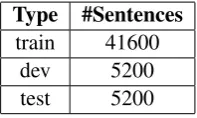
The details of the datasets used for training, de-velopment and test, in different subtasks are given in the tables 1 and 2. In table1, the training data was distributed into 26 classes named as MADAR-Corpus-26 where each class had 1600 samples. Each class had a representation of 200 samples in the dev data.
Type #Sentences
[image:2.595.132.231.308.367.2]train 41600 dev 5200 test 5200
Table 1: Corpus Details for subtask1
Type #Users #Tweets
train 2180 217592 dev 300 29869 test 500 49962
Table 2: Corpus Details for subtask2
4 Experimental Setup
4.1 Prepossessing
Preprocessing is a necessary step while handing textual data. The preprocessing steps involved in the subtasks are detailed
below:-• Tokenization and Normalization : We did not use any off-the-shelf tokenizer for the tweets. We used the standard technique of tokenizing the text on white spaces for both the tasks.
• Text cleaning (Tweets) : Unlike standard texts, tweets can contain different spelling variations of words, special characters, twit-ter handles, urls due to limited space. We tried different experiments to observe the im-pact of removal of the twitter handles and urls
on the overall classification accuracy. We ob-served that removal of these terms adversely affects the classification score. So we chose to keep the tweets as they were.
4.2 Feature Engineering
The features used for subtask1 were similar to those used in Salameh and Bouamor (2018). 3 different machine learning models were explored. All the below mentioned models were imple-mented using scikit-learn (Pedregosa et al.,2011) machine learning library.
• Linear SVM
• Multinomial Naive Bayes
• Logistic Regression
The individual features used in different subtasks are explained in detail here.
• Subtask1
– TF-IDF: We used different combina-tions of word and character level n-grams for the tasks. We observed that combining word and character level n-gram TF-IDF vectors performed signif-icantly better than individual word or character TF-IDF vectors. For our final submissions, combinations of word uni-grams and character level n-uni-grams were considered where n lies in{2,3,4,5}.
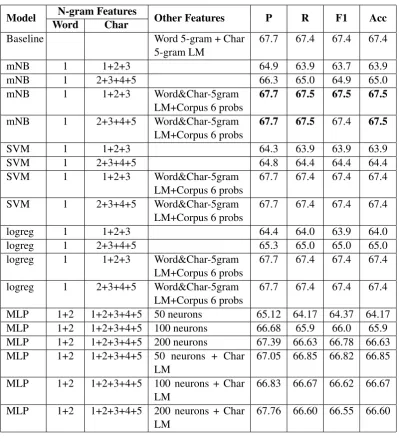
– Language Modeling: We trained dif-ferent language models (LM) for the two types of corpora available to us. We trained the language model on sen-tences specific to a particular class for both MADAR-Corpus-6 (6 LMs) and MADAR-Corpus-26 (26 LMs). 2 fea-tures were included for these language models while developing machine learn-ing models for subtask1. The coarse probabilities mentioned in table3came from the scores of the language model trained on MADAR-6 corpus. The final language model score was arrived at by adding the scores of the word and char-acter 5-gram LMs for both the corpora.
[image:2.595.116.247.410.469.2]Model N-gram Features Other Features P R F1 Acc
Word Char
Baseline Word 5-gram + Char 5-gram LM
67.7 67.4 67.4 67.4
mNB 1 1+2+3 64.9 63.9 63.7 63.9
mNB 1 2+3+4+5 66.3 65.0 64.9 65.0
mNB 1 1+2+3 Word&Char-5gram LM+Corpus 6 probs
67.7 67.5 67.5 67.5
mNB 1 2+3+4+5 Word&Char-5gram LM+Corpus 6 probs
67.7 67.5 67.4 67.5
SVM 1 1+2+3 64.3 63.9 63.9 63.9
SVM 1 2+3+4+5 64.8 64.4 64.4 64.4
SVM 1 1+2+3 Word&Char-5gram LM+Corpus 6 probs
67.7 67.4 67.4 67.4
SVM 1 2+3+4+5 Word&Char-5gram LM+Corpus 6 probs
67.7 67.4 67.4 67.4
logreg 1 1+2+3 64.4 64.0 63.9 64.0
logreg 1 2+3+4+5 65.3 65.0 65.0 65.0
logreg 1 1+2+3 Word&Char-5gram LM+Corpus 6 probs
67.7 67.4 67.4 67.4
logreg 1 2+3+4+5 Word&Char-5gram LM+Corpus 6 probs
67.7 67.4 67.4 67.4
MLP 1+2 1+2+3+4+5 50 neurons 65.12 64.17 64.37 64.17 MLP 1+2 1+2+3+4+5 100 neurons 66.68 65.9 66.0 65.9 MLP 1+2 1+2+3+4+5 200 neurons 67.39 66.63 66.78 66.63 MLP 1+2 1+2+3+4+5 50 neurons + Char
LM
67.05 66.85 66.82 66.85
MLP 1+2 1+2+3+4+5 100 neurons + Char LM
66.83 66.67 66.62 66.67
MLP 1+2 1+2+3+4+5 200 neurons + Char LM
[image:3.595.100.500.58.500.2]67.76 66.60 66.55 66.60
Table 3: Results On Dev Set for subtask1
mentioned in subtask1. We used the dialect probabilities as an additional feature which were present in the column 4 in the pro-vided data. These dialect probabilities were obtained by the best model inSalameh and Bouamor(2018). We followed an ensemble approach for the classification task. Some of the tweets were unavailable in the train-ing set. Some tweets consisted of only en-glish tokens, so the arabic dialect probabil-ities were missing for those tweets. So we used two separate classifiers with the follow-ing features to handle data of different types
– Word Unigram, Character 2-5 gram TF-IDF vectors, dialect probabilities for the tweets which contained arabic text
– Word Unigram, Character 2-5 gram TF-IDF vectors for the tweets which con-tained no arabic text or concon-tained only urls or twitter handles
During testing, different classifiers were used for inferencing with appropriate feature. We marked ‘Saudi Arabia’ as the country of ori-gin for a tweet which was unavailable be-cause most of the tweets in the training set were from the users of Saudi Arab.
4.3 Deep Models
Model N-gram Features Other Features P R F1 Acc Word Char
SVM 1 1+2+3 87.8 49.8 60.0 66.3
SVM 1 2+3+4+5 88.0 50.0 60.07 66.7
SVM 1 2+3+4+5 Dialect Proba-bilities
[image:4.595.88.506.62.297.2]87.9 49.6 59.8 66.3
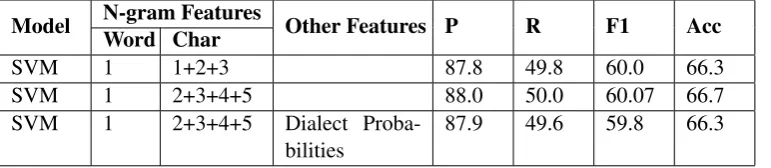
Table 4: Results on Dev Set for subtask2
Subtask-Model N-gram Features Other Features P R F1 Acc Word Char
subtask1-mNB 1 1+2+3 Word&Char-5gram
LM+Corpus 6 probs
66.56 66.31 66.21 66.31
subtask2-SVM 1 1+2+3 Dialect Proba-bilities
83.37 47.73 57.90 67.20
Table 5: Results On Test Set for subtask1 and subtask2
sequential pipeline of keras1 which contains one dense layer (with ReLU (Li and Yuan, 2017) ac-tivation) and output layer with softmax activation with categorical crossentropy as loss function and Adam as optimizer. We trained this classifier for 30 epochs with early stopping criteria on GeForce GTX 1060 GPU. In result section, we show and discuss results in detail.
5 Observations
We could observe that all the classifiers performed similarly when all the features were used. Com-bination of character and word level TF-IDF vec-tors performed better than character or word level TF-IDF vectors in isolation. We could see that the language models trained at word and character level were the biggest contributor to the system‘s performance for subtask1. TF-IDF features and coarse probabilities did not add much to the over-all accuracy. Logistic Regression and multinomial naive bayes techniques performed significantly poor for subtask2, so we did not report the results in this paper. Machine learning approaches formed marginally better than the multi-layer per-ceptrons. This could be due to the higher number of parameters that deep learning approaches try to learn compared to traditional approaches. One of the main reasons for lower classification accuracy in subtask2 is our assumption to assign country of origin for unavailable tweets as ‘Saudi Arabia’.
1https://keras.io
There were 5992 unavailable tweets in the test cor-pus.
6 Conclusion and Future Work
We presented our experiments on supervised di-alect identification task (MADAR) in Arabic. Our experiments demonstrate that for relatively low re-source task such as MADAR, traditional machine learning algorithms with feature engineering show their potentials compared to the deep learning ap-proaches. Unlabelled Arabic corpora can be used to learn character and word embeddings in Ara-bic. It would be an interesting area to explore how recurrent neural networks perform on this task.
References
Muhammad Abdul-Mageed, Hassan Alhuzali, and Mo-hamed Elaraby. 2018. You tweet what you speak: A city-level dataset of arabic dialects. InProceedings of the Eleventh International Conference on Lan-guage Resources and Evaluation (LREC-2018).
Manar Alkhatib, May El Barachi, and Khaled Shaalan. 2019. An arabic social media based framework for incidents and events monitoring in smart cities.
Journal of Cleaner Production, 220:771–785.
Areej Alshutayri and Eric Atwell. 2017. Exploring twitter as a source of an arabic dialect corpus. In-ternational Journal of Computational Linguistics (IJCL), 8(2):37–44.
[image:4.595.110.496.63.147.2]workshop on computational approaches to semitic languages, pages 53–61. Association for Computa-tional Linguistics.
Houda Bouamor, Nizar Habash, Mohammad Salameh, Wajdi Zaghouani, Owen Rambow, Dana Abdul-rahim, Ossama Obeid, Salam Khalifa, Fadhl Eryani, Alexander Erdmann, et al. 2018. The madar arabic dialect corpus and lexicon. In Proceedings of the Eleventh International Conference on Language Re-sources and Evaluation (LREC-2018).
Houda Bouamor, Sabit Hassan, and Nizar Habash. 2019. The MADAR Shared Task on Arabic Fine-Grained Dialect Identification. InProceedings of the Fourth Arabic Natural Language Processing Work-shop (WANLP19), Florence, Italy.
Andrei M Butnaru and Radu Tudor Ionescu. 2018. Unibuckernel reloaded: First place in arabic dialect identification for the second year in a row. arXiv preprint arXiv:1805.04876.
Mohamed Elaraby and Muhammad Abdul-Mageed. 2018. Deep models for arabic dialect identification on benchmarked data. In Proceedings of the Fifth Workshop on NLP for Similar Languages, Varieties and Dialects (VarDial 2018), pages 263–274.
Imane Guellil, Houda Saˆadane, Faical Azouaou, Bil-lel Gueni, and Damien Nouvel. 2019. Arabic nat-ural language processing: An overview. Journal of King Saud University-Computer and Information Sciences.
Tommi Jauhiainen, Marco Lui, Marcos Zampieri, Tim-othy Baldwin, and Krister Lind´en. 2018. Automatic language identification in texts: A survey. arXiv preprint arXiv:1804.08186.
Yuanzhi Li and Yang Yuan. 2017. Convergence analy-sis of two-layer neural networks with relu activation. InAdvances in Neural Information Processing Sys-tems, pages 597–607.
Wang Ling, Guang Xiang, Chris Dyer, Alan Black, and Isabel Trancoso. 2013. Microblogs as parallel cor-pora. InProceedings of the 51st Annual Meeting of the Association for Computational Linguistics (Vol-ume 1: Long Papers), volume 1, pages 176–186.
Maryam Najafian, Sameer Khurana, Suwon Shan, Ahmed Ali, and James Glass. 2018. Exploiting convolutional neural networks for phonotactic based dialect identification. In 2018 IEEE International Conference on Acoustics, Speech and Signal Pro-cessing (ICASSP), pages 5174–5178. IEEE.
Fabian Pedregosa, Gael Varoquaux, Alexandre Gram-fort, Vincent Michel, Bertrand Thirion, Olivier Grisel, Mathieu Blondel, Peter Prettenhofer, Ron Weiss, Vincent Dubourg, Jake Vanderplas, Alexan-dre Passos, David Cournapeau, Matthieu Brucher, Matthieu Perrot, and Edouard Duchesnay. 2011. Scikit-learn: Machine learning in Python. Journal of Machine Learning Research, 12:2825–2830.
Mohammad Salameh and Houda Bouamor. 2018. Fine-grained arabic dialect identification. In Pro-ceedings of the 27th International Conference on Computational Linguistics, pages 1332–1344.
Suwon Shon, Ahmed Ali, and James Glass. 2017. Mit-qcri arabic dialect identification system for the 2017 multi-genre broadcast challenge. In 2017 IEEE Automatic Speech Recognition and Understanding Workshop (ASRU), pages 374–380. IEEE.
Omar F Zaidan and Chris Callison-Burch. 2014. Ara-bic dialect identification. Computational Linguis-tics, 40(1):171–202.
![3 Chloro 6 {4 [3 (4 chlorophenoxy)propyl]piperazin 1 yl}pyridazine](data:image/gif;base64,R0lGODlhAQABAIAAAP///wAAACH5BAEAAAAALAAAAAABAAEAAAICRAEAOw==)