*Corresponding author.
Email addresses: [email protected] - [email protected] (E. Dubinsky),
[email protected] (K. Weller), [email protected] (C. Stenger), [email protected] (D. Vidakovic)
http://www.ejpam.com © 2007. EJPAM All rights reserved.
Vol.1, No. 1, 2008, (99-121) ISSN 1307-5543 – www.ejpam.com
99
Honorary Invited Paper
Infinite iterative processes: The Tennis Ball Problem
Ed Dubinsky¹*, Kirk Weller², Cindy Stinger³,
Draga Vidakovic
4¹ 265 North Woods Rd., Hermon, NY 13652 U.S.A.
² University of Michigan – Flint, ³ University of North Alabama, 4 Georgia State University
Abstract.
Iterative processes are central to the undergraduate mathematics curriculum. In [4], Brown et al. used a problem situation calling for the coordination of two infinite processes to analyze student difficulties in understanding the difference between the union over k of sets P({1,2,…,k}) (P is the power set operator) and the set P(N) of all subsets of the set of natural numbers. In this paper we study students’ thinking about the Tennis Ball Problem which involves movement of an infinite number of tennis balls among three bins. Here, there are three coordinations of infinite processes.As in [4], our analysis uses APOS Theory to posit a description of mental constructions needed to solve this problem. We then interviewed 15 students working in groups on the problem and we detail the responses of five of them, which represent the full range of comments of all the students. We found that only one student was able to give a mathematically correct solution to the problem. The responses of the successful student indicated that he had made the mental constructions called for in our APOS analysis whereas the others had not.
The paper ends with pedagogical suggestions and avenues for future research.
AMS subject classifications: 26A18, 97C50, 11B99, 11B99, 97C20
Key words: Infinite iterative processes , APOS theory, countable sets , natural numbers, student
learning and thinking.
1. Introduction
Iterative processes are central to many topics in the undergraduate curriculum, especially the study of infinite sequences and countably indexed collections. In their theory of embodied cognition, Lakoff and Núñez [1] suggest that iteration forms the conceptual basis of many instances of actual infinity. Dubinsky, Weller, McDonald, and Brown ([2]; [3]) illustrate the importance of infinite iteration in the historical development of mathematical infinity. Hence, research on students’ understandings of infinite iteration has the potential to make an important contribution to research in mathematics education.
Brown et al. [4] used APOS Theory to offer an empirically-based description of the construction of infinite iterative processes and their states at infinity. Their description was based on the analysis of interviews with 12 college students, who attempted to solve the following problem in elementary set theory,
True or False:
∞
=
=
1
)
(
})
,
,
2
,
1
({
kN
P
k
In this problem,Pdenotes the power set operator, and
N
represents the set of natural numbers. Although the problem could be solved using formal set theory arguments, all of the students, at least initially, tried to make sense of the infinite union by constructing iterative processes. The present study extends this research by analyzing the thinking of 15 college students in their attempts to solve the following “tennis ball problem” adapted from Falk [5]:Suppose that we have three bins of unlimited capacity, labeled holding bin, bin A, and bin T, with a dispenser button that when pushed, moves balls from the holding bin to bin A. The holding bin contains an infinite quantity of tennis balls, numbered 1, 2, 3,…. Half a minute before 12:00 noon, the dispenser is pressed and balls #1 and #2 drop into bin A, and ball #1 is moved instantaneously from A to T. A quarter of a minute before 12:00 noon, the dispenser is pressed again and balls #3 and #4 drop into bin A, with the smallest numbered ball in bin A immediately moved into T. In the next step, 1/8th of a minute before 12:00 noon, the dispenser is pressed and balls numbered #5 and #6 drop from the holding bin into bin A, with the smallest numbered ball in bin A immediately moved into T. If the pattern just mentioned continues, what will be the contents of bin A and bin T at 12 noon?
To solve the tennis ball problem, we hypothesize that an individual needs to coordinate three infinite iterative processes: between iteration through
N
and time; between iteration throughN
and the movements of the tennis balls; and between the process resulting from the first two coordinations. As a result, the tennis ball problem is a two-dimensional infinite iterative process whose cognition raises issues not found in [4], where only a single iterative process was studied.This study follows the paradigm presented in Asiala et al. [6]. We begin with a preliminary genetic decomposition of a two-dimensional infinite iterative process, which is rooted in the theoretical description of a single infinite iterative process offered by Brown et al. [4]. We then make an APOS-based analysis of interviews of students who tried to solve the tennis ball problem. Our analysis will reveal that our preliminary genetic decomposition appears to effectively describe their thinking: the lone student who gave a mathematically correct solution of the problem made the mental constructions called for by the analysis; students who were not successful failed to make one or more of those constructions.
In the next section, we briefly describe APOS Theory, present the description of infinite iterative processes offered by Brown et al. [4], discuss the preliminary genetic decomposition of the two-dimensional infinite iterative process motivated by the tennis ball problem, and relate the present study with other related literature, particularly Lakoff and Núñez [1] and Fischbein [7]. We then describe the methodology used to analyze the data. In the main part of the paper, we analyze the thinking of five students whose responses represent the full range of comments made by students in this study. In the last section, we summarize our findings, relate our results to existing literature, suggest possible pedagogical implications, and consider potential avenues for future research.
APOS AND RELATED LITERATURE
In this section, we describe some of the literature related to this study. We begin with an explanation of APOS Theory.
A description of APOS Theory
The acronym APOS, denoting Action, Process, Object, Schema, refers to the types of mental structures an individual builds in responding to certain problem solving situations. An individual uses certain mental mechanisms, such as interiorization, coordination, and encapsulation to construct these structures. According to the theory, formation of a mathematical concept begins as one applies a transformation to existing mental objects. The transformation is first conceived as an action. This is indicated by the explicit execution of all the steps of the transformation, with each step triggering the one that follows. As an individual repeats and reflects on an action, it may be interiorized into a mental process. At this point, the individual reconstructs the action in her or his mind and perceives it as being wholly under her or his control, demonstrating an ability to apply the transformation without needing to perform each step explicitly. When necessary, the individual can mentally reverse the steps of the process, as well as make coordinations with previously constructed processes. Some problem solving situations involve transformation of the process itself. This requires a shift in thinking, from seeing the original transformation as something one does, with a focus on the steps that constitute it, to a conception of the transformation as a static entity, something to which actions can be applied. To engender this shift, the individual needs to encapsulate the process into a mental object. In order for encapsulation to occur, the individual first needs to see the process as complete, that is, he or she needs to be able to imagine that all of the steps have been carried out and to know the salient properties of each step. This has always been a feature of any fully developed process conception, but is particularly important in the case of infinite processes where there is no last step. The ability to conceive of a process as complete is nevertheless insufficient for encapsulation. This was demonstrated empirically in [4], where one student, who conceived of the iterative process corresponding to the infinite unions as complete, could not successfully construct the state at infinity. What was missing was that the student had not yet made the transition from seeing the steps of the process as carried out over time to thinking of the steps of the process as being carried out at a moment in time. That is, the student did not yet see the process as a totality, or single operation. Although totality, like completeness, is always part of the transition from process to object in APOS Theory, Brown et al. [4] highlighted its importance in the case of infinite processes, where it is particularly difficult for an individual to consider infinitely many steps simultaneously. When an individual sees a process as both complete and as a totality, we say that the individual sees the transformation as a completed totality. Such a conception corresponds to Sfard’s [9] notion of condensation, which refers to the mental compression of a process into a unified whole. The ability to apply an action or process to a completed totality indicates that an encapsulation has taken place in the mind of the individual and that he or she sees the transformation as a mental object.
In developing an understanding of a mathematical topic, an individual often constructs many actions, processes, and objects. When these structures are organized and linked into a coherent framework, characterized in part by an ability to determine which phenomena can be assimilated, that is, dealt with, by these constructions, we say that the individual has constructed a schema for the topic.
Although action, process, and object conceptions constitute a hierarchy of the development of a concept, the mental formation of one conception does not replace that of another. When necessary, an individual may de-encapsulate an object back to its underlying process. In other situations, the individual may think of the transformation in terms of actions. Hence, formation of action, process, and object conceptions constitutes the full mental conceptualization of a transformation.
understanding. A preliminary genetic decomposition is informed by APOS Theory, the researchers’ understandings of the concept, existing research on its cognition and its historical development. The preliminary genetic decomposition is tested empirically by having students complete an instructional treatment that reflects the preliminary genetic decomposition or by placing students in problem solving situations where their thinking can be studied. In either case, observations of student thinking provide researchers an opportunity to gather data. Analysis of the data provides an opportunity to see whether the preliminary genetic decomposition adequately describes the students’ thinking or whether revision is needed. Once revised, an empirically-based genetic decomposition is obtained. The revised description leads to the revision of the instructional treatment, or development of one. Implementation of this instruction provides further opportunity for data analysis, which leads to additional revisions of the genetic decomposition. The cycle is repeated until it appears that a reasonable understanding has been developed and an effective pedagogical approach, which may now be considered to be research-based, has emerged.
Explanations based on APOS Theory describe only the types of thinking of which individuals might be capable in dealing with a problem situation. The structures we describe and the way in which these structures may be constructed do not necessarily describe what “really” occurs in an individual’s mind, but provide a model for understanding her or his thinking. Although an individual may give evidence of making certain mental constructions, it is not always the case that the knowledge constructed will be applied to a given situation. Other individual factors, possibly environmental or social, may affect one’s thinking in ways not accounted for by the theory. In this sense, APOS Theory only tells part of the story, although a part that has proven useful in other studies and shown to lead to the design of effective pedagogical strategies (see [10]). For a more detailed description of the theory and its use as a theoretical tool in the analysis of topics in the undergraduate curriculum, see [6] and [11].
An APOS analysis of a single infinite iterative processes
In their analysis of student’s thinking about the problem (*), Brown et al. [4] found that their subjects tried to make sense of the infinite union of power sets by constructing, or attempting to construct, infinite iterative processes and their states at infinity. The authors used APOS Theory to develop an empirically-based theoretical description of the mental construction of such processes. In their description, the authors argued that an infinite iterative process is a coordination of a process of iterating through
N
with a transformation that can be applied repeatedly. This typically begins with the construction of actions; the individual explicitly steps through a finite segment ofN
, typically writing or speaking the values assumed in sequence. The individual may repeatedly add 1, or use other terminology that suggests passing from a natural number to its successor.The action of finite iteration through a small segment of
N
is interiorized to a mental process of iterating through any finite segment ofN
. Multiple instantiations of iterating through finite, but not necessarily initial, segments ofN
are coordinated to construct an infinite process of iteration throughN
. When an individual understands that each natural number has been reached, and acknowledges that only natural numbers have been reached, completeness is indicated.Once viewed as a totality, the infinite iterative process might be encapsulated in an attempt to apply an action of evaluation to determine what is “next”; the resulting object is conventionally labeled ∞. This object may be viewed as a value of an iterating variable that is beyond all natural numbers, but it must be understood that this object is not obtained in the process of iterating through
N
, but through encapsulation of that process.to that natural number as output. Explicitly performing a small number of such assignments is considered to be an action. For example, an individual might perceive the presence of an indexing variable in given mathematical notation as a cue to start with k =1, obtain the first object using the transformation, add 1 to get k =2, obtain the second object, and so forth.
The action of finite iteration is interiorized to a mental process of finite iteration by coordinating a process of iterating through a finite segment of
N
with the transformation. Multiple instantiations of this finite mental process are coordinated to construct an infinite iterative process. Completeness is evidenced when the individual understands that an object is obtained for each natural number in order, and that objects are obtained only for the natural numbers.The ability to conceive of a process as a single operation indicates that the individual sees the process as a totality. At this point, the individual might attempt to apply an action, which might lead to encapsulation. The resulting object is the state at infinity. Since this object is beyond the objects that correspond to the natural numbers, and thus not directly produced by the process, Brown et al. [4] refer to the object as the transcendent object for the process.
Mathematical solution of the tennis ball problem
The tennis ball problem is inherently iterative and also paradoxical. The paradox arises from two seemingly contradictory ideas. At each step, the number of balls in both bin A and bin T exceeds by one that of the previous step; this suggests that bin A is not empty at 12 noon. On the other hand, ballnis moved from bin A to bin T at stepn, which indicates that at 12 noon, A is empty and T contains all of the natural numbers. The latter can be argued mathematically by assuming the contrary: If we assume that some ballpis in bin A at 12 noon, this contradicts the
fact that ballpis moved to bin T at stepp, p
2
1
minutes before 12 noon. Thus, T contains the setof natural numbers N, with both the holding bin and bin A empty.
Preliminary genetic decomposition of two-dimensional infinite iterative process
The cognition of the tennis ball problem is a variation of the cognition of the infinite iterative process considered by Brown et al. [4]. The latter involves a coordination of two infinite processes: iteration through the set
N
of natural numbers; and iteration, indexed byN
, through the unions of certain subsets ofN
. The tennis ball problem considered in the present study involves the coordination of three infinite processes: successive subdivision of the one minute time interval before 12 noon is a coordination of an iteration throughN
with a process of subdivision of the time that remains before 12 noon. The movement of the tennis balls is the coordination of an iteration throughN
with the process of moving the balls. The two iterative processes are then coordinated into a single iterative process, where, at stepn, which occursn
2
1
minutes before 12 noon, balls numbered 2n−1 and2
n
are moved from the holding bin tobin A, and ballnis moved from bin A to bin T. Encapsulation of the coordinated iterative process yields the transcendent object: at precisely 12 noon, the holding bin and bin A are empty, and the contents of bin T is equal to the natural numbers
N
.the former involves partitions of
N
into two disjoint subsets of consecutive natural numbers, whereas the problem situation in [4] involves arbitrary subsets ofN
.Other related literature
For many concepts, particularly those that are abstract and/or complex, Fischbein [7] says that we create models. The models help us to understand the concepts and to reason about them. Although an aid to thinking, a model can also be an obstacle. Specifically, a model may tacitly intervene in one’s reasoning even when it needs to be dropped. For instance, an individual may know that a point has no dimension, but, when presented with two segments of unequal length, believe that the longer segment has more points than the smaller segment because geometric points are unconsciously conceived as smalls dots. When thinking about time, an individual may tacitly think in terms of space. Given an iterative process for subdividing a finite span of time, such as that presented in the tennis ball problem, the individual reasons in spatial terms, and may, as Fischbein [7] contends, fail to avoid Zeno’s paradox. Specifically, in order to get from one point to another, one must first traverse half the distance, then half of the half, and so on, indefinitely. This means that in order to go from one point to another, infinitely many distances have to be covered. However, an infinity of distances cannot be covered in a finite span of time. Purely potential views of subdivision processes abound, so much so that Tirosh and Stavy [12] used the term intuitive rule to describe students’ predominant tendencies to see the divisibility of space and material objects as infinite and uncompletable. In a recent study that asked elementary, secondary, and university students to determine whether the number of drops of water in a cup is finite or infinite, Tirosh [13] found that fewer than 40% of the subjects believed the quantity to be finite. Many said that “everything is divisible by two, including drops of water,” “every drop can be divided by two,” “every drop is made up an infinite number of drops,” or “you can reduce the size of the drop as much as you wish” (p.346).
Deep-seated potential infinity views are not limited to subdivision processes. Throughout history, many philosophers and mathematicians rejected the existence of actual infinity. Aristotle considered actual infinities to be incomprehensible because the completion of an infinite process would require the whole of time. Although he accepted the existence of every natural number, he did not view the natural numbers as an actual infinite collection because to him, a quantity was a number, a number was something arrived at by counting, and given the untraversability of the process of counting there could be no such thing as an infinite quantity (see [14]). Fischbein [7] expressed a similar view: “we cannot conceive of the entire set of natural numbers, but we can conceive of the idea that after every natural number, no matter how big, there is another natural number” (p.310). In instructional situations, however, the natural numbers are often treated as a set. Tall [15] suggests that this may “blur” the distinction between potential and actual infinity. In a questionnaire administered to 42 university students, all claimed to see the natural numbers as a “coherent mathematical idea.” Yet, Tall reported that many students only see actual infinity as a “mathematical fiction,” while potential infinity is viewed as “reality.” So, while students may in some instances see the set of natural numbers as a “coherent mathematical idea,” they may not always see
N
as a static entity. As Tall notes, “university students go through a stage where they accept the actual infinity of a set but only the potential infinity of a process” (p.7).“the number you get if you count forever…the greatest natural integer.” This leads to the notion of an infinite sequence
a
nas possessing a final terma
∞, where “the limit tends to be considered an integral part of the sequence” (p.268).Using their method of mathematical idea analysis, Lakoff and Núñez [1] also considered the issue of final objects arising from infinite processes. They maintain that our understanding of mathematical notions of infinity, such as points at infinity, infinite sets, mathematical induction, infinite decimals, limits, transfinite numbers, and infinitesimals, is based on the establishment of a conceptual metaphor called the Basic Metaphor of Infinity (BMI) that links the target domain of processes that go on and on with the source domain of completed finite iterative processes. Lakoff and Núñez (p.158) argue that the mechanism of conceptual metaphor enables an individual to conceptualize the “result” of an infinite process, the state at infinity, in terms of a process that does have an end. Thus, the crucial effect of the BMI is to add to the target domain, iterative processes that go on and on, the completion of the process and a final resultant state. This metaphorical final result, the state at infinity, may then be perceived as an instance of actual infinity.
For instance, enumeration of
N
starts with the integer 1. This is followed by repeatedly invoking a process of adding 1 to obtain the next natural number, leading to a sequence of intermediate states 1, 2, 3, … ,n for each stepn. An individual metaphorically completes the process by adding an infinite extremity, denoted ∞ (p.175). Lakoff and Núñez note that “∞ as the extreme natural number is commonly used with the explicit or implicit sequence ‘1, 2, 3, … ,∞’ in the characterization of infinite processes” (p.166). Thus, each instance of the BMI is closely tied with iteration through
N
.METHODOLOGY
Fifteen students from three large regional universities participated in the study. The students included mathematics, mathematics education, and computer science majors. The group represented a variety of backgrounds: several had completed two semesters of calculus; others had completed several courses in mathematics beyond calculus, such as linear algebra and/or discrete mathematics; several students had nearly completed an undergraduate mathematics major; one student had completed one year of graduate school in mathematics.
The students were presented with two different problems. The interviewer verbally presented a finite version of the tennis ball problem [5], with no connection to time. This problem, which we refer to as the finite version of the problem, is given below:
Suppose that we have three bins, labeled holding bin, bin A, and bin T and a dispenser button that when pushed, moves balls from the holding bin to bin A. The first press of the dispenser drops balls #1 and #2 into bin A, with ball #1 immediately moved from A to T. When the dispenser is pressed again, balls #3 and #4 drop into bin A, with the smallest numbered ball in bin A immediately moved into T. If this process continues for npresses of the dispenser button, what will be the contents of bin A and bin T?
Following consideration of the finite version of the problem, the students received a written statement of the infinite version of problem that was presented in the Introduction.
The students were interviewed in groups, one group of three and six groups of two. Each 90 minute interview consisted of the students discussing the interviewer’s questions amongst themselves. Based on the students’ responses, the interviewer asked for further clarification and posed follow-up questions, as necessary. The interviews were audio and video taped, and written responses were collected. The audio portions were transcribed verbatim and checked against the recordings for accuracy. By grouping the students, we intended to maximize articulation of student thinking while minimizing interviewer prompting. Although the possibility of cross-student influence could not be eliminated, the cross-students’ interactions appeared to uncover individual conceptions that might not have been revealed in individual interviews. Moreover, Vidakovic [17], in an APOS analysis of students’ conceptions of inverse functions, found that mental constructions resulting from group work do not differ significantly from individual constructions students make when working on a topic alone.
DATA ANALYSIS AND RESULTS
All of the students successfully solved the finite version of the problem. They typically considered the first few steps explicitly, and eventually interiorized those actions to conclude that afternsteps, bin A contains balls numbered n+1 to
2
n
and bin T contains balls numbered 1 ton. They also observed that bins A and T each contain half of the balls dropped, and noted that the quantity in each bin increases with each subsequent step. As Felicia and Ike point out:Felicia: It sounds like that sorting algorithm where you like have a bunch of numbers and where it cuts it in half.
Ike: It cuts it in half and…
Felicia: And this would be throw-away.
Ike: Then the first base number. The biggest number in the group will stay in the big bin and the lowest, the other half, will go throw out, throw away bin.
The infinite version of the problem, which, in addition to movement of the tennis balls, included a process of subdivision of the half minute interval before 12 noon, involved two iterative processes that needed to be coordinated. To illustrate the issues that arose in their attempts to deal with these processes, we provide in-depth individual analyses of the responses of Sam in his interview with one other student, Audrey with two other students, David and Stan, and Paul with one other student. Our description of these students’ responses captures the full range of thinking expressed by the 15 students who participated in the study. We will relate our analysis of these five students to the preliminary genetic decomposition (obtained from the APOS analysis which was described earlier.)
Analysis of the interview with Sam
In this section, we describe Sam’s construction of an iterative process for the passage of time, with 12 noon as the transcendent object. Arrival at 12 noon indicates “get[ting] all of the numbers,” which enables Sam to see the movement of the balls (the successive movement of balls from the holding bin to bin A and bin A to bin T) as a completed process. He then focuses attention on the central issue, what happens to each ball, represented by the correspondence
T :n→ n .
After being presented with the infinite version of the problem, Sam quickly interiorizes the actions associated with the first few steps of the passage of time. In response to his partner Cassie, who says, “it continues in that pattern,” Sam notes the pattern explicitly, “1 over 2 to the
n.” Cassie agrees, although she expresses skepticism about the possibility of reaching 12 noon: “Now we’re taking into consideration what happens when we get to noon, which we’re never going to get to.” Sam disagrees, noting that “as we approach noon, we get all the numbers.” A few moments later he adds:
Sam: Like each iteration, we have this number in there. So you have 1, 2, 3 in T. So what happens after you have infinity iterations? And you have them all in the throw away bin. If all of them are in the throw away bin, then there’s nothing left in A.
As Sam makes this statement, he points to the written work he and Cassie have generated, and gestures to indicate that 1 goes into T at step 1, 2 goes into T at step 2, etc. However, his response fails to clarify the connection between “approaching noon” and “get[ting] all the numbers.” Asked for additional details, Sam offers the following response:
I: What do you mean by all the numbers?
Sam: Positive integers, natural numbers. Alright. And then, um, well, after the iteration, well you get some in A, but every iteration, uh, you get that n in T. So after the third iteration, you’ll have 1, 2, 3 in the throw away bin. So, then after you go through all of this, since it’s like one over two, one over four, it’s sequential limit, the time limit would be 12, so you’d have all the integers in the throw away bin, and so that means if an integer is in A, it’s not in the throw away bin.
Sam apparently sees 12 noon as the transcendent object of the process of subdividing the time. Whether a coordination between the passage of time and the movement of the balls has occurred remains less certain, but what is clear is that Sam’s view of 12 noon as the “sequential limit” appears to help him to see as complete the steps involved in moving the balls. Evidence of coordination occurs later, as seen in the following excerpt, where Sam tries to explain to Cassie why bin T is empty at 12 noon:
Sam: So pick a number.
Cassie: A million.
Sam: Alright, so at one over 2 to the million, right?
That’s really small, right? But that’s only relative, right? Cause you’ve still got till 12 o’clock?
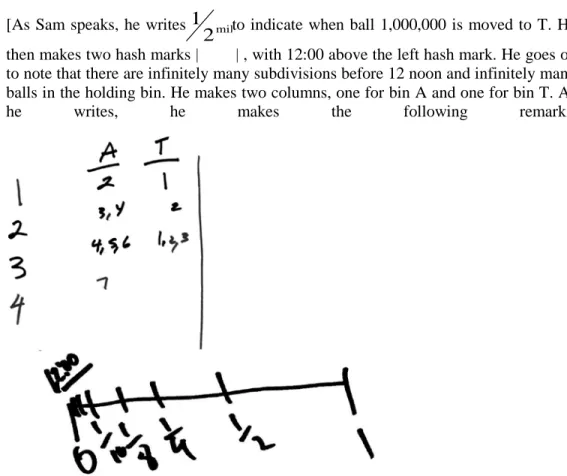
[As Sam speaks, he writes mil
2
1
to indicate when ball 1,000,000 is moved to T. Hethen makes two hash marks | | , with 12:00 above the left hash mark. He goes on to note that there are infinitely many subdivisions before 12 noon and infinitely many balls in the holding bin. He makes two columns, one for bin A and one for bin T. As
he writes, he makes the following remark:]
Sam: Yeah, like each time you have a number in here [in the holding bin], you’ve got the number over here, right [in T]? So, if you say like this is one over two etcetera, etcetera, etcetera…converging to zero.
[Sam makes a number of hand gestures. As he points to columns A and T and notes the successive movement of balls from A to T, he makes several marks in the interval (between | |) to represent the movement of successive balls as he continues:]
Sam: Each time you getnover here, right [in T]? So you’ve got one here, two here,
three here, four here, but you do that an infinite amount of times.
Here, we see evidence of coordination: for each stepn, which occurs n
2
1
minutes before 12 noon,ballnis moved from bin A to bin T. Sam’s gestures, together with his comment, “you do that an
infinite amount of times,” suggest that he sees the coordination as continuing indefinitely. What remains unclear is the explicit construction of an infinite iterative process for the movement of the tennis balls. In an attempt to answer this question, the interviewer asks Sam how he would conceive of the tennis ball problem without the connection to the time process:
Sam: At time one you push the button, at time two you push the button, at time three you push the button, so it never ends, you keep pushing the button. If you get to like somen, well you still have to push the button again. So there’s like no really, I guess I don’t see a stopping point.
Without an explicit connection to time, Sam sees the iterative process of moving the balls as incomplete. This prompted the interviewer to inquire further about the effect of the connection to time:
I: So the 12 o’clock thing sets up for you a way of…
Sam: Saying okay all of these already happened. And then okay here’s the end.
For Sam, 12 noon indicates the “next” step beyond completion of the infinitely many subdivision steps. Coordination of the time process with the process of moving the balls facilitates a conception of the latter process as complete. Consequently, Sam focuses attention on the movement of each ball, that is, consideration of the correspondencen:n→T , which he conceives as a totality. This enables him to make an encapsulation to obtain the correct result:
Sam: So I keep going, so any time I choose ann, like say I choose an nout of the holding thing. Well after the
n
th
time, it’s gonna be in T, and so that for me was like saying, okay, if I have ann, nhas to be in T, so that means all the holdingbin will end up in T.
Once Sam makes these mental constructions, he applies the relevant mathematics, in response to an interviewer query, and argues that bin A is empty using a proof by contradiction.
Analysis of the interview with Audrey
In contrast to Sam, neither Audrey, a senior mathematics major, nor her partner Sol, also a senior mathematics major, see the process of subdividing the half minute interval before 12 noon as complete:
Sol: This little number’s gonna have to be before 12. So it’s actually gonna be 12 minus…one sixteenth…so that’s powers of two and…
Sol: Yep, you would never…you would never reach 12 o’clock with this, but anyways this would just be all the numbers 1 to…
Audrey: As close as you’d get is how many that you’d have.
I: What do you mean you’d never reach 12 o'clock?
Audrey: Because you can infinitely divide this down.
Not only do both students maintain this view throughout their interview, they generally drop the connection to time in their attempt to solve the problem. In fact, from Audrey’s point of view, 12 noon indicates that only a finite number of steps have been completed:
Sol: But if you (looks at I) say if you do make it to noon somehow then why would it be a finite number of balls.
Audrey: Because you made it and you’d have a cut off point.
Sol: Well…it’s just a measure.
I: How would you define the cutoff point?
Audrey: However many times you pressed the button.
I: So you’re saying if you got to 12 noon?
Audrey: Then you’d stop pressing the button. You could count the number of times that you pressed the button and that wouldn’t be infinite, it would be finite.
I: And why wouldn’t it be infinite, if you got to 12 noon?
Audrey: Because you stopped.
Unlike Sam, whose view of the time process enabled him to solve the problem, Audrey and Sol see 12 noon as unattainable. To the degree that the passage of time figures into their thinking, it suggests that the iterative process of moving the balls cannot be completed. Their views align with what Fischbein [7] theorized and Tirosh and Stavy [12] observed: infinite subdivision processes are conceived as uncompletable.
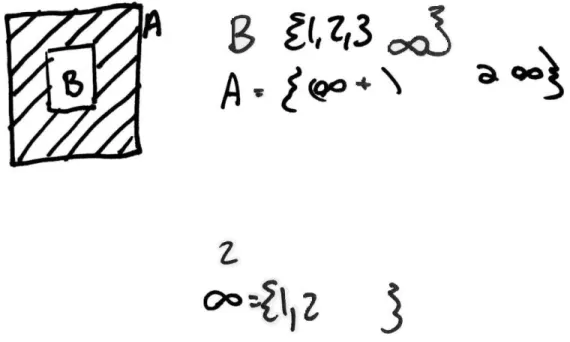
In her initial thinking about the movement of the balls, absent the connection to time, Audrey says that T is “gonna go 1 through whatever.” Sol concurs: “you'd get balls 1 through infinity over there [in T].” Sol explains that “it’s always going to pick the smallest number, so the first time it’s gonna pick one, the second time it’s gonna pick 2, then 3, then 4. It’s just gonna keep sending the balls over. Audrey adds, “you can express it as a set 1, 2, 3, dot, dot, dot, and then let it go.”
Figure 2: Audrey’s Written Work: Relationship between Bin A and Bin T
Audrey: Well, yeah, that’s the problem of…like…infinity. You have to think of it as…there’s one type of infinity in this box [T]…
I: And what type of infinity is that?
Audrey: Well, it’s just 1 through infinity, right?
Audrey: So, then there’s another type here [in A]. I mean, it’s got the same amount, but it’s infinity on to infinity again.
At this point, Audrey appears to see the state at infinity as arising from the process; in particular, the resultant state of each bin behaves like each of the intermediate states: bins A and T each contain half of the balls.
Because she fails to specify the exact contents of A, the interviewer again asks which natural numbers would reside there. Audrey focuses on bin T and reiterates that it consists of “1 up to infinity.” In her written work, though, she writes
{
1
,
2
,
3
,
}
. The interviewer points out the difference, so Audrey adds ∞ to her written work to obtain{
1
,
2
,
3
,
∞
}
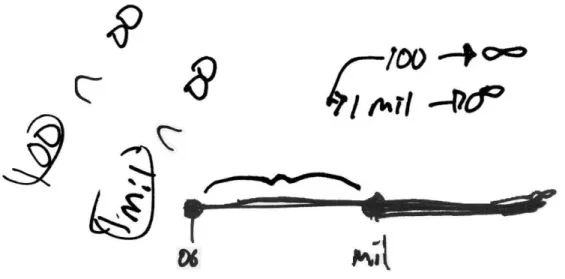
. However, she notes that “it seems really wrong,” because “it’s not really an element.” Sol suggests “just leav[ing] the dots,” because “I think with the dots you know that it’s a sequence and it’s going to infinity, but infinity isn’t an element of the set.” Audrey agrees, and later explains that ∞ cannot be an element of the set, because ∞ indicates the full measure of “going on.”Figure 3: Audrey’s Written Work: ∞ in Relation to Points on the Number Line
Audrey: Sure, this one looks bigger…but, I mean, this isn't a measurable space. How do you measure this, ‘cuz you don’t know what infinity is?
Thus, Audrey offers some indication of seeing the process of iteration through
N
as complete: (1) one obtains only natural numbers, that is, ∞ is not a natural number; (2) each natural number is infinitely far from ∞; (3) when enumerated, the natural numbers can be expressed as a set}
,
2
,
1
{
. Yet, her view of ∞ as a “full measure of going on” indicates that such a conception, if constructed, may be tenuous.In an effort to redirect the students’ thinking, the interviewer asks the students to consider the correspondencen:n→T . Audrey explains that an arbitrarily selected ballqis moved from A to T at stepq: it “hits the first bin (bin A) where it takes a little while but eventually it gets thrown away….It’s always going to go in T atq.” As she imagines continuing these steps, she considers the possibility of A being empty:
Audrey: You could say that everything moves over ‘cuz…like this one, if you go up toqit moves overqelements, alright? So if you go up to infinity, it moves an infinite number of elements. So you might think that there is nothing in A, but if you were to stop it at any one given point, there are elements in A.
I: Yeah I think we all agree about that, but do we ever stop?
Audrey: No.
I: So what happens about A?
Audrey: Well you can say it’s empty, but if you were to stop, it wouldn’t be.
I: Yeah, if you were going to stop, but we aren’t stopping, are we?
Audrey: No, Apparently not. (laughter)
Audrey: No, we said we couldn’t stop.
In this excerpt, the issue of the relationship between the final state and the intermediate states arises again. Audrey seems conflicted over the possibility of bin A being empty, since A is not empty for any intermediate state. A few moments later, she retreats from the possibility of A being empty, in large part because her view of ∞ as the full measure of “going on” is a stronger influence on her thinking:
Audrey: But since it never ends, A is really never empty because there’s always another element that’s comin’ down while something else is movin’ over. But what those elements are, I don’t know. They are natural numbers, but…
I: So in other words, what you’re saying is, at any given spot I’m gonna have stuff in B, I’m gonna have stuff in A.
Audrey: Actually, you’re going to have an equal number of stuff in A and B.
When asked to imagine completing the infinite process of placingnin T at stepn, she rejects this, because to her, completing a process necessarily implies that the process is finite:
I: Can you imagine what it would look like if you did finish, complete this process that we’ve been talking about in your mind. What would be left then if you could?
Audrey: That would be finite, if you completed it.
I: No, I meant complete the infinite process.
Audrey: You have to define infinity if you’re going to do that. Because if you went up to a million and said, “I want an infinite number of times,” and pressed this thing forever, right, you only went to a million. You’ve stopped. There’s more. What about a million and one?
Audrey concludes by saying, “we said that for any natural number, it will eventually be in T,” so “you’d think it’d [bin A] be empty, but you’re still going….I just get stuck ‘cuz balls come down all the time.”
Although she considers the possibility of bin A being empty, Audrey, like the thinking theorized in [16], sees the state at infinity as produced by the process. As a result, she retreats from that possibility. At the same time, she sees the process of iterating through
N
as being mentally in motion. The former and latter views work in tandem, leading her to conclude that both bins contain an equinumerous quantity of balls. Because the stopping point is unknown, the exact contents of both bins cannot be determined.Analysis of the interview with David and Stan
David and Stan, both of whom completed the calculus sequence and a course in linear algebra, tried to solve the infinite version of the problem by extending their reasoning about the finite case. The following exchange, which represents their initial thinking, exemplifies this:
David: As we approach 12, it’s gonna approach infinity, right? And, uh, we’ve already established the pattern, so they’re both gonna contain half the balls, I guess.
Stan: And there’s the same pattern we just…Yeah, that’s right. Uh, it’s the same pattern we just talked about.
David: It’s 1 through n and n+1 through
2
n
, but n is approaching infinity, so, um…It’s, the lower half will be in one bin and the higher half will be in the other, but since there’s not a limit on the number of balls, that doesn’t really name anything.Stan: Right.
I: OK. So what’s the lower half and what’s the upper half?
Stan: Yeah. That’s the problem. You can’t really define…you can’t tell exactly what the numbers will be. We just know that once you get done, the lower half will be over here and the upper half will be over there.
The interviewer redirects their thinking and asks whether they can name a natural number that does not end up in bin T:
I: If I give you any natural number that would come from the dispense bin, will it ever end up in the throw away bin?
Stan: Eventually, yeah. If you push, I mean theoretically speaking, assuming you have infinite balls inside the bin. Any number that comes out, so long as you push it enough times, eventually it will end up in the throw away bin.
I: Okay.
Stan: So actually it goes whatever number comes out if you end up pushingntimes whatever that number is, if that number becomesnthen it’s in the throw away.
I: Okay, what do you mean by if it becomesn?
Stan: So say you have 400 trillion on the ball, if you reach the 400 trillionth push of the button, it will end up in the throw away bin.
I: It will end up in the throw away bin. We’re doing this infinitely many times. Does that happen for then for every single, I mean can you name a natural number for which that doesn’t happen?
David and Stan: No.
A few moments later Stan suggests that bin T will eventually contain all of the natural numbers. However, David rejects this, because “both bins are filled at an equal rate,” and Stan concurs. In some respects, their thinking parallels Audrey’s; she too considered the possibility that bin T will contain N but then retreated. At this point, the similarity ends. Audrey’s difficulty lay in her conception of the state at infinity as being part of the process and her view of iteration through
N
as incomplete. David and Stan, on the other hand, want to apply a limit, as n→∞ , to the formula they generated from the finite case (afternsteps, bin T contains balls numbered 1 throughn, and bin A contains balls numbered n+1 through
2
n
), but they realize that ∞ cannot be used in calculations:Stan: So since infinity’s not an actual number, you can’t do actual math on it. You can’t add infinity, you can’t subtract infinity and what not.
I: Okay so that leaves us in kind of a conundrum then?
David: Like if we’re going infinitely we can’t…well see, yeah, we rely on our definition of n and if ndoesn’t have a definition, if it just keeps going higher, then we can’t use our little formula diagram thing to define it.
They want to take the infinite limit of the expression generated after an arbitrary number of finite steps; they realize this is impossible. At the same time, they have no alternative. The problem appears unsolvable:
Stan: Well, withnwe’re assuming it’s going to be some integer value and just like we’ve been taught in algebra, you plug some number in there and then use that, and so long as it’s a number, we can work with it. But whenever you ask us to do it infinitely many times, we no longer have a number to plug in there. We have the idea that we’re always plugging larger numbers into it, sonstops being a single number and it starts being the concept of being well, infinitely many numbers.
I: So if you’re thinking of infinity, this changes in what way?
Stan: It stops being a single number.
I: It stops being a single number and for you becomes?
Stan: Basically every number higher than what we already have.
I: So it would become that?
Stan: And the next one and then the next one and then you know.
Later in the interview, when asked to describe the natural numbers, the students write
∞
→
k
k
}
,
,
2
,
1
{
. That is, they construct a process of finite iteration and coordinate this with a process of allowingk
to approach infinity. The same type of thinking affects their attempt to solve the iterative process of moving the tennis balls: they generate an expression to represent the completion of an arbitrary number of steps, and then they attempt to apply a limit. Since they know they cannot operate with ∞, and since the process of iterating throughN
continues forever, they cannot determine the exact contents of each bin. Thus, they conclude that both bins contain half the balls.Analysis of the interview with Paul
Paul sees the set of natural numbers as a large finite set, with ∞ as a last term that can be used for calculation. For the finite version of the problem, he notes that afternsteps, T contains balls numbered 1 throughnand A contains balls numbered n+1 through
2
n
. For the infinite case, he substitutes ∞ for n and writes T with 1→∞ written under it and A with ∞+1→2∞ under it. Then he writes2∞−∞+1 for the number of balls in A and “cancels” ∞−∞ to obtain ∞+1. In short, he sees no conflict between the representation of the holding bin as containing balls∞
,
,
2
,
Paul believes that the holding bin, which he sees as consisting of
1
,
2
,
3
,
,
∞
will beemptied after ∞2 steps. This is indicated, for example, when the interviewer asks at which point
the holding bin is emptied; Paul says it would require
2
∞ steps:
I: Yeah, how many times would you have to push it to run it out?
Paul: You’d have to run it, push it half as many times as balls that are in there.
I: Well I’ve got all these balls,nequal 1, 2, 3, and so on.
Paul: Umhm. Well, if you have infinitely many balls, it would have to be infinity divided by two, because each time you’re losing two balls, so take half of them.
There are no such complications for Paul regarding the iterative process of subdividing the time. In this case, Paul conceives of an ongoing, incomplete infinite process where “you can always divide that time in half”:
Paul: …because you’re accelerating the time periods in which you’re hitting the button, getting faster and faster, following the, umm, parabolic curves, so it’ll keep getting faster and faster and faster, and there’s no limit till it reaches noon. It’ll approach it, so it’d be like an asymptote there, because it won’t ever reach it.
Not only is 12 noon unattainable, but the subdivision steps, because successively less time separates them, outnumber the steps necessary to empty the holding bin. This prevents Paul from coordinating the passage of time with the movement of the tennis balls beyond finitely many steps:
Paul: You can keep pushing the button quicker and quicker because you’re accelerating at an exponential rate, and therefore you can keep pushing it and you wouldn’t have quit with a ball in the hopper or a ball in A, because you wouldn’t have pushed noon because there’s still time left to push the button, since your last push, like if you’re at the
n
th
push, you still have 1 over2
n
, 1 over 2 to the ntime before, minutes before noon, and you always can push 1 over 2 to the n
minus, plus 1, and that would get the element in A.
Given this description of Paul’s thinking, we now turn to an analysis of his thoughts about the contents of A when the iterative processes are finished. At one point in the interview, when asked about the state of affairs at noon, his response is:
Paul: Well, provided that we had infinite pushes before noon, every ball would end up in T, provided the hopper3 ran empty, because once it ran empty, each time one ball in A would go into T until A ran out. Under those conditions T would be every ball and A would be empty along with the hopper.
This last comment might appear to suggest that Paul feels that after our process is complete, bin A is empty, which would be the correct answer. However, in light of his division of
∞
,
,
2
,
1
into two parts: 1 to∞ and n+1 to 2∞, his use of the phrase “once it (hopper) ran empty,” together with his further comments, suggests that Paul’s conclusion is based on a process very different from the one we posed. Consider, for example, his response to the same question about the situation at noon:Paul: It (hopper) would have to run out of balls, you would have to keep pushing the button even though it was empty and have one ball go to T each time until you eventually empty out A.
Paul: …you’ll have to keep pushing and pushing until the hopper runs out and keep going until A empties out into T …
It is reasonable to conclude from these excerpts that Paul has changed the process: for the first, the holding bin is emptied, with balls 1 to ∞ in bin T and balls ∞ + 1 to 2∞ in bin A; after that, he begins a new process in which the balls that remain in bin A are moved to bin T. Therefore, in Paul’s mind, at the end of the process of moving each pair of balls from the holding bin to bin A and then, simultaneously, moving one of the pair to bin T, some balls remain in bin A that need to be moved to bin B, which is not the correct answer.
DISCUSSION AND CONCLUSION
In this study we used APOS Theory to analyze students’ attempts to construct what we have called a two-dimensional infinite iterative process. Motivated by the empirically-based theoretical description of infinite iterative processes offered in [4], we developed a preliminary genetic decomposition and then tested that description in interview sessions with 15 college students to whom we posed two versions of the Tennis Ball Problem. The subjects represented a variety of backgrounds: some had completed the calculus sequence and one or two courses beyond that sequence, such as discrete mathematics or linear algebra; others had completed numerous upper division mathematics courses and were at or near the end of their undergraduate careers; and one student was a graduate student. Of the 15 interview subjects, only one supplied a correct mathematical solution. Thus, differences in mathematical background did not arise as an issue in students’ abilities to solve the problem. Outside of “bridge” courses and courses in elementary set theory, the undergraduate curriculum does not address directly the issue of students’ cognitive difficulties associated with the construction of iterative processes and their states at infinity. The results of our analysis demonstrate that mathematics instructors cannot assume that their students can deal successfully with situations involving infinite processes without instructional intervention.
The results of this study both confirm and extend the results reported in [4]: confirmation in that the students’ abilities to solve, or to make progress toward, a solution depended on their ability to see the underlying iterative processes as completed totalities and their states at infinity as transcendent objects; extension, in that the tennis ball problem involves the coordination of three infinite processes, to wit, iteration through
N
, passage of time, and movement of the tennis balls. Successive subdivision of the one minute time interval before 12 noon is a coordination of an iteration throughN
with a process of subdivision of the time that remains before 12 noon. The movement of the tennis balls is a coordination of an iteration throughN
with the process of moving the balls. The two iterative processes are then coordinated into a single two-dimensional iterative process. Encapsulation of the coordinated iterative process yields a transcendent object.Sam, the student who solved the problem correctly, appeared to make the mental constructions called for by the preliminary theoretical analysis. For the process of the subdivision of time, he viewed 12 noon as the transcendent object that indicated “get[ting] through all the numbers.” In particular, he coordinated the time process, which he saw as complete, with iteration through
N
. This enabled him to see the iteration throughN
as a completed totality. He also coordinated the time process with the process of moving the tennis balls. In noting that “you do that an infinite amount of times,” he realized that the coordination continues indefinitely.Sam to see the correspondencen:n→T in totality and to conclude that bin A is empty at 12 noon.
One aspect of Sam’s thinking suggests a possible refinement of the preliminary genetic decomposition. In their description of iterative processes, Brown et al. [4] suggested that iteration through
N
, with ∞ as the transcendent object, precedes the mental construction of an infinite iterative process indexed byN
. Sam could no doubt iterate throughN
; he easily described the subdivision steps and their relation to the natural numbers. However, when asked about the movement of the tennis balls in isolation from the time process, Sam had difficulty seeing the process of moving the balls as complete. The connection to time seemed to alleviate this difficulty. In particular, 12 noon denoted a transcendent “next” step that helped Sam to see the iteration throughN
as a completed totality. Thus, the ability to see the iteration throughN
as a completed totality may be facilitated by coordinating it with an iterative process whose transcendent object is readily apparent.For the other students, the time process did not help their thinking. In fact, Audrey, David, Stan, and Paul did not consider the time process much in their efforts to solve the problem. Beyond finitely many steps, none supplied much evidence of coordinating the passage of time with the process of moving the tennis balls. APOS Theory may help to explain this. In order to coordinate two processes, both must be fully constructed and conceived as complete. The students who saw the passage of time as incomplete also had difficulty seeing the movement of the balls as complete. As a result, coordination was likely impossible, at least beyond finitely many steps. However, the analysis of Sam’s interview casts some doubt on this interpretation. Although he viewed the time process as complete, he saw the process of moving the balls, when isolated from time, as incomplete. Hence, it may be the case that the coordination involved in the construction of a two-dimensional infinite iterative process requires only that at least one, but not necessarily both, processes be viewed as complete.
Difficulties with completeness revealed issues about the construction of final objects. A cursory analysis of the intermediate states of the iterative movement of the tennis balls could easily lead to the erroneous conclusion that bins A and T each contain an infinite quantity of balls. To avoid this pitfall, one must apply the relevant action, specifically, to determine what happens to each ball. In order to apply this action, and overcome the tendency to see the state at infinity as an extension of the intermediate states, one must see the state at infinity as transcendent. Audrey had particular difficulty doing this. Although she articulated that each ball is eventually deposited in bin T, and entertained the possibility that bin A is empty, she retreated from this possibility, in large part, because she saw the process of iterating through
N
, and consequently, that of moving the balls, as incomplete. As she noted toward the end of the interview, “I just get stuck ‘cuz balls come down all the time.” Because she could not conceive of the process in totality to make an encapsulation, her earlier thinking – each bin contains half of the balls – seemed more plausible. In contrast, Sam viewed the correspondence n:n→T in totality, enabling him to direct his focus toward the relevant action of considering what happens to each ball.and bin T contains N). Any action that leads to seeing the state at infinity as generalizing, or inheriting the properties of, the intermediate states yields an erroneous result or no solution. Any action that focuses attention on the final destination of each ball leads to the correct mathematical solution. The interview data suggest that the ability to apply an appropriate action depends on the construction of certain mental structures, particularly the ability to see the process as a completed totality and to encapsulate it. Although Lakoff and Núñez [1] cite completeness as a precondition for construction of the state at infinity, they do not mention the importance of conceiving the process as a totality, nor do they consider the effect of applying different actions to the completed iterative process.
The interview data, both in this study and [4], support Lakoff and Núñez’ contention that individuals often think about aspects of mathematical infinity by trying to apply conceptual metaphors. At the same time, the analyses conducted in both studies demonstrate that determination of the state at infinity of iterative processes may require more than metaphorical thinking. Specifically, the BMI does not identify particular mental mechanisms that may need to be applied to construct such states. Thus, our findings support the assertion made in [18]: by itself, Lakoff and Núñez’ method of mathematical idea analysis does not always provide explanations that account for the full range of students’ mathematical thinking.
In her theoretical analysis, Mamona-Downs [16] discussed students’ tendencies to conceptualize states at infinity as if they were final terms. David, Stan, and Paul all gave evidence of this type of thinking. In both cases, the students reflected on results obtained by completing a finite number of steps. In David and Stan’s case, they obtained a closed form expression from encapsulation of the finite process (bin T contains balls numbered 1 throughn; bin A contains balls numbered n+1 to
2
n
), and then attempted to apply an action to the encapsulated object; specifically, they wanted to allow n to approach infinity. However, knowing that computationswith ∞ are not possible in this context, they concluded that the problem is unsolvable. Their thinking reflected an approach learned in calculus: given a convergent infinite sequence, one can determine the limit by obtaining a closed form expression to which a limit can be applied.
In Paul's interview, he appeared to conceptualize the iteration through
N
as a finite process, with ∞ as a final object available for use in computations. Similar to David and Stan, he obtained a closed form expression to describe the contents of the two bins after completion of nsteps, but, unlike David and Stan, he substituted ∞ for n as if it were a final natural number.
Such an approach also works when considering certain types of infinite limits in calculus. The important point in both cases, and highlighted in the preliminary genetic decomposition, is that reasoning on the basis of the finite process of moving the tennis balls, whether that involves applying an action to the finite process or thinking of the iteration through
N
in finite terms, does not suffice. To solve the tennis ball problem, one must construct an infinite process.Bolzano [19], who played an important role in moving human understanding of mathematical infinity forward, argued that when given two segments of unequal length, the points in a longer segment would constitute a larger infinite quantity than that of a shorter segment. He made this claim despite noting that one could define a bijective correspondence between the two segments. On the other hand, Cantor [20] used correspondence as the sole means for the comparison of infinite sets. He understood that properties that might be relevant in a finite context did not apply when working with infinite collections. In a similar manner, Sam focused exclusively on the fact that the iteration through
N
and the passage of time both involved a countable sequence ofdiscrete steps. Unlike Paul, Sam understood that the correspondence
n
n
n2
1
:
→
is an infiniteprocess.
While the interview analysis generally confirmed the preliminary genetic decomposition, two possible refinements can be cited: (1) construction of the process of iterating through
N
may be facilitated by its coordination with an iterative process whose state at infinity is readily apparent; and (2) the successful coordination of two infinite iterative processes may require that one, but not necessarily both, iterative processes be conceived as complete. Given that these possible refinements surfaced with only a single student, further research on two-dimensional infinite iterative processes is needed to confirm this finding.Although our analysis neither tests nor prescribes a specific instructional treatment, it underscores the issues that arise in the construction of iterative processes; specifically, the issues of completeness, totality, transcendence, and coordination. As the interview results indicate, students often have difficulty constructing iterative processes, thus warranting the need for instructional intervention. Given the crucial role that infinite iteration plays in thinking about aspects of infinity, as noted in [1], [2], [3], the ultimate goal of empirical studies such as this is to guide the development of testable pedagogical materials that address the range of student difficulties associated with infinity concepts.
References
[1]: G. Lakoff, R. Núñez, Where Mathematics Comes From, Basic Books, New York, 2000.
[2]: E. Dubinsky, K. Weller, M. McDonald, A. Brown, A., Some historical issues and paradoxes regarding the concept of infinity: An APOS analysis: Part 1, Educational Studies in Mathematics, 58, 3: 335 – 359 (2005a).
[3]: E. Dubinsky, K., Weller, M. McDonald, A. Brown, Some historical issues and paradoxes regarding the concept of infinity: An APOS based analysis: Part 2, Educational Studies in Mathematics, 60, 2: 253 – 266 (2005b).
[4]: A. Brown, M. McDonald, K. Weller, Step by Step: Infinite Iterative Processes and Actual Infinity, in Research In Collegiate Mathematics (F. Hitt, D. Holton, P. Thompson, Eds.), American Mathematical Society, Providence, RI, to appear.
[5]: R. Falk, Infinity: A cognitive challenge, Theory and Psychology, 4, 1: 35-60 (1994).
[6]: M. Asiala, A. Brown, D. DeVries, E. Dubinsky, D. Mathews, K. Thomas, A framework for research and curriculum development in undergraduate mathematics education, in, Research in Collegiate Mathematics Education II (J. Kaput, A.H. Schoenfeld, E. Dubinsky, Eds.), American Mathematical Society, Providence, RI, 1996.