Proceedings of the 56th Annual Meeting of the Association for Computational Linguistics (Short Papers), pages 401–406 401
Judicious Selection of Training Data in Assisting Language for
Multilingual Neural NER
Rudra Murthy V†, Anoop Kunchukuttan‡∗, Pushpak Bhattacharyya† †Center for Indian Language Technology (CFILT)
Department of Computer Science and Engineering IIT Bombay, India.
‡
Microsoft AI & Research, Hyderabad, India.
{rudra,pb}@cse.iitb.ac.in, [email protected]
Abstract
Multilingual learning for Neural Named Entity Recognition (NNER) involves jointly training a neural network for multiple languages. Typically, the goal is improving the NER performance of one of the languages (the primary language) us-ing the other assistus-ing languages. We show that the divergence in the tag distributions of the common named entities between the primary and assisting languages can reduce the effectiveness of multilingual learning. To alleviate this problem, we propose a metric based on symmetric KL divergence to filter out the highly diver-gent training instances in the assisting language. We empirically show that our data selection strategy improves NER per-formance in many languages, including those with very limited training data.
1 Introduction
Neural NER trains a deep neural network for the NER task and has become quite popular as they minimize the need for hand-crafted features and, learn feature representations from the training data itself. Recently, multilingual learning has been shown to benefit Neural NER in a resource-rich language setting (Gillick et al.,2016;Yang et al., 2017). Multilingual learning aims to improve the NER performance on the language under consid-eration (primary language) by adding training data from one or more assisting languages. The neural network is trained on the combined data of the pri-mary(DP)and the assisting languages(DA). The
neural network has a combination of language-dependent and language-inlanguage-dependent layers, and, the network learns better cross-lingual features via these language-independent layers.
∗
This work began when the second author was a research scholar at IIT Bombay
Existing approaches add all training sentences from the assisting language to the primary language and train the neural network on the combined data. However, data from assisting languages can introduce a drift in the tag distribu-tion for named entities, since the common named entities from the two languages may have vastly divergent tag distributions. For example, the entity China appears in training split of Spanish (pri-mary) and English (assisting) (Tjong Kim Sang, 2002; Tjong Kim Sang and De Meulder, 2003) with the corresponding tag frequencies, Spanish ={Loc: 20,Org: 49,Misc: 1 }and English =
{Loc: 91,Org: 7}. By adding English data to Spanish, the tag distribution of China is skewed towardsLocationentity in Spanish. This leads to a drop in named entity recognition performance. In this work, we address this problem of drift in tag distribution owing to adding training data from a supporting language.
The problem is similar to the problem of data selection for domain adaptation of various NLP tasks, except that additional complexity is introduced due to the multilingual nature of the learning task. For domain adaptation in various NLP tasks, several approaches have been proposed to address drift in data distribution (Moore and Lewis, 2010; Axelrod et al., 2011; Ruder and Plank,2017). For instance, in machine translation, sentences from out-of-domain data are selected based on a suitably defined metric (Moore and Lewis, 2010; Axelrod et al., 2011). The metric attempts to capture similarity of the out-of-domain sentences with the in-domain data. Out-of-domain sentences most similar to the in-domain data are added.
train-Language Source Train Test Word Embeddings (#Tokens) (#Tokens)
English Tjong Kim Sang and De Meulder (2003)
204,567 46,666
Dhillon et al.(2015) (Spectral embeddings) Spanish Tjong Kim Sang(2002) 264,715 51,533
Dutch Tjong Kim Sang(2002) 202,931 68,994 Italian Speranza(2009) 149,651 86,420 German Faruqui and Pad´o(2010) 74,907 20,696
Hindi Lalitha Devi et al.(2014) 81,817 23,696
Bojanowski et al.(2017) (fastText embeddings) Marathi In-house 71,299 36,581
Tamil Lalitha Devi et al.(2014) 66,143 18,646 Bengali Lalitha Devi et al.(2014) 34,387 7,614 Malayalam Lalitha Devi et al.(2014) 26,295 8,275
Table 1: Dataset Statistics
ing instances. Adding assisting language sen-tences with lower divergence reduces the possibil-ity of entpossibil-ity drift enabling the multilingual model to learn better cross-lingual features.
Following are the contributions of the paper: (a) We present a simple approach to select assist-ing language sentences based on symmetric KL-Divergence of overlapping entities (b) We demon-strate the benefits of multilingual Neural NER on low-resource languages. We compare the pro-posed data selection approach with monolingual Neural NER system, and the multilingual Neural NER system trained using all assisting language sentences. To the best of our knowledge, ours is the first work for judiciously selecting a subset of sentences from an assisting language for multilin-gual Neural NER.
2 Judicious Selection of Assisting Language Sentences
For every assisting language sentence, we calcu-late the sentence score based on the average sym-metric KL-Divergence score of overlapping ties present in that sentence. By overlapping enti-ties, we mean entities whose surface form appears in both the languages’ training data. The symmet-ric KL-DivergenceSKL(x), of a named entityx, is defined as follows,
SKL(x) =
KL(Pp(x)||Pa(x) )
+KL(Pa(x)||Pp(x) )
/2 (1)
where Pp(x) and Pa(x) are the probability
dis-tributions for entity x in the primary (p) and the assisting (a) languages respectively. KL refers to the standard KL-Divergence score between the two probability distributions.
KL-Divergence calculates the distance between the two probability distributions. Lower the KL-Divergence score, higher is the tag agreement for an entity in both the languages thereby, reducing the possibility of entity drift in multilingual learn-ing. Assisting language sentences with the sen-tence score below a threshold value are added to the primary language data for multilingual learn-ing. If an assisting language sentence contains no overlapping entities, the corresponding sentence score is zero resulting in its selection.
Network Architecture
Several deep learning models (Collobert et al., 2011; Ma and Hovy, 2016; Murthy and Bhat-tacharyya, 2016; Lample et al., 2016; Yang et al.,2017) have been proposed for monolingual NER in the literature. Apart from the model by Collobert et al.(2011), remaining approaches ex-tract sub-word features using either Convolution Neural Networks (CNNs) or Bi-LSTMs. The proposed data selection strategy for multilingual Neural NER can be used with any of the existing models. We choose the model by Murthy and Bhattacharyya(2016)1in our experiments.
Multilingual Learning
We consider two parameter sharing configurations for multilingual learning (i) sub-word feature extractors shared across languages (Yang et al., 2017) (Sub-word) (ii) the entire network trained in a language independent way (All). AsMurthy and Bhattacharyya (2016) use CNNs to extract sub-word features, only the character-level CNNs are shared for theSub-wordconfiguration.
1The code is available here:https://github.com/
Primary Assisting Layers Data Selection Primary Assisting Layers Data Selection
Language Language Shared All SKL Language Language Shared All SKL
German
Monolingual None 87.64
-Italian
Monolingual None 75.98
-English All 89.08 89.46 English All 76.22 76.91† Sub-word 88.76 89.10 Sub-word 79.44 79.44
Spanish All 89.02 91.61† Spanish All 74.94 76.92† Sub-word 88.37 89.10† Sub-word 76.99 77.45†
Dutch All 89.66 90.85† Dutch All 75.59 77.29† Sub-word 89.94 90.11 Sub-word 77.38 77.56
Table 2: F-Score for German and Italian Test data using Monolingual and Multilingual learning strate-gies.†indicates that theSKLresults are statistically significant compared to adding all assisting language data with p-value<0.05using two-sided Welch t-test.
3 Experimental Setup
In this section we list the datasets used and the net-work configurations used in our experiments.
3.1 Datasets
The Table 1 lists the datasets used in our exper-iments along with pre-trained word embeddings used and other dataset statistics. For German NER, we useep-96-04-16.conllto create train and development splits, and use ep-96-04-15.conll as test split. As Italian has a different tag set compared to English, Spanish and Dutch, we do not share output layer for All configuration in multilingual experiments involving Italian. Even though the languages considered are resource-rich languages, we consider German and Italian as primary languages due to their relatively lower number of train tokens. The German NER data followed IO notation and for all experiments involving German, we converted other language data to IO notation. Similarly, the Italian NER data followed IOBES notation and for all ex-periments involving Italian, we converted other language data toIOBESnotation.
For low-resource language setup, we consider the following Indian languages: Hindi, Marathi2, Bengali, Tamil and Malayalam. Except for Hindi all are low-resource languages. We consider only Person, Location and Organization tags. Though the scripts of these languages are differ-ent, they share the same set of phonemes mak-ing script mappmak-ing across languages easier. We convert Tamil, Bengali and Malayalam data to the Devanagari script using the Indic NLP
li-2Data is available here:http://www.cfilt.iitb.
ac.in/ner/annotated_corpus/
brary3(Kunchukuttan et al.,2015) thereby, allow-ing sharallow-ing of sub-word features across the Indian languages. For Indian languages, the annotated data followed theIOBformat.
3.2 Network Hyper-parameters
With the exception of English, Spanish and Dutch, remaining language datasets did not have official train and development splits provided. We randomly select 70% of the train split for training the model and remaining as development split. The threshold for sentence scoreSKL, is selected based on cross-validation for every language pair. The dimensions of the Bi-LSTM hidden layer are 200 and 400 for the monolingual and multilingual experiments respectively. We extract 20 features per convolution filter, with width varying from1 to9. The initial learning rate is0.4and multiplied by 0.7 when validation error increases. The train-ing is stopped when the learntrain-ing rate drops below 0.002. We assign a weight of 0.1 to assisting language sentences and oversample primary lan-guage sentences to match the assisting lanlan-guage sentence count in all multilingual experiments.
For European languages, we have performed hyper-parameter tuning for both the monolingual and multilingual learning (with all assisting lan-guage sentences) configurations. The best hyper-parameter values for the language pair involved were observed to be within similar range. Hence, we chose the same set of hyper-parameter values for all languages.
3https://github.com/anoopkunchukuttan/
(a) English-Italian: Histogram of English Sentences
[image:4.595.87.271.74.196.2](b) Spanish-Italian: Histogram of Spanish Sentences
Figure 1: Histogram of assisting language sen-tences ranked by their sentence scores
4 Results
We now present the results on both resource-rich and resource-poor languages.
4.1 Resource-Rich Languages
Table2 presents the results for German and Ital-ian NER. We consistently observe improvements for German and Italian NER using our data se-lection strategy, irrespective of whether only sub-word features are shared (Sub-sub-word) or the entire network (All) is shared across languages.
Adding all Spanish/Dutch sentences to Italian data leads to drop in Italian NER performance when all layers are shared. Label drift from overlapping entities is one of the reasons for the poor results. This can be observed by compar-ing the histograms of English and Spanish sen-tences ranked by the SKL scores for Italian mul-tilingual learning (Figure 1). Most English sen-tences have lower SKL scores indicating higher tag agreement for overlapping entities and lower drift in tag distribution. Hence, adding all En-glish sentences improves Italian NER accuracy. In contrast, most Spanish sentences have larger SKL
scores and adding these sentences adversely im-pacts Italian NER performance. By judiciously se-lecting assisting language sentences, we eliminate sentences which are responsible for drift occurring during multilingual learning.
To understand how overlapping entities im-pact the NER performance, we study the statis-tics of overlapping named entities between Italian-English and Italian-Spanish pairs. 911 and 916 unique entities out of 4061 unique Italian entities appear in the English and Spanish data respec-tively. We had hypothesized that entities with di-vergent tag distribution are responsible for hinder-ing the performance in multilhinder-ingual learnhinder-ing. If we sort the common entities based on their SKL divergence value. We observe that 484 out of 911 common entities in English and 535 out of 916 common entities in Spanish have an SKL score greater than 1.0. 162 out of 484 common enti-ties in English-Italian data having SKL divergence value greater than 1.0 also appear more than 10 times in the English corpus. Similarly, 123 out of 535 common entities in Spanish-Italian data hav-ing SKL divergence value greater than 1.0 also appear more than 10 times in the Spanish cor-pus. However, these common 162 entities have a combined frequency of 12893 in English, mean-while the 123 common entities have a combined frequency of 34945 in Spanish. To summarize, al-though the number of overlapping entities is com-parable in English and Spanish sentences, entities with larger SKL divergence score appears more frequently in Spanish sentences compared to En-glish sentences. As a consequence, adding all Spanish sentences leads to significant drop in Ital-ian NER performance which is not the case when all English sentences are added.
[image:4.595.92.276.229.351.2] [image:4.595.311.509.585.722.2]Primary Language
Assisting Language
Hindi Marathi Bengali Malayalam Tamil
ALL SKL ALL SKL ALL SKL ALL SKL ALL SKL
Hindi 64.93 - 59.30 66.33 58.51 59.30 58.21 59.13 56.75 58.75
Marathi 54.46 63.30 61.46 - 47.67 61.28 50.13 61.05 59.04 58.62
Bengali 44.34 51.05† 41.28 55.77† 40.02 - 48.79 49.84† 38.38 44.14†
Malayalam 59.74 64.00† 65.88 66.42† 58.01 63.65† 57.94 - 58.25 58.92 Tamil 60.13 61.51† 60.54 61.67† 53.27 60.32† 61.03 61.45 53.13
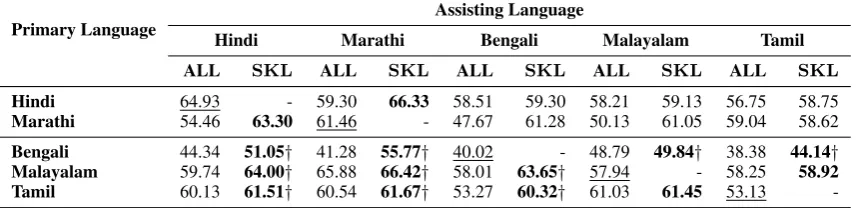
-Table 3: Test set F-Score from monolingual and multilingual learning on Indian languages. Result from monolingual training on the primary language is underlined. † indicatesSKL results statistically significant compared to adding all assisting language data with p-value< 0.05using two-sided Welch t-test.
4.2 Resource-Poor Languages
As Indian languages exhibit high lexical overlap (Kunchukuttan and Bhattacharyya, 2016) and syntactic relatedness (V Subb˜ar˜ao, 2012), we share all layers of the network across languages. Table3presents the results. Bengali, Malayalam, and Tamil (low-resource languages) benefits from our data selection strategy. Hindi and Marathi NER performance improves when the other is used as assisting language.
Bengali, Malayalam, and Tamil have weaker baselines compared to Hindi and Marathi, and are benefited from our approach irrespective of the assisting language chosen. However, Hindi and Marathi are not benefited from multilingual learn-ing with Bengali, Malayalam and Tamil. Malay-alam and Tamil being morphologically rich have low entity overlap (surface level) with Hindi and Marathi. As a result, only2-3%of Malayalam and Tamil sentences are eliminated from our approach, leading to no gains from multilingual learning. Hindi and Marathi are negatively impacted by noisy Bengali data. Bengali has less training sen-tences compared to other languages and, choosing a low SKL threshold results in selecting very few Bengali sentences for multilingual learning.
4.3 Influence of SKL Threshold
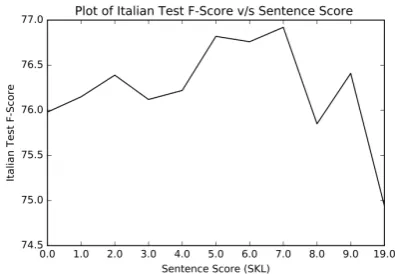
Here, we study the influence of SKL score threshold on the NER performance. We run experiments for Italian NER by adding Spanish training sentences and sharing all layers except for output layer across languages. We vary the threshold value from1.0 to9.0in steps of1, and select sentences with score less than the threshold. A threshold of0.0indicates monolingual training and threshold greater than9.0indicates all
assist-ing language sentences considered. The plot of Italian test F-Score against SKL score is shown in the Figure2. Italian test F-Score increases initially as we add more and more Spanish sentences and then drops due to influence of drift becoming significant. Finding the right SKL threshold is important, hence we use a validation set to tune the SKL threshold.
5 Conclusion
In this paper, we address the problem of diver-gence in tag distribution between primary and as-sisting languages for multilingual Neural NER. We show that filtering out the assisting language sentences exhibiting significant divergence in the tag distribution can improve NER accuracy. We propose to use the symmetric KL-Divergence met-ric to measure the tag distribution divergence. We observe consistent improvements in multilingual Neural NER performance using our data selec-tion strategy. The strategy shows benefits for ex-tremely low resource primary languages too.
This problem of drift in data distribution may not be unique to multilingual NER, and we plan to study the influence of data selection for mul-tilingual learning on other NLP tasks like sen-timent analysis, question answering, neural ma-chine translation, etc. We also plan to explore more metrics for multilingual learning, specifi-cally for morphologispecifi-cally rich languages.
Acknowledgements
[image:5.595.86.516.66.170.2]References
Amittai Axelrod, Xiaodong He, and Jianfeng Gao. 2011. Domain adaptation via pseudo in-domain data selection. InProceedings of the 2011 Conference on Empirical Methods in Natural Language Process-ing, Edinburgh, United Kingdom.
Piotr Bojanowski, Edouard Grave, Armand Joulin, and Tomas Mikolov. 2017. Enriching word vectors with subword information. Transactions of the Associa-tion for ComputaAssocia-tional Linguistics.
Ronan Collobert, Jason Weston, L´eon Bottou, Michael Karlen, Koray Kavukcuoglu, and Pavel Kuksa. 2011. Natural language processing (almost) from scratch. Journal of Machine Learning Research.
Paramveer S. Dhillon, Dean P. Foster, and Lyle H. Un-gar. 2015. Eigenwords: Spectral word embeddings.
Journal of Machine Learning Research.
Manaal Faruqui and Sebastian Pad´o. 2010. Training and evaluating a German Named Entity Recognizer with semantic generalization. In Proceedings of
KONVENS.
Dan Gillick, Cliff Brunk, Oriol Vinyals, and Amarnag Subramanya. 2016. Multilingual language process-ing from bytes. InProceedings of the 2016 Confer-ence of the North American Chapter of the Associa-tion for ComputaAssocia-tional Linguistics, San Diego, US.
Anoop Kunchukuttan and Pushpak Bhattacharyya. 2016. Orthographic syllable as basic unit for SMT between related languages. In Proceedings of the 2016 Conference on Empirical Methods in Natural Language Processing, Texas, USA.
Anoop Kunchukuttan, Ratish Puduppully, and Pushpak Bhattacharyya. 2015. Brahmi-net: A transliteration and script conversion system for languages of the In-dian subcontinent. InProceedings of the 2015 Con-ference of the North American Chapter of the Asso-ciation for Computational Linguistics: Demonstra-tions, Colorado, USA.
Shobha Lalitha Devi, Pattabhi RK Rao, Malarkodi C.S, and R Vijay Sundar Ram. 2014. Indian language NER annotated FIRE 2014 corpus (FIRE 2014 NER Corpus). InNamed-Entity Recognition Indian Lan-guages FIRE 2014 Evaluation Track.
Guillaume Lample, Miguel Ballesteros, Kazuya Kawakami, Sandeep Subramanian, and Chris Dyer. 2016. Neural architectures for Named Entity Recog-nition. In Proceedings of the 2016 Conference of the North American Chapter of the Association for Computational Linguistics, San Diego, US.
Xuezhe Ma and Eduard Hovy. 2016. End-to-end se-quence labeling via Bi-directional LSTM-CNNs-CRF. In Proceedings of the 54th Annual Meeting of the Association for Computational Linguistics, Berlin, Germany.
Robert C. Moore and William Lewis. 2010. Intelligent selection of language model training data. In Pro-ceedings of the 48th Annual Meeting of the Associ-ation for ComputAssoci-ational Linguistics, Uppsala, Swe-den.
Rudra V. Murthy and Pushpak Bhattacharyya. 2016. A deep learning solution to Named Entity Recognition. InCICLing, Konya, Turkey.
Sebastian Ruder and Barbara Plank. 2017. Learning to select data for transfer learning with Bayesian Opti-mization. InProceedings of the 2017 Conference on Empirical Methods in Natural Language Process-ing, Copenhagen, Denmark.
Manuela Speranza. 2009. The Named Entity Recogni-tion task at EVALITA 2009. InProceedings of the Workshop Evalita.
Erik F. Tjong Kim Sang. 2002. Introduction to the conll-2002 shared task: Language-independent Named Entity Recognition. InProceedings of the 6th Conference on Natural Language Learning at COLING-02, Taipei, Taiwan.
Erik F. Tjong Kim Sang and Fien De Meulder. 2003. Introduction to the conll-2003 shared task: Language-independent Named Entity Recognition. In Proceedings of the Seventh Conference on Nat-ural Language Learning at HLT-NAACL 2003, Ed-monton, Canada.
K˜arum˜uri V Subb˜ar˜ao. 2012. South Asian Languages: A Syntactic Typology. Cambridge University Press.