Abstract— In this paper, behavioral model of a high speed Phase Locked Loop (PLL) based frequency synthesizer is presented which is used for Radio Frequency Identifier (RFID) in UHF carrier. The results are validated through System Vision simulation using Very High Speed Integrated Circuit Hardware Description Language-Analog Mixed Signal (VHDL-AMS). PLL consists of a low jitter PLL employing a Voltage Controlled Crystal Oscillator (VCXO). The advantage of using low-jitter wide-band PLL is excellent performance in terms of jitter and frequency locking. Simulation results are in good agreement with theoretical calculations. Radio Frequency Identification (RFID) uses RF radiation to identify physical objects. With decreasing integrated circuit (IC) cost and size, RFID applications are becoming economically feasible and gaining popularity. In UHF passive RFID tag, communication system needs low-jitter signal for UHF transmitter and receiver to minimize the error in data stream.
Index Terms—Behavioral Modeling, Frequency Synthesizer, Phase Locked loop, RFID and VHDL-AMS.
I. INTRODUCTION
hase Locked Loops (PLLs) are widely used as an important building block of many circuits and systems [1]–[2]. In this paper, a frequency synthesizer is used to recover the data stream from the transmitted carrier. The property of making its output frequency an exact multiple of reference frequency makes PLL the ideal choice for frequency synthesizers. The common method for frequency synthesis is to lock a PLL to a multiple of some reference frequency. PLL based frequency synthesizers are used in wide range of telecommunication circuits. In this case we used it in Radio Frequency Identification (RFID) system that uses RF radiation to identify physical objects. Decreasing integrated circuit (IC) costs and sizes, RFID applications are becoming economically feasible and gaining popularity.
II. TYPES OF RFID
RFID systems can be classified according to the radio frequency used, the type of modulation used to communicate and the type of tag used in the system.
Manuscript received March 13, 2015; revised Manuscript received; revised April 4, 2015.
Ahmed Telba is with King Saud university Electrical Engineering Department Saudi Arabia (corresponding author e-mail: atelba@ ksu.edu.sa). Khalid Jamil is with PSATRI King Saud university (e-mail: [email protected]). This work is supported by NPST program by King Saud University, Project Number 12-ELE2462– 02).
Radio Frequency: The radio frequency is defined as the frequency of the sine wave generated by the reader to send a request to the tag. Carrier wave frequency is of primary importance in determining data transfer rates. In practical terms the rate of data transfer is influenced primarily by the frequency of the carrier wave used to carry the data between the tag and its reader. Generally speaking, higher the carrier frequency, higher the data transfer that can be achieved. Three frequency ranges are generally pre-defined in RFID systems as low, intermediate (medium) and high as shown in Table 1.
Fig. 1 shows the block diagram of an RFID tag baseband while Fig. 2 shows the jitter generated in oscillator for transmit and receive side. Fig. 3 shows the RFID reader-tag communication packet for design of data transmutation. UHF RFID needs low-jitter transmit and received data in clock recovery systems that can minimize the error in reading objects.
Behavioral modelling and simulation allows an easier characterization of the full system. It is more time efficient than full circuit-level simulation and is useful for verification purposes. Behavioral modelling is commonly performed with high level hardware description languages (HDLs) such
Modeling and Simulation of High Speed PLL
Based Frequency Synthesizer Used in RFID
Ahmed Telba
Member, IAENG, Member IEEE
, Khalid Jamil
P
TABLEI:RFID FREQUENCY BANDS Frequency
Range
Frequency
Low 100-500 kHz
Intermediate 10-15 MHz
[image:1.595.345.504.340.447.2]High 2.4-5.8 GHz
[image:1.595.310.537.572.688.2]as Very High Speed Integrated Circuit Hardware Description Language-Analog Mixed Signal (VHDL-AMS) [3]–[4]
VHDL-AMS is a very powerful extension of an already comprehensive VHDL language. The analog electronics extensions and general-purpose differential equation, s-domain, and z-domain extensions, combined will all digital enhancements, make this a truly rich language for modeling a broad spectrum of real-world systems [5].
A straight-forward implementation of PLL-based frequency synthesizer consists of the following basic building blocks: phase detector, loop filter, voltage controlled oscillator (VCO) and a frequency divider [2]. To the best of our knowledge there has been no previous work dealing with modelling and simulation of frequency synthesizer using dual PLLs connected in cascade. Researchers have modeled and simulated frequency synthesizer using a single PLL with different variations [6]– [8]. However, in this paper we describe a dual cascaded PLL based frequency synthesizer using VHDL-AMS which provides a low jitter signal to recover the data input of Radio Frequency Identification (RFID).
The remainder of the paper is organized as follows. In section 2, we describe a frequency synthesizer using dual cascaded PLLs. A brief overview of VHDL-AMS is provided in section 3. Each component of the PLL is then modeled behaviorally using SystemVision VHDL-AMS
environment in the section 4. Stability of the proposed system is studied in section 5. The simulation results of the proposed circuit are then discussed in section 6. Finally, section 7 concludes the paper.
III. DUAL CASCADE PLL-BASED FREQUENCY SYNTHESIZER
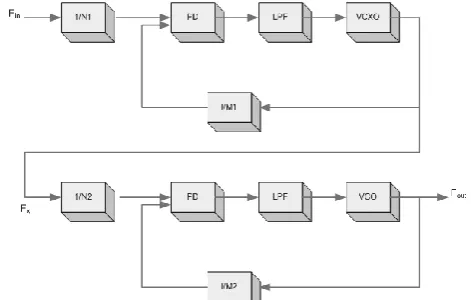
The block diagram of a dual cascaded PLL based frequency synthesizer is shown in Fig. 4. The circuit consists of two PLLs connected in cascade i.e., the output generated by the first one is supplied as an input to the second PLL. The first one is a PLL which uses a Voltage Controlled Crystal Oscillator (VCXO) with a center frequency of fx not
necessarily equal to fin. The second one is a narrow band
PLL with a wide sweep range [9]–[10]. The bandwidths of the two PLL are carefully selected to minimize the overall output jitter.
The VCXO produces a low jitter output signal. A frequency divider producing a divide-by-N signal, allows the VCXO to operate at N multiples of the reference clock provided by an oscillator running at UHF. In this case study, the carrier frequency is selected from (300 MHz-3GHz). The divider output signal is compared to that of the oscillator by a Phase Detector (EX-OR gate). A Digital-to-Analog Converter (DAC) is used to convert the digital output of the Phase Detector into an analog signal which is fed to the VCXO after being filtered by a low pass filter. The analog VCO output is passed through an Analog-to-Digital Converter (ADC) before being passed to the Phase Detector through the divider. Thus, ADC and DAC are the interface blocks.
With the first loop in lock condition [6]:
1
1
N
f
M
f
in
x (1)Similarly, for the second loop in lock condition
2
2
M
f
N
f
out
x (2)Using (1) and (2), we get
Fig 2 Jitter generated on transmitter side
[image:2.595.309.545.453.603.2]Fig 3 RFID reader-tag communication packet
)
(
2 1 2 1M
M
N
N
f
f
out
in (3)Equation 3 shows that only one VCXO is required to produce different output frequencies.
A. Overview of VHDL-AMS
VHDL-AMS, a superset of VHDL, is a powerful hardware description language for analog, digital, and mixed-signal applications. It supports modeling at various abstraction levels in electrical and non-electrical energy domains [4]. A VHDL-AMS model consists of an entity and one or more architectures. The entity specifies the interface of the model to the outside world i.e., the inputs and outputs. The architecture includes the implementation of the model. It may be coded using behavioral style, structural style, or a combination of behavioral and structural styles
SystemVision is a commercial mixed signal modelling and simulation environment that provides a virtual lab for creating and analyzing analog, digital and mixed signal systems produced by Mentor Graphics [11]. It provides simulation of the complete system before prototype and shows a dramatic improvement in simulation time for the VHDL-AMS module.
B. VHDL-AMS Behavioral Models
This section describes the basic subsystems and modules that are used in the design of the frequency synthesizer. VHDL-AMS architecture of important modules is also described briefly in this section.
C. Phase Detector
The heart of a PLL based frequency synthesizer is Phase Detector. It is a circuit that produces an output signal that is proportional to the phase difference between two inputs signals. The library model chosen for a Phase Detector is a simple Exclusive OR (EXOR) gate. This is a purely digital VHDL model. ADC and DAC are inserted at the interfaces.
D.Low Pass Filter
LPF allows only the low frequency part of the phase difference to pass to the VCO. The high frequency part is filtered out. As a result, the PLL only tracks the low frequency variation and does not allow the high frequency variation. The LPF e transfer function given in 4 and the simulated signal shown in fig .5.
2 2 2
)
(
p pw
s
Q
w
s
w
K
s
H
p
(4)where,
p
p
f
w
2
(5)The same low pass filter is used for both PLLs but with different specifications. The first PLL uses fp = 5 Hz, K= 1.0
and Q = 1.0, whereas the second PLL has the following design criteria: fp = 10MHz, K = 1.0 and Q = 1.0.
E. Voltage Controlled Oscillator
It is a voltage controlled oscillator whose output frequency is linearly proportional to the control voltage VC
generated by the Phase detector. The library model chosen for a VCO uses the following relationship:
f
out
f
c
K
v
V
in (6)The behavioral model of VCO (VCXO) is described in VHDL-AMS as shown in Fig. 6. The first VCO uses the following design values: Kv = 1 MHz / V and fc = 1.544 GHz
and the second VCO uses Kv = 200 MHz / V and fc = 600
MHz. A VCO initially runs at a frequency close to the expected data rate. A portion of the VHDL-AMS code for VCO is as follows.
F. Frequency divider
PLL used in frequency synthesis often use a frequency divider. It is a simple divide by four counter circuits implemented using two D Flip-flops. The circuit can be easily extended for different values of N. The frequency divider is another purely digital block which is described completely in VHDL. Fig. 5 shows the simulation results for the frequency divider block.
G.Stability Study of Dual Cascaded PLLs
In the proposed system, we are using two cascaded closed loop systems. Each closed loop system is described by both phase detector and voltage controlled oscillator, and may be represented by a simple gain (i.e., no dynamics). The stability of the closed loop system in this case depends on the order of the low pass filter. If the low pass filter is of the first order, then the system is always stable irrespective of the parameters (VCO gain, phase detector gain, low pass filter gain, divider ratio). If the low pass filter is of higher order i.e., second, third or fourth, etc., then the stability should be checked for each system individually.
[image:3.595.309.544.56.245.2]Using one of the known techniques (Rout's criterion, Nyquist theorem, Root Locus, Bode plot, etc.) we can check
the stability of the overall system. If we can prove that each of the two cascaded systems is stable, then we can prove that the overall system is stable. In our study we used the Bode diagram to prove the stability of the overall system by checking the stability of the low pass filter. In our study the low pass filter is of second order, and we proved that it is stable, and concluded that the overall system does not encounter any stability problems.
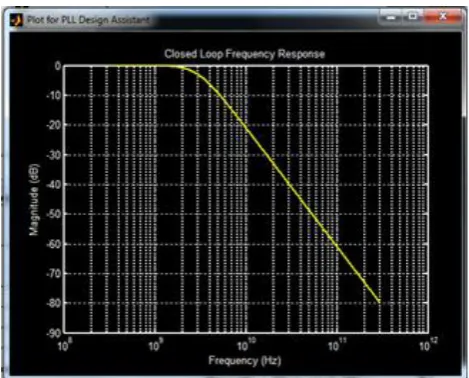
Using MATLAB and PLL Design Assist for solving the mathematical model of the proposed system in frequency domain, the closed loop frequency response of the system shown in Figure 5. Figure 6 shows closed loop step response while Figure 7 shows the closed loop pole and zero in S-plane of the system. The gain and phase margins are calculated from the graphs and the results show that the first system is stable with phase margin 81.3 degree at 5 rad/sec and the gain margin is 83 dB. Fig. 8 represents the bode plot of the first closed loop system.
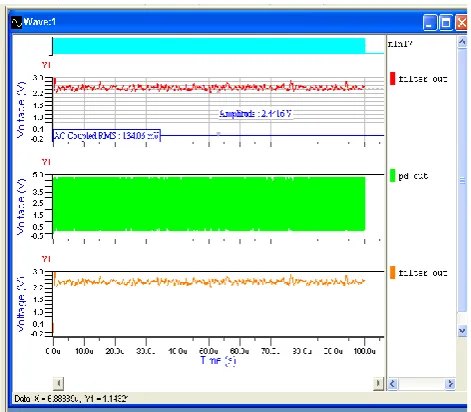
Frequency synthesizer using dual PLL connected in cascade configuration was implemented in SystemVision environment (Mentor Graphics) [11] using VHDL-AMS. Simulations of the proposed circuit were performed on a Windows 7 platform with Intel Core(TM) CPU@ 3.4 GHz processor with 4 GB RAM. Fig. 9 shows the output of the Phase Detector (PD), Loop filter out.
H.Simulation Results
Frequency synthesizer using dual PLL connected in cascade configuration was implemented in SystemVision environment (Mentor Graphics) [11] using VHDL-AMS. Simulations of the proposed circuit were performed on a Windows 7 platform with Intel Core(TM) CPU@ 3.4 GHz processor with 4 GB RAM. Fig. 9 shows the output of the Phase Detector (PD), loop filter.
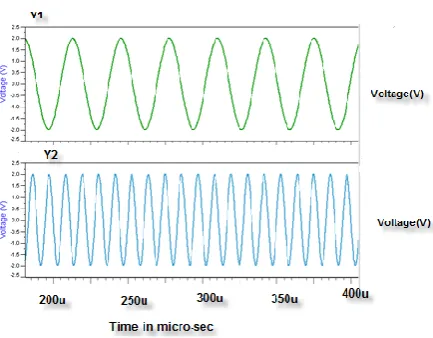
Figure 10 and 11 depicts the output of the low pass filter and the voltage controlled oscillator analog outputs of the first PLL and second PLL respectively. As can be seen in fig. 11, the output frequency is 600 MHz, which is four times the UHF carrier frequency of 300 MHz to 3GHz. The simulated output frequency is very close to the theoretical value.
The eye diagram is a useful tool for the qualitative analysis of signal used in digital transmission [12]. It gives an approximation of the timing jitter in the signal. Fig. 12 illustrates the eye diagram of voltage controlled oscillator at the output of the first and second PLL respectively.
Fig 6 closed loop step response
[image:4.595.310.546.51.257.2]Fig 7 closed loop pole and zero in S-plane
Fig 8 Simulated system using System vision
[image:4.595.47.303.371.749.2]Fig 9 Simulated phase detector XOR gate
[image:4.595.304.548.534.767.2]IV. CONCLUSION
This paper presents the behavioral modelling and simulation of a high speed frequency synthesizer, used for UHF RFID to recover the carrier in radio frequency. This simulation is written in VHDL-AMS. In this paper, we used dual PLLs connected in cascade for the frequency synthesizer application as it provides low-jitter output. Eye diagrams are used for the analysis of jitter in the digital transmission. The simulation results for the frequency synthesizer are presented and are found to be in good agreement with the theoretical calculations.
ACKNOWLEDGMENT
This work is supported by NSTIP strategic technologies program number 12-ELE2462 in the Kingdom of Saudi Arabia.
REFERENCES
[1] Wolaver, D. H. Phase-locked Loop Circuit Design, Prentice Hall, USA, 1991.
[2] Best, R. E. Phase Locked Loops: Design, Simulation, and Applications, McGraw-Hill, New York, 1999.
[3] Doboli, A. and Vemuri, R. “Behavioral modeling for high-level synthesis of analog and mixed-signal systems from VHDL-AMS,” IEEE Transactions on CAD of Integrated Circuits and Systems, 11, (2003), pp. 1504−1520.
[4] Christen, E. and Bakalar, K. “VHDL-AMS − a hardware description language for analog and mixed-signal applications,” IEEE Transactions on Circuits and Systems–II: Analog and Digital Signal Processing, 46, No. 10 (1999), 1263–1272.
[5] Ashenden, P. J., Peterson, G. D. and Teegarden, D. A. The System designer's guide to VHDL-AMS: Analog, signal, and Mixed-technology Modeling, Morgan Kaufmann, USA, 2003.
[6] Wilson, P. and Wilcock, R. “Behavioural Modeling and Simulation of a Switched-Current Phase Locked Loop”, Proceedings of IEEE International Symposium on Circuits and Systems, 5, 2005, 5174– 5177.
[7] Kozak, M. and Friedman, E. G. “Design and simulation of Fractional-N PLL frequency synthesizers”, Proceedings of IEEE International Symposium on Circuits and Systems, 4, 2004, pp. 780−783. [8] Karray, M., Seon, J. K., Charlot, J. –J. and Nasmoudi, N.
“VHDL-AMS modeling of a new PLL with an inverse sine phase detector (ISPD PLL)”, Proceedings of IEEE International Workshop on Behavioral Modeling and Simulation, 2002, pp. 80–83.
[9] Telba, A., Noras, J. M., El Ela, M. A. and Almashary, B. “Jitter Minimization in Digital Transmission using Dual Phase locked Loops”, Proceedings of the 17th IEEE International Conference on Micro Electronics, 2005, pp. 270−273.
[10] Telba, A., Noras, J. M., El Ela, M. A. and Almashary, B. “Simulation Technique for Noise and Timing Jitter in Phase Locked Loop”, Proceedings of the 16th IEEE International Conference on Micro Electronics, 2004, pp. 501−504.
[11] 1st March 2006, Mentor Graphics Corporation, SystemVision 4.2 Manual, www.mentor.com/products/sm/systemvision/
[image:5.595.53.270.54.223.2][12] Breed, G. “Analyzing Signals Using the Eye Diagram,” High Frequency Electronics Magazine, (2005), pp. 50-53.
Fig 11 voltage controlled oscillator outputs