Abstract— This paper proposes the application of lean
manufacturing system to improve the efficiency and reduce the wastes in the control cable process in the automotive industry. With the improvement of the bottleneck process and the balancing of the workflow of the process by considering the material flowchart, the process was improved and verified. The proposed workflow is developed based on the concept of lean manufacturing and the improvement in terms of more continuous flow can be achieved. As results indicated, the productivity of the studied process was increased by 33 percent and the waste was reduced to 0. In addition, the process inventory can be reduced to 0.
Index Terms—Lean manufacturing management, waste, the
control cable in automotive manufacturing
I. INTRODUCTION
N Thailand, the automobile industry is one of the most important clusters leading to more than 7 billion Baht per year of the export value, and the number of employees in this cluster is approximately 8 percent of the total employees in the country. The control cable for automobile is one of the most important parts in automotive manufacturing due to the values of the export are greater than one billion Baht per year. Generally, the manufacturing of this product is categorized as the mixing of the continuous process and job shop process. Most processes in this manufacturing still use many labors/operators leading to lower productivity and higher waste costs. There are many researchers attempted to develop and apply the lean manufacturing management system to improve the productivity and cost in the production line. In [1], Anand and Rambabu proposed the results of using Lean tool to improve the production process of the ABC Company, XYZ Section, which the product of this company is the PVC window and door. For their results, the production period of the process was improved from 360,864 to 41,764, and the value added time was improved from 1476 seconds to 740 seconds. As seen in their result, the process is significantly improved.
Manuscript received November 11, 2016; revised December 11, 2016. (This work was supported by the AMI (DSTAR), KMITL under the research grant no. DSTAR-RESERCH-01-58-01M. This work was also supported by NSTDA under the grant no. FOA-CO-2559-2738.)
Veerasak Chanarungruengkij is with the college of advanced
manufacturing innovation, King Mongkut’s Institute of Technology Ladkrabang. (e-mail: [email protected]).
Anakkapon Saenthon is with the college of advanced manufacturing
innovation, King Mongkut’s Institute of Technology Ladkrabang. (e-mail: [email protected]).
Somyot Kaitwanidvilai is with Faculty of Engineering, King Mongkut’s
Lorna [2] illustrated the study of process improvement of the pharmaceutical company, which the simulation of the process was based on the program simulation model, Siman based interface. This tool is useful for simulating the enhancements prior to actual implementation.Weixia and Jiwen [3] studied the improvement in pipe production process using the program I Grafix. As shown in their results, the process has been improved by 29.5% in terms of efficiency. Fabian and Marko [4] proposed the use of Lean management to improve the team management by collecting data into the software. Kamolrat and Natcha [5] proposed the waste reduction by lean six sigma approach for improving the micro cable manufacturing. The results showed the effectiveness of applying Lean in this manufacturing.
This research work focuses on the improvement in the control cable production line in the automotive parts manufacturing, Thai Steel Cable which is the largest company in the control cable manufacturing in Thailand. From the company’s production report, the capability of the process is 48,000 pieces per month; however, the demand from the customer is 62,449 pieces per month, thus either the new production line or process improvement needs to be considered. Adding the new production line requires the investment cost and new operators leading to the higher product cost; thus, the process improvement is a more attractive way of the company’s plan. In engineering aspect, the improvement by reducing waste, i.e. the fatigue of the operator, slow cycle time, etc. in the process will increase the productivity and reduce the production cost, and the lean management system can help to achieve these objectives by reducing the lead time of the production. Lean concept attempts to remove or shorten the process flows, organizations leading to the reduction of the production cost and reducing the lead time. Therefore, there are many researchers and industrial engineers in various industrials apply this concept for solving the manufacturing problem. In this paper, the application of lean for the control cable manufacturing process is demonstrated to solve the problem of low capability of the production line.
II. LITERATURE REVIEW
Lean concept is a system tool for eliminating the wastes or non-value added in the business process and create a new business flow for the manufacturing/company. Through the lean method, the company can optimize their profit and achieve the lower resource leading to the minimum cycle time, lead time and inventory. In addition, the profit,
Application of Lean Manufacturing System:
a Case Study of Control Cable Manufacturing
Veerasak Chanarungruengkij, Anakapon Saenthon and Somyot Kaitwanidvilai
morale, customer satisfaction and accident records in the company will then be improved. "Lean" has been defined as a systematic approach to identify and eliminate the waste through the concept of continuous improvement. Lean focuses on the value added flow of resources from the customer’s point of view. To compete in today's economy, with lean, a company will be better than its competitors. Lean emphasizes on the elimination of waste that results in higher customer satisfaction, profitability, throughput, and efficiency. Jacobs and Chase [6] stated that “Lean production” is an integrated set of activities designed to achieve production using minimal inventories of raw materials, work-in-process, and finished goods. Parts arrive at the next workstation “just in time” and are completed and move through the process quickly. Lean philosophy is also based on the logic that nothing will be produced until it is needed.
The principle or philosophy of the lean concept is the ways to identify and eliminate waste to enhance the processes and products with the customer requirement and creating a system to pull in the process to ensure a continuous flow of processes, and improve continuously to enhance their processes and products regularly to eliminate waste in the production process. There are 8 types of waste that need to be considered in Lean concept.
1. Over Production: Overproduction occurs when the goods have been produced more than the demand from the customers. One common practice that leads to this waste (“muda”) is the large batch production. Overproduction is considered as the worst waste because it hides and/or generates all the other wastes. Overproduction leads to the excess inventory and the large storage space and preservation those are the most disadvantages.
2. Waiting: When the goods are not transferred or being struck at the production process.
3. Transportation: When the product is moved, it leads to the risk of damage, lost, delay, etc. Thus, the transportation is one type of the wastes in lean concept.
4. Over-Processing: Over-processing is defined as the time more work is carried out while the customer does not require.
5. Inventory: There are many forms of inventory such as raw materials, work-in-progress (WIP), or finished goods. These three items not being actively processed is accounted as waste.
6. In contrary, with the transportation, waste, “motion”
refers to the waste that caused from either over time (wear and tear of the equipment and for workers) or during discrete events (accidents that caused damage to the equipment).
7. Defects: This causes the extra costs, rescheduling production, labor costs, etc.
8. Losses from the full potential of the personnel is not carried out to provide the organizations with maximum efficiency.
Based on the waste mentioned above, the principle of the lean concept to deal with the minimizing waste can be summarized as follows:
1. Specify the value from the customer need by product family.
2. Identify all steps in the value stream of each product family, eliminating the values which do not create the value.
3. Add the value-creating steps in tight sequence so that the product will flow smoothly toward the customer.
4. As the new flow is introduced, he customers can provide to put the value from the next upstream activity.
5. If the value and the value streams are identified, wasted steps are removed, go to the step 1 again and continue analyze them until the perfect flow/process is achieved.
III. RESEARCH METHODOLOGY AND IMPLEMENTATION
To perform the lean analysis, the following steps were carried out.
1. Survey the current state of the production line, identify and put the value of each step.
2. Analyze the process.
3. Try to improve the process using the software analysis. 4. Summarize the results.
The following issues describe the details of each step including the result and simulation software.
A. Survey the current state of the production line
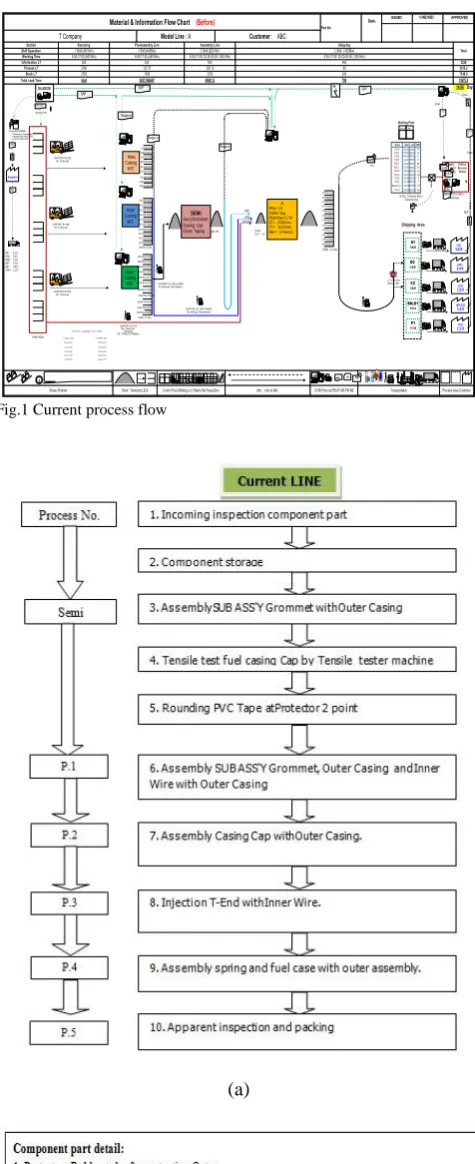
The preliminary survey starts from the study of the sources of 8 wastes in the interesting process, the control cable car. The interesting parameters are the flow chart to know the entire process, including the bottleneck, defects, and machine performance to reduce waste from the manufacturing process. Based on the survey data, the control cable production process has the lead time of 14.86 days, this long lead time is caused by the preproduction process 2.5 days, assembly process 0.5 days and the unbalanced of the process cycle time which has a percent difference of 76.4% between its maximum and minimum value. The current process efficiency is 85%; however, the standard of car maker process efficiency is specified as 95% minimum. Defect from process is 100 ppm Fig. 1 shows the studied process flow, which composes of Hilex cutting machine, Inner cutting machine, Outer cutting machine, Assembly station, Post waiting and Shipping Area. The material and cycle time, including the total lead time have been analyzed and calculated as shown in Fig. 1.
B. Process analysis and Improvement
Fig.1 Current process flow
(a)
(b)
Fig. 2 Details of the current process flow: (a) flow diagram
(b)
[image:3.595.49.287.45.628.2]abbreviation.
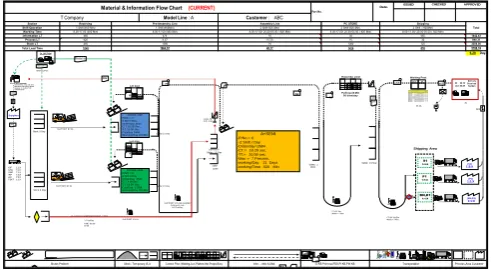
Fig. 3 Details of the proposed process flow
[image:3.595.49.289.54.292.2]The process was improved not only the combination of the process steps, but also the rearranging of the process flow as shown in Fig. 4. The single piece flow reduces the inventory and idle lead times and number of operators. The wastes were clearly decreased and the process flow was compact. The number of operators was changed from 8 to 7 resulting in the reduction of the operating cost. The cycle time, as shown in Fig. 5, was reduced from 33.36 to 20.58, that means the productivity of the process is increased. The M3, Table tape rolling process, is significantly improved as it is the bottleneck of the entire process. The 12.58 sec. was expected to be gained in the process. In addition, based on the proposed concept, the lead-time of the inventory was reduced to 0 days. Fig. 6 shows the details of flow diagram including the lead-time analysis of the new process after improvement
Material & Information Flow Chart (Before) Part No.
T Company Model Line : A Customer : ABC
Section Receiving Pre-Assembly Line Assembly Line Shipping
Total
Shift Operation 1 Shift (460 Min) 1 Shift (460Min) 2 Shift (920 Min) 2 Shift ( 920Min)
Working Time 8.00-17.00 (460 Min) 8.00-17.00 (460 Min) 8.00-17.00/ 20.00-05.00 ( 920 Min) 8.00-17.00/ 20.00-05.00 ( 920 Min)
Information LT 920 920 920 460 3220
Process LT 2760 137.07 328.12 90 3315.2
Stock LT 2760 1380 2760 240 7140.0
Total Lead Time 6440 2437.066667 4008.12 790 13675.2
14.86 Day.
Process,Area Customer Shuter,Problem Stock: Temporary,B,A Control Post (Waiting,Lot ,Pattern,Hei,Prepa,Box) Infor. , Infor.& Mat'. E-KB Print out,PDS,PI KB,PW KB Transportation
SCP A
-P/No.= 12 -2 Shift / Day -Order/day=1,704 -CT.= 20.06 sec. -TT.= 16.19 sec. -Man = 5 Presons.
Reserve SAP Inner Cutting M/C PW PI PDS 1 Suppliers
Purchase (SAP PROGRAMS) Check Every Day and Sent PDS One Time Every Week Generat 08.30 -10.00
PDS INV SECTION DHL E-mail E-mail Order (S1) 1:4:X Waiting Post (GC) 1:4:X Delivery Received Kanban Toyota IN 08.10
Out 08.55
S1 1:4:X GC 1:4:X e-K/B e-K/B Packing Export Shipping Area E-mail Order N-1 Skid PDS IN (DL): H.Komsun (Main.)
T.Detchart (Sup) (DL): T.Detchart (Main.)
J.Ratee(Sup)
CT=181 Sec/Box. Worker = 2 Man
IN Out 16:30 02:30 09:00 14:00 16:00 01:30 08:55 08:55 08:55 08:55 08:55 08:55 09:00 08:55 08:55 13:00 S1(1) S1(2) S1(3) S1(4) GC(1) GC(2)
Truck
GC(3) GC(4)
K/B 12 14 6 8 39 35 39 38 IN OUT
DHL SUPPLY COMPONENT PART 10 TRIP
5 Trip/Day Shift
08:20-10:20
10:20-13:20
13:20-15:20
15:20-17:00
17:20-20:20 5 Trip/Night Shift
20:00-22:20 22:20-01:20 01:20-03:20 03:20-05:20 05:20-07:20 Reserve
Safety 1.5 Day
4TFE00104 910130-05347
910130-03423
910130-03420 910130-05392
910130-05827 COMPONENT
CLAMP Stock 1 Lot INNER outer Reserve SAP PICK LIST Waiting Post
Date. ISSUED CHECKED APPROVED
C2 1:2:X (C2) 1:2:X BN,D1 1:1:X (BN,D1) 1:1:X P1 1:1:X (P1) 1:1:X
C2(1) 22:0008:553 C2(2) 11:3008:553 BN,D1(1) 13:0008:5524 P1(1)23:0008:5538
4TFE00204 4TFE00505 4TFE00803 4TFE01001 4TFT01102 4TFE01603 4TFT00903 4TFT01102 Outer Cutting M/C SEMI -Ass'yGrommet -Casing Cap -Outer Taping
Stock 9Day
400 Pcs. 910130-03881
910130-03143 910130-05338 910130-04033
Safety 1.5 Day
e-K/B e-K/B
SUPPORT BY DHL Mr. Ta Boonta
SUPPORT BY DHL Mr. Ta Boonta
SUPPORT BY DHL Mrs. Darunporn Hongtong Mrs. Pimporn Somkanay
SUPPORT BY LINE LEADER Mr. Witthaya Chumnanaeur
e-K/B 1:50 504KH1A-05258 504KH1A-03334 504KH1A-05303 504JH1A-03330 504KH1A-05737 504KH1A-03791 504KH1A-03054 504KH1A-05248 504KH1A-03944
Safety 1.5 Day SUPPORT BY LINE LEADER Mr. Witthaya Chumnanaeur
4TFE01104 4TFE01004 4TFE00805 910130-05827 504JH1A-05737 504KH1A-03330 SAP Hilex Cutting M/C 910130-05347 910130-05347 910130-05347 910130-05347 910130-05347 910130-05347 910130-05347 910130-05347 910130-05347
SUPPORT BY DHL Mr. Ta Boonta
[image:3.595.310.541.59.369.2] [image:3.595.300.552.604.768.2](a) (b) Fig. 5 Cycle time (a) before and (b) after improvement
The result of the improvement by lean method made the changes in process flow chart which explained in Fig. 6. From the process flow, a significant change in the process is the change from batch 10 pieces per time to one piece flow. Some sub-processes those are the protector assembly and tapes rounding are separated in the current process; thus, they were considered as the wastes in terms of inventory. The combining of these processes produced the change in the inventory in the process to 0 (JIT: Just in Time).
C. Reducing the defects from the production process
[image:4.595.307.543.284.411.2]Based on the survey data reported over the past 1 year, it was found that the defect in the production process is 100 PPM (parts per million) mainly caused from the errors in the batch assembly process. Fig. 6 shows the diagram of the improved process and Fig. 7 shows the results of a study of the waste from defects, as seen in this graph, the main defects caused from the assembly process. The other causes are from the “not tape rolling” and “staking grommet shapeless”. These sub-process were attempted to be focused.
Fig. 6 The process flow after improvement.
Fig. 7 Process defects in the 1 year data.
From the process analysis, the assembly process has no the work instruction of the checking to verify the product before sending to the next station. One of the reasons is that the process is a 10 pieces batch flow so that the in process inspection is not feasible. Thus, to improve the process, one piece flow process and the design of the mistaken error proofing (called as “POKAYOKE”) for detecting all errors from the operators were modified in the process so that the defects can be reduced to 0 PPM. In addition, The improvement of the process control by using the electrical sensors were implemented. Table I shows the results of the process before and after improvements with the use of lean techniques in the control cable manufacturing. As seen in this table, the significant improvements in terms of productivity, cycle time, lead time and defects were clearly shown, for example, 33% of the production rate was increased, etc.
TABLE I
RESULTS OF PRODUCTIVITY, CYCLE TIME, LEAD TIME AND PROCESS DEFECTS AFTER IMPROVEMENT BY LEAN CONCEPT.
IV. CONCLUSION
From the proposed concept to improve by lean approach, the results of improvement in the production line of control cable were summarized in Table 1. Based on the results, the advantages of the improvement of 71% in cycle time, 33% in productivity, 58% in lead-time and 100% in defects are gained. Clearly, the significant improvement was proposed and it can be expanded to the similar products to make more competitive in the automobile manufacturing. In the future, the automatic machine such as an automatic cutting machine for outer cable, the new cutting and forming machine for inner cable that can reduce the number of operators and sub-processes and increase the cycle time will be considered as the next research topic.
REFERENCES
[1] Anand Gurumurthy, RambabuKodali. “Design of lean manufacturing
systems using value stream mapping with simulation A case study,”
Journal of Manufacturing Technology Management, Vol 22, pp.444
- 473, 2011.
[2] Lorna R. Cintron, Sonia M. Bartolomei-Suárez. “SIM-Simulation: A
Simulation tool to predict a lean production process,” Industrial
Engineering Research Conference, 2007.
[3] Wei Xia, JiwenSun, “Simulation guided value stream mapping and
lean improvement: A case study of a tubular machining facility,”
Journal of Industrial Engineering and Management, pp.456 - 476,
2013.
[4] Fabian Fagerholm, MarkoIkonen, Petri Kettunen, “Performance
Alignment Work: How software developers experience the continuous adaptation of team performance in Lean and Agile
environments,” Information and Software Technology, Vol. 64,
pp.132 - 147 , 2015.
[5] Kamolrat Srisungsuk, NatchaThawesaengsakulthai. “Waste reduction by Lean Six Sigma approach in micro cable manufacturing,” Journal of engineering, Vol. 2, 2013.
T Company Model Line : A Customer : ABC
Material & Information Flow Chart (CURRENT) Part No.
Total
Shift Operation 1 Shift (460 Min) 1 Shift (460Min) 2 Shift (920 Min) 2 Shift (920 Min) 2 Shift ( 920Min)
Working Time 8.00-17.00 (460 Min) 8.00-17.00 (460 Min)
Section Receiving Pre-Assembly Line Assembly Line PC STORE Shipping
8.00-17.00/ 20.00-05.00 ( 920 Min) 8.00-17.00/ 20.00-05.00 ( 920 Min) 8.00-17.00/ 20.00-05.00 ( 920 Min)
Information LT 460 476 16 30 460 1442.43
Process LT 920 8.57 15.74 16 30 990.31
3356.00
Total Lead Time 1840 1864.57 48.17 1426 610 5788.74
Stock LT 460 1380 16 1380 120
6.29Day.
Process,Area Customer Shuter,Problem Stock: Temporary ,B,A Control Post (Waiting,Lot ,Pattern,Hei,Prepa,Box ) Infor. , Infor.& Mat'. E-KB Print out,PDS,PI KB,PW KB Transportation
SCP
A+SEMI
-P/No.= 6 -2 Shift / Day -Order/day=2684 -CT.= 18.29 sec. -TT.= 20.58 sec. -Man = 7 Presons. -working/Day 21 Days -working/Time 920 Min
PI PDS 1
Suppliers
Purchase (SAP PROGRAMS)Check Every Day and SentPDS One Time Every Week Generat 1. 16:30-17:00 2.08:30-10:00 PDS INV SECTION DL (S1) 1:3:X Waiting Post (BN,D1) 1:1:X Delivery Received Kanban
IN08.10
Out 08.55
S1 1:3:X Packing Export Shipping Area PDS
IN DL DL
CT=181 Sec/Box. Worker = 2 Man
IN OUT
DL SUPPLY COMPONENT PART 1 TRIP
1 T rip/Day T IME 09:30-10:00 COMPONENT INNER outer PICK LIST Waiting Post
Date. ISSUED CHECKED APPROVED
(P1) 1:1:X BN,D1 1:1:X P1 1:1:X
Stock 3 Day SUPPORT BY DL
SUPPORT BY DL
SUPPORT BY DL SUPPORT BY LINE LEADERPulling 16 min
56 T rip/Day
Haijunka post
Safety 1 BOX. PW PW
PI e-K/B e-K/B
PW Reserv e
INNER LINE -P/NO.= 9 -2 Shif t /Day -Order/Day 3544 -C.T.10.28 Sec. -T.T.15.58 Sec. -Cap/Day 5369 -Working/Day 920 Min
PI PW
Safety 1.5 Day PDS
PI Lot size
Lot size
Pulling 16 Min 56 time/day
Safety 1.5 Day
Skid
Safety 1.5 Day
Safety 1.5 Day
Cuting KB 16:00 -16:20
Stock 3 Day
CT=181 Sec. Worker = 1 Man
GIF 1:1:X
GSC7:1:X
VWF 7:1:X IRP 7:2:X AIC 7:3:X TSKT 1:1:X
OUTER LINE -P/NO.= 9 -2 Shif t /Day -Order/Day 3544 -C.T.4.69 Sec. -T.T.15.58 Sec. -Cap/Day 11769 -Working/Day 920 Min
9
8
6
3
26
34.61
65.37
88.44
100
100
0 20 40 60 80 100 0 2 4 6 8 10 12 14 16 18 20 22 24 26 Not assembly Grommet Not assembly Protector Not Tape
rolling Grommet Staking Shapeless
TOTAL
Before After % Change
Productivity ( Pcs/ManHr ) 18.75 24.82 33%
Cycle Time ( Sec ) 33.36 19.5 71%
Lead Time ( Day ) 14.86 6.29 58%
[image:4.595.50.557.439.776.2] [image:4.595.46.292.450.585.2][6] Jacobs, F. R. & Chase, R. B. 2008. Operations and supply
management: the core. Boston:McGraw Hill.
[7] Natchaphon Suphan, SuntichaiShevasuthisilp, “Productivity
Improvement of Crystal Blank Production Using Lean
Manufacturing System.”, The Graduate Research Conference,
Bangkok, Thailand, 2011.
[8] Sittiwat, Chaiwat, Precha“An Application of Lean Manufacturing
System for Electronics Industry Case Study: Server Assembly Line,”
Conference on Industrial Network, Bangkok, Thailand, 2011.
[9] RasliMuslimen, Sha’riMohd Yusof, Ana Sakura Zainal Abidin.
“Lean Manufacturing Implementation in Malaysian Automotive Components Manufacturer: a Case Study,” World Congress on Engineering, London UK, 2011.
[10] Denish B. Modi, Hemant Thakkar, “Lean Thinking: Reduction of
Waste, Lead Time, Cost through Lean Manufacturing Tools and
Technique,” International Journal of Emerging Technology and