
Original Article
Long non-coding RNA H19 as a prognostic marker in
human cancer: a meta-analysis
Meng-Cheng Hu, Jie-Yao He, Yi-Heng Hu, Jia-Wen Hong, Jun Zhang
Department of Gastroenterology, Nanjing Hospital Affiliated to Nanjing Medical University, Nanjing, Jiangsu Pro- vince, China
Received December 21, 2015; Accepted March 20, 2016; Epub May 1, 2016; Published May 15, 2016
Abstract: Long non-coding RNA (lncRNA) H19 is found to be overexpressed and associated with clinicopathologi-cal features in patients with cancer. To evaluate the cliniclinicopathologi-cal value of lncRNA H19 as a prognostic marker in human cancers, this meta-analysis collected all relevant articles and explored the association of H19 expression levels with prognosis in patients with carcinoma. Literature collections were conducted by searching electronic databases PubMed, Medline, EMBASE, Web of Science, Ovid and Cochrane library (up to July 10, 2015). Pooled hazard ratios (HRs) with corresponding 95% confidence intervals (CIs) were calculated to estimate the strength of the link be-tween H19 and clinical prognosis by STATA 12.0 software. 9 eligible studies with a total of 2105 patients conducted in 5 countries were matched to our inclusion criteria. The result showed that overexpression of H19 could predict poor overall survival (OS) and disease-free survival (DFS) incancer patients, with HR of 1.08 (95% CI 1.05-1.12), HR of 1.08 (95% CI 1.02-1.14), respectively. Cancer type (digestive and respiratory system carcinoma), paper quality (>85%, <85%), different methods of analysis (univariate and multivariate analysis) did not alter the predictive value of lncRNA H19 on poor prognosis in investigated cancers. This meta-analysis demonstrated that lncRNA H19 may potentially be used as a prognostic marker for predictingsurvival of cancer patients.
Keywords: Meta-analysis, lncRNA, H19, prognosis, cancer
Introduction
With the development of deep sequencing and DNA tiling array technology, an increasing num-ber of investigators are focusing on non-coding RNAs (ncRNAs). Non-coding RNAs are RNAs that do not encode proteins, usually including long non-coding RNA (lncRNA), microRNA (mi- RNA, miR), small interfering RNA (short interfer-ing RNA, silencinterfer-ing RNA, siRNA) and PIWI-interacting RNA (piRNA) [1, 2]. Recent studies have indicated that at least 70% of the human genome is transcribed into RNAs, which are mostly lncRNAs, longer than 200 nucleotides [3]. Emerging evidence suggests that lncRNAs have many biological actions, such as tran-scriptional and posttrantran-scriptional regulation by interfering with the promoter of gene, the reorganization of chromatin, the induction of histone modification, the regulation of subcel-lular localization and/or function of proteins and the production of endogenous siRNA [4, 5]. Increasing evidences have indicated that
lncRNAs play a key role in cell proliferation, invasion and metastasis and may be used as biomarkers for the diagnosis, treatment and prognosis of cancer [6-11].
In view of the fact that there is an association between H19 expression and the clinicopatho-logical features of human cancers, most stud-ies reported so far are limited in their sample size and discrete outcomes.Therefore, we ana-lyze all previously published data based on the robust evidence of the expression and impact of H19 in tumorigenesis, and conduct a system-atic review and quantitative meta-analysis to evaluatethe clinical value of H19 as a prognos-tic marker in human cancer.
Material and methods
Search strategy
A systematic literature search of PubMed, Medline, EMBASE, Web of Science, Ovid and Cochrane library. The literature covered was restricted to publications in English. The follow-ing key words were used for the search: “H19”, “long non-coding RNA or lncRNA”, “cancer or carcinoma or tumor or neoplasma or neoplasm or malignancy or sarcoma”, “prognostic or prog-nosis”, “outcome”, “mortality”, “survival” and “recurrence”. The literature search was stopped at July 10, 2015.
Selection criteria and quality assessment
Inclusion criteria were as follows: (1) informa-tion of study populainforma-tion and regions; (2) infor-mation of any type of human cancer; (3) description of study design; (4) investigation of the correlation between H19 expression level and survival outcome; (5) description of H19 measurement, such as quantitative PCR or in situ hybridization in human tissue; (6) descrip-tion of the reladescrip-tionship between H19 and over-all survival (OS) or disease-free survival (DFS) or progression-free survival (PFS) or other indi-cators related to survival outcome; (7) descrip-tion of the cut-off value of H19; (8) period of follow-up. The exclusion criteria were as fol-lows: (1) meta-analysis paper; (2) review paper; (3) non-English paper; (4) conference abstract; (5) non-human data; (6) paper lacking all haz-ard ratio (HR), 95% confidence interval (CI) and p value and raw data.
For quality control of a paper, the assessment was performed by two authors, who reached an agreement on all items assessed. The catego-ries of score assessment included the scientific design (five items: study objective definition,
study design, outcome definition, statistical consideration, statistical method and test description), laboratory methodology (seven items: blinding in the biological assays perfor-mance, tested factor description, tissue sam-ple conservation, description of the relevant test procedure of the biological factor, descrip-tion of the negative and positive control proce-dures, test reproducibility control, definition of the level of positivity of the test), generalisabil-ity (six items: patient selection criteria, patients’ characteristics, initial investigation, treatment description, source of samples, number of unassessable samples with exclusion causes) and results analysis (four items: follow-up description, survival analysis according to the biological marker, univariate analysis of the prognostic factors for survival, multivariate analysis of the prognostic factors for survival). Each item was scored as follows: 2 points if it was clearly defined in the article, 1 point if its description was incomplete or unclear and 0 point if it was not defined or was inadequate. The maximum theoretical score was 44 points. The final quality score was presented as per-centage, which was calculated using the for-mula (the sum of the total points divided by 44 and multiplied by 100). An optimal threshold was yet to be defined, which the cut-off point of 85% of the quality scores represented half of the investigated studies. Higher percentages reflected better reporting quality of the paper. Data extraction
num-ber of events and its P value with the formula: HR=[P0/(1-P0)]/[P1/(1P1)], where P0 represents a 5-year survival rate in the group with low expression of H19 and P1 represents a 5-year survival rate in the group with high expression of H19. The formula of 95% CI was exp (lnHR± 1.96×SE), where exp=exponential, lnHR=the natural logarithm HR and SE of HR [20, 21]. In this meta-analysis, only method 1, 2, 3 were used to calculate the HRs.
Statistical analysis
The data were analyzed using Stata 12.0 soft-ware. The HRs with the corresponding 95% CIs were used to estimate the strength of the link between H19 and clinical prognosis. The HRs with their 95% CIs and P values were collected from the original articles. However, if not avail-able, we calculated the HRs and their 95% CIs using previously reported methods, as indicat-ed above. A random-effect model was appliindicat-ed if heterogeneity was observed, whereas a fixed-effect model was usedin the absence of between-study heterogeneity. The factors con-tributing to heterogeneity were analysed by
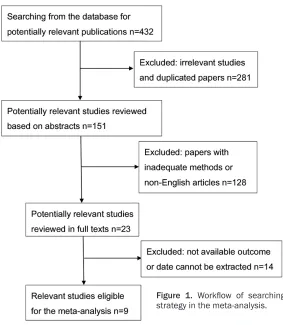
cause different statistics methods had been used or the articles were not in English. After data extraction, 9 studieswith a total of 2105 patients [23-31], were matched to our inclusion criteria and were eligible for the meta-analysis (Figure 1).
Table 1 shows the main characteristics of all of the studies. The cut-off values of the high and low expression of H19 in these studies were found to be inconsistent owing to different detection methods, such as quantitative PCR and in situ hybridization.
Association of H19 expression with prognosis in human cancer
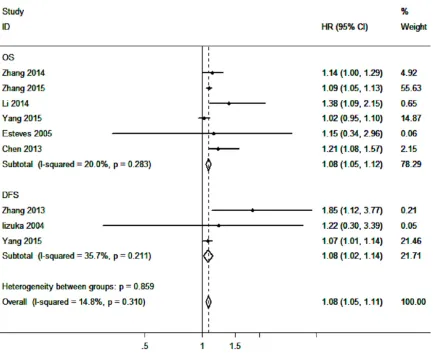
We obtained the HRs directly from four studies and indirectly from five studies by calculation using methods 2 and 3 as described. First, we investigated whether H19 was predictive for the survival (OS, DFS) of patients with cancer. The elevated expression of H19 was found to be significantly associated with poor OS (HR 1.08, 95% CI 1.05-1.12) and poor DFS (HR 1.08, 95% CI 1.02-1.14). There was no evi-Figure 1. Workflow of searching
strategy in the meta-analysis.
subgroup analysis, meta-re- gression or sensitivity analy-sis by a sequential omission of each individual study. The test for heterogeneity of com-bined HRs was carried out using a χ2-based Cochran Q
test and Higgins I2 statistic. A
P value of <0.05 or an I2 value
of >50% was considered sta-tistically significant. Publica- tion bias was evaluated using a funnel plot with Begg’s bias indicator test [22].
Results
Data selection and character-istics of eligible studies
[image:3.612.92.375.69.394.2]Table 1. Characteristics of studies included in the meta-analysis
Study Year Region Tumor type No. Stage PT SO Cut-off value Me Survival analysis Follow up Quality score
Zhang et al [23] 2014 China Grastric cancer 80 I-IV NO OS Mean 1 U+M 60 months 81.8%
Zhang et al [24] 2015 China Non-small-cell lung cancer 70 I-IV NA OS Median 1 U+M 60 months 93.2% Li et al [25] 2014 China Grastric cancer 74 I-IV NA OS 6-fold upregulation 3 U 53 months 81.8% Zhang et al [26] 2013 China Hepatocellular carcinoma 113 I-IV NA DFS Median 1 M 24 months 86.4%
Chen et al [27] 2013 America Lung cancer 1404# NA NA OS NA 3 U 200 months 72.7%
Esteves et al [28] 2005 Brazil Head and neck carcinomas 35 I-IV NO OS NA 2 U 86 months 72.7% Iizuka et al [29] 2004 Japan Hepatocellular carcinoma 59 I-III NO RFS* Mean 3 U 80 months 86.4%
Yang et al [30] 2015 Korea Hepatocellular carcinoma 240 I-IV NO OS
DFS Median 1 U+MU 120 months 93.2%
Jiang et al [31] 2015 China Glioblastoma 30 NA NO PFS Mean 3 U 30 months 81.8%
dence of statistically significant heterogeneity within the subgroups of patients with OS (P=0.283), DFS (P=0.211) (Figure 2).
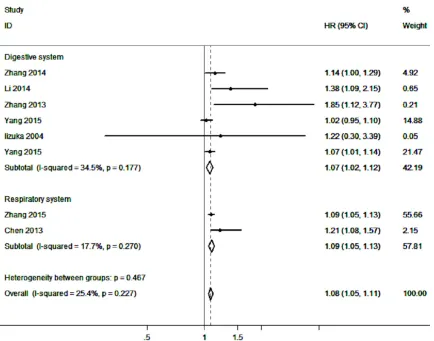
Subsequent analyses of subgroups were per-formed based on different cancer, the elevated expression of H19 was found to be significantly associated with poor prognosis in patients with digestive system carcinoma (HR 1.07, 95% CI 1.02-1.12), respiratory system carcinoma (HR 1.09, 95% CI 1.05-1.13). There was no evi-dence of statistically significant heterogeneity within the subgroups of patients with digestive system malignancy (P=0.177), respiratory sys-tem carcinoma (P=0.270) (Figure 3).
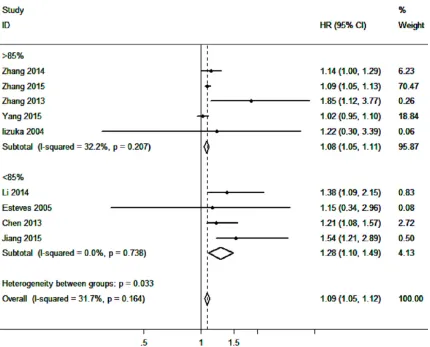
We then examined the quality of the published paper in the studies and found that the scores (more or less than 85%) did not change the result of the estimated HR (HR 1.19, 95% CI 1.08-1.31 and HR 1.08, 95% CI 1.04-1.11,
respectively) and that there was no evidence of statistically significant heterogeneity across the studies within the subgroups with scores of more or less than 85% (P=0.621 and P=0.160, respectively) (Figure 4).
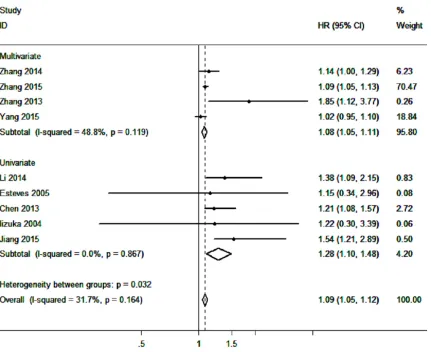
Using different methods of analysis, we obtained similar results for the association of H19 expression with prognosis with multivari-ate analysis (HR 1.08, 95% CI 1.05-1.11) and univariate analysis (HR 1.28, 95% CI 1.10-1.48). No evidence of statistically significant heterogeneity was found across the studies (P=0.119 by multivariate analysis and P=0.867 by univariate analyses) (Figure 5).
Publication bias
[image:5.612.92.525.69.422.2]metry, P value of Begg’s test was 0.452. Therefore, no significant publication bias was detected in this meta-analysis (Figure 6). Sensitivity analysis
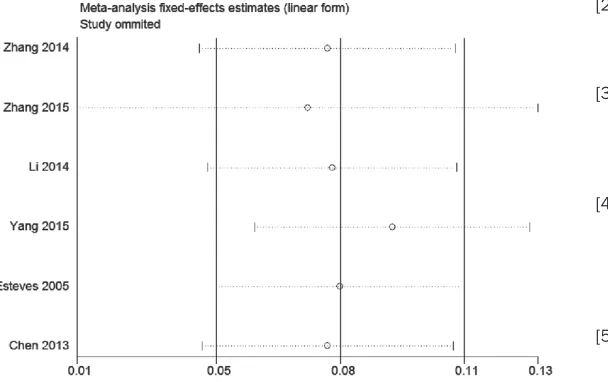
Moreover, the sensitivity analysis showed that the pooled HR of OS was reliable (Figure 7). The exclusion of any individual study did not change the pooled HR significantly.
Discussion
This study disclosed the prognostic value of H19, an important lncRNA involved in cancer progression. This meta-analysis of published clinical studies, using a detailed search strate-gy and selection criteria, provided convincing evidence that H19 expression is predictive of poor tumor survival.
It has been shown that lncRNAs play important roles in pathophysiological processes. An
increasing number of studies showing the involvement of lncRNAs in the development and the progression of various tumours have drawn attention towards these RNA species. H19, one of the lncRNAs, has been shown to be aberrantly expressed in different types of can-cer, our meta-analysis summarised the tumour prognostic role of H19 and provided evidence for the association between H19 expression and clinicopathological characteristics of hu- man cancers, suggesting that H19 may be used as a negative, unfavourable prognostic marker for most cancers.
[image:6.612.92.526.69.410.2]did not alter the predictive value of H19 on poor prognosis among the investigated cancers and no evidence of statistically significant heteroge-neity existed across the studies. Furthermore, Begg’s test showed no significant publication bias concerning the prognostic role of H19 in the different types of cancer. Therefore, this meta-analysis supports the outcomes of many studies which found that H19 is a molecular predictor of poor prognosis.
Recently, the function and role of H19 in tumor-igenesis has been extensively investigated. H19 has been shown to promote malignancy as its knockdown attenuates cell proliferation, decreases cell-matrix attachment in vitro and in vivo in pluripotent human embryonic carci-noma and embryonic stem cells. Mice trans-planted with H19 down-regulated embryonic carcinoma cells exhibit slower kinetics of tumor formation, resulting in an increased animal
sur-vival [32]. The mechanism underlying the rela-tionship between elevated H19 expression and poor prognosis in patients with cancer is uncer-tain. Many possible mechanisms have been proposed. LncRNA H19 increases cancer metastasis by associating with EZH2 and inhib-iting E-cadherin expression [33]. LncRNA H19 regulates miR-675 positively, and overexpres-sion of miR-675 induces a G1 arrest and inhib-its cell apoptosis by inhib-its negative regulatory role for p53 expression [34]. H19 promotes cancer metastasis by derepressing let-7’s suppression on its target HMGA2-mediated EMT [35]. Based on these studies and owing to its functions, H19 may be a consequential biomarker, and also be one of the causal factors for tumorigen-esis in general.
[image:7.612.94.524.69.416.2]for calculating the cut-off value were not the
[image:8.612.95.526.69.421.2]same in different studies. The inclusion of a prognosis of patients with cancer. We believe that more clinical studies should be conducted Figure 5. Forest plot of subgroup analysis showed the correlation of H19 expression with poor prognosis in studies with different methods of analysis.
Figure 6. Funnel plot for the publication bias test of the included studies for H19 expression and overall survival.
[image:8.612.92.375.468.655.2]to evaluate the prognostic potential of H19 in other types of cancer that have not been included.
In summary, this meta-analysis shows that ele-vated H19 expression is common to cancer and that it is significantly associated with the poor prognosis. Furthermore, the functional role of H19 in the regulation of cell proliferation, apop-tosis and metastasis suggests that H19 may play a key role in tumour progression. Thus, H19 may potentially be used as a new marker to predict the prognosis. More clinical studies on the different types of human cancer that have not yet been investigated need to be conducted.
Acknowledgements
The authors thank Dr. Zuoliang Shi for the help in writing and improving this paper.
Disclosure of conflict of interest
None.
Address correspondence to: Dr. Jun Zhang, Depart- ment of Gastroenterology, Nanjing Hospital Affiliated to Nanjing Medical University, No. 68, Changle Road, Qinhuai District, Nanjing, Jiangsu Province, China. Tel: +18951646225; Fax: +86 2152271108; E-mail: [email protected]
References
[1] Cech TR, Steitz JA. The noncoding RNA revolu-tion-trashing old rules to forge new ones. Cell
non-coding RNA in human carcinomas. Mol Cancer 2011; 10: 38.
[7] Loewen G, Jayawickramarajah J, Zhuo Y, Shan B. Functions of lncRNA HOTAIR in lung cancer. J Hematol Oncol 2014; 7: 90.
[8] Matouk IJ, Raveh E, Abu-lail R, Mezan S, Gilon M, Gershtain E, Birman T, Gallula J, Schneider T, Barkali M, Richler C, Fellig Y, Sorin V, Hubert A, Hochberg A, Czerniak A. Oncofetal H19 RNA promotes tumor metastasis. Biochim Biophys Acta 2014; 1843: 1414-1426.
[9] Glover AR, Zhao JT, Ip JC, Lee JC, Robinson BG, Gill AJ, Soon PS, Sidhu SB. Long noncoding RNA profiles of adrenocortical cancer can be used to predict recurrence. Endocr Relat Can-cer 2015; 22: 99-109.
[10] Du Z, Fei T, Verhaak RG, Su Z, Zhang Y, Brown M, Chen Y, Liu XS. Integrative genomic analy-ses reveal clinically relevant long noncoding RNAs in human cancer. Nat Struct Mol Biol 2013; 20: 908-913.
[11] Ariel I, Sughayer M, Fellig Y, Pizov G, Ayesh S, Podeh D, Libdeh BA, Levy C, Birman T, Tykocin-ski ML, de Groot N, Hochberg A. The imprinted H19 gene is a marker of early recurrence in human bladder carcinoma. Mol Pathol 2000; 53: 320-323.
[12] Raveh E, Matouk IJ, Gilon M, Hochberg A. The H19 Long non-coding RNA in cancer initiation, progression and metastasis - a proposed unify-ing theory. Mol Cancer 2015; 14: 184. [13] Zhu M, Chen Q, Liu X, Sun Q, Zhao X, Deng R,
Wang Y, Huang J, Xu M, Yan J, Yu J. lncRNA H19/miR-675 axis represses prostate cancer metastasis by targeting TGFBI. FEBS J 2014; 281: 3766-3775.
[image:9.612.95.399.73.264.2][14] Shi Y, Wang Y, Luan W, Wang P, Tao T, Zhang J, Figure 7. Sensitivity analysis of the pooled HR of H19 expression for overall
survival for the included studies.
[2] Holoch D, Moazed D. RNA-mediated epigenetic regula-tion of gene expression. Nat Rev Genet 2015; 16: 71-84. [3] Huang B, Zhang R. Regula-tory non-coding RNAs: revo-lutionizing the RNA world. Mol Biol Rep 2014; 41: 3915-3923.
[4] Geisler S, Coller J. RNA in unexpected places: long non-coding RNA functions in diverse cellular contexts. Nat Rev Mol Cell Biol 2013; 14: 699-712.
[5] Ørom UA, Shiekhattar R. Long noncoding RNAs usher in a new era in the biology of enhancers. Cell 2013; 154: 1190-1193.
promotes glioma cell invasion by deriving miR-675. PLoS One 2014; 9: e86295.
[15] Luo M, Li Z, Wang W, Zeng Y, Liu Z, Qiu J. Up-regulated H19 contributes to bladder cancer cell proliferation by regulating ID2 expression. FEBS J 2013; 280: 1709-1716.
[16] Luo M, Li Z, Wang W, Zeng Y, Liu Z, Qiu J. Long non-coding RNA H19 increases bladder cancer metastasis by associating with EZH2 and in-hibiting E-cadherin expression. Cancer Lett 2013; 333: 213-221.
[17] Vennin C, Spruyt N, Dahmani F, Julien S, Ber-tucci F, Finetti P, Chassat T, Bourette RP, Le Bourhis X, Adriaenssens E. H19 non coding RNA-derived miR-675 enhances tumorigene-sis and metastatumorigene-sis of breast cancer cells by downregulating c-Cbl and Cbl-b. Oncotarget 2015; 6: 29209-29223.
[18] Guyot P, Ades AE, Ouwens MJ, Welton NJ. En-hanced secondary analysis of survival data: reconstructing the data from published Ka-plan-Meier survival curves. BMC Med Res Methodol 2012; 12: 9-12.
[19] Bennouna J, Sastre J, Arnold D, Österlund P, Greil R, Van Cutsem E, von Moos R, Viéitez JM, Bouché O, Borg C, Steffens CC, Alonso-Orduña V, Schlichting C, Reyes-Rivera I, Bendahmane B, André T, Kubicka S. Continuation of bevaci-zumab after first progression in metastatic colorectal cancer: a randomised phase 3 trial. Lancet Oncol 2013; 14: 29-37.
[20] Williamson PR, Smith CT, Hutton JL, Marson AG. Aggregate data meta-analysis with time-to-event outcomes. Stat Med 2002; 21: 3337-3351.
[21] Tierney JF, Stewart LA, Ghersi D, Burdett S, Sydes MR. Practical methods for incorporating summary time-to-event data into meta-analy-sis. Trials 2007; 8: 16.
[22] Begg CB, Mazumdar M. Operating characteris-tics of a rank correlation test for publication bias. Biometrics 1994; 50: 1088-1101. [23] Zhang EB, Han L, Yin DD, Kong R, De W, Chen
J. c-Myc-induced, long, noncoding H19 affects cell proliferation and predicts a poor prognosis in patients with gastric cancer. Med Oncol 2014; 31: 155-165.
[24] Zhang E, Li W, Yin D, De W, Sun S, Han L. c-Myc-regulated long non-coding RNA H19 indi-cates a poor prognosis and affects cell prolif-eration in non-small-cell lung cancer. Tumour Biol 2015; [Epub ahead of print].
[25] Li H, Yu B, Li J, Su L, Yan M, Zhu Z, Liu B. Over-expression of lncRNA H19 enhances carcino-genesis and metastasis of gastric cancer. On-cotarget 2014; 5: 2318-2329.
[26] Zhang L, Yang F, Yuan JH, Yuan SX, Zhou WP, Huo XS, Xu D, Bi HS, Wang F, Sun SH. Epigen-etic activation of the MiR-200 family contrib-utes to H19-mediated metastasis suppression in hepatocellular carcinoma. Carcinogenesis 2013; 34: 577-586.
[27] Chen B, Yu M, Chang Q, Lu Y, Thakur C, Ma D, Yi Z, Chen F. Mdig de-represses H19 large in-tergenic non-coding RNA (lincRNA) by down-regulating H3K9me3 and heterochromatin. Oncotarget 2013; 4: 1427-1437.
[28] Esteves LI, Javaroni AC, Nishimoto IN, Magrin J, Squire JA, Kowalski LP, Rainho CA, Rogatto SR. DNA methylation in the CTCF-binding site I and the expression pattern of the H19 gene: does positive expression predict poor prognosis in early stage head and neck carcinomas? Mol Carcinog 2005; 44: 102-110.
[29] Iizuka N, Oka M, Tamesa T, Hamamoto Y, Ya-mada-Okabe H. Imbalance in expression levels of insulin-like growth factor 2 and H19 tran-scripts linked to progression of hepatocellular carcinoma. Anticancer Res 2004; 24: 4085-4089.
[30] Yang Z, Lu Y, Xu Q, Tang B, Park CK, Chen X. HULC and H19 Played Different Roles in Over-all and Disease-Free Survival from Hepatocel-lular Carcinoma after Curative Hepatectomy: A Preliminary Analysis from Gene Expression Omnibus. Dis Markers 2015; 2015: 1910-1929.
[31] Jiang X, Yan Y, Hu M, Chen X, Wang Y, Dai Y, Wu D, Wang Y, Zhuang Z, Xia H. Increased level of H19 long noncoding RNA promotes invasion, angiogenesis, and stemness of glioblastoma cells. J Neurosurg 2016; 124: 129-36.
[32] Zeira E, Abramovitch R, Meir K, Even Ram S, Gil Y, Bulvik B, Bromberg Z, Levkovitch O, Nah-mansson N, Adar R, Reubinoff B, Galun E, Gropp M. The knockdown of H19lncRNA re-veals its regulatory role in pluripotency and tu-morigenesis of human embryonic carcinoma cells. Oncotarget 2015; 6: 34691-34703. [33] Atala A. Re: Long non-coding RNA H19
increas-es bladder cancer metastasis by associating with EZH2 and inhibiting E-cadherin expres-sion. J Urol 2013; 190: 2306.
[34] Liu C, Chen Z, Fang J, Xu A, Zhang W, Wang Z. H19-derived miR-675 contributes to bladder cancer cell proliferation by regulating p53 acti-vation. Tumour Biol 2016; 37: 263-70. [35] Ma C, Nong K, Zhu H, Wang W, Huang X, Yuan

![Reversing Essential Note [Deok9] pdf](data:image/gif;base64,R0lGODlhAQABAIAAAP///wAAACH5BAEAAAAALAAAAAABAAEAAAICRAEAOw==)