Distributed Time for Petri Nets
Extended Abstract
Mogens Nielsen1, Vladimiro Sassone2, and Jiˇr´ı Srba3
1,3 BRICS , Dept. of Computer Science, Universityof Aarhus, DK
{mn,srba}@brics.dk
2Universityof Sussex, UK
Abstract. We set the ground for research on a timed extension of Petri nets where time parameters are associated with tokens and arcs carry constraints that qualify the age of tokens required for enabling. The novelty is that, rather than a single global clock, we use a set of unre-lated clocks — possibly one per place — allowing a local timing as well as distributed time synchronisation. We give a formal definition of the model and investigate properties of local versus global timing, including decidability issues and notions of processes of the respective models.
1 Introduction
Verification of finite state systems has been an important area with success-ful applications to e.g. communication protocols, hardware structures, mobile phones, hi-fi equipment and manyothers. For systems that operate for exam-ple on data from unbounded domains, new methods must be proposed since theyare not finite state anymore and model/equivalence checking is usually more difficult. Recentlyalgorithmic methods have been developed for process algebras generating infinite state systems [Mol96,BE97], timed process alge-bra [Yi90], Petri nets [Jan90], lossyvector addition systems [BM99], counter ma-chines [Jan97,AC98], real time systems [ACD90,AD90,AD94,LPY95] and many others. In particular, the idea to equip automata with real time appeared to be veryfruitful and there are even automatic verification tools for such systems as UPPAAL [LPY97] and KRONOS [BDM+98].
The main idea behind timed automata is to equip a standard automaton with a number of synchronous clocks, and to allow transitions (a) to be condi-tioned on clock values, and (b) to affect (reset) clocks. One of the objections to this formalism is the assumption of perfect synchrony between clocks. For
Author partly supported by MUST projectTOSCA.
Author partly supported by the GACR, grant No. 201/00/0400.
Basic Research in Computer Science, Centre of the Danish National Research
Foun-dation.
J.-M. Colom and M. Koutny (Eds.): ICATPN 2001, LNCS 2075, pp. 23–31, 2001. c
manyapplications this assumption is justified, but for others this is an unreal-istic assumption. It is easyto imagine systems which are geographicallyhighly distributed where this is the case, but also within hardware design the issue has been addressed, e.g. within work on so-called GloballyAsynchronous Locally Synchronous (GALS) systems [MHKEBLTP98].
We are looking for a formalism in which to model such systems. Petri nets seem to be a natural starting point, since one of the virtues of nets is the explicit representation of locality.
Several models that take time features into account have been presented in the literature (for a surveysee [Bow96,Wan98]). For example timed transi-tions Petri nets were proposed byRamchandani [Ram73]. Here each transition is annotated with its firing duration. Another model where time parameters are associated to the places is called timed places Petri nets, introduced by Sifakis [Sif77]. We will analyse timed-arc Petri nets [BLT90,Han93], a time ex-tension of Petri nets where time (age) is associated to tokens and transitions are labelled bytime intervals, which restrict the age of tokens that can be used to fire the transition. In this model, time is considered to be global, i.e., all tokens grow older with the same speed. In spite of the fact that reachability is decidable for ordinaryPetri nets [May81], reachabilityfor global timed-arc Petri nets is undecidable [RGdFE99]. On the other hand, coverabilityis decid-able for global timed-arc Petri nets [RdFEA00,AN01]. It is also known that the model offers ‘weak’ expressiveness, in the sense that it cannot simulate Turing machines [BC89].
We suggest a new model where time elapses in a place independentlyon other places, taking the view that places represent ”localities”. We generalise this idea of local clocks in such a waythat we allow to define an equivalence relation on places such that two places must synchronise if and onlyif theyare in the same equivalence class. We call this model distributed timed-arc Petri nets. As special instances we getlocal timed-arc Petri nets (LT nets) where no places are forced to synchronise, andglobal timed-arc Petri nets (GT nets) with full synchronisation. There is yet another motivation for considering LT nets, namelythat theyseem to be a weaker model than the original one with global time and some properties could be algorithmicallyverified. We investigate here to what extent this hope is justified.
2 Distributed Timed-Arc Petri Nets
In this section we define formallythe model and we consider both continuous and discrete time.
Definition 1 (Distributed timed-arc Petri net).
A distributed timed-arc Petri net (DTAPN) is a tuple N = (P, T, F, c, E, D), where
– P is a finite set of places,
– F⊆(P×T)∪(T×P)is a flow relation,
– c: F|P×T →D×(D∪ {∞}) is a time constraint on transitions such that
for each arc(p, t)∈F ifc(p, t) = (t1, t2)thent1≤t2,
– E⊆P×P is an equivalence relation on places (synchronisation relation) – D∈ {R+
0,N} is either continuousor discrete time.
Letx∈D andc(p, t) = (t1, t2). We writex∈c(p, t) whenevert1≤x≤t2. We also define•t={p|(p, t)∈F} andt•={p|(t, p)∈F}.
Definition 2 (Marking).
Let N = (P, T, F, c, E, D)be a DTAPN.AmarkingM is a function
M:P → B(D)
whereB(D)denotes the set of finite multisets on D.
Each place is thus assigned a certain number of tokens, and each token is annotated with a real (natural) number (age). Let x∈ B(D) and a ∈ D. We definex <+ain such a waythat we add the valueato everyelement of x, i.e.,
x <+a ={b+a|b ∈x}. As initial markings we allow onlymarkings with all tokens of age 0.
Definition 3(Marked DTAPN).
Amarked DTAPNis a pair(N, M)whereN is a distributed timed-arc Petri net andM is an initial marking.
Let us now define the dynamics of DTAPNs. We introduce two types of transition rules:firing of a transition andtime-elapsing.
Definition 4 (Transition rules).
LetN = (P, T, F, c, E, D) be a DTAPN,M a marking andt∈T. – We saythatt isenabled byM iff∀p∈•t. ∃x∈M(p). x∈c(p, t).
– Iftis enabled byM then it can befired, producing a markingMsuch that:
∀p∈P. M(p) =M(p)C−(p, t)∪C+(t, p)
whereC− and C+ are chosen to satisfythe following equations (note that there maybe more possibilities and that all the operations are on multisets):
C−(p, t) =
{x} ifp∈•t∧x∈M(p)∧x∈c(p, t) ∅ otherwise
C+(t, p) =
{0} ifp∈t• ∅ otherwise.
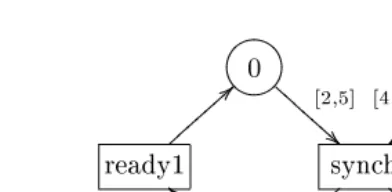
GFED @ABC 0 [2;5] !! B B B B B B B GFED @ABC 0 [4;6] }}| | | | | | | ready1 == | | | | | | | synch }}| | | | | | | !! B B B B B B B ready2 aaB B B B B B B GFED @ABC [1;1] aaB B B B B B B GFED @ABC [3;6] == | | | | | | |
Fig. 1.Example of time synchronisation for GT nets
– We define atime-elapsing transition , for:P/E → D, as follows, where [p]E denotes theE-equivalence class ofp:
M[M iff ∀p∈P. M(p) =M(p)<+([p]
E).
We writeM −→M iff eitherM[tM orM[M for sometor .
In particular we can consider the following two classes of DTAPNs. The first one requires an absolute synchronisation and was studied in the past, while the other one is a new model — completelyasynchronous.
– Global timed-arc Petri nets (GT nets):E=P×P.
– Local timed-arc Petri nets (LT nets):E=∆P ={(p, p)|p∈P}.
3 Examples
In this section we present three examples of timed-arc Petri nets in order to demonstrate the usefulness of GT nets, LT nets and the general model of dis-tributed timed-arc Petri nets. Let us first consider an example of a GT net. Figure 1 gives its graphical representation.
Places are drawn as circles and squares represent transitions with given names. The flow relation is present in form of arcs and everyarc from a place to a transition contains a time interval. In the initial marking a pair of tokens of age 0 is present in the upper two places of the picture. An interesting transi-tion is named ‘synch’. This is an example oftime synchronisation, in the sense that in order to fire this transition from the initial marking, there must be some time-elapsing step by4 or 5 time units. If the net is considered with continuous time also any -elapsing step is possible for 4 ≤ (P) ≤ 5. Then we can fire the transition ‘synch’. Whenever we want to fire this transition again, the age of tokens in the places from•synch must by synchronised in a similar fashion. Observe that the system can easilydeadlock since tokens in places maybecome dead, i.e., theyare too old to be useful for firing a transition.
done
G Fproducer
ready
GFED @ABCconsumer
ready
oo GFED @ABC0
@ A //recycle
,, kk WVUT PQRSstore
[0;0] --[0;0] OO [1;1] mm [1;1] )) R R R R R R R R R R R R R R R R R R R R R RR
get ready
[image:5.595.44.391.48.244.2]66 m m m m m m m m m m m m m m m m m m m m m m ll GFED @ABC oo
produce
ZZ << y y y y y y y y y y y yconsume
OOswitch
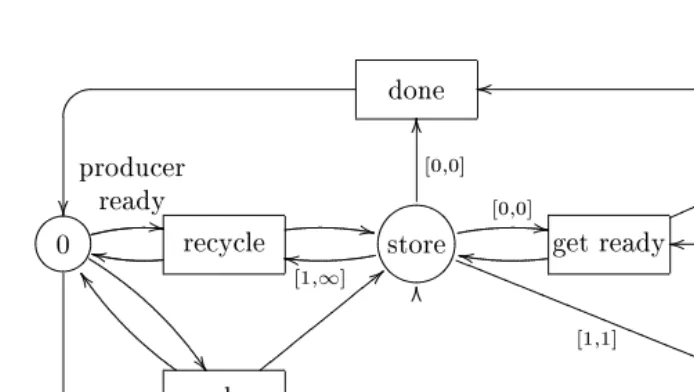
BC OO OOFig. 2.Producer/consumer example for LT nets
assume that this constraint is irrelevant, i.e., it is of the form [0,∞]. Thus the onlyinteresting place where time-parameters are of importance is ‘store’. The other places are just control ones and time can elapse completelyindependently there. From the initial marking we can fire a transition ‘produce’ which adds a number of products (tokens) into ‘store’. If time elapses during the production process, products of several ages can appear in ‘store’. Byfiring the transition ‘switch’ we add one token of age 0 into ‘store’ and one into the place ‘consumer ready’. Now producer is active and he can consume products of age 1 from ‘store’. Notice that no time elapsing step is allowed, otherwise there is no token of age 0 in ‘store’ and the transition ‘get ready’ cannot be fired. When consumer consumed all the products he wanted, a transition ‘done’ is performed (again checking that there is still the control token of age 0 in ‘store’) and producer becomes active again. Since consumer is not forced to consume all the products of age 1, it can be the case that products that are too old appear in ‘store’, however, theycan be recycled byfiring the transition ‘recycle’. The example in Figure 2 demonstrates that LT nets are not so weak as theymaylook. First, it shows that theyallow to implement a potentiallyinfinite timed-queuein a place — in our example in the place ‘store’. Second, a mechanism is sketched how to restrict a time-elapsing step by means of a control token — in our case this token is added bythe transition ‘switch’.
GFED @ABC A
v=? x
i :=0
//GFED@ABC B
xi1 v:=i
xi:=0 //GFED@ABC
C v=i
xi>1
//
ECD @
GF
v6=i
GFED @ABC CS
BCD @
GA v:=?
[image:6.595.77.359.46.95.2]??
Fig. 3.Fischer’s protocol for mutual exclusion
GFED @ABC 0
[2;3]
GFED @ABC 0
[5;8]
t 1
t 2
GFED
@ABC GFED@ABC
Fig. 4.Dependent transitions in a GT net and independent in an LT net
manyprocesses, each of them running the previouslymentioned code. Processes operate on a common shared variablev, Ais the initial state and each process has got its own clockxi. All the clocks are globallysynchronised. Our aim is to
show that this protocol is correct in the sense that at most one process can enter the critical sectionCS.
Fischer’s protocol can be easilymodelled in the GT net formalism as was shown in [AN01]. Synchronisation between places B and C is essential for the mutual exclusion property. However, in this example no behaviour of processes in the critical section is considered. So the protocol onlyinsures safe scheduling mechanism. Assume that we have another GT net N that models the process behaviour in the critical section. If we want e.g. to put the control mechanism together withN and still separate their time-parameters, one solution is to define it as distributed timed-arc Petri net. The places in the control mechanism will belong to one equivalence class and the places of N will belong to the other equivalence class. Thus we obtain a complete time-independence between the scheduling process and the process behaviour in the critical section.
4 Investigating DTAPNs
We aim at providing a common ground on which to assess relative expressiveness of GT nets and LT nets. One attempt is to formalise a notion of processes of DTAPNs. The standard notion of processes of P/T nets [GR83] lends itself more readilyto LT nets than to GT nets, as illustrated bythe net of Figure 4.
[image:6.595.169.264.129.226.2]fire anymore. So, even if there are no static connections betweent1andt2, time constrains do not allow to consider them as totallyindependent. If instead we consider the net under the local time interpretation, t1 and t2 are again inde-pendent, as theycannot affect each other’s enabledness.
We studyDTAPN processes in order to establish their properties with respect to timed firing sequences and to be able to prove results assessing the relative expressiveness of LT versus GT nets.
Another attempt is to consider various decidabilityquestions. Ruiz, Gomez and Escrig recentlyproved in [RGdFE99] that reachabilityis undecidable for GT nets. Their proof does not implyundecidabilityfor LT nets, because it relies on synchronised places. In principle, it may seem that the model of LT nets is less powerful than the one of GT nets.
Nevertheless, we demonstrate that reachabilityfor LT nets is undecidable as well. The proof is based on a reduction from the halting problem of Min-skymachine with two counters. Notice that this contrasts with the result by Mayr [May81] stating the decidabilityof reachabilityfor ordinaryPetri nets. The reachabilityproblem for local timed-arc Petri nets can be formulated as follows.
Problem: Reachabilityfor LT nets.
Instance: A marked LT net (N, M) and a final markingM. Question: M −→∗M ?
Theorem 1. Reachability for LT nets is undecidable.
On the other hand, we onlyneed to restrict the class of considered nets very little in order to get the expected difference between local and global timed nets. Saythat a marking issimple if each place contains at most one token, and that a marked DTAPN issimple if the initial marking is simple.
Theorem 2. Reachability is decidable for simple LT nets, but undecidable for simple GT nets.
The coverabilityproblem for GT nets was shown to be decidable — for discrete time in [RdFEA00] and for continuous time in [AN01]. Bymodifying these results we get that coverabilityis decidable even for DTAPNs. The problem is defined as follows.
Problem: Coverabilityfor DTAPNs.
Instance: A marked DTAPN (N, M) and a final markingM. Question: ∃M. M −→∗M ∧ ∀p∈P. M(p)⊆M(p) ?
5 Conclusion
We have introduced a Petri net model aimed at capturing the ideas behind the Globally Asynchronous Locally Synchronous paradigm, and provided some initial results on our model. However, we believe there are manyinteresting problems to be addressed in the future for such models.
References
[AC98] P. A. Abdulla and K. Cerans. Simulation is decidable for one-counter nets. In Proceedings of 9th International Conference on Concurrency Theory (CONCUR’98), volume 1466 ofLNCS, pages 253–268, 1998.
[ACD90] R. Alur, C. Courcoubetis, and D. Dill. Model-checking for real-time systems.5th Symp. on Logic in Computer Science (LICS 90), pages 414–425, 1990.
[AD90] R. Alur and D. Dill. Automata for modelling real-time systems. In Proc. of Int. Colloquium on Algorithms, Languages and Program-ming, volume 443 ofLNCS, pages 322–335, 1990.
[AD94] R. Alur and D. Dill. Automata for Modelling Real-Time Systems. Theoretical Computer Science, 126(2):183–236, 1994.
[AN01] P.A. Abdulla and A. Nylen. BQOs and timed Petri nets. In In-ternational Conference on Application and Theory of Petri Nets (ICATPN 2001), 2001.
http://www.docs.uu.se/∼parosh/publications/publications.shtml. [BC89] T. Bolognesi and P. Cremonese. The weakness of some timed
models for concurrent systems. Technical Report CNUCE C89-29, CNUCE–C.N.R., 1989.
[BDM+98] M. Bozga, C. Daws, O. Maler, A. Olivero, S. Tripakis, and S. Yovine. Kronos: A model-checking tool for real-time systems. InProceedings of CAV’98, volume 1427 of LNCS, pages 546–550. Springer–Verlag, 1998.
[BE97] O. Burkart and J. Esparza. More infinite results. Bulletin of the European Association for Theoretical Computer Science, 62:138– 159, June 1997. Columns: Concurrency.
[BLT90] T. Bolognesi, F. Lucidi, and S. Trigila. From timed Petri nets to timed LOTOS. InProceedings of the IFIP WG 6.1 Tenth Interna-tional Symposium on Protocol Specification, Testing and Verifica-tion (Ottawa 1990), pages 1–14. North-Holland, Amsterdam, 1990. [BM99] A. Bouajjani and R. Mayr. Model checking lossy vector addition systems. In Annual Symposium on Theoretical Aspects of Com-puter Science (STACS’99), volume 1563 ofLNCS, pages 323–333. Springer-Verlag, 1999.
[Bow96] Fred D.J. Bowden. Modelling time in Petri nets. InProceedings of the Second Australia-Japan Workshop on Stochastic Models, 1996.
http://www.itr.unisa.edu.au/∼fbowden/pprs/stomod96/. [GR83] U. Goltz and W. Reisig. The non-sequential behaviour of Petri
[Han93] H.M. Hanisch. Analysis of place/transition nets with timed-arcs and its application to batch process control. In Application and Theory of Petri Nets, volume 691 ofLNCS, pages 282–299, 1993. [Jan90] P. Jancar. Decidability of a temporal logic problem for Petri nets.
Theoretical Computer Science, 74(1):71–93, 1990.
[Jan97] P. Jancar. Bisimulation equivalence is decidable for one-counter processes. In Automata, Languages and Programming, 24th In-ternational Colloquium (ICALP’97), volume 1256 ofLNCS, pages 549–559. Springer-Verlag, 1997.
[LPY95] K.G. Larsen, P. Pettersson, and W. Yi. Model-checking for real-time systems. In Proc. of Fundamentals of Computation Theory, number 965 in LNCS, pages 62–88, 1995.
[LPY97] K.G. Larsen, P. Pettersson, and W. Yi. Uppaalin a Nutshell.Int. Journal on Software Tools for Technology Transfer, 1(1–2):134–152, 1997.
[May81] E.W. Mayr. An algorithm for the general Petri net reachability problem (preliminary version). In Proc. 13th Ann. ACM Sympo-sium on Theory of Computing, pages 238–246. Assoc. for Comput-ing Machinery, 1981.
[MHKEBLTP98] T. Meincke, A. Hemani, S. Kumar, P. Ellervee, J. Berg, D. Lindqvist, H. Tenhunen, A. Postula. Evaluating Benefits of Globally Asynchronous Locally Synchronous VLSI Architecture). InProc. 16th Norchip, pages 50–57, 1998.
[Mol96] F. Moller. Infinite results. InProceedings of CONCUR’96, volume 1119 ofLNCS, pages 195–216. Springer-Verlag, 1996.
[Ram73] C. Ramchandani. Performance Evaluation of Asynchronous Con-current Systems by Timed Petri Nets. PhD thesis, Massachusetts Institute of Technology, Cambridge, 1973.
[RdFEA00] V. Valero Ruiz, D. de Frutos Escrig, and O. Marroquin Alosno. Decidability of properties of timed-arc Petri nets. InICATPN 2000, volume 1825, pages 187–206, 2000.
[RGdFE99] V. Valero Ruiz, F. Cuartero Gomez, and D. de Frutos Escrig. On non-decidability of reachability for timed-arc Petri nets. In Pro-ceedings of the 8th Int. Workshop on Petri Net and Performance Models (PNPM’99), pages 188–196, 1999.
[SBM92] F. B. Schneider, B. Bloom, and K. Marzullo. Putting time into proof outlines. InProceedings REX Workshop on Real-Time: The-ory in Practice, volume 600 of LNCS, pages 618–639. Springer-Verlag, 1992.
[Sif77] J. Sifakis. Use of Petri nets for performance evaluation. In Pro-ceedings of the Third International Symposium IFIP W.G. 7.3., Measuring, modelling and evaluating computer systems (Bonn-Bad Godesberg, 1977), pages 75–93. Elsevier Science Publishers, Ams-terdam, 1977.
[Wan98] J. Wang. Timed Petri Nets, Theory and Application. Kluwer Aca-demic Publishers, 1998.