1
Time-dependent viscoelastic rheological response of pure,
modified and synthetic bituminous binders
Airey, G.D., Grenfell, J.R.A., Apeagyei, A., Subhy, A. and Lo Presti, D.
Nottingham Transportation Engineering Centre, University of Nottingham, United Kingdom
Abstract Bitumen is a viscoelastic material that exhibits both elastic and viscous components of response and displays both a temperature and time dependent relationship between applied stresses and resultant strains. In addition, as bitumen is responsible for the viscoelastic behaviour of all bituminous materials, it plays a dominant role in defining many of the aspects of asphalt road performance, such as strength and stiffness, permanent deformation and cracking. Although conventional bituminous materials perform satisfactorily in most highway pavement applications, there are situations that require the modification of the binder to enhance the properties of existing asphalt material. The best known form of modification is by means of polymer modification, traditionally used to improve the temperature and time susceptibility of bitumen. Tyre rubber modification is another form using recycled crumb tyre rubber to alter the properties of conventional bitumen. In addition, alternative binders (synthetic polymeric binders as well as renewable, environmental-friendly bio-binders) have entered the bitumen market over the last few years due to concerns over the continued availability of bitumen from current crudes and refinery processes. This paper provides a detailed rheological assessment, under both temperature and time regimes, of a range of conventional, modified and alternative binders in terms of the materials dynamic (oscillatory) viscoelastic response. The rheological results show the improved viscoelastic properties of polymer and rubber modified binders in terms of increased complex shear modulus and elastic response, particularly at high temperatures and low frequencies. The synthetic binders were found to demonstrate complex rheological behaviour relative to that seen for conventional bituminous binders.
2
1. Introduction
In the measurement of the physical properties of bitumen, primary emphasis is generally given to the characterisation of the rheological behaviour of the material. In this context, rheology is defined as the study of the deformation or flow properties of materials whether in liquid, melted or solid form, in terms of the materials’ elasticity and viscosity (Ferry 1980; Barnes et al. 1989). In terms of its rheology, bitumen can be classified as a thermoplastic, viscoelastic liquid that behaves as a glass-like elastic solid at low temperatures and/or during rapid loading (short loading times – high loading frequencies) and as a viscous (Newtonian) fluid at high temperatures and/or during slow loading (long loading times – low loading frequencies). As a viscoelastic material, bitumen exhibits both elastic and viscous components of response and displays both a temperature and time dependent relationship between applied stresses and resultant strains. The rheology of bitumen is consequently defined by its stress-strain-time-temperature response. However, within the linear viscoelastic (LVE) region of response, the interrelation between stress and strain is influenced by temperature and time alone and not by the magnitude of the stress (i.e. deformation at any time and temperature is directly proportional to the applied load) (Van der Poel 1954).
Various techniques exist to measure the rheological properties of bituminous binders, including; transient (creep) shear test methods using sliding plate rheometers (Gaw 1978; Griffin et al. 1956), capillary forced flow rheometers (Schweyer et al. 1976), cone and plate viscometers (ASTM 1986), and annular shear configurations (Ferry 1980). However, these traditional methods are often conducted in the non-linear flow region and are therefore difficult to characterise in the laboratory or to model in practical engineering applications (Anderson et al. 1994). Therefore, dynamic oscillatory testing using a dynamic shear rheometer (DSR) is the preferred means of measuring the rheological, viscoelastic properties of bituminous binders generally within the region of linear response (Airey and Brown 1998; Goodrich 1988; Pink et al. 1980).
3
(TTSP) or the method of reduced variables (Ferry 1980). The production of a smooth, continuous master curve generally relies on the bitumen exhibiting simple rheological behaviour, termed or classified as ‘thermo-rheological simplicity’. Work by various researchers, has found that there is an interrelationship between temperature and frequency (or temperature and loading time) for bitumen, which, through shift factors, can bring measurements done at different temperatures to fit one overall continuous curve at a reduced frequency or time scale (Dickinson and Witt 1974; Goodrich 1991; Monismith et al. 1966).
The paper aims to use the above mentioned rheological testing techniques (dynamic oscillatory testing) and analytical methods to provide a detailed evaluation of the rheological response of a range of binders. This has been achieved by comparing the viscoelastic rheological properties of a range of modified and synthetic binders to those of conventional penetration grade bitumens. The polymer modified bitumens have included both elastomeric and plastomeric polymers while two types of crumb tyre rubber have been used in the tyre rubber modified binders. The synthetic binders have consisted of a range of acrylate based polymer binders produced using two polymerisation methods (atom transfer radical polymerization and catalytic chain transfer polymerization) as well as a number of synthetic binder – penetration grade bitumen blends. The rheological (viscoelastic) properties were determined by means of dynamic (oscillatory) mechanical analysis using a dynamic shear rheometer and presented in the form of temperature and frequency (time) dependent rheological parameters.
2. Materials
2.1 Standard penetration grade bitumen
Five standard penetration grade bitumens have been included in the testing programme. The five bitumens were produced by blending a hard (10/20 penetration grade) bitumen and a soft (160/220 penetration grade) bitumen (both from the same crude source) to produce the following binders:
4
40/60 pen (penetration = 55 dmm; softening point = 52°C) 70/100 pen (penetration = 86 dmm; softening point = 45°C) 160/220 pen (penetration = 195 dmm; softening point = 39°C)
These five unmodified binders have been used in the paper to provide a standard rheological reference for the modified (polymer and tyre rubber) and synthetic (polyacrylate) binders. Their conventional binder properties of penetration (BS EN 1426) and softening point (BS EN 1427) were determined in order to group them into the different binder grades.
2.2 Polymer modified bitumens
The polymers traditionally used for bitumen modification can be divided into two broad categories of plastomers and elastomers. In terms of their definitions, plastomers modify bitumen by forming tough, rigid, three dimensional networks to resist deformation, while elastomers have a characteristically high elastic response and, therefore, resist permanent deformation by stretching and recovering their initial shape. Globally, approximately 75 percent of modified binders can be classified as elastomeric, 15 percent as plastomeric with the remaining 10 percent being either rubber or miscellaneously modified (Bardesi et al. 1999; Diehl 2000). Examples of plastomers used in bitumen modification include polyethylene, polypropylene, polyolefins and polyvinyl chloride. Within the elastomeric group, styrenic block copolymers have shown the greatest potential when blended with bitumen (Bull and Vonk 1984). Other examples of elastomers used in bitumen modification include natural rubber, polybutadiene, polyisoprene, isobutene isoprene copolymer, polychloropren and styrene butadiene rubber.
5
Styrenic block copolymers, commonly termed thermoplastic rubbers due to their ability to combine both elastic and thermoplastic properties, can be produced by a sequential operation of successive polymerisation of styrene butadiene styrene (SBS) (Bardesi et al. 1999). Alternatively, a di-block precursor can be produced by successive polymerisation of styrene and the mid-block monomer butadiene, followed by a reaction with a coupling agent (Whiteoak 1990). Therefore, not only linear copolymers but also multi-armed copolymers (known as star-shaped, radial or branched copolymers) can be produced. The structure of an SBS copolymer therefore consists of styrene butadiene styrene tri-block chains, having a two-phase morphology of spherical polystyrene block domains within a matrix of polybutadiene (Isacsson and Lu 1995). SBS copolymers derive their strength and elasticity from physical cross-linking of the molecules into a three-dimensional network. The polystyrene end-blocks impart the strength to the polymer while the polybutadiene, rubbery matrix mid-blocks give the material its exceptional elasticity. The effectiveness of these cross-links diminishes rapidly above the glass transition temperature of polystyrene (approximately 100°C), although the polystyrene domains will reform on cooling restoring the strength and elasticity of the copolymer (Isacsson and Lu 1995).
The elastomeric polymer used in this study was a linear styrene butadiene styrene (SBS) copolymer ‘Finaprene 502’ with 31% styrene content (Airey 2003). The SBS copolymer was used with the 70/100 pen bitumen to produce a SBS PMB with a polymer content of 7% by mass. Similar to the EVA PMB, the SBS PMB was prepared with a Silverson high shear laboratory mill at 185C until steady state conditions were achieved. The two PMBs are labelled simply as ‘EVA PMB’ and ‘SBS PMB’ in the subsequent tables and figures.
2.3 Tyre rubber modified bitumens
6
rubberised bitumen was included in the American Society for Testing and Materials (ASTM) D8 and later specified in ASTM D6114-97.
In this study, two types of TR were used with a 35/50 pen bitumen at 18% rubber content by mass of bitumen (15.25% by mass of total blend) based on previous studies (Celauro et al. 2012; Lo Presti and Airey 2013; Wang et al. 2012). The two types of TR consisted of a standard recycled rubber derived from discarded truck and passenger car tyres and produced by ambient grinding to produce a fine (< 1mm) powder (labelled as TRN). The second product consists of 100% recycled truck tyres (which by nature have a relatively high content of natural rubber) together with a special oil and Fischer-Tropsch (FT) wax component (labelled as TRW) (Subhy et al. 2015). Both TR modified binders were produced using a standard Silverson mixer at a mixing temperature and time of 180°C and 140 min based on previous studies and available standards and specifications such as ASTM D6114, CalTrans Bitumen Rubber User Guide, SABITA Manual 19, VicRoads and APRG Report No. 19 and Austroads User Guide (Lo Presti et al. 2012). The two modified binders have been labelled simply as TRN MB and TRW MB in the subsequent tables and figures.
2.4 Synthetic polyacrylate binders
7
In this paper, two processes, atom transfer radical polymerization (ATRP) and catalytic chain transfer polymerization (CCTP), have been used to produce a range of non-fossil fuel based polyacrylate binders (Airey and Mohammed 2008; Airey et al. 2011). ATRP is a method of controlled free radical polymerization widely used for academic and laboratory scale studies (Kato et al. 1995; Wang and Matyjaszewski 1995). The process consisted of the polymerization reaction in the bulk (i.e. in the absence of solvent) which is then quenched at a predefined time by diluting the resulting reaction mixture with tetrahydrofuran. Finally the polymeric product can be collected via precipitation of this solution in hexane (Airey and Mohammed 2008). In this study ATRP was used to synthesize three acrylic polymers, polyethyl acrylate (EA), polymethyl acrylate (MA) and polybutyl acrylate (BA). By conducting the polymerizations in this manner, isolation of the polymeric materials (EA, MA and BA) was successfully achieved.
Although ATRP allows very fine control over the polymers molecular weight (Mwt) and polydispersity index value (PDI) such that targeted molecular weights can be obtained with a high degree of consistency, it is currently not a commercially viable process, as it requires considerable quantities of the metal complexes which result in the need for additional clean up stages for the materials produced. For that reason, a range of MA and BA binders were also produced using CCTP. This polymerization mechanism utilizes low spin cobalt complexes such as CoPhBF in ppm levels to exercise fine control over the molecular weight of the polymer (Gridnev and Ittel 2001). Details of the homo-polymer synthesis of the MA and BA based binders as well as co-polymer synthesis of a MA-BA product can be found in Airey et al. (2011).
8
3. Rheological testing
3.1 Dynamic oscillatory testing
At present the most commonly used method of fundamental rheological testing of bitumen is by means of dynamic mechanical analysis (DMA) using oscillatory-type testing, generally conducted within the region of linear viscoelastic (LVE) response. These oscillatory tests are generally undertaken using dynamic shear rheometers (DSRs), which apply oscillating shear stresses and strains to samples of bitumen sandwiched between parallel plates at different loading frequencies and temperatures (Airey 2002a; Airey 2003; Goodrich 1988; Petersen et al. 1994).
The sinusoidally varying shear strain applied during the dynamic oscillatory test can be expressed as:
t
t
( ) 0sin (1)
and the resulting stress as:
(t) 0 sin t (2)
Where 0 is the peak strain, 0 is the peak stress (Pa), is the angular frequency (rad/sec), t is
time (seconds) and is the phase angle (degrees). The loading frequency, , also known as the angular frequency or rotational frequency is defined as:
f
2 (3)
Where f is the testing frequency (Hz). The sinusoidally varying strain and stress can also be represented by the following complex notation as:
t i
e
* 0 (4)
9
i t
e
0
* (5)
The complex shear modulus (G*) is then defined as:
i e G 0 0 * *
* (6)
The above equation for the complex modulus can also be written as:
'' ' sin cos * 0 0 0 0 iG G i
G
(7)
Where G* is the complex shear modulus (Pa), G is the storage modulus (Pa) and G is the loss modulus (Pa). The in-phase component of G*, or the real part of the complex shear modulus, is defined as:
cos * ' G
G (8)
and the out-of-phase component, or the imaginary part of the complex shear modulus, as:
sin * '' G
G (9)
10
bituminous material can be considered to be purely viscous in nature, whereas of 0 corresponds to purely elastic behaviour. Between these two extremes the material behaviour can be considered to be viscoelastic in nature with a combination of viscous and elastic responses.
3.2 Sample preparation
Various geometries, such as cone and plate, parallel plates, and cup and plate, can be used in dynamic mechanical testing. For many materials cone and plate geometry is preferred as shear stress and shear rate are constant over the entire area of the plate, thereby simplifying calculations and giving accurate fundamental rheological properties. However, for bitumen testing parallel plate geometry is almost invariably used to avoid the very small gap present at the centre of the cone and plate geometry.
In general two testing (plate) geometries are commonly used with the DSR, namely a 8 mm diameter spindle with a 2 mm testing gap and a 25 mm diameter spindle with 1 mm testing gap. The selection of the testing geometry is based on the operational conditions with the 8 mm plate geometry generally being used at low temperatures (-5C to 20C) and the 25 mm geometry at intermediate to high temperatures (20C to 80C). However, it is possible to use the same testing geometry over a wide temperature range, although the precision of the results may be limited as a result of compliance errors and the reduction in precision with which the torque can be measured at low stress levels.
11
testing gap plus 50 m. The bitumen that was squeezed out between the plates was then trimmed flush to the edge of the plates using a hot spatula or blade. Finally, the gap was closed by a further 50 m to achieve the required testing gap as well as a slight bulge around the circumference of the testing geometry (periphery of the test specimen) (Airey and Hunter 2003).
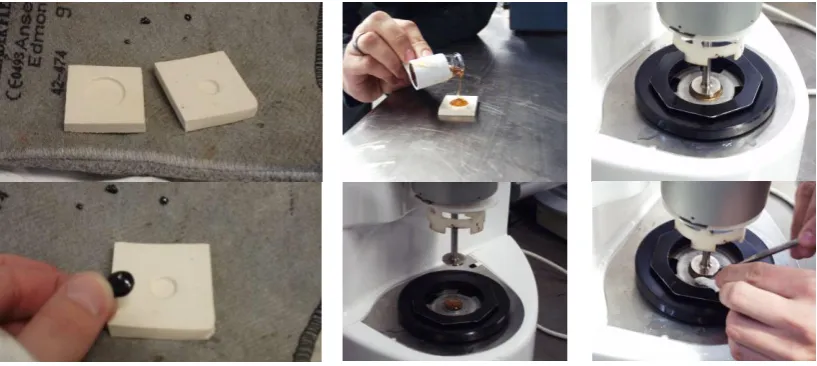
For the synthetic polyacrylate binders and the acrylate-bitumen blend, the DSR samples were prepared using either 8 mm or 25 mm diameter silicone moulds due to the small quantities of EA, MA and BA that were produced. The procedure used to prepare the samples for rheological testing is shown in Figure 1. For the synthetic binders, samples were prepared by heating the binder to 150C for 15 minutes and then pouring the hot binder into 8 mm or 25 mm diameter silicone moulds as required. For the blend, the sample was heated to 160°C in its sample containers for at least 15 minutes in order to ensure that the material was liquid. The blend was then mixed with a spatula to homogenise the material before pouring the blended binder into a silicone mould.
Both silicone moulds allow slightly more material to be placed in the mould than what is required in the final testing geometry (2 mm for the 8 mm geometry and 1 mm for the 25 mm geometry). This allowed sample discs of 2.5 mm thickness for the 8 mm diameter moulds and 1.5 mm for the 25 mm diameter moulds to be produced. Once the samples had cooled and solidified, they were removed from the moulds and placed on the lower (bottom) plate of the DSR. The upper plate of the DSR was then gradually lowered to the required testing gap plus 25 µm. The binder that was squeezed out between the plates was then carefully trimmed off from the edge of the plates using a hot blade to produce a smooth edge surface. Finally, the gap was closed by a further 25 m to achieve the required testing gap together with a slight bulge of squeezed out binder around the circumference of the testing geometry (periphery of the test sample) (Airey and Hunter, 2003).
3.3 Experimental programme
12
and the phase lag or phase angle (). The storage modulus (G) and loss modulus (G) were then calculated according to the following equations:
cos 2
4 0
R h M
G , (10)
sin 2
4 0
R h M
G , (11)
where R is the plate radius and h is the gap between the parallel plates. The storage and loss modulus were then used to calculate G* for the different binders.
Two test types were performed on the conventional penetration grade bitumens, EVA, SBS and TR modified binders, and the polyacrylate synthetic binders. The first set of tests consisted of amplitude sweeps undertaken using stress sweeps at 10C and 1 Hz for the 8 mm testing geometry and at 40C and 1 Hz for the 25 mm testing geometry. The stress sweeps consisted of ramping the applied torque from its lowest level to either its highest level or to a point where the material had experienced significant mechanical damage. Extra stress sweep tests at 30C as well as different frequencies (0.1 and 5 Hz) were performed on the conventional bitumens. The stress sweeps were then used to determine the limit of the LVE response based on the point where complex shear modulus, G*, had decreased to 95% of its initial value as prescribed by Anderson et al. (1994).
Once the linearity limits were established, the binders were subjected to dynamic oscillatory frequency sweeps at different temperatures performed within the region of LVE response. The frequency sweep tests were performed under controlled strain loading conditions using frequencies between 0.1 to 10 Hz (0.01 to 15 Hz for the PMB binders) at 5C temperature intervals between 5 and 75C. In general, the tests between 5 and 35C were undertaken with the 8 mm diameter and 2 mm testing gap geometry and from 40 to 75C with the 25 mm diameter and 1 mm testing gap geometry.
13
combination of rheological master curves at a reference temperature of 25C, isothermal and isochronal plots, Black diagrams and shift factor functions were used to model and represent the rheological behaviour of the various binders with the rheological data being compared to conventional penetration grade bitumen.
4. Linear viscoelastic rheological characterisation
4.1 Thermo-rheological simplicity
The dynamic oscillatory rheological data generated from the DSR frequency sweep tests were plotted in the form of Black diagrams for the selected binders analysed in this study. Plots of two of these binders have been shown as illustrations of the different types of rheological behaviour. Figure 2 shows the Black diagram produced for the methyl acrylate synthetic binder (MA), while Figure 3 show the rheological data for the 7% EVA PMB. Black diagrams (complex shear modulus versus the phase angle) can be successfully used to assess the “thermo-rheological simplicity” and application of time-temperature superposition principle (TTSP) of different binders (Airey 2002b). As the plot allows all the oscillatory dynamic data to be presented in one graph without the need to perform TTSP manipulations of the raw data, it provides a useful check of time-temperature equivalency (Airey 2002b; Soenen et al. 2006). A smooth set of black curves indicates the establishment of time-temperature equivalency, while a disjointed curve indicates the breakdown of TTSP, usually associated in bitumen with the presence of either high wax content, asphaltene structuring or polymer modification (Lesueur et al. 1996; Planche et al. 1996).
14
possible to produce a unique and continuous master curve for the norm of the complex shear modulus.
However, the Black curves for the EVA PMB in Figure 3 show a clear discontinuity between the rheological data produced at different testing temperatures between 10 and 75C. These discrete curves within the intermediate temperature and frequency range (centre of the Black space) are the result of the semi-crystalline nature of the EVA polymer and the compatibility between the polymer and base bitumen. The Black diagram clearly illustrates the lack of thermo-rheological simplicity for the EVA PMB and therefore the inability of the rheological data to be shifted through time-temperature superposition to produce continuous rheological master curves (Airey 2002b). Similar Black diagrams were produced for the remaining EVA PMBs although the severity of the discontinuity between rheological data at different temperatures decreased for the lower EVA content binders (Airey 2002a).
4.2 Time-temperature superposition
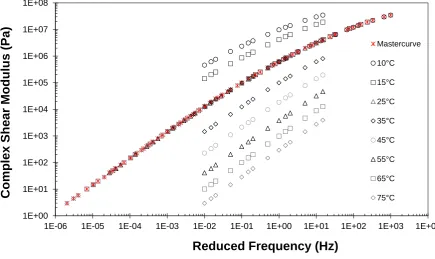
Following the Black diagram checks, the rheological data were plotted in the form of isothermal curves and shifted according to TTSP (method of reduced variables) or PTTSP to produce continuous rheological master curves for those binders demonstrating thermo-rheological simplicity (all thermo-rheological parameters) or partial thermo-thermo-rheological simplicity (master curves for the norm of the complex shear modulus). An example of the generation of the G* master curve for one of the conventional penetration grade bitumens (70/100 pen) is shown in Figure 4. The smooth, continuous nature of the master curve and the ability of the individual isotherms to shift to form the master curve indicates the applicability of TTSP and the accepted ‘thermo-rheological simplicity’ of conventional bitumen (Anderson et al. 1994).
15
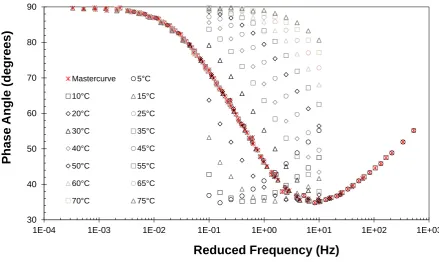
the smooth nature of the master curve and the ease of overlap of the isotherms supports the thermo-rheological simplicity of this and the other polyacrylate binders.
4.3 Shift factors
The horizontal shifting used to produce master curves is based on the equivalency between frequency (time) and temperature. The temperature dependency of the rheological behaviour is represented by shift factors and expressed as:
f f
a r
T , (12)
where aT is the shift factor, f is the tested frequency and fr is the reduced frequency at an arbitrarily chosen reference temperature, which in the case of the penetration grade bitumens, PMBs, CR MBs and synthetic polymers is 25C.
The experimentally determined shift factors associated with the horizontal TTSP shifting of the rheological parameters (G*, G, G and ) can be modelled using an Arrhenius equation of the following form (Ferry 1980):
0 1 1 303 . 2 log T T R H
aT , (13)
where R is the universal gas constant, H is the flow activation energy and T0 is an arbitrarily selected reference temperature, taken to be 25C (298 K) in this study. If log aT is plotted against the reciprocal of temperature (in K), then the activation energy for each of the binders can be determined from both the slope (s) and intercept (i) of a linear fit to the data using the following equations (Daga and Wagner 2006):
Rs H 2.303
, (14)
i RT H 2.303 0
16
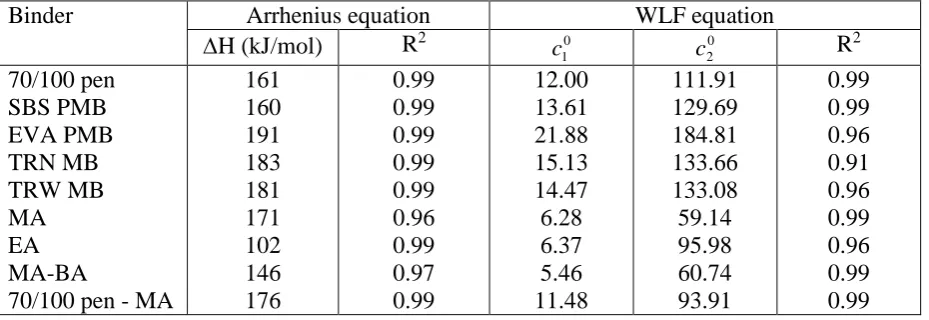
As the viscosity of the material is proportional to exp(H/RT) (Ferry 1980), it is generally accepted that the higher the activation flow energy, the higher the chain stiffness (McKee et al. 2005). The activation energies for all the binders included in this paper are presented in Table 1. Previous studies on the synthetic acrylate polymers have shown that the binders with higher H values generally showed higher G* values at particular temperatures and loading frequencies (Airey and Mohammed 2008; Airey et al. 2011). The results in Table 1 show the lower activation energy for EA compared to the co-polymer MA-BA and MA which suggests that EA and the MA-BA co-polymer will have lower G* values than MA. The 70/100 pen bitumen with MA blend and the remaining penetration grade and modified binders all have similar activation energy values. Based on the high R2 values for all nine binders, it can be concluded that the Arrhenius equation can be successfully used to determine the shift factors for standard bitumen as well as the modified binders and synthetic polyacrylate binders. In terms of determining the activation energy for these binders, previous studies have shown that for the synthetic binders there is a weak correlation with Tg (increasing) (Airey et al.
2011).
It is also possible to model the experimentally determined shift factors using a Williams Landel Ferry (WLF) equation (Williams et al. 1955):
0 0 2 0 0 1 log T T c T T c aT , (16)
where 0 1
c and 0 2
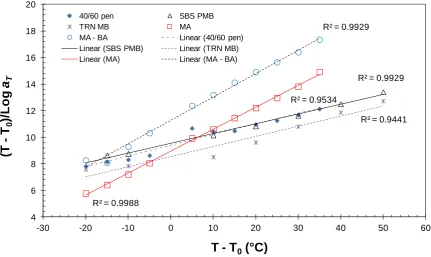
c are empirically fitted parameters, T is temperature and To is the reference temperature of 25C. Equation 16 can be rearranged into a linear form as shown in equation 17 and depicted in Figure 6 for a standard 70/100 pen bitumen, the 7% SBS PMB, the TRN MB using granulated crumb rubber, the synthetic MA binder and the co-polymer MA-BA:
0
0 1 0 1 0 2 0 1log c c T T
c a T T T
, (17)
The constants 0 1
c and 0 2
17 s
c10 1, (18)
and
s i
c20 , (19)
The data in Figure 6 show that, similar to the Arrhenius equation, there is an excellent fit between the WLF equation and the experimental shift factors for all the binders. It is interesting to note the different slopes of the polyacrylate binders (MA and MA-BA) compared to the three bituminous binders (70/100 pen, SBS PMB and TRN MB). This results in the two groups of binders having similar values for the constants 0
1
c and 0 2
c (listed in Table 1) with the values being significantly lower for the MA, EA and MA-BA binders compared to the bituminous binders. The values of 0
1
c and 0 2
c for the 70/100 pen – MA blend lie between the values associated with the penetration grade bitumen and the polyacrylate MA binder. As would be expected from literature (Ferry 1980), the results in Figure 6 and Table 1 show an improved fit for the WLF equation (R2 values of 0.99) for the polymeric materials (MA, MA-BA and EA) compared to that found for the Arrhenius equation (R2 values of 0.96 and 0.97). However, for the penetration grade bitumen and modified binders, there is a very similar fit for both the WLF and Arrhenius equations.
The accuracy of the Arrhenius and WLF equations relative to the experimentally determined shift factors for the standard 70/100 pen bitumen is shown in Figure 7 where the WLF equation provides a slightly better fit to the experimental shift factor data compared to the Arrhenius equation. This behaviour agrees with that generally found for petroleum bitumens where two fits are usually needed due to the thermo-rheological complexity and bimodal rheology of bitumen (Lesueur 1999). For bitumen, the WLF equation is preferred at temperatures above the Tg of the binder (temperatures of 5C to 80C used in this study),
while the Arrhenius equation is more applicable at temperatures below Tg and at high
18 4.4 Time dependent behaviour
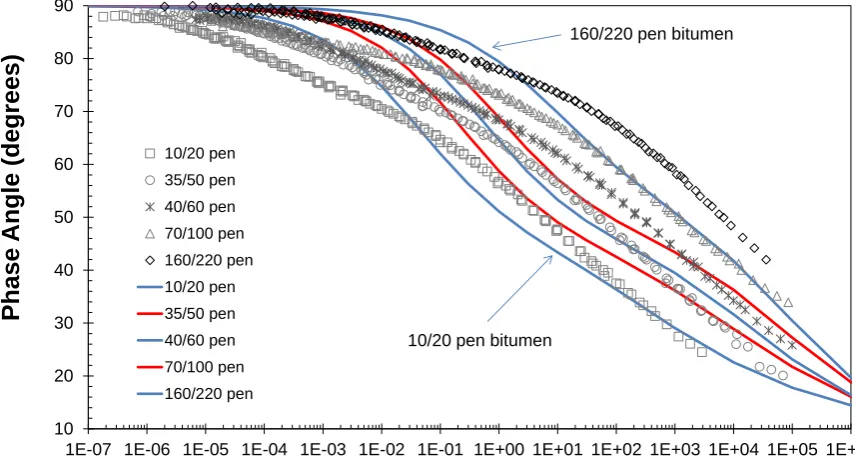
Complex modulus and phase angle master curves at a reference temperature of 25C (298 K) are shown in Figures 8 and 9 for the five standard penetration grade bitumens. In addition to the rheological data (G* and δ) for each of the five bitumens, the 2S2P1D mechanical model developed by researchers at the Ecole Nationale des Travaux Publics de l’Etat (ENTPE) in France was used to model the rheological master curves (Md. Yusoff et al. 2013). The 2S2P1D Model, an abbreviation of the combination of two springs, two parabolic creep elements and one dashpot, is a model based on the generalisation of the Huet-Sayegh Model and used to describe the rheological properties of binders and asphalt mixtures (Olard and Di Benedetto 2003; Olard et al. 2003; Delaporte et al. 2007; Pellinen et al. 2007; Md. Yusoff et al. 2011).
The 2S2P1D Model consists of seven parameters and G* is calculated based on the following expression:
g 0-
-1 01 αiωτ iωτ iωβτ G
G G
ω
G* -k h
(20)
where k and h are exponents with 0k h1, α is a constant, G0 is the static modulus when
ω0, Gg is the glassy modulus when ω. The value of β is a constant and defined by the
following expression:
G G
βτη g 0 (21)
where η is Newtonian viscosity and τ is the characteristic time, a function of temperature. τ evolution can be approximated by a shift factor law such as the WLF and Arrhenius equations in the range of temperatures observed in the laboratory (Delaporte et al. 2007):
T τo aτ T (22)
19
and therefore the parameters can be reduced to six. In addition to the prediction of G*, the phase angle, δ, can be determined as:
G' G"
δ 1
tan (23)
where G' and G" are storage and loss moduli. Olard et al. (2003) conducted dynamic tests on nine binders and four asphalt mixtures (with one mixture design). They found that the model fitted the experimental data reasonably well, even though anomalies were still seen particularly for the phase angles between 50 to 70o.
The predicted complex modulus master curves in Figure 8 show the accuracy of the 2S2P1D model for the penetration grade bitumens. These predicted master curves will therefore be used as a standard bitumen rheological reference when comparing the time dependent behaviour of the other binder groups in Figures 10 and 12. However, there is some discrepancy between the 2S2P1D model prediction and the test data for the phase angle master curves in Figure 9 for all five bitumen grades. This lack of fit between experimental data and model prediction is similar to that highlighted in previous studies (Olard and Di Benedetto 2003; Olard et al. 2003; Pellinen et al. 2007). Notwithstanding these slight discrepancies, the 2S2P1D phase angle master curve predictions have still been used in Figures 11 and 13.
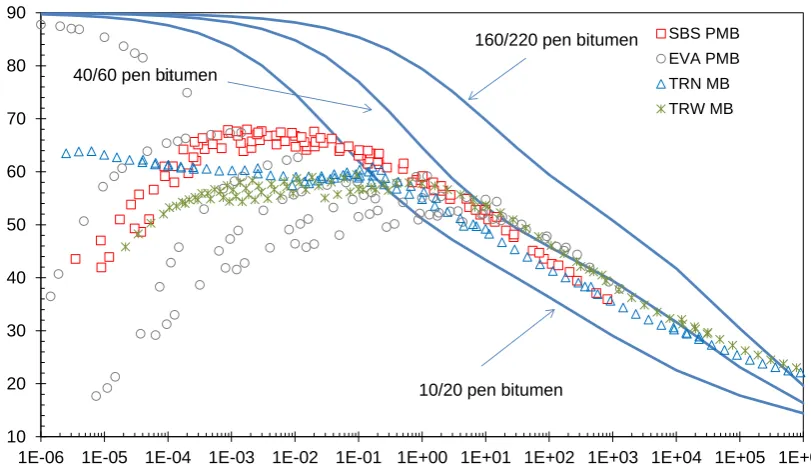
The time dependency of the two PMBs (SBS PMB and EVA PMB) together with the two elastomeric crumb rubber modified binders (TRN MB and TRW MB) are shown in the form of master curves of complex shear modulus in Figure 10 together with the predicted rheological properties of a ‘soft’ (160/220 pen), ‘intermediate’ (40/60 pen) and ‘hard’ (10/20 pen) bitumen. Figure 11 shows the phase angle master curves for these four binders with the lack of thermo-rheological simplicity demonstrated for the EVA PMB in Figure 3 and the subsequent application of PTTSP resulting in a discontinuous phase angle master curve for this semi-crystalline PMB.
20
master curves all show a standard sigmoidal-type shape with the G* values at high frequencies approaching a limiting upper glassy modulus (horizontal asymptote) of approximately 1 to 2 GPa and at low frequencies approaching a constant viscosity asymptote at an angle of 45 on the log complex modulus versus log frequency plot.
The master curves provide a useful interpretation of the influence of polymer and crumb rubber modification on the rheological properties of the modified binders. At high frequencies, the rheological behaviour of the modified binders (polymer and rubber) is dominated by the base bitumen used in their production. This results in the SBS and EVA PMBs together with the TRN and TRW MBs having similar G* values although the semi-crystalline EVA PMB is slightly higher due to its plastomeric nature. It is envisaged that all four modified binders (as with the three penetration grade bitumens) will all approach a similar upper limiting stiffness (glassy modulus) with similar rheological properties. However, at intermediate and particularly at low frequencies, there is a significant increase in complex modulus due to the stiffening effect of the polymers and crumb rubber. This results in the rheological behaviour shifting from that seen for an intermediate grade bitumen (40/60 pen) at intermediate frequencies (temperatures) to, at a minimum, a hard (10/20 pen) bitumen at low frequencies (high temperatures). This increased stiffness and reduced temperature (and time) susceptibility are key benefits of both polymer and crumb tyre rubber modification.
In terms of the detailed rheology, there are subtle differences between the four modified binders in Figure 10 with the EVA PMB showing the occurrence of ‘branching’ at low frequencies, due to the semi-crystalline nature of the plastomeric EVA co-polymer, unlike the smooth master curves produced for the other three binders (Airey 2002a). For the SBS PMB and crumb rubber MBs (all essentially elastomeric materials), there is a similarity in their rheological performance with all showing increased complex shear modulus (stiffness) at low frequencies as a result of the dominant polymer and rubber networks present in the modified binder (Airey 2003; Subhy et al. 2015).
21
angles of 90) at low frequencies (equivalent to high temperatures) to lower phase angles and increased elastic response (phase angles approaching 0) at high frequencies (low temperatures). Although there were discrepancies between the actual phase angle master curves of the penetration grade bitumens and the 2S2P1D prediction (as shown in Figure 9), the graph still provides a useful comparison between the conventional bitumen behaviour and that of the modified binders.
All three modified binders (SBS PMB, TRN MB and TRW MB) show a distinctive phase angle plateau region at intermediate frequencies. This reduction in phase angle values (increased elastic response) with modification and the presence of a phase angle plateau is an indication of the presence of polymer ‘elastic’ networks or entanglements in the modified binders. In the case of the SBS PMB, this polymer network is formed by the physical cross-linking of polystyrene blocks (Airey 2003). For the two tyre rubber modified binders, the increased elastic response at intermediate to low frequencies is a result of the establishment of a rubberised network in the binder (Subhy et al. 2015). The differences between the three modified binders is more noticeable at low frequencies where the nature of the polymer (or rubber) network is dependent on the properties of the polymer or rubber type, base bitumen and the compatibility of the bitumen-modifier system. For the SBS PMB there is a further reduction in phase angle with increasing elastic response after the plateau region which is also seen for TRW MB but not for TRN MB. This increased elastic response at low frequencies (equivalent to high temperatures) provides the binder with enhanced resistance to permanent deformation and together with the increased stiffness shown in Figure 10 is a key rheological benefit of polymer and rubber modification.
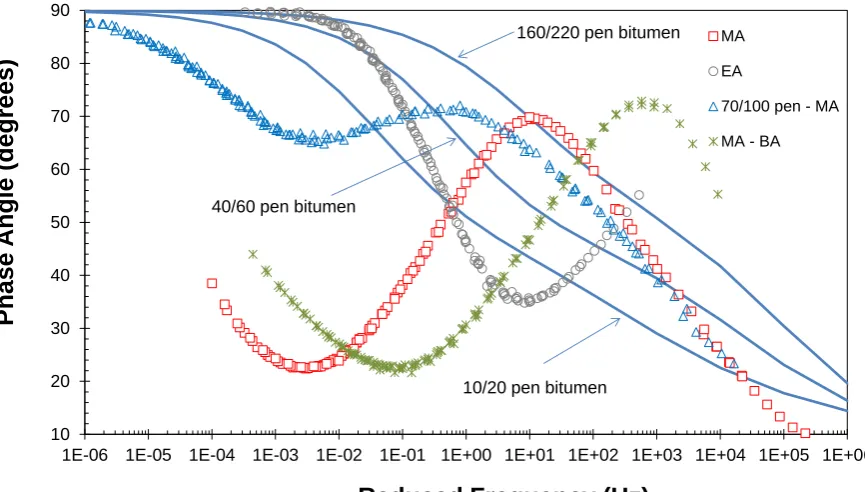
The time dependency of the synthetic polyacrylate binders is shown in the form of master curves of complex shear modulus and phase angle in Figures 12 and 13 together with the rheological properties of a ‘soft’ (160/220 pen), ‘intermediate’ (40/60 pen) and ‘hard’ (10/20 pen) bitumen. In addition to MA and EA, the co-polymer MA-BA and the 70/100 pen bitumen – MA blend have also been included.
22
reduced frequency values of approximately 0.0001 to 1 Hz for MA, 0.001 to 10 Hz for MA-BA and 0.1 to 100 Hz for EA. This intermediate plateau region is characterised by a plateau modulus (
G
N0 ) which is independent of both molecular weight and temperature (Ahmad et al. 2001). There is also evidence from the TTSP complex modulus master curves to suggest that the rheological profile for the MA homo-polymer (and possibly for MA-BA and EA) approach a upper limiting value of G* at high frequencies similar to that seen for penetration grade bitumen. Although the plateau region is not invariant with reduced frequency (faT), avalue of the plateau modulus (
G
N0 ) can be approximated by taking an average of the upper and lower limits at either end of the nominally linear region in Figure 12. The upper and lower limits for MA can be taken as 1.0 × 10⁵ Pa <G
N0 < 5 × 10⁶ Pa, co-polymer MA-BA as 8 × 10⁴ Pa <G
N0 < 6 × 10⁵ Pa and EA as 5 × 10⁴ Pa <G
N0 < 3 × 10⁵ Pa. The intermediate plateau region sits between two distinct regions corresponding to a high frequency (or transition) region and a low frequency (or terminal) region. Rheological data for MA, EA and BA, covering the two distinct terminal and transition regions as well as the intermediate plateau region, can be found in previous studies for a wider range of molecular weight synthetic binders (Airey and Mohammed 2008; Airey et al. 2008a; Airey et al. 2008b).The effect of blending MA with a 70/100 pen bitumen at a ratio of 1:1 by mass results in a binder with a complex shear modulus master curve similar to that seen for the standard penetration grade bitumens and positioned between the original 70/100 pen bitumen and the ‘hard’ MA binder. The smooth continuous nature of the master curve indicates the compatibility and uniformity of the mixed blend. In terms of a comparison of the polyacrylate binders with the standard penetration grade bitumens, Figure 12 shows that the MA homo-polymer is approximately equivalent to the ‘hard’ bitumen, EA is similar to the ‘soft’ (160/220 pen) and MA-BA tends to vary from one extreme to the other (hard to soft) depending on the loading frequency.
23
bitumens, which consists of a continuous transition from viscous response at low frequencies to elastic response at high frequencies.
Although the rheological profiles of the synthetic polymers are similar, there is a distinct difference between the position of the complex modulus and phase angle master curves of the MA based synthetic polymer compared to the MA-BA co-polymer and EA homo-polymer. In general, MA-BA demonstrated a ‘softer’ more viscous behaviour as shown by a lower complex modulus master curve in Figure 12 and the position of the phase angle master curve to the right of the MA master curve in Figure 13. This rheological behaviour is expected due to the presence of the lower viscosity butyl acrylate (23%) in the co-polymer. At the same time EA showed an even lower complex modulus master curve in Figure 12 and a more viscous behaviour in Figure 13. This ‘softer’ rheological behaviour was also confirmed by the lower values of H for MA-BA and EA compared to MA in Table 1.
The results show that it is possible to produce a range of synthetic polyacrylates with different rheological responses by altering the reactant type, reactant concentration and polymerization conditions to match the rheological properties of road bitumens. All the polyacrylate binders showed a similar rheological profile with a unique viscoelastic response as represented by the phase angle master curves together with an upper limiting stiffness and intermediate temperature/frequency ‘plateau’ region as shown in the complex modulus master curves. The results of the rheological examination of the binders showed that the key material property that influenced the performance of the polyacrylates in these specific application tests was the type of acrylate polymer. Previous studies have also show that glass transition temperature rather than molecular weight also plays a significant role in the rheological performance of these polyacrylate binders (Airey et al. 2011).
4.5 Temperature dependent behaviour
It is arguably more desirable to relate the physical and physicochemical properties of the modified binders and synthetic polymers to their rheological properties as a function of temperature rather than frequency (or time). This can be accomplished by transposing the time dependent rheological data to temperature dependent data using the master curves and shift factor functions. To undertake this task, the WLF equation with fitted 0
1
c and 0 2
24
constants for each of the rheological parameters (G* and ) was used together with the 25C reference temperature master curves to generate extended isochronal plots at three loading frequencies of 0.1, 1 and 10 Hz. An example of the extended complex modulus isochronal plots is shown in Figure 14 for the 70/100 pen bitumen. It is important to note that with the use of TTSP and the fitted WLF equations, the rheological data points are not extrapolated outside the measured data obtained from the dynamic oscillatory temperature-frequency sweep tests. Experimental data points taken from each of the test temperatures at a frequency of 1 Hz have been included in Figure 14 to confirm the validity of the calculation procedure.
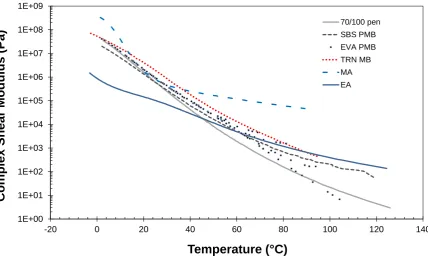
The rheological properties of six of the selected binders in terms of complex shear modulus (70/100 pen bitumen, SBS PMB, EVA PMB, TRN MB, MA and EA) and phase angle (70/100 pen bitumen, SBS PMB, TRN MB, MA and EA) isochronal plots at a frequency of 1 Hz are shown in Figures 15 and 16. The range of temperatures for the binders differ from each other due to the procedure used to predict the isochrones but generally cover the temperature range from approximately -5C to 120C. Compared to the conventional penetration grade bitumen, the modified binders (SBS PMB, EVA PMB and TRN MB) and the synthetic binders (MA and EA) all show an increase in complex modulus at intermediate to high temperatures with this increase in stiffness being considerable for MA. It is interesting to note that at approximately 20°C all binders, with the exception of TRN MB and EA, have the same complex modulus. In terms of the PMBs this is expected as the base bitumen used to produce these binders was a 70/100 pen bitumen while TRN MB was produced with a 35/50 pen bitumen. Although MA has the same stiffness as the 70/100 pen bitumen at 20°C, it is significantly stiffer at both lower and higher temperatures, while EA is considerably softer at low temperatures compared to the other binders.
25 4.6 Rheological fingerprinting
Black diagrams can be considered as rheological ‘fingerprints’ for different binders and have been used in Figure 17 to provide a convenient method of comparing all four categories of binder used in this study (standard penetration grade bitumen, polymer modified binders, tyre rubber modified binders and synthetic polyacrylate binders). The Black curves in Figure 17 clearly show the similar nature of the two polyacrylate binders with the curves for MA and EA overlapping in the centre of the plot. As expected the harder MA is positioned at the top of the graph (higher complex shear modulus values) while EA displays lower complex modulus values and increased viscous response.
The effect of SBS modification on the rheological parameters (complex modulus and phase angle) is shown in Figure 17 with the increased elastic response at low complex modulus values clearly evident in the Black curves. The clear shift of TRN MB to lower phase angles (improved elastic response) compared to the standard bitumen is evident in the typical 3-shape curve associated with rubberised binders (Subhy et al. 2015).
5. Conclusions
A range of conventional penetration grade bitumens, elastomeric and plastomeric polymer modified bitumens, tyre rubber modified binders and synthetic polyacrylate binders have been subjected to a detailed rheological study. These different types of binder (conventional, modified and synthetic) have undergone dynamic oscillatory testing using a DSR and rheological analysis using complex shear modulus and phase angle master curves, isochronal plots and Black diagrams to provide a detailed evaluation of the rheological response of these binders.
Some of the key findings from the study include:
26
temperature. It was also possible to accurately model the required shift factors using an Arrhenius equation as well as the WLF function. The determined WLF constants were then used, together with the master curves, to transpose the time dependent rheological data to temperature dependent data.
The rheological properties of conventional bitumens are improved by means of both polymer and tyre rubber modification. The mechanism associated with SBS and EVA polymer modification consists of the establishment of a polymer network within the modified binder which is a function of the nature of the base bitumen, the nature and content of the polymer and the bitumen-polymer compatibility. A similar mechanism occurs for rubber modified binders with the formation of a rubber network within the bitumen matrix. The improved viscoelastic properties of the PMBs and TR MBs consist of increased complex shear modulus and elastic response of the modified binders, particularly at high temperatures and low frequencies.
Synthetic polyacrylate binders can be successfully produced by means of both ATRP and CCTP to generate a range of different molecular weight polyethyl acrylate (EA), polymethyl acrylate (MA) and polybutyl acrylate (BA) binders. The rheological properties of these synthetic binders were found be to significantly different from those found for both conventional penetration grade bitumens as well as polymer and crumb rubber modified binders. The rheological properties of the polyacrylate binders were reminiscent of an amorphous polymer or possibly a partially crystalline polymer with an intermediate complex modulus plateau region and a complex transition from elastic to viscous response in terms of the material’s phase angles.
References
AASHTO Designation: TP5, Standard method of test for determining the rheological properties of asphalt binder using a dynamic shear rheometer (DSR) (1994)
Airey, G.D., Brown, S.F.: Rheological performance of aged polymer modified bitumens. Assoc Asphalt Tech 67:66-100, 67, 66-100 (1998)
Airey, G.D.: Rheological Evaluation of Ethylene Vinyl Acetate Polymer Modified Bitumens. Construction and Building Materials, 16(8), 473-487 (2002a)
27
Airey, G.D.: Rheological Properties of Styrene Butadiene Styrene Polymer Modified Road Bitumens. Fuel, 82(14), 1709-1719 (2003)
Airey, G.D., Hunter, A.E.: Dynamic Mechanical Testing of Bitumen – Sample Preparation Methods. Proceedings of the ICE - Transport, 156(TR2), 85-92 (2003)
Airey, G.D., Mohammed, M.H.: Rheological Properties of Polyacrylates used as Synthetic Road Binders. Rheologica Acta, 47, 751-763 (2008)
Airey, G.D., Mohammed, M.H., Collop, A.C., Hayes, C., Parry, T.: Linear viscoelastic behaviour of polyacrylate binders and bitumen blends. International Journal of Road Materials and Pavement Design, 9, Special Issue, 13-35 (2008a)
Airey, G.D., Mohammed, M.H., Fichter, C.: Rheological characteristics of synthetic road binders. Fuel, 87, 1763-1775 (2008b)
Airey, G.D., Wilmot, J., Grenfell, J.R.A., Irvine, D.J., Barker, I.A., El Harfi, J.: Rheology of polyacrylate binders produced via catalytic chain transfer polymerization as an alternative to bitumen in road pavement materials. European Polymer Journal, 47, 1300-1314 (2011)
Ahmad, N.M., Lovell, P.A., Underwood, S.M.: Viscoelastic properties of branched polyacrylate melts. Polymer International, 50, 625-634 (2001)
Anderson, D.A., Christensen, D.W., Bahia, H.U., Dongre, R., Sharma, M.G., Antle, C.E., Button, J.: Binder Characterisation and Evaluation. Volume 3: Physical Properties, SHRP-A-369, National Research Council, Washington, D.C. (1994)
ASTM: Standard Test Method for Viscosity of Asphalt with Cone and Plate Viscometer. ASTM D 3205-77, Annual Book of ASTM Standards, 4.03, 468-472 (1986)
Bardesi, A. et al.: Use of modified bituminous binders, special bitumens and bitumens with additives in pavement applications. Technical Committee Flexible Roads (C8), World Road Association (PIARC) (1999)
Barnes, H.A., Hutton, J.F., Walters, K.: An introduction to rheology. Elsevier, Amsterdam (1989)
BS EN 1426. Bitumen and bituminous binders — Determination of needle penetration, British Standards (2007)
BS EN 1427. Bitumen and bituminous binders — Determination of the softening point — Ring and Ball method, British Standards (2007)
28
Cavaliere, M.G., Diani, E., Vitalini Sacconi, L.: Polymer modified bitumens for improved road application. Proceedings of the 5th Eurobitume Congress, Stockholm, 1A, 1.23, 138-142 (1993)
Celauro, B., Celauro, C., Lo Presti, D., Bevilacqua, A.: Definition of a laboratory optimization protocol for road bitumen improved with recycled tire rubber. Construction and Building Materials, 37, 562-572 (2012)
Chailleux, E., Audo, M., Bujoli, B., Queffelec, C., Legrand, J., Lepine, O.: Alternative Binder from Microalgae. Transportation Research Circular, Number E-C165. Papers from a Workshop, 7-14 (2012)
Daga, V.K., Wagner, N.J.: Linear viscoelastic master curves of neat and laponite-filled poly(ethylene oxide)-water solutions. Rheol Acta, 45, 813-824 (2006)
Delaporte, B., Di Benedetto, H., Chaverot, P., Gauthier, G.: Linear viscoelastic properties of bituminous materials; from binders to mastics. J Assoc Asphalt Paving Technol, 76, 455-494 (2007)
Dickinson, E.J., Witt, H.P.: The dynamic shear modulus of paving asphalts as a function of frequency. Transaction Soc Rheol, 18, 591-605 (1974)
Diehl, C.F.: Ethylene-styrene interpolymers for bitumen modification. Proceedings of the 2nd Eurasphalt and Eurobitume Congress, Barcelona, 2, 93-102 (2000)
Ferry, J.D.: Viscoelastic properties of polymers. John Wiley and Sons, New York (1980) Fini, E.H., Kalberer, E.W., Shahbazi, G., Basti, M., You, Z., Ozer, H., Aurangzeb, Q.:
Chemical Characterization of Biobinder from Swine Manure: Sustainable Modifier for Asphalt Binder. Journal of Materials in Civil Engineering, 23(11), 1506-1513 (2011)
Fini, E.H., Al-Qadi, I.J., Xiu, S., Mills-Beale, J., You, Z.: Partial replacement of asphalt binder with bio-binder: characterisation and modification. International Journal of Pavement Engineering, 13(6), 515-522 (2012)
Gaw, W.J.: The measurement and prediction of asphalt stiffness at low and intermediate pavement service temperatures. Assoc Asphalt Tech, 47, 457-494 (1978)
Goodrich, J.L.: Asphalt and polymer modified asphalt properties related to the performance of asphaltic concrete mixes. Assoc Asphalt Tech, 57, 116-175 (1988)
Goodrich, J.L.: Asphaltic binder rheology, asphalt concrete rheology and asphalt concrete mix properties. Assoc Asphalt Tech, 60, 80-120 (1991)
29
Binders - Functional Properties and Performance Testing, E&E.5.111, Strasbourg (1996)
Gridnev, A.A., Ittel, S.D.: Catalytic Chain Transfer in Free-Radical Polymerizations. Chemical Reviews, 101(12), 3611-3659 (2001)
Griffen, R.L., Miles, T.K., Penther, C.J., Simpson, W.C.: Sliding plate microviscometer for rapid measurements of asphalt viscosity in absolute units. ASTM Special Technical Publication 212:36 (1956)
Heitzman, M.: Design and construction of asphalt paving materials with Crumb Rubber Modifier. Transportation Research Record 1339, 1-12 (1992)
Institute of Petroleum. Determination of the complex shear modulus and phase angle of bituminous binders – dynamic shear rheometer (DSR), Method, IP PM CM/99 (1999) Isacsson, U., Lu, X.: Testing and appraisal of polymer modified road bitumens – state of the
art. Materials and Structures, 28, 139-159 (1995)
Kato, M., Kamigaito, M., Sawamoto, M., Higashimura, T.: Polymerization of Methyl Methacrylate with the Carbon Tetrachloride / Dichlorotris- (triphenylphosphine) ruthenium(II)/Methylaluminum Bis(2,6-di-tert-butylphenoxide) Initiating System: Possibility of Living Radical Polymerization. Macromolecules, 28(5), 1721-1723 (1995)
Kriz, P., Stastna, J., Zanzotto, L.: Glass Transition and Phase Stability in Asphalt Binders. Road Materials and Pavement Design, 9, 37-65 (2008)
Lesueur, D., Gerard, J.F., Claudy, P., Letoffe, J.M., Planche, J.P., Martin, D.: A structure-related model to describe bitumen linear viscoelasticity. J Rheol, 40, 813-836 (1996) Lesueur, D.: On the thermorheological complexity and relaxation modes of asphalt cements.
Journal of Rheology, 43, 1701-1704 (1999)
Lo Presti, D., Airey, G.D., Partal, P.: Manufacturing terminal and field bitumen-tyre rubber blends: The importance of processing conditions. Procedia-Social and Behavioral Sciences, 53, 485-494 (2012)
Lo Presti, D.: Recycled Tyre Rubber Modified Bitumens for road asphalt mixtures: A literature review. Construction and Building Materials, 49, 863-881 (2013)
Lo Presti, D., Airey, G.D.: Tyre rubber-modified bitumens development: The effect of varying processing conditions. Road Materials and Pavement Design, 14(4), 888-900 (2013)
30
binder formulation. Proceedings of the Eurasphalt & Eurobitume Congress, Session 5: Binders - Functional Properties and Performance Testing, E&E.5.115, Strasbourg (1996)
McKee, M.G., Unal, S., Wilkes, G.L., Long, T.E.: Branched polyesters: recent advances in synthesis and performance. Progress in Polymer Science, 30, 507-539 (2005)
Md. Yusoff, N.I., Shaw, M.T., Airey, G.D.: Modelling the linear viscoelastic rheological properties of bituminous binders. Constr Build Mater, 25, 2171-2189 (2011)
Md. Yusoff, N.I., Mounier, D., Ginoux, M.S., Hainin, M.R., Airey, G.D., Di Benedetto, H.: Modelling the rheological properties of bituminous binders using the 2S2P1D Model. Construction and Building Materials, 38, 395-406 (2013)
Mezger, T.G.: The Rheology Handbook: For rotational and oscillatory rheometers. Hannover (2002)
Monismith, C.L., Alexander, R.L., Secor, K.E. Rheological behaviour of asphalt concrete. Assoc Asphalt Tech, 35, 400-450 (1966)
Olard, F., Di Benedetto, H.: General ‘‘2S2P1D’’ model and relation between the linear viscoelastic behaviours of bituminous binders and mixes. Road Mater Pavement, 4, 185-224 (2003)
Olard, F., Di Benedetto, H., Eckmann, B., Triquigneaux, J.P.: Linear viscoelastic properties of bituminous binders and mixtures at low and intermediate temperatures. Road Mater Pavement, 4, 77-107 (2003)
Pellinen, T.K., Zofka, A., Marasteanu, M., Funk, N.: The use of asphalt mixture stiffness predictive models. J Assoc Asphalt Paving Technol, 76, 575-626 (2007)
Peralta, J., Williams, R.C., Rover, M., Silva, H.M.R.D.: Development of Rubber-Modified Fractionated Bio-Oil for Use as Noncrude Petroleum Binder in Flexible Pavements. Transportation Research Circular, Number E-C165. Papers from a Workshop, 23-36 (2012)
Petersen, J.C., Robertson, R.E., Branthaver, J.F., Harnsberger, P.M., Duvall, J.J., Kim, S.S., Anderson, D.A., Christensen, D.W., Bahia, H.U., Dongre, R., Sharma, M.G., Antle, C.E., Button, J., Glover, C.J.: Binder Characterisation and Evaluation. Volume 4: Test Methods, SHRP-A-370, National Research Council, Washington, D.C. (1994)
31
Planche, J.P., Lesueur, D., Hines, M.L., King, G.N.: Evaluation of elastomer modified bitumens using SHTP binder specifications. Eurasphalt & Eurobitume Congress E&E.5.121, Strasbourg (1996)
Raouf, M.A., Williams, C.R., 2010. General Rheological Properties of Fractionated Switchgrass Bio-Oil as a Pavement Material. Road Materials and Pavement Design, 11, 325-353 (2010)
Schweyer, H.E., Smith, L.L., Fish, G.W.: A constant stress rheometer for asphalt cements. Assoc Asphalt Tech, 45, 53-72 (1976)
Soenen, H., De Visscher, J., Vanelstraete, A., Redelius, P.: Influence of thermal history on rheological properties of various bitumen. Rheol Acta, 45, 729-739 (2006)
Subhy, A., Lo Presti, D., Airey, G.D.: An investigation on using pre-treated tyre rubber as a replacement of synthetic polymers for bitumen modification. Road Materials and Pavement Design, 16, Issue Supplement 1: EATA, 245-264 (2015)
Van der Poel, C.: A general system describing the visco-elastic properties of bitumen and its relation to routine test data. J Applied Chemistry, 4, 221-236 (1954)
Wang, H., You, Z., Mills-Beale, J., Hao, P.: Laboratory evaluation on high temperature viscosity and low temperature stiffness of asphalt binder with high percent scrap tire
rubber. Construction and Building Materials, 26(1), 583-590 (2012)
Wang, J.S., Matyjaszewski, K.: Controlled/"living" radical polymerization. atom transfer radical polymerization in the presence of transition-metal complexes. Journal of the American Chemical Society, 117(20), 5614-5615 (1995)
Wen, H., Bhusal, S., Wen, B.: Laboratory Evaluation of Waste Cooking Oil–Based Bioasphalt as Sustainable Binder for Hot-Mix Asphalt. Transportation Research Circular, Number E-C165. Papers from a Workshop, 49–60 (2012)
Williams, M.L., Landel, R.F., Ferry, J.D.: The Temperature-Dependence of Relaxation Mechanisms in Amorphous Polymers and Other Glass-Forming Liquids. Journal of the American Chemical Society, 77(14), 3701-3707 (1955)
Whiteoak, C.D.: The Shell Bitumen Handbook. Shell Bitumen, Surrey, UK (1990)
33
[image:33.595.68.533.127.287.2]Tables
Table 1. Arrhenius and WLF shift factor parameters for selected binders
Binder Arrhenius equation WLF equation
H (kJ/mol) R2 0
1
c c20 R
2 70/100 pen SBS PMB EVA PMB TRN MB TRW MB MA EA MA-BA
70/100 pen - MA
34
Figures
Figure 1. Methodology for preparing and loading polyacrylate binders and blends into the DSR: 25 mm and 8 mm silicone moulds and binder samples; pouring and placing binder samples in DSR; and setting final testing gap and trimming excess binder around testing geometry
Figure 2. Black diagram showing thermo-rheological simplicity for polymethyl acrylate binder MA
Figure 3. Black diagram showing disruption of thermo-rheological simplicity for EVA PMB Figure 4. TTSP shifting of complex shear modulus isotherms to produce a continuous complex shear modulus master curve at a reference temperature of 25C for a conventional 70/100 pen bitumen
Figure 5. TTSP shifting of phase angle isotherms to produce a continuous phase angle master curve at a reference temperature of 25C for polyethyl acrylate binder EA
Figure 6. Horizontal shift factors modelled for a conventional 40/60 pen bitumen, SBS PMB, TRN MB, MA and EA synthetic binders using a relationship with temperature difference in terms of the WLF equation
Figure 7. WLF and Arrhenius equation fits of experimentally determined shift factors for 70/100 pen bitumen
Figure 8. TTSP shifted complex shear modulus master curve data at a reference temperature of 25°C together with 2S2P1D modelled data for a range of penetration grade bitumens Figure 9. TTSP shifted phase angle master curve data at a reference temperature of 25°C together with 2S2P1D modelled data for a range of penetration grade bitumens
Figure 10. Time dependent complex shear modulus master curves for polymer and tyre rubber modified binders at a reference temperature of 25°C
Figure 11. Time dependent phase angle master curves for polymer and tyre rubber modified binders at a reference temperature of 25°C
Figure 12. Time dependent complex shear modulus master curves for polyacrylate homo-polymers, co-polymer and synthetic polymer-bitumen blend at a reference temperature of 25°C
Figure 13. Time dependent phase angle master curves for polyacrylate homo-polymers, co-polymer and synthetic co-polymer-bitumen blend at a reference temperature of 25°C
Figure 14. TTSP extended complex shear modulus isochronal plots at 0.1, 1 and 10 Hz together with isolated experimental data points at 1 Hz for 70/100 pen bitumen
35
Figure 16. Predicted phase angle isochronal plots at 1 Hz for different conventional, polymer modified, tyre rubber modified and synthetic binders
36
[image:36.595.90.499.136.319.2]37
[image:37.595.73.512.83.342.2]Figure 2. Black diagram showing thermo-rheological simplicity for polymethyl acrylate binder MA
Figure 3. Black diagram showing disruption of thermo-rheological simplicity for EVA PMB 1E+04
1E+05 1E+06 1E+07 1E+08 1E+09
10 20 30 40 50 60 70 80 90
Complex
Shear
Modulus
(Pa)
Phase Angle (degrees)
5°C 10°C
15°C 20°C
25°C 30°C
35°C 40°C
45°C 50°C
55°C 60°C
1E+00 1E+01 1E+02 1E+03 1E+04 1E+05 1E+06 1E+07 1E+08
10 20 30 40 50 60 70 80 90
Complex
Shear
Modulus
(Pa)
Phase Angle (degrees)
10°C 15°C 25°C 35°C
[image:37.595.75.508.440.705.2]38
Figure 4. TTSP shifting of complex shear modulus isotherms to produce a continuous complex shear modulus master curve at a reference temperature of 25C for a conventional 70/100 pen bitumen
1E+00 1E+01 1E+02 1E+03 1E+04 1E+05 1E+06 1E+07 1E+08
1E-06 1E-05 1E-04 1E-03 1E-02 1E-01 1E+00 1E+01 1E+02 1E+03 1E+04
Complex
Shear
Modulus
(Pa)
Reduced Frequency (Hz)
Mastercurve
10°C
15°C
25°C
35°C
45°C
55°C
65°C
[image:38.595.76.512.84.343.2]39
Figure 5. TTSP shifting of phase angle isotherms to produce a continuous phase angle master curve at a reference temperature of 25C for polyethyl acrylate binder EA
30 40 50 60 70 80 90
1E-04 1E-03 1E-02 1E-01 1E+00 1E+01 1E+02 1E+03
Phase
Angle
(degre
es)
Reduced Frequency (Hz)
Mastercurve 5°C
10°C 15°C
20°C 25°C
30°C 35°C
40°C 45°C
50°C 55°C
60°C 65°C
40
Figure 6. Horizontal shift factors modelled for a conventional 40/60 pen bitumen, SBS PMB, TRN MB, MA and EA synthetic binders using a relationship with temperature difference in terms of the WLF equation
Figure 7. WLF and Arrhenius equation fits of experimentally determined shift factors for 70/100 pen bitumen
R² = 0.9534
R² = 0.9929
R² = 0.9441
R² = 0.9988
R² = 0.9929
4 6 8 10 12 14 16 18 20
-30 -20 -10 0 10 20 30 40 50 60
(T
-T0
)/
L
o
g
aT
T - T0(°C)
40/60 pen SBS PMB
TRN MB MA
MA - BA Linear (40/60 pen) Linear (SBS PMB) Linear (TRN MB) Linear (MA) Linear (MA - BA)
-5 -4 -3 -2 -1 0 1 2 3
0 10 20 30 40 50 60 70 80 90
Log
aT
Temperature (°C)
Experimental Shift Factors
WLF Equation
[image:40.595.81.512.441.699.2]41
Figure 8. TTSP shifted complex shear modulus master curve data at a reference temperature of 25°C together with 2S2P1D modelled data for a range of penetration grade bitumens
Figure 9. TTSP shifted phase angle master curve data at a reference temperature of 25°C together with 2S2P1D modelled data for a range of penetration grade bitumens
1E+00 1E+01 1E+02 1E+03 1E+04 1E+05 1E+06 1E+07 1E+08 1E+09
1E-07 1E-06 1E-05 1E-04 1E-03 1E-02 1E-01 1E+00 1E+01 1E+02 1E+03 1E+04 1E+05
Compl ex Shear Modul us (Pa)
Reduced Frequency (Hz)
10/20 pen 35/50 pen 40/60 pen 70/100 pen 160/220 pen 10/20 pen 35/50 pen 40/60 pen 70/100 pen 160/220 pen
160/220 pen bitumen 10/20 pen bitumen
10 20 30 40 50 60 70 80 90
1E-07 1E-06 1E-05 1E-04 1E-03 1E-02 1E-01 1E+00 1E+01 1E+02 1E+03 1E+04 1E+05 1E+06
Phase
Angle
(degre
es)
Reduced Frequency (Hz)
10/20 pen 35/50 pen 40/60 pen 70/100 pen 160/220 pen 10/20 pen 35/50 pen 40/60 pen 70/100 pen 160/220 pen
160/220 pen bitumen
[image:41.595.76.504.441.669.2]42
[image:42.595.75.514.82.343.2]Figure 10. Time dependent complex shear modulus master curves for polymer and tyre rubber modified binders at a reference temperature of 25°C
Figure 11. Time dependent phase angle master curves for polymer and tyre rubber modified binders at a reference temperature of 25°C
1E+01 1E+02 1E+03 1E+04 1E+05 1E+06 1E+07 1E+08 1E+09
1E-06 1E-05 1E-04 1E-03 1E-02 1E-01 1E+00 1E+01 1E+02 1E+03 1E+04
Complex
Shear
Modulus
(Pa)
Reduced Frequency (Hz)
SBS PMB
EVA PMB
TRN MB
TRW MB
160/220 pen bitumen 10/20 pen bitumen
40/60 pen bitumen
10 20 30 40 50 60 70 80 90
1E-06 1E-05 1E-04 1E-03 1E-02 1E-01 1E+00 1E+01 1E+02 1E+03 1E+04 1E+05 1E+06
Phase
Angle
(degre
es)
Reduced Frequency (Hz)
SBS PMB
EVA PMB
TRN MB
TRW MB
160/220 pen bitumen
[image:42.595.101.507.438.671.2]