SUM FREQUENCY MIXING AND QUANTUM
INTERFERENCE IN THREE-LEVEL ATOMS
Richard R. Moseley
A Thesis Submitted for the Degree of PhD
at the
University of St Andrews
1995
Full metadata for this item is available in
St Andrews Research Repository
at:
http://research-repository.st-andrews.ac.uk/
Please use this identifier to cite or link to this item:
http://hdl.handle.net/10023/13753
Sum F requency M ixin g
and
Q uantum In terferen ce
in
T h ree-L evel A tom s
A thesis presented by
R ichard R. M oseley, B .Sc
to the
University of St. Andrews
in application for the degree of
Doctor of Philosophy
ProQuest Number: 10167412
All rights reserved INFORMATION TO ALL USERS
The quality of this reproduction is dependent upon the quality of the copy submitted. In the unlikely event that the author did not send a com plete manuscript and there are missing pages, these will be noted. Also, if material had to be removed,
a note will indicate the deletion.
uest
ProQuest 10167412
Published by ProQuest LLO (2017). Copyright of the Dissertation is held by the Author. All rights reserved.
This work is protected against unauthorized copying under Title 17, United States C ode Microform Edition © ProQuest LLO.
ProQuest LLO.
789 East Eisenhower Parkway P.Q. Box 1346
D eclarations
I, Richard Robert Moseley, hereby certify th at this thesis has been composed by myself, th at it is a record of my own work, and th at it has not been accepted in partial or complete fulfillment of any other degree or professional qualification. I was adm itted to the Faculty of Science of the University of St. Andrews under Ordinance General No. 12 in October 1991 and as a candidate for the degree of Ph.D . in October 1992.
Richard R. Moseley Septem ber 1994
I hereby certify th at the candidate has fulfilled the conditions of the Resolution and Regulations appropriate to the Degree of Ph.D.
Malcolm H. Dunn Septem ber 1994
A bstract
This work contains theoretical and experim ental studies of the properties of three-level atoms subjected to two single-frequency, continuous-wave laser sources with special emphasis on magnetic-field-induced sum frequency mixing (SFM) and electromagnetically-induced transparency (FIT).
In sodium vapour, two resonant-enhancem ent routes for SFM were experim en tally studied. In one route (3S-3P-3D ) the output is generated on a quadrupole- allowed transition and on the other (3S-3P-4P), a dipole-allowed transition. Phase m atching conditions are studied in detail. On the second route, the two contri butions to the phase m ism atch can combine to heavily distort the spectroscopic lineshapes observed.
Doubly-resonant SFM is considered and two paths for excitation of the out put coherence are identified. Control of their relative strength, via the input laser strengths, is predicted, as well as interference between them . These are both exper im entally observed on the 3Si/2~3Pi/2- 3D3/2 transition scheme in sodium.
Theory is presented to show how the use of a strong upper laser in resonant SFM can, by FIT , greatly reduce the absorption on the lower transition w ithout similarly reducing the nonlinear process. A significant increase in conversion efficiency is predicted.
Theory is also presented on the inclusion of the local field correction, which is relevant for high vapour densities, in the Bloch equations for the three-level atom. Nonlinear coherence cross-coupling term s arise and the generalised equations are then used for two case studies; one concerning FIT, the other SFM.
D ad
A cknow ledgem ents
I wish to gratefully thank my supervisors, Prof. Malcolm Dunn and Dr. Bruce Sinclair, for their guidance, suggestions, patience and physical insight displayed during the course of this work. I owe a large debt of gratitude to Dr. Sara Shepherd for her ideas, our frequent discussions and tuition in the art of tweaking. I would also acknowledge useful discussions and encouragement from Dr. Christoph Keitel regarding the work on EIT in this thesis. I would like to thank the D epartm ent of Physics and Astronomy for its technical backup and assistance, especially Les and Derek for the loan of equipment.
I wish to extend my gratitude to The Carnegie Trust for the Universities of Scotland who provided my scholarship to carry out this work.
T
a b l e
o f
C
o n t e n t s
Declarations
A bstract
D edication
A cknow ledgem ents
Table of Contents
1 Introduction 1
1.1 B a c k g ro u n d ... 1
1.2 Non-Linear Optics ... 3
1.3 Atomic Coherence and Q uantum Interference ... 6
1.4 Electrom agnetically-induced Transparency (EIT) ... 8
1.5 EIT in Nonlinear Optical P ro c e s s e s ... 14
1.6 Inversionless Lasing and P h a so n iu m ... 17
1.7 The Local Field E f f e c t ... 18
1.8 A Guide to the Following C h a p te r s ... 19
R eferences...21
2 T heory and N um erical M odeling 32 2.1 Descriptions of Coherent E x c ita tio n ...32
2.2 Numerical Solutions and E x ten sio n s...41
2.3 N Level R u le s ...46
2.4 Specimen S ystem s...46
3 E xperim ental Equipm ent and A tom ic System s 60
3.1 Laser S y ste m s ... 60
3.2 O ther Experim ental E q u ip m e n t...68
3.3 Vapour S y ste m s...72
3.4 Atomic Systems: Na and R b ... 75
R eferences...86
4 The Consequences of Different R esonant E nhancem ent Schem es for Sum Frequency M ixing in Vapours 89 4.1 Introduction to Sum Frequency M ix in g ... 89
4.2 Phase M atching in Vapours ...93
4.3 Phase M atch Behaviour C a lc u la tio n s ...101
4.4 Initial E x p e rim e n ts... 107
4.5 The Dipole-Dipole-Quadrupole S c h e m e ... 114
4.6 The Dipole-Quadrupole-Dipole S c h e m e ... 123
4.7 Final R em ark s...130
R eferences... 131
5 R oute Interference in R esonant Sum Frequency M ixing 133 5.1 Resonant Sum Frequency M ix in g ...133
5.2 Excitation of P o p u la tio n ... 134
5.3 Excitation of pi3 ... 138
5.4 Experim ental Excitation to the 3D Levels ...148
5.5 Experim ental Resonant S F M ... 155
5.6 D iscu ssio n ... 162
R eferences...165
6.2 Density M atrix T h e o r y ...169
6.3 Enhancem ent of the Nonlinear P r o c e s s ...177
6.4 Numerical M o d els...181
6.5 Towards Experim ental R ealisatio n ... 182
References . ...189
7 The Local Field Effect in Coherent Three-Level A tom Processes 192 7.1 The Local Field C o rrectio n ... 192
7.2 The Two-Level A to m ...194
7.3 The Three-Level A to m ... 195
7.4 D iscu ssio n ... 197
7.5 Application 1: Homogeneously Broadened E I T ... 201
7.6 Application 2: High Density S F M ... 206
R eferences...210
8 Sub-D oppler E lectrom agnetically-induced Transparency and Lens-ing 212 8.1 Sub-Doppler E I T ...212
8.2 EIT: Experim ental R e s u lts ... 214
8.3 Electrom agnetically-induced F ocusing...221
8.4 Discussion of E I F ...228
R eferences...232
9 Conclusions 233 9.1 Suggestions for Further W o r k ...236
R eferences...239
A ppendix A Rules for N Level D ensity M atrix M odels 240
Chapter 1
1
. I
n t r o d u c t io n
1.1. Ba
ckground
The work presented in this thesis concerns the interaction of light with the atoms in a gas. It is by no means the first work in this area.
The modern view of this field was born when Fraunhofer discovered, experim en tally, th a t the spectrum of light em itted by the sun contained numerous, narrow well-defined dark bands. Later work showed th at each line was unique to an el em ent and th at a study of the wavelength of these spectral features, whether in light em itted from a sample, or from incident light absorbed within a sample, could be used to determ ine the composition of the sample. Furtherm ore, it could tell a great deal about the atom itself. Nowadays this form of study is called spec troscopy and it has a variety of applications in all physical sciences. This thesis is concerned with furthering the understanding of how atoms react to strong, coher ent, narrow-bandwidth optical radiation when applied at two separate wavelengths simultaneously. It is, therefore, spectroscopy but also falls into the more precise classification of non-linear optics.
coher-1. Introduction 1.1 B ackground
ence, high intensity and narrow bandw idth and, when subjected to such radiation, atoms react in ways th at cannot always be explained under a rate equation analysis. Coherent excitation [1], as this regime is called, leads to a variety of phenomena, such as the Rabi flopping of populations [2] and Autler-Townes splitting [3] (also called the ac Stark effect). Its hallm ark is th at the atom ic wavefunction th at is pro duced can hold a definite phase relationship to the oscillating fields of the incident electrom agnetic wave. We say th a t the atom has “coherences” induced between the wavefunctions of its discrete levels. This is possible only when the incident light is both coherent and monochromatic.
(a)
(b)(c)
Figure 1.1: Three possible three-level atom configurations: (a) cascade, (b) lam bda (A) and (c) vee (V). The arrows denote near-resonant fields incident on dipole- allowed transitions. The third, unprobed, transition in each configuration is assumed to be dipole forbidden.
1. Introd uction 1.2 N on-L inear O ptics
transition, while suffering strong perturbation on the other transition is studied in regard to interference between the two coherent excitation processes.
1.2. N on-L inear O ptics
W hen light impinges on a medium a polarisation is set up within the atom s of th at medium. Usually the light intensity is low enough th at a linear relation between the polarisation induced in the medium , P , and the electric field of the light, P , is an accurate description:
p = (1.1)
The constant, is term ed the linear susceptibility of the m edium and depends
strongly on the m edium and the wavelength of the light. However, if the incident | light is particularly intense, and a laser output often is, this linear relation breaks
down and we m ust express the polarisation as a power series containing higher-order terms:
P = eox“ >£ + • ■ • (1.2) The study of the effects of these higher-order term s is called non-linear optics and is m otivated by a num ber of scientific and commercial objectives. Among the most im portant consequence of the term , the second-order nonlinear susceptibility, is the ability of the m edium to generate new frequencies of light [4] by: doubling the input frequency (second harmonic generation); subdiving the input frequency into two additive parts (param etric oscillation); or combing two separate input waves to produce a sum or difference frequency. Similarly, the third-order susceptibility, can lead to the generation of new frequencies of light — among other applications [5].
1.2.1. Second-Order W ave M ixing in Vapours
1. Introduction 1.2 N on-L inear O ptics
sym m etry argum ent [6] shows th at a centrosym m etric m edium , of either a gas or appropriate crystal structure, cannot m ediate a second-order process, and for such m edia = 0. Therefore, it is usual to use an appropriate non-centrosym metric crystal with a large second-order nonlinear coefficient for such experim ents. How ever, despite the intrinsic sym m etry of an atomic vapour, second-order nonlinear processes can be observed in them if the vapour sym m etry is broken by some exter nal means. W hile vapours have lower conversion efficiencies than crystals in general, with tighter tuning restrictions and being bulky in physical dimensions (generally re quiring vacuum equipm ent), they do have some advantages. Principally, they allow generation in the ultra-violet, vacuum -ultra-violet and X-ray regions of the spectra, below the absorption cut-off point in nonlinear crystals around 200nm. Further more, they are able to w ithstand very high input intensities th at would damage conventional crystals and are scalable to large physical dimensions. For these rea sons vapours have become widely established for third-order wave mixing processes [5, 7], but second-order processes can be as efficient [8] and have been the subject of detailed research (see Sinclair [9] for a review). The required sym m etry breaking can be obtained by a variety of means including: transverse m agnetic or electric fields; high intensity focused laser pulses; or non-collinear beam geometries.
2
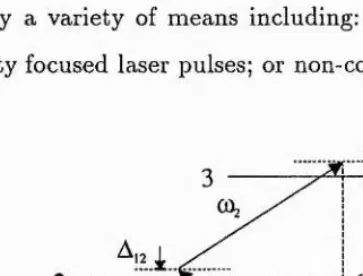
Figure 1.2: A generic atomic level scheme for sum frequency mixing
In order to realise a useful conversion efficiency, the input wavelengths in a
4
I
[image:16.614.207.389.485.623.2]1. Introduction 1.2 N on-L inear O ptics
gaseous wave mixing process m ust be tuned close to resonant transitions, as in figure 1.2. This is highlighted by the simplified equation for the second-order susceptibility in a gas [8, 9, 10]:
wherein fXij are the transition m atrix elements, A,j the detunings, and 7ij the de cay rates. For the sum frequency mixing (SFM) process shown in figure 1 .2 the conversion efficiency is increased by several orders of m agnitude when either A12 or A i3 are near zero, ie. when either single-photon or two-photon resonance conditions are satisfied. Also evident from this expression is the role of the transition m atrix elements. The product of these m ust be as high as possible for efficient conversion. Unfortunately, selection rules require th at in a closed three-level atomic system one of these transitions cannot be dipole-allowed. However, use of a quadrupole-allowed transition can still lead to efficient conversion [8, 1 1].
demon-1. Introd uction 1.3 A tom ic C oherence and Q uantum Interference
strates the advantage of having the quadrupole transition on the output. This work constitutes chapter 4.
1.3. A tom ic C oherence and Q uantum Interference
By pushing the nonlinear process to simultaneous single and two-photon resonance a new realm of atomic conditions is entered. The approxim ations made in deriving equation 1.3 break down and the coherences generated on each transition are strongly influenced by each other. The possibility of interference between the coherences arises and the SFM process needs to be re-evaluated in light of this. This is presented in chapter 5. The wider context of atom ic coherence and quantum interference phenom ena is relevant to this work, and as background to the work presented in later chapters concerning electromagnetically-induced transparency. A sum m ary of relevant pioneering work is, therefore, given below.
An early study of a quantum interference effect concerned the problem of a dis crete state placed within a continuum. In his 1961 treatm ent of such “autoionising” states, Fano [17] introduced the concept of the phase of the interaction between the state and the continuum. This was shown to vary across the state’s linewidth and markedly asym m etrical absorption curves, which had zeros in the absorption to
one side of the m ain peak, were predicted in agreement with experim ental work. A ; straightforward physical view of this cancellation in the absorption is of the excita
tion through the two routes to the end product — an ionised atom — interfering. The two routes in this case are (a) direct photo-ionisation, and (b) excitation to the discrete state followed by rapid decay and, hence, ionisation. Later measure ments by Austin and M arr [18, 19] of the vacuum ultra-violet absorption spectra of cadm ium and zinc vapours respectively, showed sharp interference features between close autoionising lines. These showed dram atically th at neighbouring lines in the continuum could lead to interference, and thus cancellation in absorption, as well.
Some tim e later, in 1976, experim ents in sodium at Pisa, Italy discovered a co- |
1
I
1. Introduction 1.3 A tom ic C oherence and Q uantum Interference
1. Introduction 1.4 E lectrom agn etically-induced T ransparency (E IT )
1.4. E lectrom agn etically-in d u ced T ransparency (E IT )
Recent work in this area has tended to concentrate not so much on the transfer of population, but on the absorption and emission properties of systems displaying this form of quantum interference. Generally the conceptual and experim ental structures revolve around a three level atom which is being excited by a strong laser on one transition (the “coupling” field), and the effect th at this has on the absorption on the other transition, which is m onitored by a weak probe field.
1.4.1. The Rabi frequency and Autler-Townes Splitting
A central param eter to the m ajority of this work is the Rabi frequency [2, 29]. The Rabi frequency, fî, is basically a measure of the strength of the interaction between the atom and the incident radiation. It is defined as:
(1.4)
where E is the strength of the electric field of the incident light and is the transition m atrix element, as before. It corresponds to the rate the population would flop back and forward between the levels of an undam ped system. (See [1,2] for a comprehensive introduction.)
It also corresponds to the splitting of the atomic level caused by the interaction of strong, resonant, monochrom atic light. This splitting is term ed the Autler-Townes (or ac Stark) effect [1, 3, 29] and is the high frequency analogue of the dc Stark effect. More generally, the levels at each end of the transition split into two components separated by O, which is given by:
Ù = VA2 + æ (1.5)
where A is the detuning of the coupling field from resonance. This splitting has been observed in the optical range for some tim e (eg. see [30, 31, 32]) in both beam and vapour experiments. However, it was not realised until fairly recently th at the
1. Introduction 1.4 E lectrom agn etically-induced T ransparency (E IT )
absorption lineshape for transitions to an Autler-Townes doublet was not necessarily just the addition of two, appropriately split, sub-components but th at between the two components an interference was created leading to a greatly reduced absorp tion probability: electromagnetically-induced transparency. This sharp interference feature occurs even when the Autler-Townes splitting is less than the homogeneous linewidth (although not when the splitting is less than the inhomogeneous linewidth) and appears as a narrow transparency window within the absorption profile. The position of the feature is set by the two-photon resonance, the w idth by the cou pling held Rabi frequency, and the reduction in absorption by a com bination of the coupling held strength and the two-photon dephasing. See section 2.4.2 for some example lineprohles and some explanation of the dépendance on these param eters.
1.4.2. Initial Work on EIT
r 3d
r
3d 2d
1
Figure 1.3: On the left the bare state scheme considered for EIT, and on the right, the corresponding dressed state view.
The concept of EIT can be traced to a paper by Imamoglu and Harris [33] in which the authors considered the possibility of lasing w ithout inversion in a three- level atom ic system. The bare and dressed state views of the problem are shown in hgure 1.3. They considered the atomic response to light at Wp which is tuned across the 1-2 transition while a strong, resonant field couples the 2-3 transition. They
1. Introduction 1.4 E lectrom agn etically-induced Transparency (E IT )
showed th at a strong interference occurred at the two-photon resonance condition and explained the phenomenon via the spontaneous decay of lifetime-broadened dressed states, in keeping w ith their earlier work [34, 35, 36]. However, it was the first two observations using an optical frequency coupling field [37, 38] that dem onstrated the power and robust nature of EIT.
4d5d ‘D
A,c=570.3nm
4d5p ‘D^
5s5p 'P
ST
5s' ‘S.
6s'6p7d
l=337.1nm 6s'6p7s'P°, :
6s'6p' 'Po
A.=lp64nm 3
Ap=283nm
1
Figure 1.4: The atomic schemes used in the Stanford dem onstrations of EIT. On the left the strontium system using an autoionising state and on the right the collisionally-broadened lead vapour system using the near coincidence in coupling transition wavelength to the wavelength of the Nd;YAG laser.
Figure 1.4 shows the schemes used in these first two experim ents at Stanford. The strontium experim ent [37] used an autoionising state as the interm ediate level due to its large lifetime-broadened linewidth and dem onstrated an increase in the transm ission from an optically thick exp(—20) to exp( —1). The following experim ent in dense lead vapour [38] extended observations into the predom inantly collisionally broadened regime, as opposed to the overwhelming natural broadening encountered in the first experiment. This was an im portant step and dem onstrated conclusively th a t the probe transition linewidth was unim portant in the EIT process, rather it was the two-photon coherence decay (from their labelling scheme, 7 1 2) th at controlled the transparency. Both experim ents used pulsed dye lasers pum ped by a Q-switched injection-seeded Nd:YAG laser. The coherence requirements of the coupling laser
1. Introduction 1.4 E lectrom agn etically-induced T ransparency (E IT )
were stressed and single-longitudinal mode operation of this laser was critical to the experim ental success.
1.4.3, Differing V iew s of EIT
A description of the physics behind EIT can come from different, but equivalent, viewpoints. Three of these are sum marised below:
• Coherent Population Trapping. EIT is an alternative m anifestation of coherent population trapping, ie. observation of this by the transition susceptibilities rather than the level populations. This view is in keeping w ith the historical references of the work at Pisa and Rochester [20, 21, 22, 23, 24].
• Interference Between the Dressed States. By including both the bare atom and the atom-held interaction in the system Ham iltonian a new basis set of levels are generated, called “dressed states” [1, 39, 40, 41]. Since the atom-held interaction is included in the Hamiltonian, this basis includes Autler-Townes
splitting intrinsically and consists of pairs of levels separated by Ù (see equation i
1.5). (These pairs of levels are analogous to the two Autler-Townes components in the bare state view.) EIT is the m anifestation an interference between the pair of closely spaced dressed states coupled by their lifetime-broadening [33]. • Interference Between Two Routes. A conceptually useful viewpoint is th at of
an interference between two absorption paths [42], a sim ilar explanation to th a t for Fano interference and, as presented in chapter 5 of this thesis, inter ference of excitation paths in resonant sum frequency mixing. The two routes are direct absorption to the interm ediate level and a hyper-Ram an process involving a cycle of the coupling transition, see figure 1.5. Density m atrix perturbation chains (of the sort presented in Berm an [43, 44] and chapter 5 of
1. Introduction 1.4 E lectrom agn etically-induced Transparency (E IT )
1
2
1
Figure 1,5: The two interfering routes for absorption th at combine to give EIT. this work) can serve to highlight this. The direct absorption route is:
fii2 I
h2
Pi\
h i P22
while the second route via the coupled transition is:
pii ^
If the density m atrix system is simplified and solved by strictly following these perturbation paths then EIT is predicted confirming that these are the prin ciple paths involved. The central role of pia, the two-photon coherence, in EIT is highlighted by this analysis. This construction also clearly shows the interference to occur in the generation of pi2, which then leads to P2 2 and the
population effects, ie. it shows EIT to be fundam ental to coherent population trapping effects. Furtherm ore, it shows why the coherence decay rate of the two-photon transition, 7 1 3, is so im portant in determ ining the strength of the EIT feature. If this param eter is high then the second route will have a low strength and therefore the interference effect is proportionately reduced.
'■1
1. Introduction 1.4 E lectrom agn etically-induced Transparency (E IT )
1.4.4. R eview of Subsequent EIT Literature
Since the original observations of EIT in 1991 there have been several advances and extensions to the theoretical background, and some interesting consequences of the process have been presented. This includes work on EIT in nonlinear processes which will be treated separately in the next section. The related topics of inversionless lasing and phasonium are discussed in section 1.6.
A review of the initial E IT experiments, placing them in the wider context of other work, appeared soon after the Stanford experim ents in Physics Today [45]. This is a helpful introduction to the area, accessible to the non-specialist. There after, a series of papers were w ritten by the Stanford group on various aspects of the phenomena. To begin with, Harris, Field and Kasapi [46] considered the conse quences of the highly dispersive conditions experienced by the probe pulse during the EIT window. They predicted th at probe pulses would propagate with unusually slow group velocities — a sample atom ic scheme led to a prediction of up to 250 times less than the speed of light. (A recent result from the group claims a m ea surem ent of a factor of 126 between the speed of light and the group velocity of the probe pulse [47].)
An im portant set of papers concerns the m utual propagation of coupling and probe radiation pulses within the context of EIT. Harris pointed out th at pulses with m atched am plitude profiles [48] would set up a state where, after a character istic distance, both pulses would propagate without loss. This includes the Fourier frequency components of the probe pulse which lie outside the single-atom trans parency window. Further work by Harris discerned the two norm al modes th at are such th at one is driven to zero and the other is independent of space and tim e in propagation for this situation [49]. Simultaneously, the concept of dressed-field pulses (a direct analogue of the dressed states in a population trapped system) was advanced by Eberly, Pons and Haq [50] in which the com bination of coupling and probe pulse th at propagates w ithout interaction w ith the m edia was isolated
1. Introduction 1.5 EIT in N onlinear O ptical P rocesses
(equivalent to one of H arris’ norm al modes).
Field introduced the possibility of observing EIT w ithout a coupling field by using an ultra-high finesse resonant cavity to induce vacuum Rabi splitting [51], and hence, inversionless lasing w ithout any externally injected coherent field. Field and Imamoglu also investigated the properties of spontaneous emission from the interm ediate state in the presence of EIT [52]. Emission from the state is unaffected by the interference th at leads to EIT and, thus, the observed spontaneous emission should be unusually bright due to the lack of re-absorption.
The noise properties of EIT, and the possibility of squeezing, has occupied other workers. Gheri and Walls [53] and, later, Fleischhauer, R athe and Scully [54] pre dicted th a t 50% phase-noise squeezing was possible for the probe light, if the system was contained in a resonant cavity. Two studies of EIT due to quantized fields have appeared recently [55, 56] and predict m atched photon statistics and correlation of high frequency phase fluctuations respectively. Taking EIT into the solid-state do main, the possibility of EIT, and inversionless lasing, on an intersubband transition in semiconductor quantum wells has recently been advanced [57].
Another theoretical initiative has been the proposal of radiative renorm alisation [58] to EIT [59]. This theoretical structure involves less coupled equations and is designed to be well suited to the study of strong field nonlinear optical problems. It involves taking the Fourier transform of the Liouville equation (see chapter 2 or [6]) and substituting the resulting expression for p(w) into itself. This gives a second order result and causes a simplification of the theoretical system.
1.5. EIT in N onlinear O ptical P rocesses
Among the first of the applicable consequences of EIT to be realised was its use in enhancing nonlinear wave mixing processes in gases. Harris, Field and Imamoglu [60] considered a four-wave sum frequency mixing process (as shown in figure 1.6) in which the m ain limiting factor was the re-absorption of the generated sum-frequency
1. Introduction 1.5 EXT in N onlinear O ptical P rocesses
wave. They illustrated th a t use of a strong coupling laser on the last transition could induce EIT, hence removing the re-absorption, but th at this did not also nullify the nonlinear conversion process at the same time. W hile between the Autler-Townes components the absorption sees an interference in routes, the nonlinear process does not and sees the constructive addition of the wings of the two components. Hence, the ratio of nonlinear generation to re-absorption takes a sharp rise when the Autler-Townes splitting is in excess of any inhomogeneous broadening inherent in the system, and a large increase in conversion efficiency (of up to 4 orders of m agnitude) results.
2
1
D.C. Electric Field
2s
Is
(3)
(
2
)(
1
)Figure 1.6: On the left, the original four-wave mixing system considered by Harris et al. for the enhancem ent of nonlinear processes by EIT. While, on the right, the dc electric field coupled system in hydrogen on which it was first observed.
The first dem onstration of an enhancem ent in nonlinear wave mixing by quantum interference was actually via Fano interference, and not EIT, in 1990 [61]. However, a clear dem onstration of the asym m etry in the linear (absorption) and nonlinear susceptibilities under EIT was m ade by Hakuta, M arm et and Stoicheff [62] three m onths later. This work used a dc electric field as the coupling radiation field to create the transparency and the re-absorption of second harm onic generation reso nant with the ls -2s,p transition in hydrogen (see figure 1.6) was radically reduced.
1. Introduction 1.5 EIT in N onlinear O ptical P rocesses
A ctual dem onstration of an increase in the conversion efficiency required an in creased particle density and interaction length product and was indicated in a later work giving a fuller description of the theory and experim ent [63]. The development of the experim ent by substitution of an optical frequency coupling field instead of the dc electric field was later presented [64] and again the separate behaviours of the linear and nonlinear susceptibilities clearly dem onstrated. The predicted phase m atching point at the centre of EIT was used to dem onstrate th a t a nonlinear pro cess could be enhanced by a strong laser, even off resonance, and an increase of a factor of 59 in the nonlinear conversion efficiency was observed in lead vapour [65].
Around this tim e various theoretical works emerged which also have a bearing in this area. An earlier paper by Tewari and Agarwal in 1986 [6 6] discussed the effect of using an additional strong laser to change the phase m atching properties and re-absorption in a four-wave mixing process. W hile not using a field actually involved in the wave mixing process, the concepts and consequences are the same [67]. Later works by the same authors [6 8, 69] continue this them e and, moreover, include the effects of possible amplification without inversion on the fundam ental waves to further enhance the nonlinear process. The effect of the various laser linewidths on the enhancement of nonlinear processes was treated analytically by Lakshmi and Swain [70] and in particular a narrow coupling laser linewidth was shown to be of critical im portance. The properties of the hydrogen experim ent were considered by Gheri, Saavedra and Walls [71], this experim ent was shown to be capable of producing the second harm onic field w ith highly squeezed quantum fluctuations.
The application of EIT to reduce the input wave absorption in a second-order three-wave mixing experim ent is presented in chapter 6 of this thesis and is shown to give a similar enhancement to th at possible by reduction of the output wave re-absorption.
16
-1. Introduction 1.6 Inversionless Lasing and P hasonium
1.6. Inversionless Lasing and P hasoniu m
The wider context of this subject area embraces the concept of lasing w ithout in version. A very substantial body of theoretical work has been built up in the past five years and, recently, there have been dem onstrations of transient gain w ithout population inversion [72, 73, 74, 75]. The development of the various schemes has been reviewed by Kocharovskaya [76] and further references may be found in this, reference [77], and in the review by M andel [78]. The basic principles of amplifica tion without inversion are th a t there m ust be small signal gain with no population inversion in the bare states in the presence of all the appropriate coherent coupling and incoherent pump fields and th at there m ust be some extraction of energy from the medium. This last specification is necessary to deli ni ate between this field and th at of enhanced nonlinear processes.
Briefly, two mechanisms for amplification without inversion have been isolated [79, 80]. Firstly, several proposals involve coherent population trapping and a hidden inversion in the dressed state basis (eg. see [76, 81, 82, 83, 84, 85, 8 6] and references therein). O ther proposals give amplification w ithout inversion in any basis set, so called amplification by atomic coherence, (eg. see [53, 76, 87, 8 8, 89, 90] and references therein). Some proposals can be made to exhibit amplification by both mechanisms (eg. [80]) and the driving force to this work is the possibility of the generation of light at new wavelengths, especially in the UV, VUV and X-ray regions of the spectrum . Additionally, the application of these ideas to the direct production of 7-rays via quantum coherence at nuclear-level crossings has been proposed [91].
Another relevant concept is th at of accessing the resonantly-enhanced refractive index close to an atomic transition w ithout the accompanying absorption [92]. An atom ic system prepared in this way has been dubbed “phasonium ” as its only effect on the probe is one of refraction. Scully initially proposed this concept and recently reviewed theoretical progress [42]. No direct observation of a system prepared in this way has been made to date. Various schemes have been proposed relying on the
1. Introduction______________________________________ 1.7 T h e Local Field Effect differing inversionless laser schemes [93]. Proposed applications include improved resolution in optical microscopy, inverse Cerenkov detection in particle accelerators and m agnetom etry [42, 94] (although the latter could be argued to be more an application of EIT than the concepts central to phasonium).
It is in this area th at chapter 8 has its im pact. The spatial consequences of an EIT experim ent are studied and lensing induced by the radial profile of the coupling laser on the probe laser is seen. This observation has relevance for the design of all experiments and devices in this field.
1.7. T h e Local F ield Effect
In most gaseous nonlinear optics, and all of the above work, it is generally assumed th a t the microscopic, local field experienced by an atom is equal to the injected macroscopic electric field. However, at very high particle densities, vV, such that:
:$> 10 (1.6)
where A is the transition wavelength, it is known to be inaccurate. At densities satisfying this inequality the polarisation induced in the surrounding atoms has a significant feedback effect on the local field experienced by an atom and this m ust be included in the formulation of the atomic response. This is term ed the local field correction, or near-dipole-dipole effect, and is an im portant phenomenon in the solid-state [95, 96]. In dense atomic vapours it can also be im portant and the local electric field, El^ should be expressed in term s of both the injected macroscopic
electric field, E", and the polarisation induced in the sample, P , thus:
El = E + ^ (1.7)
OÊ0
This is the Lorentz-Lorenz equation and has been shown to be valid for arbitrary tim e-dependent fields in a nonlinear m edium [97, 98]. It is responsible for several interesting optical effects such as the possibility of intrinsic optical bistability [99], ultrafast optical switching [1 0 0] and resonance line shifts [1 0 1, 1 0 2].
1, Introduction 1.8 A G uide to th e Follow ing C hapters
This high density correction is relevant in the context of this thesis due to EIT. Usually the resonance-line absorption in m edia of sufficient density for this effect to be relevant is very severe (with penetration depths of less than one wavelength of the incident light) but w ith the reduction of absorption due to EIT such densities can now be probed. Therefore, the effect of the local-held correction is im portant to include in the three-level atom model, used to provide the theoretical background for EIT, and this is done in chapter 7 of this work.
1.8. A G uide to th e Follow ing C hapters
In the following chapters of this thesis the work introduced above will be dealt with in detail. The contribution of each principle chapter was m entioned in the appropriate context above, but a short sum m ary of the flow is given here.
Imm ediately following this introduction are two general chapters giving, firstly, the background to the theoretical structures and numerical com putations used in the rem ainder of the thesis (chapter 2 and appendix A) and, secondly, a description of the experim ental equipm ent and atomic systems used in the experim ental studies (chapter 3). Thereafter, chapter 4 contains an experim ental study of near-resonant, sum frequency mixing in sodium vapour. Emphasis is placed on the bulk phase m atching properties of the experim ent and two possible resonant enhancem ent routes, which differ in the placing of the dipole-forbidden transition, are contrasted. This is followed in chapter 5 by a detailed consideration of doubly-resonant sum fre quency mixing. Two possible excitation paths for the output coherence are identified and their independent control is postulated. Theoretical work and numerical cal culations predict interference between these two routes, and an experim ental study verifies both the control and interference of the pathways. Two theoretical studies follow. Firstly, in chapter 6, the enhancem ent of resonant, second-order sum fre quency mixing by using EIT, to reduce a parasitic input wave absorption is predicted. Formal theory is developed, numerical calculations presented, and possibilities, and
1, Introduction 1.8 A G uide to th e Following C hapters
attendant problems, for experim ental observation are given. Secondly, the inclusion of the local field correction in the density m atrix equations for a three-level cascade atom is described. This general theoretical extension for high densities is then used to look at two case studies, EIT and SFM. Chapter 8 returns to the experim ental work with the observation of EIT in rubidium vapour using continuous-wave lasers. Focusing and de-focusing is observed on the probe laser beam and this is traced to the spatial profile of the other, coupling laser beam. This novel effect, and its im pli cations, are discussed in detail. Finally, chapter 9 concludes the work and proposes some areas of possible future investigation.
R
e f e
r e n c e s
[1] Bruce W. Shore, The Theory of Coherent Atomic Excitation (Wiley, New York, 1990).
[2] R. Loudon, The Quantum Theory of Lights Oxford Science Publications, 2 ed. (Oxford University Press, Oxford, 1991).
[3] S. H. A utler and C. H. Townes, Stark effect in rapidly varying fields Phys Rev
1 0 0, 703 (1955).
[4] Y. R. Shen, The Principles of Nonlinear Optics (Wiley, New York, 1984). [5] D. C. Hanna, M. A. Yuratich, and D. Cotter, Nonlinear Optics of Free Atoms
and Molecules (Springer Verlag, Berlin, 1979).
[6] Amnon Yariv, Optical Electronics, 3 ed. (Holt-Saunders, New York, 1985). [7] R. B. Miles and S. E. Harris, Optical third-harm onic generation in alkali m etal
vapors IEEE J Quantum Electron Q E -9, 470 (1973).
[8] D. S. Bethune, R. W. Sm ith, and Y. R. Shen, Optical quadrupole sum- frequency generation in sodium vapour Phys Rev Lett 37, 431 (1976).
[9] Bruce D. Sinclair, Second Harmonic Generation in Sodium Vapour Induced by a Magnetic Field, PhD thesis, University of St. Andrews, 1987.
[10] Alistair J. Poustie, Magnetic Field Induced Sum Frequency Mixing in Sodium Vapour, PhD thesis. University of St. Andrews, 1990.
1. Introd uction _______ R eferences [11] H. Uchiki, H. Nakatsuka, and M. M atsuoka, Optical second harmonic genera
tion in gases in m agnetic field J Phys Soc Japan 52, 3010 (1983).
[1 2] Sara Shepherd, Use and Development of a C W Titanium Sapphire Laser for
Non-Linear Optics, PhD thesis. University of St. Andrews, 1993.
[13] M. H. Dunn, Continuous-wave, single-frequency, second harm onic generation in sodium vapour Opt Commun 45, 346 (1983).
[14] B. D. Sinclair and M. H. Dunn, Continuous-wave second-harmo'nic generation in sodium vapour Phys Rev A 34, 3989 (1986).
[15] B. D. Sinclair and M. H. Dunn, M agnetic field gradients and particle density effects in second-harmonic generation in sodium vapour J. Mod. Opt. 35, 517 (1988).
[16] A. J. Poustie and M. H. Dunn, M agnetic field induced sum frequency mixing in sodium vapour Phys Rev A 47, 1365 (1993).
[17] U. Fano, Effects of configuration interaction on intensities and phase shifts
Phys Rev 124, 1866 (1961).
[18] G. V. M arr and J. M. Austin, Absorption cross-section m easurem ents on the vacuum ultraviolet spectrum of cadm ium vapour Proc Roy Soc A 310, 137 (1969).
[19] G. V. M arr and J. M. Austin, Absorption cross-section measurem ents on the vacuum ultra-violet spectrum of zinc vapour J Phys B: A t Mol Phys 2, 107 (1969).
[2 0] E. Arimondo and G. Orriols, Nonabsorbing atomic coherences by coherent two- photon transitions in a three-level optical pumping. Nouvo Cimento Lettere
17, 333 (1976).
1. Introduction_______________________________________________________ R eferences
[21] G. Alzetta, L. Moi, and G. Orriols, Nonabsorption hyperfine resonances in a sodium vapour irradiated by a m ultim ode dye-laser II Nuovo Cimento B 52 B , 209 (1979).
[22] G. Orriols, Nonabsorption resonances by nonlinear coherent effects in a three- level system H Nuovo Cimento B 53B , 1 (1979).
[23] R. M. W hitley and C. R. Stroud Jr., Double optical resonance Phys Rev A
14, 1498 (1976).
[24] H. R. Gray, R. M. W hitley, and C. R. Stroud Jr, Coherent trapping of atomic populations Opt Lett 3, 218 (1978).
[25] P. M. Radmore and P. L. Knight, Population trapping and dispersion in a three-level system J Phys B 15, 561 (1982).
[26] P. E. Coleman and P. L. Knight, Population trapping in photoionisation to dressed continuum states J Phys B: At Mol Phys 15, L235 (1982).
[27] Y. L. Shao, D. Charalambidis, C. Fotakis, Jian Zhang, and P. Lambropoulos, Observation of laser-induced continuum structure in ionization of sodium Phys Rev Lett 67, 3669 (1991).
[28] S. Cavalieri, F. S. Pavone, and M. M atera, Observation of a laser-induced resonance in the photoionization spectrum of sodium Phys Rev Lett 67, 3673 (1991).
[29] P. L. Knight and P. W. Milonni, The Rabi frequency in optical spectra Phys Rep 6 6, 21 (1980).
[30] J. L. Picque and J. Pinard, Direct observation of the Autler-Townes effect in the optical range J Phys B: A t Mol Phys 9, L77 (1976).
1. Introduction_______________________________________________________ R eferences
[31] R. E. Grove, F. Y. Wu, and S. Ezekiel, M easurement of the spectrum of resonance fluorescence from a two-level atom in an intense monochrom atic field Phys Rev A 15, 227 (1977).
[32] H. R. Gray and C. R. Stroud Jr., Autler-Townes effect in double optical reso nance Opt Commun 25, 359 (1978).
[33] A. Imamoglu and S. E. Harris, Lasers without inversion : Interference of dressed lifetime-broadened states Opt Lett 14, 1344 (1989).
[34] S. E. Harris, Lasers w ithout inversion : Interference of lifetime-broadened 7 resonances Phys Rev Lett 62, 1033 (1989).
[35] A. Imamoglu, Interference of radiatvely broadened resonances Phys Rev A 40, 2835 (1989).
[36] S. E. Harris and J. .J. Macklin, Lasers w ithout inversion : Single-atom tran sient response Phys Rev A 40, 4135 (1989).
[37] K.-J. Boiler, A. Imamoglu, and S. E. Harris, Observation of electromagneti- cally induced transparency Phys Rev Lett 6 6, 2593 (1991).
[38] J. E. Field, K. H. Hahn, and S. E. Harris, Observation of electrom agnetically induced transparency in collisionally broadened lead vapour Phys Rev Lett 67, 3062 (1991).
[39] Claude Cohen-Tannoudji and Serge Reynaud, Dressed-atom description of resonance fluorescence and absorption spectra of a multi-level atom in an intense laser beam J Phys B: A t Mol Phys 10, 345 (1977).
[40] Claude Cohen-Tannoudji and Serge Reynaud, Modification of resonance ra- m an scattering in very intense laser fields J Phys B: A t Mol Phys 10, 365
(1977).
1. Introduction ____________________________________________________R eferences
[41] P. R. Berm an and Rainer Salomaa, Comparison between dressed-atom and bare-atom pictures in laser spectroscopy Phys Rev A 25, 2667 (1982).
[42] M arian O. Scully, From lasers and masers to phaseonium and phasers Phys Rep 219, 191 (1992),
[43] P. R. Berm an, Effects of collisions on linear and non-linear spectroscopic line shapes Phys Rep 43, 101 (1978).
[44] Paul R. Berm an, Theory of collisional effects in Doppler-free spectroscopy Phys Rev A 13, 2191 (1976).
[45] B arbara Goss Levi, Some benefits of quantum interference become transparent Physics Today 45, 17 (1992).
[46] S. E. Harris, J. E. Field, and A. Kasapi, Dispersive properties of electrom ag netically induced transparency Phys Rev A 46, R29 (1992).
[47] A. Kasapi, G. Y. Yin, M. Jain, A. M erriman, and S. E. Harris, in Interna tional Conference on Quantum Electronics Technical Digest (Optical Society of America, W ashington DC, 1994), Vol. 10.
[48] S. E. Harris, Electrom agnetically induced transparency w ith m atched pulses
Phys Rev Lett 70, 552 (1993).
[49] S. E. Harris, Normal modes for electromagnetically induced transparency Phys Rev Lett 72, 52 (1993).
[50] J.H. Eberly, M. L. Pons, and H. R. Haq, Dressed-field pulses in an absorbing medium Phys Rev Lett 7 2 ,5 6 (1994).
[51] J.E. Field, Vacuum-Rabi-splitting-induced transparency Phys Rev A 47, 5064 (1992).
1. Introduction ___________________________________________________ R eferences [52] J. E. Field and A, Imamoglu, Spontaneous emission into an electrom agneti
cally induced transparency Phys Rev A 48, 2486 (1993).
[53] K. M. Gheri and D. F. Walls, Squeezed lasing w ithout inversion or light am plification by coherence Phys Rev A 45, 6675 (1992).
[54] M. Fleischhauer, U. R athe, and M. 0 . Scully, Phase-noise squeezing in elec trom agnetically induced transparancy Phys Rev A 46, 5856 (1992).
[55] Girish S. Agarwal, Coherent population trapping states of a system interacting with quantized fields and the production of the photon statistics m atched fields Phys Rev Lett 71, 1351 (1993).
[56] Michael Fleischhauer, Correlation of high-frequency phase fluctuations in elec trom agnetically induced transparency Phys Rev Lett 72, 989 (1994).
[57] Yang Zhao, Danhong Huang, and Cuakai Wu, Electric-field-induced quantum coherence on the intersubband transition in semiconductor quantum wells Opt Lett 19, 816 (1994).
[58] 0 . Blum, P. Harshman, T. K. Gustafson, and P. L. Kelley, Application of ra diative renormalization to strong-field resonant nonlinear optical interactions Phys Rev A 47, 5165 (1993).
[59] P. J. Harshman, 0 . Blum, T.K. Gustafson, and P. L. Kelley, Application of radiative renorm alisation to electrom agnetically induced transparency Opt
Lett 18, 1706 (1993).
[60] S .E. Harris, J. E. Field, and A. Imamoglu, Nonlinear optical processes using electrom agnetically induced transparency Phys Rev Lett 64, 1107 (1990).
[61] K. H. Hahn, D. A. King, and S. E. Harris, Nonlinear generation of 104.8nm radiation within an absorption window in zinc Phys Rev Lett 65, 2777 (1990).
1. Introduction_______________________________________________________ R eferences
[62] K. H akuta, L. M arm et, and B. P. Stoicheff, Electric-ffeld-induced second- harmonie generation with reduced absorption in atom ic hydrogen Phys Rev
Lett 66, 596 (1991).
[63] K. H akuta, L. M arm et, and B. P. Stoicheff, Nonlinear optical generation with reduced absorption using electric-field coupling in atom ic hydrogen Phys Rev A 45, 5152 (1992).
[64] G. Z. Zhang, K. H akuta, and B. P. Stoicheff, Noninear optical generation using electrom agnetically induced transparency in atomic hydrogen Phys Rev Lett
71, 3099 (1993).
[65] Maneesh Jain, G. Y. Yin, J. E. Field, and S. E. Harris, Observation of elec trom agnetically induced phase m atching Opt Lett 18, 998 (1993).
[6 6] S. P. Tewari and G. S. Agarwal, Control of phase m atching and nonlinear generation in dense m edia by resonant fields Phys Rev Lett 56, 1811 (1986). [67] Surya P. Tewari and G. S. Agarwal, Vacuum-ultraviolet generation using
electromagnetic-field-induced transparency Phys Rev Lett 6 6, 1797 (1991). [6 8] G. S. Agarwal and Surya P. Tewari, Large enhancements in nonlinear gener
ation by external electrom agnetic fields Phys Rev Lett 70, 1417 (1993). [69] Suyra P. Tewari, Nonlinear mixing of radiation in a m edium having gain w ith
out population inversion Opt Commun 103, 216 (1993).
[70] P. A nantha Lakshmi and S. Swain, Effect of laser linewidths on nonlinear optical processes exploiting electrom agnetically induced transparency J Mod
Opt 38, 2031 (1991).
[71] K. M. Gheri, C. Saavedra, and D. F. Walls, Intracavity second-harmonic gen eration using an electrom agnetically induced transparency Phys Rev A 4, 48 (1993).
27
1. Introduction ___________________________________________________ R eferences [72] J. Gao, C. Guo, X. Guo, G. Jin, P. Wang, J. Zhao, H. Zhang, Y. Jiang, D.
Wang, and D. Jiang, Observation of light amplifiication w ithout population inversion in sodium Opt Commun 93, 323 (1992).
[73] A. Nottelm ann, C. Peters, and W. Lange, Inversionless amplification of pi cosecond pulses due to Zeeman coherence Phys Rev Lett 70, 1783 (1993). [74] W. E. van der Veer, R. J. J. van Diest, A. Donszelmann, and H. B. van Linden
van den Heuvell, Experim ental dem onstration of light amplification w ithout population inversion Phys Rev Lett 70, 3243 (1993).
[75] Edward S. Fry, Xingfu Li, Dm itri Nikonov, G. G. Padm abandu, M arian 0 . Scully, Arlie V. Smith, Frank K. T ittel, Ching Wang, Steve R. W ilkinson, and Shi-Yao Zhu, Atomic coherence effects within the sodium Dj line: Lasing w ithout inversion via population trapping Phys Rev Lett 70, 3235 (1993). [76] Olga Kocharovskaya, Anplification and lasing w ithout inversion Phys Rep 219,
175 (1992).
[77] Richard R. Moseley, Nonlinear Optical Coherence Processes in Vapours, First year report. University of St. Andrews, Scotland (unpublished).
[78] Paul Mandel, Lasing w ithout inversion: a useful concept? Contemp Phys 34, 235 (1993).
[79] 0 . Kocharovskaya, P. Mandel, and Y. V. Radeonychev, Inversionless ampli- fiction in a three-level medium Phys Rev A 45, 1997 (1992).
[80] C. H. Keitel, 0 . A. Kocharovskaya, L. M. Narducci, M. O. Scully, S.-Y. Zhu, and H.M. Doss, Two mechanisms for inversionless amplification in four-level atoms with ram an pumping Phys Rev A 48, 3196 (1993).
[81] B. R. Mollow, Stim ulated emission and absorption near resonance for driven systems Phys Rev A 5, 2217 (1972).
1. Introduction_______________________________________________________ R eferences [82] F. Y. Wu, S. Ezekiel, M. Ducloy, and B. R. Mollow, Observation of amplifica
tion in a strongly driven two-level atomic system at optical frequencies Phys Rev Lett 38, 1077 (1977).
[83] M. Lewenstein, Y. Zhu, and T. W. Mossberg, Two-photon gain and lasing in strongly driven two-level atom s Phys Rev Lett 64, 3131 (1990).
[84] O. A. Kocharovskaya and Ya. I. Khanin, Coherent amplification of an ultra- short pulse in a three-level m edium w ithout a population inversion JE T P Lett 48, 630 (1988).
[85] M. O. Scully, S.-Y. Zhu, and A. Gavrielides, Degenerate quantum -beat laser : Lasing w ithout inversion and inversion w ithout lasing Phys Rev Lett62, 2813
(1989).
[8 6] L. M. Narducci, H. M. Doss, P. Ru, M. O. Scully, S. Y. Zhu, and C. Keitel, A simple model of a laser w ithout inversion Opt Commun 81, 379 (1991). [87] A. Imamoglu, J. E. Field, and S. E. Harris, Lasers w ithout inversion : A closed
lifetime broadened system Phys Rev Lett 66, 1154 (1991).
[8 8] G. S. Agarwal, Origin of gain in systems without inversion in bare or dressed states Phys Rev A 44, R28 (1991).
[89] Y. Zhu, Lasing without inversion in a closed three-level system Phys Rev A
45, R6149 (1992).
[90] Yifu Zhu, Oliver C. Mullins, and Min Xiao, Inversionless laser from a closed multilevel system Phys Rev A 47, 602 (1993).
[91] R. Coussement, M. Van den Bergh, G. S’heeren, G. Neyems, R. Non wen, and P. Boolchand, Nonreciprocity of gam m a emission and absorption due to quantum coherence at nuclear-level crossings Phys Rev Lett 71, 1824 (1993).
30
1. Introduction______________________________________________ R eferences [92] M. 0 . Scully and S.-Y. Zhu, Ultra-large index of refraction via quantum in
terference Opt Commun 87, 134 (1992). |
[93] M. Fleischhauer, C. H. Keitel, M. O. Scully, Chang Su, T. Ulrich, and Shi- | -j Yao Zhu, Resonantly enhanced refractive index w ithout absorption via atomic |
•I
coherence Phys Rev A 46, 1468 (1992).
I
[94] M arian O. Scully and Michael Fleischhauer, High-sensitivity m agnetom eter 1|
I
based on index-enhanced m edia Phys Rev Lett 69, 1360 (1992). |
I
[95] Max Born and Emil Wolf, Principles of Optics, 5 ed. (Pergam on Press, Oxford,
1975).
[96] W. J. Dufhn, Electricity and Magnetism, 3rd ed. (McGraw-Hill, London, 1980).
[97] Charles M. Bowden and Jonathan P. Dowling, Near-dipole-dipole effects in dense media: Generalized Maxwell-Bloch equations Phys Rev A 47, 1247 (1993).
[98] Charles M. Bowden and Jonathan P. Dowling, Erratum : Near-dipole-dipole effects in dense media: Generalized Maxwell-Bloch equations Phys Rev A 49, 1514 (1994).
[99] R. Friedberg, S. R. H artm ann, and Jam al T. M anassah, Mirrorless optical bistability condition Phys Rev A 39, 3444 (1989).
[100] M. E. Crenshaw, M. Scalora, and C. M. Bowden, U ltrafast intrinsic optical switching in a dense medium of two-level atoms Phys Rev Lett 68, 911 (1992). [101] R. Friedberg, S. R. H artm ann, and Jam al T. Manassah, Effect of local-held
correction on a strongly pum ped resonance Phys Rev A 40, 2446 (1989).
1. Introduction_____________________________ R eferences
[102] Jeffery J. Maki, Michelle S. M alcuit, J. E. Sipe, and Robert W. Boyd, Linear and nonlinear optical m easurem ents of the Lorentz local field Phys Rev Lett 67, 972 (1991).
ïl
C
hapter 2
Theory and Numerical Modeling
2. T
h e o r y
a n d
N
u m e r ic a l
M
o d e l in g
When an atom is subject to incident radiation the evolution of its excited state populations, and its feedback on to the field, are of prim e interest. For broad-band or incoherent excitation the response of the system may be described well by a rate equation approach using the Einstein coefficients. However, if the incident radiation (light) is narrow-band (relative to the width of the atom ic level) and coherent then the reaction of the atom requires a more complex description. Q uantum m echan ics is used and the atom ic description is given in term s of the populations of the various atomic levels and the coherences set up between them . In the first part of this chapter I will summarise the possible theoretical bases of interest and then proceed in more detail w ith the density m atrix approach which is used dominantly in later chapters. Thereafter, various simple atomic systems will be covered as ex amples both of the formalism and various atomic coherence effects of interest ie. sum frequency mixing, electromagnetically-induced transparency and inversionless lasing.
2.1. D
escrip tion s o f C oherent E xcitation
2.1.1. A to m ic P ro b a b ility A m p litu d e s
The quantum mechanical treatm ent of the atom takes as its starting point the tim e dependent Schrodinger equation [1, 2]:
= (2.1)
2. T heory and N um erical M odeling 2.1 D escriptions o f C oherent E xcitation
Here # (r, t) is the overall wavefunction of the atom and 7i the Ham iltonian of the system. In this approach Ti is taken as the sum of the atom ic Ham iltonian, and atom -held interaction H am iltonian, V{t):
'H — -f V{t) (2.20
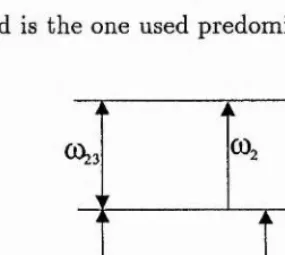
The m ajority of the effects dealt with in this work have at their base the three-level atom . This is a simplihed view of an atom where only three levels have an im portant role in the atom ic response and is a useful and popular approxim ation. Figure 2.1 is a cascade three level atom , which is of interest in sum frequency mixing among other phenomena, and is the one used predom inantly in this work.
[image:46.613.217.360.317.444.2]CO ,
Figure 2.1: A simple cascade three-level atom
The wavefunction of the atom ic system is generally expressed as a linear combi nation of some basis set, most usefully the unperturbed states of an isolated atom. These are the solutions of the atomic Hamiltonian and satisfy the Schrodinger equa tion, both tim e dependent and tim e independent. In Dirac notation [2], this is expressed, for level ji> with energy Ci, as:
'Hq\i >= >
The total system wavefunction is by definition: 'J = ^ üi\i >
(2.3)
(2.4)
'
2. T heory and N um erical M odeling 2.1 D escriptions o f C oherent E xcitation
where a,- are the probability am plitudes for the individual levels. The physical i observable most closely associated with these is the probability of finding the atom
in th at level and is the square modulus, \ai\^.
In order to discern the evolution of the probability am plitudes for the cascade system the interaction Ham iltonian, V(f), m ust be stated. In the dipole approxi m ation, where only dipole allowed transitions are im portant, we may state it as:
y (f) = —er.E (2.5)
in which the two electric fields included in E are defined to be:
Ei{t) = ~ -f c. c. ) 2 = 1,2 (2.6) To proceed, equation 2.4 is substituted in equation 2.1 and the properties of |% > are used to remove several term s. The system then simplifies to:
ciiV(f)|1 Z> -|-Û2V (f)|2 > ( f ) l ^ ihài\l > -f-z^Û3|3> (2.7) To find the evolution of the three probability am plitudes in turn this equation is operated on by the appropriate bra (< %|) and the orthonorm ality of the basis set invoked. The interaction strengths of the levels with the fields are embodied in the transition m atrix elements, yL2,j, with the definitions:
< 1|V (^)|2> = iJ-uEi (2.8a) < 2 |y ( f ) |3 > = H2 3E2 (2.8b)
and complex conjugates thereof. We then gain equations for the rapidly-varying Schrodinger am plitudes, under the rotating-wave approxim ation [1, 3], for example:
61 = (2.9)
where fîi2 is the half-Rabi frequency for the transition, defined as:
(2.1 0a) (2.1 0b)
1
2. T heory and N um erical M odeling 2.1 D escriptions o f C oherent E xcitation
However, when looking over long tim e scales, especially for steady-state behaviour,
it is useful to convert to the interaction picture and remove the optical frequency a oscillations of the am plitudes by the definitions:
È; = o g g -M -" " )' (2.11a)
0 3 = (2.11b)
This then gives the com pleted coupled tim e evolution of the slowly-varying am pli tudes as:
ài = iD i2d2 (2.1 2a)
0,2 — iA i2 ^2 = d" % 1^23^3 (2.1 2b) G3 — 2 A13&3 = ii},2S^ 2 (2.1 2c)
wherein the detuning term s, Ajj, are defined as:
A12 — Wi — w%2 (2.13a)
A j3 = (wi -j- ÜJ2) — (cui2 T 11^23) (2.13b)
and decay rates may be added phenomenologically by the generalisation to complex detunings eg.:
A12 —> Â12 = A i2 — (2.14)
Solutions to this system are gained in different ways depending on the problem under consideration. Perturbation theory may be appropriate or linearisation with respect to some probe field may be used. Steady-state is often considered and for this the tim e derivatives are simply set to zero. Physically the population probabilities may be gained by the square modulus of the various am plitudes, and products of the form a i« 2 &re associated w ith transition rates. Many papers use this formalism to avoid the complications of a full density m atrix treatm ent eg. [4, 5] and it can be a relatively simple way to calculate various quantities or gain some physical insight into the response of the atom.