HPTLC METHOD FOR ESTIMATION OF FLAVONOIDS AND
PHENOLIC ACID IN
CLITORIA TERNATEA
ROOT EXTRACT
Saravanan J.1, Swathi K. P.1 and R. Arivukkarasu2
1
Department of Pharmacology, KMCH College of Pharmacy Coimbatore, Tamil Nadu.
2
Department of Pharmacognosy, KMCH College of Pharmacy, Coimbatore, Tamil Nadu.
ABSTRACT
Clitoria ternatea is a well known bioactive plant used in traditional
system of medicine. The aim of the present study is to evaluate the
ethanolic extract of white flowered variety of Clitoria ternatea roots
(EECT) with standard flavonoid markers such as rutin, quercetin,
gallic acid by HPTLC techniques. The chromatographic separation was
carried out on precoated silica gel 60F254 aluminium plates using
mixture of Toluene- Ethyl acetate-Formic acid- Methanol (3 : 6 : 1.6:
0.4v/v) as mobile phase and densitometric evaluation of spots was
carried out at 254 nm using Camag TLC Scanner-3 with win CAT
1.3.4 version software. The identity of the constituents in the ethanol
extract of Clitoria ternatea were confirmed by overlaying their UV absorption spectra with
the standard markers rutin, quercetin and gallic acid at 254 nm. The percentage of active
constituents present in the extract was calculated from the peak area. From the result of
HPTLC analysis it was evident that EECT contains phytoconstituents like gallic acid (0.8%)
and rutin (0.06%).
KEYWORDS: HPTLC, Clitoria ternatea, rutin, gallic acid.
INTRODUCTION
Clitoria ternatea (Family: Fabaceae) is a well known plant in traditional medicine. It has two
varieties blue flowered and white flowered. This has been used for centuries as a memory
enhancer, antistress, anxiolytic, anticonvulsant, tranquilizing, antidepressant and sedative
agent. It has antitubercular and antidysenteric properties and is an antidote to snake poison
and scorpion poison.[1] A wide range of secondary metabolites such as flavonol glycosides,
Volume 5, Issue 10, 766-775. Research Article ISSN 2277– 7105
*Corresponding Author’
Swathi K. P.
Department of
Pharmacology, KMCH
College of Pharmacy
Coimbatore, Tamil Nadu.
Article Received on 11 August 2016,
Revised on 31 August 2016, Accepted on 20 Sapt. 2016
triterpenoids, steroids and anthocyanins have been identified and isolated from Clitoria
ternatea.[2] The extract of Clitoria ternatea possesses a wide range of pharmacological
activities including anti inflammatory, analgesic, diuretic, antidiabetic, local anesthetic,
antimicrobial, insecticidal, antipyretic, blood platelet aggregation-inhibiting and smooth
muscle relaxing properties.[3] Earlier studies have proved that the roots of white flowered
variety show good antioxidant activity as compared to blue flowered variety.[4] The
antioxidant activities represent a key parameter to evaluate the biological property of the
plant. Thus, it is essential to characterize and quantify the important compounds present in
the plant.[5]
Nowadays the quality of medicinal plant products is assured by using modern analytical
techniques and applying suitable standards. HPTLC has come out as a significant tool for the
qualitative, and semi quantitative quantitative phytochemical analysis of herbal drugs.
HPTLC has excellent resolution which permits simultaneous identification of several samples
in a single run, using a small quantity of mobile phase. It is a high output, time saving and a
rapid low cost analytical method.[6]
The aim of the present study is to evaluate the ethanolic extract of white flowered variety of
Clitoria ternatea roots (EECT) with standard flavonoid markers such as Rutin, Quercetin,
Gallic acid by HPTLC techniques
MATERIALS AND METHOD Instrumentation
Analysis was performed on a Camag HPTLC system equipped with a sample applicator
Linomat V, twin trough development chamber (10x10) size, TLC Scanner III, Wincats
integration software was used.
Sample collection and extract preparation
The roots of white flowered variety of Clitoria ternatea were collected from Thrissur district
of Kerala and authenticated from the Botanical survey of India (BSI) Coimbatore, Tamil
Nadu (No.BSI/SRC/5/23/2015/Tech/2551). The coarse powder of Clitoria ternatea roots
were extracted with ethanol in Soxhlet extractor. Extract was concentrated to dryness in
Extract preparation for HPTLC analysis
Accurately weighed 500mg of EECT was dissolved in 5ml ethanol. The sample was then
filtered by using Whatmann filter paper (No.1).
Preparation of standard solution
Accurately weighed 10mg of standards (quercetin, rutin, and gallic acid) were taken
separately in to 10ml volumetric flask, and the solution was made up to 10ml with ethanol to
obtain a concentration 1mg/ml.
Samples Loading
The plates were pre-washed with methanol and activated at 600C for 10 min prior to
chromatography. 2, 5, 10μl of EECT and 5μl of standard solutions such as Rutin, Gallic
acid(GA) and Quercetin (QUER)were loaded as 6mm band length in the 10 x 10cm Silica gel
60F254TLC plate using Camag microlite syringe and CAMAG LINOMAT V instrument.
Mobile phase
The organic solvents such as Toluene- Ethyl acetate- Formic acid- Methanol (3: 6: 1.6: 0.4
v/v) was used as a mobile phase. The twin trough developing chamber was saturated with the
mobile phase for 10 minutes before the development of samples loaded TLC plate.
Spot development
The samples loaded plate was kept in TLC twin trough developing chamber with respective
mobile phase and developed up to 85mm.
Photo-documentation
The developed plate was dried by hot air to evaporate solvents from the plate. The plate was
kept in Photo-documentation chamber (CAMAG REPROSTAR 3) and captured the images
at UV 254 and 366nm.
Scanning
The plate was fixed in scanner stage (CAMAG TLC SCANNER 3) and scanning was done at
UV366 and 254nm.The peak table, peak display and peak densitogram were noted. The
RESULTS
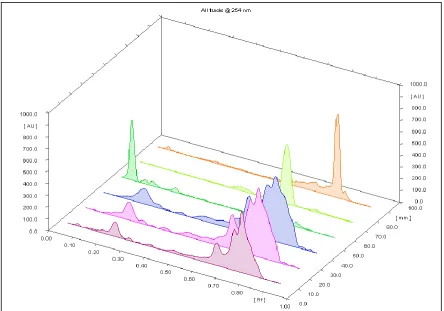
A B
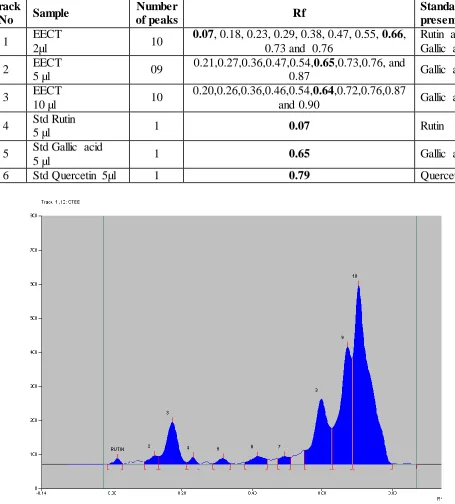
[image:4.596.73.520.85.370.2] [image:4.596.77.521.430.741.2]Table 1: HPTLC analysis on Clitoria ternatea root extract correlate with standard flavonoid and phenolic acid marker compounds such as Rutin, Quercetin, Gallic acid. Track
No Sample
Number
of peaks Rf
Standard present
1 EECT
2µl 10
0.07, 0.18, 0.23, 0.29, 0.38, 0.47, 0.55, 0.66, 0.73 and 0.76
Rutin and Gallic acid
2 EECT
5 µl 09
0.21,0.27,0.36,0.47,0.54,0.65,0.73,0.76, and
0.87 Gallic acid
3 EECT
10 µl 10
0.20,0.26,0.36,0.46,0.54,0.64,0.72,0.76,0.87
and 0.90 Gallic acid
4 Std Rutin
5 µl 1 0.07 Rutin
5 Std Gallic acid
5 µl 1 0.65 Gallic acid
6 Std Quercetin 5µl 1 0.79 Quercetin
[image:5.596.63.518.115.619.2]Fig.4: Chromatogram of EECT (5μl)
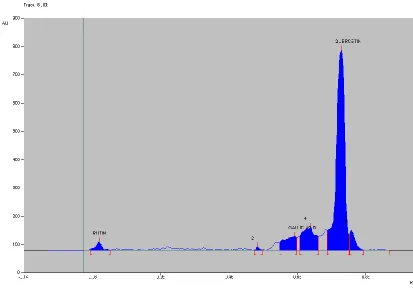
Fig.6: Chromatogram of standard rutin (5μl)
Fig 8: Chromatogram of standard quercetin (5μl)
DISCUSSION
Several studies have reported that the polyphenolic compounds like flavonoids, phenolic
acids in the plant Clitoria ternatea may be the reason behind its multiple biological effects
like antioxidant activity[4], anti inflammatory and analgesic activity[7][8], antiasthmatic
activity[9], antidiabetic activity[10] etc. In order to justify and quantify the presence of these
polyphenolic compounds the extract was subjected to HPTLC screening against marker
compounds such as gallic acid, quercetin and rutin. The phytoconstituents in the three
concentrations of sample were identified and confirmed by comparing the chromatogram
obtained from the reference markers and quantified from the corresponding peak area. From
the result of HPTLC analysis it was evident that EECT contains gallic acid and rutin.
Rutin is a flavonoid glycoside well-known as Vitamin P and has antiplatelet, antihypertensive
and antiviral properties, as well as strengthing the capillaries of blood vessels, which are the
results of its high free radical scavenging and antioxidant capacity. In addition
hypolipidaemic, cytoprotective, antiallergic[11], anti-inflammatory, antibacterial and
Gallic acid is phenyl propanoid, chemically it is 3, 4, 5- Trihydroxybenzoic acid, possesses
astringent activity and plays a potential protective role against different kinds of oxidative
damaged diseases.[5] [14]
The phytoconstituents were quantified from the corresponding peak areas and it was found to
contain 0.06% of rutin and 0.8% of gallic acid per 100mg of extract.
CONCLUSION
The present study revealed that the ethanol extract of white flowered variety of Clitoria
ternatea root contain major polyphenolics, rutin and gallic acid which provide a scientific
rationale for its multiple biological effects.
ACKNOWLEDGEMENT
The authors owe deep gratitude to Dr. A. Rajasekaran, Principal and Staff members in
KMCH college of Pharmacy Coimbatore, for providing facilities to carry out the research
work.
REFERENCES
1. A.K. Gupta. Reviews on Indian medicinal plants., 2008; 7th ed: 172-180.
2. R. Kavitha, V. Premalakshmi. Phytochemical analysis of ethanolic extract of leaves of
Clitoria ternatea L, Int J Pharm Bio Sci., 2013 Oct; 4(4): 236–242.
3. Pulok K. Mukherjee, Venkatesan Kumara, N. Satheesh Kumara, Micheal Heinrich, The
Ayurvedic medicine Clitoria ternatea—From traditional use to scientific Assessment,
Journal of Ethnopharmacology., 2008 Sep; 120: 291–30.
4. A.P Patil, V.R.Patil. Comparative evaluation of antioxidant activity of root of blue and
white flowered variety of Clitoria ternatea Linn, International Journal of Pharmacology.,
2011; 1-7.
5. Tapan Seal. Quantitative HPLC analysis of phenolic acids, flavonoids and ascorbic acid
in four different solvent extracts of two wild edible leaves, Sonchus arvensis and
Oenanthe linearis of North-Eastern region in India. Journal of Applied Pharmaceutical
Science., 2016 February; 6(02): 157-166.
6. P. Deepa, S. Murugesh et al. HPTLC analysis of Dolichandrone atrovirens (sprague)
plant bark, world journal of pharmaceutical research., 2013 Dec; 3(1): 1019-1029.
7. Patil Amol P, Patil Vijay R. Anti-inflammatory and analgesic activity of leaves of white
8. B. Parimala Devi, R.Boominathan, Subhash C.Mandal. Anti inflammatory, analgesic and
antipyretic properties of Clitoria ternatea root. Fitoterapia., 2003 Feb; 74: 345–349.
9. Dnyaneshwar J. Taur, Ravindra Y. Patil, Evaluation of antiasthmatic activity of Clitoria
ternatea L. roots. Journal of Ethnopharmacology., 2011 Apr; 136: 374–376.
10.Prashant R. Verma, Prakash R. Itankar, Sumit K. Arora, Evaluation of antidiabetic,
antihyperlipidemic and pancreatic regeneration, potential of aerial parts of Clitoria
ternatea , Rev Bras Farmacogn., 2013 Oct; 23: 819-829.
11.Rosane, W. I, Oliveira, Z. D, Fernandes, S. C, Vieira, I. C. Development of a biosensor
based on gilo peroxidase immobilized on chitosan chemically crosslinked with
epichlorohydrin for determination of rutin. Journal of Pharmaceutical and Biomedical
Analysis., 2006; 41: 366–372.
12.Casa, C. L, Villegas, I, Alarco´ n de la Lastra, C, Motilva, V, Martı´n Calero, M. J.
Evidence for protective and antioxidant properties of rutin, a natural flavone, against
ethanol induced gastric lesions. Journal of Ethnopharmacology., 2000; 71: 45–53.
13.Webster, R. P, Gawde, M. D, Bhattacharya, R. K. Protective effect of rutin, a flavonol
glycoside, on the carcinogen-induced DNA damage and repair enzymes in rats. Cancer
Letters., 1996; 109: 185–191.
14.Rajasekaran.A, Arivukkarasu.R, Archana.D. HPTLC Method for estimation of Gallic
acid and Rutin in Haritaki -An Ayurvedic Formulation. International Journal of