FORMULATION AND EVALUATION OF LOSARTAN POTASSIUM
FLOATING TABLETS: OPTIMIZATION BY 2
3FACTORIAL DESIGN
K. P. R. Chowdary*, K. Ravi Shankar and T.Vijay
Vikas Institute of Pharmaceutical Sciences, Nidigatla Road, Rajahmundry- 533103.
ABSTRACT
The objective of the present study is optimization of Losartan Potassium floating tablet formulation by 23 factorial design. Floating tablets of losartan potassium (50 mg) were formulated employing HPMC K15M (50 %) as matrix forming polymer, sodium bicarbonate as gas generating agent and beeswax and ethyl cellulose as floating enhancers. Losartan Potassium floating tablets were formulated as per 23 factorial design. The three factors involved in the 23 factorial design are sodium bicarbonate (Factor A), beeswax (Factor B) and ethyl cellulose (Factor C). The two levels of sodium bicarbonate (Factor A) are 10 and 20 %, the two levels of beeswax (Factor B) are 2 % and 5 % and the two levels of ethyl cellulose (Factor C) are 5% and 10%. Eight losartan potassium floating tablet formulations were prepared employing selected combinations of the levels of the three factors as per 23 factorial design. All the floating tablets prepared were evaluated for drug content, hardness, friability, disintegration time, floating lag time, floating time and drug release characteristics. Losartan Potassium floating tablets prepared as per 23 factorial design were non-disintegrating in water and aqueous acidic (pH 1.2) and alkaline (pH 7.4) fluids and were of good quality with regard to drug content, hardness, friability and suitable for controlled release. ANOVA indicated that the individual effects of sodium bicarbonate (Factor A), bees wax (Factor B) and ethyl cellulose (Factor C) and the combined effects of sodium bicarbonate and bees wax (AB), sodium bicarbonate and ethyl cellulose (Factor AC) on the floating lag time are highly significant (P < 0.01).Formulations Fabc, Fac, Fab and Fa exhibited excellent floating over 24 h with a floating
lag time in the range 9-48 seconds. Higher levels (20 %) of sodium bicarbonate gave shorter floating lag time. Losartan potassium release from the floating tablets prepared except formulation Fa was slow and spread over 12 h and dependent on the composition of the
Volume 4, Issue 2, 465-477. Research Article ISSN 2277– 7105
Article Received on 19 Nov 2014,
Revised on 14 Dec 2014, Accepted on 08 Jan 2015
*Correspondence for
Author
Prof. K.P.R. Chowdary
Vikas Institute of
Pharmaceutical Sciences,
Nidigatla Road,
tablets. Drug release from formulation Fa was very rapid. Losartan Potassium release from
the floating tablets was by non-fickian diffusion mechanism. Optimization of losartan potassium floating tablet formulation was done taking floating lag time as the parameter for optimization. For optimization, floating lag time was taken as response (Y) and level of sodium bicarbonate as (X1), level of bees wax as (X2) and level of ethyl cellulose as (X3). The
polynomial equation describing the relationship between the response, Y and the variables, X1 , X 2 and X3 based on the observed data was found to be Y = 12.96 - 13.09 (X1) + 7.70
(X2) – 7.86 (X1 X2) -2.92 (X3) - 3.08(X1 X3) + 0.32 (X2 X3) - 0.18(X1 X2 X3). Based on the
polynomial equation developed, the optimized losartan potassium floating tablet formulation with a floating lag time of 20 seconds or 0.33 min could be formulated employing sodium bicarbonate (100mg/tablet), beeswax (17.5mg/tablet) and ethyl cellulose (37.5mg/tablet). The optimized formulation (Fopt) exhibited a floating time of 24 h with a lag time of 16-20
seconds fulfilling the target floating lag time set indicating validity of the optimization technique employed. Formulations Fopt, Fab, Fac andFabc prepared exhibited excellent floating
characteristics (floating over 24h with a lag time in the range 09 to 48 seconds) and good sustained release of losartan potassium over 12 h. As such, these formulations are considered as the best floating tablet formulations of losartan potassium suitable for b.i.d administration.
KEYWORDS: Floating tablets, Losartan potassium, Optimization, Factorial design,
Sustained release.
INTRODUCTION
prolonged period of time .While the system is floating on the gastric contents, the drug is released slowly at the desired rate from the system. After release of drug, the residual system is emptied from the stomach .This results in an increased gastric residence time and a better control of the fluctuation in plasma drug concentration.[4, 5] Several approaches are currently used to retain the dosage in the stomach. These include bioadhesive systems,[6] swelling and expanding systems,[7,8] floating systems[9,10] and other delayed gastric emptying devices.[11,12]
The principle of floating tablets offers a simple and practical approach to achieve increased residence time in the stomach and upper g.i. tract to enhance the bioavailability and to obtain controlled release. Floating tablets are designed based on gas generating principle. Design of floating tablets needs a strong matrix forming polymer, a gas generating agent and a floating enhancer such as beeswax. Several polymers such as various viscosity grades of HPMC, Carbopol 934P, Eudragit RL, calcium alginate, Chitosan, Xanthan gum, guargum, ethyl cellulose etc., have been used in the design of floating tablets of various API. Sodium bicarbonate is the preferred gas generating agent in the formulation of floating tablets.
In the present study sustained release floating tablets of losartan potassium were formulated employing HPMC K15M (50 %) as matrix forming polymer, sodium bicarbonate as gas generating agent and beeswax and ethyl cellulose as floating enhancers. Losartan potassium is an affective antihypertensive drug which is a highly specific Angiotensin II AT1 receptor antagonist. It is readily absorbed from the gastro intestinal tract, having oral bioavailability of 33% and plasma elimination half life of 1.5 to 2.5 hours. Upper small intestine is the major site of absorption of losartan potassium. These characteristics made it suitable for floating drug delivery.[13,14] A dose of 50 mg 2 or 3 times daily is required. Floating tablets of losartan potassium were designed in the present study to enhance its bioavailability and to achieve sustained release over 12 h for b.i.d. administration. Sustained release of losartan potassium over 10-12h is aimed in addition to good floating characteristics. Formulation of losartan potassium floating tablets was optimized by 23 factorial design.
in some systematic manner. These formulations are then evaluated according to one or more attributes, such as hardness, dissolution, appearance, stability, taste and so on. Based on the results of these tests, a particular formulation (or series of formulations) may be predicted to be optimal. The optimization procedure is facilitated by applying factorial designs and by the fitting of an empirical polynomial equation to the experimental results. The predicted optimal formulation has to be prepared and evaluated to confirm its quality. The objective of the present study is optimization of losartan potassium floating tablet formulation by 23 factorial design.
EXPERIMENTAL
Materials
Losartan Potassium was a gift sample from M/s Micro Labs Ltd, Pondicherry. HPMC K15M, ethyl cellulose (50 cps), sodium bicarbonate, dicalcium phosphate (DCP) and beeswax were procured from commercial sources. All other materials used were of Pharmacopoeial grade.
Methods
Estimation of Losartan Potassium
An ultraviolet (UV) spectrophotometric method based on the measurement of absorbance at 250 nm in 0.1 N HCl was used for the estimation of losartan potassium. The method obeyed Beer-Lambert’s law in the concentration range of 0-10 μm/mL. When a standard drug solution was assayed repeatedly (n=6), the relative error (accuracy) and coefficient of variation (precision) were found to be 0.85% and 1.25%, respectively. No interference from the excipients used was observed.
Formulation of Floating Tablets
The required quantities of losartan potassium, HPMC K15M, ethyl cellulose, DCP and sodium bicarbonate were thoroughly mixed in a dry mortar by following geometric dilution technique. Beeswax was melted in a dry beaker and the blend of the above mentioned ingredients was added to the molten beeswax and mixed thoroughly. The blend was transferred to a dry mortar and granulated with hydro-alcoholic (1:1) solution. The dried granules formed were passed through mesh No. 16 to break the aggregates. The lubricants talc and magnesium stearate were passed through mesh No. 60 on to the dry granules and blended in a closed polyethylene bag. The tablet granules were then compressed into tablets on a 8-station tablet punching machine (Karnavathi Rimek Minipress II) to a hardness of 4-5 Kg/cm2.
Evaluation of Tablets
Hardness of the tablets was tested using a Monsanto hardness tester. Friability of the tablets was determined in a Roche friabilator.
Disintegration time of the tablets was determined using a Paramount tablet disintegration test machine using water, 0.1N HCl and phosphate buffer of pH 7.4 as the test fluids.
Floating Lag Time and Floating Time
In Vitro buoyancy was determined by measuring floating lag time and duration of floating. The tablets were placed in a 250 ml glass beaker containing 0.1N HCl. The time required for the tablet to rise to the surface and float was determined as floating lag time. The duration in which the tablet remains floating was determined as floating time.
Drug Release Study
Drug release from the floating tablets prepared was studied using 8-station dissolution rate test apparatus (Labindia, DS 8000) employing a paddle stirrer at 50 rpm and at a temperature of 37±0.5⁰C, 0.1 N HCl (900 mL) was used as dissolution fluid. A 5mL aliquot of dissolution medium was withdrawn through a filter (0.45μm) at different time intervals and assayed spectrophotometrically by measuring absorbance at 250 nm. All drug release experiments were conducted in triplicate (n=3).
Data Analysis
RESULTS AND DISCUSSION
The principle of floating tablets offers a simple and practical approach to achieve increased residence time in the stomach and upper G.I. tract to enhance the bioavailability and to obtain controlled release. Floating tablets of losartan potassium were designed based on gas generating principle. The objective of the present study is optimization of formulation of losartan potassium floating tablets based on gas generating principle.
Matrix tablets each containing 50 mg of losartan potassium were formulated employing HPMC K15M (50%) as matrix forming polymer, sodium bicarbonate as gas generating agent and ethyl cellulose and beeswax as floating enhancers. Losartan potassium floating tablets were formulated as per 23 factorial design. The three factors involved in the 23 factorial study are sodium bicarbonate (Factor A), beeswax (Factor B) and ethyl cellulose (Factor C). The two levels of sodium bicarbonate (Factor A) are 10 and 20 %, the two levels of beeswax (Factor B) are 2 % and 5 % and the two levels of ethyl cellulose (Factor C) are 5% and 10%. Eight losartan potassium floating tablet formulations were prepared employing selected combinations of the levels of the three factors as per 23 factorial design. The floating tablets were prepared by melting- wet granulation method as per the formula given in Table 1. All the floating tablets prepared were evaluated for drug content, hardness, friability, disintegration time, floating lag time, floating time and drug release characteristics.
The physical parameters of the floating tablets prepared are given in Table 2.Hardness of the tablets was in the range 4.0-5.0 Kg/cm2.Weight loss in the friability test was less than 0.85% in all the cases. All the tablets prepared contained losartan potassium within 100±3% of the labelled claim. All the floating tablets prepared were found to be non-disintegrating in water and aqueous acidic (pH 1.2) and alkaline (pH 7.4) fluids. As such the prepared floating tablets were of good quality with regard to drug content, hardness, friability and were suitable for controlled release.
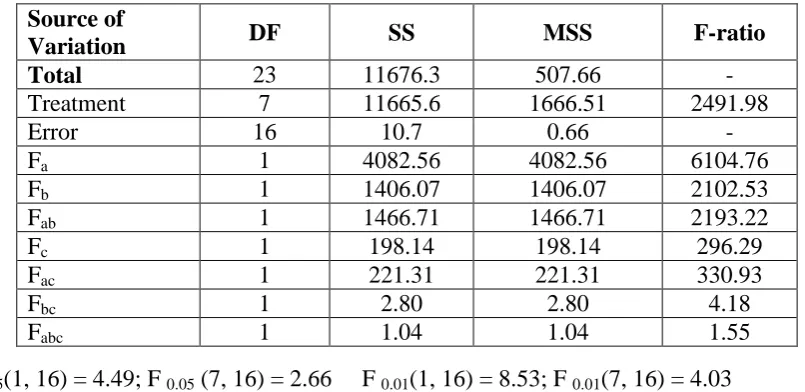
bees wax(AB), sodium bicarbonate and ethyl cellulose(Factor AC) on the floating lag time are highly significant (P < 0.01).Whereas the combined effect of bees wax and ethyl cellulose (Factor BC) and combined effects of the three factors involved (Factor ABC)are not significant in influencing floating lag time of the tablets.
The order of increasing floating lag time observed with various floating tablets prepared was Fabc < Fac < Fab< Fa< F1 < Fc< Fb < Fbc.Formulations Fabc, Fac , Fab and Fa exhibited excellent
floating over 12-24 h with a floating lag time in the range 9-48 seconds. Sodium bicarbonate at 20 % strength gave less floating lag time than at 10 % strength. Formulations Fabc, Fac, Fab
and Fa are considered as the best floating tablets formulated based on the floating
characteristics.
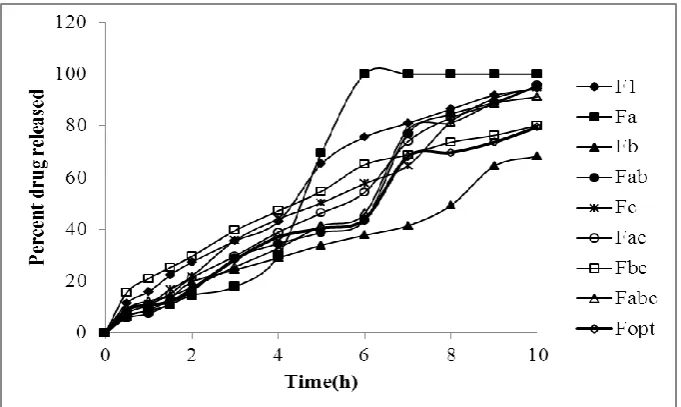
Losartan potassium release from the floating tablets prepared was studied in 0.1N HCl. The drug release profiles of floating tablets prepared are shown in Fig.1. Drug release parameters of the tablets prepared are summarized in Table 5.Losartan potassium release from the floating tablets prepared was slow and spread over 12 h and depended on the composition of the tablets. The release data were analysed as per zero order, first order, Higuchi and Korsemeyer- Peppas kinetic models. The coefficient of determination (R2) values in the analysis of release data as per various kinetic models are given in Table 4. Drug release from all the floating tablets prepared followed zero order kinetics. ANOVA of release rate (K1)
values (Table 6) indicated that individual and combined effects of all the three factors except the combined effect of sodium bicarbonate and ethyl cellulose (AC) are highly significant (P < 0.01) in influencing release rate of drug from the floating tablets.
Formulations Fab, Fac andFabc exhibited excellent floating characteristics and good sustained
release of losartan potassium over 10-12 h. As such these formulations are considered as the best floating tablet formulations of losartan potassium suitable for b.i.d administration.
Drug release from all the floating tablets prepared was diffusion controlled as indicated by the linear Higuchi plots. When the release data were analysed as per Korsemeyer- Peppas equation, the release exponent ‘n’ was found to be in the range 0.631-1.007 in all the cases indicating ‘non-Fickian diffusion’ as the release mechanism from these floating tablets.
response (Y) and level of sodium bicarbonate as (X1), level of bees wax as (X2) and level of
ethyl cellulose as (X3). The polynomial equation describing the relationship between the
response, Y and the variables, X1 , X 2 and X3 based on the observed data was found to be Y
= 12.96 - 13.09 (X1) + 7.70 (X2) – 7.86 (X1 X2) -2.92 (X3) - 3.08(X1 X3) + 0.32 (X2 X3) -
0.18(X1 X2 X3). Based on the above polynomial equation, the optimized Losartan Potassium
floating tablet formulation with a floating lag time of 20 seconds or 0.33 min could be formulated employing sodium bicarbonate (100 mg/tablet), beeswax (17.5mg/tablet) and ethyl cellulose (37.5mg/tablet). To verify Losartan Potassium floating tablets were formulated employing the optimized levels of sodium bicarbonate, beeswax and ethyl cellulose as per the formula given in Table 1. The optimized Losartan Potassium floating tablet formulation was prepared and evaluated for floating and drug release characteristics. The optimized formulation exhibited a floating time of 24 h with a lag time of 16-20 seconds fulfilling the target floating lag time set. This result also indicated validity of the optimization technique employed. The optimized formulation (Fopt) gave slow and gradual release of Losartan Potassium over 12 h.
Overall, formulations Fopt, Fab, Fac andFabc prepared exhibited excellent floating characteristics
(floating over 24h with a lag time in the range 09 to 48 seconds) and good sustained release of losartan potassium over 12 h. As such, these formulations are considered as the best floating tablet formulations of losartan potassium suitable for b.i.d administration.
Table 1: Formulae of Losartan Potassium Floating Tablets Prepared as Per 23 Factorial
Design.
Ingredient (mg/tab) F1 Fa Fb Fab Fc Fac Fbc Fabc Fopt
Losartan potassium 50 50 50 50 50 50 50 50 50
Sodium bicarbonate 50 100 50 100 50 100 50 100 100
Bees wax 10 10 25 25 10 10 25 25 17.5
Ethyl cellulose 25 25 25 25 50 50 50 50 37.5
HPMC K15M 250 250 250 250 250 250 250 250 250
Dicalcium phosphate 95 45 80 30 70 20 55 5 25
Talc 10 10 10 10 10 10 10 10 10
Magnesium stearate 10 10 10 10 10 10 10 10 10
Table 2: Physical Parameters of Losartan Potassium Floating Tablets Prepared as per
23 Factorial Design.
Table 3: ANOVA of Floating Lag time Values of Losartan Potassium Tablets Prepared
as per 23 Factorial Design.
F 0.05(1, 16) = 4.49; F 0.05 (7, 16) = 2.66 F 0.01(1, 16) = 8.53; F 0.01(7, 16) = 4.03
Table 4: Coefficient of determination (R2) Values in the Analysis of Release Data of
Losartan potassium Floating Tablets Prepared as per Different Kinetic Models.
Formulation Hardness
(Kg/cm2)
Friability (% wt. loss)
Drug Content (mg/tablet)
Floating lag time (min- sec)
Floating Time (h)
F 1 4.0 0.68 49.9 5-36 24
F a 4.5 0.59 49.22 0-48 20
F b 5.0 0.78 51.3 35-40 24
F ab 4.5 0.85 50.2 0-13 24
Fc 4.2 0.60 49.2 16-19 24
Fac 4.0 0.75 48.9 0-13 24
Fbc 4.5 0.69 48.6 48-08 24
Fabc 4.0 0.72 49.5 0-9 24
Fopt 4.0 0.75 49.4 16 to 20 sec 24
Source of
Variation DF SS MSS F-ratio
Total 23 11676.3 507.66 -
Treatment 7 11665.6 1666.51 2491.98
Error 16 10.7 0.66 -
Fa 1 4082.56 4082.56 6104.76
Fb 1 1406.07 1406.07 2102.53
Fab 1 1466.71 1466.71 2193.22
Fc 1 198.14 198.14 296.29
Fac 1 221.31 221.31 330.93
Fbc 1 2.80 2.80 4.18
Fabc 1 1.04 1.04 1.55
Formulation Zero order First order Higuchi Korsemeyer –Peppas
F1 0.985 0.982 0.977 0.991
Fa 0.923 0.839 0.820 0.960
Fb 0.989 0.965 0.961 0.991
Fab 0.988 0.963 0.993 0.985
Fc 0.996 0.938 0.970 0.993
Fac 0.996 0.939 0.960 0.993
Fbc 0.977 0.947 0.994 0.995
Fabc 0.983 0.945 0.938 0.973
[image:9.595.86.510.597.743.2]Table 5: Release Parameters of Losartan Potassium Floating Tablets Prepared as per 23
Factorial Design.
Formulation T50 (h)
Release Rate Release
Exponent (n) K0 (mg/h) K1(h-1)
F1 4.2 4.89 0.282 0.822
Fa 4.5 7.47 0.474 1.007
Fb 8.0 3.13 0.102 0.785
Fab 6.4 5.0 0.274 1.006
Fc 5.0 4.72 0.258 0.901
Fac 5.6 4.85 0.265 0.974
Fbc 4.3 3.77 0.157 0.631
Fabc 5.6 4.75 0.237 1.005
Fopt 6.0 4.04 0.155 0.986
Table 6: ANOVA of Release Rates (K1) of Losartan Potassium Floating Tablets
Prepared as per 23 Factorial Design.
Source of Variation DF SS MSS F-ratio
Total 23 1.039 0.04 -
Treatment 7 1.037 0.14 1069.92
Error 16 0.002 0.0001 -
Fa 1 0.009 0.009 71.03
Fb 1 0.018 0.018 130.21
Fab 1 0.045 0.045 325.29
Fc 1 0.002 0.002 17.90
Fac 1 8.82 8.82 0.63
Fbc 1 0.00 0.00 5.08
Fabc 1 0.01 0.01 108.27
[image:10.595.128.469.518.721.2]F 0.05(1, 16) = 4.49; F 0.05 (7, 16) = 2.66 F 0.01(1, 16) = 8.53; F 0.01(7, 16) = 4.03
Fig 1: Drug Release Profiles of Losartan Potassium Floating Tablets Prepared as per 23
CONCLUSIONS
1. Losartan potassium floating tablets prepared as per 23 factorial design were non-disintegrating in water and aqueous acidic (pH 1.2) and alkaline (pH 7.4) fluids and were of good quality with regard to drug content, hardness, friability and suitable for controlled release.
2. ANOVA indicated that the individual effects of sodium bicarbonate (Factor A), bees wax (Factor B) and ethyl cellulose (Factor C) and the combined effects of sodium bicarbonate and bees wax(AB), sodium bicarbonate and ethyl cellulose(Factor AC) on the floating lag time are highly significant (P < 0.01).
3. Formulations Fabc, Fac, Fab and Fa exhibited excellent floating over 24 h with a floating lag
time in the range 9-48 seconds. Higher levels (20 %) of sodium bicarbonate gave shorter floating lag time.
4. Losartan potassium release from the floating tablets prepared except formulation Fa was
slow and spread over 12 h and dependent on the composition of the tablets. Drug release from formulation Fa was very rapid.
5. Losartan potassium release from the floating tablets was by non-fickian diffusion mechanism.
6. Optimization of losartan potassium floating tablet formulation was done taking floating lag time as the parameter for optimization. For optimization, floating lag time was taken as response (Y) and level of sodium bicarbonate as (X1), level of bees wax as (X2) and
level of ethyl cellulose as (X3).
7. The polynomial equation describing the relationship between the response, Y and the variables, X1 , X 2 and X3 based on the observed data was found to be Y = 12.96 - 13.09
(X1) + 7.70 (X2) – 7.86 (X1 X2) -2.92 (X3) - 3.08(X1 X3) + 0.32 (X2 X3) - 0.18(X1 X2 X3).
8. Based on the polynomial equation developed, the optimized losartan potassium floating tablet formulation with a floating lag time of 20 seconds or 0.33 min could be formulated employing sodium bicarbonate (100mg/tablet), beeswax (17.5mg/tablet) and ethyl cellulose (37.5mg/tablet).
9. The optimized formulation (Fopt) exhibited a floating time of 24 h with a lag time of
16-20 seconds fulfilling the target floating lag time set indicating validity of the optimization technique employed.
10. Formulations Fopt, Fab, Fac and Fabc prepared exhibited excellent floating characteristics
release of losartan potassium over 12 h. As such, these formulations are considered as the best floating tablet formulations of losartan potassium suitable for b.i.d administration.
REFERENCES
1. Ansel HC, Allen LV, Popovich NG., Pharmaceutical Dosage Forms and Drug Delivery Systems. Philadelphia, Lippincott Williams and Wilkins Chapter -3, 2003; 23-31.
2. Agyilirah G A, Green M, Ducret R. Evaluation of gastric retention properties of a cross linked polymer coated tablet versus those of a non-disintegrating tablet. Int J Pharm., 1991; 75: 241-245.
3. Hoffman AF, Pressman JH, Code CF. Controlled entry of orally administered drugs: physiological considerations, Drug Dev. Ind. Pharm., 1983; 9: 1077-1085.
4. Mayavanshi AV, Gajar SS. Floating drug delivery system to increase gastric retention of drug: A Review. J. Pharm. Res., 2008; 345-348.
5. Vachhani savan R, Patel Dipen, Prajapati ST, Patel CN. Formulation and in-vitro evaluation of floating capsules of Loratadine; J Chem. Pharma Res., 2010; 2(2): 57-64. 6. Santus G, Lazzarini G, Bottoni G. An in vitro-in vivo investigation of oral bioadhesive
controlled release furosemide formulations. Eur. J. Pharm. Biopharm., 1997; 44: 39-52. 7. Deshpande, A.A, Rhodes, C.T., Shah, N.H. and Malick, A.W., Controlled release drug
delivery systems for prolonged gastric residence: an overview. Drug Dev. Ind. Pharm., 1996; 22: 531-539.
8. Deshpande, A.A., Shah, N.H. Rhodes, C.T. and Malick, W., Development of a new controlled-release system for gastric retention. , Pharma. Res., 1997; 14: 815-819.
9. Menon A, Ritschel WA, Sakr A., Development and evaluation of a monolithic floating dosage form for furosemide, J. Pharm. Sci., 1994; 83: 239-245.
10. Whitehead L, Fell JT, Collett JH, Sharma HL, Smith AM., Floating dosage forms: an in vivo study demonstrating prolonged gastric retention. J. Control. Rel., 1998; 55: 3-12. 11. Singh B.N, Kim K.H. Floating drug delivery system: An approach to oral controlled drug
delivery via gastric retention. J.Control. Rel., 2000; 63: 235-259.
12. Chawla G, Bansal A., A means to address regional variability in intestinal drug absorption. Pharm. Tech., 2003; 27: 50-68.
14. Y.S. Tanwar, M. Jamini, and B. Srivastava2; Formulation and In Vitro Evaluation of Floating Tablets of Losartan Potassium; Mahidol University Journal of Pharmaceutical Sciences; 2013; 40(2): 17-24.
15. Bolton .S, Pharmaceutical Statistics, New York, NY, Marcel Decker Inc, 2nd Edition, 1990; 532-570.
16. Higuichi T, Mechanism of sustained action medication: theoretical analysis of rate of release of solid drugs dispersed in solid matrices. J. Pharm. Sci., 1963, 52: 1145-1149. 17. Korsmeyer RW, Gurny R, Doelkar E, Buri P, Peppas NA., Mechanism of solute release
from porous hydrophilic polymers. Int. J. Pharm., 1983; 15: 25-35.