IDENTIFICATION & SCREENING OF NSSNP’S FOR
HYPERTHYROIDISM & PERFORMING MODELLING & DOCKING
STUDIES ON NSSNP’S CODING PROTEIN OF HYPERTHYROIDISM
Jyothi J S*, Anitha P M, Kusum Paul
Department of Biotechnology, The Oxford College of Engineering, Bangalore 560068, India.
ABSTRACT
Hyperthyroidism, commonly known as overactive thyroid, occurs
mainly because of the presence of thyroid hormone in the bloodstream
in an abnormal way. The thyroid hormones are found in the thyroid
gland, which is located in the neck. Graves disease, Toxic thyroid adenoma and Toxic Multi nodular goiter are some of the other reasons causing hyperthyroidism. Hyperthyroidism is characterized by the symptoms such as nervousness, irritability, increased perspiration, hand tremors, anxiety and muscular weakness. Genetic variation and Single nucleotide polymorphisms (SNPs) analysis will be an effective approach to understand the molecular mechanism involved in hyperthyroidism in an enhanced way. In our work, we identified genetic variations followed by SNPs to investigate the genes involved in hyperthyroidism, so as to obtain the target genes. The genetic variation and SNPs identification fetched us C1QTNF6 as a target gene. There was need to find the structural information for C1QTNF6 genes, Modeller tool was used to serve this purpose. Finally, modelled structure was validated, followed by docking studies to analyze interaction between target protein and lead molecules.
Keywords: Hyperthyroidism, Genetic variation, non-synonymous SNPs.
INTRODUCTION
Hyperthyroidism is a disease which is identified by a medical condition, in which there is a presence of thyroid hormones in blood stream in an abnormal way. Thyroid hormones are produced by the thyroid gland, which is present in the neck region. Thyroid gland looks after
Volume 3, Issue 4, 914-925. Research Article ISSN 2277 – 7105
Article Received on 05 April 2014,
Revised on 28 April 2014, Accepted on 19 May 2014
*Correspondence for
Author
Jyothi J S
Department of Biotechnology,
The Oxford College of
Engineering, Bangalore
the body’s growth and metabolism, and for this purpose it produces hormones which may lead to the hyperthyroidism, if produced in excess. In general, hyperthyroidism is treated with drugs, whereas in some cases, radiotherapy and surgery are advisable. Graves disease, Toxic thyroid adenoma and Toxic multinodular goiter are some of the other reasons causing hyperthyroidism. Hyperthyroidism is characterized by the symptoms such as nervousness, irritability, increased perspiration, hand tremors, anxiety and muscular weakness.
Studies on thyroid disease shows 42 million Indians suffer from this endocrine disorder, and also the disease is different from the other diseases mainly in terms of diagnosis and accessibility of medical treatment [1]. Studies reveal the fact that thyroid signals undergo cross-talk with a wide range of other signaling pathways but the interaction between some of the pathways which is quiet complex and hence, difficult to understand. Some of the conditions with disordered thyroid signaling can be helpful in providing us few key regulatory pathways that may be potential therapeutic targets [2].
Genetic variationand Single nucleotide polymorphisms (SNPs) analysis will be an effective approach to understand the molecular mechanism involved in hyperthyroidism in an enhanced way. Sometimes, the non-synonymous SNPs (nsSNP) are found to be associated with the disease, which result in an amino acid substitution. nsSNP are believed to make change in structure and compromise the function of a protein. The protein structure may undergo various changes due to the biochemical differences of the amino acid variant and by the location of the variant in the protein sequence. Epidemiologic studies stated that significant association can be viewed between SNPs and disease susceptibility. Sort Intolerant from Tolerant (SIFT) and Polymorphism Phenotype (PolyPhen) are the two programs that can help us in selecting better nsSNP for an association study [3].nsSNPs are considered very important factor which contributes to the functional diversity of the encoded proteins in the human population. It is difficult to understand the effect of noncoding SNPs on gene regulation, so much more sincere work is planned on nsSNPs. It is seen, that these nsSNPs affect gene expression by modifying DNA and transcription factor binding and inactivate active sites of enzymes or change splice sites, hence leading to the production of defective gene products [4].
disease. Genome-wide association studies (GWAS) helps in obtaining novel genes and also few genes with effects that would not be easily detected by linkage studies [5].
For the identification of genetic variation and SNPs, efficient tool or database is required. We used National Centre for Biotechnology Information (NCBI) for the identification of genetic variation, Genome Wide Association studies (GWAS) for genome studies and Sort Intolerant from Tolerant (SIFT) for the identification of SNPs. These identifications helped us to come up with the target gene for the hyperthyroidism, C1QTNF6 i.e. Complement C1q tumor necrosis factor-related protein 6.Once, the target protein is found, it is necessary to predict the 3d structure of the protein. C1QTNF6 was modelled using modeller, a tool based on homology modelling. A proper validation of the modelled tertiary structure was needed, and hence SAVES was used to serve the purpose. Our final step was to analyze the interaction between the target and the lead molecules, which was done using Autodock.
The main aim of our research was to investigate the Genetic variations followed by the SNPs to obtain the target gene, predict the tertiary structure for the target gene and analyze the interaction between target and lead molecules.
MATERIALS AND METHODS Collection of Dataset
Genetic variations of hyperthyroidism were observed with NCBI databases, which resulted 23 genetic variants in all 23 pairs of chromosomes in case of hyperthyroidism. From the GWAS, we obtained 24 hyperthyroid SNPs from loci with p-values under 10-6.
Protein sequence of resultant candidate gene
We obtained the protein sequence for both, normal as well as mutation case. >gi|32967294|ref|NP_114116.3| complement C1q tumor necrosis factor-related protein 6 [Homo sapiens].
MQWLRVRESPGEATGHRVTMGTAALGPVWAALLLFLLMCEIPMVELTFDRAVASG
CQRCCDSEDPLDPAHVSSASSSGRPHALPEIRPYINITILKGDKGDPGPMGLPGYMGR EGPQGEPGPQGSKGDKGEMGSPGAPCQKRFFAFSVGRKTALHSGEDFQTLLFERVFV NLDGCFDMATGQFAAPLRGIYFFSLNVHSWNYKETYVHIMHNQKEAVILYAQPSER
SIMQSQSVLDLAYGDRVWVRLFKRQRENAIYSNDFDTYITFSGHLIKAEDD.
This sequence corresponds to normal case.
>gi|32967294|ref|NP_114116.3| complement C1q tumor necrosis factor-related protein 6 [Homo sapiens]
MQWLRVRESPGEATGHRVTMVTAALGPVWAALLLFLLICEIRMVELTFDRAVASDC QRCCDSEDPLDPAHVSSASSSGRPHALPEIRPYINITILKGDKGDPGPMGLPGYMGRE GPQGEPGPQGSKGDKGEMGSPGALCQKRFFAFSVGRKTALHSGEDFQTLLFERVFV NLDGCFDMATGQFAAPLRGIYFFSLNVHSWNYKETYVHIMHNQKEAVILYAQPSEH
SIMQSQSVMLDLAYGDRVWVRLFKRQRENAIYSNDFDTYITFSGHLIKAEDD. This sequence corresponds to mutated case.
Protein structure prediction
The tertiary structure for the candidate gene, C1QTNF6 was modeled using modeler, which is used to build the 3D structures of target and template sequences. Modeller is based on homology modeling. We modified the amino acid mutated regions of tertiary structure predicted, based on gene polymorphism. The changes were made in the amino acid position in the tertiary structure predicted for C1QTNF6 namely, Pro138Lys and Arg226His.
Validation of the predicted tertiary structure
Ligand Preparation
The pharmacogenomic properties of ligand molecules within activation of hyperthyroidism structures were selected from PharmaGKB database. All the two-dimension compounds were converted to three-dimension (tertiary structure) with the help of ChemSketch, by using their respective SMILEs code. All the ligands were converted to pdb format from sdf or mol format with the use of chimera software. The training sets of lead molecules were generated through conformational search module and further energy minimization of the ligands was done by Hyperchem Professional 7.0 which is showed in (Table 8).
Molecular Docking
We used mutated protein structure for molecular docking. A library of lead molecules was prepared and docked with the respected targets. The AutoDock 4.2 and AutoDock Tools (ADT) v 1.5.4 software was used to analyze the interaction between target and lead molecules. The Pharmacophore modeled ligand molecules of 5 compounds were downloaded from Pubchem compounds database for molecular simulation and docking. The Lamarckian genetic algorithm that helps to calculate the intermolecular interactions, electrostatic interactions, and hydrogen bond energy and van-der-waals forces shows interaction of protein and ligands. The molecular docking score is predicted according to cluster of histograms.
RESULTS AND DISCUSSIONS
From the NCBI
The genomes of hyperthyroidism shows 23 genetic variants in all 23 pairs of chromosomes the list of information is predicted.
Table: 1. Genetic variations of hyperthyroidism were observed from NCBI databases
Disease Total gene variations
Clinical significance
Molecular consequences
Variation type
Hyperthyroidism 23 Pathogenic (23) Missense (12) Deletion 1
Single variation 22
The genome wide association study of hyperthyroidism shows
There are 24 hyperthyroid SNPs from loci with p-values under 10-6 for hyperthyroidism. Gene variants are strongly associated with hyperthyroidism.
SNP Chromo some
Substit
ution Region Alleles
p-value OR
rs1265883 1q23.2 G/T SLAMF6 0.1 2E 1.34 [1.25-1.43] rs2294025 8q24.22 A/G TG,WISP1,SLA 0.19 8E 1.16 [1.10-1.22] rs1456988 14q32.2 G/T Intergenic 0.53 5E 1.12 [1.09-1.18] rs229527 22q12.3 G/T C1QTNF6, RAC2 0.71 5E 1.23 [1.19-1.3] rs5912838 Xq21.1 A/C GPR174, ITM2A 0.58 2E 1.32 [1.25-1.37]
rs505922 9q34.2 C/T ABO 0.53 2E 1.14 [1.1-1.19] rs2273017 6p21.32 C/T MHC 0.51 2E 1.53 [1.40-1.66] rs3893464 6p22.1 C/T MHC 0.36 2E 1.53 [1.39-1.67] rs4313034 6p22.1 C/T MHC 0.83 2E 1.67 [1.47-1.90] rs3132613 6p21.33 C/G MHC 0.25 1E 1.43 [1.30-1.57] rs4248154 6p21.33 C/T MHC 0.54 1E 1.38 [1.27-1.50] rs9394159 6p21.31 A/T MHC 0.53 4E 1.36 [1.24-1.48] rs4713693 6p21.31 C/T MHC 0.65 7E 1.40 [1.28-1.53] rs3761959 1q23.1 A/G FCRL3 0.40 2E 1.23 [1.17-1.30] rs1024161 2q33.2 C/T CD28, CTLA4 0.69 2E 1.30 [1.23-1.38] rs6832151 4p14 G/T RHOH, CHRNA9 0.35 1E 1.24 [1.17-1.31] rs4947296 6p21.33 C/T MUC21, C6orf15 0.14 4E 1.77 [1.65-1.91] rs1521 6p21.33 C/T HLA-B 0.79 2E 1.92 [1.78-2.08] rs6457617 6p21.32 C/T HLA, DRB1, DQA1,
DQB1 0.45 7E 1.40 [1.32-1.48] rs2281388 6p21.32 C/T HLA, DPB1 0.32 2E 1.64 [1.55-1.74] rs370409 6q15 G/T BACH2, MAP3K7 0.67 2E 1.15 [1.09-1.22] rs9355610 6q27 A/G RNASET2, FGFR1OP 0.47 7E 1.19 [1.13-1.26] rs505922 9q34.2 C/T ABO 0.53 8E 1.13 [1.07-1.20] rs12101261 14q31.1 C/T TSHR 0.64 7E 1.35 [1.28-1.43]
Linkage analysis of SNPs screening using GeneCruiser
Based on linkage analysis of hyperthyroidism with 7 SNPs are more significantly associated with hyperthyroidism was listed in Table 3.
Table: 3: Hyperthyroidism of Linkage analysis of SNPs screening using GeneCruiser. Variation
Name
Ensembl Gene
Stable Id
Description HGNC
Gene Symbol
Uniprot
rs12101261 ENSG00000165409 Thyrotropin receptor precursor (TSH-R) (Thyroid-stimulating hormone receptor).
TSHR P16473
rs1265883 ENSG00000162739 SLAM family member 6 precursor (NK-T-B-antigen) (NTB-A) (Activating NK receptor).
SLAMF6 Q96DU3
rs2273017 ENSG00000204296 Uncharacterized protein C6orf10. C6orf10 Q5SRN2 rs2281388 ENSG00000172899 MHC class II HLA-SX-alpha gene.
(Fragment).
Q30181
rs2294025 ENSG00000042832 Thyroglobulin precursor. TG P01266 rs229527 ENSG00000133466 Complement C1q tumor necrosis
factor-related protein 6 precursor.
C1QTNF6 Q9BXI9
rs370409 ENSG00000112182 Transcription regulator protein BACH2 (BTB and CNC homolog 2).
BACH2 Q9BYV9
Identification of Damaged hyperthyroidism genes nsSNPs
To identify the hyperthyroidism genes nsSNPs that affected protein structure, the selected nsSNPs were analyzed for predicting a possible impact of amino acids on the structure and function of the protein. The list of protein sequences and their mutational sites were predicted in Table 4. The protein sequences (NP_114116.3) with each nsSNP position and their amino acid variants was submitted as input for analyzing the protein structural change due to amino acids.
Table: 4.Hyperthyroidism nsSNP screening of based on gene mutations searched using SIFT
SNP GenBank Position Allele Protein Position Allele
rs229527 NM_031910.3 139 GGT ⇒
GTG NP_114116.3 21
G [Gly] ⇒
V [Val]
Protein structure prediction
The selected proteins C1QTNF6 sequences were aligned and modelled using modeller. The 3d structure of C1QTNF6 protein was modelled (Fig. 3). Since PSI-BLAST search generated with 30% of identity (PDB ID: 1C28) to C1QTNF6 protein sequence. The quality of the protein validated by Ramachandran plot output gave 81.1% residues in the in most favored regions, 18.9% in the allowed region, 2.4% residues in the generously allowed region and 0.0% disallowed region 0.0%. The C1QTNF6 protein structure procheck results shows that 72.60% of the residues had an averaged 3D-1D score >0.2 and quality of structure shows only 28.889 %.
(a) Normal Protein structure prediction (b) Mutate Protein structure prediction
Active site prediction
[image:9.595.95.503.486.739.2]The biological property of all modeled protein structures is further used to predict ligand binding and active site amino acids using CastP. The amino acids involved in dimerization with different disease shows strong structural insight in its mechanism of drug interaction. The active site amino acids and the surface area were listed in Table 7.
Table 7: Active site properties of C1QTNF6 and SH2B receptors.
Name of the
Protein
No. of Pockets Solvent accessible Surface area Molecular surface
Active site Amino acids
C1QTNF6 32 140.5 125.3 Arg150, Gly157, Glu158, Phe159, Phe160, Lys162, Val208, Val246, Arg247, Lys248 and Phe249
SH2B3 24 641.1 106.6 Pro184, Trp185, Ser186, Ala188, Glu190, Pro192, Pro193, Glu194, Leu196, Arg226, and Ala227
Ligand Preparation
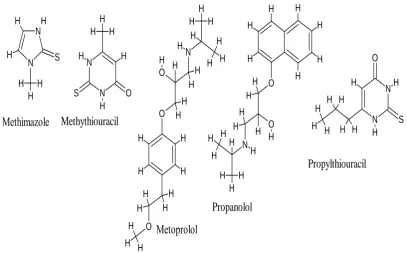
The pharmacogenomic properties of ligand molecules within activation of hyperthyroidism structures were selected from PharmaGKB database. The pharmacogenomic properties of hyperthyroidism within disease targets and the activation of amino acids such as Methimazole, Methythiouracil, Metoprolol, Propranolol and Propylthiouracil molecules has used for molecular docking.
Table: 8 .Energy Minimization of hyperthyroidism ligand molecules.
Molecular Docking
The protein C1QTNF6 3D structures model of mutated macromolecules & ligand for hyperthyroidism Methimazole, Methythiouracil, Metoprolol, Propranolol and Propylthiouracil is used for molecular docking were performed using Autodock4.2 software. The docking results are shown in below listed tables 9.
Table: 9. Protein (C1QTNF6)-Ligands molecular Docking of hyperthyroidism. Compound
Name No of
H-bonds
Binding Energy
Inhibitory Const(uM)
Intermol Energy
Torsional
Energy RMSD
Amino acids
Methylthiouracil
4 -5.57 82.45 -5.57 0.0 0.06
Glu158, Asn255, Gln161, Lys250 Metoprolol
3 -5.09 184.71 -7.78 2.68 1.12
Arg453, Lys250, Glu158 Propylthiouracil
2 -5.55 85.97 -6.14 0.6 0.44 Thr202, Ala153 Methimazole
2 -4.02 1.13 -4.02 0.0 0.03 Arg150, Lys151 Propranolol 1 -5.57 633.1 -7.36 +1.79 0.94 His155
The molecular docking results of C1QTNF6 is interacted with Synthetic ligands within active site amino acids such as Arg150, Gly157, Glu158, Phe159, Phe160, Lys162, Val208, Val246, Arg247, Lys248 and Phe249 Methylthiouracil ligand shows with 4 hydrogen bonds & low energy -5.57 kcal/mol.
Compound Name Before Energy Minimization Minimization After Energy Total Energy
Energy Gradient Energy Gradient
Figure 4: Molecular docking results of protein (C1QTNF6)- hyperthyroidism Ligand.
CONCLUSION
In our analysis, it found out that nsSNPs rs229527 showed less stable, deleterious, probably damaging, and high-risk score. The mutant protein structures of rs229527 nsSNPs showed very high energy and RMSD values compared to the homology modeled structure. It is therefore concluded rs229527 nsSNPs as the potential functional polymorphic. The pharmacogenomic drug molecules that shows great interest with hyperthyroidism with disease risk of potential drug targets. Further using molecular screening all the selected compounds is strong interacts with these mutated genes and these compounds itself can use for personalized medicine.
ACKNOWLEDGEMENT
Author are thankful to Preenon Bagchi, Azyme Biosciences Pt. Ltd., Bangalore, India.
REFERENCES
1. Unnikrishnan AG and Menon UV, 2011, “Thyroid disorders in India: An epidemiological perspective”, Indian Journal of Endocrinology and Metabolism, 15(Suppl2): S78–S81.
3. Johnson MM, John Houck and Chu Chen, 2005 “Screening for Deleterious Nonsynonymous Single-Nucleotide Polymorphisms in Genes Involved in Steroid Hormone Metabolism and Response”, Cancer Epidemiol Biomarkers Prev, 14(5):1326-1329.
4. Masoodi TA, Al Shammari SA, Al-Muammar MN, and Alhamdan AA, 2012 “ Screening and Evaluation of Deleterious SNPs in APOE Gene of Alzheimer’s Disease”, Neurology Research International, 8pages.
5. Forabosco P, Bouzigon E, Ng MY, Hermanowski J, Fisher SA, Criswell LA and Lewis CM,2009, “Meta-analysis of genome-wide linkage studies across autoimmune diseases”, European Journal of Human Genetics,17, 236–243.
6. Karczewski KJ, Daneshjou R, Altman RB, 2012 “Pharmacogenomics”, PLOS Computational Biology, 8(12).
7. Mehrotra N , Soni R, 2005 “Pharmacogenomics: A Step Towards Personalized Medicine”, Bioinformatics India Journal 3(5).
8. Eriksson N, Tung JY, Kiefer AK, Hinds DA, Francke U, Mountain JL, Chuong B, 2012 “Novel Associations for Hypothyroidism Include Known Autoimmune Risk Loci”, PLoS ONE, 7(4).
9. Agretti P, De Marco G, Biagioni M, Iannilli A, Marigliano M, Pinchera A, Vitti P, Cherubini V, Tonacchera M,2012, “Sporadic congenital nonautoimmune hyperthyroidism caused by P639S mutation in thyrotropin receptor gene”, Eur J Pediatr,171(7), 1133-7. 10.Rose E & Micconnell JS, 1947, “The Treatment of thyrotoxicosis with goitrogenic
compound”, American clinical & clinatological association, 59, 91-107.
11.Moreno JC, 2003, “Identification of novel genes involved in congenital hypothyroidism using serial analysis of gene expression”, Hormone research, 60 (Suppl) 3, 96-102.