85
©IJRASET: All Rights are Reserved
Energy Efficient Smart Classroom
Bhushan K Patil1, Ravindra D Badgujar2, Nilesh L Nil3, Satish N Suryawanshi4, Dinesh C Patel5, Pratima P Bagul 6
1,2,3,4,5,6
Dept. of E&TC, R C Patel Institute of Technology, Shirpur, North Maharashtra University, Jalgaon.
Abstract: Power generation, power utilization and power saving are the most crucial issues in modern era. Power generation is not under the control of common user and hence available power must saved and utilize effectively. In educational an institute which includes lecture hall, classrooms and practical laboratories, huge amount of power is wasted due to human errors and negligence. Significant amount of energy can be saved by avoid energy waste for unoccupied and daylight hour and turning off fan during absence of students and teacher. This paper proposes a concept of energy efficient smart classroom using Arduino Microcontroller. The light intensity, temperature, humidity, noise level and presence of human being in classroom is sensed using sensors. The sensed parameters are used to control lighting and fans. The proposed system is also used to monitor noise level in the specified area and when noise level exceeds threshold SMS will be send to predefined authority. The proposed system could be better option for power saving with minimal cost and better performance results.
Keywords: DHT 11 sensor, PIR motion sensor, Sound detector, GSM modem and Ardiuno UNO microcontroller.
I. INTRODUCTION
In homes, schools, colleges or industry we see that fan and lights are kept ON even if there is nobody in the room or area. The power wastages most commonly occurred in organizations are considered so as to avoid the wastage of power in the class room where more electricity is wasted due to carelessness or the negligence of students. To overcome this wastage the automatic switching of electrical appliances is considered. This is done based on the control of the electrical appliances during the class session timings where the switching ON of the electrical appliances is done automatically and in the remaining hours when the students move to other places like libraries, laboratories the switching OFF of the electrical appliances is done. The need of power consumers increasing rapidly meanwhile the renewable and non-renewable power generations are insufficient and the power wastage is also high due to the absence of people.
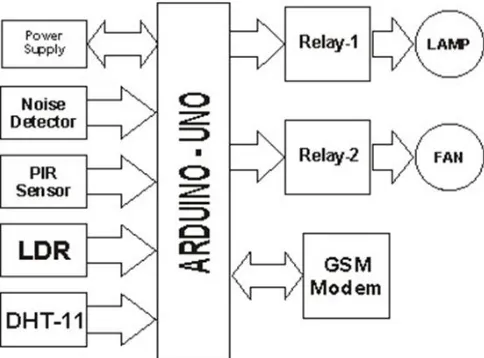
[image:1.612.189.431.536.715.2]This project is implemented for the purpose of getting a classroom fully Smart and Automatic. The aim of the project is to make the peripherals in a classroom fully automatic like the lights, fans etc. This project can simplify the total routine of the class structure. ‘Energy Efficient Smart Classroom’ is a microcontroller based project designed for making a class fully automated using sensors and relays. All the controlling is automated using the Arduino UNO Microcontroller. The input to the controller is the pulses received from the sensors. The sensors detect the motion of the human, temperature of the room, noise and light in the room. The project uses different type of interfaces to automate the classroom. PIR sensor or Passive Infrared Sensor is used to detect the human interference and LDR circuit is used to detect the light in the room.
86
©IJRASET: All Rights are Reserved
II. METHODOLOGY
The basic principle of working of the proposed project is the sensing of data from the sensor. Convert the analog data into the digital form. Process the digital data and display it on LCD followed by automatic switching of electrical appliances.
A. Aims and Objectives
To develop an Automated Power Controlling System using embedded system for minimizing the wastage of power in the institutions. The electrical appliances are controlled based on the given necessary conditions.
III.HARDWARE REQUIREMENT
A. DHT 11 Humidity & Temperature Sensor
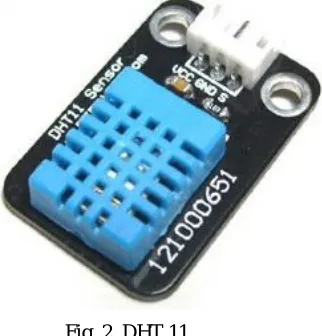
This DHT11 Temperature & Humidity Sensor features a temperature & humidity sensor complex with a calibrated digital signal output. By using the exclusive digital-signal-acquisition technique and temperature & humidity sensing technology, it ensures high reliability and excellent long-term stability. This sensor includes a resistive-type humidity measurement component and an NTC temperature measurement component, and connects to a high-performance 8-bit microcontroller, offering excellent quality, fast response, anti-interference ability and cost-effectiveness.
[image:2.612.243.404.343.511.2]Each DHT11 element is strictly calibrated in the laboratory that is extremely accurate on humidity calibration. The calibration coefficients are stored as programmes in the OTP memory, which are used by the sensor’s internal signal detecting process. The single-wire serial interface makes system integration quick and easy. Its small size, low power consumption and up-to-20 meter signal transmission making it the best choice for various applications, including those most demanding ones. The component is 4-pin single row 4-pin package. It is convenient to connect and special packages can be provided according to users’ request [5].
Fig. 2 DHT 11
B. PIR Sensor
PIRs are basically made of a pyro electric sensors (which you can see below as the round metal can with a rectangular crystal in the center), which can detect levels of infrared radiation. Everything emits some low level radiation, and the hotter something is, the more radiation is emitted. The sensor in a motion detector is actually split in two halves. The reason for that is that we are looking to detect motion (change) not average IR levels. The two halves are wired up so that they cancel each other out. If one half sees more or less IR radiation than the other, the output will swing high or low [6].
[image:2.612.205.424.610.721.2]87
©IJRASET: All Rights are Reserved
C. Sound Detector
[image:3.612.207.409.189.343.2]The sound sensor module provides an easy way to detect sound and is generally used for detecting sound intensity. This module can be used for security, switch, and monitoring applications. Its accuracy can be easily adjusted for the convenience of usage. It uses a microphone which supplies the input to an amplifier, peak detector and buffer. When the sensor detects a sound, it processes an output signal voltage which is sent to a microcontroller then performs necessary processing. Sound detection sensor module for arduino detects whether sound has exceeded a threshold value. Sound is detected via microphone and fed into an LM393 op amp. The sound level set point is adjusted via an on board potentiometer. When the sound level exceeds the set point, an LED on the module is illuminated and the output is set low [7].
Fig.4 Sound Detector
D. 16X2 LCD
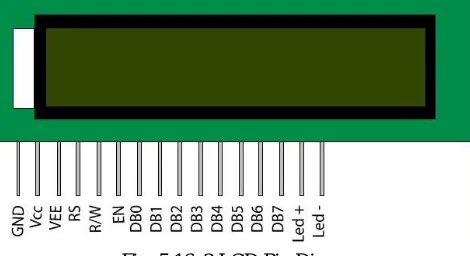
LCD (Liquid Crystal Display) screen is an electronic display module and find a wide range of applications. A 16x2 LCD display is very basic module and is very commonly used in various devices and circuits. These modules are preferred over seven segments and other multi segment LEDs. The reasons being: LCDs are economical; easily programmable; have no limitation of displaying special & even custom characters (unlike in seven segments), animations and so on.
A 16x2 LCD means it can display 16 characters per line and there are 2 such lines. In this LCD each character is displayed in 5x7 pixel matrix. This LCD has two registers, namely, Command and Data [8].
The command register stores the command instructions given to the LCD. A command is an instruction given to LCD to do a predefined task like initializing it, clearing its screen, setting the cursor position, controlling display etc. The data register stores the data to be displayed on the LCD. The data is the ASCII value of the character to be displayed on the LCD.
Fig. 5 16x2 LCD Pin Diagram
E. Arduino UNO Microcontroller
[image:3.612.190.425.503.631.2]88
[image:4.612.208.423.81.213.2]©IJRASET: All Rights are Reserved
Fig. 6 Arduino UNO Microcontroller
F. GSM Modem
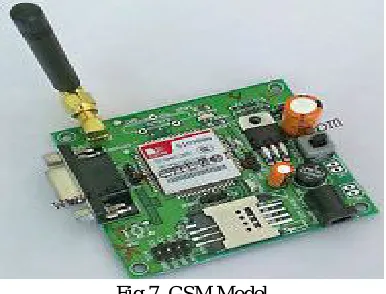
[image:4.612.210.403.361.508.2]GSM RS232 Modem built with SIMCOM Make SIM900 Quad-band GSM engine, works on frequencies 850 MHz, 900 MHz, 1800 MHz and 1900 MHz. It is very compact in size and easy to use as plug in GSM Modem. The Modem is designed with RS232 Level converter circuitry, which allows you to directly interface PC Serial port. The baud rate can be configurable from 9600-115200 through AT command. Initially Modem is in Autobaud mode. This GSM RS232 Modem is having internal TCP/IP stack to enable you to connect with internet via GPRS. It is suitable for SMS as well as DATA transfer application in M2M interface. The modem needed only 3 wires (Tx,Rx,GND) except Power supply to interface with microcontroller/Host PC. The built in Low Dropout Linear voltage regulator allows you to connect wide range of unregulated power supply (4.2V -13V). Using this modem, you will be able to send & Read SMS through simple AT commands
Fig.7 GSM Model
IV. RESULT
89
[image:5.612.190.420.74.251.2]©IJRASET: All Rights are Reserved
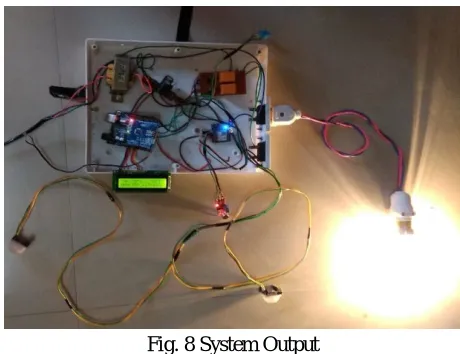
Fig. 8 System Output
V. CONCLUSIONS
In this project we have developed a real time model that can control all appliances of classrooms, laboratories, auditorium, etc. automatically without having human interference so that there is a chance to reduce the power wastage and human efforts. This system has a lot of advantages such as simple structure, small size, and low power consumption, low cost and stable.
REFERENCES
[1] SridharR., Sri VigneshPrasanthA., Pranesh M., GowthamS. And Thangaarsu S.K. (2014), ‘SMS based automatic vehicle accident information system’, International Journal of Innovative Research in Science, Engineering and Technology, Vol. 3, No. 2, pp.68-72.
[2] Md.Kamrul Hassan Majumdar, HimelBiswas, Md. Haider Ali Shaim, KaziTanvirAhmmed (2014), ‘Automated energy saving and safety system’, International Conference on Electrical Engineering and Information & Communication Technology, Vol. 2, No. 14, pp. 524-532.
[3] ChinnamSujana, Adanki Puma Ramesh and GopalaReddyP. (2011), ‘Automatic detection human and energy saving based zigbee communication’, International journal on computer science and engineering, Vol. 3, No. 6, pp. 2346-2353.
[4] http://www.iarjset.com/upload/2016/july-16/IARJSET%2042.pdf
[5] https://www.mouser.com/ds/2/758/DHT11-Technical-Data-Sheet-Translated-Version-1143054.pdf [6] https://learn.adafruit.com/pir-passive-infrared-proximity-motion-sensor.