Abstract— Logistics has recently acquired great significance in industry, in part due to rapidly growing interest in supply chain management. One of the important open issues in logistics is the effective integration of logistical cost component such as transportation cost with facility location models. This research significantly extends traditional facility location models for introducing several logistical cost components such as holding cost, transportation cost and ordering cost in a multi-commodity, multi location network. Since location and logistical cost are highly interrelated, this paper provides an integrated model, and seeks to minimize total transportation cost by simultaneously determining optimal locations, flows, shipment composition, and shipment cycle times.
Index Terms— Supply Chain, Logistics, and Optimization Model
I. INTRODUCTION
Supply Chain Management (SCM) is a frequently encountered phrase these days. Managers strive to improve the efficiency, effectiveness and productivity of their organization, but it is seen that their efforts are mostly restricted to their own functional boundaries in the enterprises. The efforts of the managers may be highly praiseworthy, however it does not constitute effective SCM without a concurrent effort on their part to manage some other vital aspects of delivering products to customers on time, in accost effective manner. It is the total customer satisfactions at reduced overall costs, which help enterprises, achieve the competitive edge in the business in the era of liberalization and globalization. A large number of manufacturing enterprises are organized as network of manufacturing and distribution sites. Enterprises procure raw material, semi finished components and then transform them into subassemblies and other finished products. Distribution of the products is then taken up for distribution to customers scattered around the globe. The distribution route may be through a chain of central warehouses and then to retailers before reaching to customers.
Min [5] quotes that, “a supply chain is referred to as an integrated system which synchronizes a series of inter-related business processes”. More concisely, supply chain management is defined as `the integration of key business
Prof. Gopal Agarwal is with the National Institute of Technology, Jaipur, India, 302017 (corresponding author, phone: +91-9414078962; e-mail: [email protected]).
Lokesh Vijayvargy is with Jaipuri Institute of Management, Jaipur, India, 302033 (e-mail: [email protected]).
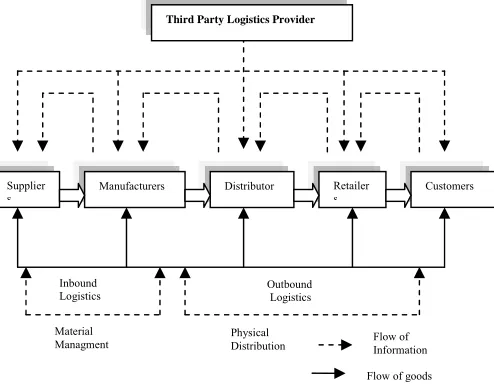
[image:1.612.306.553.255.448.2]processes from end-users through original suppliers that provide products, services, and information and add value for customers. [9]. A supply chain is characterized by a forward flow of goods and a backward flow of information as shown by Fig. 1. Typically, a supply chain is comprised of two main business processes.
Fig. 1: The Supply Chain Process
Material management (Inbound logistics) is concerned with the acquisition and storage of raw materials, parts, and supplies. To elaborate, material management supports the complete cycle of material flow from the purchase and internal control of production materials to the planning and control of work-in-process, to the warehousing, shipping, and distribution of finished products.
On the other hand, physical distribution (Outbound logistics) encompasses all outbound logistics activities related to providing customer service. These activities include order receipt and processing, inventory deployment, storage and handling, outbound transportation, consolidation, pricing, promotional support, returned product handling, and life-cycle support. Combining the activities of material management and physical distribution, a supply chain does not merely represent a linear chain of one-on-one business relationships, but a web of multiple business networks and relationships. Along a supply chain, there may be multiple stakeholders comprised of various suppliers, manufacturers, distributors, third-party logistics providers, retailers, and customers. The importance of logistics network design, and the need for the coordination of production and distribution decisions, has long been
Designing of Multi-Commodity, Multi Location
Integrated Model for Effective Logistics
Management
Gopal Agarwal and Lokesh Vijayvargy
Third Party Logistics Provider
Supplier s
Manufacturers Distributor Retailer
s
Customers
Inbound
Logistics Outbound Logistics
Material
Managment Physical Distribution Flow of Information
evident. Facility location, as the decision at the strategic level in logistics system, plays an important role. The objective of design or reconfiguration of the logistics network is to minimize annual system wide cost subject to a variety of service level requirements.
Abundant researches have been done in location-allocation problems, ranging from the single product multi location problem to uncapacitated facility location problem and capacitated facility location problem, to the versions considering dynamic and stochastic properties of the supply chain network, multiple products, and/or multiple layers/echelons with or without intra-layer flows, to some models integrating tactical and operational decisions in the logistics system, like production decisions, inventory management, and routing, to some models considering risk management, financial aspects, and international factors, etc. Abundant research has been done in this field from modeling by considering different scenarios to methods such as different heuristic methods.
This paper develop linear model for shipping base on Shipper’s decisions include the design of the transportation network, choice of the means of transportation and assignment of each customer shipment to a particular means of transport. A shipper’s goal is to minimize total cost of fulfilling customer order while achieving the responsiveness promised.
The rest of the paper is organized as follows. Section 2 describes the literature review about logistics model in various field and location-allocation problem in logistics network for product family. Section 3 discuss problem in logistics problem in multi product with multi location. Section 4 introduces the models for such problem. Section 5and 6 concludes the paper by identifying the future work, especially the potential solution techniques for the new model.
II. LITERATUREREVIEW
Since from time to time, there are serveral researcher’s fomulated many model in area of logistics. Aikens [1] analysis nine different location problem model.Pirkul [6] proposed the PLANWAR model. It is a formulation to the multi-commodity, multi-plant, capacitated facility location problem that seeks to locate a number of production plants and distribution centers so that total operating costs for the distribution network are minimized. Verma [10] have developed Multi-objective transportation problem which refers to a special class of vector-minimum linear programming problems in which the constraints are of equality type and all the objectives are non-commensurable and conflict with each other. Shih [7] has proposed a mixed integer programming model for the planning and scheduling of coal imports in a power company. Shiang [16] have developed a procedure to derive the fuzzy objective value of the fuzzy transportation problem, in that the cost coefficients and the supply and demand quantities are fuzzy numbers. Joalyemi [4] have developed a deterministic model for planning production and transportation quantities in multi plant and multi warehouse environment with extensible capacities. Jayaraman [18] developed the PLOT (Production, Logistics, Outbound, and Transportation) design system. The system addresses a class of distribution network design problems, which is characterized by multiple product families, a central manufacturing plant site, multiple distribution center and cross-docking sites, and
retail outlets (customer zones) which demand multiple units of several commodities. Goetschalckx [8] reviewed the mixed integer programming models of location-allocation problems as the foundation, and then focused on the identification of relevant factors included in the formulations, such as stochastic feature, dynamic characteristics, and status of facilities. Das [14] propose a method to solve the multi objective transportation problem in which the coefficients of the objective functions as well as the source and destination parameters are in the form of interval. Talluri [15] proposes a multi-phase mathematical programming approach for SCN design, which involves a variety of techniques that include multi criteria efficiency models, based on game formulations, and linear and integer programming methods.
This paper concerns such kind of logistics networks which distribute a family of product with different level of supply chain.
III. PROBLEMDEFINITION
Faced with increasing competition and mounting cost pressures, a growing number of firms are considering re-configuring or re-engineering their corporate structures through the consolidation and phase-out of some of their existing warehouses.
The consolidation of warehouses can help a company save transportation, inventory and warehousing costs due to economies of scale. To elaborate, the square root rule shows that the reduced number of warehouses can decrease total inventory carrying costs [9]. Also, the lower variance of the aggregate demand can reduce the chance of stock-outs [2]. Total transportation costs can be reduced, due to increased opportunities for large-volume shipments and the subsequent negotiation leverage for better freight rates. Total transportation costs can be further reduced by eliminating cross-hauling among too many warehouses. Furthermore, material handling costs would decrease due to increased opportunities for bulk storage and mass picking at centralized locations. Central administrative costs can be lessened through managing fewer warehouses. Despite its various cost saving potentials, warehouse consolidation has a drawback. It lengthens lead-time, and consequently may deteriorate customer service. This is because the fewer the warehouses, the longer the distances from customers.
IV. MODELDEVELOPMENT
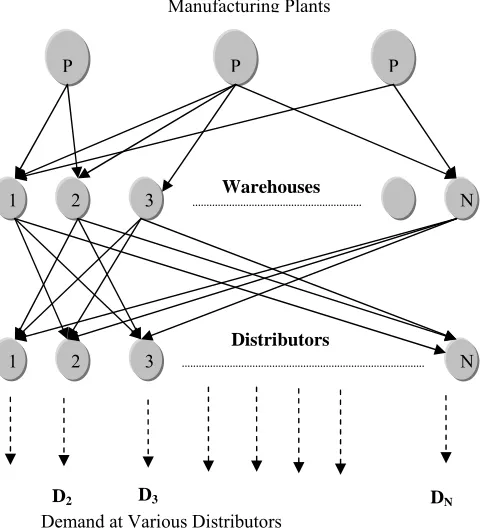
The problem of finding an optimal two tier distribution network can be formulated as a Mixed Integer Linear Programming Model. This has been achieved as follows (See in fig. 2):
The objective will be to minimize the total cost per month. The costs, which have been considered, are transportation cost, material handling cost, cost of working capital blocked up in the inventory due to transportation time, average inventory holding cost, ordering cost and inventory holding cost due to safety stock.
would means goods flowing out of a location and also flowing into the same location.
[image:3.612.66.312.140.406.2]All the demand nodes i.e, the present warehouses and distributors totaling ‘N’ in number are given a chance to Become the warehouse as well as distributors. In other world we will be having N warehouses and N distributors in the model.
Fig. 2: Network model for Logistics
Goods flow from manufacturing plants to the branch offices is represented by the decision variable Xifhjk. Decision variable is restricted to have only integer value.A. Assumptions of the Model
Prior to developing the mathematical model, we make the following underlying assumptions:
1. Each distributor receives the goods only from the warehouses or directly from plant.
2. The average monthly demand at various nodes has been taken as independent of each other.
3. Manufacturing location always has the material ready when the order arrives.
4. Major safety stock is maintained at the warehouses for its direct sale and for the distributors which are replenished at regular intervals by the warehouse. 5. Operating cost at warehouse is not considered.
6. Various model of product is assumed as a single model 7. Central sell tax is not considered.
B. Mathematical Notations
The following parameters and variables are used to describe the deterministic logistics model. Here ‘i’ denotes item, ‘h’ denotes cycle time, ‘f’ denotes freight rates, ‘j’ denotes manufacturing facility, ‘k’ denotes warehouse, and ‘l’
denotes distribution. The notations are grouped into three categories as follows:
Input Parameter
I Set of items
H Set of cycle-times F Set of freight rates
J Number of open manufacturing plants K Number of open warehouses
Si Selling prize of item i
O Ordering cost
Th Cycle-time h
K Annual inventory holding cost percentage of items selling prize
Wi Weight/volume per unit of item i
Cfjk Freight cost rate f from manufacturing plant j to warehouse k
Gfkl Freight cost rate f from warehouse k to distributor l
Ef Weight/Volume capacity of freight f ui Capacity limit of flow of item i from
plant to warehouse or warehouse to distributor
Uj Manufacturing capacity limit of plant j Dil Demand of item i at distribution center l SIGil Standard deviation of demand during lead
time for item i at distribution center l LTWjk Transportation time from plant j to
warehouse k
LTDkl Transportation time from warehouse k to distributor l
Decision variables
Xifhjk Integer variable representing flow of item i from plant j to warehouse k with cycle time h, freight category f
Yifhkl Integer variable representing flow of item i from warehouse k to distributor l with cycle time h, freight category f
Ufhjk Integer variable, representing the number of trucks required to transports the material from plant j to warehouse k with cycle time h and freight f
Vfhkl Integer variable, representing the number of trucks required to transports the material from warehouse k to distribution center l with cycle time h and freight f Binary variables
Aihjk Binary variable, equal to 1 if item i is ordered on cycle time h from plant j to warehouse k, otherwise 0
Bihkl Binary variable, equal to 1 if item i is ordered on cycle time h from warehouse k to distribution center l, otherwise 0 C. Model structure
In the mathematical model that follows, the objective function comprises the following components:
(i) Average Inventory holding cost
Average inventory carried, can be approximated as 3σ+ Xifhjk/2, for 99.87% customer service level. Average inventory holding cost is given as
Warehouses
Distributors
P P P
1 2
2 N
3 N
1 3
Manufacturing Plants
D2 D3 DN
h i ifhkl Ii h Hf Fk Kl L ifhjk
i h Ii
i hHf Fj Jk K
Y kS T X kS T 2 1 2 1
J j kl ihkl jk ihjk K l il H h Ii k K
i SIG A LTW B LTD
kS ( ( )) ]
3 2 0.5
(ii) Ordering costs
Total Ordering cost is sum of cost which incurred to place the order from warehouse to plant and distributor to warehouse, which is given as
ihkl I
i h Hk Kl L h ihjk
I
i h Hj Jk K h
B
T
O
A
T
O
(iii) Transportation costs
Total transportation cost is sum of cost which incurred to transport the goods from plant to warehouse and warehouse to distributor, which is given as
H
h f Fj JkK
h fhjk fjkU T
C / h
H h f Fk Kl L
fhkl fklV T
G /
(iv) Cost of working capital blocked up in the inventory due to transportation time
This cost is the interest cost on borrowed money. This is fraction of unit selling prize per month. Cost of inventory due to transportation time for goods supplied to distributor is calculated in two parts:-
For flow of goods from manufacturing plant (j) to distributor (l) via warehouse (k), (k, l=1 to K, k≠l). Cost of inventory due to transportation time between manufacturing plant (j) and warehouse (k).
(v)
Material handling cost
ifhkl i kl I
i h Hf Fk Kl L
ifhjk i jk Ii
i h Hf Fj Jk K
Y S TD kL X S LTW k
In the model constraint
(1) ensures that demand for each item at each destination is met
(2) capacity limitation at each facility (3) warehouse balance constraint
(4) (5), (6), (7) freight rates on shipment according to weight
(8) and (9) ensures that only one cycle time applies to an item
(10) and (11) impose restriction on the number of open plants and warehouses
D.
Mathematical ModelThe decision variables and input parameters defined in previous section have been used to develop the various linear and nonlinear functions for costs and constraints. All the linear functions have been put together to obtain logistics model. Minimize: 2 1 2 1
ihkl Ii h Hk Kl L h ihjk
I
i h Hj Jk K h
ifhkl i h I
i h Hf Fk Kl L ifhjk
i h Ii
i h Hf Fj Jk K
B T O A T O Y kS T X kS T
Hh f Fj Jk K
h fhjk fjk
U
T
C
/
hH
h f Fk Kl L fhkl fklV T
G /
ifhkl i kl I
i hHf Fk Kl L ifhjk
i jk Ii
i hHf FjJk K
Y S TD kL X S LTW
k
+
J j kl ihkl jk ihjk K l il H h Ii k K
i
S
IG
A
LTW
B
LTD
kS
(
(
))
]
3
2 0.5Subject to:
H
h f Fk K ifhkl
Y
D
il,
l
,
i
(1)
H
h f Fk K ifhjk
X
U
ij,
j
,
i
(2)
H
h f F h Hf Fj J ifhjk L
l
ifhkl
X
Y
,
k
,
i
(3)
I ii ifhjk h
X
W
T
E
(f1)U
fhjk
f
,
h
,
j
,
k
(4)
I i i ifhkl hY
W
T
E
(f1)V
fhkl
f
,
h
,
k
,
l
(5)
I i
i ifhjk h
X
W
T
E
fU
fhjk
f
,
h
,
j
,
k
(6)
I i
i ifhkl h
Y
W
T
E
fV
fhkl
f
,
h
,
k
,
l
(7)
H h
ihjk
A
1
i
,
j
,
k
(8)l
B
H h ihk
1
i
,
k
,
l
(9)
F f h Hifhjk
X
H h i ihjkU
A
i
,
j
,
k
(10)l F f h H
ifhk
Y
H h i ihklU
B
i
,
k
,
l
(11)E. Data Requirement
The data required for the mentioned formulation is as follows:-
1. List of the manufacturing location, warehouses and distributors.
2. The demand data for the products, for all warehouses and distributors.
3. Cost of all models of product.
4. Transportation times and costs from one location to the others.
5. Different truck capacity and volume occupied by different model of prodct.
6. Inventory holding cost at warehouse and distributor.
V. CONCLUSIONS
cost, inventory cost due to transportation time and material handling cost have been taken.
VI. SCOPE FOR FUTURE WORK
This paper is an attempt to find the optimal distribution network by considering various logistics costs. The following suggestions are made for future work in this direction:
One of the major concerns of the company is to minimize obsolescence of the finished goods in storage. This Nonlinear Integer Programming model may be used to simulate the costs of transportation while implementing a policy to reduce this obsolescence. This model further can be integrated with the
production planning and scheduling of the manufacturing plants.
The current model is limited to only to two levels of destinations. The actual concern for the company is to minimize the total logistics cost. Hence the concept could be extended to the level of retailers.
As we found that if we take transportation cost per unit instead of per freight then total logistics cost reduces by in creasing number of order. So model can be extended by considering that we can transport the goods for a number of distributors by selecting appropriate route. The current model can be integrated with the
geographical information system to located varoius stages of supply chain.
REFERENCE
[1] C. H. Aikens, "Facility location models for distribution planning,"European Journal of Operational Research, Vol. 22, pp. 263-279, 1985.
[2] D. Simchi-Levi, P. Kaminsky, and E. Simchi-Levi, Designing and Managing the Supply Chain: Concepts, Strategies, and Case Studies. New York: McGraw-Hill/Irwin, 2008.
[3] F. S. Hillier, and G. J. Lieberman, “Introduction to Operations Research,” Tata McGraw-hill publishing company limited, 2002.
[4] J. K. Jolayemi, and F. O. Olorunniwo, “A deterministic model for planning production quantities in a multi plant, multi warehouse environment with extensible capacities,” International journal of production economics, Vol. 50, No.1, pp.15-34, 2003.
[5] H. Min, and G. Zhou, “Supply Chain Modeling: Past, Present and Future”. Computer and Industrial Engineering, Pergamon, Vol. 43, pp. 231-249, 2002. [6] H. Pirkul, and V. Jayaraman, “A multi-commodity,
multi plant, capacitated facility location problem: formulation and efficient heuristic solution”, Computer and operation research, Vol.25, pp. 869-878, 1998. [7] L. H. Shih, “Planning of fuel coal imports using a
mixed integer programming method,” International journal of production economics, Vol. 53, pp. 243-249, 1997.
[8] M. Goetschalckx, C. J. Vidal, and K. Dogan, "Modeling and design of global logistics systems: A review of integrated strategic and tactical models and design algorithms," European Journal of Operational Research, Vol. 143, pp. 1-16, 2002.
[9] R. Bordley, M. Beltramo and D. Blumenfeld, “Consolidating distribution centers can reduce lost
sales,” International Journal of Production Economics, vol. 58, pp. 57-61, 1999.
[10] R. Verma, M. P. Biswal, and A. Biswas, “Fuzzy programming technique to solve multi-objective transportation problems with some non-linear membership functions”, Fuzzy Set and System, vol. 91, pp. 37-43, 1997.
[11] S. Chanas, and D. Kuchta, “A concept of the optimal solution of the transportation problem with fuzzy cost coefficients,” Fuzzy sets and System, Vol. 82, pp. 299-305, 1996.
[12] S. Chopra, and P. Meindl, Supply Chain Management, Pearson Education (Singapur) Pte. Ltd., 2003
[13] S. Chopra, “Designing the distribution network in a supply chain”, Transportation Research Part E: Logistics and Transportation Review, Vol. 39 (2), pp. 123-140, 2003.
[14] S. K. Das, A. Goswami, S. S. Alam, “Multiobjective transportation problem with interval cost, source and destination parameters,” European Journal of Operational Research, Vol. 117, pp. 100-112, 1999. [15] S. Talluri, and R. C. Baker, “A multi-phase
mathematical programming approach for effective supply chain design”, European Journal of Operational Research, Vol. 141, pp. 544 –558, 2002.
[16] T. L. Shiang, and K. Chiang, “Solving fuzzy transportation problems based on extension principle,” European Journal of operation research, Vol. 153, No. 3, pp. 661-674, 2004.
[17] V. Adlakha, and K. Kowalski, “A simple heuristic for solving small fixed-charge transportation problems,” International Journal of management Science, Omega, Vol. 31, No. 3, pp. 205-211, 2003.