Decoder Integration and Expected BLEU Training
for Recurrent Neural Network Language Models
Michael Auli Microsoft Research Redmond, WA, USA
Jianfeng Gao Microsoft Research Redmond, WA, USA [email protected]
Abstract
Neural network language models are often trained by optimizing likelihood, but we would prefer to optimize for a task specific metric, such as BLEU in machine trans-lation. We show how a recurrent neural network language model can be optimized towards an expected BLEU loss instead of the usual cross-entropy criterion. Fur-thermore, we tackle the issue of directly integrating a recurrent network into first-pass decoding under an efficient approxi-mation. Our best results improve a phrase-based statistical machine translation sys-tem trained on WMT 2012 French-English data by up to 2.0 BLEU, and the expected BLEU objective improves over a cross-entropy trained model by up to 0.6 BLEU in a single reference setup.
1 Introduction
Neural network-based language and translation models have achieved impressive accuracy im-provements on statistical machine translation tasks (Allauzen et al., 2011; Le et al., 2012b; Schwenk et al., 2012; Vaswani et al., 2013; Gao et al., 2014). In this paper we focus on recurrent neural network architectures which have recently advanced the state of the art in language modeling (Mikolov et al., 2010; Mikolov et al., 2011; Sundermeyer et al., 2013) with several subsequent applications in ma-chine translation (Auli et al., 2013; Kalchbrenner and Blunsom, 2013; Hu et al., 2014). Recurrent models have the potential to capture long-span de-pendencies since their predictions are based on an
unbounded historyof previous words (§2). In practice, neural network models for machine translation are usually trained by maximizing the likelihood of the training data, either via a cross-entropy objective (Mikolov et al., 2010; Schwenk
et al., 2012) or more recently, noise-contrastive es-timation (Vaswani et al., 2013). However, it is widely appreciated that directly optimizing for a task-specific metric often leads to better perfor-mance (Goodman, 1996; Och, 2003; Auli and Lopez, 2011). The expected BLEU objective pro-vides an efficient way of achieving this for ma-chine translation (Rosti et al., 2010; Rosti et al., 2011; He and Deng, 2012; Gao and He, 2013; Gao et al., 2014) instead of solely relying on tra-ditional optimizers such as Minimum Error Rate Training (MERT) that only adjust the weighting of entire component models within the log-linear framework of machine translation (§3).
Most previous work on neural networks for ma-chine translation is based on a rescoring setup (Arisoy et al., 2012; Mikolov, 2012; Le et al., 2012a; Auli et al., 2013), thereby side stepping the algorithmic and engineering challenges of di-rect decoder-integration. One recent exception is Vaswani et al. (2013) who demonstrated that feed-forward network-based language models are more accurate in first-pass decoding than in rescoring. Decoder integration has the advantage for the neu-ral network to directly influence search, unlike rescoring which is restricted to an n-best list or lat-tice. Decoding with feed-forward architectures is straightforward, since predictions are based on a fixed size input, similar to n-gram language mod-els. However, for recurrent networks we have to deal with theunbounded history, which breaks the usual dynamic programming assumptions for effi-cient search. We show how a simple but effective approximation can side step this issue and we em-pirically demonstrate its effectiveness (§4).
We test the expected BLEU objective by train-ing a recurrent neural network language model and obtain substantial improvements. We also find that our efficient approximation for decoder inte-gration is very accurate, clearly outperforming a rescoring setup (§5).
wt
ht-1
ht
yt
V
W U
[image:2.595.122.243.71.199.2]0 0 1 0 0 0
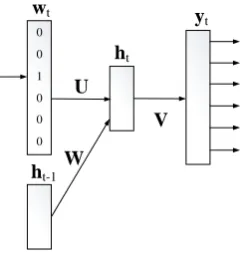
Figure 1: Structure of the recurrent neural network language model.
2 Recurrent Neural Network LMs
Our model has a similar structure to the recurrent neural network language model of Mikolov et al. (2010) which is factored into an input layer, a hid-den layer with recurrent connections, and an out-put layer (Figure 1). The inout-put layer encodes the word at positiontas a 1-of-N vectorwt. The
out-put layer yt represents scores over possible next
words; both the input and output layers are of size
|V|, the size of the vocabulary. The hidden layer statehtencodes the history of all words observed
in the sequence up to time step t. The state of the hidden layer is determined by the input layer and the hidden layer configuration of the previous time step ht−1. The weights of the connections
between the layers are summarized in a number of matrices: U represents weights from the in-put layer to the hidden layer, and W represents connections from the previous hidden layer to the current hidden layer. Matrix V contains weights between the current hidden layer and the output layer. The activations of the hidden and output layers are computed by:
ht= tanh(Uwt+Wht−1)
yt= tanh(Vht)
Different to previous work (Mikolov et al., 2010), we do not use the softmax activation function to output a probability over the next word, but in-stead just compute a single unnormalized score. This is computationally more efficient than sum-ming over all possible outputs such as required for the cross-entropy error function (Bengio et al., 2003; Mikolov et al., 2010; Schwenk et al., 2012). Training is based on the back propagation through
time algorithm, which unrolls the network and then computes error gradients over multiple time steps (Rumelhart et al., 1986); we use the expected BLEU loss (§3) to obtain the error with respect to the output activations. After training, the output layer represents scores s(wt+1|w1. . . wt,ht) for
the next word given the previoustinput words and the current hidden layer configurationht.
3 Expected BLEU Training
We integrate the recurrent neural network lan-guage model as an additional feature into the stan-dard log-linear framework of translation (Och, 2003). Formally, our phrase-based model is pa-rameterized byMparametersΛwhere eachλm∈
Λ, m = 1. . . M is the weight of an associated feature hm(f, e). Function h(f, e) maps foreign
sentencesf and English sentenceseto the vector h1(f, e). . .(f, e), and the model chooses
transla-tions according to the following decision rule:
ˆ
e= arg max
e∈E(f) Λ
Th(f, e)
We summarize the weights of the recurrent neural network language model as θ={U,W,V} and add the model as an additional feature to the log-linear translation model using the simplified nota-tionsθ(wt) =s(wt|w1. . . wt−1,ht−1):
hM+1(e) =sθ(e) =
|e|
X
t=1
logsθ(wt) (1)
which computes a sentence-level language model score as the sum of individual word scores. The translation model is parameterized by Λ and θ which are learned as follows (Gao et al., 2014):
1. We generate an n-best list for each foreign sentence in the training data with the baseline translation system givenΛwhereλM+1 = 0
using the settings described in§5. The n-best lists serve as an approximation toE(f)used in the next step for expected BLEU training of the recurrent neural network model (§3.1).
2. Next, we fix Λ, set λM+1 = 1 and
opti-mize θ with respect to the loss function on the training data using stochastic gradient de-scent (SGD).1
1We tuned λ
M+1 on the development set but found that
3. We fix θ and re-optimize Λ in the presence of the recurrent neural network model using Minimum Error Rate Training (Och, 2003) on the development set (§5).
3.1 Expected BLEU Objective
Formally, we define our loss function l(θ) as the negative expected BLEU score, denoted as xBLEU(θ)for a given foreign sentencef:
l(θ) =−xBLEU(θ) = X
e∈E(f)
pΛ,θ(e|f)sBLEU(e, e(i)) (2)
where sBLEU(e, e(i)) is a smoothed
sentence-level BLEU score with respect to the reference translation e(i), and E(f) is the generation set
given by an n-best list.2 We use a sentence-level BLEU approximation similar to He and Deng (2012).3 The normalized probabilityp
Λ,θ(e|f)of
a particular translationegivenf is defined as:
pΛ,θ(e|f) = exp{γΛ
Th(f, e)} P
e0∈E(f)exp{γΛTh(f, e0)} (3)
whereΛTh(f, e)includes the recurrent neural
net-workhM+1(e), andγ ∈[0,inf)is a scaling factor
that flattens the distribution forγ < 1and sharp-ens it forγ >1(Tromble et al., 2008).4
Next, we define the gradient of the expected BLEU loss functionl(θ)using the observation that the loss does not explicitly depend onθ:
∂l(θ) ∂θ =
X
e
|e|
X
t=1
∂l(θ) ∂sθ(wt)
∂sθ(wt)
∂θ
=X
e
|e|
X
t=1 −δwt
∂sθ(wt)
∂θ
whereδwt is theerror termfor English wordwt.5
The error term indicates how the loss changes with the translation probability which we derive next.6 2Our definitions do not take into account multiple derivations
for the same translation because our n-best lists contain only unique entries which we obtain by choosing the highest scor-ing translation among strscor-ing identical candidates.
3In early experiments we found that the BLEU+1 approxi-mation used by Liang et al. (2006) and Nakov et. al (2012) worked equally well in our setting.
4Theγparameter isonlyused during expected BLEU training but not for subsequent MERT tuning.
5A sentence may contain the same word multiple times and we compute the error term for each occurrence separately since the error depends on the individual history.
6We omit the gradient of the recurrent neural network score
∂sθ(wt)
∂θ since it follows the standard form (Mikolov, 2012).
3.2 Derivation of the Error Termδwt
We rewrite the loss function (2) using (3) and sep-arate it into two termsG(θ)andZ(θ)as follows:
l(θ) =−xBLEU(θ) =−G(θ)Z(θ) (4)
=−
P
e∈E(fP)exp{γΛTh(f, e)}sBLEU(e, e(i)) e∈E(f)exp{γΛTh(f, e)}
Next, we apply the quotient rule of differentiation:
δwt =
∂xBLEU(θ) ∂sθ(wt) =
∂(G(θ)/Z(θ)) ∂sθ(wt)
= Z1(θ)
∂G(θ) ∂sθ(wt)−
∂Z(θ)
∂sθ(wt)xBLEU(θ)
Using the observation thatθis only relevant to the recurrent neural networkhM+1(e)(1) we have
∂γΛTh(f, e)
∂sθ(wt) =γλM+1
∂hM+1(e)
∂sθ(wt) =
γλM+1
sθ(wt)
which together with the chain rule, (3) and (4) al-lows us to rewriteδwt as follows:
δwt =
1 Z(θ)
X
e∈E(f), s.t.wt∈e
∂exp{γΛTh(f, e)}
∂sθ(wt) U(θ, e)
= X
e∈E(f), s.t.wt∈e
pΛ,θ(e|f)U(θ, e)λM+1s γ θ(wt)
whereU(θ, e) =sBLEU(e, ei)−xBLEU(θ).
4 Decoder Integration
Directly integrating our recurrent neural network language model into first-pass decoding enables us to search a much larger space than would be pos-sible in rescoring.
that it depends on the entire left prefix of a sen-tence. Furthermore, the weaker independence as-sumptions also dramatically reduce the effective-ness of dynamic programming by allowing much fewer states to be recombined.7
To solve this problem, we follow previous work on lattice rescoring with recurrent networks that maintained the usual n-gram context but kept a beam of hidden layer configurations at each state (Auli et al., 2013). In fact, to make decoding as efficient as possible, we only keep thesingle best
scoring hidden layer configuration. This approx-imation has been effective for lattice rescoring, since the translations represented by each state are in fact very similar: They share both the same source words as well as the same n-gram context which is likely to result in similar recurrent his-tories that can be safely pruned. As future cost estimate we score each phrase in isolation, reset-ting the hidden layer at the beginning of a phrase. While simple, we found our estimate to be more accurate than no future cost at all.
5 Experiments
Baseline. We use a phrase-based system simi-lar to Moses (Koehn et al., 2007) based on a set of common features including maximum likeli-hood estimatespML(e|f)andpML(f|e), lexically
weighted estimates pLW(e|f) and pLW(f|e),
word and phrase-penalties, a hierarchical reorder-ing model (Galley and Mannreorder-ing, 2008), a linear distortion feature, and a modified Kneser-Ney lan-guage model trained on the target-side of the paral-lel data. Log-linear weights are tuned with MERT.
Evaluation. We use training and test data from the WMT 2012 campaign and report results on French-English and German-English. Transla-tion models are estimated on 102M words of par-allel data for French-English, and 99M words for German-English; about 6.5M words for each language pair are newswire, the remainder are parliamentary proceedings. We evaluate on six newswire domain test sets from 2008 to 2013 con-taining between 2034 to 3003 sentences. Log-linear weights are estimated on the 2009 data set comprising 2525 sentences. We evaluate accuracy in terms of BLEU with a single reference.
Rescoring Setup. For rescoring we use ei-7Recombination only retains the highest scoring state if there are multiple identical states, that is, they cover the same source span, the same translation phrase and contexts.
ther lattices or the unique 100-best output of the phrase-based decoder and re-estimate the log-linear weights by running a further iteration of MERT on the n-best list of the development set, augmented by scores corresponding to the neural network models. At test time we rescore n-best lists with the new weights.
Neural Network Training. All neural network models are trained on the news portion of the parallel data, corresponding to 136K sentences, which we found to be most useful in initial exper-iments. As training data we use unique 100-best lists generated by the baseline system. We use the same data both for training the phrase-based sys-tem as well as the language model but find that the resulting bias did not hurt end-to-end accu-racy (Yu et al., 2013). The vocabulary consists of words that occur in at least two different sentences, which is 31K words for both language pairs. We tuned the learning rateµ of our mini-batch SGD trainer as well as the probability scaling parameter γ(3) on a held-out set and found simple settings of µ= 0.1andγ = 1to be good choices. To prevent over-fitting, we experimented with L2 regulariza-tion, but found no accuracy improvements, prob-ably because SGD regularizes enough. We evalu-ate performance on a held-out set during training and stop whenever the objective changes less than 0.0003. The hidden layer uses 100 neurons unless otherwise stated.
5.1 Decoder Integration
dev 2008 2010 syscomb2010 2011 2012 2013 AllTest Baseline 24.11 20.73 24.68 24.59 25.62 24.85 25.54 24.53 RNN n-best rescore 24.83 21.41 25.17 25.06 26.53 25.74 26.31 25.25 RNN lattice rescore 24.91 21.73 25.56 25.43 27.04 26.43 26.75 25.72 RNN decode 25.14 22.03 25.86 25.74 27.32 26.86 27.15 26.06 Table 1: French-English accuracy of decoder integration of a recurrent neural network language model (RNN decode) compared to n-best and lattice rescoring as well as the output of a phrase-based system using an n-gram model (Baseline); Alltest is the corpus-weighted average BLEU across all test sets.
[image:5.595.83.518.61.130.2]dev 2008 2010 syscomb2010 2011 2012 2013 AllTest Baseline 19.35 19.96 20.87 20.66 19.60 19.80 22.48 20.58 RNN n-best rescore 20.17 20.29 21.35 21.27 20.51 20.54 23.03 21.21 RNN lattice rescore 20.24 20.38 21.55 21.43 20.77 20.63 23.23 21.38 RNN decode 20.13 20.51 21.79 21.71 20.91 20.93 23.53 21.61
Table 2: German-English results of direct decoder integration (cf. Table 1).
dev 2008 2010 syscomb2010 2011 2012 2013 AllTest Baseline 24.11 20.73 24.68 24.59 25.62 24.85 25.54 24.53 CE RNN 24.80 21.15 25.14 25.06 26.45 25.83 26.69 25.29 + xBLEU RNN 25.11 21.74 25.52 25.42 27.06 26.42 26.72 25.71 Table 3: French-English accuracy of a decoder integrated cross-entropy recurrent neural network model (CE RNN) and a combination with an expected BLEU trained model (xBLEU RNN). Results are not comparable to Table 1 since a smaller hidden layer was used to keep training times manageable (§5.2).
5.2 Expected BLEU Training
Training with the expected BLEU loss is compu-tationally more expensive than with cross-entropy since each training example is an n-best list in-stead of a single sentence. This increases the num-ber of words to be processed from 3.5M to 340M. To keep training times manageable, we reduce the hidden layer size to 30 neurons, thereby greatly increasing speed. Despite slower training, the ac-tual scoring at test time of expected BLEU mod-els is about 5 times faster than for cross-entropy models since we do not need to normalize the out-put layer anymore. The results (Table 3) show improvements of up to 0.6 BLEU when combin-ing a cross-entropy model with an expected BLEU variant. Average gains across all test sets are 0.4 BLEU, demonstrating that the gains from the ex-pected BLEU loss are additive.
6 Conclusion and Future Work
We introduce an empirically effective approxima-tion to integrate a recurrent neural network model into first pass decoding, thereby extending pre-vious work on decoding with feed-forward
neu-ral networks (Vaswani et al., 2013). Our best re-sult improves the output of a phrase-based decoder by up to 2.0 BLEU on French-English translation, outperforming n-best rescoring by up to 1.1 BLEU and lattice rescoring by up to 0.4 BLEU. Directly optimizing a recurrent neural network language model towards an expected BLEU loss proves ef-fective, improving a cross-entropy trained variant by up 0.6 BLEU. Despite higher training complex-ity, our expected BLEU trained model has five times faster runtime than a cross-entropy model since it does not require normalization.
In future work, we would like to scale up to larger data sets and more complex models through parallelization. We would also like to experiment with more elaborate future cost estimates, such as the average score assigned to all occurrences of a phrase in a large corpus.
7 Acknowledgments
[image:5.595.79.518.194.267.2]References
Alexandre Allauzen, H´el`ene Bonneau-Maynard, Hai-Son Le, Aur´elien Max, Guillaume Wisniewski, Franc¸ois Yvon, Gilles Adda, Josep Maria Crego, Adrien Lardilleux, Thomas Lavergne, and Artem
Sokolov. 2011. LIMSI @ WMT11. In Proc. of
WMT, pages 309–315, Edinburgh, Scotland, July.
Association for Computational Linguistics.
Ebru Arisoy, Tara N. Sainath, Brian Kingsbury, and Bhuvana Ramabhadran. 2012. Deep Neural
Net-work Language Models. In NAACL-HLT
Work-shop on the Future of Language Modeling for HLT, pages 20–28, Stroudsburg, PA, USA. Association for Computational Linguistics.
Michael Auli and Adam Lopez. 2011. Training a Log-Linear Parser with Loss Functions via
Softmax-Margin. InProc. of EMNLP, pages 333–343.
Asso-ciation for Computational Linguistics, July.
Michael Auli, Michel Galley, Chris Quirk, and Geof-frey Zweig. 2013. Joint Language and Translation
Modeling with Recurrent Neural Networks. InProc.
of EMNLP, October.
Yoshua Bengio, R´ejean Ducharme, Pascal Vincent, and Christian Jauvin. 2003. A Neural Probabilistic
Lan-guage Model. Journal of Machine Learning
Re-search, 3:1137–1155.
Michel Galley and Christopher D. Manning. 2008. A Simple and Effective Hierarchical Phrase
Reorder-ing Model. InProc. of EMNLP, pages 848–856.
Jianfeng Gao and Xiaodong He. 2013. Training MRF-Based Phrase Translation Models using Gradient
Ascent. InProc. of NAACL-HLT, pages 450–459.
Association for Computational Linguistics, June. Jianfeng Gao, Xiaodong He, Scott Wen tau Yih, and
Li Deng. 2014. Learning Continuous Phrase
Rep-resentations for Translation Modeling. In Proc.
of ACL. Association for Computational Linguistics, June.
Joshua Goodman. 1996. Parsing Algorithms and
Met-rics. InProc. of ACL, pages 177–183, Santa Cruz,
CA, USA, June.
Xiaodong He and Li Deng. 2012. Maximum Expected BLEU Training of Phrase and Lexicon Translation
Models. InProc. of ACL, pages 8–14. Association
for Computational Linguistics, July.
Yuening Hu, Michael Auli, Qin Gao, and Jianfeng Gao. 2014. Minimum Translation Modeling with
Recur-rent Neural Networks. InProc. of EACL.
Associa-tion for ComputaAssocia-tional Linguistics, April.
Nal Kalchbrenner and Phil Blunsom. 2013.
Re-current Continuous Translation Models. In Proc.
of EMNLP, pages 1700–1709, Seattle, Washington, USA, October. Association for Computational Lin-guistics.
Philipp Koehn, Hieu Hoang, Alexandra Birch, Chris Callison-Burch, Marcello Federico, Nicola Bertoldi, Brooke Cowan, Wade Shen, Christine Moran, Richard Zens, Chris Dyer, Ondrej Bojar, Alexandra Constantin, and Evan Herbst. 2007. Moses: Open Source Toolkit for Statistical Machine Translation. In Proc. of ACL Demo and Poster Sessions, pages 177–180, Prague, Czech Republic, Jun.
Hai-Son Le, Alexandre Allauzen, and Franc¸ois Yvon. 2012a. Continuous Space Translation Models with
Neural Networks. In Proc. of HLT-NAACL, pages
39–48, Montr´eal, Canada. Association for Compu-tational Linguistics.
Hai-Son Le, Thomas Lavergne, Alexandre Al-lauzen, Marianna Apidianaki, Li Gong, Aur´elien Max, Artem Sokolov, Guillaume Wisniewski, and
Franc¸ois Yvon. 2012b. LIMSI @ WMT12. InProc.
of WMT, pages 330–337, Montr´eal, Canada, June. Association for Computational Linguistics.
Percy Liang, Alexandre Bouchard-Cˆot´e, Ben Taskar, and Dan Klein. 2006. An end-to-end discriminative
approach to machine translation. In Proc. of
ACL-COLING, pages 761–768, Jul.
Tom´aˇs Mikolov, Karafi´at Martin, Luk´aˇs Burget, Jan Cernock´y, and Sanjeev Khudanpur. 2010. Recur-rent Neural Network based Language Model. In
Proc. of INTERSPEECH, pages 1045–1048. Tom´aˇs Mikolov, Anoop Deoras, Daniel Povey, Luk´aˇs
Burget, and Jan ˇCernock´y. 2011. Strategies for Training Large Scale Neural Network Language
Models. InProc. of ASRU, pages 196–201.
Tom´aˇs Mikolov. 2012. Statistical Language Models
based on Neural Networks. Ph.D. thesis, Brno Uni-versity of Technology.
Preslav Nakov, Francisco Guzman, and Stephan Vo-gel. 2012. Optimizing for Sentence-Level BLEU+1
Yields Short Translations. InProc. of COLING.
As-sociation for Computational Linguistics.
Franz Josef Och. 2003. Minimum Error Rate Training
in Statistical Machine Translation. InProc. of ACL,
pages 160–167, Sapporo, Japan, July.
Antti-Veikko I Rosti, Bing Zhang, Spyros Matsoukas, and Richard Schwartz. 2010. BBN System De-scription for WMT10 System Combination Task. In Proc. of WMT, pages 321–326. Association for Computational Linguistics, July.
Antti-Veikko I Rosti, Bing Zhang, Spyros Matsoukas, and Richard Schwartz. 2011. Expected BLEU Training for Graphs: BBN System Description for
WMT11 System Combination Task. In Proc. of
WMT, pages 159–165. Association for
Computa-tional Linguistics, July.
David E. Rumelhart, Geoffrey E. Hinton, and Ronald J. Williams. 1986. Learning Internal Representations
by Error Propagation. InSymposium on Parallel and
Holger Schwenk, Anthony Rousseau, and Mohammed Attik. 2012. Large, Pruned or Continuous Space Language Models on a GPU for Statistical Machine
Translation. InNAACL-HLT Workshop on the
Fu-ture of Language Modeling for HLT, pages 11–19. Association for Computational Linguistics.
Martin Sundermeyer, Ilya Oparin, Jean-Luc Gauvain, Ben Freiberg, Ralf Schl¨uter, and Hermann Ney. 2013. Comparison of Feedforward and Recurrent
Neural Network Language Models. In IEEE
Inter-national Conference on Acoustics, Speech, and Sig-nal Processing, pages 8430–8434, May.
Roy W. Tromble, Shankar Kumar, Franz Och, and
Wolfgang Macherey. 2008. Lattice Minimum
Bayes-Risk Decoding for Statistical Machine
Trans-lation. InProc. of EMNLP, pages 620–629.
Associ-ation for ComputAssoci-ational Linguistics, October. Ashish Vaswani, Yinggong Zhao, Victoria Fossum, and
David Chiang. 2013. Decoding with Large-scale Neural Language Models improves Translation. In
Proc. of EMNLP. Association for Computational Linguistics, October.
Heng Yu, Liang Huang, Haitao Mi, and Kai Zhao. 2013. Max-Violation Perceptron and Forced
Decod-ing for Scalable MT TrainDecod-ing. InProc. of EMNLP,