Margin-based Decomposed Amortized Inference
Gourab Kundu∗ and Vivek Srikumar∗ and Dan Roth
University of Illinois, Urbana-Champaign Urbana, IL. 61801
{kundu2, vsrikum2, danr}@illinois.edu
Abstract
Given that structured output prediction is typically performed over entire datasets, one natural question is whether it is pos-sible to re-use computation from earlier inference instances to speed up inference for future instances. Amortized inference has been proposed as a way to accomplish this. In this paper, first, we introduce a new amortized inference algorithm called the Margin-based Amortized Inference, which uses the notion of structured margin to identify inference problems for which pre-vious solutions are provably optimal. Sec-ond, we introducedecomposed amortized inference, which is designed to address very large inference problems, where ear-lier amortization methods become less ef-fective. This approach works by decom-posing the output structure and applying amortization piece-wise, thus increasing the chance that we can re-use previous so-lutions for parts of the output structure. These parts are then combined to a global coherent solution using Lagrangian relax-ation. In our experiments, using the NLP tasks of semantic role labeling and entity-relation extraction, we demonstrate that with the margin-based algorithm, we need to call the inference engine only for a third of the test examples. Further, we show that the decomposed variant of margin-based amortized inference achieves a greater re-duction in the number of inference calls.
1 Introduction
A wide variety of NLP problems can be natu-rally cast as structured prediction problems. For
* These authors contributed equally to this work.
some structures like sequences or parse trees, spe-cialized and tractable dynamic programming algo-rithms have proven to be very effective. However, as the structures under consideration become in-creasingly complex, the computational problem of predicting structures can become very expensive, and in the worst case, intractable.
In this paper, we focus on an inference tech-nique calledamortized inference(Srikumar et al., 2012), where previous solutions to inference prob-lems are used to speed up new instances. The main observation that leads to amortized inference is that, very often, for different examples of the same size, the structures that maximize the score are identical. If we can efficiently identify that two inference problems have the same solution, then we can re-use previously computed structures for newer examples, thus giving us a speedup.
This paper has two contributions. First, we de-scribe a novel algorithm for amortized inference calledmargin-based amortization. This algorithm is on an examination of the structured margin of a prediction. For a new inference problem, if this margin is larger than the sum of the decrease in the score of the previous predictionandany increase in the score of the second best one, then the previ-ous solution will be the highest scoring one for the new problem. We formalize this intuition to derive an algorithm that finds provably optimal solutions and show that this approach is a generalization of previously identified schemes (based on Theorem 1 of (Srikumar et al., 2012)).
Second, we argue that the idea of amortization is best exploited at the level ofpartsof the struc-tures rather than the entire structure because we expect a much higher redundancy in the parts. We introduce the notion of decomposed amor-tized inference, whereby we can attain a significant improvement in speedup by considering repeated sub-structures across the dataset and applying any amortized inference algorithm for the parts.
We evaluate the two schemes and their combi-nation on two NLP tasks where the output is en-coded as a structure: PropBank semantic role la-beling (Punyakanok et al., 2008) and the problem of recognizing entities and relations in text (Roth and Yih, 2007; Kate and Mooney, 2010). In these problems, the inference problem has been framed as an integer linear program (ILP). We compare our methods with previous amortized inference methods and show that margin-based amortization combined with decomposition significantly out-performs existing methods.
2 Problem Definition and Notation Structured output prediction encompasses a wide variety of NLP problems like part-of-speech tag-ging, parsing and machine translation. The lan-guage of 0-1 integer linear programs (ILP) pro-vides a convenient analytical tool for representing structured prediction problems. The general set-ting consists of binary inference variables each of which is associated with a score. The goal of in-ference is to find the highest scoring global ment of the variables from a feasible set of assign-ments, which is defined by linear inequalities.
While efficient inference algorithms exist for special families of structures (like linear chains and trees), in the general case, inference can be computationally intractable. One approach to deal with the computational complexity of inference is to use an off-the-shelf ILP solver for solv-ing the inference problem. This approach has seen increasing use in the NLP community over the last several years (for example, (Roth and Yih, 2004; Clarke and Lapata, 2006; Riedel and Clarke, 2006) and many others). Other approaches for solving inference include the use of cutting plane inference (Riedel, 2009), dual decomposi-tion (Koo et al., 2010; Rush et al., 2010) and the related method of Lagrangian relaxation (Rush and Collins, 2011; Chang and Collins, 2011).
(Srikumar et al., 2012) introduced the notion of an amortized inference algorithm, defined as an inference algorithm that can use previous predic-tions to speed up inference time, thereby giving an amortized gain in inference time over the lifetime of the program.
The motivation for amortized inference comes from the observation that though the number of possible structures could be large, in practice, only a small number of these are ever seen in real
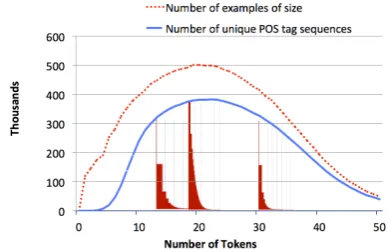
[image:2.595.316.512.198.324.2]data. Furthermore, among the observed structures, a small subset typically occurs much more fre-quently than the others. Figure 1 illustrates this observation in the context of part-of-speech tag-ging. If we can efficiently characterize and iden-tify inference instances that have the same solu-tion, we can take advantage of previously per-formed computation without paying the high com-putational cost of inference.
Figure 1:Comparison of number of instances and the num-ber of unique observed part-of-speech structures in the Gi-gaword corpus. Note that the number of observed structures (blue solid line) is much lower than the number of sentences (red dotted line) for all sentence lengths, with the difference being very pronounced for shorter sentences. Embedded in the graph are three histograms that show the distribution of observed structures for sentences of length 15, 20 and 30. In all cases, we see that a small number of tag sequences are much more frequent than the others.
We denote inference problems by the bold-faced lettersp andq. For a problem p, the goal
of inference is to jointly assign values to the parts of the structure, which are represented by a col-lection of inference variablesy∈ {0,1}n. For all
vectors, subscripts represent theirithcomponent. Eachyiis associated with a real valuedcp,i∈ <
which is the score for the variable yi being
as-signed the value 1. We denote the vector com-prising of all the cp,i as cp. The search space
for assignments is restricted via constraints, which can be written as a collection of linear inequalities,
MTy ≤b. For a problemp, we denote this
fea-sible set of structures byKp.
The inference problem is that of finding the fea-sible assignment to the structure which maximizes the dot productcTy. Thus, the prediction problem
can be written as
arg max
y∈Kp
We denote the solution of this maximization prob-lem asyp.
Let the setP ={p1,p2,· · · }denote previously solved inference problems, along with their re-spective solutions{y1
p,yp2,· · · }. Anequivalence
classof integer linear programs, denoted by[P], consists of ILPs which have the same number of inference variables and the same feasible set. Let K[P]denote the feasible set of an equivalence class
[P]. For a programp, the notationp ∼ [P] indi-cates that it belongs to the equivalence class[P].
(Srikumar et al., 2012) introduced a set of amor-tized inference schemes, each of which provides a condition for a new ILP to have the same solu-tion as a previously seen problem. We will briefly review one exact inference scheme introduced in that work. Supposeqbelongs to the same
equiv-alence class of ILPs asp. Then the solution toq
will be the same as that ofpif the following
con-dition holds for all inference variables:
(2yp,i−1)(cq,i−cp,i)≥0. (2)
This condition, referred to as Theorem 1 in that work, is the baseline for our experiments.
In general, for any amortization scheme A, we can define two primitive operators TESTCONDITIONA and SOLUTIONA. Given
a collection of previously solved prob-lems P and a new inference problem q,
TESTCONDITIONA(P,q) checks if the
solu-tion of the new problem is the same as that of some previously solved one and if so, SOLUTIONA(P,q)returns the solution.
3 Margin-based Amortization
In this section, we will introduce a new method for amortizing inference costs over time. The key observation that leads to this theorem stems from thestructured marginδ for an inference problem
p∼[P], which is defined as follows:
δ= min
y∈K[P],y6=yp
cTp(yp−y). (3)
That is, for all feasibley, we havecTpyp ≥cTpy+ δ. The marginδis the upper limit on thechange in objectivethat is allowed for the constraint setK[P] for which the solution will not change.
For a new inference problemq∼[P], we define ∆as the maximum change in objective value that can be effected by an assignment that is not the
A B=yp
cp
cq
δ
∆
decrease in value ofyp
increasing
objecti
ve
cpTyp
[image:3.595.313.521.60.229.2]Two assignments
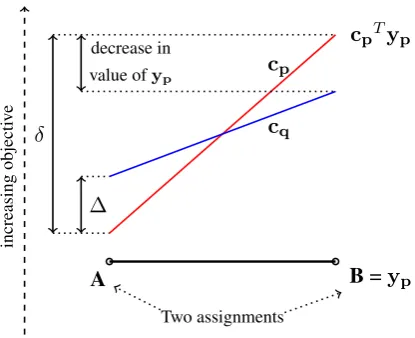
Figure 2: An illustration of the margin-based amortization scheme showing the very simple case with only two compet-ing assignmentsAandB. SupposeBis the solutionypfor
the inference problempwith coefficientscp, denoted by the
red hyperplane, andAis the second-best assignment. For a new coefficient vectorcq, if the marginδis greater than the
sum of the decrease in the objective value ofypand the
max-imum increase in the objective of another solution (∆), then the solution to the new inference problem will still beyp. The
margin-based amortization theorem captures this intuition.
solution. That is,
∆ = max
y∈K[P],y6=yp
(cq−cp)T y (4)
Before stating the theorem, we will provide an in-tuitive explanation for it. Moving fromcp tocq,
consider the sum of the decrease in the value of the objective for the solutionypand∆, the
maxi-mum change in objective value for an assignment that is not the solution. If this sum is less than the marginδ, then no other solution will have an ob-jective value higher than yp. Figure 2 illustrates
this using a simple example where there are only two competing solutions.
This intuition is captured by our main theorem which provides a condition for problemspandq
to have the same solutionyp.
Theorem 1 (Margin-based Amortization). Let p
denote an inference problem posed as an inte-ger linear program belonging to an equivalence class [P] with optimal solution yp. Let p have
a structured margin δ, i.e., for any y, we have
cTpyp ≥cTpy+δ. Letq ∼[P]be another infer-ence instance in the same equivalinfer-ence class and let∆be defined as in Equation 4. Then,ypis the
solution of the problemqif the following holds:
Proof. For some feasibley, we have
cTqyp−cTqy ≥ cTqyp−cTpy−∆
≥ cTqyp−cTpyp+δ−∆
≥ 0
The first inequality comes from the definition of∆ in (4) and the second one follows from the defini-tion ofδ. The condition of the theorem in (5) gives us the final step. For any feasibley, the objective
score assigned toyp is greater than the score
as-signed toyaccording to problemq. That is,ypis
the solution to the new problem.
The margin-based amortization theorem pro-vides a general, new amortized inference algo-rithm. Given a new inference problem, we check whether the inequality (5) holds for any previously seen problems in the same equivalence class. If so, we return the cached solution. If no such problem exists, then we make a call to an ILP solver.
Even though the theorem provides a condition for two integer linear programs to have the same solution, checking the validity of the condition re-quires the computation of∆, which in itself is an-other integer linear program. To get around this, we observe that if any constraints in Equation 4 are relaxed, the value of the resulting maximum can only increase. Even with the increased∆, if the condition of the theorem holds, then the rest of the proof follows and hence the new problem will have the same solution. In other words, we can solve relaxed, tractable variants of the maxi-mization in Equation 4 and still retain the guaran-tees provided by the theorem. The tradeoff is that, by doing so, the condition of the theorem will ap-ply to fewer examples than theoretically possible. In our experiments, we will define the relaxation for each problem individually and even with the relaxations, the inference algorithm based on the margin-based amortization theorem outperforms all previous amortized inference algorithms.
The condition in inequality (5) is, in fact, a strict generalization of the condition for Theorem 1 in (Srikumar et al., 2012), stated in (2). If the latter condition holds, then we can show that∆≤0and (cq−cp)Typ≥0. Sinceδis, by definition,
non-negative, the margin-based condition is satisfied.
4 Decomposed Amortized Inference One limitation in previously considered ap-proaches for amortized inference stems from the
expectation that the same full assignment maxi-mizes the objective score for different inference problems, or equivalently, that the entire structure is repeated multiple times. Even with this assump-tion, we observe a speedup in prediction.
However, intuitively, even if entire structures are not repeated, we expect parts of the assign-ment to be the same across different instances. In this section, we address the following question: Can we take advantage of the redundancy in com-ponents of structures to extend amortization tech-niques to cases where the full structured output is not repeated? By doing so, we can store partial computation for future inference problems.
For example, consider the task of part of speech tagging. While the likelihood of two long sen-tences having the same part of speech tag sequence is not high, it is much more likely that shorter sec-tions of the sentences will share the same tag se-quence. We see from Figure 1 that the number of possible structures for shorter sentences is much smaller than the number of sentences. This im-plies that many shorter sentences share the same structure, thus improving the performance of an amortized inference scheme for such inputs. The goal of decomposed amortized inference is to ex-tend this improvement to larger problems by in-creasing the size of equivalence classes.
To decompose an inference problem, we use the approach of Lagrangian Relaxation (Lemar´echal, 2001) that has been used successfully for various NLP tasks (Chang and Collins, 2011; Rush and Collins, 2011). We will briefly review the under-lying idea1. The goal is to solve an integer linear
programq, which is defined as
q: max
MTy≤bc
T qy
We partition the constraints into two sets, sayC1
denoting M1Ty ≤ b1 and C2, denoting
con-straints M2Ty ≤ b2. The assumption is that in
the absence the constraintsC2, the inference
prob-lem becomes computationally easier to solve. In other words, we can assume the existence of a sub-routine that can efficiently compute the solution of the relaxed problemq0:
q0 : max
M1Ty≤b1
cTqy
We define Lagrange multipliersΛ ≥ 0, with one λi for each constraint inC2. For problemq, we
can define the Lagrangian as
L(y,Λ) =cTqy−ΛT M2Ty−b2
Here, the domain ofyis specified by the constraint
setC1. The dual objective is
L(Λ) = max
M1Ty≤b1
cTqy−ΛT M2Ty−b2
= max
M1Ty≤b1
cq−ΛTM2T y+ ΛTb2.
Note that the maximization in the definition of the dual objective has the same functional form asq0
and any approach to solveq0 can be used here to find the dual objectiveL(Λ). The dual of the prob-lemq, given by minΛ≥0L(Λ), can be solved
us-ing subgradient descent over the dual variables. Relaxing the constraintsC2 to define the
prob-lemq0has several effects. First, it can make the
re-sulting inference problemq0easier to solve. More importantly, removing constraints can also lead to the merging of multiple equivalence classes, lead-ing to fewer, more populous equivalence classes. Finally, removing constraints can decompose the inference problem q0 into smaller independent
sub-problems{q1,q2,· · · }such that no constraint
that is inC1has active variables from two different
sets in the partition.
For the sub-problemqicomprising of variables yi, let the corresponding objective coefficients be cqi and the corresponding sub-matrix of M2 be
Mi
2. Now, we can define the dual-augmented
sub-problem as
max
Mi 1
T
y≤bi 1
cqi−ΛTMi2
T
yi (6)
Solving all such sub-problems will give us a com-plete assignment for all the output variables.
We can now define the decomposed amortized inference algorithm (Algorithm 1) that performs sub-gradient descent over the dual variables. The input to the algorithm is a collection of previ-ously solved problems with their solutions, a new inference problem q and an amortized inference
schemeA(such as the margin-based amortization scheme). In addition, for the task at hand, we first need to identify the set of constraintsC2 that can
be introduced via the Lagrangian.
First, we check if the solution can be obtained without decomposition (lines 1–2). Otherwise,
Algorithm 1Decomposed Amortized Inference
Input: A collection of previously solved infer-ence problemsP, a new problemq, an
amor-tized inference algorithmA.
Output: The solution to problemq 1: ifTESTCONDITION(A,q,P)then
2: return SOLUTION(A,q,P)
3: else
4: Initializeλi ←0for each constraint inC2. 5: fort= 1· · ·T do
6: Partition the problem q into
sub-problems q1,q2,· · · such that no con-straint in C1 has active variables from
two partitions.
7: forpartitionqido
8: yi ← Solve the maximization
prob-lem forqi(Eq. 6) using the amortized
schemeA.
9: end for
10: Lety←y1;y2;· · ·
11: ifM2y ≤b2 and(b2−M2y)iλi = 0
then
12: return y
13: else
14: Λ←Λ−µt b2−M2Ty+ 15: end if
16: end for
17: return solution ofqusing a standard
infer-ence algorithm
18: end if
we initialize the dual variables Λ and try to ob-tain the solution iteratively. At the tth itera-tion, we partition the problemqinto sub-problems
{q1,q2,· · · } as described earlier (line 6). Each
partition defines a smaller inference problem with its own objective coefficients and constraints. We can apply the amortization schemeAto each sub-problem to obtain a complete solution for the re-laxed problem (lines 7–10). If this solution satis-fies the constraintsC2 and complementary
slack-ness conditions, then the solution is provably the maximum of the problemq. Otherwise, we take a
subgradient step to update the value ofΛ using a step-sizeµt, subject to the constraint that all dual
variables must be non-negative (line 14). If we do not converge to a solution inT iterations, we call the underlying solver on the full problem.
sub-problem cannot be solved using the procedure, then we can either solve the sub-problem using a different approach (effectively giving us the stan-dard Lagrangian relaxation algorithm for infer-ence), or we can treat the full instance as a cache miss and make a call to an ILP solver. In our ex-periments, we choose the latter strategy.
5 Experiments and Results
Our experiments show two results: 1. The margin-based scheme outperforms the amortized infer-ence approaches from (Srikumar et al., 2012). 2. Decomposed amortized inference gives further gains in terms of re-using previous solutions.
5.1 Tasks
We report the performance of inference on two NLP tasks: semantic role labeling and the task of extracting entities and relations from text. In both cases, we used an existing formulation for struc-tured inference and only modified the inference calls. We will briefly describe the problems and the implementation and point the reader to the lit-erature for further details.
Semantic Role Labeling (SRL) Our first task is that of identifying arguments of verbs in a sen-tence and annotating them with semantic roles (Gildea and Jurafsky, 2002; Palmer et al., 2010) . For example, in the sentence Mrs. Haag plays Eltiani., the verbplaystakes two arguments:Mrs. Haag, the actor, labeled as A0 and Eltiani, the role, labeled as A1. It has been shown in prior work (Punyakanok et al., 2008; Toutanova et al., 2008) that making a globally coherent prediction boosts performance of SRL.
In this work, we used the SRL system of (Pun-yakanok et al., 2008), where one inference prob-lem is generated for each verb and each infer-ence variables encodes the decision that a given constituent in the sentence takes a specific role. The scores for the inference variables are obtained from a classifier trained on the PropBank cor-pus. Constraints encode structural and linguistic knowledge about the problem. For details about the formulations of the inference problem, please see (Punyakanok et al., 2008).
Recall from Section 3 that we need to define a relaxed version of the inference problem to effi-ciently compute∆for the margin-based approach. For a problem instance with coefficients cq and
cached coefficients cp, we take the sum of the
highestnvalues ofcq−cpas our∆, wherenis
the number of argument candidates to be labeled. To identify constraints that can be relaxed for the decomposed algorithm, we observe that most constraints are not predicate specific and apply for all predicates. The only constraint that is predi-cate specific requires that each predipredi-cate can only accept roles from a list of roles that is defined for that predicate. By relaxing this constraint in the decomposed algorithm, we effectively merge all the equivalence classes for all predicates with a specific number of argument candidates.
Entity-Relation extraction Our second task is that of identifying the types of entities in a sen-tence and the relations among them, which has been studied by (Roth and Yih, 2007; Kate and Mooney, 2010) and others. For the sentence Oswald killed Kennedy, the words Oswald and Kennedywill be labeled by the type PERSON, and
the KILLrelation exists between them.
We followed the experimental setup as de-scribed in (Roth and Yih, 2007). We defined one inference problem for each sentence. For every entity (which is identified by a constituent in the sentence), an inference variable is introduced for each entity type. For each pair of constituents, an inference variable is introduced for each relation type. Clearly, the assignment of types to entities and relations are not independent. For example, an entity of type ORGANIZATION cannot participate
in a relation of type BORN-IN because this
rela-tion label can connect entities of type PERSONand
LOCATIONonly. Incorporating these natural
con-straints during inference were shown to improve performance significantly in (Roth and Yih, 2007). We trained independent classifiers for entities and relations and framed the inference problem as in (Roth and Yih, 2007). For further details, we refer the reader to that paper.
To compute the value of∆for the margin-based algorithm, for a new instance with coefficientscq
and cached coefficientscp, we define∆to be the
sum of all non-negative values ofcq−cp.
5.2 Experimental Setup
We follow the experimental setup of (Srikumar et al., 2012) and simulate a long-running NLP pro-cess by caching problems and solutions from the Gigaword corpus. We used a database engine to cache ILP and their solutions along with identi-fiers for the equivalence class and the value ofδ.
For the margin-based algorithm and the Theo-rem 1 from (Srikumar et al., 2012), for a new in-ference problem p ∼ [P], we retrieve all infer-ence problems from the database that belong to the same equivalence class [P]as the test prob-lemp and find the cached assignmenty that has
the highest score according to the coefficients of
p. We only consider cached ILPs whose solution
is y for checking the conditions of the theorem.
This optimization ensures that we only process a small number of cached coefficient vectors.
In a second efficiency optimization, we pruned the database to remove redundant inference prob-lems. A problem is redundant if solution to that problem can be inferred from the other problems stored in the database that have the same solution and belong to the same equivalence class. How-ever, this pruning can be computationally expen-sive if the number of problems with the same so-lution and the same equivalence class is very large. In that case, we first sampled a 5000 problems ran-domly and selected the non-redundant problems from this set to keep in the database.
5.3 Results
We compare our approach to a state-of-the-art ILP solver2 and also to Theorem 1 from (Srikumar
et al., 2012). We choose this baseline because it is shown to give the highest improvement in wall-clock time and also in terms of the num-ber of cache hits. However, we note that the re-sults presented in our work outperform all the pre-vious amortization algorithms, including the ap-proximate inference methods.
We report two performance metrics – the per-centage decrease in the number of ILP calls, and the percentage decrease in the wall-clock infer-ence time. These are comparable to the speedup and clock speedup defined in (Srikumar et al., 2012). For measuring time, since other aspects of prediction (like feature extraction) are the same across all settings, we only measure the time taken for inference and ignore other aspects. For both
2We used the Gurobi optimizer for our experiments.
tasks, we report the runtime performance on sec-tion 23 of the Penn Treebank. Note that our amor-tization schemesguarantee optimal solution. Con-sequently, using amortization, task accuracy re-mains the same as using the original solver.
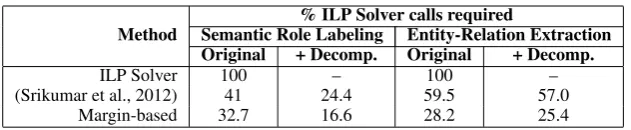
Table 1 shows the percentage reduction in the number of calls to the ILP solver. Note that for both the SRL and entity-relation problems, the margin-based approach, even without using de-composition (the columns labeledOriginal), out-performs the previous work. Applying the de-composed inference algorithm improves both the baseline and the margin-based approach. Overall, however, the fewest number of calls to the solver is made when combining the decomposed inference algorithm with the margin-based scheme. For the semantic role labeling task, we need to call the solver only for one in six examples while for the entity-relations task, only one in four examples re-quire a solver call.
Table 2 shows the corresponding reduction in the wall-clock time for the various settings. We see that once again, the margin based approach outperforms the baseline. While the decomposed inference algorithm improves running time for SRL, it leads to a slight increase for the entity-relation problem. Since this increase occurs in spite of a reduction in the number of solver calls, we believe that this aspect can be further improved with an efficient implementation of the decom-posed inference algorithm.
6 Discussion
Lagrangian Relaxation in the literature In the literature, in applications of the Lagrangian relax-ation technique (such as (Rush and Collins, 2011; Chang and Collins, 2011; Reichart and Barzilay, 2012) and others), the relaxed problems are solved using specialized algorithms. However, in both the relaxations considered in this paper, even the re-laxed problems cannot be solved without an ILP solver, and yet we can see improvements from de-composition in Table 1.
exper-% ILP Solver calls required
Method Semantic Role Labeling Entity-Relation Extraction
Original + Decomp. Original + Decomp.
ILP Solver 100 – 100 –
(Srikumar et al., 2012) 41 24.4 59.5 57.0
Margin-based 32.7 16.6 28.2 25.4
Table 1: Reduction in number of inference calls
% time required compared to ILP Solver
Method Semantic Role Labeling Entity-Relation Extraction
Original + Decomp. Original + Decomp.
ILP Solver 100 – 100 –
(Srikumar et al., 2012) 54.8 40.0 81 86
[image:8.595.142.458.60.125.2]Margin-based 45.9 38.1 58.1 61.3
Table 2: Reduction in inference time
iments (call it Lag1) and T to 1 (call it Lag2). In SRL, compared to solving the original problem with ILP Solver, bothLag1andLag2are roughly 2times slower. For entity relation task, compared to ILP Solver,Lag1is186times slower andLag2 is1.91times slower. Since we used the same im-plementation of the decomposition in all experi-ments, this shows that the decomposed inference algorithm crucially benefits from the underlying amortization scheme.
Decomposed amortized inference The decom-posed amortized inference algorithm helps im-prove amortized inference in two ways. First, since the number of structures is a function of its size, considering smaller sub-structures will allow us to cache inference problems that cover a larger subset of the space of possible sub-structures. We observed this effect in the problem of extracting entities and relations in text. Second, removing a constraint need not always partition the structure into a set of smaller structures. Instead, by re-moving the constraint, examples that might have otherwise been in different equivalence classes be-come part of a combined, larger equivalence class. Increasing the size of the equivalence classes in-creases the probability of a cache-hit. In our ex-periments, we observed this effect in the SRL task.
7 Conclusion
Amortized inference takes advantage of the reg-ularities in structured output to re-use previous computation and improve running time over the lifetime of a structured output predictor. In this pa-per, we have described two approaches for amor-tizing inference costs over datasets. The first, called themargin-based amortized inference, is a
new, provably exact inference algorithm that uses the notion of a structured margin to identify previ-ously solved problems whose solutions can be re-used. The second, calleddecomposed amortized inference, is a meta-algorithm over any amortized inference that takes advantage of previously com-puted sub-structures to provide further reductions in the number of inference calls. We show via ex-periments that these methods individually give a reduction in the number of calls made to an infer-ence engine for semantic role labeling and entity-relation extraction. Furthermore, these approaches complement each other and, together give an addi-tional significant improvement.
Acknowledgments
References
Y-W. Chang and M. Collins. 2011. Exact decoding of phrase-based translation models through Lagrangian relaxation. EMNLP.
J. Clarke and M. Lapata. 2006. Constraint-based sentence compression: An integer programming ap-proach. InACL.
D. Gildea and D. Jurafsky. 2002. Automatic labeling of semantic roles. Computational Linguistics.
R. Kate and R. Mooney. 2010. Joint entity and relation extraction using card-pyramid parsing. In Proceed-ings of the Fourteenth Conference on Computational Natural Language Learning, pages 203–212. Asso-ciation for Computational Linguistics.
T. Koo, A. M. Rush, M. Collins, T. Jaakkola, and D. Sontag. 2010. Dual decomposition for parsing with non-projective head automata. InEMNLP.
C. Lemar´echal. 2001. Lagrangian Relaxation. In
Computational Combinatorial Optimization, pages 112–156.
M. Palmer, D. Gildea, and N. Xue. 2010. Semantic Role Labeling, volume 3. Morgan & Claypool Pub-lishers.
V. Punyakanok, D. Roth, and W. Yih. 2008. The im-portance of syntactic parsing and inference in se-mantic role labeling. Computational Linguistics.
R. Reichart and R. Barzilay. 2012. Multi event extrac-tion guided by global constraints. InNAACL, pages 70–79.
S. Riedel and J. Clarke. 2006. Incremental integer linear programming for non-projective dependency parsing. InEMNLP.
S. Riedel. 2009. Cutting plane MAP inference for Markov logic. Machine Learning.
D. Roth and W. Yih. 2004. A linear programming formulation for global inference in natural language tasks. In Hwee Tou Ng and Ellen Riloff, editors,
CoNLL.
D. Roth and W. Yih. 2007. Global inference for entity and relation identification via a linear programming formulation. In Lise Getoor and Ben Taskar, editors,
Introduction to Statistical Relational Learning.
A.M. Rush and M. Collins. 2011. Exact decoding of syntactic translation models through Lagrangian re-laxation. In ACL, pages 72–82, Portland, Oregon, USA, June.
A. M. Rush, D. Sontag, M. Collins, and T. Jaakkola. 2010. On dual decomposition and linear program-ming relaxations for natural language processing. In
EMNLP.
V. Srikumar, G. Kundu, and D. Roth. 2012. On amor-tizing inference cost for structured prediction. In
EMNLP.
K. Toutanova, A. Haghighi, and C. D. Manning. 2008. A global joint model for semantic role labeling.