Proceedings of the 49th Annual Meeting of the Association for Computational Linguistics:shortpapers, pages 18–23,
Efficient Online Locality Sensitive Hashing via Reservoir Counting
Benjamin Van Durme HLTCOE
Johns Hopkins University
Ashwin Lall
Mathematics and Computer Science Denison University
Abstract
We describe a novel mechanism called Reser-voir Countingfor application in online Local-ity Sensitive Hashing. This technique allows for significant savings in the streaming setting, allowing for maintaining a larger number of signatures, or an increased level of approxima-tion accuracy at a similar memory footprint.
1 Introduction
Feature vectors based on lexical co-occurrence are often of a high dimension,d. This leads toO(d) op-erations to calculate cosine similarity, a fundamental tool in distributional semantics. This is improved in practice through the use of data structures that ex-ploit feature sparsity, leading to an expected O(f) operations, wherefis the number of unique features we expect to have non-zero entries in a given vector. Ravichandran et al. (2005) showed that the Lo-cality Sensitive Hash (LSH) procedure of Charikar (2002), following from Indyk and Motwani (1998) and Goemans and Williamson (1995), could be suc-cessfully used to compress textually derived fea-ture vectors in order to achieve speed efficiencies in large-scale noun clustering. Such LSHbit
signa-turesare constructed using the following hash
func-tion, where~v∈Rdis a vector in the original feature space, and~ris randomly drawn fromN(0,1)d:
h(~v) =
1 if~v·~r≥0, 0 otherwise.
Ifhb(~v)is theb-bit signature resulting frombsuch hash functions, then the cosine similarity between vectors~uand~vis approximated by:
cos(u, ~~ v) = |~u~u||·~v~v| ≈cos(D(hb(~ub),hb(~v)) ∗π),
whereD(·,·) is Hamming distance, the number of bits that disagree. This technique is used when b d, which leads to faster pair-wise comparisons between vectors, and a lower memory footprint.
Van Durme and Lall (2010) observed1 that if the feature values are additive over a dataset (e.g., when collecting word co-occurrence frequencies), then these signatures may be constructedonlineby unrolling the dot-product into a series of local oper-ations:~v·~ri = Σt~vt·~ri, where~vtrepresents features observed locally at timetin a data-stream.
Since updates may be done locally, feature vec-tors do not need to be stored explicitly. This di-rectly leads to significant space savings, as only one
counteris needed for each of thebrunning sums.
In this work we focus on the following observa-tion: the counters used to store the running sums may themselves be an inefficient use of space, in that they may be amenable to compression through approximation.2 Since the accuracy of this LSH rou-tine is a function ofb, then if we were able to reduce the online requirements of each counter, we might afford a larger number of projections. Even if a chance of approximation error were introduced for each hash function, this may be justified in greater overall fidelity from the resultant increase inb.
1
A related point was made by Li et al. (2008) when dis-cussing stable random projections.
2
Abbit signature requires the online storage ofb∗32bits of memory when assuming a 32-bit floating point representation per counter, but since here the only thing one cares about these sums are their sign (positive or negative) then an approximation to the true sum may be sufficient.
Thus, we propose to approximate the online hash function, using a novel technique we callReservoir
Counting, in order to create a space trade-off
be-tween the number of projections and the amount of memory each projection requires. We show experi-mentally that this leads to greater accuracy approx-imations at the same memory cost, or similar accu-racy approximations at a significantly reduced cost. This result is relevant to work in large-scale distribu-tional semantics (Bhagat and Ravichandran, 2008; Van Durme and Lall, 2009; Pantel et al., 2009; Lin et al., 2010; Goyal et al., 2010; Bergsma and Van Durme, 2011), as well as large-scale processing of social media (Petrovic et al., 2010).
2 Approach
While not strictly required, we assume here to be dealing exclusively with integer-valued features. We then employ an integer-valued projection matrix in order to work with an integer-valued stream of on-line updates, which is reduced (implicitly) to a stream of positive and negative unit updates. The sign of the sum of these updates is approximated through a novel twist onReservoir Sampling. When computed explicitly this leads to an impractical mechanism linear in each feature value update. To ensure our counter can (approximately) add and sub-tract in constant time, we then derive expressions for
theexpected valueof each step of the update. The
full algorithms are provided at the close.
Unit Projection Rather than construct a projec-tion matrix from N(0,1), a matrix randomly pop-ulated with entries from the set{−1,0,1}will suf-fice, with quality dependent on the relative propor-tion of these elements. If we let p be the percent probability mass allocated to zeros, then we create a discrete projection matrix by sampling from the multinomial: (1−2p : −1, p : 0,1−2p : +1). An experiment displaying the resultant quality is dis-played in Fig. 1, for variedp. Henceforth we assume this discrete projection matrix, withp = 0.5.3 The use of such sparse projections was first proposed by Achlioptas (2003), then extended by Li et al. (2006).
3Note that if using the
pooling trickof Van Durme and Lall (2010), this equates to a pool of the form: (-1,0,0,1).
Percent.Zeros
Mean.Absolute
.Error
0.1 0.2 0.3 0.4 0.5
0.2 0.4 0.6 0.8 1.0
Method
[image:2.612.338.513.73.228.2]Discrete Normal
Figure 1: Withb = 256, mean absolute error in cosine approximation when using a projection based onN(0,1), compared to{−1,0,1}.
Unit Stream Based on a unit projection, we can view an online counter as summing over a stream drawn from {−1,1}: each projected feature value unrolled into its (positive or negative) unary repre-sentation. For example, the stream: (3,-2,1), can be viewed as the updates: (1,1,1,-1,-1,1).
Reservoir Sampling We can maintain a uniform sample of sizek over a stream of unknown length as follows.Acceptthe firstkelements into an reser-voir (array) of sizek. Each following element at po-sitionnis accepted with probability nk, whereupon an element currently in the reservoir isevicted, and replaced with the just accepted item. This scheme is guaranteed to provide a uniform sample, where early items are more likely to be accepted, but also at greater risk of eviction. Reservoir sampling is a folk-lore algorithm that was extended by Vitter (1985) to allow for multiple updates.
Reservoir Counting If we are sampling over a stream drawn from just two values, we can implic-itly represent the reservoir by counting only the fre-quency of one or the other elements.4 We can there-fore sample the proportion of positive and negative unit values by tracking the current position in the stream, n, and keeping a log2(k + 1)-bit integer
4
counter,s, for tracking the number of1values cur-rently in the reservoir.5 When a negative value is accepted, we decrement the counter with probability
s
k. When a positive update is accepted, we increment the counter with probability(1−s
k). This reflects an update evicting either an element of the same sign, which has no effect on the makeup of the reservoir, or decreasing/increasing the number of1’s currently sampled. An approximate sum of all values seen up to positionnis then simply: n(2ks−1). While this value is potentially interesting in future applications, here we are only concerned with its sign.
Parallel Reservoir Counting On its own this counting mechanism hardly appears useful: as it is dependent on knowingn, then we might just as well sum the elements of the stream directly, counting in whatever space we would otherwise use in maintain-ing the value ofn. However, if we have a set oftied
streams that we process in parallel,6 then we only need to tracknonce, acrossbdifferent streams, each with their own reservoir.
When dealing with parallel streams resulting from different random projections of the same vector, we cannot assume these will be strictly tied. Some pro-jections will cancel out heavier elements than oth-ers, leading to update streams of different lengths once elements are unrolled into their (positive or negative) unary representation. In practice we have found that tracking the mean value of n across b streams is sufficient. When using ap = 0.5zeroed matrix, we can updatenby one half the magnitude of each observed value, as on average half the pro-jections will cancel out any given element. This step can be found in Algorithm 2, lines 8 and 9.
Example To make concrete what we have cov-ered to this point, consider a given feature vec-tor of dimensionality d = 3, say: [3, 2, 1]. This might be projected into b = 4, vectors: [3, 0, 0], [0, -2, 1], [0, 0, 1], and [-3, 2, 0]. When viewed as positive/negative, loosely-tied unit streams, they re-spectively have lengthn: 3, 3, 1, and 5, with mean length 3. The goal of reservoir counting is to effi-ciently keep track of an approximation of their sums (here: 3, -1, 1, and -1), while the underlying feature
5
E.g., a reservoir of sizek= 255requires an 8-bit integer. 6Tied in the sense that each stream is of the same length, e.g., (-1,1,1) is the same length as (1,-1,-1).
k n m mean(A) mean(A0)
10 20 10 3.80 4.02
10 20 1000 37.96 39.31
50 150 1000 101.30 101.83
100 1100 100 8.88 8.72
[image:3.612.331.525.71.146.2]100 10100 10 0.13 0.10
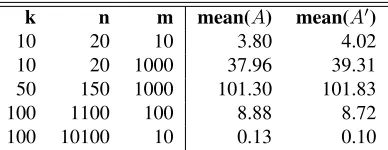
Table 1:Average over repeated calls toAandA0.
vector is being updated online. A k = 3reservoir used for the last projected vector, [-3, 2, 0], might reasonably contain two values of -1, and one value of 1.7 Represented explicitly as a vector, the reser-voir would thus be in the arrangement:
[1, -1, -1], [-1, 1, -1], or [-1, -1, 1].
These are functionally equivalent: we only need to know that one of thek= 3elements is positive.
Expected Number of Samples Traversingm con-secutive values of either1or−1in the unit stream should be thought of as seeing positive or negative mas a feature update. For a reservoir of sizek, let A(m, n, k)be the number of samples accepted when traversing the stream from positionn+ 1ton+m. A is non-deterministic: it represents the results of flippingmconsecutive coins, where each coin is in-creasingly biased towards rejection.
Rather than computingAexplicitly, which is lin-ear inm, we will instead use theexpectednumber of updates, A0(m, n, k) = E[A(m, n, k)], which can be computed in constant time. WhereH(x) is the
harmonic numberofx:8
A0(m, n, k) = n+m
X
i=n+1
k i
= k(H(n+m)−H(n))
≈ kloge(n+m n ).
For example, consider m = 30, encountered at positionn = 100, with a reservoir ofk = 10. We will then accept10 loge(130100)≈3.79samples of 1.
As the reservoir is a discrete set of bins, fractional portions of a sample are resolved by a coin flip: if a = kloge(n+nm), then accept u = dae samples with probability (a− bac), and u = bac samples
7
Other options are: three -1’s, or one -1 and two 1’s. 8Withxa positive integer,H(x) =Px
i=11/x≈loge(x)+
otherwise. These steps are found in lines 3 and 4 of Algorithm 1. See Table 1 for simulation results using a variety of parameters.
Expected Reservoir Change We now discuss how to simulate many independent updates of the same type to the reservoir counter, e.g.: five updates of 1, or three updates of -1, using a single estimate. Consider a situation in which we have a reservoir of sizekwith some current value ofs,0≤s≤k, and we wish to performuindependent updates. We de-note byUk0(s, u)the expected value of the reservoir after theseuupdates have taken place. Since a sin-gle update leads to no change with probability sk, we can write the following recurrence forUk0:
Uk0(s, u) = s kU
0
k(s, u−1) + k−s
k U
0
k(s+ 1, u−1),
with the boundary condition: for alls,Uk0(s,0) =s. Solving the above recurrence, we get that the ex-pected value of the reservoir after these updates is:
Uk0(s, u) =k+ (s−k)
1− 1
k
u
,
which can be mechanically checked via induction. The case for negative updates follows similarly (see lines 7 and 8 of Algorithm 1).
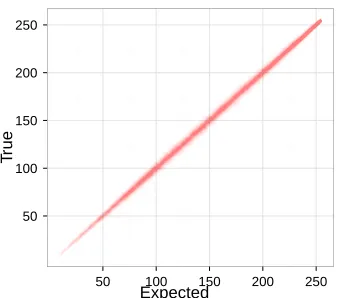
Hence, instead of simulating u independent up-dates of the same type to the reservoir, we simply update it to this expected value, where fractional up-dates are handled similarly as when estimating the number of accepts. These steps are found in lines 5 through 9 of Algorithm 1, and as seen in Fig. 2, this can give a tight estimate.
Comparison Simulation results over Zipfian dis-tributed data can be seen in Fig. 3, which shows the use of reservoir counting in Online Locality Sensi-tive Hashing (as made explicit in Algorithm 2), as compared to the method described by Van Durme and Lall (2010).
The total amount of space required when using this counting scheme isblog2(k+ 1) + 32:b reser-voirs, and a 32 bit integer to trackn. This is com-pared tob32 bit floating point values, as is standard. Note that our scheme comes away with similar lev-els of accuracy, often at half the memory cost, while requiring larger bto account for the chance of ap-proximation errors in individual reservoir counters.
Expected
T
rue
50 100 150 200 250
[image:4.612.341.510.78.227.2]50 100 150 200 250
Figure 2: Results of simulating many iterations ofU0, fork= 255, and various values ofsandu.
Algorithm 1RESERVOIRUPDATE(n, k, m, σ, s)
Parameters:
n: size of stream so far
k: size of reservoir, also maximum value ofs m: magnitude of update
σ: sign of update
s: current value of reservoir
1: ifm= 0orσ= 0then
2: Return without doing anything 3: a:=A0(m, n, k) =kloge n+nm
4: u:=daewith probabilitya− bac,bacotherwise 5: ifσ= 1 then
6: s0:=U0(s, a) =k+ (s−k) (1−1/k)u 7: else
8: s0:=U0(s, a) =s(1−1/k)u
9: Returnds0ewith probabilitys0− bs0c,bs0cotherwise
Bits.Required
Mean.Absolute
.Error
0.06 0.07 0.08 0.09 0.10 0.11 0.12
●
●
● ●
● ●
●
●
●
●
●
1000 2000 3000 4000 5000 6000 7000 8000
log2.k
● 8
●32
b
[image:4.612.312.537.289.655.2]● 64 128 192 256 512
Algorithm 2COMPUTESIGNATURE(S,k,b,p)
Parameters:
S: bit array of sizeb k: size of each reservoir
b: number of projections
p: percentage of zeros in projection,p∈[0,1]
1: Initialize b reservoirsR[1, . . . , b], each represented by alog2(k+ 1)-bit unsigned integer
2: Initializebhash functionshi(w)that map featuresw
to elements in a vector made up of−1 and1 each with proportion 1−2p, and 0 at proportionp.
3: n:= 0
4: {Processing the stream}
5: foreach feature value pair(w, m)in streamdo
6: fori:= 1tobdo
7: R[i] :=ReservoirUpdate(n, k, m, hi(w), R[i]) 8: n:=n+bm(1−p)c
9: n:=n+1with probabilitym(1−p)−bm(1−p)c
10: {Post-processing to compute signature}
11: fori:= 1. . . bdo
12: ifR[i]>k2then
13: S[i] := 1
14: else
15: S[i] := 0
3 Discussion
Time and Space While we have provided a stant time, approximate update mechanism, the con-stants involved will practically remain larger than the cost of performing single hardware addition or subtraction operations on a traditional 32-bit counter. This leads to a tradeoff in space vs. time, where a high-throughput streaming application that is not concerned with online memory requirements will not have reason to consider the developments in this article. The approach given here is motivated by cases where data is not flooding in at breakneck speed, and resource considerations are dominated by a large number of unique elements for which we are maintaining signatures. Empirically investigat-ing this tradeoff is a matter of future work.
Random Walks As we here only care for the sign of the online sum, rather than an approximation of its actual value, then it is reasonable to consider in-stead modeling the problem directly as a random walk on a linear Markov chain, with unit updates directly corresponding to forward or backward state
[image:5.612.324.526.75.118.2]-4 -3 -2 -1
0
1
2
3
Figure 4: A simple 8-state Markov chain, requiring
lg(8) = 3 bits. Dark or light states correspond to a prediction of a running sum being positive or negative. States are numerically labeled to reflect the similarity to a small bit integer data type, one that never overflows.
transitions. Assuming a fixed probability of a posi-tive versus negaposi-tive update, then in expectation the state of the chain should correspond to the sign. However if we are concerned with the global statis-tic, as we are here, then the assumption of a fixed probability update precludes the analysis of stream-ing sources that contain local irregularities.9
In distributional semantics, consider a feature stream formed by sequentially reading the n-gram resource of Brants and Franz (2006). The pair: (the dog: 3,502,485), can be viewed as a feature value pair: (leftWord=’the’: 3,502,485), with respect to online signature generation for the worddog. Rather than viewing this feature repeatedly, spread over a large corpus, the update happens just once, with large magnitude. A simple chain such as seen in Fig. 4 will be “pushed” completely to the right or the left, based on the polarity of the projection, irre-spective of previously observed updates. Reservoir Counting, representing an online uniform sample, is agnostic to the ordering of elements in the stream.
4 Conclusion
We have presented a novel approximation scheme we callReservoir Counting, motivated here by a de-sire for greater space efficiency in Online Locality Sensitive Hashing. Going beyond our results pro-vided for synthetic data, future work will explore ap-plications of this technique, such as in experiments with streaming social media like Twitter.
Acknowledgments
This work benefited from conversations with Daniel ˇStefonkoviˇc and Damianos Karakos.
[image:5.612.75.300.162.380.2]References
Dimitris Achlioptas. 2003. Database-friendly random projections: Johnson-lindenstrauss with binary coins. J. Comput. Syst. Sci., 66:671–687, June.
Shane Bergsma and Benjamin Van Durme. 2011. Learn-ing BilLearn-ingual Lexicons usLearn-ing the Visual Similarity of Labeled Web Images. In Proc. of the International Joint Conference on Artificial Intelligence (IJCAI). Rahul Bhagat and Deepak Ravichandran. 2008. Large
Scale Acquisition of Paraphrases for Learning Surface Patterns. InProc. of the Annual Meeting of the Asso-ciation for Computational Linguistics (ACL).
Thorsten Brants and Alex Franz. 2006. Web 1T 5-gram version 1.
Moses Charikar. 2002. Similarity estimation techniques from rounding algorithms. InProceedings of STOC. Michel X. Goemans and David P. Williamson. 1995.
Improved approximation algorithms for maximum cut and satisfiability problems using semidefinite pro-gramming. JACM, 42:1115–1145.
Amit Goyal, Jagadeesh Jagarlamudi, Hal Daum´e III, and Suresh Venkatasubramanian. 2010. Sketch Tech-niques for Scaling Distributional Similarity to the Web. InProceedings of the ACL Workshop on GEo-metrical Models of Natural Language Semantics. Piotr Indyk and Rajeev Motwani. 1998. Approximate
nearest neighbors: towards removing the curse of di-mensionality. InProceedings of STOC.
Ping Li, Trevor J. Hastie, and Kenneth W. Church. 2006. Very sparse random projections. In Proceedings of the 12th ACM SIGKDD international conference on Knowledge discovery and data mining, KDD ’06, pages 287–296, New York, NY, USA. ACM.
Ping Li, Kenneth W. Church, and Trevor J. Hastie. 2008. One Sketch For All: Theory and Application of Con-ditional Random Sampling. In Proc. of the Confer-ence on Advances in Neural Information Processing Systems (NIPS).
Dekang Lin, Kenneth Church, Heng Ji, Satoshi Sekine, David Yarowsky, Shane Bergsma, Kailash Patil, Emily Pitler, Rachel Lathbury, Vikram Rao, Kapil Dalwani, and Sushant Narsale. 2010. New Tools for Web-Scale N-grams. InProceedings of LREC.
Patrick Pantel, Eric Crestan, Arkady Borkovsky, Ana-Maria Popescu, and Vishnu Vyas. 2009. Web-Scale Distributional Similarity and Entity Set Expansion. In Proc. of the Conference on Empirical Methods in Nat-ural Language Processing (EMNLP).
Sasa Petrovic, Miles Osborne, and Victor Lavrenko. 2010. Streaming First Story Detection with applica-tion to Twitter. InProceedings of the Annual Meeting of the North American Association of Computational Linguistics (NAACL).
Deepak Ravichandran, Patrick Pantel, and Eduard Hovy. 2005. Randomized Algorithms and NLP: Using Lo-cality Sensitive Hash Functions for High Speed Noun Clustering. InProc. of the Annual Meeting of the As-sociation for Computational Linguistics (ACL). Benjamin Van Durme and Ashwin Lall. 2009. Streaming
Pointwise Mutual Information. InProc. of the Confer-ence on Advances in Neural Information Processing Systems (NIPS).
Benjamin Van Durme and Ashwin Lall. 2010. Online Generation of Locality Sensitive Hash Signatures. In Proc. of the Annual Meeting of the Association for Computational Linguistics (ACL).