University of Warwick institutional repository: http://go.warwick.ac.uk/wrap
A Thesis Submitted for the Degree of PhD at the University of Warwick
http://go.warwick.ac.uk/wrap/58049
This thesis is made available online and is protected by original copyright. Please scroll down to view the document itself.
i
Processes of ‘positive
multiculturalism’ in practice: an
extended case study with Warwick Arts
Centre (WAC)
Research undertaken as part of Arts and Humanities
Research Council’s (AHRC) Collaborative Doctorate Award
(CDA)
By
Rachel King
PhD Thesis
University of Warwick
School of Theatre, Performance and Cultural Policy Studies
ii
Table of Contents
List of Figures
iii
Acknowledgements
iv
Abstract
v
Chapter 1
Introduction
Overall Methodological Framework
Conceptual Framework
Locating WAC
1
27
49
102
Chapter 2
Case Study A: Creating spaces for collaboration
between WAC users
129
Chapter 3
Case Study B: Making connections across
Coventry
203
Chapter 4
Case Study C: Devising a performance for
WAC’s new Creative Space
232
Conclusion
327
Bibliography
369
Appendix 1
387
Appendix 2
388
Appendix 3
389
Appendix 4
392
Appendix 5
393
Appendix 6
394
Appendix 7
396
iii
List of Figures
Figure 1: Photograph of Warwick Arts Centre's foyer space. Copyright of WAC, date unknown. ... 1
Figure 2: Key conceptual framework of overall case study. ... 18
Figure 3: Extract from Reflective Journal: annotation of original title. ... 20
Figure 4: Final image in Shaun Tan's The Arrival (2007). ... 22
Figure 5: Journal notes - introducing research to WAC. ... 32
Figure 6: Journal notes – early stages of collaboration with WAC ... 32
Figure 7: Core participants of three case studies ... 40
Figure 8: WAC's location in sub-regions and West Midlands. ... 106
Figure 9: Map of University of Warwick campus (2009)... 109
Figure 10: Stan's Café’s Of All the People in All The World (2003) in WAC foyer. Photographs used with the permission of the Company. ... 117
Figure 11: Exterior view of WAC's Creative Space (2010). Photograph used with permission of the University of Warwick ... 123
Figure 12: Interior views of Creative Space (2009). Author’s own. ... 124
Figure 13: Y1 Aims and Research Methods. ... 131
Figure 14: Data collection methods for Audience Reception Study. ... 133
Figure 15: Journal notes - doubts concerning appropriate language. ... 137
Figure 16: Journal notes - making sense of identity. ... 141
Figure 17: Sample of participants' responses to question 'How would you describe your ethnic identity?' ... 142
Figure 18: Audience Forum 1 in WAC's Butterworth Hall bar area. Author's own... 198
Figure 19: SBB - display of pupils’ skin colour artwork ... 220
Figure 20: SBB - Prof. Abraham working with primary school pupils. ... 226
Figure 21: Devising process - experimenting in WAC's Creative Space. ... 266
Figure 22: Sample of stage plans from participants’ Creative Journals (Y3) ... 270
Figure 23: Participants' changing relationship with WAC. ... 277
Figure 24: Images of 'name-game' in progress. ... 287
Figure 25: Luggage tag from audience feedback. ... 307
Figure 26: Performance event - Steward Announcement. ... 308
Figure 27: Performance event - Dancing Game. ... 312
Figure 28: Performance event - audience member alters 'image of hope'. ... 316
Figure 29: Performance event - final 'image of hope'. ... 317
Figure 30: Case Study A-C comparison of types of 'strangers' and types of 'collaboration' ... 331
iv
Acknowledgements
I owe many thanks to the numerous people who have supported me throughout this research. Firstly, I would like to thank the AHRC for the CDA. I am grateful to staff at WAC for welcoming me, giving me their time, expertise and access to invaluable resources. In particular, I would like to thank Alan Rivett, Director of WAC, for his continual support and his generous and vibrant contributions and also Brian Bishop and Carly Mee for their cooperation, excellent advice and encouragement. I would also like to acknowledge the vital contributions made by the many research participants with whom I have worked.
v
Abstract
This thesis consists of three distinct but interconnecting case studies that took place between 2007 and 2010 in collaboration with Warwick Arts Centre (WAC), Britain’s second largest multi-arts venue. The study developed practice-led methods to investigate the dynamic interactions between notions and perceptions of ‘multiculturalism’ and ‘internationalism’ in relation to WAC’s theatre and performance programming and education activities. The first case study is a qualitative audience reception study designed to make sense of WAC’s programme in relation to multicultural and international issues. The second case study focuses on an educational outreach project that placed two local schools in collaboration with a commissioned teacher-artist and a University of Warwick academic. These encounters inspired the final case study, which made use of WAC’s newly built Creative Space as a site for a devising project with young people from nearby Coventry, culminating in a performance for an invited audience.
The thesis explores the varied complexities that frame ‘multiculturalism’ by focusing on its origins as a political concept in post-1945 Britain and its subsequent association with contemporary contentious social, political and cultural national and international issues. An analysis of the negative effects of ‘multiculturalism’ is balanced by considerations of the project’s emergent concepts: ‘hospitality’ and ‘conviviality’, which articulate the possibilities of living in diversity in more ‘positive’ terms. These paradigms reverberate throughout each case study, informing their methodologies, influencing their conceptual frameworks and placing ‘multiculturalism’ in more dynamic and relevant dimensions of pedagogical and creative practices. Each case study considers collaboration between strangers and investigates the potential of WAC as a hospitable and convivial environment. These new perspectives demonstrate the optimistic possibilities of creative and humane action for producing a ‘positive multiculturalism’.
1
CHAPTER ONE
Introduction
Welcome to Warwick Arts Centre
Response to Figure 1:
[image:7.595.132.537.208.591.2]The people arrive. The people gather. They huddle, they queue, they wait, they chat, they wonder, they wander, they lounge, they speculate, they sip, they prepare. Different people gather. Some talk together, some stand alone, some peruse the programme notes of the production they are about to see. Some hope to laugh tonight. Some hope to be moved. (Some hope it’s only on for an hour). Some chat, some babble, some debate, some listen in.
2
Some speak Mandarin. Some don’t. Some brush past each other. Some say ‘Excuse me, sorry, thanks’. Some say ‘Please have your tickets ready, this evening’s performance will begin in ten minutes’. Some greet each other. Some do not greet each other. Some rush through to catch the bus. Some arrive late and fumble for their tickets. One says to their friend ‘this is nice, isn’t it?’ One mutters to themselves about the cost of a sandwich. Different people gather. A woman; here to see the London Contemporary Dance Theatre stands at the bar. A man; here to see an Irish folk band also stands at the bar. She gets served before him. He bristles. Another stands with earphones in and eyes fixed to their mobile screen. Another, overwhelmed by the space, is guided through the foyer by a steward. Another sits, awkwardly, on a lime-green-cubed stool. Another is climbing the Arts Centre’s roof above. Another tries to balance a cappuccino on the thin arm of an orange sofa. Different people gather. Different people gather; together. Different people gather; separately.1
Figure 1 is an image from Warwick Arts Centre’s (WAC) archive of marketing materials and was one of its first publicity photographs I came across when I began this research in 2007. In a single frozen frame, it captures a dynamic flux of interactions within WAC’s expansive foyer. For potential customers of WAC, it signals that WAC is a ‘lively’ and ‘vibrant’ arts organisation. For me, as a researcher within WAC, this image made tangible the many occasions I had observed the live, ephemeral interactions between strangers in its spaces. In particular, I was drawn to the ways in which some of the bodies in the image are captured in motion, in a preternatural-like form. This image presents WAC as a space-in-process or,
1
This response was originally performed as part of a postgraduate research day for School of Theatre
and Performance Studies students at The University of Warwick, 2011. The paper was entitled
Embracing the 'Messy' in Qualitative Research: Making Sense of 'Multiculturalism' in Warwick Arts
3 as geographer Doreen Massey describes, ‘space as a simultaneity of stories-so-far’ (Massey, 2005, 9). At this particular moment in time and within this particular foyer space, these human beings exist in ‘multiplicity and simultaneity’ (Massey, 2000; 2005) each contributing to a diversity of actions in a shared co-existence, switching between collective behaviours and distinctly differing individual activities. The photograph’s blurriness came to represent for me the ‘messiness’ involved when researching a ‘real-world’ organisation. In Doing Research in the Real World, David E. Gray defines the ‘real world’ as ‘any setting where human beings come together for communication, relationships or discourse’ (Gray, 2009, 3). WAC is constituted by the attendance and presence of human beings; their very existence brings life to WAC’s foyer space. They bring their stories, fears, hopes, grievances, desires and an endless list of needs, making WAC a complex and messy place to get to know and understand.
4 perform in the main theatre. One particular mother was so overwhelmed by her first experience of being in WAC’s large foyer space that she had to be supported to her seat by a steward. Alan Rivett, Director of WAC, also shared an anecdote from one of the many occasions he had stood in the foyer, watching as audiences arrived. One evening, two major performances were taking place at the same time: The Dubliners, an Irish folk band, were performing in the concert hall (Butterworth Hall) whilst the London Contemporary Dance Theatre was performing on the main theatre stage. Rivett observed as the working class, Coventry-based Irish communities and the middle-to-upper class dance communities shared the foyer space during the interval. He noticed their social differences, marked by the way they navigated the space either with familiarity or discomfort. At first, he explained, their co-mingling was slightly awkward and frosty but, finally, after sharing a joke at the bar, Rivett noticed how the two groups began to interact with increasing ease. Each of these episodes has given me a different way of thinking about WAC and its place within the lives of those who use it. In composing this collage of responses, I have attempted to capture and review fragments of the multiple experiences, encounters and voices of others who have contributed to this research project.
5 occasions to get to another part of campus. One of my most memorable encounters happened in 2008 while playing the title role in Caryl Churchill’s
The Skriker (1994). I stood anxiously in the narrow corridors behind the café that connects the foyer space to the backstage areas and the administrative offices. I was waiting for my cue to walk through the foyer in order to enter the Studio theatre via its main doors. The wait was nauseating: I remember the infusion of end-of-the-day food and cold coffee invading the small patch of personal space I had managed to occupy in this bustling corridor. I was in costume: a black, full-length, Victorian dress with a large staff and a big black bag. My face was painted white except for charcoal lips and eyes. I was so preoccupied with last-minute line runs that I had not quite realised how ‘out of place’ I looked. One of WAC’s cafe workers was busy bringing trolleys of left-over food in and out of the narrow corridor. He passed me and then stopped himself. He looked straight at me, let out a blast of laughter and in his loud Italian accent he pointed at my whitened face and said ‘Oh, ha! You look a bit pale today darling!’ He seemed pleased with his joke and continued chuckling his way back into the kitchen. It was a relief to forget my nerves, even if only fleetingly.
The cue came and it was time to go. I walked ‘in character’ past WAC users who were sat in the café and made my way to the Studio. As I approached, I caught a friend stare before finally recognising and shouting out my name, ‘Oh! Is that you?’ I didn’t answer back, of course, and
6 travelling across space; you are altering it a little; moving it on; producing it. The relations that constitute it are being reproduced in an always slightly altered form’ (Massey, 2000, 226). In these few minutes in WAC, I had crossed paths and had random exchanges with a variety of different WAC users: University students, WAC staff, WAC customers – some strangers and some friends. These temporary interactions and unpredicted encounters, however small, were now part of WAC and part of the human beings involved. As Massey suggests, even within these small moments and across this small section of space, our movements, actions and relations had altered WAC ‘a little’ and simultaneously, by being within this place and its many spaces, WAC had changed us ‘a little’.
My experiences as both a WAC user and a University of Warwick student have inevitably shaped and affected my role as a researcher within WAC. In the prologue of The Theatre of the Urban: Youth and Schooling in Dangerous Times Kathleen Gallagher acknowledges that the research she is about to present constitutes an act of storytelling:
7 Like Gallagher, I have encountered ‘rich contexts, diverse characters and practices’ and I hope to communicate these personal and lived experiences throughout this thesis.
Focus of the Inquiry
In June 2007, I was accepted by the School of Theatre, Performance and Cultural Policy Studies, the University of Warwick and Warwick Arts Centre, UK as the doctoral researcher in a collaborative research project from October 2007-September 2010. This thesis presents an extended case study comprised of three sub-cases, each with its own focus on aspects of theatre, performance and education activities at WAC. I will introduce the nature of this research inquiry by providing details of the original plan as designed by Baz Kershaw (academic supervisor) and Alan Rivett (Director of WAC) and the ways it developed over the course of the three years. The original thesis title was:
Processes of audience reception and aesthetic adaptation in performance for a positive multiculturalism: an extended case study with Warwick Arts Centre (Kershaw and Rivett, 2007).
The original lead question for the project was:
8 The plan situated the key concepts of ‘multiculturalism’ and ‘internationalism’ within contemporary debate:
Its key problematic arises from existing interpretations of multiculturalism as a strongly contested area of political, economic, social and cultural realities in the wider European context of increasing displacement and migration. Its key intellectual issue is the utility of new ambiguities and ambivalences in conceptions of internationalism under the impact of globalisation (ibid).
9 these complex concepts were interpreted and communicated by WAC and perceived and understood by selected groups of WAC users (both regular and non-regular).
There are, however, some discernible differences between the terms ‘internationalism’ and ‘multiculturalism’ relevant to this research. Kira Kosnick argues that ‘multiculturalism tends to be more “inward looking” and concerned with territorially limited spaces such as nation-states, cities or even local neighbourhoods’ (Kosnick, 2009, 164). In contrast, ‘internationalism’ is less concerned with the configurations and manifestations of national identity and, instead, is focused on possibilities of the inter-relationships ‘between and within states’ (Ishay, 1995, xxi) and ‘beyond borders’ (Lynch, 1999, 83). Kjell Goldmann argues that ‘internationalism’ does not seek to abolish the existence of separate nation-states, rather, it invests in the notion that ‘if there is more law, organisation, exchange, and communication among states, this will reinforce peace and security’ (Goldmann, 1994, 2) as well as ‘economic well-being’ (Lynch, 1999, 83).2
As I will detail in Locating WAC, the connection between ‘internationalism’ and ‘multiculturalism’ is complicated further by the notion of
2 The desire for ‘peace’ between nations has been, and remains, a central motivation behind various
internationalist movements. For example, ‘the 1948 Convention on the Prevention and Punishment of the Crime of Genocide [and] the 1948 Universal Declaration of Human Rights’ (Linklater, 2002, 265)
were established to protect vulnerable groups following the devastation of the Second World War and
the horror of genocide perpetrated by the Nazi regime. As David Held explains such international laws
‘constitute the basis of a cosmopolitan orientation to politics and human welfare’ (Held, 2010, 55) meaning that the law attempts to recognise the ‘equal worth of human beings’ (ibid) irrespective of
10 ‘cosmopolitan’ and such tensions are relevant to both The University of Warwick and WAC. The University’s ‘Vision 2015’, for example, demonstrates its strategic commitment to ‘embedding internationalism into every area of the University’s mission’ in order to ensure its ‘global presence’ (The University of Warwick, 2011a). Internationalism, as expressed here, involves the systematic development of relations between nations so as to secure the University’s status in an increasingly globalised and competitive network of Higher Education institutions. The University’s 2015 webpage explains that this Vision is predicated on the practices of ‘cosmopolitanism’. For example, it is the University’s desire that every Warwick student ‘experiences inter-cultural learning in a cosmopolitan environment’ (The University of Warwick, 2011a). As Kosnick observes, it is worth making sense of the ‘institutions, interest groups and policy makers who mobilize cosmopolitanism for a variety of political projects’ (Kosnick, 2009, 161). For the University, engendering a thirst for ‘cosmopolitan’ curiosity and promoting the virtues of living amongst diversity and difference is coherent with its ambitions to be recognised as an internationally recognised educational institution.
11 acquired proclivity that can only be afforded by those who have access to ‘knowledge, cultural capital and education’ (Binnie et al., 2006, 8; Vertovec and Cohen, 2002) such as the ‘globe-trotting business people, aesthetes, academics, holiday-makers and medical tourists’ (Dikeç et al., 2009, 2) of the world. As Mike Featherstone explains, ‘these mobile elites, who enjoy the freedom of physical movement and communication, stand in stark contrast to those who are confined to place, whose fate is to remain located’ (Featherstone, 2002, 1). In other words, cosmopolitanism suggests access to ‘mobility’ in ways that multiculturalism does not (Molz and Gibson, 2007; Kosnick, 2009).
Whilst I raise questions about the tensions between ‘multiculturalism’, ‘internationalism’ and ‘cosmopolitanism’, these concepts share particular values that are critical to the practice-based methodologies I have deployed. Given that this CDA sought to investigate ‘positive multiculturalism’ in WAC,
the research became focused on notions of ‘conviviality’ and ‘hospitality’. As I will detail, these concepts intersect the definitions of ‘multiculturalism’, ‘internationalism’ and ‘cosmopolitanism’ by directing attention towards the ways we might live convivially amongst ‘strangers’ in the context of an increasingly heterogeneous Europe (Gilroy, 2004).3 As Kosnick suggests:
Both cosmopolitanism and multiculturalism exhibit in terms of ethics, interests and orientations a certain openness, eagerness and ability to engage with different cultural traditions and orientations that are ‘strange’ in their origin (Kosnick, 2009, 164).
12 The three case studies explore and question the differing methods and conditions that may enable an ‘openness, eagerness and ability to engage’ with difference to thrive in WAC.
The original research design placed emphasis on investigating the ‘positive’ features of these concepts in relation to three aspects of WAC’s theatre and performance-based activities: its programming, its commissioning and its education outreach work. In the first year, a multicultural audience reception study was planned which aimed to ‘develop effective feedback structures and processes mainly using low-cost digital technologies’ (Kershaw and Rivett, 2007). In the second and third year of the project, I was due to track the creative processes of a commissioned professional theatre company from the sub-regions of WAC as well as the work of commissioned individual artists working in local primary schools. It was intended that the feedback from the audience reception study would be used to inspire these creative processes ‘in response to internationalist and multiculturalist concerns’ (ibid) of the company and/or artists. Through action research-based approaches, it was envisioned that these latter activities would allow me to investigate processes of ‘aesthetic adaptation’ in practice, thereby creating a space for me to explore ‘positive multiculturalism’ in WAC.
The original plan stated that:
13 the ante on identifying achievable positive, democratic
outcomes through such dynamics (Kershaw and Rivett, 2007).
By orientating the practice around notions of the ‘positive’, it was anticipated that this collaborative research would provide WAC with constructive and progressive ways to re-consider its relationships with issues relating to ‘multiculturalism’ and ‘internationalism’. However, as the study proceeded, the original design had to be altered in response to some major practical changes which took place within WAC and also to accommodate the emergent issues which arose within the fieldwork. Methods were necessarily adapted to respond to such changes and this gave rise to a more developed research design:
Outline of Key Research Activities
Year 1 (Y1): 2007-2008
14 as well as to try to make sense of the key terms (‘multiculturalism’ and ‘internationalism’) together. These ‘forums’ were influenced by collaborative learning strategies which were used to generate discussion (Ellsworth, 2005; Freire, 1998, 2000, Monk et al., 2011, Muijs and Reynolds, 2011). In doing so, the inquiry was directed towards practice-led and pedagogically oriented methods and I developed such methods in Y3.
Year 2 (Y2): 2008-2009
15 Church of England school in deprived outskirts of Coventry and, the other, a large multi-ethnic, multi-faith community school in the deprived inner city of Coventry. Funded mainly by the Wellcome Trust, this science-based project focused on learning about the human body through arts-based pedagogies. I was involved in observing the sessions in both schools, interviewing teachers, children, the teacher-artist and WAC’s Education department to see how issues of ‘multiculturalism’ resonated with the project’s mission and methods. This project also came to inspire aspects of the practice-led research in Y3.
Year 3 (Y3): 2009-2010
Y3's methodological strategies diverged considerably from the original plan. This arose in response to the knowledge gained so far in the study and also in light of a significant change made to WAC’s building. In 2007, WAC’s Butterworth Hall was closed for a major £8 million refurbishment. As part of this transformation, Rivett requested that a ‘Creative Space’ be built alongside the new development. This space was designed as an open ‘rehearsal room’ for professional artists and other WAC users (Rivett, 2009). The space was installed with minimal technical equipment and without any formal seating and opened in May 2009.4 In September 2009 I began working as a quasi-commissioned theatre practitioner and educator with a group of ten culturally diverse secondary school students (aged 15-18) from
4This Creative Space was officially named the ‘Helen Martin Studio’ in November 2010 after one of
16 Coventry who had little or no previous experience of WAC.5 I also appointed four international postgraduate students from University of Warwick to work as co-collaborators and practitioners. There was one PhD student from the Institute of Education, one from the MA in Drama and Theatre Education and two students studying the MA in International Performance Research.6 We worked together in both the young people’s school space and in WAC’s new studio space over twelve workshops (around 27 hours in total contact time). During the workshop series we used a variety of devising strategies in which we explored issues relating to ‘migration’, ‘being a stranger’. This culminated in a twenty minute ‘work-in-progress’ presentation to an invited audience in the Creative Space on 6th Dec 2009.7The performance used a promenade-like arrangement of the open space that framed the audience as ‘new arrivals’ and the young people as ‘hosts’ who guided the audience around the space. The performance was followed by an informal discussion between audience members and the student participants.
Re-focusing the conceptual framework
In Case Study Research in Practice, Helen Simons explains that ‘progressive focusing’ is an integral part of case study research. Simons describes it as a ‘process of refining issues once in the field’ (Simons, 2009, 33) and suggests that it ‘is a useful concept in an open or emergent design where the most significant issues may not be known in advance’ (ibid). Robert E Stake also highlights the necessary adaptations that are required in the process of conducting case study research:
5
There were originally fifteen young people but some dropped out or were not able to continue for personal reasons. I will provide details of the group in Case Study C.
6
I will describe the students and their courses in more detail in Case Study C. 7
17 Etic issues are the researcher’s issues, sometimes the
issues of a larger research community, colleagues and writers … issue statements may not fit the case circumstances well and need repair. Issues evolve. And emic issues emerge. These are the issues of the actors, the people who belong to the case. These are issues from the inside (Stake, 1995, 20).
In this study, the conceptual framework was always in negotiation and was contingent on the development of ‘emic’ issues within the research field. Not only is such ‘emergence’ a key feature of case study research but also practice-led research which, as Estelle Barrett and Barbara Bolt explain, ‘may draw on conventional research methods and practices but is emergent, not completely pre-determined or fixed’ (Barrett and Bolt, 2007, 198). Given that an aspiration of the research was to create spaces for the identification and development of something called ‘positive multiculturalism’, ‘emic’ or
emergent issues would be central to my conceptualisation of a positive
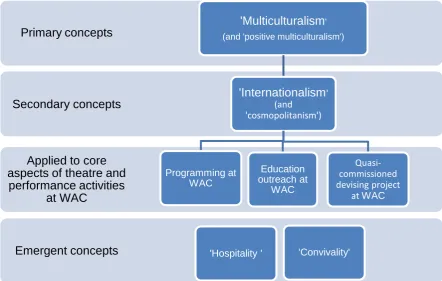
18 Figure 2: Key conceptual framework of overall case study.
Further to this, the two core etic issues of this study, ‘multiculturalism’ and ‘internationalism’, shifted in significance throughout the project. ‘Internationalism’ manifested as the secondary concept in the framework. As part of the research, I had to identify gaps or ambiguities in the research field and, within the first three months of Y1 after attending senior management meetings in WAC and observing and tracking its programming decisions and marketing materials, I had noticed that WAC used ‘internationalism’ far more frequently and confidently than ‘multiculturalism’. Furthermore, the term ‘cosmopolitanism’ frequently appeared alongside these primary and secondary concepts, which I will return to in the section
Emergent concepts Applied to core aspects of theatre and performance activities
at WAC Secondaryconcepts
Primaryconcepts 'Multiculturalism
' (and 'positive multiculturalism')
'Internationalism' (and
'cosmopolitanism')
Programming at WAC
'Hospitality '
Education outreach at
WAC
Quasi-commissioned devising project
at WAC
19 Locating WAC in this Introduction.8 ‘Multiculturalism’ was never directly
mentioned. Instead, in WAC’s Future Plan 2007-11, synonyms such as ‘widening participation’ ‘audience diversity’ and programming for ‘contemporary’ issues were used. For example, in the following extract, WAC describes its aim to increase cultural diversity amongst its audiences:
We will broaden engagement with the artistic programme by audiences and participants, with specific attention to attracting members of those communities under-represented in the current audience, while partnering the University in its widening participation strategies (Warwick Arts Centre, 2007).
This document analysis allowed me to check WAC’s ‘public face’ and marketing material against what I was experiencing, witnessing and observing as a researcher. Whilst it is evident that WAC was interested in issues relating to ‘multiculturalism’, in this instance, it had found alternative ways to address such concerns. Therefore, by re-positioning ‘multiculturalism’ as the primary focus of the research, I was able to pursue WAC’s ambivalent relationship with the concept. Nevertheless, ‘internationalism’ remained a prominent term throughout the study and I was interested in the ways in which these two terms interacted with, complemented and contradicted one another in the context of WAC.
Towards the end of my first year of the fieldwork, my study of parallel theoretical perspectives on ‘multiculturalism’ had made me aware of its controversial nature within political discourse, governmental policy and public
8 This thesis addresses the notion of ‘cosmopolitanism’ in relation to specific issues that emerged in
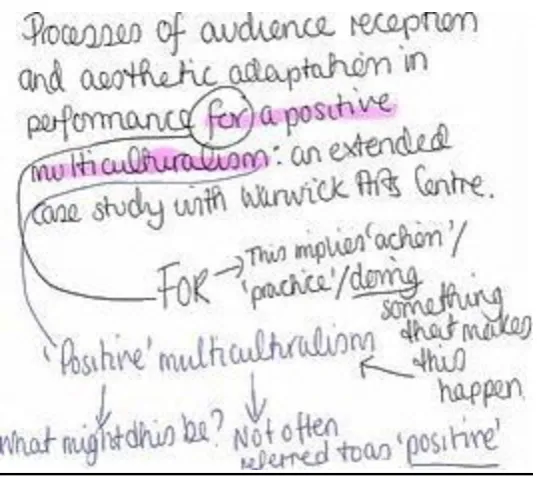
20 debate (Gilroy, 2004; Modood, 2007; Sen, 2007; Malik, 2009). I had also encountered how politically sensitive it was through my first-hand experience of using the term within the research field. This learning had made me question the ways in which ‘multiculturalism’ might be re-imagined in more positive terms. The following extract is taken from one of my reflective journals at this stage of the research and it shows the initial process of re-configuring the epistemological framework of the research by questioning the notion of ‘positive multiculturalism’ in the original title9:
Figure 3: Extract from Reflective Journal: annotation of original title.
By this time, it had become apparent that the commissioning project planned for Y2 was no longer viable. As shown above, I wanted to use new practice-led methods to bring ‘positive multiculturalism’ into action within WAC. Furthermore, given my burgeoning experience in both devising and performing in fledgling theatre companies as well as my recent profile as a freelance drama and theatre practitioner, I felt, intuitively, that drama and
21 theatre-based pedagogies might enable such practice-led explorations as well as fulfilling Kershaw and Rivett’s desire to open up a space for ‘experimentation, language play, negotiation and refreshed identities as a basis for new types of conviviality’ (Kershaw and Rivett, 2007). It was through such methods that the notions of ‘conviviality’ and latterly, ‘hospitality’ came into focus. In order to situate both terms within this study, I will give a brief outline of the key moments in the field study which led to their emergence. Following this, I will give details of the ways the ideas underpinning these terms have informed the analysis of each case study.
Emergent concepts and emergent methods
There were two main stimuli which informed the exploration and creation of ‘convivial’ spaces within the research field. In After Empire: melancholia or convivial culture? Paul Gilroy observes that the emergence of ‘convivial culture’ in Europe has offset the feelings of ‘postcolonial melancholia’ which had begun to characterise postcolonial countries such as Britain (Gilroy, 2004). For Gilroy, ‘conviviality’ offers a new and more positive way of interpreting both ‘multiculturalism’ and ‘cosmopolitanism’ (ibid, 65). His use of ‘conviviality’ provided a theoretical reference point for this research and the following provocation was crucial in shaping my conceptual and methodological framework:
22
to the unfamiliar without being fearful or hostile
[emphasis mine] (Gilroy, 2004, 3).
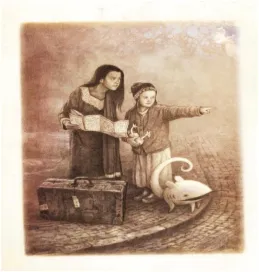
[image:28.595.186.446.426.699.2]Gilroy draws attention to the ‘ordinary multiculturalism that distinguishes us and orients our hopes for a better country’ (Gilroy, 2004, xi) and, in particular, he focuses on examples from Britain’s conurbations (mainly London) in which ‘the processes of cohabitation and interaction’ have ‘made multiculture an ordinary feature of social life’ (ibid). Within such urban spaces, Gilroy argues, there are signs of Britain’s ‘ability to live with alterity without becoming anxious, fearful, or violent’ (ibid). For me, this hopeful notion of convivial living resonates with the final image of Shaun Tan’s graphic novel The Arrival (Tan, 2007) which became the second critical influence of the study and served as a key devising stimulus in Y3 when working with the young people:
23 Using his idiosyncratic style of acute detail and magic realism, Tan tracks the journey of a man leaving his family and home to find work in a foreign land. We follow the man as he moves through strange worlds; with looming dragon tails overhead and exaggerated buildings imposing themselves on him as he encounters the unfamiliar. He meets other migrants, each
with their own tragic stories of displacement. Eventually, he begins to settle in his new world and his wife and daughter come to join him. In the final image of this epic tale, his
daughter, a recent migrant and settler into this new place, now helps this new arrival, who is shown above to be lost and with a map in hand. The young girl smiles as she directs the newcomer, showing her the way. I suggest that, in this image, Tan makes a deliberate yet subtle choice to pierce the murky browns and oppressive greys used so far in the book. In the top right hand corner of the image, a blue sky seems to be breaking through the insipid sepia, rupturing it for the first time. For me, Tan’s image offers another version of ‘conviviality’. It hints at the possibility of ‘dwelling comfortably in proximity to the unfamiliar without being fearful or hostile’ (Gilroy, 2004, 3). Finding ways to create and open up spaces for ‘convivial interaction’ and collaboration between strangers became a central theme of the three years of the study.
24 unfamiliar with WAC and that my collaborators and I were unfamiliar with their school in Coventry, we started to connect Tan’s story with our own localised journeys to these unfamiliar places. We also observed and re-performed the different kinds of social interactions and behaviours often exhibited when encountering new spaces and other strangers. Informed by this, our promenade performance event attempted to take the audience on different journeys around the space, framing them interchangeably as ‘strangers’, ‘new arrivals’, ‘guests’ and, finally, as ‘friends’ (explored in detail in Case Study C). Since completing and analysing this practice-led research and in light of my subsequent theoretical readings into notions of hospitality, I have revisited the previous two case studies and retrospectively applied this new learning to the findings.
25 with the audience members in Y1 and the young people in Y3 in two different spaces in WAC. In these case studies, I will analyse the methods and strategies used to enable both groups of research participants to move beyond the ‘host/guest’ binary and towards more negotiated, inclusive and convivial relationships.
26 Case Study A: How did aspects of ‘positive multiculturalism’ emerge through an audience reception study with a group of regular, culturally diverse WAC users?
Case Study B: How did aspects of ‘positive multiculturalism’ emerge in WAC’s educational outreach project Skin, Blood and Bone?
Case Study C: How did aspects of ‘positive multiculturalism’ emerge in the devising project and performance event in WAC’s newly built Creative Space Studio?
27 multiculturalism’. This thesis is an articulation of these different epistemological approaches and their potential ontologies.
Overall methodological framework
Introduction
Each sub-case will describe and analyse the specific research methods used to generate and collect data. In this section, I will outline the overall epistemological and methodological framework that enabled these methods to develop. In this study, the methods did not simply serve as a means of gathering information about WAC. As the fieldwork progressed, the epistemological framework opened out to include more practice-led and pedagogically oriented methods and these different practices and pedagogies played an integral role in the exploration and creation of different modes of ‘positive multiculturalism’ within WAC.
28 Yvonna S. Lincoln explain, ‘qualitative researchers deploy a wide range of interconnected methods, hoping always to get a better fix on the subject matter at hand’ (Denzin and Lincoln, 2000, 2). They go on to identify the qualitative researcher as a ‘bricoleur’ or ‘craftsman’ who organises multiple methods ‘ranging from interviewing to observing, to interpreting personal and historical documents, to intensive self-reflection and introspection’ (ibid). I also participated directly in the research field, developing my own practice as a research-facilitator in order to help make sense of the ‘dynamic interaction between notions and perceptions of multiculturalism and internationalism’ (Kershaw and Rivett, 2007) in WAC. In The Encyclopaedia of Case Study Research (Mills et al., 2010), David Wicks describes the methodological approach adopted by the ‘bricoleur’:
It has a practical application in studying complex phenomena, where researchers’ interactions with their subjects, the possibility of multiple realities, and the unforeseen directions research can take are embraced by an approach to research that can follow a number of different paths, not all of which can be planned for in advance of research being conducted (Wicks in Mills et al., 2010, 60).
29 gaining knowledge is part of an unfolding process of emergence, reflection and reiterative action.
This process of reiteration was particularly relevant to Y3’s devising project. The learning which took place in Y1 and Y2 fed into the research design for Y3. Such strategies are integral to Donald A. Schön’s notion of the reflective practitioner (Schön, 1995) who argues that practice is a form of experiential learning and by reflecting on such practice, the researcher discovers new ways of knowing. As part of this process of reflection, I kept a series of reflective journals which not only served as an aid to record field notes but, more critically, enabled me to continually keep track of my research practice as it evolved. I include extracts from these journals in the thesis to capture this process of questioning and ‘reflecting in action’ (Schön, 1995). Given that I was researching issues relating to ‘multiculturalism’ I argue that the reflective journals were paramount to managing the ethical considerations of the project. I was able to question my own thoughts and responses and challenge the methodological choices in relation to the emergent issues in the fieldwork.
Following on from this, I have identified two core features of the research design that affected and shaped the methodological and epistemological framework:
Collaborating with WAC
30 Collaborating with WAC
According to the AHRC, one of the core advantages of the CDA partnership is that the researcher is able to ‘gain first-hand experience of work outside an academic environment’ (Bakhshi et al., 2008, 21). Furthermore, the collaborating organisation has agreed to ‘provide access to resources, knowledge and expertise that might not otherwise be available’ (ibid). In the first year of the project the main focus was on establishing ethnographic strategies that would enable me to ‘get to know’ WAC as a participant observer. Participant-observation enables the researcher to engage in a more direct, proximate relationship with the research subjects or research site. I will outline some of the methods used to enable this collaboration and some of the problematics involved in working with a ‘real-life’ organisation.
From October to December in 2007, I was more of an observer at
31 WAC users. I attended WAC productions in the Autumn/Winter season 2007 where I was simultaneously ‘observer’ as researcher and ‘observer’ as WAC audience member. I would watch the audiences as much as I was watching the productions, observing their reactions, looking and listening during the interval and afterwards in the foyer. The shift towards being more of a ‘participant’ researcher in WAC only began to happen when I started to devise and conduct the audience reception study. In fact, throughout the three years of the study, I was constantly negotiating my role as ‘participant-observer’, alternating from one mode to the other depending on what was most appropriate for the research. I will focus on two particular events that proved to be highly significant in developing my collaborative relationship with WAC.
32 Figure 5: Journal notes - introducing research to WAC.
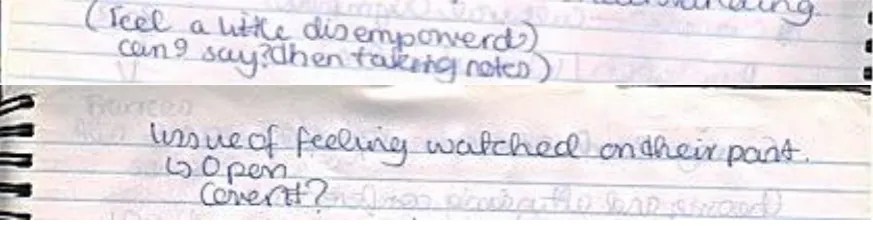
As is shown, I crossed out ‘well’, wincing at my mistake. I instantly regretted my explanation because ‘how well’ suggests that I was there to ‘assess’ and ‘evaluate’ rather than to ‘explore’ and ‘question’ WAC’s relationship with issues of ‘multiculturalism’ and ‘internationalism’. I was worried that I had potentially alienated the staff as is shown by my comment: ‘nervous response to me’. There were further concerns:
Figure 6: Journal notes – early stages of collaboration with WAC
I wanted to know:
Am I allowed to record their conversational exchanges that occur during the meeting?
How much do the other members of WAC staff already know about why I’m doing this research?
[image:38.595.114.551.421.534.2]33 It is evident that I felt self-conscious about my role as ‘researcher’ in WAC and that I was questioning the ‘ethics’ involved in observing rather than explicitly participating in such a meeting. As Simons explains ‘through observing, you can tell if you are welcome, who is anxious, who the key players are in the informal structure, and whether there are any unspoken rules’ (Simons, 2009, 55). In this case, I had been invited to ‘listen in’ on their programming meeting but since this was the first time I had ever met most of the members of staff, we had not yet established trust amongst us. This led to two conflicting issues. On the one hand, I felt ‘disempowered’. This was because I was uncertain about my role within that meeting, leading me to question if I should talk and/or take notes. On the other hand, I was also concerned that some of the staff members were uncomfortable with me being part of the meeting.
Following this, I met with the Acting Head of Marketing (AHM) to begin planning the audience reception study. Our meeting exposed a mutual misunderstanding about the project’s research aims and methods. I will describe some of the emergent points:
On hearing that I intended to invited a ‘culturally diverse’ group of WAC users to participate in the research, the meeting AHM presented me with some Arts Council England (ACE) research done in 2003, which investigated:
34 The AHM wanted to know in what ways my research was related to this ACE initiative and if this research would be responding directly to such policies. At the time, I was unaware of this Arts Council research and was unable to effectively respond to this.
The AHM also raised her concern about the focus/feedback groups, explaining that doing ‘focus group’ work was a specialist skill that required specific training and suggested that the Arts Council may have companies that they would recommend for support.
She asked questions about the budget for this project. She suggested that the audience members should be given further incentives than just free tickets, suggesting that all travel expenses needed to be paid, and refreshments provided before/after the shows. She said that focus groups are often offered money (£20 per hour of their time).
She suggested that WAC could send an e-flyer out to customers to advertise the project but this would have to be prepared by me and put in as a proposal to the marketing team so that they can make time for this task. She stressed that the planning needed for this was complex and I needed to give ‘timelines’ in advance to the marketing team.
35 agendas were in tension with one another. As the AHM of WAC, she was concerned about the logistics of the project and wanted to ensure that there was an efficient strategy in operation. Her priority was to guarantee WAC
customers a positive experience and therefore her concerns were legitimate. Since the plan for the audience reception study was only in its embryonic form, it was completely possible for some of its aims and methods to be challenged.
However, the misunderstanding arose because she had thought that I wanted to deploy an existing approach to audience research, whereas, I was hoping to evolve more explorative methods that would enable me to understand WAC and its relationships with issues of ‘multiculturalism’ and ‘internationalism’ from a range of alternative perspectives. As was stated in the original plan, I was interested in capturing the ‘dynamic interactions between the notions and perceptions of multiculturalism and internationalism’ (Kershaw and Rivett, 2007). This reception study was not seeking to address the audience demographics of WAC’s ‘non-culturally and culturally diverse products’ which the ACE research had done. Further to this, the project did not aim to carry out conventional ‘focus group’ research and, instead, intended to use ‘feedback groups’ which later evolved into live ‘Audience Forums’.
36 served to strengthen my own grasp of the epistemology of the research. I realised that in order for WAC staff to have trust in the research, I needed to make explicit the ‘exploratory’ nature of the research. They needed a more specific briefing on what the research project was trying to do, particularly for those members of staff who were likely to be involved in the project. Therefore, in November 2007 I was invited by Rivett to formally introduce my research by giving a verbal presentation to senior and middle management at WAC. This was crucial to the ‘process of building rapport’, as mentioned earlier (DeWalt and DeWalt, 2002, 35). I outlined the research aims and was open about the problematics of the research. I specifically mentioned that I was ‘feeling my way through’ the research, using practice-led research methods. I also asked staff for their expertise and input. This was all part of the process of gaining their trust and demonstrating that I was there as collaborator as well as a critical friend and researcher.
37 and non-academic organisation. The AHRC explain that ‘novelty is created when people with different knowledge, skills, competences, incentives and values come together in new combinations’ (Bakhshi et al., 2008, 8). Collaboration between strangers became a common feature of the three case studies. The Audience Forums in Y1, the SBB project in Y2, and the devising project in Y3 each focused on different types of collaboration between diverse groups and individuals who had not previously met.
As explained earlier, there was an expectation that this collaborative project would generate bespoke positive and achievable outcomes for WAC. I attempted, as far as possible, to connect the research inquiry with issues relating to WAC’s Future Plan 2007-11. I must stress that this was not a goal-driven research project and WAC did not expect me to follow its Future Plan. Rather, it acted as a useful reminder of WAC’s mission statement and ethos which, in turn, provided me with some guiding principles when conducting the research. In this document, WAC stresses the importance of developing its audience relationships with both regular and new WAC users and aims to do this by:
Continuing to develop useful dialogue with existing audiences which develops trust and loyalty
Increasing awareness of and involvement in WAC’s education programme
Developing art-form specific initiatives relating to widening participation are supported
38 According to this, building ‘dialogue, trust and loyalty’ are deemed as the key components to nurturing their relationships with existing audiences. Furthermore, ‘increasing involvement in their education programme’ and ‘outreach work’ is considered critical for attracting new audiences. I attempted to respond to these concerns. In Y1, I hoped that the Audience Forums would offer WAC a new and positive way to ‘foster dialogue’ between audience members and the centre. In Y3, I hoped that the final project in WAC’s new studio would bring existing audience members into convivial interaction with new members.
Ernest T. Stringer explains that action research often ‘incorporates
actions that attempt to resolve the problem being investigated’ (Stringer,
39 parties. When WAC’s financial restrictions meant that the Y2 commissioning project could no longer take place, I adapted the research design to accommodate such changes. Similarly, WAC granted me access to their studio space to be used as a research site in the final year. This flexibility and cooperation were key conditions of this exploratory research study and I will develop this further in Case Study C.
Researching issues relating to ‘multiculturalism’ in WAC
At the beginning of this chapter, I described WAC as a complex place to research because it is a ‘real-life’ organisation and is always in a process of flux and change. There may be aspects of its operations that are relatively stable and predictable. Its box office and café, for example, are run according to a fairly regular timetable and many of its tasks are carried out by a regular group of staff members who, presumably, follow particular spatial patterns and temporal rhythms from one day to the next. However, as a public space which welcomes over 300,000 visitors every year, it invites any number of thoughts, behaviours and interactions into its spaces at different times. These incoming activities and practices can never be fully known or measured. In After Method: mess in social science research, John Law proposes that:
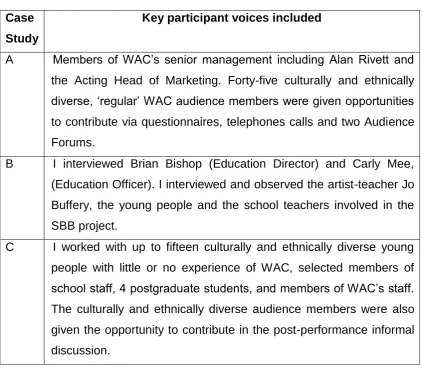
40 Given that the original lead question was interested in ‘the dynamic interactions between perceptions and notions of multiculturalism and internationalism’, I argue that this research inquiry was epistemologically framed by notions of flux and messiness. In response to this, this thesis presents multiple cases, using multiple perspectives within multiple contexts in WAC. In an attempt to capture the multiplicity of voices within WAC, each of the three case studies invited the qualitative contributions of selected groups of WAC staff and regular or first time WAC users10:
Figure 7: Core participants of three case studies
Case Study
Key participant voices included
A Members of WAC’s senior management including Alan Rivett and the Acting Head of Marketing. Forty-five culturally and ethnically diverse, ‘regular’ WAC audience members were given opportunities to contribute via questionnaires, telephones calls and two Audience Forums.
B I interviewed Brian Bishop (Education Director) and Carly Mee, (Education Officer). I interviewed and observed the artist-teacher Jo Buffery, the young people and the school teachers involved in the SBB project.
C I worked with up to fifteen culturally and ethnically diverse young people with little or no experience of WAC, selected members of school staff, 4 postgraduate students, and members of WAC’s staff. The culturally and ethnically diverse audience members were also given the opportunity to contribute in the post-performance informal discussion.
10
41 In order to make the research inquiry more democratic, I sought the perspectives of those in positions of managerial power within WAC and also those who had never had the opportunity to visit WAC, despite living in Coventry. Crucially, the Audience Forums in Y1 and the devising project in Y3 created spaces for these ‘multiple voices’ to come together in interaction and polyvocal exchange. I attempted to explore ‘conviviality’ in practice using distinct pedagogic strategies, within contrasting sites and producing divergent outcomes (the forums produced two ninety minute discussions and the devising project produced a new performance event). These processes were underpinned by a relational methodological approach which embraced the messiness and complexity of the social encounter by establishing spaces in which ‘notions and perceptions of multiculturalism and internationalism’ (Kershaw and Rivett, 2007) were explored through collaborative learning processes. In Case Studies A and C, therefore, I am interested in the active
role the facilitation techniques played in imbuing these WAC users with experiences relevant to the themes we were exploring. In Case Study B, I will analyse the strategies deployed by WAC’s Education department to encourage collaboration amongst strangers.
Ethical considerations
42 concepts alongside, not despite, its participants. Issues relating to the ‘practice of ethics’ (ibid), therefore, were not simply a logistical requirement, but integral to the study’s exploration of, in particular, multiculturalism. Whilst a broad outline of ethical considerations are given below, discussions relating to the ethical engagement of participants in the inquiry’s generation of knowledge are interwoven – both implicitly and explicitly – throughout the thesis.
Because this study was conceived as a collaborative research project of which WAC was a major participant, the Arts Centre had granted me access to a range of administrative and historical documents relating to the Arts Centre. I was also given permission to interview staff members as and when I deemed it necessary. The WAC interviewees cited directly by this thesis are Alan Rivett, Brian Bishop, Carly Mee and Jo Buffery.11 In order to
ensure that WAC’s institutional backing was substantiated by the personal
approval of the individuals to whom I had spoken, each one was contacted and given the opportunity to review the relevant extracts of recorded interview used in the thesis. This gave them a chance to edit, rephrase or withdraw their comments, had they considered it necessary. Another member of staff, who was the Acting Head of Marketing and helped to conduct the audience reception study, has since left WAC. She has, therefore, been given a pseudonym of AHM when discussed in relation to our meetings.
11
43 Case Study A: participants
From the very beginning of the recruitment process, it was made explicit to all forty-five participants in the audience reception study that this was a research project and that both their written and spoken feedback might feature in the final thesis. I continued to remind participants of this fact and sought further permission from them at specific moments in the project, particularly those in which their views and opinions might directly contribute to the research. The telephone interviews, for instance, were recorded with participants’ full knowledge and agreement – reaffirming the permissions sought at the outset of the project. Furthermore, the research aims underpinning the Audience Forums, which were attended by a smaller constituency of sixteen members, were also made clear, and further permission was sought to record the proceedings and to use and publish their feedback within the thesis. None of the participants are named and, in the images used, I have blurred their faces to ensure anonymity.
Case Study B: participants
In advance of Y2’s research beginning, I sought and received a clearance from the Criminal Records Bureau (CRB) formally authorising my ability to conduct work with a group of young people. Skin, Blood and Bone
44 participating adults were recorded with their expressed permission. In keeping with the protocol established with WAC staff members, Jo Buffery, the teacher artist, was given the opportunity to review quotations taken from my interviews with her. A small number of photographs from the SBB process are presented in Case Study B. These were given to me by WAC Education, which had already sought permission from the schools to use the materials.
Case Study C: participants
The school and young people were all notified in advance of the project beginning that this was a piece of research with WAC, meaning that sessions would be recorded and that their participation would inform my research. Furthermore, the lead schoolteacher on the project asked the young people to seek written permission from their parents before beginning the project. All names have been replaced with pseudonyms and I have been granted permission to use photographs on the understanding that I pixilate their faces so that the young people are unidentifiable. Whilst these images are less illustrative than they might have been, I have chosen use them to add visual interest where appropriate.
45 my evidence gathering. Given that I was working with young people, I was not merely a researcher focused exclusively on research, but mindful of the more immediate role I played in safeguarding the young people. It should be noted that, supporting this priority, there was a member of the school staff present in the workshops and, in the later stages, postgraduate collaborators, who supported the process as well as contributed directly to the research inquiry.
Case Study C: audience members
A significant oversight during the performance-event stage of Case Study C was the failure to consult audience members on whether it would be permissible to present video footage or photographs of the event alongside this thesis. In light of this, the photographs used to support my analysis of Case Study C have been digitally altered so that the participants are unidentifiable. This means that readers will get a sense of the spatial dynamics of the performance.
Research-specific ethical considerations
46 engagement with the research process and its relevant concepts made me increasingly conscious of the pitfalls of essentialism and more ‘inclusive’ methods were introduced in an attempt to circumvent this.
Another emergent ethical consideration was the extent to which participants actively partook in the process of research. During Case Study A, I felt the need to de-centralise my role as researcher and maximise the opportunity for different groups of ethnically and culturally diverse WAC users to contribute. As stated above, this began with a reconsideration of my questionnaire design, but grew to incorporate more dialogic approaches (e.g. Audience Forums) to exploring the study’s key concepts. In this sense, my engagement with ethical principles within the epistemological framework gave rise to more inclusive methods of implicating participants within the research. Allowing principles of ‘positive multiculturalism’ as well as other emergent concepts to shape the research process had a definitive impact on Case Study C. This phase of the research was not a simple act of evidence gathering, but a pedagogical process aimed at enabling participants’ inclusion in ways that both mirrored and shaped the inquiry’s emergent concepts of conviviality and hospitality.
Overview of thesis
49
Conceptual Framework
A high degree of racial/ethnic/religious mix in its principal cities will be the norm in twenty-first century Europe, and will characterise its national economic, cultural and political life (Modood, 2007, 4).
We need to know what sorts of insight and reflection might actually help increasingly differentiated societies and anxious individuals to cope successfully with the challenges involved in dwelling comfortably in proximity to the unfamiliar without being fearful or hostile (Gilroy, 2004, 3).
If, as Tariq Modood asserts, the populations of twenty-first century European cities are heterogeneous, how do we, as Gilroy deliberates, ‘cope successfully’ with such diversity? Given that this collaborative research is focused on exploring the possible manifestations of ‘positive
multiculturalism’ in the context of WAC, I have investigated the ways WAC might be considered as a site of progressive ‘hospitality’ and even ‘conviviality’ within its regional, national and international communities. In a reiterative response to the questions raised in the following three case studies of this thesis, this Conceptual Framework foregrounds the interrelationships between ‘multiculturalism’, ‘positive multiculturalism’,
‘hospitality’ and ‘conviviality’ in WAC by aiming to make sense of them in the wider British context.
50 hospitality (Derrida 1999, 2000, 2001, 2005; Derrida and Dufourmantelle, 2000) and his influence on a range of researchers concerned with migration and multicultural living (Ahmed, 2000; Dikeç 2002; 2009; Lashley et al., 2007; Molz and Gibson, 2007; Still, 2010; Kearney and Semonovitch, 2011; Yegenoglu, 2012). This framework is comprised of two main parts:
Part 1: Making sense of British multiculturalism
- The emergence of multiculturalism in post-Second World War Britain
- Contesting multiculturalism in twenty-first century Britain
- Strangers meeting: locating positive multiculturalism in
twenty-first century Britain
Part 2: Making sense of multiculturalism in British arts and
cultural policies and practices
- From ‘ignoring’ difference to ‘navigating difference’
- Opening up shared spaces: reflecting on the practices of
the Lyric Hammersmith and Contact Theatre, Manchester