Original citation:
Bucher, Silke V., Chreim, Samia, Langley, Ann and Reay, Trish. (2016) Contestation about collaboration : discursive boundary work among professions. Organization Studies, 37 (4). pp. 497-522.
Permanent WRAP URL:
http://wrap.warwick.ac.uk/98748
Copyright and reuse:
The Warwick Research Archive Portal (WRAP) makes this work by researchers of the University of Warwick available open access under the following conditions. Copyright © and all moral rights to the version of the paper presented here belong to the individual author(s) and/or other copyright owners. To the extent reasonable and practicable the material made available in WRAP has been checked for eligibility before being made available.
Copies of full items can be used for personal research or study, educational, or not-for profit purposes without prior permission or charge. Provided that the authors, title and full bibliographic details are credited, a hyperlink and/or URL is given for the original metadata page and the content is not changed in any way.
Publisher’s statement:
Copyright © The Author(s) 2016. Reprinted by permission of SAGE Publications.
Published version: http://dx.doi.org/10.1177/0170840615622067
A note on versions:
The version presented here may differ from the published version or, version of record, if you wish to cite this item you are advised to consult the publisher’s version. Please see the ‘permanent WRAP url’ above for details on accessing the published version and note that access may require a subscription.
Contestation about Collaboration:
Discursive Boundary Work among Professions
Silke Bucher, HEC Montreal
Ann Langley, HEC Montreal
Samia Chreim, University of Ottawa
Trish Reay, University of Alberta
Contestation about Collaboration:
Discursive Boundary Work among Professions
Abstract
We examine how professions responded to a potential change in jurisdictional boundaries by
analyzing the written submissions of five professional associations in reaction to a government
proposal to strengthen interprofessional collaboration, relating these responses to the
professions´ field positions. We identify four foci for framing used by the professions,
represented by their professional associations, to discursively develop their boundary claims: (1)
framing of the issue of interprofessional collaboration (that we call issue framing), (2) framing of
justifications for favored solutions (that we call justifying), (3) framing of the profession’s own
identity (that we call self-casting), and (4) framing of other professions’ identities (that we call
altercasting). We find that professions employed these foci differently depending on two
dimensions of their field positions – status and centrality. Our study contributes to the literature
by identifying distinctive ways through which the foci for framing may be mobilized in
situations of boundary contestation, and by theorizing how field position in terms of status and
centrality influence actors’ framing strategies.
Keywords
Introduction
Professions engage in boundary work (Gieryn, 1983) to maintain, change or broaden their
practice domains. Boundaries between professions are negotiated (Thomas & Hewitt, 2011) and
the stakes are high: Boundaries define a profession´s access to material and non-material
resources such as power, status, and remuneration (Abbott, 1988). While boundary work
between professions can occur at the individual or organizational level, our focus here is on the
field level (DiMaggio & Powell, 1983; Fligstein & McAdam, 2011). Fields are defined as the set
of “organizations that, in the aggregate, constitute a recognized area of institutional life”
(DiMaggio & Powell, 1983, p. 148); they span diverse constituents – macro-actors such as
government, professional associations, regulatory agencies, suppliers, and consumers. They are
also generally stratified, with some actors occupying higher or lower status or more or less
central “field positions” than others (Abbott, 1988; Leblebici, Salancik, Copay, & King, 1991).
A number of studies have explored the strategies that professions employ in their attempts
to construct, defend or contest professional boundaries (Abbott, 1988; Allen, 2000; Lawrence,
2004; Suddaby & Greenwood, 2005) either in ongoing work or in response to particular events,
and scholars have suggested that higher status professions tend to defend existing boundaries
while lower status professions strive to change them (e.g., Abbott, 1988; Battilana, 2011).
However, we currently lack a systematic account of how professions discursively construct their
boundaries, and in particular how differences in professions’ field positions influence the use of
different discursive strategies in response to events that raise questions about existing boundaries
(Battilana, 2011; Lockett, Currie, Finn, Martin, & Waring, 2014).
A focus on the discursive manifestations of professions’ boundary work in relation to field
of their negotiating and positioning with government and other field actors through the creation
and distribution of official documents. A deeper understanding of how field positions are
reflected and played out in discursive strategies within such documents can enhance reflexivity
concerning the boundary claims of different groups. In an era of government-led initiatives to
alter professional jurisdictions and behaviours as part of efforts to improve efficiency and
effectiveness (Martin, Currie, & Finn, 2009; Thomas & Hewitt, 2011) struggles around
boundaries are likely to become increasingly common, and are likely to be played out through
texts. We therefore ask: How do professions engage in discursive boundary work in response to
initiatives aimed at reshaping professional practice? and How do the field positions of
professions influence the types of discursive boundary work they engage in?
The health care field is a particularly interesting context for examining how professions
negotiate boundaries. Demarcations between health care professions are well-established; they
are also numerous given the high stratification of the field, with multiple professions striving to
maintain or extend jurisdictions (Abbott, 1988; Finn, 2008). Events that impact practice domains
are therefore likely to trigger discursive boundary work. In this paper, we analyze the texts
created by professions (represented by professional associations) in response to a government
document proposing interprofessional collaboration (IPC), a move that would restructure
professional practices in Ontario, Canada. In particular, we studied the texts produced by five
professional associations, focusing on their discursive boundary work in relation to their field
positions. We draw on the notion of “framing” popularized in the social movements literature
(Cornelissen & Werner, 2014; Snow & Benford, 1988) to capture these discursive strategies.
Our study revealed four main foci for framing in the profession’s written reactions to the
favored solutions (that we call justifying), framing of the profession’s own identity (that we call
self-casting), and framing of other professions’ identities (that we call altercasting). It is by
engaging with these foci in different ways that the professions defend or contest existing
boundaries. We find that variations in how the different professions mobilize the different foci
for framing are related to two dimensions of their field position: status and centrality. Our study
thus contributes to the literature by identifying different patterns and foci for framing associated
with boundary work at the field level, and by theorizing the relationships between professions’
field positions and their patterns of framing.
In the next section, we review the literature on boundary work and field positions and
explain in more detail how the notion of framing offers a promising approach to studying
discursive boundary work at the field level.
Boundary Work, Field Positions and Framing
Professional boundaries and field positions
Boundaries are “distinction[s] that establish categories of objects, people or activities”
(Lamont & Molnár, 2002; Zietsma & Lawrence, 2010, p. 191) and that regulate interactions
between them (Scott, 1994). In particular, professional boundaries distinguish “special”
occupations from other workers based on expert knowledge that professions use to solve
problems (Abbott, 1988). In contrast to other occupations, professions often hold exclusive rights
to perform work associated with that knowledge (Abbott, 1988), which accords them
considerable autonomy (Pickard, 2009). These exclusive rights are exerted through professional
licensing bodies and government legislation. Specific areas of knowledge and practice also
demarcate different professions and sub-professions from each other. Similarly, differences in
processes (Chreim, Williams, & Hinings, 2007; Goodrick & Reay, 2010) and each profession’s
common values, approaches to problem-solving, and language (Hall, 2005). Professions may
occupy different positions in the field based on two important dimensions – status and centrality.
Professional status is related to authority, or the capacity of a profession to control the
work of other professions (Abbott, 1988; Freidson, 2001). In professionalized fields, this
capacity and related status increases with the exclusiveness and specificity of the domain of
knowledge controlled by a profession (Suddaby & Viale, 2011). In the field of healthcare,
physicians are situated at the apex of the status hierarchy due to their extensive training and
exclusive rights. Other professions such as nurses or pharmacists are restricted from performing
certain tasks without a physician’s order (Freidson, 2001). Also, professions that emerge in
vertical differentiation of the professional workforce, such as health assistants, or new
professions are usually lower in status than established ones (Abbott, 1988). In addition to
distinguishing between high and low status groups, more recent studies have focused on actors
that lie between these extremes. “Middle status” actors (Phillips & Zuckerman, 2001) are
important because they often follow their own specific interests and engage in different practices
from high or low status actors. In terms of field level developments, middle status actors may not
only be more inclined to change than high status actors, but also have more resources than lower
status actors to achieve change (Lockett, Currie, Waring, Finn, & Martin, 2012).
While status hierarchy is an important characteristic of professionalized fields, it is
different from a second important dimension of field position, which distinguishes between
central and peripheral positions (Greenwood & Suddaby, 2006; Leblebici et al., 1991). The
concept of centrality draws attention to the distribution of practices in a field and actors’
more established accounting firms as central to their field, while the smaller and newer firms
were viewed as peripheral. With regards to health care, Abbott (1988) distinguished two areas:
the “medical area” composed of physicians, nurses and other lower status groups; and, important
to our study, the “psychotherapeutic area”, with psychiatrists at the top, followed by
psychologists and then other groups like social workers. With a majority of health care
interventions addressing the physical dimension and only a smaller segment addressing mental
illnesses (CAMH 2015), professions in the medical area can be characterized as more central to
the health care field, while those in the psychotherapeutic area are more peripheral.
In summary, boundaries demarcate professions from other professions and sub-professions
with distinctive status and centrality in the field; however these boundaries are not fixed. In the
following sections, we discuss how professions discursively negotiate their boundaries by
engaging in boundary work and then how field positions influence such boundary work.
Boundary work and framing
Boundary work consists of strategies used to establish, obscure or dissolve distinctions
between groups of actors (Gieryn, 1983). Professions continually negotiate boundaries, but can
also be pushed to engage in boundary work by events that affect demarcations between them,
such as state interventions that respond to public opinion or economic pressures (Dingwall, 2012;
Micelotta & Washington, 2013; Muzio & Ackroyd, 2005), as is the case in our study. Rather
than merely reacting to such pressures, professions can actively shape events to pursue their own
interests (Currie, Lockett, Finn, Martin, & Waring, 2012; Micelotta & Washington, 2013). Put
differently, professions can use such events to open up “discursive opportunity structures”
(McCammon, Sanders Muse, & Newman, 2007; Werner & Cornelissen, 2014) that allow them to
The notion of “framing” has been applied in other field-level studies (Benford & Snow,
2000; Lefsrud & Meyer, 2012; Werner & Cornelissen, 2014) to describe discursive strategies
relating to boundaries. In general, “framing” involves assigning meanings and interpreting
conditions and events in ways aimed at achieving specific goals (Granqvist & Laurila, 2011;
Snow & Benford, 1988); through framing, field-level actors “legitimate or delegitimize the
acceptance of a particular program of change” (Suddaby & Viale, 2011, p. 434).
Scholars have typified framing strategies by which actors legitimize change or the status
quo in a variety of ways. For example, Werner and Cornelissen (2014) suggest that faced with a
particular discursive opportunity structure, actors may engage in “frame blending” (employing
conjunctive language to link desired meanings to pre-existing ones), or “frame shifting” (using
disjunctive language associated with contrast and difference to suggest changes with respect to
pre-existing understandings). Frame blending and shifting strategies may be more or less
moderate or radical depending on the narrowness or openness of perceived opportunities.
Others have typified framing in terms of different modes of justification. For example,
Suddaby and Greenwood (2005) drew attention to different types of theorization in a boundary
dispute between accountancy and law firms; and Vaara and colleagues identified different
strategies for legitimating mergers, acquisitions and alliances in the media (Vaara & Tienari,
2002; Vaara, Tienari, & Laurila, 2006). These authors distinguished a variety of justifications
including rational argument, recourse to norms and values, and “naturalization” (where
assumptions replace explicit justifications).
Different types of framing have also been identified in the social movements literature.
Benford and Snow (2000) discuss diagnostic, prognostic, and motivational aspects of framing.
solutions; the third (motivation) is closely related to justification. Lefsrud and Meyer (2012)
drew on these three types of framing to examine the climate change debate, and how experts
discursively positioned their own and others’ identities, implicitly constructing boundaries
between groups. This suggests that there may be interesting linkages between the framing of
issues and the framing of identities (see also Cornelissen & Werner, 2014) in the context of
boundary work that warrant further development.
Overall, the literature suggests that attention to various types of “framing” offers a
promising approach to understanding discursive strategies in response to new opportunities.
However, these have not yet been explored in the context of professions’ discursive boundary
work. Moreover, this leads to the question of how field positions might influence framing.
Boundary work, framing and field positions
Various empirical studies have shown that different professions appear to have different
perspectives on the roles of other professionals in their work, but few have attempted to relate
boundary work systematically to field positions, especially at the field level. Finn (2008), for
example, found in a workplace study that physicians viewed “teamwork” within an operating
room setting in terms of efficiency, while nurses constructed “teamwork” as involving more
egalitarian structures. Similarly, Lockett et al. (2014) observed that physicians within a high
status primary care service displayed less “allocentrism,” (i.e., recognition that change is
contingent on other professionals’ thoughts and actions) than physicians or nurses in lower status
positions. These findings suggest that status is important to boundary work; however it remains
unclear how the relationships between framing strategies and field position play a role.
In fact there is some confusion concerning the role status plays in boundary work. For
incursion by emphasizing the exclusiveness of their abstract knowledge and training, and by
constructing the role of aspiring actors as “technicians” or as “non-experts” (Abbott, 1988;
Allen, 2000; Currie et al., 2012; Lefsrud & Meyer, 2012). Yet other studies found the contrary.
For example, Sanders and Harrison (2008) observed that in contrast to lower status professionals,
the highest status professionals did not explicitly claim their competence as a legitimization
strategy to shape boundaries. Rather “silence” appeared to express “a taken-for-granted
assumption of their own technical superiority” (Sanders & Harrison, 2008, p. 297). In other
words, “claiming competence” seemed to be necessary only when it was questionable.
Overall, the question of what influences different patterns of framing in relation to
boundary work at the field level, and in particular what role field position plays in this regard,
remains under-explored. If we assume that macro-actors in different positions have different
interests and will therefore try to influence field-level developments in different ways (Currie et
al., 2012; Meyer & Höllerer, 2010; Zietsma & Lawrence, 2010), then we need to consider in
more detail how different positions translate into different framing strategies at the field level. To
examine these issues, we study the way in which multiple professions engaged in a public
discussion relating to the (re)shaping of professional boundaries in health care.
Methodology
Research context
The health care field is an ideal setting for addressing discursive boundary work given the
large number of professions active in the field and their high degree of stratification (Abbott,
1988; Finn, 2008). Events that impact practice domains hold particular significance because
professions regard their boundaries very seriously, and governments increasingly strive to
al., 2009). One common initiative around the world concerns the promotion of workforce
flexibility through inter-professional collaboration (Kuhlmann & Saks, 2008). The specific
context for this study reflects these developments. Specifically, we explore the boundary work of
professional associations in the health care field in Ontario, Canada, in response to an Ontario
government initiative aimed at “improving access to seamless, effective, patient-centred care”
(HPRAC, 2008, p. 1) by supporting and facilitating interprofessional collaboration (IPC).
In Ontario, government initiatives usually follow a multi-step process, starting with the
consultation of advisory bodies by the responsible government department (in this case the
Ministry of Health and Long Term Care, the “Ministry” in what follows), research on the issue,
presentation of proposals to the government, consultation of key stakeholders, and further rounds
of consultations and amendments that may be ultimately transformed into new laws or
regulations. Our study focused on the first phase of the IPC initiative – the multi-step
consultation between the Ministry, the Health Professions Regulatory Advisory Council
(HPRAC; labelled “Advisory Council” in what follows) – a lay body established in 1991 that
advises the Minister of Health on issues relating to the health care professions – and various
professional associations. The process led to the production of a report and proposals to the
Minister by the Advisory Council and submissions by members of the public, the private sector
and professional associations in response to the proposals.
In its interim report to the Minister in 2008, the Advisory Council presented IPC as part of
a “trend toward breaking down the exclusive control or monopolies that some health professions
have had in the delivery of care, to allow overlapping scopes of practice” (HPRAC, 2008, p. 2).
The initiative’s goal was to strengthen IPC by proposing regulatory adjustments to practice
document, “overlapping scopes of practice better enable collaboration by allowing substitution of
available providers to perform certain activities” (HPRAC, 2008, p. 2). This move, if established
in regulation, would require the existing boundaries around certain practice domains to be
opened. The Council’s “Invitation to comment” on the matter of IPC can be interpreted as a
discursive opportunity structure that professions used to engage in boundary work in order to
maintain or change their jurisdictions.
Our study focuses on the responses of professional associations to the Council´s report.
Due to their important role in the health care field in general and the IPC initiative in particular,
we focus our analysis on Physicians, Registered Nurses and Psychologists together with their
junior professions of Registered Practical Nurses and Psychological Associates (capital letters
indicating reference to their respective associations).
Overall research strategy and data
We were interested in two research questions. First, we wanted to examine how
professions employed framing to discursively (re)draw boundaries in a chain of publicly
available texts. Consistent with our view that boundaries are negotiated and socially constructed
we used an interpretive approach to analyze discursive data (Heracleous, 2004; Jørgensen &
Phillips, 2002). Second, we strived to better understand how differences in framing by each of
the professions was related to their field positions. We characterized the five professions’ field
positions by drawing on extant literature on health professions; in addition, we consulted
context-specific documents on the Ontario professions to validate general descriptions found in
literature as being appropriate in Ontario (see Appendix for a list of key sources).
Our main dataset consisted of texts issued within the discursive space that was opened up
containing a Discussion Guide with 43 questions around IPC
(http://www.health.gov.on.ca/en/common/ministry/publications/reports/hprac_08/2_hprac_interp
ro_20080300.pdf). This Council document was addressed to professional bodies, private and
public organizations as well as the general public. This document set the tone of the discussion
and pre-structured the topic to some extent. More importantly, we attended to the subsequently
issued submissions of several professional associations. We collected these texts from the
official Advisory Council page (http://www.hprac.org/en/projects/
Interprofessional_Collaboration_DG_Responses.asp) set up to gather the written submissions in
2008. Due to their importance in the overall development of the professional field and the IPC
initiative, we focused our analysis here on the submissions of five specific professional
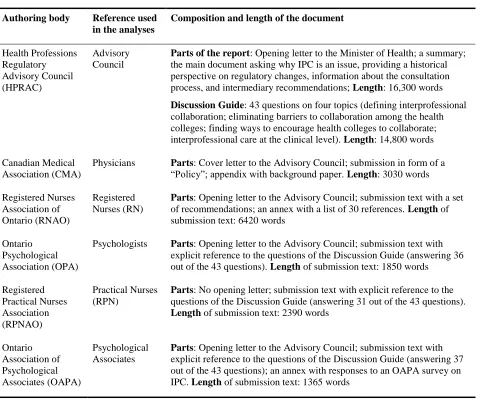
associations. Table 1 provides an overview of these texts, their composition and length.
Insert Table 1 here
Data analysis and interpretation
Data analysis included two broad stages. First, we examined the professions’ field
positions. Drawing on documents from Ontario and general literature on health professions, we
distinguished the five focal professions according to their status – based on a profession’s
authority over others, and centrality – based on a profession’s embeddedness within prevailing
practices in the field (see earlier definitions). Second, we inductively analyzed the discursive
boundary work strategies used by the professions, and related these to field positions.
Field position of professions: Within the medical area, which accounts for more than 85% of
interactions in the health care field in Ontario (CAHM 2015) and therefore comprises actors at
the field’s center, Physicians are clearly the highest status actors (Abbott, 1988; Freidson, 2001),
profession subordinated to the Registered Nurses. Physicians hold a number of exclusive rights
such as communicating a diagnosis (Medicine Act 1991) and in many cases need to authorize
other professions to perform their work. Practical Nurses hold lower levels of education than
RNs, their senior profession (diploma vs. university degree). We therefore position Practical
Nurses as low status in the medical hierarchy, and Registered Nurses as middle-status actors.
The psychotherapeutic area comprises actors more at the periphery of the health care field.
This positioning is also reflected in Ontario legislation which defines a total of 12 so called
controlled acts, only one referring to the psychotherapeutic area. Psychotherapeutic professions
in our study included Psychologists, who hold lower status than Psychiatrists (not included in our
study as there was no separate submission to the Advisory Council), as well as Psychological
Associates (PA). PAs are less educated than Psychologists (a masters vs. a doctoral degree). PAs
therefore hold a lower status position than Psychologists who we characterize as middle-status.
Discursive boundary work strategies and relations with field positions: Our analysis of
discursive boundary work strategies followed four steps.First,we identified themes that were
indicative of boundary work by looking for explicit or implicit aspects related to professional
roles and practices, capabilities, relationships, and hierarchy employed by each profession in
relation to itself and other groups with whom it interacted. Initially, there were a large number of
different themes, some of them specific to individual texts; by moving back and forth between
data and the literature presented earlier, these were gradually condensed into four more abstract
themes or “foci for framing,” common across the five texts. We call these “foci for framing”
because each deals with a different specific element or object around which framing occurs, but
with all four contributing collectively to constituting an understanding of how professional
(1) framing the “issue” of IPC itself, expressed in how the professions referred to the topic of
IPC, its problems and solutions (labeled “issue framing” in what follows); (2) framing of
justifications for favored boundary configuration solutions where actors draw on different forms
of knowledge to substantiate their claims (we call this “justifying”); (3) framing of the
profession’s own identity where the profession who authored a document referred to “self” as a
profession and as a discussant of IPC (labeled “self-casting”); and (4) framing of other
professions’ identities, referring to the (re)positioning of other groups in relation to one’s own
(labeled “altercasting” following Weinstein & Deutschberger, 1963).
In a second step, we focused on each of the professions. We explored in-depth their
particular use of the four foci for framing in relationship to their field positions, extracting the
most salient similarities and differences between professions’ strategies across the different foci.
We iteratively considered extant literature to better ground our distinctions. For instance, in line
with Vaara et al. (2006), we distinguished between the use of rational resources where actors
refer to “utility or function of specific actions or practices” (Vaara et al., 2006, p. 800),
normative resources where actors mobilize values or norms about how things “should” be done.
We also identified experiential resources as a separate category where actors referred to elements
based on local experiences in laying their claims.
In a third step, we looked across the particular uses of framing for the five professions, for
patterns in the way field positions manifested themselves in framing strategies. We identified
distinctive field position-framing relationships associated with the dimensions of status and
centrality. In a final step, we returned to the literature and to our data in an effort to better
understand the theoretical mechanisms underlying the relationships discovered in the previous
The tables in the findings sections provide extensive examples of our coding of the four
foci for framing and the five professions’ particular framing strategies within and across these
categories. The authors worked separately and then jointly on the analysis and interpretation of
the findings. In the next section, we present our first order findings, showing the
profession-specific strategies adopted in relation to the four foci for framing. In the following section, we
abstract from the first order findings to theoretically relate framing strategies to field positions.
First Order Findings: Discursive Boundary Work Strategies across Four Foci for Framing
We now present the four foci for framing that we identified in the professions’ texts – issue
framing, justifying, self-casting, and altercasting – and show how the five macro-actors
mobilized these categories differently as they responded to the Advisory Council´s report. In the
context of our study, the distinctive ways in which the professions mobilized the different foci
for framing can be interpreted as strategies of boundary work aimed at discursively defending or
contesting jurisdictional demarcations in the field.
While we present the foci for framing separately, in the submissions, they were sometimes
overlapping. We present direct quotes from the texts with italics and underlining as reflected in
the original; we add bold type where we wish to draw attention to particular words or passages in
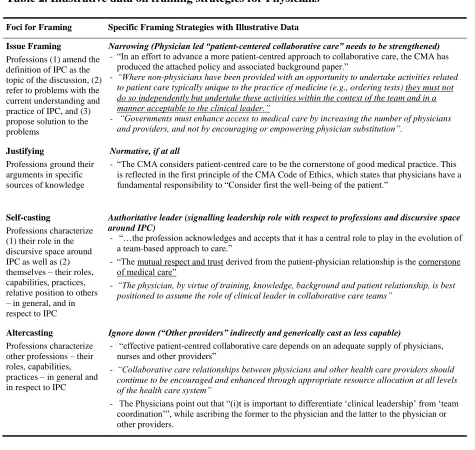
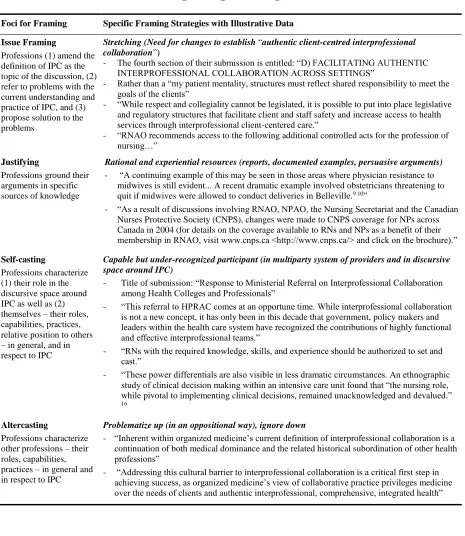
the texts. Further illustrative data on the strategies adopted for each profession within each of the
categories are provided in Tables 2 to 6.
Insert Tables 2 to 6 here
Issue Framing: Narrowing vs. Stretching
The Advisory Council launched the process described here by publishing their document
encouraging interprofessional collaboration. This served as a mechanism to potentially open up
The document elaborated on a number of “obstacles” and “barriers” to IPC that created or
reinforced “silos” between professional groups rather than fostered collaboration. The Council
claimed that one way to reduce interprofessional barriers was through changes in regulation
including “revis[ing] professional scopes of practice as necessary” and “redefining who can
provide care.” The following excerpt illustrates these proposals:
The [Advisory Council] proposes that any initiatives should be directed to finding ways to: Assist health regulatory colleges and their members to work collaboratively, rather than competitively, and to learn from and about each other through a process of mutual respect
and shared knowledge to… [among others] improve patient care and facilitate better results for patients.
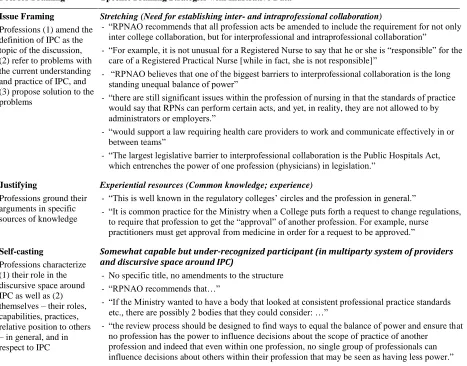
In the five response submissions we analyzed, the professions referred to the focal issue of
IPC as put forth by the Advisory Council. Issue framing involved framing IPC as the topic of the
discussion, referring to problems with the current understanding and practice of IPC, and
proposing solutions. While we found that each of the professions amended the label and
understanding of IPC put forth by the Council, we further distinguished between narrowing and
stretching the discourse around IPC as salient variants of issue framing.
Narrowing the discourse was characterized by ascribing IPC a meaning very similar to
existing models of work between professions, implying a need to strengthen the status quo. This
variant was clearly associated with the Physicians holding the field position of central, high
status actors as mentioned earlier. Theirdocument was entitled “Achieving patient-centred
collaborative care.” In their definition of “collaborative care”, the Physicians emphasized their
own central role in the model:
Collaborative care entails physicians and other providers using complementary skills, knowledge and competencies and working together to provide care to a common group of patients based on trust, respect and an understanding of each other’s skills and knowledge.
Physicians’ definition of collaborative care, responsibilities or decisions were never meant to be
shared among team members, but rather to be “divided” and skills were to “complement” each
other with physicians standing out in this complementarity in their distinctiveness from “other
providers.” Accordingly, Physicians resisted proposals that would involve expanding other
providers’ scope of practice. They stated:
We want to reinforce the notion that collaboration is not contingent upon the expansion of scopes of practice for certain provider groups.
Building on this, the document signaled the Physicians’ concern that they might become
dispensable if there were changes in the scope of practice. They stated that they “don’t believe
that successful collaborative arrangements can be achieved through regulation or legislation” and
argued that “[c]larity of roles… and communication is at the heart of any newly established
interprofessional collaboration.” Thus, Physicians framed the problems surrounding IPC as
having less to do with a need for change than for “clarifying” the present system (see Table 2).
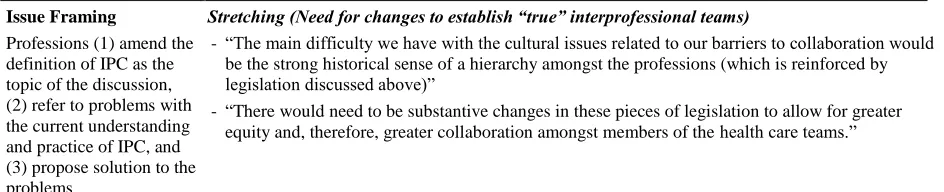
The four professions other than Physicians, all with a relatively lower status, stretched the
meaning of IPC as put forth by the Council, clearly indicating their aim to move away from the
status quo and thus open boundaries. The Registered Nurses deviated somewhat from the
Council’s notion of “patient-centred” IPC, claiming the need to discuss “authentic
client-centred” IPC, thereby already pointing to perceived deficiencies in current IPC practice. They
also responded to the Physician’s document by challenging the validity of several statements in
it. For instance, the RNs contrasted what they thought the physicians said with what physicians
did, reframing the physicians’ perspective as incompatible with “authentic” IPC:
In contrast to the Physicians’ framing, the RNs perceived interprofessional care to be “grounded
in mutual respect and shared knowledge” between care providers and enacted by a “health-care
team.” While the RNs did not assume that legislation would guarantee IPC, they regarded
legislative structures as important “facilitators” in achieving it (see also Table 3).
Similar to the RNs’ adjective “authentic”, we notice that the Psychologists´ notion of
“true” interprofessional care criticized current legislation and regulatory bodies that did not
sufficiently consider different professions when talking of IPC:
We … have concerns about the perspectives in some material from the Ministry of Health… that, in the past, have made reference to interprofessional collaboration but, upon further examination, have limited these interprofessional teams to medicine and nursing alone. We believe true interprofessional teams are the result of a number of professions working together for the care of their patients.
Accordingly, “true” IPC can be related to the Psychologists’ call to “expand” the definition of
IPC, “to ensure that it is recognized that anyone on an [IPC] team can be seen as the primary
lead in the care of a particular patient” – an explicit claim to opening existing boundaries. The
Psychologists viewed changes in legislation as a means to clarify or open boundaries by
providing “agreed upon definitions of controlled acts” to reduce “confusion and negative
relations between regulated professionals,” but it should also allow for “greater equity” among
professionals (see Table 4).
For their part, the striking aspect of the lower status junior professions’ issue framing was
their expression of the need to open up boundaries not only with physicians, but also with their
senior professions. The Practical Nurses wrote that they “believe (...) that the biggest issues for
interprofessional practice… are both inter and intraprofessional.” They expressed concern
about the “veto power” of Physicians, stating that, “if physicians do not accept a proposed
“excuses”: “The possible liability of one profession for the practice is often used as an excuse for
why the scope of practice of one profession should not be fully implemented or expanded.” They
argued that the regulators “should work to ensure that the hierarchy of professions is
eliminated and that all professions and professionals are treated equally” (see Table 5).
Similarly, the Psychological Associates stated that they “support (...) the overall goal of
promoting health regulatory colleges and their members to work collaboratively”, but again like
the Practical Nurses added “that intraprofessional collaboration and interprofessional
collaboration are equally important”. And they specified that:
Within the College of Psychologists, [the Psychological Associates] believe… increased awareness of the scope of practice of Psychological Associates by the public and by
Psychologist members would improve access to patient care, maximize collective resources, and ensure all regulated health care professionals work to their maximum competency and capability.
Thus the claim that change was needed due to hierarchical situations that hampered IPC put forth
by the RNs and the Psychologists, reverberated through the Psychological Associates’ text, and,
as in the case of the Practical Nurses, were extended to intraprofessional relationships (see Table
6). More strongly than the other groups, PAs recommended changes in legislation, suggesting:
…the development of regulations to expressly state that interprofessional collaboration is a goal or expected practice and a body to share strategies that are working successfully to achieve this goal.
Justifying: Normative vs. Rational vs. Experiential Resources to Legitimize Solutions
Professions drew on various discursive resources to justify the way they framed the issue
as well as their preferred solutions in terms of professional boundaries. While the professions
differed in the type of resources they referred to and the extent to which they justified their
claims, a salient distinction we found across professions was between the use of normative vs.
Physicians rarely made use of explicit justificatory resources to substantiate their claims;
but if they did, the resources were mostly normative in kind, that is, referring to values or norms
about how things “should” be done (Vaara et al., 2006) rather than formal evidence. This
approach constructed their position in conformity with long-standing traditions and values that
need to be protected (by maintaining and strengthening the physicians´ role). They referred to
only one external study, which was on issues of medical liability, and to two internal and
normative documents, one of which was their “Code of Ethics”. The Physicians first and
foremost mobilized uncontested values such as the patient´s well-being and various ethical
principles such as “trust” between physicians and patients. Moreover, the Physicians imbued
central professional dimensions with continuity, claiming for instance that patients´ expectations
of physician leadership “will not change” (for further illustrations, see Table 2).
The middle-status professions and more particularly the Registered Nurses drew on
rational justificatory resources and did so in such a way as to suggest the need for change. This
framing strategy was reflected in arguments that made recourse to the utility of IPC (Vaara et al.,
2006) and drew on different forms of evidence from sources outside or inside the professions
(see Tables 3-6). The Nurses made extensive use of this variant and drew on multiple resources
to exhibit problems with current structures. They recurrently referred to professional skills not
used in existing work models; they cited 30 studies such as a “Statistics Canada report” which
“suggests that workplace environment, including the quality of working relations between
physicians and nurses, was associated with medication errors”; drawing also on experiential
resources they referred to two documented “dramatic examples” of harm caused due to existing
obstacles to IPC. In comparison to Nurses, the Psychologist’s use of rational resources was less
Canada that testified to existing barriers to IPC, and provided rational arguments (such as an
“underutilization of health human resources”) for change.
In terms of the junior professions, it is interesting to note that they refer to evidence not so
much in the form of statistics and formal evidence, but in the form of more or less generalized
experiences or opinions. For example, the Practical Nurses repeatedly derived arguments for
change from common knowledge – indicated in formulations such as “This is well known”, “it is
not unusual” or “common practice” – which was often supplemented by certain concrete
examples to give additional credibility. The Psychological Associates constructed their response
on more local evidence, including a survey among their members concerning experiences with
IPC. They attached importance to this experiential evidence by explicitly mentioning the survey
in their opening letter and attaching the survey’s results to their response (see Tables 5 and 6).
Self-casting: Authoritative leader vs. Capable but under-recognized participant
The framing of professions’ self-identities was manifested in two ways in the documents:
(1) in how they implicitly presented themselves as a more or less significant voice in the
discursive space opened up by the IPC initiative and (2) in how they referred explicitly to their
identity as a profession within the document. These two ways of self-casting appeared to be
broadly consistent with each other for each of the professions, and had similar implications for
boundary construction. We identified two main variants that express different claims to
knowledge and that position professions differently with regard to each other: self-casting as
authoritativeleader somewhat separate from other parties vs. self-casting as a capablethough
under-recognized participant in a multiparty professional system and discursive space.
In their self-casting, the Physicians clearly express a role of authoritativeleaders (see also
way they labelled and presented their submission. Specifically, although the Discussion Guide
issued by the Advisory Council was framed as an “Invitation to comment” on the matter of IPC,
in their cover letter, the Physicians demonstrated their autonomy by advancing issues that they
regarded as crucial, rather than responding to a discussion opened up by the Advisory Council:
Enhancing patient-centred collaboration amongst the health professions is a priority for the
[Physicians]… In an effort to advance a more patient-centred approach to collaborative care, the
[Physicians have] produced the attached policy and associated background paper.
Their main document consisted of what they called a “Policy.” In general, policies by the
Physicians “describe the Association’s positions on issues relevant to the Canadian healthcare
system” and “provide members, Canadian physicians and the general public with well-articulated
normative statements” (www.cma.ca). In this vein, their submission delineated 12 “principles”
on how the association strived “to ensure the evolution of collaborative care in Canada.”
In terms of explicit references to their identity as a profession, the Physicians express their
role as authoritative leaders in three ways. First, they stress their historical “patient advocate”
role. Second, referring to medical knowledge, they point to the physician’s “unique appreciation
of the full spectrum of health and health care delivery”. Third, they identify themselves within
collaborative work environments as the profession that is “best equipped to provide clinical
leadership”. In their framing, Physicians leave no doubt that this identity is incontestable – and
that there is a distinct exclusionary boundary that cannot be questioned:
The concept of ´most responsible physician´ has been and continues to be used to identify the individual who is ultimately responsible for the care of the patient.
The other four professions cast themselves to different degrees as capable but
under-recognized participants both in the discursive space of IPC and in the professional system more
generally. The Registered Nurses (RNs) presented themselves as a strong voice participating in
the ministerial referral, acknowledging other initiators of and parties in the discussion. Also, they
took up the general ideas of the Discussion Guide, but expressed their own priorities and
arguments by structuring their document according to a set of recommendations rather than
following the sequence and content of the Advisory Council’s 43 questions. In terms of their
professional identity they presented themselves as capable professionals, but somewhat
under-recognized, particularly by physicians. This was insistently expressedby criticizing how the
Physicians drew the boundary between themselves and other health care providers. The RNs
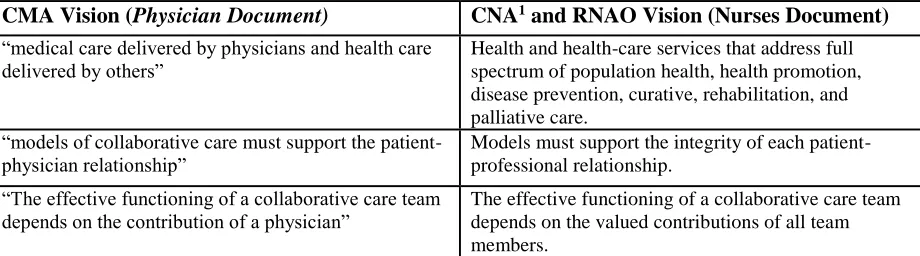
[image:25.612.81.541.417.545.2]extracted 13 verbatim quotes from the Physician’s report and contrasted them in a two-column
table with the RNs’ view of the roles and responsibilities of professionals in IPC. This alternative
vision, according to the RNs, “respects the knowledge, skills, and abilities of all members of an
interprofessional collaborative team”, thus opening identity boundaries. See the examples below,
taken verbatim from the table in the RNs’ report (for additional data, see Table 3):
CMA Vision (Physician Document) CNA1 and RNAO Vision (Nurses Document)
“medical care delivered by physicians and health care delivered by others”
Health and health-care services that address full spectrum of population health, health promotion, disease prevention, curative, rehabilitation, and palliative care.
“models of collaborative care must support the patient-physician relationship”
Models must support the integrity of each patient-professional relationship.
“The effective functioning of a collaborative care team depends on the contribution of a physician”
The effective functioning of a collaborative care team depends on the valued contributions of all team members.
While they claimed that RNs “have knowledge, skill, and experience” to perform more inclusive
roles, they complained that in current practice these capabilities were often not fully recognized.
Similar to the Registered Nurses, the Psychologists acknowledge other parties in the
discursive space around IPC, but their discursive position seems more detached and critical.
They went further than the RNs in conforming to the “invitation to comment” by explicitly
structuring their responses according to the 43 questions provided by the Discussion Guide. But
in their opening letter, they underlined their importance as an Association in achieving the goals
related to IPC, and they also put forward “some concerns relating to underlying assumptions
implicit in the questions found in the guide.”Second, in their explicit references to their identity
as a profession, the Psychologists presented themselves in terms of what they were capable of
doing as well as by what they were hindered from doing under the current arrangements. In their
opening letter they stressed that their association was founded “to advance psychology as an
independent profession with the highest ethical standards of practice”. But, somewhat
contrasting this claim with actual practice, as shown above, they indicated that instead of
interprofessional teams referring to a “number of professions working together” – including them
– the notion was often “limited… to medicine and nursing alone” (see also Table 4).
The Practical Nurses position themselves as a voice in a discursive space with multiple
parties led by the Advisory Council, for instance by explicitly structuring their responses
according to the 43 questions provided by the Discussion Guide. In contrast to the other four
texts, though, the submission of the Practical Nurses came neither with an opening letter, nor did
they highlight their own issues of importance (e.g., through specific recommendations or a
survey). In terms of their professional identity, the PNs expressed concerns about
under-recognition and hence only indirectly cast themselves as capable professionals: They mentioned
that subgroups within professions – like them – “may be seen as having less power” or
complained that “[i]t is not unusual for hospital board members to think that nurses´ practice is
only under the direction of physicians” – while in fact other professions including themselves as
The Psychological Associates positioned themselves as a contributing voice to an overall
discursive space, but in contrast to the RNs and Psychologists, as one among many others,
explicitly “appreciate[ing] the opportunity to have [their] voice heard”. Like the Practical Nurses,
they structured their response according to the 43 questions of the Discussion Guide, but also
provided four recommendations upfront before they addressed the questions. In comparison to
the senior professions, and like the Practical Nurses, the Psychological Associates’ self-casting
as a professionwas more indirect and focused on hindrances to their possible roles. They stated
that their title “is not well understood by members of the public, by Psychologist(s) (,,,) …or by
other health professions” which was seen as an “obstacle to optimizing the skills and
competencies” of their members. This critique was addressed in particular to members of their
senior profession (also see Table 6).
Altercasting: Problematizing (Up) vs. Ignoring (Down)
Altercasting constituted the fourth focus for framing. Because some professions positioned
(or not) other professions very explicitly and separately from their own self-identity framing, we
treat this category separately. We found that professions either problematized or ignored other
professions, depending on whether other professions were situated further up or further down in
the status hierarchy, implying different constructions of boundaries.
In contrast to their very explicit and highly laudatory self-casting, the Physicians engaged
in a form of altercasting that can be characterized as “ignoring” – referring to other, lower status
professions mostly in an indirect and generic way. By setting themselves apart from “other
health care professionals,” they clearly closed the boundaries between themselves and various
themselves as authoritative and superior (as indicated in the previous section) the Physicians
indirectly altercast those “other” groups as less capable (see also Table 2).
In continuity with the oppositional way in which Registered Nurses referred to the
Physicians’ submission when expressing their own professional role (shown above), they went
on to altercast physicians very critically, i.e., problematizing their role. They characterized
“organized medicine,” a label that depersonalizes the profession and foregrounds its institutional
character, as having a “preoccupation with shared scopes of practice as inherently competitive”
and a “reluctance to engage in professionally appropriate power-sharing with other disciplines.”
In sum, the Registered Nurses cast Physicians as defensive of professional boundaries, as
anti-IPC, and moreover, as exercising wholesale subordination of other professions to the detriment
of patient care and other professions. Interestingly, however, and similar to the Physicians, other
professional groups of lower status were not mentioned explicitly in the Registered Nurses’
submission. Thus the RNs altercasted others by problematizing up, but ignoring down (Table 3).
Similar to the RNs, the Psychologistsproblematized the existence of an unjustified
dominance of one profession over others. In contrast to the RNs, their critique was less pointed,
however, and they often only used notions of “some professions” without specifying that they
meant the physicians. When they did refer specifically to physicians, they remained unspecific
about other professions, indicating that “a professional with particular skill sets should be able
to provide [a certain] service with independent authority without the need of a physician to
delegate that authority”. In sum, the Psychologists remained more non-specific when referring to
other professions, expressing a somewhat more distant position. At the same time, the
Psychologists made no specific reference to other, lower status professions, reflective of the
The Practical Nurses, like the RNs, problematized up by explicitly altercasting physicians
as dominant but they also included their own senior profession (the RNs) within their critique,
for instance when disqualifying liability arguments by RNs and Physicians as a mere “excuse,”
as already stated above. Moreover, at various points in the text, medical dominance was related
to existing regulations and government bodies that were criticized as “perpetuat[ing] that
physicians can determine the practice of other professions” (see Table 5).
The Psychological Associates’ altercasting also follows the pattern of problematizing up
addressed in particular to the Psychologists, that they characterized as lacking an “awareness of
the scope of practiceof Psychological Associates” and as responsible for related deficiencies in
intraprofessional relations:
“A lack of communication to members of the public and other health professionals about scope of practice issues for members from the College of Psychologists is a barrier to collaboration. Public education about scope of practice is essential and is not as well done as it could be.”
The Psychological Associates addressed more generally other health care providers as not
sufficiently familiar with their scope of practice; or as being supported by legislation in their
exclusive role over other providers (including themselves). With regard to physicians, they stated
that “the need for referrals for some services to be signed by a physician [e.g. admission to a
hospital] hinders access for patients” thus impeding IPC (see also Table 6).
Summarizing, we identified four foci for framing through which professions mobilized
boundary-relevant themes and put forth their claims to maintain or change jurisdictional
demarcations between them – issue framing, justifying, self-casting and alter-casting. We also
found distinctive variants within the four foci for each of the professions reflecting different
overall framing strategies as illustrated in Tables 2-6 and summarized in Table 7 (see next
and Psychologists when it comes to justifying and altercasting. In the following section, we
discuss more in detail the four foci for framing, their differential use and how the different
framing strategies can be understood in relation to the professions’ respective field positions.
Second Order Analysis: Framing Strategies and Field Positions
The previous section examined the discursive boundary work of five different professions across
four distinct foci for framing. We showed (a) how issue framing could involve either the
narrowing or the stretching of definitions of inter-professional collaboration, associated with
closing or opening boundaries, (b) how justifying solutions to boundary issues might rely on
normative, rational or experiential resources; (c) how self-casting might construct professions as
either authoritative leaders or capable but under-recognized participants in both the professional
field as a whole and in the discussion of IPC, and (d) how altercasting involved problematizing
or ignoring other professional groups in order to contest or reaffirm boundaries. Table 7
summarizes these findings, showing the patterns observed across the four foci for framing for the
different professional groups, along with their classification according to field position. We now
draw on the above analysis to show how the framing strategies of the different professions
cluster together, theorizing their relationship with field positions. We examine the broader
implications of this analysis for other situations in which multiple professions interact at the field
level around boundary issues, and relate our findings to the previous literature. We structure our
key insights in this section according to the two dimensions of field position (status and
centrality), focusing first on status relations between professions of similar degrees of centrality,
and then examining the nuances visible when centrality is more closely considered.
High status and generic naturalistic framing
The most striking pattern emerging from our first order analysis and revealed in Table 7
concerns the differences between the framing strategies of physicians (the highest status, most
central profession) and all the others. While physicians narrowed the definition of IPC, justified
their approach mainly on the basis of normative resources, referred to themselves as
authoritative leaders and ignored distinctions among other groups, the other professions
stretched the definition, drew on multiple rational and/or experiential resources, identified
themselves as capable but distinctly under-recognized and problematized professions higher in
the status ordering. We argue here that the overall pattern of framing observed for the physicians
is importantly related to their high status in the field and can be characterized as “naturalistic”
and “generic.” Moreover, we argue that this pattern is likely to be reproduced in other situations
where high status professions use discursive means to defend existing boundaries.
We label this pattern observed across the four foci for framing as “naturalistic” following
the language suggested by Vaara and Tienari (2002) because the strategies adopted for each of
the foci for framing in Table 7 affirm directly and indirectly the preferred solution as a more or
less “natural” state of affairs, about which there cannot or should not be any argument. For
example, the narrowing of the issue reformulates the status quo as already reflecting the
direction for change (e.g., existing forms of “collaborative care” are equated with IPC), justifying
this on the basis of assumptions or normative principles construed as a matter of fact rather than
through evidence-based argument. This underpins a perspective in which current boundary
arrangements cannot be seriously questioned. Similarly, in their self-casting, by labeling their
document a “policy” rather than a “response,” they assumeauthoritative leadership indirectly
Finally, in their altercasting, the absence of differentiation accorded to “lesser” groups (ignoring)
again naturalizes the separation between themselves as uniquely important and generic
unspecified others. Thus, their framing strategies as well as being naturalistic are also generic in
that their discourse does not identify other professions as worthy of specific attention.
Theorizing around these empirical observations, it is as if these high status professionals
have concluded that if they were to frame their position as in reaction to others’ proposals, if they
were to engage in more formal and detailed rational justifications surrounding their position, or if
they were to recognize the distinctiveness and diversity of other groups, they might implicitly
place more value on these proposals than they deserve and consequently accord them legitimacy.
In other words, generic naturalistic framing enables high status professionals to downplay
challenges by using the language of authority associated with their status, and presenting their
preferences as the natural order of things. We suggest here that similar patterns in discursive
strategies may be likely for other high status groups attempting to defend existing boundaries.
This is confirmed in our own data when we consider the altercasting of the registered
nurses and the psychologists in relation to their own junior professions, with respect to whom
they hold field positions of relatively higher status. Neither the nurses nor the psychologists refer
specifically to the members of their junior professions within their submissions to HPRAC, even
though an opening up of boundaries could presumably imply a potentially greater role for the
lower status group. In other words, their approach to ignoring lower status groups fit the pattern
of naturalization we noted for the physicians.
The relationships we are suggesting here are also to a degree echoed empirically in other
work, although not necessarily theorized or drawn together to explicitly relate field positions to
and Greenwood´s (2005) rhetorical strategy of “ontological theorization.” The law firms in
Suddaby and Greenwood’s study clearly represented a profession defending their terrain against
intrusion from challengers, although we hesitate to position their status as necessarily higher than
that of the accounting firms. Also, Lockett et al. (2014) in a study of social positions in context
of change (though not of discursive boundary work) found that the highest status actor displayed
least acknowledgement of other professions’ impact on their own work.
Lower status and targeted argumentative framing
As shown in Table 7, the four lower status professions (with respect to physicians)
collectively mobilized a different set of framing strategies that we characterize as “targeted” and
“argumentative.” By stretching the notion of IPC, these professional groups took up the new
discursive opportunity structure (McCammon et al., 2007) offered by the Advisory Council,
placing their own distinctive stamp on it, and then drawing on a variety of justificatory resources
including rational and experiential arguments to support their positions.
Perhaps most interesting is the way all the lower status groups promoted redefinitions of
boundaries not only through their self-casting as capable but under-recognized, but also through
their explicit problematization of targeted higher status groups as barriers to IPC and to more
open boundaries. While all the groups targeted the physicians, the lowest status practical nurses
and psychological associates explicitly targeted their more senior professions. In other words, the
generic naturalistic framing of higher status professions is explicitly deconstructed in the
targeted argumentative framing of other professions. While higher status groups “assume”
power as legitimate (without using the word), lower status groups “unmask” power often
referring to it in highly explicit terms (see extracts in the text and in Tables 2-6), and targeting
Theoretically, the boundary work strategies we identified here make sense in terms of field
positions in several ways. First, because of their lower status, these professions need to bring to
bear stronger more evidential and argumentative resources to overcome the resources of
authority inherent to higher status groups. By engaging in open debates and by backing up their
claims for change with evidence, lower status actors (like the four professions in our case)
attempt to position themselves as credible actors and strengthen the claims that they make from
their relatively weaker field positions. Second, the targeted undermining of high status groups
serves two purposes. On the one hand, it is important for those who wish to open boundaries to
level the playing field in order to lay claim to the capacity to participate equally in shared
practices. Thus, lower status professions emphasize capability but also note how it is unfairly
under-recognized by higher status groups. On the other hand, by drawing explicit attention to
power structures and hierarchies in the field, lower status professions counter their naturalization.
By so doing, they may delegitimize attempts of higher status groups to block boundary
redefinition (whether through discursive boundary work or other forms of influence). We suggest
that similar patterns in discursive strategies may be likely for other lower status actors attempting
to promote change in existing boundaries.
We find some empirical support for this in other studies that explored discursive strategies
of field level actors in times of change. For instance, Suddaby and Greenwood (2005) found that
Big Five accounting firms – as proponents of change towards multidisciplinary practices –
mobilized “pragmatic legitimacy” (Suchman, 1995) to back up their claims. This notion is
similar to the use of rational and experiential resources by Registered Nurses, Psychologists,
Practical Nurses and Psychological Associates in our study, although the question of status is not
framing climate change, experts engaged in constructing their own “expert identities” in order to
support their own credibility and claims while undermining others’ identities and with it their
position in the discussion.
Middle status specificities
So far, we have discussed status in relation to two categories: high and low, proposing
that discursive boundary work strategies of high status professions are likely to take the form of
generic naturalistic framing, while lower status professions are likely to engage in targeted
argumentative framing. But what about the middle status actors who are positioned higher than
their junior groups, but lower with respect to the highest status professions? As we indicated in
our field position analysis, the RNs and the Psychologists fall into this category. We will
consider the position of psychologists later when we focus more particularly on the role of the
dimension of centrality. However, the clear hierarchy among the three professions of physicians,
nurses and practical nurses offers some insight into how middle status might matter.
A first observation noted above is that the discourses of the middle status groups appear
most like that of high status actors when directed towards the lower status junior professions (the
RNs and Psychologists are largely silent about their junior professions), but follows the pattern
of lower status groups with higher status groups who appear as the only ones worthy of attention.
The pattern of problematizing up and ignoring down (Table 7) appears to be universal, holding
firmly across all status groups.
This is interesting in itself, but we also observed some other more subtle empirical
distinctions between middle and lower status professions. Specifically, we saw that the RNs
contested the boundary vis-à-vis physicians by drawing on a much greater variety of resources