warwick.ac.uk/lib-publications
Original citation:
Wu, Yue, Guo, Weisi, Yuan, Hu, Li, Long, Wang, Siyi, Chu, Xiaoli and Zhang, Jie. (2016)
Device-to-device (D2D) meets LTE-unlicensed. IEEE Communications Magazine, 54 (5). pp. 154-159.
Permanent WRAP URL:
http://wrap.warwick.ac.uk/75974
Copyright and reuse:
The Warwick Research Archive Portal (WRAP) makes this work by researchers of the
University of Warwick available open access under the following conditions. Copyright ©
and all moral rights to the version of the paper presented here belong to the individual
author(s) and/or other copyright owners. To the extent reasonable and practicable the
material made available in WRAP has been checked for eligibility before being made
available.
Copies of full items can be used for personal research or study, educational, or not-for profit
purposes without prior permission or charge. Provided that the authors, title and full
bibliographic details are credited, a hyperlink and/or URL is given for the original metadata
page and the content is not changed in any way.
Publisher’s statement:
“© 2016 IEEE. Personal use of this material is permitted. Permission from IEEE must be
obtained for all other uses, in any current or future media, including reprinting
/republishing this material for advertising or promotional purposes, creating new collective
works, for resale or redistribution to servers or lists, or reuse of any copyrighted component
of this work in other works.”
A note on versions:
The version presented here may differ from the published version or, version of record, if
you wish to cite this item you are advised to consult the publisher’s version. Please see the
‘permanent WRAP URL’ above for details on accessing the published version and note that
access may require a subscription.
Device-to-device (D2D) Meets LTE-Unlicensed
Yue Wu
1*, Weisi Guo
2, Hu Yuan
2, Long Li
1, Siyi Wang
3, Xiaoli Chu
1, Jie Zhang
1Abstract—In this article, we look into how the LTE network can efficiently evolve to cater for new data services by utilizing direct communications between mobile devices and extending the direct transmissions to the unlicensed bands, i.e., device-to-device (D2D) communications in conjunction with LTE-Unlicensed. In doing so, it provides an opportunity to solve the main challenge of mutual interference between in D2D and conventional cellular (CC) transmissions. In this context, we review three inter-connected major technical areas of multi-hop D2D: transmission band selection, routing path selection, and resource management. Traditionally, D2D transmissions are limited to specific regions of a cell’s coverage area in order to limit the interference to CC primary links. We show that by allowing D2D to operate in the unlicensed bands with protective fairness measures for Wi-Fi transmissions, D2D is able to operate across the whole coverage area and in doing so, efficiently scale the overall network capacity whilst minimizing cross-tier and cross-technology interference.
I. INTRODUCTION
A. Background
Over the past decade, two factors have significantly in-fluenced mobile data demand density. On the one hand, the proliferation of smart-phones has led to an explosive demand for mobile multimedia services. On the other hand, an in-creasing number of people now live in cities, dramatically increasing the density of mobile users and shrinking the inter-distance between devices and giving rise to new commu-nication opportunities. Recently, the concept of LTE-Direct, i.e., device-to-device (D2D) communications in co-existence with cellular networks in the same frequency spectrum, has been proposed [1]. D2D communications enable devices to communicate directly with each other without access to a fixed wireless infrastructure1. Typically, this is achieved with the high density of mobile user equipments (UEs) and allow-ing multi-hop transmissions of delay tolerant data between the UEs. The potential advantages of D2D communications include throughput enhancement, UE energy saving [2], and coverage expansion. The economic attraction to mobile oper-ators is that significant capacity and coverage gains can be achieved without having to invest in network-side hardware upgrades or new cell deployments.
At the same time, LTE-Unlicensed (LTE-U), also known as License-Assisted Access, has attracted significant research and development attention. LTE-U extends LTE transmissions into
1Yue Wu, Long Li, Xiaoli Chu and Jie Zhang are with the Department of
Electronic and Electrical Engineering, The University of Sheffield, UK.2Weisi Guo and Hu Yuan are with the School of Engineering, University of Warwick, UK. 3Siyi Wang is at the Dept. of Electrical and Electronic Engineering, Xi’an Jiaotong-Liverpool University, China. *Corresponding Author E-mail: [email protected]
13GPP TR 36.843: study on LTE device to device proximity services and
radio aspects.
the unlicensed ISM bands while adhering to unlicensed spec-trum requirements [3]. By utilizing the considerable amount of unlicensed spectrum available around the globe, low power transmissions can avoid cross-tier interference. LTE-U has been included in 3GPP Release 13 standardization along with carrier aggregation [4].
B. Contribution & Organisation
In this paper, we demonstrate how the combination of state-of-the-art base station (BS) assisted D2D[1]and LTE-U can significantly improve the Quality of Service (QoS) of both conventional cellular (CC) and D2D UEs. We show in Section II that without the flexibility of extending to and dynamically selecting the unlicensed ISM bands, CC QoS targets will constrain D2D operations to specific regions of a cell’s coverage area. In Sections III and IV, we discuss the routing path selection and radio resource management (RRM) schemes to enable the combination of multi-hop D2D and LTE-U, respectively. The simulation results in Section V show that by allowing D2D to operate in the unlicensed bands with protective measures for Wi-Fi and LTE-U CC transmissions, D2D is able to operate across the LTE network and in doing so, efficiently scale the overall network capacity whilst minimizing cross-tier and cross-technology interference.
We review both centralized and distributed algorithms that enable multihop D2D path selection and RRM.We also show that, compared to other direct communication technologies operating on unlicensed bands (e.g., Wi-Fi Direct, Bluetooth, etc.), LTE-U D2D communications exhibit advantages in terms of efficient peer discovery and link establishment [1], and flexible RRM.
II. D2DANDLTE-U SYSTEMOVERVIEW
Macro-BS Zone A: High
CC DL Interference
Zone B: High CC UL Interference
Zone D: Wi-Fi Co-existence Zone C: D2D
[image:3.612.79.270.54.231.2]Operations Permitted
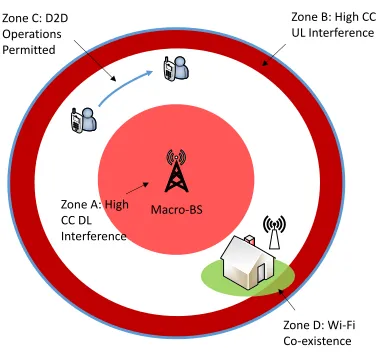
Fig. 1. D2D operation are restricted to certain parts of a macro-BS’s coverage area due to cross-tier interference with CC transmissions.
A. D2D and CC Performance Trade-off
Due to the mobilities of devices and the complex interfer-ence effects, traditional static radio planning can prove to be difficult to apply, while statistical methods have recently been proven to yield useful insights [5]–[7]. In a recent study on multi-hop D2D [7], where BSs, CC UEs, and D2D UEs all conform to spatial Poisson Point Processes (PPPs) of different densities, it was found that statistically D2D sharing the uplink (UL) band performs much better than D2D sharing the downlink (DL) band in terms of outage probability. However, D2D sharing the UL band leads to higher interference to CC transmissions. Therefore, there is a trade-off between D2D and CC communication performance while considering whether to use the UL or DL band for D2D communications. Letting D2D transmissions utilise the DL band will favor CC reliability over D2D reliability, whereas letting D2D transmissions utilise the UL band will favor D2D reliability over CC reliability.
The performance trade-off between D2D and CC commu-nication performances also has implications on the geometric zones where D2D communications should use the UL or DL band. As shown in Fig. 1, the centre of the BS’s coverage area (Zone A) is generally off-limits to D2D transmissions using the cellular DL band due to the high DL interference from the nearby macro-BS. The macro-BS’s cell edge (Zone B) is generally off-limits to D2D transmissions using the cellular UL band due to the high UL interference from cell-edge CC UEs transmitting at high power levels. Hence, if only the cellular DL or UL bands can be used, reliable D2D communications would be kept away from the cell-centre or the cell-edge respectively, and only operate inZone C.
B. D2D Integration with LTE-U
The mutual interference and aforementioned limitations of D2D communications utilising licensed band would be more significant in higher cellular traffic areas (e.g., city centre during office hours), where would also be the hotspots of D2D communications. Targeting these problems, we propose an architecture to allow D2D communications to use
LTE-Fig. 2. Listen-Before-Talk (LBT) for LTE-U.
U. As we will show later, LTE-U opens up the possibility for D2D to operate anywhere in the macro-BS’s coverage area except for the regions where other unlicensed-band radio-access technologies (RATs) are in use (e.g., the Wi-Fi hotspot inZone D). In order to communicate in the unlicensed band, there are two major coexistence requirements: (1) low transmit power levels (typically 200mW to 1W), and (2) interference avoidance through Clear Channel Assessment (CCA) or Listen Before Talk (LBT).
An LTE-U D2D UE needs to periodically perform spectrum sensing to check for the presence of other occupants in the channel before transmission (LBT). This is achieved by first detecting the energy level of the channel for a designed duration (normally 20µs). If the energy level in the channel is below the CCA energy threshold, the UE transmits for a Channel Occupancy Time (COT) (normally 1-10ms). If the energy level is over the CCA energy threshold, the D2D UE waits for a random period, before it performs another CCA. After the COT has elapsed, if the UE wants to con-tinue transmitting, it has to repeat the CCA process2. This
entire process is illustrated in Fig. 2. In fact, LTE-U enabled multi-hop D2D will no longer be restricted to the previously mentioned operation zones as long as the unlicensed spectrum regulations are fulfilled [3]. This would significantly expand the D2D operational areas.
III. MULTI-HOPROUTINGALGORITHMS
Conventional wireless multi-hop communications have been studied for ad-hoc networks, where distributed or centralized tabular-based routing methods are used to extend communica-tion range via relay nodes. D2D multi-hop routing is different from conventional multi-hop routing in that: 1) D2D commu-nications are assisted and/or controlled by the LTE network; 2) the mutual interference between D2D and CC transmissions needs to be considered in D2D multi-hop routing. Hence, multi-hop routing algorithms need to be revisited for D2D communications. In this section, we first review multi-hop routing schemes for D2D communications and then propose a routing algorithm for LTE-U enabled multi-hop D2D.
A. Routing Algorithms for D2D
In order to limit the mutual interference between D2D and CC transmissions, a popular approach is to introduce and
23GPP Release 13 Technical Report R1-152182 (2015): Response LS on
[image:3.612.316.558.59.153.2]1) Escape to Edge
2) Migrate along Cell Edge
3) Return to Destination
Interference Avoidance Routing (IAR) LTE-D with Unlicensed Band Routing
Macro-BS Macro-BS
1a) Listen-Before-Talk (LBT)
2) IAR on Unlicensed Band Macro-BS’
Cell Edge
Macro-BS’ Cell Edge
[image:4.612.103.513.54.258.2]Wi-Fi AP 1b) SPR
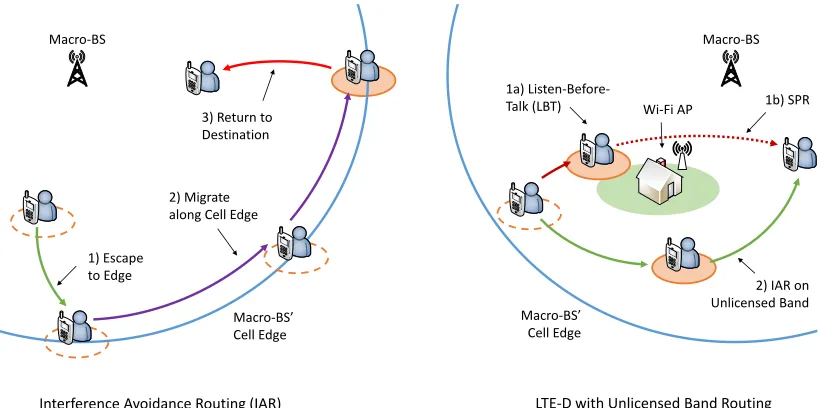
Fig. 3. Interference-Avoidance-Routing and Unlicensed LBT Routing for Multi-hop D2D.
optimise an exclusion zone, wherein only D2D transmissions are allowed on a given frequency band. The exclusion zone is usually defined as a geometric area centred at the receiving D2D UE. The size of an exclusion zone is defined such that up to a certain number of CC and D2D UEs can transmit simultaneously in the macro-BS coverage area without causing failed reception at the central D2D UE [8]. By controlling the size and location of the exclusion zone through D2D transmit power control, exclusion-zone based D2D relay se-lection can ensure low outage probabilities for both D2D and CC UEs. In [9], the exclusion zone is defined in terms of the interference-to-signal ratio at the D2D receiver in a system consisting of one BS, one D2D pair, and multiple CC UEs. More specifically, the exclusion zone is defined as a δD-interference limited area (ILA), in which CC UEs
could generate an accumulated interference level no larger than δDPD,Rto the D2D receiver, whereδDis the the
interference-to-signal ratio threshold andPD,Ris the received power at the
D2D receiver.
In [10], the authors proposed a framework to build up a global network graph representation for the transmission states of all UEs and a graph-based optimal routing algorithm for two types of multi-hop D2D communications: connected transmission, and opportunistic transmission. However, due to the fast changing nature of wireless channels, it is infeasible to build up and maintain a large-scale network graph for all UEs.
1) Shortest-Path-Routing (SPR): The commonly used greedy path selection algorithm is called shortest-path-routing (SPR) [7], [11]. SPR seeks to minimize the total multi-hop distance or the number of hops, in order to improve the multi-hop D2D transmission reliability. In SPR, each D2D UE knows its own location and that of the final destination UE [7], which is similar to the greedy algorithm in [12]. This is achieved by the BS relaying the destination location information to the active relay UE in order to update the SPR
path selection in the presence of mobility. Each UE that holds the message will first identify the UEs that it can reliably transmit to, and then transmit to the one that is closest to the destination UE. The SPR algorithm for a generic D2D source and destination pair is as follows:
1) The transmitting UE identifies the UEs that can decode its transmissions reliably within a coverage radius;
2) The transmitting UE identifies the UEs (from Step 1) that are closer to the destination than itself;
3) The transmitting UE transmits to the UE that is of the longest distance from itself among the UEs identified in Step 2), and this receiving UE becomes the transmitting UE in the next step;
4) Repeat Steps 1)-3) until the destination UE is reached.
2) Interference Avoidance Routing (IAR): Whilst algo-rithms such as the SPR can yield a reasonable performance and minimize the delay, it may not always yield the best reliability performance. This is because when cross-tier interference between CC and D2D transmissions is considered, selecting the shortest path is not always the optimal strategy.The cross-tier interference is the lowest when the D2D transmissions occur at the macro-BS’s coverage boundary (cell-edge). As previously shown in Fig. 1, a cell-edge routing path would reduce the D2D interference to CC transmissions in the UL band; and would reduce the CC interference to D2D transmissions using the DL band. The interference avoidance routing (IAR) algorithm tends to migrate along the cell-edge in order to trade-off a longer route for reduced interference.
Such an IAR algorithm has 3 stages (as illustrated in Figure 3):
• Stage 1 (Escape to Cell Edge): D2D transmission from the source UE to the closest cell-edge UE;
• Stage 2 (Migrate along Cell Edge): D2D transmission from the cell-edge UE to a cell-edge UE closer to the destination;
desti-Distance (m)
-20 0 20 40 60 80 100 120
Distance (m)
-420 -400 -380 -360 -340 -320 -300 -280 -260 -240
LTE-U LBTwith SPR Wi-Fi AP
Wi-Fi UEs (D2D enabled)
Full Band Selection with SPR LTE-U with SPR
LTE-U with IAR
LTE UEs (D2D enabled)
D2D Source UE
[image:5.612.54.290.56.181.2]D2D Destination UE
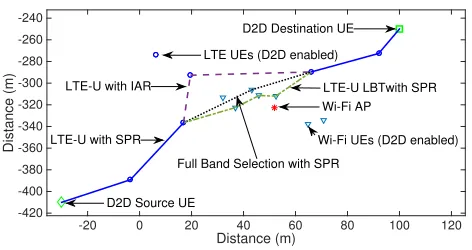
Fig. 4. Routing Paths for D2D (Unlicensed Band Enabled): 1) LTE-U with SPR using LBT contention, 2) LTE-U with IAR to avoid contention, and 3) Full Band Selection with SPR.A single path is shown for illustrative purposes.
nation UE.
In [11], a case study based on a single macro-BS and multiple D2D UEs in Ottawa city showed that the cross-tier interference can be effectively mitigated. In essence, the IAR algorithm will result in a trade-off between improving the performance of each hop and increasing the total number of hops. It was found that the IAR route is approximately 2.5-fold longer than the SPR route on average [11], but the advantage is that the mutual interference between D2D and CC UEs can be significantly reduced and the reliability performance of IAR is superior to that of SPR unless the distance between the source and destination D2D UEs is small. The results in [11] show that there is an intuitive trade-off in the outage probability performance between CC and D2D UEs. For a stringent CC outage constraint, D2D transmission is not permitted. As the CC outage constraint gets relaxed, the optimal D2D routing algorithm changes from IAR to SPR. Aside from the longer route and higher complexity of IAR as compared to SPR, IAR is sensitive to the selection between the UL and DL bands for D2D transmissions and the mutual interference between multiple D2D transmissions in proximity.
B. Routing Scheme for D2D with LTE-U
Base on the above discussion, we propose a routing al-gorithm for LTE-U enabled multi-hop D2D communications. D2D routing decisions are based on SPR wherever LTE-U transmission opportunities are available. The blue solid line in Fig. 4 shows an LTE-enabled multi-hop D2D route based on SPR. If the D2D UE does not get a chance to transmit in the unlicensed bands or the LTE-U transmission cannot fulfill the QoS requirement, then the D2D UE would choose one of the following strategies:
• Wait for a CCA period:the D2D UE holds the data
trans-mission and performs LBT until there is an unlicensed channel available for transmission.
• Perform a localized IAR: the IAR is used for D2D transmissions to hop around the local Wi-Fi APs, thus avoiding contention with Wi-Fi transmissions. Unlike the macro-BSs, there is no clearly defined Wi-Fi cell-edge, and the localized IAR will rely on exchanging channel energy information between UEs and finding a
UE that measures channel energy below the CCA energy threshold.
• Switch to the licensed cellular band: the D2D trans-mission uses the resource block (RB) allocation scheme in [13], where the UL band is viable when the D2D path is far from the nearest BS and the DL band is viable when the D2D path is far from the cell-edge.
The SPR and IAR algorithms (LTE-U enabled) are both distributed algorithms, where the routing decision lies entirely with the relay UE node that currently holds the data packets. Based on 3GPP recommendations 3: the nearest BS acts as a centralized coordination unit that sends regular control commands to either continue D2D communications, or should it fail, establish CC communications. The BS also forwards location updates of the destination UE, so that each relay UE can make accurate route selection choices. In terms of UE velocity, our studies found that as long as it is below high speed train velocities, the speed of the multi-hop routing process is sufficiently fast to be responsive to UE movements.
IV. RADIORESOURCEMANAGEMENT
A. Radio Resource Management for D2D
There exists a trade-off between the efficiency of RRM and the associated overhead (including control and computational overhead) to the cellular network [13]. In a network consisting of multiple concurrent multi-hop D2D links, such overhead might increase out of control and eventually overwhelm the whole network. In [6], the authors presented a theoretical upper bound of the total throughput of D2D communications without optimising RRM. They considered a single cell with the BS at the center of its disk coverage area, where one CC UE and multiple D2D UEs coexist. The CC UE and each D2D transmitter utilise a constant transmit powerPC andPD,
respectively. There is a data rate requirementRDfor each D2D
pair. With these settings, the authors concluded that:
• D2D transmission is prevented when its distance to the BS is smaller than a guard distanceGB to protect the CC
communications. GB increases with PD and decreases
withPC.
• There exists a guard distanceGD between D2D pairs to
guarantee the data rate requirementRD of D2D
commu-nications.GD increases with RD and slightly decreases
withPD.
• There exists a range of PD that maximise the total
throughput of all D2D pairs in the system. The total D2D throughput drops quickly when PD goes beyond
the optimal range.
Optimised RRM mechanisms have been proposed for multi-hop D2D communications. In [14], the distributed RRM mech-anism for multi-hop D2D communications features reduced overhead. In [15], the authors proposed a network coding and caching mechanism for improving the throughput and
3Study on architecture enhancements to support Proximity-based Services
Wi-Fi busy; cellular free. Wi-Fi busy; cellular busy. Wi-Fi free; cellular free/busy. w/o cellular free w/o cellular busy w/ LTE-U both
11.87 11.75 24.2
Idle D2D
Reuse CC LTE-U
w/o LTE-U w/ LTE-U (1) w/ LTE-U (2) w/ LTE-U (3)
11.75 0.45 1.8 0.94 w/o LTE-U w/ LTE-U (1) w/ LTE-U (2) w/ LTE-U (3)
11.87 0.45 1.8 10.89
(1) (3)
(2) (2) (2)
(1) (3)
(2) (2) (2)
CC UE
[image:6.612.64.551.58.227.2](Mbps)
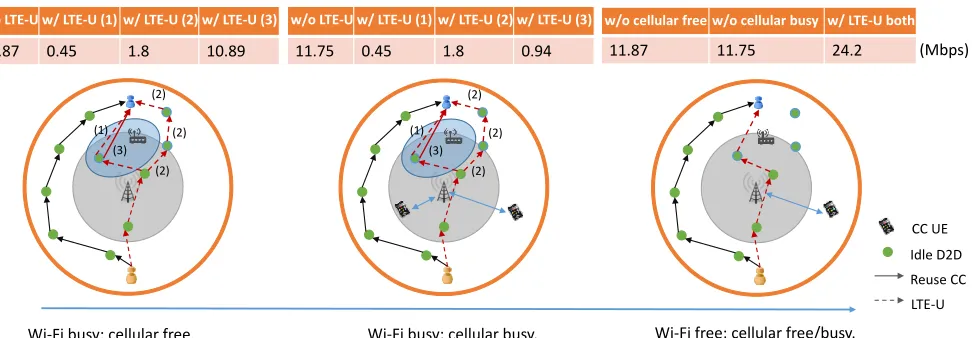
Fig. 5. Throughput performance in different scenarios. The black solid lines denote the D2D routes without LTE-U, the red lines represent the D2D routes with LTE-U enabled (a solid line denotes a D2D link utilising the cellular band, and a dashed line represents a D2D link using unlicensed band(s)), and the blue lines show the CC communications.
decreasing transmission delays of multi-hop D2D. The two-stage semi-distributed RRM mechanism in [13] limits the overhead through:
1) RB allocation (long-term scheduling): the BS conducts a centralised RB allocation for both CC and D2D UEs periodically (e.g., several seconds).
2) Power control (short-term scheduling): after the RB allocation, each D2D UE decides the transmit power based on its own channel measurements.
Although this semi-distributed RRM mechanism was proposed for single-hop D2D communications, we can modify it to be used for multi-hop D2D communications: 1) in the first stage, RBs are allocated to all hops; and 2) in the second stage, each hop performs power control based on local channel measure-ment. In the following, we will illustrate how this algorithm can be adopted for LTE-U enabled D2D communications.
B. Joint Routing and Radio Resource Management for D2D with LTE-U
Following the analysis in [6], we note that the vacuum area for D2D communications (i.e., the disk area centered at the BS with radiusGB) can be filled up if D2D communications
are allowed to utilise unlicensed bands (see the strategies in Section III-B). Furthermore, the averageGDcan be decreased
by combining D2D and LTE-U, because the guard distance required between a D2D pair utilising licensed band and one using unlicensed band is small. Based on the RRM mecha-nism [13] and incorporating the routing algorithm proposed in Section III-B, we propose the following joint routing and RRM mechanism for LTE-U enabled multi-hop D2D:
(1) Stage one: location updating and channel allocation.
Each D2D transmitter would first try to use unlicensed bands and may fall back to the licensed band according to the strategies in Section III-B. In that case, the BS would allocate cellular radio resource (e.g., resource blocks in LTE/LTE-A) to D2D communications [13] and update the location information
of UEs periodically (see Section III-B). This is a long-term scheduling considering long-term factors, such as traffic load and UE status, and decisions are made in a centralised manner.
(2)Stage two: power control and routing.Each UE decides
its transmit power according to its channel state. If the D2D transmission utilises unlicensed bands, it may choose any transmit power PD ≤ Pmax, e.g., based on a water-filling algorithm for maximizing throughput [13]. D2D communica-tions utilising the licensed band may follow the power control schemes discussed in [1], [14], [15]. The UE also choose its receiver according to the strategies proposed in Section III-B. These are short-term scheduling decisions considering the time-varying wireless channel and are thus performed in a distributed manner.
V. PERFORMANCEANALYSIS
In Fig. 5, we evaluate the throughput performance of LTE-U enabled D2D communications in different traffic load scenarios through simulations in a network consisting of one cellular BS and one Wi-Fi AP. For LTE-U enabled D2D communications, the transmission period t is set as 1ms. In the scenarios with ’Wi-Fi busy’, we compare the three routing strategies for LTE-U enabled D2D: (1) wait for a CCA period, (2) LTE-U IAR, and (3) switch to the cellular band, as proposed in Section III-B. D2D communications in the cellular band use the IAR algorithm and the RRM mechanism proposed in [14], which can be summarised as: a) the UL CC UE transmits at a power level that keeps its SINR ataΓC
when there is no D2D transmission, whereΓCis the UL SINR requirement for CC UEs anda >1is a control parameter; and b) the D2D UE transmits at a power level that keeps the SINR of the interfered CC UE aboveΓC.
than 100% to 24.2Mbps). However, when the traffic load of Wi-Fi is heavy, D2D communications should utilise the licensed cellular band with IAR. This is mainly because of the low probability of D2D accessing the unlicensed bands and the mutual interference between Wi-Fi and D2D transmissions in unlicensed bands due to spectrum sensing errors in the LBT process. If a multi-hop D2D route needs to go through a busy Wi-Fi hotspot, it is better to switch to the cellular band (i.e., strategy (3)).
VI. CONCLUSIONS ANDOPENCHALLENGES
In this article, we have examined how two emerging cellular technologies can merge together and create synergies. Whilst D2D communications underlaying cellular networks can po-tentially improve the network capacity of a conventional LTE network, it lacks the full spatial flexibility due to cross-tier interference. Combining D2D with LTE-U, we have shown that D2D can operate across the full coverage area of a network and achieve improved network-wide capacity. We note that there are several challenges in combining D2D communications with LTE-U. In terms of performance versus fairness, it is obvious that a longer transmission period t for D2D communications utilising unlicensed bands can improve the throughput performance of D2D communications. As we can see from the results, in the Wi-Fi busyscenario, a longer t is critical to the throughput performance of LTE-U enabled D2D communications. However, a longer t might affect the performance of nearby Wi-Fi APs and users. Thus an efficient algorithm should be proposed for choosing an appropriate t.
A number of cross-RAT joint optimisation and coordina-tion challenges remain when combining D2D with LTE-U.
Routing and RRM are still the paramount challenges for the combination of D2D communications with LTE-U. A more capable algorithm, such as ant colony optimisation and graph theory [10], may be used to develop joint routing and RRM mechanism for LTE-U enabled D2D communications. In Wi-Fi free scenario, LTE-U enabled D2D communications can achieve a very high throughput due to the plenty of spectrum available and the possible use of maximum transmit power, where it would be valuable to discuss the trade-off between throughput and energy efficiency.
REFERENCES
[1] L. Wei, R. Hu, Y. Qian, and G. Wu, “Enable device-to-device communi-cations underlaying cellular networks: challenges and research aspects,”
IEEE Commun. Mag., vol. 52, no. 6, pp. 90–96, June 2014.
[2] Z. Zhou, M. Dong, K. Ota, J. Wu, and T. Sato, “Energy efficiency and spectral efficiency tradeoff in Device-to-Device (D2D) communica-tions,”IEEE Wireless Communication Letters, vol. 3, no. 5, Jul. 2014. [3] 3GPP, “RP-140808: Review of Regulatory Requirements for Unlicensed
Spectrum,” Alcatel-Lucent, Alcatel-Lucent Shanghai Bell, Ericsson, Huawei, HiSilicon, IAESI, LG, Nokia, NSN, Qualcomm, NTT Docomo, Technical Report, 2014.
[4] R. Zhang, M. Wang, L. Cai, Z. Zheng, and X. Shen, “Lte-unlicensed: the future of spectrum aggregation for cellular networks,” Wireless Communications, IEEE, vol. 22, no. 3, pp. 150–159, June 2015. [5] Q. Ye, M. Al-Shalash, C. Caramanis, and J. Andrews, “Resource
optimization in Device-to-Device cellular systems using time-frequency hopping,” IEEE Transactions on Wireless Communications, vol. 13, no. 10, pp. 5467–5480, Jul 2014.
[6] M. Ni, L. Zheng, F. Tong, J. Pan, and L. Cai, “A geometrical-based throughput bound analysis for device-to-device communications in cel-lular networks,”IEEE Journal on Selected Areas in Communications (JSAC), vol. 33, no. 1, pp. 100–110, Jan 2015.
[7] S. Wang, W. Guo, Z. Zhou, Y. Wu, and X. Chu, “Outage Probability for Multi-hop D2D Communications with Shortest Path Routing,”IEEE Communications Letters, Sep. 2015.
[8] G. Parissidis, M. Karaliopoulos, T. Spyropoulos, and B. Plattner, “Interference-aware routing in wireless multihop networks,”IEEE Trans-actions on Mobile Computing, vol. 10, no. 5, pp. 716–733, May 2011. [9] H. Min, J. Lee, S. Park, and D. Hong, “Capacity enhancement using an interference limited area for device-to-device uplink underlaying cellular networks,” IEEE Transactions on Wireless Communication, vol. 10, no. 12, pp. 3995–4000, 2011.
[10] Y. Li, C. Song, D. Jin, and S. Chen, “A dynamic graph optimization framework for multihop device-to-device communication underlaying cellular networks,”IEEE Wireless Commun., vol. 21, no. 5, pp. 52–61, October 2014.
[11] H. Yuan, W. Guo, and S. Wang, “Emergency route selection for D2D cellular communications during an urban terrorist attack,” in IEEE International Conference on Communications Workshops (ICC), Sydney, Jun. 2014, pp. 237–242.
[12] C. Lin, S. Yuan, S. Chiu, and M. Tsai, “Progressface: An algorithm to improve routing efficiency of GPSR-like routing protocols in wireless Ad hoc networks,” inIEEE Transactions on Computers, vol. 59, no. 6, Jun. 2010, pp. 822–834.
[13] D. H. Lee, K. W. Choi, W. S. Jeon, and D. G. Jeong, “Two-stage semi-distributed resource management for device-to-device communication in cellular networks,”IEEE Trans. Wireless Commun., vol. 13, no. 4, pp. 1908–1920, April 2014.
[14] B. Kaufman, J. Lilleberg, and B. Aazhang, “Spectrum sharing scheme between cellular users and ad-hoc device-to-device users,”IEEE Trans. Wireless Commun., vol. 12, no. 3, pp. 1038–1049, March 2013. [15] Y. Wu, W. Liu, S. Wang, W. Guo, and X. Chu, “Network coding in