warwick.ac.uk/lib-publications
Original citation:
Ortiz Gonzalez, Jose Angel, Ran, Li, Mohamed Motalab Ali Soli, A., Davletzhanova, Zarina,
Alatise, Olayiwola M., Mawby, P. A. (Philip A.), Borong, Hu, Zheng, Zeng, Hai, Ren, Li, Hui and
Shengyou, Xu (2016) Enabling high reliability power modules : a multidisciplinary task. In:
International Symposium on 3D Power Electronics Integration and Manufacturing,
McKimmon Center, Raleigh, NC, USA, 13-15 June 2016
Permanent WRAP URL:
http://wrap.warwick.ac.uk/83998
Copyright and reuse:
The Warwick Research Archive Portal (WRAP) makes this work by researchers of the
University of Warwick available open access under the following conditions. Copyright ©
and all moral rights to the version of the paper presented here belong to the individual
author(s) and/or other copyright owners. To the extent reasonable and practicable the
material made available in WRAP has been checked for eligibility before being made
available.
Copies of full items can be used for personal research or study, educational, or not-for profit
purposes without prior permission or charge. Provided that the authors, title and full
bibliographic details are credited, a hyperlink and/or URL is given for the original metadata
page and the content is not changed in any way.
Publisher’s statement:
© 2016 IEEE. Personal use of this material is permitted. Permission from IEEE must be
obtained for all other uses, in any current or future media, including reprinting
/republishing this material for advertising or promotional purposes, creating new collective
works, for resale or redistribution to servers or lists, or reuse of any copyrighted component
of this work in other works.
A note on versions:
The version presented here may differ from the published version or, version of record, if
you wish to cite this item you are advised to consult the publisher’s version. Please see the
‘permanent WRAP url’ above for details on accessing the published version and note that
access may require a subscription.
Enabling High Reliability Power Modules: A
Multidisciplinary Task
J. Ortiz Gonzalez, L. Ran, A. Mohamed Motalab Ali
Soli, Z. Davletzhanova , O. Alatise, P. Mawby
School of Engineering University of Warwick Coventry, United Kingdom
Borong Hu, Zheng Zeng, Hai Ren, Li Hui, Shengyou
Xu
School of Electrical Engineering Chongqing University
Chongqing, China
Abstract — Reliability of power electronic systems is a major
concern for application engineers in the automotive and power system sectors. Power electronic modules are one of the main sources of failure in wind energy conversion systems. Power electronic converters used in wind turbine electric drivetrains, railway traction, more-electric-aircrafts, marine propulsion and grid connected systems like FACTS/HVDC require reliable power devices and modules. Wide bandgap semiconductors like SiC have demonstrated enlarged electrothermal Safe-Operating-Areas compared with silicon devices. However, the reliability of SiC power modules and packages has been identified as an area of potential weakness. Traditional packaging systems have been developed for Si hence the different thermomechanical properties of SiC cause different stresses in the packaging thereby potentially causing reduced reliability. This paper identifies some of the key areas for the development of reliable power electronic systems using SiC. The focus is on condition monitoring, packaging system innovation and thermo-mechanical stress analysis as a function of the mechanical properties of Si and SiC. Power cycling experiments and finite element models have been used to support the analysis.
Keywords – power module, reliability, SiC
I. INTRODUCTION
Widebandgappowersemiconductorsarenow commercially available and have demonstrated improved electrical or thermal performance compared to silicon devices. These include higher breakdown voltage, higher operating temperature and improved switching characteristics. Applications like railway traction and automotive are already or planning to benefit from the superior performance. SiC discrete devices are widely and commercially available from different manufacturers in traditional TO-247 and TO-220 packages and different manufacturers are moving into SiC power modules and hybrid power modules.
Initial reports show a reduced reliability and lifetime for SiC power modules [1] caused by the different thermomechanical properties of SiC as compared with Si and this is a main issue if SiC modules are to replace Si modules. Improving the reliability of the switching unit/module is one of the main goals of the semiconductor industry, hence some key
challenges have to be addressed. Understanding the different stresses on the package is one of the main challenges. This paper presents an analysis of the different stresses generated in the packaging elements when SiC is the semiconductor used. The importance of identifying the temperature during operation is analyzed in Section III, where the ability of detecting the junction temperature to enable condition monitoring as a tool for extending the lifetime and reliability of the power module is analyzed. Section IV shows initial considerations of a silicon carbide Schottky diode in press-pack, a packaging alternative for SiC where the weaker elements of the packaging system, namely die attach/solder and wire bonds are removed. Section V concludes the paper.
II. POWER CYCLING AND STRESS MAPPING
Power cycling test is a useful tool for obtaining information about lifetime of a packaging system [2] and the reduced reliability of SiC power modules during power cycling identified in reference [1] suggests that the adoption of SiC power modules in several areas where high reliability is a main requirement may not be as simple as it appears to be. The different thermomechanical properties, higher Young’s Modulus and a thicker die of SiC as compared with silicon are the reasons behind the different stresses on the weak elements of the packaging.
In the case of silicon IGBTs [3], recent studies show that even low junction temperature excursions during power cycling can cause damage or accelerate the degradation of the power module if the module has been already aged. Power cycling is a time consuming task and even with accelerated tests, the time required for obtaining meaningful data is a major drawback. There are limited studies on the lifetime of SiC power modules and the work presented in this paper tries to extrapolate the lifetime test data obtained from the power cycling of Si devices to SiC devices
The thermomechanical stresses during power cycling have been modelled for both SiC (CPM2-1200-0080B, Cree) and Si (SiGC41T120R3E, Infineon) devices on the same package. The model used for this analysis is shown in Fig. 1.
The junction temperature during power cycling test (ΔTj=120⁰C, Tjmean=90⁰C), von Mises stress, creep rate and This work was supported by the U.K. EPSRC (EP/K036327/1 and
creep energy density are presented in Fig. 2. The higher stress, strain and strain energy are concentrated in the SiC die-attach solder layer, in the corners of the die, under the same junction temperature profile.
Fig. 1: Package model for power cycling analysis
Fig. 2: Simulated power cycling results
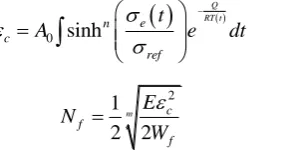
The higher stresses suggest a lower lifetime for the SiC device and a model for predicting the lifetime using simulated data where the “creep strain” is used as a degradation indicator as given by equations (1) and (2) [4].
0 sinh
Q RT t
e n c
ref
t
A
e dt
(1)2 1 2 2
m c
f
f
E N
W
(2)
where Nf is the number of cycles to failure, e is cyclic
thermal stress, c is creep strain and E is Young’s modulus of
the solder layer
The estimated lifetime using FEA simulation data for a Si
[image:3.595.324.539.130.290.2]IGBT and the results for the power cycling of Si IGBT modules [3] are presented in Fig. 3, where it can be seen that the values obtained from the model correlate well with the values obtained from the power cycling experiments. Using equations (1) and (2) and the simulated data for SiC devices, the estimated lifetime is also presented in Fig. 3.
Fig. 3: Experimental and simulated life time estimation
The reliability of the die attach for Si and SiC devices has been evaluated for different junction temperature swings in
Tjmean=90⁰C. SiC lifetime is quadratic correlated to Si under
the same temperature profile. It is much lower for low temperature swings which is expected in practical operation. For ΔTj=90⁰C temperature swings, the lifetime of the SiC
device is only 60% of Si; but as the temperature swing increases, the lifetime of SiC and Si eventually become similar. This implies that SiC could be more problematic in the normal operating range. The results of this model establish a foundation for SiC device reliability assessment and lifetime prediction by learning from previous research on Si devices, and provide theoretical support and technical assistance for SiC packaging design.
III. JUNCTION TEMPERATURE AND CONDITION MONITORING
In the case of SiC Schottky diodes, the electrical properties of a Schottky diode with temperature affect the losses and increase the junction temperature during power cycling [5]. One of the approaches for enhancing the reliability of the power module is monitoring of the operating junction temperature and modifying the operating conditions for achieving an extended lifetime. The junction temperature can be measured using a sensor attached to the die, as industrial organizations like Mitsubishi has done with the all SiC power module for railway traction applications [6], but where this is not possible the ability of identifying the operating junction temperature relies on the use of Temperature Sensitive Electrical Parameters (TSEPs) [7].
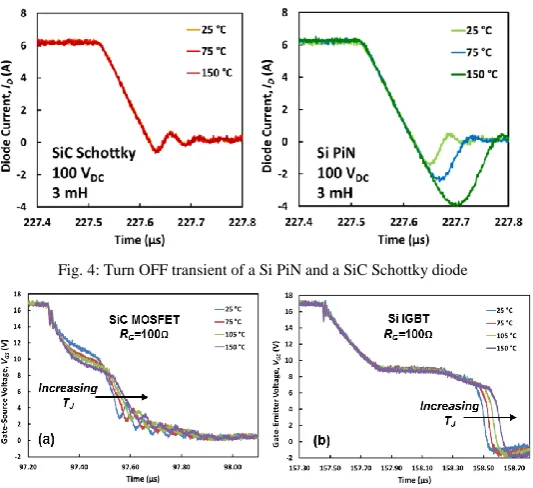
[image:3.595.102.252.577.652.2]able to inject the sensing current through the device. In the case of Si PiN diodes, the behavior of the current during the turn OFF transient is a TSEP that will give information about the temperature of operation during a switching event, but in the case of SiC Schottky diodes the switching transient is not affected by temperature, as it is shown in Fig. 4.
[image:4.595.322.537.167.264.2]The delay of the gate voltage during the turn OFF is a good TSEP for Si IGBTs, as it can be seen in Fig. 5, but it is not as sensitive for SiC MOSFETs, even when a high gate resistance is used in order to increase the time resolution of the turn OFF transient.
[image:4.595.31.298.182.426.2]Fig. 4: Turn OFF transient of a Si PiN and a SiC Schottky diode
Fig. 5: Gate voltage during turning off. SiC, MOSFET (a) Si IGBT (b)
The ability to measure the junction temperature online will lead to the development of a reliable power module and in conjunction with a suitable condition monitoring strategy will reduce the cost of the power electronics system maintenance. Intelligent gate drivers, like that described in reference [8] from Amantys, sensors embedded in the power module, such as micro Rogowski coils [9], and the ability to monitor the gate voltage and current are the key areas of research in order to achieve the reliable switching unit, as well as expanding the knowledge about TSEPs for silicon devices to SiC devices, despite the disadvantages of the lower temperature sensitivity of this wide bandgap semiconductor. An initial consideration on TSEPs for SiC MOSFETs has been presented in [10], but further research on the practical implementation of the proposed TSEPs has to be done.
IV. HIGH RELIABILITY PRESSURE PACKAGING
The normal operation of a power module causes temperature cycling of the elements of the packaging. The different Coefficients of Thermal Expansion (CTE) of the materials in contact generate stresses on the weak elements of the packaging, namely the solders and wire bonds [11], leading to the degradation of the module. Press-pack modules are a packaging alternative where the solder and wire bonds are
removed, which have been used for large area Si thyristors and diodes and IGBT multichip modules.
The enhanced reliability of this packaging system because of the removal of these elements and the feature of failing into short-circuit make SiC press-pack modules a packaging alternative to consider. The evaluation of a SiC Schottky diode has been done using a single chip prototype, in order to analyze its performance. A model of the proposed prototype is presented in Fig. 6.
Fig. 6: Press-Pack SiC Schottky diode model
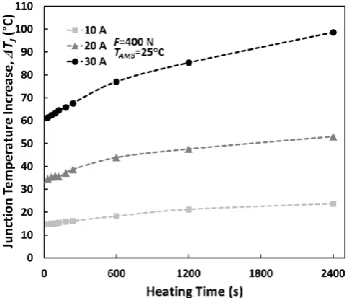
[image:4.595.362.505.430.546.2]There are several challenges related to the machining and the small sizes of the SiC dies compared with the larger area Si devices, where the press-pack package is a clear advantage, like thyristors or diodes. A detail of a multiple chip prototype of a SiC Schottky diode is represented in Fig.7. Press-pack modules allow double side cooling of the semiconductor die and this was one of the main areas of development in the last few years, as double side cooling will increase the power density of the modules. The heat transfer capability depends on the clamping force, as it is presented in Fig. 8 where a single side cooling system was used, but the double side cooling has a higher impact on the junction temperature rise as it is presented in Fig. 9.
Fig. 7: Prototype of a multichip press-pack SiC Schottky diode
[image:4.595.339.524.563.703.2]As can be observed in Fig. 9 and Fig. 10 the impact of the double side cooling would be an important factor for increasing the power density. The junction temperature increase for 10 A and 20 A is considerably lower even for a lower clamping force used, as the results shown in Table I indicate, where a DC heating current is used without increasing the temperature beyond the specifications of the manufacturer.
[image:5.595.77.253.138.284.2]Fig. 9: Junction temperature rise during DC heating. Single side cooling
Fig. 10: Junction temperature rise during DC heating. Double side cooling
TABLE I:TEMPERATURE RISE DURING DC HEATING
DC Heating Current, for 2400 seconds,
(A)
Single Side Cooling F =300 N
Single Side Cooling F =500 N
Double Side Cooling F =400 N
Junction Temperature
Rise (°C)
Junction Temperature
Rise (°C)
Junction Temperature
Rise (°C)
10 39.6 35.5 23.6
20 95.7 85.2 53.1
30 - - 98.6
V. CONCLUSIION
This paper shows the effect of different size, CTE and Young’s modulus of the predicted reliability of SiC and Si power modules. It would be possible to establish a stress mapping between the two types of devices. The SiC is shown to be less tolerant to power or temperature cycling. The temperature sensitive electric parameters of the SiC device are discussed and further research is needed to enable condition monitoring. Press pack with double side cooling is suggested as an alternative technology for high reliability.
REFERENCES
[1] C. Herold, M. Schaefer, F. Sauerland, T. Poller, J. Lutz and O. Schilling, "Power cycling capability of modules with SiC-diodes," Integrated Power Systems (CIPS), 2014 8th International Conference on, Nuremberg, Germany, 2014
[2] L. R. GopiReddy, L. M. Tolbert and B. Ozpineci, "Power cycle testing of power switches: A literature survey," in IEEE Transactions on Power Electronics, vol. 30, no. 5, pp. 2465-2473, May 2015
[3] W. Lai, M. Chen, L. Ran, O. Alatise, S. Xu and P. Mawby, "Low ∆TJ
stress cycle effect in IGBT power module die-attach lifetime modeling," in IEEE Transactions on Power Electronics, vol. 31, no. 9, pp. 6575-6585, Sept. 2016
[4] D. Herkommer, J. Punch, M. Reid, “A reliability model for SAC solder covering isothermal mechanical cycling and thermal cycling conditions”. Microelectronics Reliability, vol. 50, no. 1, pp. 116-126, Jan 2010
[5] J. Ortiz Gonzalez, O. Alatise, N. Nobeen, J. Hu, L. Ran, and P. Mawby, “Electrothermal Considerations for Power Cycling in SiC Technologies”. 9th International Conference on Integrated Power Systems (CIPS), Nuremberg, Germany, 2016
[6] Furuhashi M., Recent developments in high power SiC MOSFETs and modules, ECPE Sic & GaN User Forum “Potential of Wide Bandgap Semiconductors in Power Electronic Applications”, April 2015 [7] Y. Avenas, L. Dupont and Z. Khatir, "Temperature measurement of
power semiconductor devices by thermo-sensitive electrical parameters—A review," in IEEE Transactions on Power Electronics, vol. 27, no. 6, pp. 3081-3092, June 2012.
[8] http://www.amantys.com/igbt-drivers
[9] M. Koga, M. Tsukuda, K. Nakashima, I. Omura, “Application-specific micro Rogowski coil for power modules - Design tool, novel coil pattern and demonstration”, 9th International Conference on Integrated Power
Systems (CIPS), Nuremberg, Germany, 2016
[10] J. Ortiz Gonzalez, O. Alatise, J. Hu, L Ran and P Mawby, “Temperature sensitive electrical parameters for condition monitoring in SiC power MOSFETs” 8h IET International Conference on Power Electronics
Machines and Drives (PEMD), Glasgow, 2016
[image:5.595.74.252.306.455.2]