warwick.ac.uk/lib-publications
Original citation:Harrison, Mark and Zaksauskienė, Inga. (2016) Counter-intelligence in a command economy. The Economic History Review, 69 (1). pp. 131-158.
Permanent WRAP URL:
http://wrap.warwick.ac.uk/71034
Copyright and reuse:
The Warwick Research Archive Portal (WRAP) makes this work by researchers of the University of Warwick available open access under the following conditions. Copyright © and all moral rights to the version of the paper presented here belong to the individual author(s) and/or other copyright owners. To the extent reasonable and practicable the material made available in WRAP has been checked for eligibility before being made available.
Copies of full items can be used for personal research or study, educational, or not-for profit purposes without prior permission or charge. Provided that the authors, title and full bibliographic details are credited, a hyperlink and/or URL is given for the original metadata page and the content is not changed in any way.
Publisher’s statement:
"This is the peer reviewed version of the following article: Harrison, Mark and Zaksauskienė, Inga. (2016) Counter-intelligence in a command economy. The Economic History Review, 69 (1). pp. 131-158. which has been published in final form at.
http://dx.doi.org/10.1111/ehr.12113 This article may be used for non-commercial purposes in accordance with Wiley Terms and Conditions for Self-Archiving."
A note on versions:
The version presented here may differ from the published version or, version of record, if you wish to cite this item you are advised to consult the publisher’s version. Please see the ‘permanent WRAP URL’ above for details on accessing the published version and note that access may require a subscription.
First draft: 26 April 2013. This version: 24 November 2014. Mark Harrison*
Department of Economics and CAGE, University of Warwick
Centre for Russian and East European Studies, University of Birmingham Hoover Institution on War, Revolution, and Peace, Stanford University
Inga Zaksauskienė**
Faculty of History, Vilnius University
Abstract
We provide the first thick description of the counter-intelligence function in a command economy of the Soviet type. Based on documentation from Soviet Lithuania, the paper considers the KGB (secret police) as a market regulator, commissioned to prevent the disclosure of secret government business and forestall the disruption of government plans. Where market regulation in open societies is commonly intended to improve market transparency, competition, and fair treatment of consumers and
employees, KGB regulation was designed to enforce secrecy, monopoly, and discrimination. One consequence of KGB regulation of the labour market may have been adverse selection for talent. We argue that the Soviet economy was designed to minimize the costs.
Keywords: communism, command economy, discrimination, information, loyalty, regulation, security, surveillance, Soviet Union.
JEL Codes: N44, P21.
* Mail: Department of Economics, University of Warwick, Coventry CV4 7AL, United Kingdom. Email:[email protected].
Acknowledgements
Previous versions of this paper were presented to the Warwick conference on the Economic History of Coercion and State Formation, University of Warwick, 31 March and 1 April 2014; the Yale Program in Economic History Conference on Russian, Soviet, and Post-Soviet Economic History: New Frontiers, Yale University, 1 and 2 November 2013, the Hoover Institution workshop on totalitarian regimes, 22 July to 2 August 2013, the Berliner Forschungskolloquium zur
Wirtschaftsgeschichte, 5 June 2013, and the Uppsala Centre for Russian and Eurasian Studies conference “What Have We Learned from the Soviet Archives?” Uppsala, 10 and 11 May 2013. The authors thank Arvydas Anušauskas, Sascha O. Becker, Gregory S. Crawford, Michael Ellman, Paul R. Gregory, Stefan Hedlund, Martin Kragh, Sergei Kudriashov, Naomi Lamoreaux, Peter Law, Andrei Markevich, Steven Nafziger, Leonid Polishchuk, Meelis Saueauk, Robert Service, David Shearer, Peter
First draft: 26 April 2013. This version: 24 November 2014. counter-intelligence.The agencies of the state that are assigned special competence in the sphere of struggle with the intelligence agencies of other states and the disruptive activities of the
organizations and persons that they exploit. C[ounter-intelligence] is one of the instruments of the state’s political power.1
Our goal is to describe the role of the secret police in the Soviet command economy. This topic is entirely missing from the standard textbooks on the subject. The verdict of the late Alec Nove on secret policemen as agents for ‘inspection and control’ is typical:
Nothing needs to be said about them in the present context, despite their importance in Soviet life.2
And in a footnote:
Large Soviet enterprises possessed, and probably still possess, a ‘secret department’ staffed by secret police, which organized a
network of informers. However, they were more likely to be roused by a disrespectful remark about Stalin than by, say, the overspending of the wage fund.
This prompts a question: Is it possible that state security was embedded in the Soviet economy’s basic units, and yet had no serious implications for their working arrangements?
The implications, we will show, were considerable. Using archival records and other sources, we will describe how the KGB (Committee of State Security or secret police) acted as a market regulator. Although this was a command economy, the communist state did not have the capacity to direct every resource from the centre, and it delegated most detailed allocation to internal and external markets. In these markets buyers met sellers, agreed prices, made contracts, and fulfilled them more or less – closely monitored from above.3
1Nikitchenko et al.,Kontrrazvedyvatel’nyi slovar’, p. 142
2Nove,Soviet economy, p. 98.
In market economies, the mission of the regulator is typically to secure benefits for consumers and employees by limiting market power and enforcing transparency and fair treatment. In a command economy, in contrast, everything was the other way around. We will show that KGB regulation in the economy served the ruling party, not the citizen. Instead of limiting market power, the KGB enforced the ruling party’s monopoly of power, including its power over the economy and its monopoly of information. Instead of providing transparency, the KGB enforced the secrecy of government business, including economic secrecy. Instead of fair treatment, the KGB enforced political discrimination in the market for skilled and supervisory employment. Each of these roles carries
significant economic implications.
The paper is organized as follows. Sections I to III consider the relevant literatures and our contribution, which is in the fields of regulation and command economies. In Sections IV to VI we provide background: the nature of Soviet rule, the Soviet conception of counter-intelligence, and KGB organization and resources. Sections VII to X describe the structure and conduct of KGB counter-intelligence in the economy; based on evidence from Soviet Lithuania in the 1960s we explain the role of the KGB in secrecy and management selection and its use of personnel records and surveillance to screen people and
investigate events. This leads to Section XI, which considers the
regulatory burden. Concluding, Section XII asks: what if the KGB had not existed?
I
Our paper contributes to two literatures: on market regulation, and on the working arrangements of command economies.
In market economies, government regulation is often proposed as the solution to market problems. Consumers lose from anti-competitive practices and hidden information, and also when legal contract
enforcement is costly.4Employees suffer unfair redistribution because of employer discrimination, whether preference-based or statistical.5 Regulation can protect citizens by limiting market power, assuring market transparency, and ruling out unfair discrimination.
These are the benefits that market regulation can secure, but then problems come thick and fast. Regulation incurs costs. Given costs as well
4Anti-competitive practices: Pigou,Economics; costly enforcement: Shleifer, ‘Efficient regulation’.
as benefits, economic theory recommends regulation up to a point where the excess of regulatory benefits over burdens is maximized.6The
beneficiaries of regulation, however, are not necessarily the same citizens that will pay the costs. Costs are direct and indirect. The direct costs of the regulator are paid by taxpayers. Regulated firms pass on indirect or compliance costs in higher prices to consumers or lower wages to employees. Finally benefits, like costs, are hard to measure. The chances that the political equilibrium will coincide with the social welfare
optimum are slim.
More generally, regulation is political. Governments and lobbies can use regulation to serve multiple goals, including hidden purposes that may work against the public good. Because of this, Dieter Helm has written, ‘Economics can illustrate the costs and benefits of intervention, but not the desirability’.7
II
In that context we turn to the literature on command economies of the Soviet type. It divides into two streams. Some economists (and economic historians) have set out to investigate the Soviet-type economic system as a whole. Some historians (and economic historians) have focused on particular issues that link security and the economy. Their findings have tended to face in opposite directions.
Most economists have described the Soviet Union as a developmental state that provided public goods and pursued economic growth, although not efficiently.8While this tradition was always willing to acknowledge the Soviet one-party state, the political economy of dictatorship has
6Helm, ‘Regulatory reform’, p. 177; Viscusi, Vernon, and Harrington, Economics, p. 9.
7Helm, ‘Regulatory reform’, p. 171
become more salient in post-Soviet reinterpretations.9From the
economists’ perspective, however, Soviet military power appeared to be just a burden that got in the way of economic goals. The defence burden affected the system’s results, but the system could be understood without it. The fact that the Soviet command economy was used to support a mass army and thermonuclear weapons was incidental to most textbook
stories, as Vladimir Kontorovich and Alexander Wein have noted.10 If the economists somewhat neglected the foreign aspect of a power-building dictatorship, then they entirely overlooked the domestic aspect. State security does not appear in the chapter headings or subject indexes of any textbooks on the Soviet economy or command economies, their economic history and development, or comparative economic systems.11 It is missing from the essays published by the United States Congress Joint Economic Committee in periodic collections on the Soviet economy that were intended to inform U.S. policy makers.12It does not feature in the only readable, entertaining, and otherwise highly accurate novel ever written in English about the Soviet economic system.13
Of course the economists often acknowledged the abundant historical research on the role of state security in periodic waves of repression, the use of detainees for forced labour, the elimination of particular
economists and statisticians, and so forth. In doing so, however, they treated these events more as burdens on the system than as evidence of how the system worked.
9Ellman,Socialist planning(3rd edn); Gregory,Political economy; Gregory and Harrison, ‘Allocation’; Olson, ‘Dictatorship’; see also Wintrobe,Political economy.
10Kontorovich and Wein, ‘What did the Soviet rulers maximize?’
11In addition to those already listed see Campbell,Soviet economic power; Eatwell, Milgate, and Newman,New Palgrave; Jasny,Soviet industrialization; Kaser,Soviet economics; Kaser, ed.,Economic history; Kornai,Economics;Socialist system; Millar,ABCs; Rutland,Myth; Schwartz, Introduction; Wilczynski,Economics. Rare exceptions are a few pages by Joseph Berliner,Factory, pp. 289-293), and a fresh chapter in Ellman, Socialist planning(3rd edn).
12U.S. Congress Joint Economic Committee,Soviet economy in a new perspective;Soviet economy in a time of change;Soviet economy in the 1980s;Gorbachev’s economic plans.
III
Historical research on Soviet internal and external security offers a great contrast to the picture familiar to most economists. Based on evidence from former Soviet archives, the historians have shown that external security considerations were decisive in critical moments of the economy’s development such as Stalin’s decisions to force the pace of industrialization, collectivize agriculture, and resettle, imprison, or execute millions of ordinary people.14
Historians have also documented many issues of Stalin’s time that link internal security with working arrangements in the economy. From the 1920s the secret police were ever-present in the Soviet factory. Stalin distrusted the professional managers on whom he depended for
economic results, expecting them to respond rationally to incentives by lying and cheating (as they did). He employed professionals such as planners and statisticians to monitor the managers and report honestly on trends in the economy; he also set the secret police to monitor managers and other professionals.15
From the 1920s, Stalin used periods of heightened political and economic mobilization to identify and isolate the persons he could not trust. Economic officials were exposed to arrest and punishment when they did not support overambitious mobilization plans and targets, when they did not meet them, or because of some other weakness in their performance or record. From time to time conflicts erupted over the role of the security police in oversight of the economy, as when higher officials sometimes tried to protect their subordinates. Stalin managed these conflicts in such a way as to avoid any challenge to his position.16
On one interpretation, Stalin used the apparatus of state security to manage the economy and control underperformance through terror.17 While this might have been an element in individual cases, it does not
14Barber and Harrison, eds.,Soviet Defence-Industry Complex; Harrison, ed.,Guns and rubles; ‘Communism’; Ken,Mobilizatsionnoe
planirovanie; Khlevniuk, ‘Objectives’; Samuelson,Plans; Simonov, Voenno-promyshlennyi kompleks; Schneider,Structure; Stone,Hammer and rifle; Velikanova,Popular perceptions.
15Belova and Gregory, ‘Dictator’; Markevich, ‘How much control’.
16Davies,Industrialisation, vol. 3, pp. 339-241; vol 4, pp. 82-84; vol. 6, pp. pp. 303-306.Gregory,Terror, 121-124; Kuromiya,Stalin’s industrial revolution, pp. 162-172, 175-186.
explain the waves of repression that broke over the economy. These were largely unrelated to economic performance. R. W. Davies has shown that when Stalin was preparing the Great Terror most economic information reaching the Politburo was favourable.18The peaks of repression are more reasonably linked to times when heightened anxieties about foreign enemies increased Stalin’s desire to deal with the enemy within.19
The implication is that, when Stalin’s secret police intervened in the economy, their purpose was to manage loyalty, not economic
performance. This distinction is not watertight, because Stalin’s secret police could and did look into plan failure for evidence of disloyalty. If they believed they found it, however, their response was to remove the disloyal elements from the situation, not to repair the plan, for which Stalin used other agencies.20
Using terror to manage disloyalty, Stalin held onto unrivalled power until his death in 1953. The costs were severe, however. Repeated purges not only destroyed millions of lives, but also extended upwards into the higher ranks. Information flows to the centre were continually
compromised by fear and because private grievances intruded into many enquiries. For Stalin’s successors, reform of state security became a top priority. The KGB (1954 to 1991) was the outcome of this reformist impulse.
To summarize, domestic security was built into the Soviet economic system in its formative years. The Stalin years do not foretell how this worked in later years, however, because post-Stalin leaders were
resolved to put a stop to mass terror and they reformed state security to embody their resolve. For this reason, the role of state security in the Soviet economy under the KGB requires fresh evidence. The evidence is available from those former Soviet states, such as Lithuania, that have broken decisively with the communist past and have opened their KGB archives.
Our contribution is to describe the KGB as a market regulator of the mature command economy. Markets persisted under the command system because the government did not have the capacity to direct many resources in detail from above, and instead organized or allowed internal markets in which buyers and sellers were authorized or allowed to do
18Davies, ‘Soviet economy’.
19Harrison, ‘Dictator’. On Stalin’s fear of a domestic ‘fifth column’ in 1937 see Khlevniuk, ‘Objectives’. On the 1920s see Simonov, ‘War scare’; Sokolov, ‘Before Stalinism’; Velikanova,Popular perceptions.
business subject to regulation. The command economy had well-known market regulators that planned the contracts, approved the prices and wages, set the working conditions and quality standards, collected statistics, audited accounts, and evaluated outcomes. Behind the scenes was another regulator, the KGB, which supervised the economy’s key facilities and their employees and intervened so as to forestall threats to the security of the regime and suppress disruption of its plans.
IV
We provide relevant background by describing what is known today about the system of Soviet rule, the Soviet concept of counter-intelligence, and the organization and resources available to the Soviet
counter-intelligence agency – the KGB and especially its second administration. Our primary evidence is documentation of the Soviet Lithuania KGB held in Vilnius, Lithuania, and also (on microfilm) in the Hoover
Institution at Stanford University in California. The Hoover Archive holds a million pages of plans, reports, correspondence, and other
documentation of the Soviet Lithuania KGB from 1940 to the 1980s.21 This evidence is supplemented by a secondary literature contributed by Lithuanian historians on the KGB in the system of Soviet rule.22
From the documentation available we focus on the 1960s and early 1970s. In these years Soviet rule grappled with new questions of politics and economics. The political question was: How to rule? Stalinist violence
21 See the Lietuvos SSR Valstybės Saugumo Komitetas (KGB) Selected Records collection of the Hoover Archive, described at
http://www.hoover.org/library-and-archives/collections/east-europe/featured-collections/lietuvos-ssr (accessed 14 May 2014). The originals of these records are to be found in the Lithuanian Special Archives (Lietuvos ypatingasis archyvas) in Vilnius, described at
http://www.archyvai.lt/en/archives/specialarchives.html (accessed 14 May 2014).
22Anušauskas, ‘Du aspektai’; ‘KGB reakcija’;KGB Lietuvoje;
Burinskaitė, ‘Buvusių kalinių’; ‘Kompromitavimas’; “Dezinformacinė veikla’; ‘Slaptosios tarnybos vieta’; ‘KGB propagandinės akcijos’; Grybkauskas, ‘Industrial management’; ‘Soviet dopusk system’; ‘State-security clearance’; ‘Nomenklatūrinis sovietinės Lietuvos pramonės valdymas’; ‘KGB veikla’; ‘Second Party Secretary’; ‘Sovietine
had been replaced by a softer, more paternal authoritarianism. Would this continue to assure political stability?
The economic question of the time was: How to grow? Since the 1930s Soviet rulers had searched for mechanisms that would combine
mobilization with efficiency. In the 1960s the search became public with open critiques of overcentralized authority and proposals to delegate it from Moscow to the regions and from ministers to firms and managers.23
In this context we consider Lithuania, one of the smaller Soviet republics, with a 1970 census population just over 3 million. Four out of five residents were of local ethnicity; the remainder were Polish and Russian. Lithuanian ethnicity was strongly linked with Roman Catholicism and memories of nationhood. From 1918 until the Soviet annexation of 1940, Lithuania was independent (and a province of the Russian Empire before that). From 1940 to 1953 Lithuania suffered repeated border changes, occupations, armed resistance, killings, and deportations.24Only after 1953 did Lithuania become peaceful again.
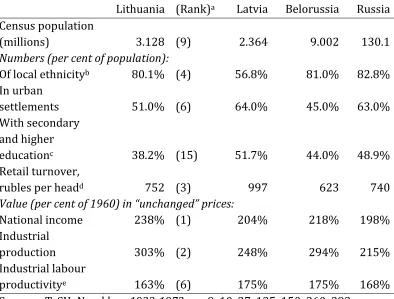
In the 1960s Lithuania was just a part of the Soviet economy, which was still experiencing its postwar Golden Age. The sharp productivity slowdown of the mid-1970s was yet to come. According to official statistics (summarized in Appendix Table A-1), Lithuania’s population was less urbanized and less educated than elsewhere in the Soviet Union. Despite this, average living standards in Lithuania (measured by retail turnover per head in government stores) were no worse than in other Soviet regions and probably better. The Lithuanian economy was growing and industrializing faster than others.
Considered strategically, Lithuania had an importance in the Soviet Union beyond its size.25A KGB status report of 5 January 1966 is typical. It lists Lithuania’s strategic location, the deployment of nuclear weapons (military facilities ‘of special importance’) on its territory, the presence of important industrial and scientific facilities, the barely-suppressed
memory of a free and independent Lithuania, the existence of a large nationalist emigration in Western Europe and North America, and
23Kibita,Soviet economic management; Kontorovich. ‘Lessons’; Markevich and Zhuravskaya, ‘M-form hierarchy’; Schroeder, ‘Soviet economy’.
24Reklaitis,Cold War Lithuania; Statiev,Counter-insurgency; Weiner and Rahi-Tamm, ‘Getting to know you’.
growing contact through letters and tourism between Lithuanians and foreigners, many with family ties. According to the report, the number of people maintaining correspondence with relatives abroad is 430,000 (or one in seven of the resident population). There are 12,000 citizens claiming German ethnicity. The number ‘returning to the republic’ (i.e. freed from imprisonment and exile to distant provinces after the death of Stalin) is given as 20,000, including 8,179 formerly active nationalists and pro-German collaborators, of whom 784 are being watched. Also under surveillance are 132 ‘former agents’ of the imperialist powers.26
While some security risks (such as the lingering presence of the ageing prewar generation) should have diminished over time, others were
growing. Rising numbers were permitted to travel between Soviet Lithuania and the ‘capitalist and developing countries’ on business or for tourism.27Still, the annual total never exceeded 20,000, so by modern standards Lithuania was extraordinarily isolated.28
The special risks suggest that, when we study Soviet rule in Lithuania, we should first ask what we expect to find: a microcosm of Soviet rule in general, or a particular case of colonial rule at the periphery? While some of Lithuania’s risks were specific, the template of rule that managed them was the same one that Moscow used throughout the Soviet Union. This template was effective because it did not require any special talent or sensitivity to cultural differences to make it work. Ordinary people could operate it effectively, and it would be effective anywhere with little or no adaptation: Register the population, recruit an agent network to keep watch over it, seize public and private records and lock them away, eliminate former elites, establish a state monopoly of housing and business, and control or suppress schools, the media, and all civic and cultural organizations. The template was tried and tested in Russia, Ukraine, and Central Asia between 1917 and1939.29Between 1939
26Hoover/LYA, K-1/3/644, 1-22 (Col. Obukauskas, chief of Lithuania KGB second administration, report dated 5 January 1966).
27Anušauskas,KGB Lietuvoje, p. 71
28In 2011 Lithuania received more than one million visitors from European Union countries (so not counting visitors from Russia), as reported inVakarų ekspresas, 29 June 2012, at
http://www.ve.lt/naujienos/ekonomika/ekonomikos-naujienos/uzsienieciai-pernai-lietuvoje-keliavo-daugiau-768088/ (accessed 10 September 2013).
and1953 it was applied to new Soviet borderlands and extended to Eastern Europe.30
If this does not sufficiently rule out the colonial-rule hypothesis, it can be further tested in other ways. Ethnic discrimination in Soviet political selection could be taken to support the idea of colonial rule. This was the case at higher levels. In the non-Russian republics Moscow’s practice was to appoint a person of local ethnicity as the first party secretary and a Russian as second secretary to act as ‘governor-general’.31This practice persisted through the Soviet period.
At lower levels of the command system, in contrast, the evidence is that ethnic discrimination was indirect and transitory. When the Baltic KGBs were first established, for example, Russian personnel
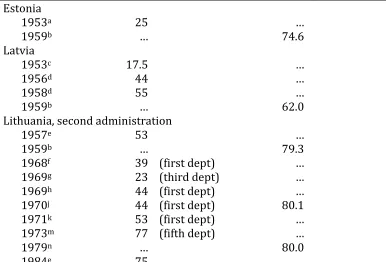
predominated. This was predictable: regardless of nationality and residence, KGB officers had to be party members, they could not have remained on occupied territory during World War II, and they could not have emigrants or armed resisters to Soviet rule as close relatives. At first such criteria excluded most local residents from recruitment to the Baltic security services. Evidence from the archives, although incomplete, suggests that the local nationals’ share in KGB personnel converged on their underlying population shares over time – rapidly in Latvia, more slowly in Lithuania (see the Appendix, Table A-2). This tends to argue against the idea of colonial rule.
As for the economy, there is no sign of colonial exploitation.
Lithuanians experienced the same command regime as others. By Soviet standards, as already discussed, the Lithuanian economy grew and prospered.
To summarize, while our evidence base pertains to Lithuania, and many Lithuanians considered themselves to be in a state of colonial subjugation, our message is not about colonial rule. It is about Soviet rule in general. When the KGB responded to events in Lithuania, its actions followed the same pattern that was established everywhere under Soviet rule, including in Russia itself.
V
A standard KGB source from our period defines counter-intelligence as:
30Applebaum,Iron curtain; Reklaitis,Cold War Lithuania; Statiev, Counter-insurgency; Tannberg,Politika Moskvy; Weiner and Rahi-Tamm, ‘Getting to know you’.
The agencies of the state that are assigned special competence in the sphere of struggle with the intelligence agencies of other states and the disruptive activities of the organizations and persons that they exploit.32
The documented principles of Soviet Lithuania KGB activity show that the KGB saw the threat posed by ‘the intelligence agencies of other states’ as having two elements: spying and ‘disruption’. Seen in these terms, the mission of KGB counter-intelligence was then preventive: to eliminate spies and suppress disruption.
As far as spying is concerned, the sphere of information classified as secret was much larger in the Soviet Union than in most states.33Virtually any information-gathering that went outside a narrow range of
authorized channels of enquiry could be called into question.
Despite this, the KGB of Soviet Lithuania caught few spies. As a senior officer noted (in 1968):
Since 1958 we have not identified any cases of the undercover placement of hostile agents on the territory of the republic.34
A wider goal of the adversary, however, was considered to be to establish direct or indirect influence over people that were hostile or confused with the aim of achieving ideological, political, or economic disruption. This extension was important because, even if few hostile agents were caught, evidence that they might be present was easily found in frequent signals that the KGB received concerning events and persons that might be classed as disruptive.
When the KGB received signals of potentially hostile activity, it evaluated them using an implicitly statistical methodology of detection. This methodology was rooted in the early history of the Soviet internal security police, until 1934 the OGPU (later NKVD).35From May 1931, the OGPU centre required local departments to submit two streams of reports. Ordinary reports were produced monthly on the basis of
32Nikitchenko et al.,Kontrrazvedyvatel’nyi slovar’,p. 142.
33Described by Harrison, ‘Accounting’.
34Hoover/LYA, K-1/3/663, 62 (undated transcript). See also Hoover/LYA, K-1/3/664, 14-23 (Lt. Col. Matulionis, chief of second division of third department of the Lithuania KGB second administration, report dated 24 April 1968).
summative statistics of activity. Extraordinary reports took the form of event-based narratives. Local officials asked the centre why it required both. Shearer continues:
The two types of reporting were necessary, explained an OGPU official patiently. These reports functioned together to not just to report crime, criminals, and police informant activities, but to build a ‘normal’ profile of a region, and then to identify crimes that ‘fall outside the ordinary pattern’.
Only this comparison would enable police officials:
To identify and isolate, immediately and easily, any out of the ordinary activities, and the social types associated with those activities.
Here can be seen a statistical concept of prevention that started from the implicit probability that a person or an event represented a security threat. This concept of threat perception strongly reflects the ‘dictator’s dilemma’: as the ruler’s power increases, so does the care with which the subject hides inner feelings of disaffection that might lead to hostile thought and action.36At the point when disloyalty is expressed openly, the dictator’s position is already threatened. To detect disaffection and forestall resistance, the dictator must watch for early warnings and act on them, even if there is a lot of noise and many false alarms.
When this concept was put into practice, we will see, the result was the profiling of persons and the screening of events. Persons were profiled on the basis that disloyal people as a group have shared
characteristics. These shared characteristics could then identify a person that might be disloyal, allowing the KGB to intervene to isolate the person or change their behaviour. The identifying characteristics could be
markers of past political weakness or guilt, based on historical records, or they could be signals of current alienation or hostility, derived from surveillance.
Events could be screened in the same spirit. This was a command economy, vulnerable to disruption by any event not previously authorized by a directive or plan. The mission of KGB operatives, in the words of one officer, was to watch out for ‘processes that are essentially anomalous, that is, incorrect, deviating from the general rule of processes and
phenomena’.37In Vilnius in 1968, as in Moscow in 1931, it was events that ‘fall outside the ordinary pattern’ that could signal the presence of the enemy. Once identified, abnormal events could be investigated, leading to clarification of those responsible and their motives and connections.
The search for the hidden hand of the enemy at work could be frustrating. Typical culprits were as you might expect: natural causes, negligence, or private malice without political significance. It was hard to find a case where sinister forces were truly at work. A KGB department chief lamented one year:38
In 1966 in the facilities of the republic no serious hostile
manifestations orChP[chrezvychainye proizshestviya, emergency situations] have been identified.
Most likely the KGB shared the existential anxiety that afflicts other public organizations with a preventive commission: How do you know you’ve averted something that hasn’t happened yet? When do you know you’ve done enough? And how do you justify the resources you have?
VI
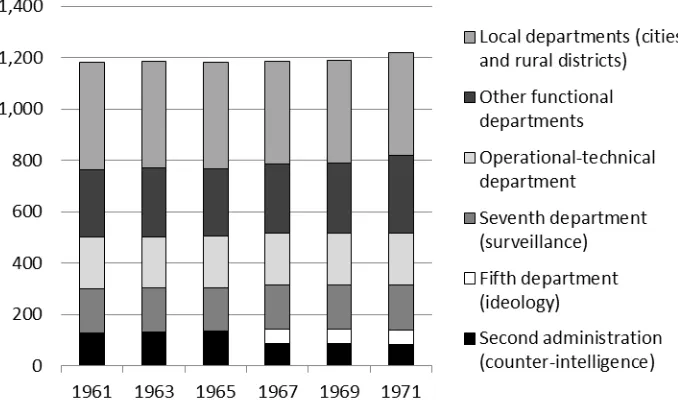
The main resources available to the Lithuania KGB were its salaried workforce and largely unpaid agent network. As far as employees are concerned, Figure 1 shows that throughout the 1960s the KGB had a static complement, numbering fewer than 1,200 officers, other ranks, and civilians. Around 140 of these were specially tasked with
counter-intelligence under the KGB second administration (including the KGB fifth department for ‘ideology’, hived off from the second administration in
37Hoover/LYA, K-1/3/664, 14-23 (Lt. Col. Matulionis, chief of second division of third department of the Lithuania KGB second administration, report dated 24 April 1968).
38Hoover/LYA, K-1/3/654, 1-9 (Lt, Col. Sudzilovskii, chief of third department of the Lithuania KGB second administratin, report 20 January 1967). The general experience recalls a parallel in the Federal
investigations of ‘sabotage’ (FBI Classification 98) in the United States in the eras of World War II, the Korean war, and the Vietnam war (described by Haines and Langbart,Unlocking the files, p. 97): ‘In almost all cases … no wilful acts of sabotage were discovered. Upon investigation the Bureau usually found most of the cases revolved around labor disputes and attempts to organize unions in plants, disgruntled workers, juveniles, and greedy entrepreneurs who sought extra profits by providing the
1967). But in practice most of those working in other units, for example, for surveillance and eavesdropping, and in the local departments in every town and rural district, worked in support of counter-intelligence
activities most of the time.
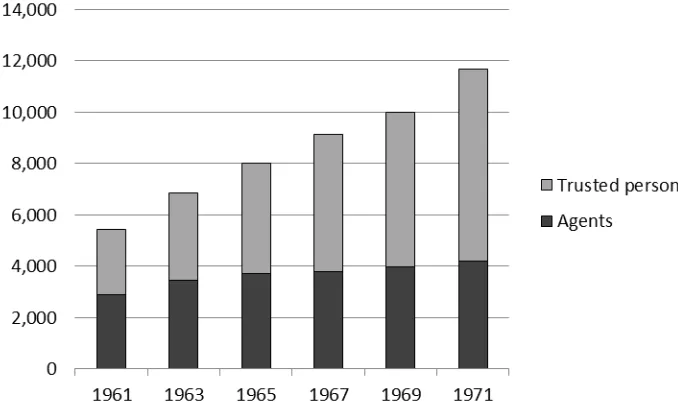
The primacy of counter-intelligence is clear from evidence on the size of the informer network, shown in Figure 2. Informers fell into two categories, agents (whose relationship with the KGB was formalized by signed agreements and codenames) and ‘trusted persons’ (who had not signed anything and were known by initials). Nearly all informers were supervised directly by the second administration or indirectly through local units.39Informers were much more numerous than salaried KGB staff and, unlike the latter, they increased rapidly through the 1960s.
In a country of three million people the small number of KGB career operatives may surprise, but it should not. The KGB was a core element of the system of power, both as a channel of information and as an
instrument of unlimited authority. A large KGB could have threatened the personal authority of the Soviet Union’s rulers. From Stalin’s time, Soviet rulers knew the value of keeping such organizations small and close, with a tight rein on budgets and personnel.40
Table 1 puts KGB resources around 1970 in perspective. Soviet Lithuania had approximately four KGB officers and informers per thousand residents. Lithuania’s figure is above the three per thousand found in the Soviet Union in the 1930s, but far below the 17 per thousand East Germans in the last year of their society’s existence. Poland was sparsely policed by comparison with the others, but the density of
39One resource that does not enter into Figures 1 or 2 is the small numbers (between 8 and 10 throughout the 1960s and 1970s) of
supernumerary operatives (vneshtatnye operativnye sotrudniki), usually officers of the KGB and Soviet Army reserves, that the KGB placed in the secure facilities that it supervised. As described by Nikitchenko et al. (1972: 55), their role was to coordinate the agent network, enforce the regime of secrecy, assist with surveillance, and so on. There were ten supernumeraries in 1964/65, 8 in 1971, and 9 in 1979: LYA, K-41/1/644, 97-105 (Col. Sudzilovskii, chief of third department, Lithuania KGB second administration, reported dated 31 January 1966); K-41/1/688, 147-154 (Col. Naras, chief of Lithuania KGB second administration, report dated 19 April, 1971); K-41/1/755, 138a-148 (Col. Grishechkin, chief of third department, Lithuania KGB second administration, report dated 10 February 1979). See also Burinskaitė and Okuličiūtė, eds., KGB slaptieji archyvai, pp. 52-61.
surveillance rose rapidly towards the end. On present knowledge these differences are unexplained.
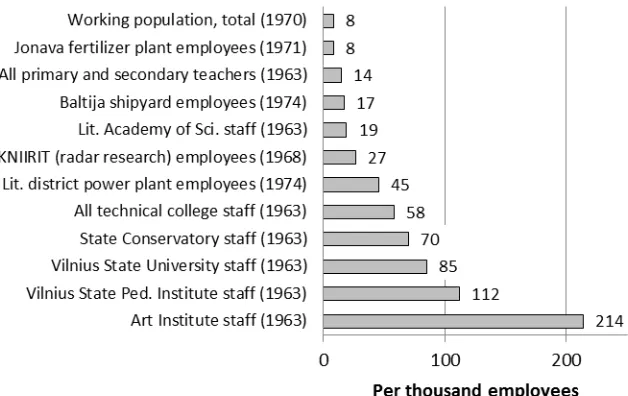
By implication, surveillance assets were a scarce resource. How were they allocated? If KGB assets were spread smoothly across Lithuania’s working population, the result would have been 8 per thousand in every workplace. Figure 3 shows that the KGB economized by concentrating informers on the places where educated young people were likely to gather: schools, colleges, research institutes, and secure facilities. By implication, many backwaters were left unobserved. Given that allocation, a relatively small complement was evidently enough to keep Soviet
society quiet for most of the time. ‘Most of the time’ may not have been good enough in the long run, but even the Stasi could not hold East Germany down forever.
Like many organizations with a preventive mission, the KGB made little or no attempt to measure the efficiency with which it used its assets. Occasionally we find indicators of activity or case-load. As Table 2 shows, data were reported from time to time through the 1960s on verified alerts, cases (and persons) under investigation, and persons prosecuted. The numbers do not support an image of information channels crowded with signals and vigilant officers worn out by heavy case loads. In the later sixties, as the dissident movement got under way across the country, the average officer of the Lithuania KGB was having to deal with a couple of signals during the year and was faced with perhaps one investigation. Prosecutions per officer were trivially low. In the course of a year only one in four agents and trusted persons was providing an alert that turned out to have operational importance. Where the change in case load
indicators over time is known, they were falling.
VII
The KGB was embedded in the economy through the second (counter-intelligence) administration’s third department. According to a document of January 1966 the third department (26 operatives) was responsible for work on the railways and air transport, important industrial facilities, research institutes, and civil defence organizations. It also regulated the regime of secrecy; it gave or refused clearance for access to classified documents and employments, and it supervised foreigners when they were visiting economic facilities.41The third department is therefore at the focus of our study.
41Hoover/LYA, K-1/3/644, 39-47 (Col. Obukauskas, chief of Lithuania KGB second administration, report dated 31 January 1966). Other
The third department’s responsibilities included building the agent network; assigning staff and informers to carry out surveillance at secure facilities with a particular focus on employees with access to government secrets; preparing for visits and exhibitions; and lecturing the workers at every opportunity to watch out for suspicious behaviour and be on their guard against ‘the adversary’s ideological diversions’.42
The raison d’être of the third department in Lithuania deserves brief attention. Saulius Grybkauskas has pointed out that, while a number of facilities located in the republic were engaged indirectly in defence work, as a relatively agrarian border province Soviet Lithuania did not have any of the specialized final producers of military equipment that would
normally qualify the KGB to establish a third department in Vilnius.43In their absence, the local KGB justified the existence of a third department with reference to the presence of approximately 2,000 politically
unreliable persons in the industrial workforce.44As détente set in, KGB reports consistently detected heightened activity on the part of hostile forces and among foreign specialists. The implication Grybkauskas draws is that the local KGB was protecting its resources.
The personnel of the third department were probably a cut above the average KGB officer. In 1977 three quarters of third department officers
operatives), responsible for foreigners and nuclear weapons; the second (47 operatives), responsible for anti-Soviet organizations, the Catholic Church, intellectuals, and young people, and the fourth (18 operatives), responsible for penetrating hostile agencies and networks. In 1967 a nationwide initiative reorganized the second administration’s second department as the KGB fifth department for ‘ideology’.
42For a plan of work setting out objectives of the third department see Hoover/LYA, K-1/3/664, 1-13 (Lt. Col. Akimov, chief of third department, Lithuania KGB second administration, report dated 4 March 1968). For an assignment of officers to secure (and some non-secure) facilities, see Hoover/LYA, K-1/3/664, 111-119 (Lt. Col. Akimov, chief of third
department, Lithuania KGB second administration, report dated 18 June 1968). Lecturing the workers: Hoover/LYA, K-1/3/656, 87 (Summary of report on reinforcement of the regime of secrecy at facilities of industry, communications, and transport, etc., dated 24 February 1966);
K-1/3/668, 4-13 (Major Trukhachev, chief of Kaunas city KGB third division, report dated 12 February 1969); K-1/3/668, 179 (Major Trukhachev, chief of Kaunas city KGB third division, report dated 9 December 1969).
43Grybkauskas, ‘KGB veikla’.
had college degrees and all had experience of secondary schooling.45This compares well with the wider Lithuanian population, where less than 40 per cent of those aged 10 and over had higher and secondary experience according to the 1970 census (see the Appendix, Table A-1).
A similar judgement applies to the third department’s informer network. In 1968 it comprised 239 agents and trusted persons. The typical informer was an engineer, with higher education, aged 25 to 50 years and with 5 to 15 years’ experience as an informer. Most had no foreign language (all but 25), and no relatives abroad (all but 16), and most were clear of compromising evidence on themselves or close relatives (all but 13). Only five had been recruited under pressure (‘by means of compromising evidence’).46
What did it mean to be a secure facility under KGB surveillance? As Kristina Burinskaitė describes it, the territory of a closed facility was screened and secured from outsiders. Workplace conversations were monitored and employees’ contacts with visitors were controlled. Foreign visitors were excluded or, if admitted, were shown equipment and
products designed to mislead, while secret activities were temporarily suspended.47
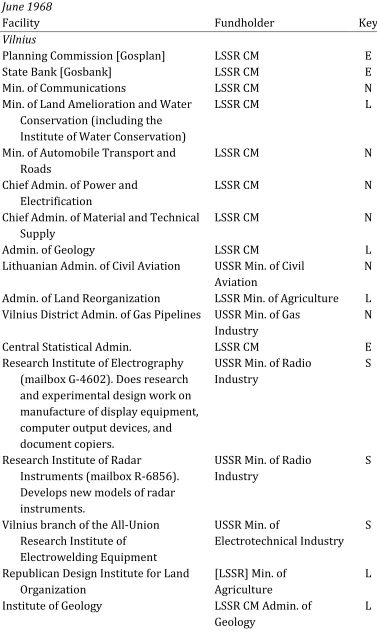
What kind of facilities were secure? In 1968 there were 107 (listed in Appendix Table A-3). We classify them in five categories:
Economic regulators(3 facilities): Lithuania’s planning commission, branch of the USSR state bank, and statistical administration.
Science-based facilities(34 facilities): R&D services and electronic products.
Location-based activities(26 facilities): civil defence, border security (including ports and airports), and topographical activities involving maps and aerial surveys.
Network utilities(37 facilities): power, gas, and water, and railway, highway, mail, and cable and wireless services.
45Grybkauskas, ‘KGB veikla’, p. 100.
46Hoover/LYA, K-1/3/670, 92-94 (1968).
47 Burinskaitė, ‘Dezinformacinė veikla’, p. 101). Such visits required approval by the government in Moscow, after consultation with the KGB and Soviet Army general staff: Hoover/LYA, K-1/3/670, 29-30
Heavy industry plants(7 facilities): such as shipyards and fertilizer factories.
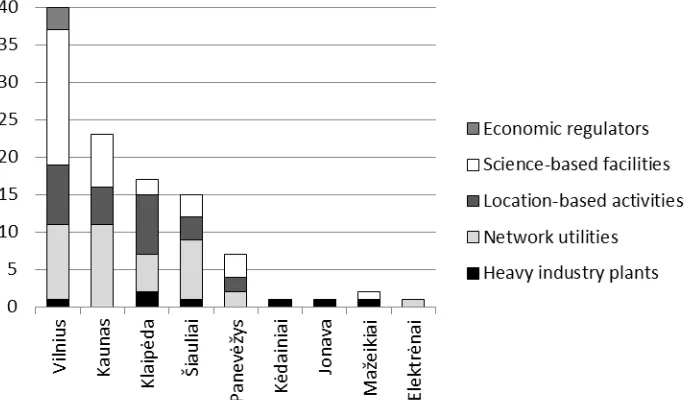
These facilities were distributed among Lithuania’s largest urban districts as shown in Figure 4. In this centralized society cities, industries, and political power had common origins, and the prominence of the capital city is not surprising. Thus Vilnius had a monopoly of the economic regulators. More generally, we compare the distributions of facilities (in 1972) and of the urban population (in the 1970 census). On that basis, as noted under the figure, three other concentrations stand out: science-based facilities in Vilnius, location-based activities in Lithuania’s seaport Klaipėda, and network utilities in Šiauliai, a staging post for missile troops.
Employment statistics place the ‘secure facilities’ and trends affecting them in context. Figure 5 shows that the secure facilities accounted for less than one tenth of the Lithuanian public-sector (roughly, non-farm) workforce, but its growth rate (10 percent annually) was much above that of the public sector as a whole (6 percent annually). Employment at the ‘specially important’ defence subcontractors was growing particularly fast (more than 12 per cent annually). Security clearances for the
‘specially important’ facilities were also growing at 10 percent annually. The only slow-growing segment of the secret sphere was the KGB-regulated non-industrial facilities (such as railways).
What did the third department actually do? Soviet regime security The relied on a capacity to block unauthorized channels for information and action of any kind. The KGB administered interlocking mechanisms that upheld this capacity, including enforcement of the secrecy of government paperwork, security clearance of personnel for access to secret business, and continuous KGB screening of persons and events for signs that would lead to investigation and intervention. We describe those systems before asking: if they did not exist, then what?
VIII
We begin with secrecy. A regime of secrecy governed official documentation, based on ‘conspirative norms’.48Every Soviet
organization received secret plans and other instructions from higher authority through a secure channel, maintained by its first or ‘secret’ department. This, not listening for ‘a disrespectful remark about Stalin’, was the ‘secret’ department’s primary function. In turn, the first
department was staffed by party members and supervised directly by the
KGB third department. Thus, the KGB enforced the regime of secrecy throughout the economy.
When KGB third department officers came visiting, they inspected the secret department and checked the storage and handling of secret
correspondence for compliance with instructions (which were also secret). The instructions assured the security of secret documents at every stage from creation through transmission and storage to destruction.
Because government business was secret, no one could exercise management responsibility in the Soviet economy without access to secret documentation. This access depended on security clearances that were issued by the KGB third department. In effect there was a segment of the Soviet labour market where cleared personnel were supplied and demanded – and supply fell persistently short.
The overall number of security clearances in Soviet Lithuania is known only for particular years and sectors. In 1979, according to Grybkauskas, 14,000 personnel had clearance at the highest level, ‘top secret (special file)’.49This was around 1 per cent of the public-sector workforce.50Those cleared at lower levels were presumably more numerous. We know (from Figure 5) that in the elite facilities of ‘special importance’ around one quarter of the workforce was cleared for access to paperwork classified at any level, but this proportion was presumably above the average.
On the evidence of Figure 5 the number of positions requiring access to secrets was growing rapidly. Combined with the normal turnover of employees, this implied a significant demand for new security clearances. In 1973 the third department issued a total of 4,257 clearances.
Sometimes clearance was refused, blocking a person’s further career. The average rejection rate in 1973 was 7 percent.51
The clearance system faced the KGB with two problems, both of which arose from the economy. One was the growing demand for clearances, which strained KGB resources; the other was that rejections caused problems for managers, who were reluctant to enforce them.
49Grybkauskas, ‘Soviet dopusk system’, p. 80.
50In 1979 the Lithuanian public sector employed 1,435,000 ‘workers and staff’ (TsSU,Nar. khoz. 1979, p. 390).
Rising demand for cleared personnel was driven by both real growth and inflation.52Real growth was driven by the underlying expansion of the secret sphere. This expansion was driven by the steady, year-on-year growth of Soviet defence spending, combined with the secure facilities’ supply privileges which enabled them to grow at the expense of their environment. Alongside real growth went a kind of grade inflation. Security classifications were arbitrary to some extent, and caution led to over-classification, so that new lines of work were classified while old lines were not declassified. There were growing numbers of requests for clearance from facilities that were not secure but had links with secure facilities that they could not develop without clearance to visit. Finally, there was high turnover among cleared employees, whose replacements had to be put forward for clearance.53The inflation was countered by periodic reviews that cut back the number of posts requiring clearance: for example, by 30 percent in industry and science across Lithuania in 1963, as Figure 5 confirms.54
In the market for cleared personnel, supply fell short of demand. The evidence of shortage is that the KGB kept uncovering persons without security clearance in chains of secret correspondence. When they were identified, managers resisted instructions to exclude them and tried to avoid compliance by means of delay and negotiation.
Full compliance with the clearance system was an impossible goal. Managers regularly nominated people for clearance whom the KGB considered obviously unsuitable.55The clearance process was time consuming, and sometimes took so long that managers admitted
promotion candidates to secret correspondence before their status was determined. When the outcome was rejection, the director’s first
headache was to explain reversal of the appointment to the candidate by
52 Discussed by Grybkauskas, ‘Nomenklatūrinis sovietinės Lietuvos pramonės valdymas’, p. 36.
53Hoover/LYA, K-1/3/654, 112-13 (Major Trukhachev, chief of Kaunas city KGB third division, report dated 12 October 1967).
54 Hoover/LYA, K-1/3/654, 122 (Col. Petkevičius, chairman of
Lithuania KGB, report to the KGB second administration in Moscow, dated October 1967).
poor conduct or performance; the KGB could not be mentioned.56When clearance was refused, managers not infrequently ignored the outcome.57
According to Grybkauskas, the KGB had limited capacity to manage or discipline passive resistance.58Directors appeared to survive conflicts with KGB officers without suffering lasting career damage, implying that it was worse to fail over the plan than to fail over security. On several occasions, for example, the KGB supervisor instructed the Elfa electrical engineering factory director to remove politically unreliable employees from their duties. The director was reluctant to comply, given the
difficulty of replacing them. He successfully exploited the turnover of KGB supervisors to delay action continuously, in one case for almost twenty years. This marks a dramatic change in the political atmosphere since Stalin’s time, when to ignore the NKVD was to sign your own death warrant.
To summarize, by the 1960s it was feasible to work around the KGB. At the same time, ‘feasible’ does not mean ‘costless’. To play games with state security surely took time, patience, and nerve. Notably, while the KGB could be put off, there is no evidence that its officers could be bought off. There are no cases on file of corrupt side-payments and no evidence suggesting regulatory capture.
IX
KGB security clearance for appointment to management positions was based on personal data collated from records and surveillance. Records supplied historical evidence, while surveillance added new signals. The collective term for this information was ‘compromising evidence’ (kompromat), so-called because it raised some question mark over the person’s loyalty. Loyalty could be put in question by a person’s
circumstances or actions. Kompromat provided the KGB with the evidence base for it to discriminate over candidates for sensitive
56Hoover/LYA, K-1/3/654, 101-104 (Lt. Col.Žilinskas, chief ofŠiauliai KGB, report dated 16 September 1967).
57Hoover/LYA, K-1/3/664, 24 (Lt. Col., Snakin, deputy chief of Kaunas KGB,report dated 11 April 1958.); K-1/3/664, 29-36 (Col. Petkevičius, chairman of Lithuania KGB, report to the Lithuania communist party central committee dated 7 May 1968); K-1/3/670, 45-49 (Lt. Col. Žilinskas, chief ofŠiauliai KGB, report dated 30 January 1969).
employment and at other gateways such as applications for foreign travel.59
We extract more detailed insight into kompromat and discrimination from a small person-level dataset. In December 1972 the KGB of
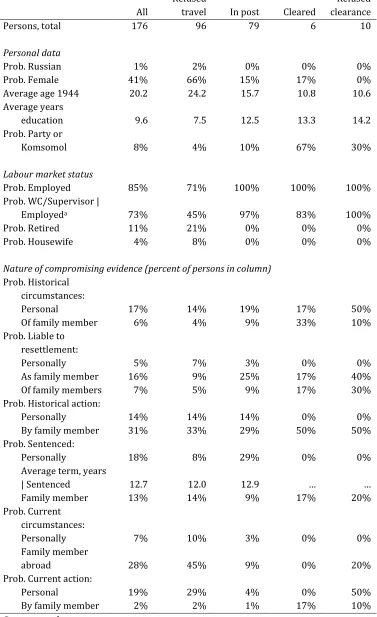
Panevėžys (1970 census population 73,000) sent Vilnius details of 176 persons on whom their files held kompromat. The lists were compiled to respond to a request from the centre, based on concern about the extent to which people with kompromat were being granted access to sensitive employment and foreign travel. Listed separately were 6 persons cleared for ‘top secret’ documentation (and therefore holding senior positions) in spite of the evidence; 10 persons refused clearance because of the
evidence, but still retaining the senior positions for which clearance had been sought; 96 persons refused permission to travel abroad because of the evidence; and 79 persons occupying senior positions in spite of the evidence. (The numbers sum to 191 but there was some double-counting, so 15 people were listed twice.) With a few gaps the lists provide each person’s full name (and so gender and ethnicity), year of birth, level of education, party or Komsomol membership, occupational status and/or position, and a summary of the kompromat in each case.
The dataset is surely not the population of all those in KGB files, even in a small market town. As a sample it would not be random or
representative. The people in it were chosen because they held relatively important positions or because they had applied to travel abroad; neither makes a typical citizen. Still the sample is suggestive of what the KGB saw as ground for suspicion.
In Table 3 we classify the reported evidence along two dimensions: historical versus contemporaneous, and circumstantial versus voluntary action. As the table shows, the 176 people were the subject of 321 reports. Just over half the reports (167) could be classified as historical and
involuntary, that is, the evidence reflected circumstances of the distant past over which the subject had never had any control, such as conditions into which they were born or that were created by the action of others. The next largest categories related to contemporaneous circumstances (65) and voluntary actions that belonged to the historical past (55). Only one tenth (34) concerned voluntary actions that were current or recent. But since these 34 reports were associated with 34 distinct persons, they also represented one fifth of the 176 people in the sample. Some examples illustrate the numbers.
Historical/circumstantial evidence (16 7 signals).The subject was born into a family of the pre-Soviet urban or rural elite; or was liable to resettlement under Soviet occupation in their own right or as a family member; or a family member collaborated with the German occupation or resisted the Soviet occupation, or fled the country after the war; or a family member was sentenced for ‘state crimes’.
The KGB’s focus on past repression was well founded. Working from a survey of Soviet war refugees in Europe and America, Inkeles and Bauer, created a measure of their respondents’ underlying (as opposed to superficial) hostility to the Soviet system and looked for determinants in their life histories.60They found that the single most important factor in hostility was ‘experience of arrest by the secret police of oneself or a family member’.
Contemporaneous/circumstantial evidence (6 5 signals).The subject was in touch with a relative abroad, who might be (but did not need to be) linked to anti-Soviet activity); or had a family member at home who was known to grumble about the regime; or was employed at or lived close by a secure facility. Having a relative abroad created a Catch-22. You want to travel to Germany because your brother is there. But the fact that your brother is there will be held against you as
kompromat. Thus, the reason that you want something becomes the grounds on which it will be denied.
Historical/voluntary hostile action (55 signals).In the past the subject collaborated with the German occupation or resisted the Soviet occupation, or had been sentenced for ‘state crimes’ in their own right. Of course many of those that supported German occupation acted under some degree of coercion; equally, it’s debatable to what extent voluntary action was required for a conviction under Stalinist laws on counter-revolutionary crimes. Still, rightly or wrongly, many Lithuanians did have pro-German sympathies in wartime or chose to resist Soviet rule so this classification seems more reasonable than any other.
Contemporaneous/voluntary hostile action (34 signals).Finally, the subject violated Soviet norms of behaviour or demonstrated
disaffection by attending church; or by openly expressing anti-Soviet views; or by having unauthorized contact with foreigners.
We learn more by sorting the sample on the criterion of
contemporaneous/voluntary hostile action. In other words, what were the average characteristics of those that were showing a bad attitude in the present, by comparison with those that were living under the shadow of past or present circumstances they could not control?
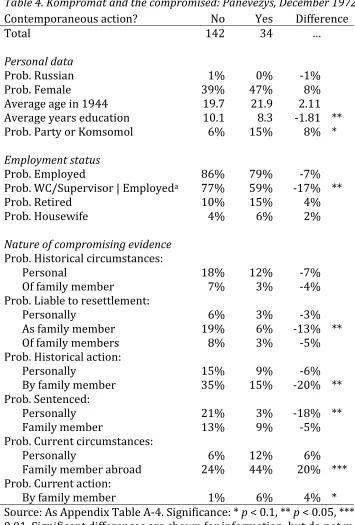
Table 4 shows that those engaging in current or recent actions that the regime considered hostile were two years older and with two years less of education. They were substantially more likely to be female and to have relatives abroad. On all measures they werelesslikely to carry historical markers of disloyalty. This is a product of selection, not of the age
difference, which has the ‘wrong’ sign (one would expect older citizens, having lived longer before Soviet rule, to have worse, not better histories.) Two differences are suggestive, however. One is that those engaged in current hostile activity were more likely to have relatives abroad. Another is that they were somewhat more likely to be party or Komsomol
members.
Beyond a few sums, the KGB did not do data analysis. What would it have given them? Most likely, what they knew already from direct
experience: People whose families were expropriated or penalized in the past often harbour grievances in their hearts. Those that carry the stigma of hostile social origins or associations have mostly learned to keep their mouths shut, but some of the others have not. Party membership can be a cover for disloyalty. Some of those that have won a party card against the odds think it gives them a license to say what they like.
X
Events, like people, could be profiled and categorized. One duty of the third department was to identify events that were abnormal, and therefore emergencies or ‘ChP’ (chrezvychainye proizshestviya) for investigation. These events were, by definition, deviations from the plan decreed by the party. Here more than anywhere, we see that the life of the KGB officer was just one damn thing after another. Emergencies were numerous and frequent. In the fields, a hayrick burned.61A train was late or derailed. Factory equipment was damaged or employees were
harmed.62Whose hand was at work? Did it belong to the foreign
61 Hoover/LYA, K-1/3/627, 251-255 (Petkevičius, deputy chairman of Lithuania KGB, report dated January 1964); K-1/3/637, 37-40 (Lt. Col. Jankevičius and Lt. Col. Kardanovskii, deputy chiefs of Lithuania KGB investigation department and second department of the second administration respectively, undated report).
62Hoover/LYA, K-1/3/668, 61-62 (Lt. Col. Sarpalius, chief of Mažeikiai district KGB, report dated 21 May 1969); 74-75 (Lt. Col. Sarpalius, chief of Mažeikiai district KGB, report dated 15 May 1969); 80-82 (Lt. Col.
adversary, or to some unnoticed person under their influence? Every event was logged and investigated.
Unsolved cases were like toothache; they lingered, could not be ignored, and were often hard to clear. Perhaps in the New Year of 1966 Lithuania KGB chief Randakevičius could celebrate:63
Much attention has been given to work on cases of unsolvedChP. This was to implement the USSR KGB Collegium’s decision of 27 February 1965. As a result, clarity has been achieved and measures adopted in seven cases of unsolved crime.
A different kind ofChPwas industrial conflict. Here the agency was always human. Significant stoppages were exceptional; go-slows, and walk-outs at the shop level were more frequent (but sometimes poorly distinguished from supply breakdowns). A brickworks inŠiauliai district suffered a strike in February 1968; three shifts, 150 person-days, and 7,500 rubles of output were lost. The KGB reported the immediate cause of the strike as a fall in output leading to non-payment of bonuses for January. The fall in output was in turn traced to … well, everything that was wrong with the Soviet economy: ‘fuel shortage, supply of frozen materials to the workshop, poor labour organization, lack of showers for workers to wash after the shift, late provision of supplementary dinners, and the combine management’s insensitive and abrasive attitude to the workers’.64(No surprises there.)
Of greater interest is a dispute at a parts factory in Ukmergė district. In February 1969 the management decided to compensate for
overspending the wage fund by cutting piece rates. The workers went on strike; a shift was lost. The Ukmergė KGB rushed to the scene. KGB Captain Ivanov held talks and listened to all sides. The managers’ decision, he concluded, was correct, but it should have been introduced more gradually and with more consultation. Ivanov made
recommendations: the managers must improve communication, and the workers must return to work. The strike leaders had would be punished;
KGB third department (sic), undated report); 128 (Lt. Col. Lesitskas, chief of Kėdainiai district KGB, report dated 9 December 1968).
63 Hoover/LYA, K-1/3/643, 1-16 (Maj. Gen. Randakevičius, chairman of Lithuania KGB, report to the USSR KGB in Moscow dated 7 January 1966).
one was a former state criminal.65So, it seems, Alec Nove was half right: the KGB was not interested in ‘overspending of the wage fund’ as such – but it was interested in overspending if the result was disruption and conflict.
XI
While distributing benefits to the regime, KGB regulation was costly. Costs were direct and indirect. Based on the records of the regulator, we can show only the direct costs. The Lithuania KGB was a small
organization, employing one per thousand of the workforce, so the direct costs of KGB regulation could not be large.
Indirect costs may have been much greater. The KGB was small, but the work of complying with its own directives on secrecy has been put at one third of staff time.66This implies that regulated facilities also incurred high compliance costs. But only the records of the regulated facilities will pin this down, so it must await future research.
The literature on regulation in market economies recognizes that the regulator is likely to know less about costs than the firm that is regulated. Because of this, regulation may have unintended consequences. Acting on ignorance, regulation can incentivize firms to raise costs, dilute quality, or underinvest in necessary infrastructure.67
Applying these ideas to the Soviet context, we think of KGB regulation in the labour market as a mechanism that changed the incentives of managers and employees. We consider each in turn.
On the side of managers, KGB security clearance raised the cost of recruiting qualified personnel. In order to avoid delays and other difficulties, managers had an incentive to recruit personnel on known loyalty before known competence. This would be bad enough if loyalty and incompetence were unrelated, and worse if they were correlated. Egorov and Sonin have considered the loyalty-competence trade-off under a dictator who values competence, but fears the challenge of
enemies and betrayal by his nearest supporters, and fears them more, the more competent they are. For this reason, they write, ‘loyalty and
65 Hoover/LYA, K-1/3/668, 26-27 (Lt. Col. Galvidis, chief of Ukmergė district KGB, report dated 5 March 1969).
66Harrison, ‘Accounting’.
incompetence are two sides of the same token’.68The implication is that the dictator will select adversely for talent.69
On the side of employees, KGB selection created more disincentives. It raised the personal risk associated with investment in skills and
qualifications because no one could be sure that that the KGB did not hold some marker of disloyalty that would be used sooner or later to deny promotion. For some employees the risk of exposure of a dubious record could become a reason to avoid gaining the competences that would put them in line for promotion. KGB regulation made a quiet life in a low-skill, low-wage environment preferable to seeking distinction and risking the scrutiny that would follow.
Adverse selection of human capital and disincentives to acquire it in the first place sound bad for human capital formation and economic performance. But the command system was designed to minimize the downside. The Soviet was organized to supply the means of national power, such as capital goods and munitions, in the age of mass production. Vertically integrated, standardized production relied on managers with literacy, numeracy, basic training, and people skills; there was no return to unique talents or entrepreneurial vision.70As long as this model remained globally competitive, the command economy could afford to forego some of the human capital and suppress some of the talent that would otherwise have been supplied. The ‘chief adversary’ was the United States, after all, and the US economy also does not appear to have recruited the brightest and the best for industrial management in the 1950s and 1960s.71
The age of standardized mass production was coming to an end, however. It began a century earlier as transport and communication costs fell to a level, ‘neither prohibitive nor trivial’, that allowed production to be centralized and controlled on a large scale.72As costs fell further, the Soviet economy had to face the flexible production and services
revolution that would transform the market economies. It is hard to
68Egorov and Sonin, ‘Dictators’.
69Likewise Brus,Socialist ownership, p. 200, concluded from
experience that communism tended to ‘negative selection’ of personnel for ‘servility and conformity’.
70Thus Berliner,Factory, emphasized networking as a key skill of the Soviet manager, along with mastery of ‘simulation’ and the ‘safety factor’.
71Halberstam,Reckoning; Johnson, ‘Managing’.
imagine the labour market of a ‘post-industrial’ economy working well under KGB regulation.
There is no evidence, though, that the KGB ever looked into the hidden costs or unintended consequences of its counter-intelligence role. These were questions that no one needed to ask.
XII
Why should economic historians pay attention to the secret police in the command economy? A short answer is that secret policemen paid much attention to economic matters. Why and how and with what implications for the working arrangements and performance of the command system are questions that have rarely been posed.
The counter-intelligence function of the KGB was embedded in the Soviet economy through the officers and agent network of the second administration’s third department. Through its third department, the KGB became a regulator of the command system.
Like a market regulator in an open society, the KGB had preventive and protective functions. There the similarity ends. Where a market-economy regulator might aim to shield the citizen from monopoly power, the KGB’s mission was to shield the regime by preventing the leakage of government business and hostile disruption of the planned economy. Where a market-economy regulator might work to reduce unfair
treatment and information asymmetries, the KGB acted to enforce secrecy and political discrimination.
The KGB carried out its preventive mission by profiling persons and screening events for markers of hostile influence or disloyalty. Its objectives were to prevent disloyal persons from gaining access to government business and to suppress their influence over events.
The significance of an organization can be judged by what might have happened if it did not exist. Open societies are continually ‘disrupted’ because competent citizens who are critical of the ruling order intrude into government business so that its business is leaked, triggering demands for public accountability. Independently of the government, people join together to change the status quo with disruptive innovations, or to resist corporate plans and government policies. In the command economy all these activities were classified as disruptions that ought to be suppressed, and it was the special function of KGB counter-intelligence to suppress them.
Put that way, our question has a clear answer. Without an
would have become known to the citizens. Unofficial representatives would have demanded explanations and even a say.
In order to preserve the Soviet command hierarchy, KGB counter-intelligence imposed regulatory burdens, as yet unmeasured, on the economy. Compliance costs were large enough that we find some
evidence of evasion. There was also a cost to human capital formation in the systematic exclusion of talented, potentially disloyal citizens from selection for management. But the command economy, just like state security, was designed to be managed by ordinary people with basic training; it did not demand gifted free-thinkers.
Our subject suggests several avenues for future research. To the extent that previous scholarship has ignored the counter-intelligence function, it has neglected to measure the burdens associated with it. KGB records give us reason to think these burdens existed, but do not tell us how large they were. Research in the records of the facilities that were regulated by the KGB may shed further light.