http://wrap.warwick.ac.uk/
Original citation:
Alexander-Craig, I. D. and Wilson, D. H. (1987) CONFER : a knowledge system for
bio-process control. University of Warwick. Department of Computer Science. (Department
of Computer Science Research Report). (Unpublished) CS-RR-103
Permanent WRAP url:
http://wrap.warwick.ac.uk/60799
Copyright and reuse:
The Warwick Research Archive Portal (WRAP) makes this work by researchers of the
University of Warwick available open access under the following conditions. Copyright ©
and all moral rights to the version of the paper presented here belong to the individual
author(s) and/or other copyright owners. To the extent reasonable and practicable the
material made available in WRAP has been checked for eligibility before being made
available.
Copies of full items can be used for personal research or study, educational, or
not-for-profit purposes without prior permission or charge. Provided that the authors, title and
full bibliographic details are credited, a hyperlink and/or URL is given for the original
metadata page and the content is not changed in any way.
A note on versions:
Research
report
103
-CONFER:
A
KNOWTEDGE
SYSTEM
FOR
BIOPROCESS
CONTROT
loln
D
Croig
&
Dovld
H
Wilson
(RRr03)
Abshocl
The
control ond
monitoring
of
fermentotion
proceses
iso
knowledge-intensive ocifuity
which
requires
the
opplicotion
of o
consideroble
body
of
expert
knowledge.
Thispoper
describes
ond
motlvotes CONFER,
o
knowledge
system
for
reol
time
bioprocess
monitoring
ond control.
CONFERcontoins
o
blockboord
problem-sotving
system
whlch
lsougmented
by
o
declorotlve knowledge bose
ond
o
collectlon
of
process
models,
The system
uses
the
knowledge bose
ond
models
to
improve lts
problem-solving
performonce.
CONFER ls designed
to
be occountoble,
so
detoiled
explonotions
of
ltsoctivitles ore
essentiol. Unlike
other
systems.
explonotion
isthe
bosis
of
the system deslgn
ond
portlolly motivotes
the
inclusion
of the knowledge
bose
ond
the
Incluslon
of
the
knowledge
bose
ond
process
models.
Deportment
of
Computer Sclence
University
of
Worwick
Coventry
CV4
7AL,
UKCONFER: A KNOWLEDGE
SYSTEM FOR BIOPROCESS
CONTROL
Iain D. Craig and David H. Wilson Department of Computer Science,
University of Warwick,
Coventry CV4 7AL,
UK
I.
INTRODUCTION
The control and moniroring
of
fermentation processes is a knowledge-intensive activity and requires rhe applicarionof
a considerable bodyof
expert knowledge. The CONFER system is concernedwith
thercal-time control
of
a barch fermentation process, informing the user of the state of the process and recom-mending an optimum lime to haruest the product. In addition, CONFER canjustify
its actions and explainwhat is happening
in
the process at various levels of detail. In order to perform thisusk, it
is necessaryfor
the system to include extensive knowledge
of
the fermentation process, the kinds of data available from thefermentor and the exp€rt knowledge required to use this data to infer the current state of the process.
The
system usesthe
blackboardmodel
of
problem-solving@rman,
1975; Feigenbaum, 1978;Hayes-Roth, 1983;
Nii,
1986a; Craig, 1987a) to perform the monitoring and control functions. The black-board model was chosen becauseit
is oneof
t}re most powerful and flexible problem-solving architecruresknown.
The architecture allows reasoning processes to be interfaced to extemal processes such asthe ability to reason using many, different kinds of knowledge. Additionally,
it
allows explicit access to alldecisions made and actions taken during the problem-solving process: such
explicit
access is requiredfor
explanation.
The
CONFER
prototype is being designed to control and monitor ilre productionof
p-galrctosidasefrom a mixed medium. This prccess was selected because it is well understood and because it embodies the
problems generally found
in
fermentation processes. Although there are no direct commercial applicationsof this particular process, its fundamenul properties are universal
o
this class of problem.The structure
of
this paper is as follows.In
the next section, we outline the enzyme productionpro-cess at operon level. Section three
briefly
describes the blackboard architecture. Section four is concernedwith
therole
of
explanationin
CONFER. Thefifth
section presents an overviewof
ttre architectureof
CONFER. The final section recapitulates the main points of the paper.
I.l.
AcknowledgementsThe authors would
like
to express their gratitude to Anthony Richardsof
ttre Departmentof
Biologi-cal Sciences, University of Warwick, our domain expert without whom this project would not be possible.
2.
STRUCTURE, FUNCTION AND BEHAVIOUR
OFTHE
LAC
OPERONDuring
the growthof
the bacteriumEsclurichia coli
on a minimal medium containing lactose, theonzyme p-galactosidase is induced
o
change lactose into a form that can be metabolised by the E.coli cells. The inducrionof
this enzyme is controlled, both positively and negatively, so thatit
occrns in highconcen-trations
in
the cellonly
when required. For example, during growth on glucose media there is norequire-mcnt
for
thc enzyme and its production is not induced. The mechanismsfor
inducing andfor
controilingthe induction
of
the p-galactosidase enzyme, andof
controllingits
induction, are centred on a particular scqucnce on theDNA
in
eachE.coli
nucleus. The sequenceof
genes for encoding both the enzymes and the regulatory system is called an operon,The result
of
this control is that, under optimum conditions, there is a dramatic change in thecorrcen-trations
of
the p-galactosidascin
the cell.If
the subsrarc providedfor
growth is glucose or glycerol, fiverepressor
protein
grves nse
toconcentration
ofthc
enzyme increases by a facrorof
1000- l00m
(Jacob, 196l).2.1.
OperonStructure
The lac operon is responsible for the production of three proteins involved in promoting growth on a lactose substrate. These are:
(i)
p-galacosidase - responsible for splitting the lactose into glucose and galactose (Z),(iD
pormease - responsible for increasing the levels of lactose uptake by the cell(D,
and(iii)
transacetylase - role remains unclear (A).The genes
for
these proteinsform
0re operon which respondsto
the presenceof
lactose(or
someother chemically
similar
p-galactoside). Theability
of
these genesto
ranscribe messenger RibonucleicAcid (mRNA)
is controlledby
the stateof
the Operaor (O),homoter
(P) and Repressor gene(I)
which precede the operonon
theDNA
chain (seefigure
1).
The Operatoris
inhibitedby a
repressa proteinwhich prevents activation of the operon unless lactose is present in the medium.
2.2.
OperonBehaviour
Normally the Repressor gene (the
/
gene) produces mRNA for a protein which specifically regulates the operon. This is the repressor protein which is normally bound to the Operatm, preventing mRNAtran-scription
of
the geneslac Z
YA.
The Inducer enters thecell
and bindsto
the repressor. This reduces theability
of
the repressor !o occupy the Operaorsite.
Released from the repressor, the Operator is nowavail-ablc
o
the prorcin which builds RNA. This is the RNA polymerase which builds mRNA as specified by theDNA
code. The mRNA sequence is specified by theZ,Y
and A genes of the operon. The mRNA moves lothe synthesising machinery of the cell where the code it carries is translated into small amounts of the three
proteins (enzymes). Translation occurs through the binding
of
free amino acids to each otherin
an mder specified by the mRNA nucleotide sequence.*In
order that large amountsof
the desired enzymes be produced, the Promoter must also be bound.The Promoter is bound
by
a Catabolite Activator Protein (CAP). This CAP binding is itself dependent oncell cAMP levels
lowso
noCAP binding
to
Promoter.lnducer
boundlo
repressorso Operator
active. Result:Iow enzyme production
cell cAMP
levelslow so
noCAP
bindinglo
Promoter. repressorremains
boundso Operator
inactive.Result:
no enzyme production
cell cAMP
levels high soCAP binding
to
Promoter.Inducer
bound to
repressorso
ODerator active. Result:rapid enzyme production
cell
cAMP
levelshigh
soCAP binding
to
Promoter.repressor
remains boundso Operator
inactive.Result:
no enzyme production
there bcing high levels of cyclic Adenosine Monophosphate (cAMP) in the cell, and this in turn depends on there being
low
levelsof
catabolites (such as glucose)in
tlre medium. Given low glucose levels, the CAP andcAMP bind
and, togetherwith an RNA
polymerase, activate the Promoter. The boundhomotcr
incrcases the Operaor
activity
which increases the rateof
operon Eanscriptionof
mRNA, and hence ulti-mately increases the levelsof
enzymein
the cell. High levelsof
glucose, a lactose catabolit€, prevent the processof
CAP bindingby
interferingwith
the conversionof
Adenosine Triphosphat€ (ATP) inlo cAMP. Thc inhibitionof
a process by a catabolite is termed catabolite repression.In
addition to this controlof
the Promoter by contingent CAP binding, there is a degreeof
overlap between theOperaor
and the Promoter such thatif
the repressor is bound to the Operator, it. also effectsCAP activation
of
the Promoter. This has the result that evenif
the glucose levels are low,if
lrctose levelsare also
low,
such bindingwill
not occur because ttre binding site on the Promoter remains partiallyoccu-pied by the repressor on the Operator.
Negative control of the opcron is manifested
in
the pnrduction of the repressc protein by the/
gene,rcsulting
in inhibition of
the operon. The positive controlof
the operon is achievedby
the interactionof
the CAP/cAMP and RNA polymerase causing the Promoter to increase enzyme transcription. The
interac-tion of these forms of control is summarised in figure 2.
2.3.
SystemFunction
The
growthof
E.coli on a
batch cultureof
a
glucose/lactose mediumis
diauxic. Thatis,
growth displays two distinct phases (see figure 3).Initially,
the bacteria metabolise the available glucose and multi-plyrapidly.
Once the glucose becomes exhausted, the specific growth rate reaches a plateau (see figure 3).After
a period, rapid growth resumes as the E.coli operons respond, enabling the cell to utilise the lactosein
the medium. To be metabolised, the lactose must be taken into the cells and split to produce glrrcose and galactose. The resulting glucose€n
then be metabolised !o promote furthergrowth.
To perform thisfunc-tion, the
E.coli
cells produce large quantitiesof
the permease, transacetylase and p-galacosidase enzymes.hoduction
of
these enzymesis
triggeredonly
when glucose levels arelow
and lactose levels are high.diauxic
growth.=
at
o
lC
o
o
5
10
4
10 103
2
10 101 10
Generalised
graph
of
of
b-galactoside
from
concentration
'.
in the
cellthe
fermentation
[image:9.595.65.456.214.447.2]a
mixed
medium.
Figure
3.
I
growth on
glqcose
I
I
growth
on
lactose
I,F
l/
I
lactose
concenlratio^
r--
/
/
The primary goal
of
the CONFER systemis
the determinationof
the time at which the maximum concentrationof
the p-galactosidase enzyme is reached. Productionof
p-galrcOsidaseis
initiated when the glucosein
the mediumis
exhausted. Production continuesuntil
lacose has also been metabolised, atwhich
point
the enzymes are rapidly broken down by the cell. Given only data about gas uptake and pHchanges, the system must be able O infer the scate
of
the pnrcess and what is occurring at the operon levelin
terms of operon control. Using this knowledge, the CONFER syst€m explains why the process isbehav-ing in a particular fashion at various levels of abstraction.
3.
THE BLACKBOARD ARCHITECTURE
The blackboard architecture for problem-solving has been developed from work on a speech
under-standing system called
IIEARSAY-II
(Erman, 1975; Hayes-Roth, 1977; Erman, 1980). The archirccturehas found favour as the basis for designing and building
AI
systems operating in complex domains,some-times in real time.
It
is attractive becauseit
provides a method for dealing with complexity, a property not sharcd by any other commonly used architecture, and becauseof
its enormous power andflexibility.
This section describes the architecture which is depicted schematicallyin
figure4.
For further information, tlrereader
is
recommendcd!o
consult (llayes-Roth, 1983; Flayes-Roth, 1985;Nii,
19864Nii,
1986b; Craig,1987a; Craig, 1987b).
3.1.
TheBlackboard
At
the centreof
the blackboard architectureis
the blackboard,I
hierarchically organised databasecontaining solution elements generated
by
the problem-solving process. The blackboard contains two ormore abstraction levels which represent the problem space at different levels of detail. Solution elements at
varying levels
of
abstraction represent the stateof
the solution, and are typically linked together intosolu-tion "islands", each
of
which represents a large-grained partial solution to partof
the problem. The organi-sationof
the blackboard into abstraction levels gives the architecture considerable power,for it
is possibleto make problem-solving decisions
of
varying extents: those in the more abstract regionsof
the blrckboard cover larger portionsof
the solution sprce than do those at lower levels.By
sEucturing the blackboard asBlackboard
database
Knowledge
Source,
o
o
O
Knowledge
Sourcen
Scheduler
abstraction (bottom-up)
or
a combinationof
the two.A
blackboard system is, therefue, able to viewtlp
problem to be solved in dilTerent ways at 0re same time.
3.2.
Knowledge SourcesSolution elements are placed on the blackboard by Krnwledge Sources. Knowledge Sources (KSs) represent large-grained "chunks" of problem-solving knowledge: ttrey can be thought of as "mini-expe,r1s",
each knowledgeable
in
somehighly
restricted partof
the problem domain. For example,in
the speechunderstanding
task, there
is a
Knowledge
Sourcewhich can
determinethe
words
which can
behypothesised from a set of syllables. Knowledge Sources are independent modules which respond to events
on the blackboard.
A
blackboard event is either the addition or modification of a solution element. When anevent occws, some or
all
Knowledge Sourcesin
the system respond toit
(this is refened to astriggeing)
and become candidates
for
activation.If
aKS is
selectedfor
activation,or
sclwduled,it
can update theblackboard causing more blackboard events. Knowledge Sources may, though, only respond to
bbkboard
evenLs and may only indirectly communicate with each other by placing or modifying solution elements on the blackboard -- they are not permitted to engage in any direct communication with other KSs.
Knowlcdge Sources respond to events at different levels of abstraction and may act upon the same or
upon other levels. That is,
if
a KS triggers on a particular abstraction level, its action may execute at that orat another level. By acting at different levels
of
abstraction, solution islands are created and progessivelylinked ino a
solutionto
the problem. Problem-solvingactivity
terminates when some, problem-specific,condition holds on the blackboard: this is detected either by a Knowledge Source or by a
monitc
process whose role is to contf,ol the activities of the svstem.33.
Control
The architecture operates a basic match-deliberat€-act cycle. During the match phase, Knowledge
Sources respond
o
blackboard events. During the deliberation phase, the system determines which KSs areto be cxecuted:
ttnsc
KSs selected during the deliberation phase are executedin
the last part of the cycleand cause blackbmrd events.
-7
-blackboard events.
Unlike
otler
architectures (most notably, the productionrule
architecture (Newell,1973)),
it
is not necessarily the case that any given KSwill
be executed on the same cycle asitwas
trig-gcred. Knowledge Sources can wait many cycles before execution, and are held in the meantime in a
con-uol
database. The control database, which is typically organised as an agenda, is used by the systemcon-troller or
scheduler. The scheduler is responsiblefor
executing Knowledge Sources executions accordingto
the prescriptionsof
oneor
more controlsrategies.
It
operatesby
examining the agenda and selectingthe most appropriate Knowledge Source trr execute, given the prevailing blackboard state. The criteria dctermining the most appropriate KS are provided by the connol strategy in force at selection time.
The
implementationof
control asa
strategy-based process operatingon a
control memoryis
lhesecond main source
of
powerto
the blackboard architecure. The architecturepermis
the concurrent orsequential application of a
mixtue of
strategies, the mixture being determined by the needs of the problem undsr attack. Combinationsof
bottom-up andtopdown
reasoning can easily be accommodated by black-board systems and may be intergratedwith
other typesof
strat€gy. The HASP/SIAP sonar interpretation system (Feigenbaum, 1978;Nii,
1982) inroduced a model-driven strategy into a basically botom-up pro-cess;the HEARSAY-II
system adopteda
twophase suategy combiningbotom-up
processingwith
anopportunistic second phase.
Opportunistic contxol is often cited as rfte differentiating property
of
blackboard systems Out,for
adifferent perspective, see (Craig,
1987a).
Opportunistic control is basically the suategy which selects thebest
option
available,and is
sensitiveto
the
stateof
the
problem-solving processand the
available knowledge. Most blackboard systems implemented to date have incorporated an opportunistic element intothcir control
processesin an
anemptto
promote faster convergenceon
a
solution:the OPM
system(Hayes-Roth,
1979), indeed, was
basedon
an
opportunisticmodel
of
humanplanning
behaviour.HEARSAY-II's
second, opportunistic, phase was designed so that the best possible use was made ofavail-able speech signal hypotheses.
The scheduler in a blackboard system may be implemented in a variety
of
ways. In theFIEARSAY-II
system,it
was implemented as a setof
proceduresin
the system's implementation language. Since thatflexibil-ity. The AGE blackboard shell
(Nii,
1979) employs generic scheduling components which are sensitive tovarious types of events. The schedulers which can be constnrcted using AGE combine pieces of LISP code
witlr control
rules.
ACE scheduling is commonly referred to as event scheduling.The second main approach to scheduling is krcwledge scheduling which considen the control
prob-lcm
as the selectionof
the best itemof
knowledgeto
applyto
the emerging solution; event schedulingviews the
problem asbeing how
bestto
handlean
evenL Knowledge schedulingin
the BBI
syst€m(Hayes-Roth, 1984; Hayes-Roth, 1986)
is
used as the basisfor a
powerful theoryof
control called theBlackboard
Control Model
(Hayes-Roth, 1985). The BlackboardConrol
Model considers controlto
beanothcr domain
in
whichto
solve problems and views the conEol process as a varietyof
planning. TheConrol
Modelexplicitly
represents control decisions on a second blackboard: this has the advantage thatexplicit
rcasoning processes can be employed to control a system's activities. Because there is an explicitrepresentation
of
the decisions made in controlling a syst€m, ttreConrol
Model is considerably mmeflexi-ble
than other proposals. The powerof
this model derivesfrom
thefact
that the control blackboard israsponsible for controlling its own activities: that is, control is reflexive. The NBB blackboard sys0em shell
(Craig, 1987c) uscd to construct the CONFER system uses the Control Model as a way
of
making explicitits control decisions for grealer transparency of operation.
The blackboard architecture has been successfully employed
in
a numberof
systems. Manyof
the systems have solved problems in signal processing(I{EARSAY-II
and HASP/SIAP, for example) andpro-tcin
chemistry (PROTEAN (Hayes-Roth, 1984; Hayes-Roth, 1986) andCHRYSALIS Cferry,
1983),for
example). Thc architecture is being applied in other domains also, for example, in the construction site
lay-out domain
(Iommelein,
1986). Its power andflexibility
singleit
out at present as the main candidatefor
application in complex problem domains.
4.
EXPLANATION
Within AI
there are many systems whichclaim to
incorporate explanation facilities.This
sectionbriefly
presents an alternative approach, based upon a different definitionof
what constitutes an-9-Instead
of
explaining, most systems engageonly in
justificationof
their reasoningor
action (e.g.,Davis, 1982). This is achieved by prcsenting the reasoning steps the systcm has performed
in
termsof
theKSs that have been applied
in
deriving a solution or sub-goal. Mere stalementof
the sleps taken by asys-tem
in
solving a problem does not constitute an explanationof
why those steps were taken, only thar thoseparticular steps
r€re
taken, and that each was justified in the circumstarrces (in that it legally followed fromthe previous state).
It
isleft
o
the user to decide why a particular step was selecoed in preference to othen,and to decide the relative importance of each step in achieving the gool being examined.
4.1.
The Goal ofExplanation
The goal of explanation is the
anival
at a state of mutual understanding between agents engaged in adialogue. In the case of system explanation, this translates into a goal of describing a reasoning sequence or
process
in
such a way that the user attains understandingof
that reasoning Such a task encompassas mone than just a statementof
the problem solving steps.It
requires that general knowledge be incorponated, andthat the problem be viewed at different levels
of
abstraction, so that users can interrogUe the system untilsatisficd that they undcrstand why a particular decision was made. Sysrcms that simply replay the
ader of
rule application cannot achieve the primary goal of elaboration to transfer understanding.
One reason
for
thelimited
formof
"explanation" in currently implemented systems is that"explana-tion"
tends to be implemented by an extra module added to the functioning problem solving framework.In
this situation, development
of
explanation facilities is constrainedby
the inference engine and rulestruc-ture that has been adopted. For adequate explanation to be produced by a system,
it
should be considered asa primary aspect from the first stages of prototype design.
A
system that intends to incorporate explanation should be designed !o support explanation (Clancey, 1983; Swartouq 1983; Neches, 1985), not treat it as anadditional feature that can only be implemented in a restricted form because
of
the imposed syst€msfruc-ture.
Explanation is a fundamental aspectof
AI
systems, particularly those that are aimed at applicationsinvolving
human interaction. Good explanation incorporat€s both justification so that an expert can verifythat the corrcct decision has been taken, and elaboration so that others can understand why particular
deci-sions were taken and
how
those steps relateto
the problem asa whole. Only a
syst€m that has been4.2. Explanation in CONFER
In
order t,o perform explanat^ion, a varietyof
data must be accessed, including data storedon
tlp
blackboard. The data stnred on the blackboard during the problem solving process results from KS
execu-tion. The knowledge in the KSs is in a form which cannot be explicitly accessed. In order to achieve
expla-nation,
it
is
necessaryto
incorporate additional knowledgeto
relaxthis constraint
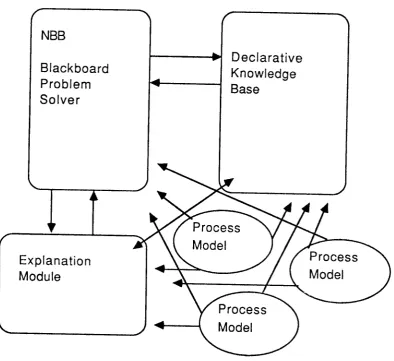
CONFER therefqeincorporales nvo additional representations ofknowledge required by the explanation process: a declarative knowledge base and a set of process models (these
will
be de.scribed below).Given the
threekinds
of
knowledge available 0o CONFER(tnowledge
applied duringproblem-solving, general knowledge and process models), explanation facilities can be provided which can account
for
the decisions madeby
the systemin
termsof
the knowledgedirectly
applied, togetherwith
otherrelevant information and knowledge
of
the process asa
whole. Theform
of
explanation providedwill
depend on the needsof
the user.Initially
the explanation formwill
be of a "traditional", rule-oriented form that allows for justificationof
system action.With
the additional kindsof
knowledge available, userswill
have the
faciliry
to investigate asp€ctsof
this explanationuntil
they achieve a levelof
description they canunderstand.
Alternatively,
users may enquire asto
therole
playedby a
particular&cision or
itemof
knowledge in the problem.
It
is prognsed that these facilitieswill
enable CONFER to:focus on a particular concept for explanation, and
absEact away from a concept and view it in terms of the whole process.
The incorporation
of
diverse knowledge structureswill
assist CONFERin
approaching the goalof
providing explanations
trat
promote understanding in a manner not so far implemented in other sysbms.5.
CONFER SYSTEM STRUCTURE
NBB
Blackboard
Problem
Solver
Declarative
Knowledge
Base
Process
Model
Explanation
Module
Process
Model
Process
[image:17.595.92.487.84.445.2]Model
the blackboard problem-solving system; a declarative knowledge base;
process models, and an cxplanation sub-system.
The components and their relationships are shown in figure 5.
We view
CONFER as being explanation-driven.That is,
theability of
the systemn
justify
andexplain
is
act"ions in a meaningful way is the most crucial factor in the design. In order to make the systemaccountable in this way, its components must be given access to explicit representations of problem domain
knowledge
--
botl
procedurally encoded as Knowledge Sourcesin
the blackboard problem-solver, anddeclaratively represented in the knowledge base -- as well as to conuol strategies. As a consequence of this
design decision, the system includes a declarative knowledge base and a set of process models.
5.1.
The Problem-solverThc role of the blackboard problem-solver is to perform monitoring and diagnosis tasks in addition to
controlling
the fermentation equipmenl The blackboard recieves inputfrom
sensors attached to the f€r-mentation vessel and from a mass spectromet€r. This information is used to infer the state of the process in real time. The blackboard containsfour
abstractionlevels in
its domain panel: the levels are concernedwith the input
data, the general stateof
the
fermentation processin
termsof
abstracted data and thebehaviour
of
the culture at ttre cellular and molecular levels. The inclusion of cellular and molecular levels permits the system to make detailed hypotheses about the state of the process: in particular, the system caninfer
the kindsof
microbiological processes responsiblefor
observed behaviours. Furthermore,it
allows the systcm to delermine the potential effectsof
hypothesised control decisions which change the stateof
the fermentation process.In
additionto
reasoning about the fermentation process, the problem-solver reasons about its own behaviour. The problem-solver is controlled by a versionof
the BlackboardConrol
Model (Flayes-Roth,1985)
which explicitly
representsall
connol
decisionsat a
varietyof
absractionlevels.
The explicit-12-of
a systemwith
greatly increasedflexibility.
Theexplicit
represenLationof
control assistsin
explanationarut justification. Since the problem-solver is able to reason about and record each control decision
it
has made,it
is able to derermine, at a later time, precisely whyit
made that decision. When justifying aparticu-lar
processcontrol
decision, the blackboard problem-solveris
ableto
examine the circumstarrces underwhich that decision was made. The task of explaining why a particular decision was made and of
explain-ing
the backgroundto it
is also eased because the blackboard records the stateof
the conEol problem aswell as the process problem: this information is available for inspection at all times.
5.2.
Declarative Knowledge BaseIn
additionto
theexplicit
representationof
control information, a declarative represenbtion is alsomaintained.
The
declarative knowledge base contains static information about microbiological objects(e.g.,
DNA)
and concepts (e.g., transcription):this is
thekind
of
backgroundtnowledge
possessed byhuman practitioners and forms a general context within which they operate.*
The declarative knowledge base also conlains a dynamic comg)nent derived from the operations
of
the probtem-solver. As part
of
the lnowledge base, there is a representationof
the kindsof
actions which may be taken by Knowledge Sources and the relationships tlrey have to blackboard events and states. This information can be uscd by thc blackboard to extend its problem-solving capabilities and to reason aboutis
own actions at a deeper level. However, the dynamic component of the knowledge base also records
infor-mation which can be
of
use in explanation -- explanation for humans as well as for the problem-solver.** By anchoring problem-solving decisions in background knowledge, a rich context is provided within whichto
do explanation. We have conjectured that explanation depends,in
part, upon theability
toela-borate concepts and action descriptions. This ability requires a
priori
ttrat relevant background informationbe available: the declarative knowledge base provides this information.
'
1he knowlcdge barc is being developed by Catherine R. Betu.5.3.
Process ModelsThe system contains a number
of
process models. Process models are usedin
a varietyof
ways by CONFER--
they are usedto
assist explanationsof
micro- and macro-biological processes and!o
assistproblem-solving Knowledge Sources
in
the process control andmonioring
activities. Altttough we havenot yet workcd out the
full
detailsof
the models and their structure, we believe that theywill
have dual declarative/procedural representations. The procedural reprasentation corresponds to afaidy
conventionalQualitative Reasoning approach to processes (Bobrow, 1984).
Using a procedural representation, a biological process can be simulated to determine its behaviour under different conditions
--
this is usefulin
detailed reasoning about the possible effectsof
a decisiono
altcr one
or
moreof
the fbrmentation process' parameters. The procedural representation is also useful inattcmpting to determine what could be the cause
of
some observedeffect.
When queried by the user, theprocedural representation
can be run
to
provide
informationto
the
explanation sub-system,in
effectanimating
the
processfor
tlre purposesof
explicatingit
to
the
user.The
procedural models used by CONFER areircremental in
ttre sensetiat
they can be startedfrom
any state and resumed after resultshave bcen cxtracted. The need
for
incremental modelsis
dictatedby
the requirementsof
the blackboard problem-solvcr.The declarative representation
of
biological processes is expected to serve a role very similar to thedcclarativc knowledge base. That is, the declarative process representation permits inferences to be rnade at
any time without thc necd to execute a pr@ess. This entails that ttre causal links between steps in each
pro-ccss can be examined and tlre consequences seen at any time. The declarative process model also permits examination
of
the process structure. This appears to be particularly valuable when establishing the statesthrough which a process must pass in order to reach some goal state. The goal state might be suggested,
for
example,
by a
problem-solving Knowledge Source involvedin
setting fermentation process parameteni;alternatively, the user might cause a goal state to be set during an explanation session by asking a question
about what happens !o the process when the fermenter is in a given state.
-14-We anticipate the nced for other models, e.g., a cell growth model and the two compartnent model of
cel-lular mctabolism. The interactions between the various models remain an interesting open question at this timc.
5.4. Explanation
CONFER's final
componenris
the explanation sub-system.In
the above description, therole of
explanation has been stressed as a major design factor.
It
is the explanation sub-system which is finally ttrcconsumer
of
the information heldin or
derivedby
the system andis
the least understoodof
CONFER'sfour
modules. The explanation sub-system hastwo
basic roles: thefirst is to
provide justifications, thesecond
is to
provide explanations. The justification task can be performedin
a conventional manner by tracing the decisions madeby
the blackboard problem-solver and augmenting the tracewith
information about Knowledge Sources. The explanation component is concernedwith
using the backgroundinforma-tion provided
by
the knowledge base and proce,ss models to augment the user's understandingof
thepro-cess and its state.
The blackboard problem-solver maintains
all
problem solving stepsit
has takenin
its globaldaa-basc, enabling the explanation module Later O examine the state
of
the problem when a particular decisionwas made. In addition to the domain knowledge required io solve a problem, the blackboard also maintains
all
relevant control knowledge concerning how the problem was solved. The levelsof
abstraction withinthe blackboard architecture facilitate explanations
of
varying granularities. In addition to information heldon
the
blackboard,the
explanation sub.system makesuse
of
knowledgestoed
in
the
declarative knowledge base and the results of executing the process models.6.
CONCLUSIONS
This paper has described the CONFER system. CONFER is a real-time problem-solving system
for
the monitoring and control
of
fermentation processes. The processCONFER
is designed to control is theproduction
of
p-galacosidnse from a mixed medium. The system has been designed with accountiability asa primary goal. As a consequence
of
ttris decision, explanation is seen as a crucial feature and is supportedsys-tcm is required to support
it
in tlre wide variety of tasksit
must perform. The system is, we believe, the flrstof
its kind insofar asit
embodies considerably more knowledge,in
more varied forms, than in mostprevi-ous
AI
systcms.REFERENCES
(Bobrow,
1984)Bobrow, D.C.
Qualitative Reasoning about Physical Systems:An
Introdrction,Artilicial
Intelligence Joumal,Yol.24,
pp.I
- 5, 1984(Clancey, 1983) Clancey, W.J. The Epistemology
of
a Rule-Based Expert System-- A
Frameworkfor Explanation,
Artificial
Intelligence, Vol. 20, pp. 215 - 251, 1983(Craig, 1987a) Craig,
I.D.
The Blackboard Architecture:A
Definition and Its Implications, ResearchReport RR98, Deparunent of Computer Science, University of Warwick, March, 1987
(Craig, 1987c) Craig, I.D. The BB-SR System, Research Report RR%, Department of Computer
Sci-cnce, University of Warwick, February, 1987
(Craig, 1987b) Craig, I.D. The Blackboard Architecture: Example Systems, Research Repmt
RR10l,
Department of Computer Science, University of Warwick, May, 1987
(Darnell, 1986) Darnell J., Lodish H. and Baltimore D., Molecular Cell Biology, Scientific American Books, New
York,
1986(Davis,
1982) Davis,R.. Teiresias: Applicationsof
Meta-Level Knowledge,in
Davis, R. and Lenat,D.B., Knowledge-Based Systems in
Artilicial
Intelligence, McGraw-Hill, NewYork,
1982(Erman, 1975) Erman,
L.D.
andlrsser,
V.R.,A
Multi-level Organisation for Problem Solving UsingMany, Diverse, Cooperating Sources of Knowledge. Proc. UCAI 4, Vol. 2, pp. 483
-
490,1975(Erman,
1980)L.D.
Erman,F.
Hayes-Roth,V.R.
Irsser
and D.R. Reddy. The
HEARSAY-trspeech-understanding system: Integrating knowledge
to
resolve uncertainty. Computing Surveys,Vol.
12,pp.2l3-253,
1980(Feigenbaum, 1978) Feigenbaum, E. and
Nii,
H.P., Rule-based Understandingof
Signalsin
Pattern-
16-(Hayes-Roth, 1977) Hayes-Roth, F. and I-€sser, V.R., Focus
of
Attentionin
the Hearsay-Il speechunderstanding system.
hoc. UCAI 5,pp.27
- 35,1977(Haycs-Roth, 1979)
F.
Hayes-Roth andB.
Hayes-Roth.A
Cognitive Modelof
Planning. CognitiveScience,
Vol.
3, pp.215-310,1979.(tlayas-Roth, 1983) Hayes-Roth, B. The Blackboard Architecture:
A
General Framework forProb-lem Solving?
ReportNo.
HPP-83-30, Heuristic Programming Project, Computer Science Dept., Stanford University, Palo Alto, CA, May 1983(Hayes-Roth, 1984)
B.
Hayes-Roth.BBI:
An
Architecturefor
Blackboard Systems that Control,Explain
andLeam
abouttheir own Behavior.
Technincal Report HPP-84-16, Computer ScienceDepartment, Stanford Universily, I 984.
(tlaycs-Rottr, 1985)
B.
Hayes-Roth.A
Blackboard Architecturefor Control. Artificial
Intelligerrce Journal, Vol. 26, pp. 251-321, 1985.(Hayes-Roth, 1986)
B.
Hayes-Roth,A.
Garvey,M.V.
JohnsonJr.,
andM.
Hewes.
A
l-ayeredEnvironment
for
Reasoning aboutAction.
ReportKSL
86-38, Knowledge Systems Laboratory, Computer Science Departmcnt, Stanford University, 1986.(Jacob,
196l)
Jacob F. and MonodJ.
Genetic Regulatory Mechanismsin
the Synthesisof
Pro0eins,Journal of Molecular Biology,
Vol.
3, 1961(Neches, 1985) Neches,
R.,
Swartout, W.R. and Moore,J.
Explainable (and Ivtaintainable) ExpertSystems, PToc.IJCAI-85, pp. 382 - 389, 1985
(Newell,
1973) Newell,A.
Production systems: modelsof
control structures.In
W.G. Chase (ed.),Visual Information Processing, Academic Press, New
York,
1973(Nii,
1979) H.P.Nii
and N. Aiello. AGE:A
knowledge-based program for building knowledge-based programs.hoc. UCAI
6, pp. 645-655.(Nii,
1986a) H.P.Nii.
The Blackboard Modelof
Problem Solving.AI
Magazine,Vol.
7, pp. 38-53, 1986.(Nii,
1986b) H.P.Nii.
Blackboard Systems PartTwo:
Blackboard Application Systems.AI
lvtaga-zinc, Vol. 7, pp.82-106, 1986.
(Stent,
l97l)
Stent G.S., Molecular Genetics: An Introductory Narrative, W.H.Freeman and Co., SanFrancisco.
l97l
(Swartout, 1983) Swartout, W.R.
EXPLAIN: A
System for Creating and Explaining Expert Consult-ing Programs,Artificial
Intelligence, Vol. 21, pp. 285 - 325, 1983(Terry,
1983)A. Terry. The CHRYSALIS
koject:
HierarchicalConrol
of
Production Syslems.Memo HPP-83-19, Computer Science Department, Stanford University, 1983.