THE EFFECT OF
EXTRAVERSION,
EXTERNAL AROUSAL, AND
GAME-EXPERIENCE ON
MEMORY PERFORMANCE
IN IN-GAME
ADVERTISEMENTS.
J. Schipper (s1358898)
FACULTY OF BEHAVOURIAL SCIENCES
COMMUNICATION STUDIES - MARKETING COMMUNICATION
EXAMINATION COMMITTEE
Dr. M. Galetzka
Prof.dr. A.T.M. Pruyn
Abstract
This study investigates the interaction between the level of extraversion, the level of external
arousal and game-experience and its effect on memory performance in video games for
advertising purposes. One-hundred participants (i.e., 50 introverted, 50 extraverted)
voluntarily participated in a between-subjects experiment executed in the video game Grand
Theft Auto V under either the low-arousal or the high-arousal external condition. The
performance of participants was investigated with recall and recognition (i.e., explicit
memory), and word-completion (i.e., implicit memory) tests. Results show that participant’s
recognition performance on brand identifiers were based on an interaction between
extraversion, external arousal and experience. Introverted participants performed better in the
low-arousal condition while extraverted participants performed better in the high-arousal
condition, only if the participants had high game-experience. Low-experienced participants
did not differ significantly. Recall performance was based on an interaction between
extraversion and external arousal. Introverted participants performed better in the low-arousal
condition while extraverted participants performed better in the high-arousal condition.
Implicit memory performance was based on experience and extraversion. Introverted
participants performed better than extraverted participants in any condition due to the
probable use of intentional retrieval strategies by introverts. Finally, the practical implications
of this study were that investors with an introverted target group should integrate their brand
identifier in low-arousal video game contexts, whereas investors with an extraverted target
group should integrate their brand identifier in high-arousal video game contexts (i.e., blood,
Introduction
Brand placement is the implementation of brand identifiers through audio and visual sources
within the terms of mass-media communication in return for paid advertising or other
promotional considerations (d’Astous & Chartier, 2000; Gupta & Gould, 1997; Karrh, 1998).
Brand identifiers are names, terms, signs, symbols and designs used to differentiate brands
from competitors (Kotler, 1991). The concept of brand placements is increasingly used as a
response to developments that provide the viewer control to ignore advertisements in the
television industry, such as Netflix and Youtube (Lee & Faber, 2007; Nelson, 2004).
Brand placement positively differs from traditional advertising on two central aspects:
They are used to avoid interruption in consumer activities and are not necessarily perceived as
marketing messages (DeLorme & Reid, 1999). Brand placement negatively differs on one
central aspect from traditional advertising: Advertisements are primary focal points in
traditional advertising, whereas brand placements are secondary focal points (Lee & Faber,
2007). Forcing the placements as primary focal points may be ineffective as the gamer
controls the video game and therefore allocates attention and creates mental maps of the
game-space (Grodal, 2000).
Current study investigated memory of brand placements in video games. This type of
brand placement had not been researched thoroughly, especially in comparison with movie
placements. There are five developments why this concept should be researched more
thoroughly: 1) Gamers have improved performance in attentional flexibility and visual
discrimination leading to increased recall and recognition (Green & Bavelier, 2003; 2007); 2)
Video game characteristics allow brand placements to be interactive, more vivid and more
adept to stimulating creative perceptions than movies (Steuer, 1992). Interactivity enhances
memory effects and increases recall (Lombard & Ditton, 1997; Kim & Biocca, 1997); 3)
non-gamers (Nelson, 2002; Youn et al., 2003); 4) The games industry is one of the fastest
growing industries with a value of approximately $66.3 billion in hardware and software sales
with an expectation of $86.1 billion in 2016 (Newzoo, 2013). This growth increased diversity
in age, lifestyle and gender up to a representation of nearly every person in society (Chaney et
al., 2004; Van Opstal, 2011); and 5) Organizations increasingly invest in in-game advertising:
approximately $77 million in 2006 and an expectation of approximately $7.2 billion in 2016
(Gaudiosi, 2008; Takahashi, 2011). It is important to study how to optimize these
investments.
Current study focused on understanding why and under which circumstances these
brand placements in video games are effective or ineffective, while focusing on the level of
extraversion. Extraversion is associated with in-game behavior and gaming motives (Yee,
Ducheneaut, Nelson & Likarish, 2011). Graham and Gosling (2013) argue that individuals
express personality in video games (i.e., MMORPGs) in the same way they express
personality in other virtual environments (e.g., Facebook or other websites). Knowledge of
this plausible effect of personality on in-game memory is important in in-game advertising.
Personality is likely to have an impact on the individual effectiveness of in-game
advertisements. Extraversion is closest related to attention and memory (Graham & Gosling,
2013; Mahyari, Drennan & Luck, 2009). Therefore, it is plausible that extraversion affects
recognition and recall in video games along with other personal attributes, such as
visualization, imagination, innovativeness, and curiosity. Furthermore, Howarth and Eysenck
(1968) found that extraverts recalled twice as many associations than introverts in a
time-pressured assignment, demonstrating that memory performance and extraversion are related.
Another study found that high-arousal contexts resulted in optimal performance for extraverts
Therefore, current study focused on how extraversion affects in-game advertising memory
performance in high-arousal and low-arousal context.
Current study investigated how extraversion affects implicit and explicit memory
performance on brand placements in high-arousal and low-arousal video games. Brand
placement, implicit and explicit memory, extraversion and high-arousal were defined in order
to study the role of extraversion in in-game advertising. The video game Grand Theft Auto V
was used during current study. This video game allowed the researcher to control arousal in a
virtual environment that offers a great amount of advertisements.
Literature Review
Brand Placement
Since the 1940s brands have been used as background filling, character development and
stimulation for realism in movies. Nowadays, brands pay movie-developers and
game-developers $25,000-$700,000 to use the product within the movie or video game based on
interactivity and visibility (Chunovic, 2002).
An important advantage of brand placements is the possible unobtrusiveness (i.e., they
are generally secondary aspects, do not interrupt the viewer and they often add realism to the
context) and are therefore less likely to result in persuasion knowledge (Edwards, Li & Lee,
2002; Friestad & Wright, 1994). Persuasion knowledge means that consumers recognize
persuasion attempts. If consumers recognize persuasion attempts, this may lead to negative
coping strategies such as message rejection and counter-argumentation (Petty & Cacioppo,
In-game Advertising
In-game advertising is the paid implementation of brand identifiers through audio and visual
sources within video game programming in order to increase brand awareness (D’Astous &
Chartier, 2000; Karrh, 1998). Nelson (2002) was one of the first to study the effects of
in-game advertising by measuring recall and recognition effects after short gaming sessions,
where participants played a racing game, Gran Turismo 2, and were exposed to multiple
billboards in the game. She found that 30% of the advertisements were recalled after the
session and 10% after five months. Many researchers followed upon her suggestion to study
the effects more specifically, but failed to find grounded evidence that could be generalized
over the population, genres and the type of brand placement. Nearly all studies that followed
focused on the sport or racing genres, because these genres are in real life also associated with
many advertisements (Chaney et al., 2004; Grigorovici & Constantin, 2004; Nelson, 2002;
Nelson, 2004; Schneider & Cornwell, 2005). Nelson (2002) even found that the absence of
expected brands affected perceived realism negatively.
Implicit and Explicit Memory
Memory is the acquisition, storage and retrieval of information (Solomon, Bamossy,
Askegaard & Hogg, 2010). Current study differentiated between two types of memory:
explicit and implicit. Explicit memory is the intentional and conscious retrieval of events and
is based on cognitive processing (Lee, 2002). Implicit memory, also known as procedural
memory, consists of memory effects that occur without intentional and conscious retrieval
(Law & Braun-LaTour, 2004).
Explicit and implicit memories are dissociated in terms of brain activation. Explicit
memory occurs through the frontal lobes of the brain in an effortful process, whereas implicit
2004). This means that in order to measure effectiveness of advertising, it is necessary to
study both implicit and explicit memory.
In order to notice and process stimuli from events into the memory, the stimuli need to
become part of the attention span of a certain user. Primary objects that demand attention in
video games are playing and experiencing the game (Grigorovici & Constantin, 2004).
Secondary objects that demand attention are optional focal points (e.g., advertisements). The
limited capacity model assumes that cognitive capacity is limited and will be allocated to
primary and secondary objects or tasks. If certain cognitive capacity has been allocated to a
primary object, there is no possibility of allocating the same capacity to a secondary object
(Nelson et al., 2006). Game-experience has been demonstrated to be closely related to
capacity-allocation. Experienced players need less cognitive capacity to play a video game,
leaving to use the remaining capacity for secondary aspects, whereas inexperienced players
use more cognitive capacity to control the in-game character (Lee & Faber, 2007; Schneider
& Cornwell, 2005). Furthermore, experienced players outperformed inexperienced players in
change-detection leading to better memory creation (Boot, Kramer, Simons, Fabiani &
Gratton, 2008).
Explicit memory is easy to measure and therefore it has been used in many in-game
advertising studies. However, implicit memory is equally as important and may influence the
interpretation of choice behavior and remains longer available in memory (Law &
Braun-LaTour, 2000). Furthermore, implicit recognition is important to measure, because people
tend to be unaware of what they actually experienced while playing the game.
Explicit memory stores the information of the objects allocated with cognitive
capacity, while implicit memory may store the information of the objects that were not
consciously allocated with cognitive capacity.
The Effect of Extraversion on Implicit and Explicit Memory
Extraversion is the sensitivity to positive cues based on the level of warmth, gregariousness,
assertiveness, activity, excitement seeking and positive emotions (Costa & McRae, 1995).
Individuals that are low in extraversion (i.e., introverts) are individuals with an exaggerated
thought process in relation to observable behavior. Individuals high in extraversion (i.e.,
extraverts) are individuals with a reduction of thought processes in relation to observable
behavior (Freyd, 1924).
Many studies claim that differences in dopamine levels result in a certain level of
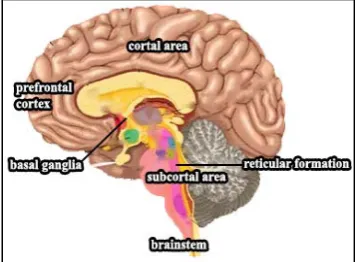
extraversion. Based on the type of brainstem, the reticular
formation (e.g., for filtering incoming stimuli) regulates the
release of dopamine (see Figure 1). The prefrontal cortex is
responsible for working memory, the basal ganglia is
responsible for procedural memory formation (Saint-Cyr &
Taylor, 1992) and both are for normal functioning dependent on
the amount of dopamine (Cohen & Servan-Schreiber, 1992).
Dopamine is a neurotransmitter for the evaluation of pleasure, alertness, energy and
happiness and is responsible for the normal functioning of working memory and procedural
memory (Cohen & Servan-Schreiber, 1992). High extraversion is the result of a low level of
internal arousal and creates more dopamine than internally high-aroused introversion. This
increase of dopamine leads to higher performance in working memory and procedural
memory, which are needed in order to recall and recognize brands. However, external arousal
is equally as important, because low-arousal external context results in optimal performance
for introverts and high-arousal external context results in optimal performance for extraverts
[image:8.595.390.568.294.425.2](Eysenck, 1967). High-arousal external context can be created by stimulating virtual blood
and screams of pain in video games (Jeong, Biocca, Bohil, 2009; Jeong, Bohil & Biocca,
2011).
Howarth and Eysenck (1968) demonstrated that optimal performance differs between
the levels of extraversion by asking participants to remember seven pairs of associative words
in a laboratory setting with retention intervals of 0 minutes to 1 day. The more immediate the
recall, the bigger difference was found between introverts and extraverts. Extraverts recalled
twice as many associations as introverts did.
Few studies investigated the effect of extraversion on implicit memory (i.e.,
procedural learning) (Corr, 2003). This is due to the possible contamination of implicit
measurements: 1) A participant adopting an intentional retrieval strategy; and 2) The
awareness of being tested (Schacter et al., 1989). An intentional retrieval strategy occurs
when the participant consciously retrieves information from the experiment in order to give
the correct answers (e.g., completion of the word fragment). Findings from one of the few
studies on personality and implicit memory are that extraversion correlates with better task
performances within procedural learning. In their study a drug called haloperidol (i.e., in order
to decrease arousal activity) was used to artificially control the level of extraversion.
Introverts performed more optimal after taking the drug, assuming that lower internal arousal
increases procedural learning under time-pressure (i.e., high-arousal) external context (Corr &
Kumari, 1997).
This literature review demonstrated that next to the current known aspects that affect
the effectiveness of in-game advertising (e.g., prominence, frequency, visibility, age, context,
game experience) (Van Opstal, 2011) studying extraversion adds an important aspect to this
I. Eysenck (1967) argues that extraversion is one of the most important role players in
learning and memory. Extraverted participants even outperform introverts participants
on time-pressured memory performance. Therefore, we hypothesize:
1A Extraverts perform better in recall tasks in the high-arousal context than introverts.
1B Extraverts perform better in recognition tasks in the high-arousal context than introverts.
1C Introverts perform better in recall in the low-arousal context than extraverts. 1D Introverts perform better in recognition in the low-arousal context than
extraverts.
II. Corr and Kumari (1997) demonstrate that lower internal arousal (i.e., extraversion)
increases procedural learning (i.e., implicit memory). Therefore, we hypothesize:
2A Extraverts perform better in implicit memory tasks in the high-arousal context than introverts.
2B Introverts perform better in implicit memory tasks in the low-arousal context than extraverts.
III. Boot et al. (2008) and Schneider and Cornwell (2005) demonstrate that inexperienced
players use most of their cognitive capacity on controlling the character and that
experienced players outperform inexperienced players in accuracy of
change-detection. This leads to smaller differences between the players, because it is only a
side-assignment for the inexperienced participants. Therefore, we hypothesize:
3A High experience is needed to demonstrate the interaction between arousal and extraversion for recall tests.
3B High experience is needed to demonstrate the interaction between arousal and extraversion for recognition tests.
Method
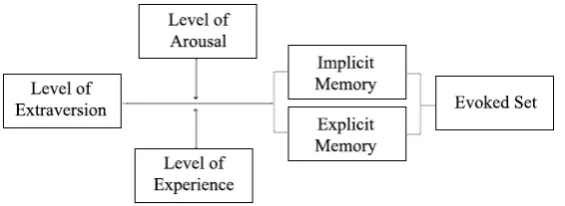
[image:11.595.175.458.163.266.2]The design of current between-subjects experimental study was based on the model in
Figure 2, which is created from the literature review on extraversion, arousal and memory.
Figure 2: Extraversion Effect on Brand Placement Memory Performance Moderated by Level of Arousal and Level of Experience.
Current study used a 2 (low extraversion, high extraversion) x 2 (low in-game arousal,
high in-game arousal) x 2 (low experience, high experience) between-subjects
experimental design.
Participants
One-hundred participants from gaming forums (e.g., http://xgn.nl and http://gtagames.nl) and
the environment of the researcher (80 men and 20 women; 68 highly educated and 32 poorly
educated) average aged 26.3 years (SD = 13.4) voluntarily participated in this experiment.
There were 50 introverts and 50 extraverts randomly assigned to each of the two arousal
conditions. Fifty-seven participants were experienced in GTA V and 43 participants were
inexperienced in GTA V.
Procedure
Participants were told that the study investigated the relationship between personality and
memory performance. They completed a personality test (see Appendix 1) and listened to
instructions about the experiment. They drove through the virtual world (see Appendix 6),
twenty minutes. After the play session, the participants were given a recall test, a recognition
test, and a word-completion test, each with its own instructions (see Appendices 2, 3 and 4).
Pre-test
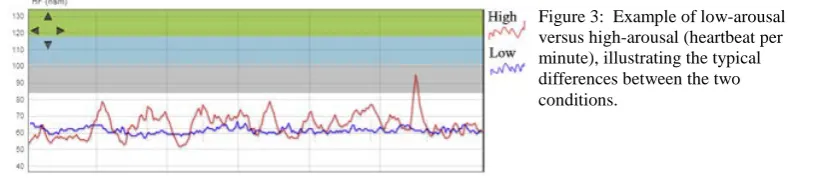
In order to demonstrate the difference in arousal between the low-arousal context and the
high-arousal context, a pre-test was executed with sixteen participants wearing a Polar RCX5
Heartbeat Control. From these statistics heartbeat measurements were used at zero minutes
(null-measurement), three minutes, six minutes and twelve minutes in both the low-arousal
and high-arousal condition. This was done in order to confirm the research design and
demonstrate that the factor of stress or arousal was significantly higher in the high-arousal
condition than in the low-arousal condition.
An ANCOVA [between-subjects factor: arousal (low, high); covariate:
null-measurement heart beat] revealed that the heartbeat (in beats per minute) was significantly
higher in the high-arousal condition than in the low-arousal condition at three minutes, six
minutes and twelve minutes. At nine minutes, the heartbeat was non-significantly higher in
[image:12.595.64.537.513.611.2]the high-arousal condition than in the low-arousal condition (see Table 1 and Figure 3).
Table 1: Means and standard deviations of pretest.
Low-arousal High-arousal
Measure M SD M SD F (1, 13) p
At three minutes 71.41 2.58 82.47 2.58 7.54 0.02 At six minutes 70.16 2.07 81.46 2.07 12.26 <0.01 At nine minutes 71.41 3.21 81.59 3.20 4.14 0.06 At twelve minutes 71.54 2.22 79.96 2.22 5.91 0.03
[image:12.595.56.467.656.745.2]Stimulus materials
The Dutch-revised Eysenck Personality Questionnaire was utilized in this study (see
Appendix 1). It is a questionnaire containing nineteen yes- or no-questions dealing with
personality. In the past Cronbach’s Alphas of 0.72-0.85 were reported in seven studies
(Sanderman et al., 2012). Cronbach’s Alpha in current study was 0.834 based on the nineteen
items (n=100).
The video game Grand Theft Auto V was used for controlling arousal and used as
input for memory performance tests (see Figures 4, 5, 6 and 7 for examples). It is a
free-roaming video game released in 2013 where the player decides whether to play violent or
non-violent, containing thousands of non-existent brand identifiers. These non-existent brand
identifiers increase the possibility to test in isolation (Nelson et al., 2006). The gaming
consoles Sony PlayStation 3 (with a DualShock 3 Controller) and Microsoft Xbox 360 (with
an Xbox 360 Wireless Controller) were used to play the video game.
Figures 4 & 5: Participants bought candy and took a holiday self-portrait in front of 'Vinewood' in the low-arousal condition.
Figures 6 & 7: Participants destroyed police helicopters and robbed the supermarket in the high-arousal condition.
The environment of the experiment was either in a living room or bed room offline.
Skype (http://skype.com) and an iPad Mini with webcam and microphone were used to
A custom-made memory test was utilized in this study (see Appendices 2, 3 and 4): A
memory test containing three sections of recall (nine categories), recognition (63 brand logos)
and fourteen word-completion tasks.
Measures
Current study used independent variables extraversion, experience and arousal. The
dependent variables were recall, recognition and word completion performance.
Extraversion. Sanderman et al. (2012) revised the Eysenck Personality Questionnaire
in The Netherlands for the evaluation of extraversion based on nineteen items (see Appendix
1). The level of extraversion increased with yes-answers on questions 1-5, 7, 9, 10 and 12-19,
and with no-answers on questions 6, 8 and 11. For the purpose of the study design, two
groups were formed: introverts (score 0-9) and extraverts (score 10-19).
Experience. This variable was measured with a 1-item scale. Participants had to
indicate their level of experience with the video game GTA V on a scale from one (i.e., no
experience) to five (i.e., ten hours or more experience). Participants with over 6 hours
experience in-game were assumed to be experienced and those with less experience were
assumed to be inexperienced.
Recall. This variable was measured by the number of correct recalls. Participants were
asked to name all the brand names they could remember from the play session and were
assisted with nine categories, in which the brand names could fit (websites, car brands, radio
channels, daily life products, shops, restaurants, beer, television programs and the category
‘other’). Recall is a suitable measure for memory performance, because the data are easy to
compare due to the pragmatic nature of surveys (Law & Braun-LaTour, 2004). Considering
that awareness is the goal of brand placement, the fitting of these tests is high. Recall test
Recognition. This variable was measured in the number of correct answers of logo
recognition corrected with the incorrect answers. The maximum number of correct logos was
46 and the maximum number of incorrect logos was 17. The final score was calculated with
the d-prime analysis in order to filter sensitivity and bias. d’ is the standardized difference
between the means of the Signal Present (hit and miss) and Signal Absent (false alarm and
correct rejection) distributions. This d’ score was calculated using the formula d’ = z(H) –
z(F). z(H) is the z-score of the hit rate and z(F) is the z-score of the false alarm rate. The
d-prime analysis calculates the sensitivity bias in order to correct mistakes made by participants
that were biased to claim that they had seen a lot of logos of which a certain number was a
false alarm (Keating, 2005). As an illustration, a low score of -0.03 consisted of thirteen
correct recognitions (hits) and five incorrect recognitions (false alarm). A high score of 2.68
consisted of 26 correct recognitions and zero incorrect recognition.
Word-completion. This variable was measured in the number of correct completions
of word-fragments (see Appendix 4). The highest possible score was 14. Implicit recognition
is more difficult to measure, using performance tests such as the word-completion test
(McDowell, Lustig & Parkin, 1995; Tulving, Schacter & Stark, 1982) to find changes in
performance (Yang, Roskos-Ewoldsen, Dinu & Arpan, 2006). In this test a word fragment
(e.g., Total B) needs to be transferred into meaningful combinations by filling in the missing
word (e.g., Total Bankers).
Results
This section analyses the effect of extraversion on the memory performance scores of
A total of 100 participants filled in the memory tests. In Figure 8, aided recall and
word completion represent the number of correct recalls or correct completions of brand
names in the test. Recognition is the d’ score (see section Recognition for calculation).
Measure N Min Max M SD
Aided Recall 100 0 18 7.12 4.14
Word Completion 100 0 9 2.61 1.61
[image:16.595.65.530.157.224.2]Recognition 100 -0.33 2.68 1.02 0.70
Figure 8: Descriptive statistics of the memory performance tests.
Recall
A 2x2x2 ANOVA was conducted to investigate the effects of arousal (low, high),
extraversion (low, high) and experience (low, high) on recall. Shapiro-Wilk and Levene’s
tests were used to evaluate the assumptions of normality and homogeneity of variance.
Neither was violated.
The ANOVA revealed a main effect of experience, F (1, 92) = 61.13, p < 0.01. High
experience levels (M = 9.26, SD = 3.57) had significantly higher recall than low experience
levels (M = 4.28, SD = 2.30).There was no significant main effect for arousal, F (1, 92) =
1.41, p = 0.24, or extraversion, F (1, 92) = 0.03, p = 0.87.
A significant interaction between arousal and extraversion was found, F (1, 92) =
13.026, p < 0.01. In the high-arousal condition extraverts had significantly higher recall than
introverts and in the low-arousal condition extraverts had lower recall than introverts (see
Figures 9 and 10). Therefore, hypotheses 1A (extraverts perform better in recall tasks in the
high-arousal context than introverts) and 1C (introverts perform better in recall in the
low-arousal context than extraverts) are accepted. See Figure 9 for means and standard deviations
Introversion Extraversion
Condition M SD M SD
High-Arousal 5.40 3.11 7.84 3.85
[image:17.595.181.393.255.439.2]Low-Arousal 8.88 5.06 6.36 3.34
Figure 9: Means and standard deviations of recall in the four conditions.
The predicted interaction among arousal, extraversion and experience was not
significant, F (1, 92) = 0.90, p = 0.35. Therefore, hypothesis 3A is rejected: High experience
is needed to demonstrate the interaction between arousal and extraversion for recall tests.
Figure 10: Estimated Marginal Means of Recall demonstrate the interaction between arousal and extraversion.
4.2.1. Recognition
A 2x2x2 ANOVA was conducted to investigate
the effects of arousal (low, high), extraversion
(low, high) and experience (low, high) on
recognition. Shapiro-Wilk and Levene’s tests were
used to evaluate the assumptions of normality and
homogeneity of variance. Neither was violated.
The ANOVA revealed a main effect of
[image:17.595.331.531.524.699.2]experience, F (1, 92) = 20.84, p < 0.01. High experience levels (M = 1.26, SD = 0.67) had
higher recognition than low experience levels (M = 0.70, SD = 0.59). There was no
significant main effect for arousal, F (1, 92) = 2.45, p = 0.12, or extraversion, F (1, 92) = 1.08,
p = 0.30.
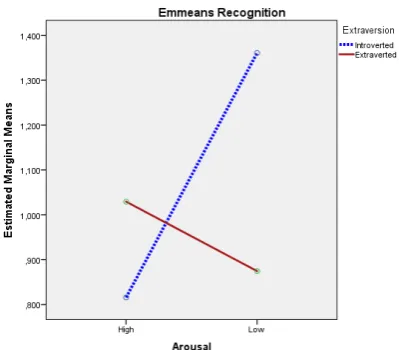
A significant interaction was found for arousal and extraversion, F (1, 92) = 6.02, p =
0.02, as can be seen in Figure 11. In the high-arousal condition extraverts had significantly
higher recognition than introverts and in the low-arousal condition extraverts had significantly
lower recognition than introverts (see Figures 12, 14 and 15). Therefore, hypotheses 1B
(extraverts perform better in recognition tasks in the high-arousal context than introverts) and
1D (introverts perform better in recognition in the low-arousal context than extraverts) are
accepted.
Introversion Extraversion
Condition M SD M SD
High-Arousal 0.82 0.64 1.02 0.74
Low-Arousal 1.36 0.69 0.87 0.59
Figure 12: Means and standard deviations of recognition in the four conditions.
Also a three-way interaction between arousal, extraversion and experience was
revealed, F (1, 92) = 7.75, p < 0.01. High experienced extraverted participants had higher
recognition in the high-arousal condition than high experienced introverts and high
experienced introverted participants had higher recognition in the low-arousal condition than
high experienced extraverts (see Figures 13-15). The interaction between arousal and
extraversion was non-significant for low experienced participants (see Figure 14). Therefore,
hypothesis 3B was accepted: High experience is needed to demonstrate the interaction
Low Experience High Experience
Introversion Extraversion Introversion Extraversion
Condition M SD M SD M SD M SD
[image:19.595.79.509.185.367.2]High-Arousal 0.68 0.60 0.48 0.41 0.92 0.67 1.46 0.66 Low-Arousal 0.89 0.66 0.78 0.66 1.67 0.51 0.95 0.53
Figure 13: Means and standard deviations of recognition in the four conditions split by experience.
Figures 14 & 15: Estimated Marginal Means of Recognition demonstrate no interaction between arousal and extraversion in low experience and an interaction at high experience.
4.2.2. Word completion
A 2x2x2 ANOVA was conducted to investigate the effects of arousal (low, high),
extraversion (low, high) and experience (low, high) on word completion. Shapiro-Wilk and
Levene’s tests were used to evaluate the assumptions of normality and homogeneity of
variance respectively. Homogeneity was not violated, but one group (introversion in
low-arousal) violated the Shapiro-Wilk assumption.
The ANOVA revealed a main effect of extraversion, F (1, 92) = 4.40, p = 0.04.
Introverts (M = 2.94, SD = 1.63) had significantly higher completion performance than
extraverts (M = 2.28, SD = 1.54). Also a main effect was revealed for experience, F (1, 92) =
completion performance than low experience levels (M = 1.93, SD = 1.12). There was no
significant main effect for arousal, F (1, 92) = 1.49, p = 0.23.
These main effects were not qualified by interactions between arousal and
extraversion, F (1, 92) = 2.32, p = 0.13, or arousal, extraversion and experience, F (1, 92) =
0.15, p = 0.70 (see Figure 16). Therefore, hypotheses 2A (extraverts perform better in implicit
memory tasks in the high-arousal context than introverts) and 3C (high experience is needed
to demonstrate the interaction between arousal and extraversion for implicit memory tests) are
rejected. Hypothesis 2B, introverts perform better in implicit memory tasks in the low-arousal
context than extraverts, is accepted.
Figure 16: Estimated Marginal Means of Word-Completion demonstrate no interaction between arousal and extraversion.
Conclusion
This study found evidence for an interaction between arousal and the level of extraversion
that affects memory performance on in-game advertised brands. It turned out that experience
was another important factor in determining performance and even interacted with both
extraversion and arousal when it concerned recognition. In the results section the acceptance
For recall, the level of extraversion interacted with the arousal condition. Extraverts
performed better in the high-arousal condition than introverts, while introverts performed
better in the low-arousal condition. Furthermore, game-experience was demonstrated to be a
main effect in the performance on recall for all conditions.
For recognition, the level of extraversion interacted with the arousal condition and
with the level of experience. Extraverts performed better in the high-arousal condition than
introverts, while introverts performed better in the low-arousal condition, only if the
participants were high-experienced. In a low-experienced context, extraversion did not play a
significant role. No interaction was found between arousal and extraversion for
low-experienced participants. Also for recognition, experience demonstrated to be a main effect in
the performance for all conditions.
For word-completion, the level of extraversion did not interact with the arousal
condition. Extraverts did not perform better in the high-arousal condition than introverts.
However, the level of extraversion demonstrated to be a main effect on the word-completion
performance. Introverts performed better in total than extraverts and thus in the low-arousal
condition.
In Figure 17 this study’s hypotheses are summarized as accepted (V) or rejected (X).
H# Hypothesis
1A Extraverts perform better in recall in the high-arousal context than introverts. V 1B Extraverts perform better in recognition in the high-arousal context than introverts. V 1C Introverts perform better in recall in the low-arousal context than extraverts. V 1D Introverts perform better in recognition in the low-arousal context than extraverts. V 2A Extraverts perform better in word-completion in the high-arousal context than
introverts.
X
2B Introverts perform better in word-completion in the low-arousal context than extraverts.
V
3A Experience demonstrates the arousal-extraversion interaction for recall. X 3B Experience demonstrates the arousal-extraversion interaction for recognition. V 3C Experience demonstrates the arousal-extraversion interaction for word-completion. X
Discussion
The results of this study are an important addition to the current knowledge on in-game
advertising and extraversion. The findings of this study are the first to demonstrate the effect
of extraversion on memory performance in in-game advertising. Specifically for practical
purposes on how to reach target groups based on personality in video games, this study
formulates a clear vision of how to reach introverted and how to reach extraverted targets.
Consistent with existing literature. In current study, the findings that extraverts
perform better than introverts in high-arousal contexts and introverts perform better than
extraverts in low-arousal contexts is in line with many studies into extraversion and explicit
memory performance (Eysenck, 1967). This is because extraverts have a lower level of
internal arousal, resulting in more dopamine creation, which is responsible for the functioning
of working memory and procedural memory (Cohen & Servan-Schreiber, 1992). Extraverts
have low internal arousal and can therefore progress more external arousal. Introverts reach
the maximum of their internal arousal faster, resulting in lower performance when external
arousal is high (Eysenck, 1967; Howarth & Eysenck, 1968). Also in line with existing
research is the reason why the high-arousal context was considered to be more
arousal-creating. This is because of the high amount of violence, blood, screams and speed in the
high-arousal compared to no blood, no violence, no screams and slower speed in the
low-arousal condition (Jeong, Biocca & Bohil, 2009). The findings of this study demonstrated that
experience, especially for recognition, had an important interaction with arousal and
extraversion, which is in line with studies by Boot et al. (2008). This lack of significant
recognition effect for low-experienced participants can be explained with studies by Lee &
Faber (2007), Grigorovici and Constantin (2004), and Schneider and Cornwell (2005).
Advertising is one of the secondary aspects in video games, playing the video game is the
allocated to the primary aspect. Therefore, there is a limited amount left for the secondary
aspects. Playing Grand Theft Auto V turned out to be quite difficult for non-experienced
players.
Inconsistent with existing literature. The findings of the study are not in line with
implicit memory performance studies by Corr and Kumari (e.g., 1997). Introverts performed
better in word-completion, no matter the condition. As described in the literature review,
introverts are characterized by exaggerated thought processes in relation to observable
behavior (Freyd, 1924). This means that introverts were more likely to use intentional
retrieval strategies as described by Schacter et al. (1989). Because of the intentional retrieval
strategy (i.e., in contrast to the necessary unintentional retrieval strategy), introverts could
more easily think about the correct word-completion. Therefore, introverts could get higher
performance on this specific test. However, in the high-arousal condition, introverts still had a
low performance due to the fact that these participants did not process the brand identifiers
during the stressful play session. Extraverts, on the other hand, performed poor on both
conditions because of the fact that these participants were less likely to use their thought
processes and were therefore less likely to use intentional retrieval strategies (Freyd, 1924;
Schacter et al., 1989). This caused random and even non-existent completions of the
word-fragments by extraverts, resulting in poor performance scores. Finally, unfamiliarity kept the
performance scores relatively low, causing a smaller potential of differences in the conditions
due to higher cognitive elaboration (Nelson, 2002; Russell, 2002). For example, many
inexperienced participants mentioned brands such as Sprite, Coca-Cola, Audi,
Mercedes-Benz, because they had seen the parody brand Sprunk, eCola, Obey or Benefactor.
Future research. For future research, it would be interesting to apply this study
design on other media. Television programs, movies, internet websites, and applications all
on extraversion or personality in general. Until this date, there are a few or no studies that
connect extraversion with memory performance of brand placements. Finally, the number of
participants in current study was quite low due to time-constraints. More participants of each
cell can therefore increase the significance and generalization of current study. Other
personality characteristics (e.g., neuroticism) may as well be researched within this study
design as an extra variable.
Practical implication. The practical implication of the results of current experiment is
that those who were investing time and money in in-game advertising without the
acknowledgement of the effect extraversion has on memory performance in video games (i.e.,
advertisement effectiveness) should re-consider their view on in-game advertising targeting.
The current study supports the idea that the level of extraversion has an effect on memory
performance based on low-arousal or high-arousal conditions. Investors with an introverted
target group should integrate their brand identifier in low-arousal video game contexts,
whereas investors with an extraverted target group should integrate their brand identifier in
high-arousal video game contexts (i.e., blood, screams, fast speed, weapons, cursing, etc.).
General conclusion. Current study demonstrated that extraversion has a significant
effect on memory performance based on the external arousal created by the environment.
Furthermore, it was demonstrated that game-experience is an important central aspect that
affects both the absolute performance (i.e., high-experience results in higher performance)
and the relative performance (i.e., high-experience results in more significant differences
References
Boot, W., Kramer, A., Simons, D., Fabiani, M., & Gratton, G. (2008). The effects of video
game playing on attention, memory, and executive control. Acta Psychologica, 129(3),
387-398. doi: 10.1016/j.actpsy.2008.09.005
Chaney, I., Lin, K., & Chaney, J. (2004). The effect of billboards within the gaming
environment. Journal of Interactive Advertising, 5(1), 54-69.
doi: 10.1080/15252019.2004.10722092
Chunovic, L. (2002). Trying to price placement. Advertising Age, 73(48), 2, 4. Retrieved on 13
November 2013 from: http://adage.com/article/news/price-placement/50757/
Cobelens, S. (2009). Exploring in-game advertising in first person shooters (Master’s thesis).
Retrieved from http://www.liacs.nl/assets/Masterscripties/Stef-Cobelens.pdf
Cohen, J., & Servan-Schreiber, D. (1992). Context, cortex, and dopamine: a connectionist
approach to behavior and biology in schizophrenia. Psychological Review, 99, 45–77.
doi: 10.1037/0033-295X.99.1.45
Corr, P. (2003). Personality and dual-task processing: disruption of procedural learning by
declarative processing. Personality and Individual Differences, 34(7), 1245-1269. doi:
10.1016/S0191-8869(02)00112-5
Corr, P., & Kumari, V. (1997). Sociability/impulsivity and attenuated dopaminergic arousal:
critical flicker/fusion frequency and procedural learning. Personality and Individual
Differences, 22(6), 805-815. doi: 10.1016/S0191-8869(96)00279-6
Costa, P., & McCrae, R. (1995). Domains and facets: hierarchical personality assessment using
the Revised NEO Personality Inventory. Journal of Personality Assessment, 64(1), 21-50.
D’Astous, A., & Chartier, F. (2000). A study of factors affecting consumer evaluations and
memory of product placements in movies. Journal of Current Issues and Research in
Advertising, 22(2), 31–40. doi: 10.1080/10641734.2000.10505106
DeLorme, D. & Reid, L. (1999). Moviegoers' experiences and interpretations of brands in
films revisited. Journal of advertising 28(2), 71-95. doi:
10.1080/00913367.1999.10673584
Entertainment Software Association (2013). Game player data. Retrieved on 1 November 2013
from http://www.theesa.com/facts/gameplayer.asp
Eysenck, H. (1967). The biological basis of personality. Springfield: CC Thomas,14, 134,
158.
Freyd, M. (1924). Introverts and extroverts. Psychological Review, 31(1), 74. doi:
10.1037/h0075875
Friestad, M. & Wright, P. (1994). The persuasion knowledge model: how people cope with
persuasion attempts. Journal of Consumer Research, 2, 1-31. Retrieved from:
http://www.jstor.org/stable/2489738
Graham, L., & Gosling, S. (2013). Personality profiles associated with different motivations
for playing World of Warcraft. Cyberpsychology, Behavior, and Social Networking, 16(3),
189-193. doi: 10.1089/cyber.2012.0090
Green, C., & Bavelier, D. (2003). Action video game modifies visual selective attention.
Nature, 423, 534–537. Retrieved from:
http://www.nature.com/nature/journal/v423/n6939/abs/nature01647.html
Green, C., & Bavelier, D. (2007). Action video game experience alters the spatial resolution of
attention. Psychological Science, 18, 88–94. doi: 10.1111/j.14679280.2007.01853.x
Grigorovici, D., & Constantin, C. (2004). Experiencing interactive advertising beyond rich
virtual environments. Journal of Interactive Advertising, 5(1), 22-36. doi:
10.1080/15252019.2004.10722091
Grodal, T. (2000). Video games and the pleasures of control. In Media Entertainment: The
Psychology of Its Appeal. Mahwah, NJ: Lawrence Erlbaum, 197-214.
Gaudiosi, J. (2008), I want to buy in-game ads. Why are so many parties involved? Advertising
Age, 79 (11), 38. Retrieved on 13 November 2013 from
http://adage.com/article/digital/i-buy-game-ads-parties-involved/125723/
Gupta, P. & Gould, S. (1997). Consumers’ perceptions of the ethics and acceptability of
product placements in movies: product category and individual differences. Journal of
Current Issues and Research in Advertising, 19 (1), 37-50. doi:
10.1080/10641734.1997.10505056
Howarth, E., & Eysenck, H. (1968). Extraversion, arousal and paired-associates recall. Journal
of Experimental Research in Personality, 3, 114–116. Retrieved from:
http://psycnet.apa.org/psycinfo/1969-09706-001
Humphreys, M., & Revelle, W. (1984). Personality, motivation, and performance: a theory of
the relationship between individual differences and information processing. Psychological
Review, 91, 153–184. doi: 10.1037/0033-295X.91.2.153
Jeong, E., Biocca, F., & Bohil, C. (2009). Advertising effects through violent virtual
experience: presence, arousal, brand memory and attitude in 3D violent
games. Proceedings of World Class University Project, Sungkyunkwan University,5(6), 7.
Jeong, E., Bohil, C., & Biocca, F. (2011). Brand logo placements in violent games. Journal of
Advertising, 40(3), 59-72. doi: 10.2753/JOA0091-3367400305
Karrh, J. (1998), Brand placement: a review. Journal of Current Issues and Research in
Keating, P. (2005). D-prime (signal detection) analysis. UCLA Phonetics Lab. Retrieved on 18
June 2014 from http://www.linguistics.ucla.edu/faciliti/facilities/statistics/dprime.htm
Kim, T., Biocca, F. (1997). Telepresence via television: two dimensions of telepresence may
have different connections to memory and persuasion. Journal of Computer-Mediated
Communication, 3(2). doi: 10.1111/j.1083-6101.1997.tb00073.x
Law, S. & Braun-LaTour, K. (2000). I'll have what she's having: gauging the impact of product
placements on viewers. Journal Psychology & Marketing, 17(12), 1059-1075. Retrieved
from: http://scholarship.sha.cornell.edu/articles/322
Law, S., & Braun-LaTour, K. (2004). Product placements: how to measure their impact. The
psychology of entertainment media: Blurring the lines between entertainment and
persuasion, 63-78.
Lee, A. (2002). Effects of implicit memory on memory-based versus stimulus-based brand
choice. Journal of Marketing Research, 39(4), 440-454. doi:
10.1509/jmkr.39.4.440.19119
Lee, M., & Faber, R. (2007). Effects of product placement in on-line games on brand memory:
a perspective of the limited-capacity model of attention. Journal of Advertising, 36(4),
75-90. doi: 10.2753/JOA0091-3367360406
Lombard, M. & Ditton, T. (1997). At the heart of it all: the concept of presence. Journal of
Computer-Mediated Communication, 3(2). doi: 10.1111/j.1083-6101.1997.tb00072.x
Mahyari, P., Drennan, J., & Luck, E. (2009). The effectiveness of product placement within the
immersive environment. In Proceedings of the 38th European Marketing Academy
Conference (EMAC 2009). European Marketing Academy.
McDowell, J., Lustig, A., & Parkin, G. (1995). Indirect learning of event sequences: the effects
of divided attention and stimulus continuity. Canadian Journal of Experimental
NASDAQ (2013). China to end ban on video game consoles, may open market to Microsoft,
Sony, Nintendo, retrieved on 1 November 2013 from
http://www.nasdaq.com/article/china-to-end-ban-on-video-game-consoles-may-open-market-to-microsoft-sony-nintendo-cm280927
Nelson, M. (2002). Recall of brand placements in computer/video games. Journal of
Advertising Research, 42, 80–92.
Nelson, M., Keum, H., & Yaros, R. (2004). Advertainment or adcreep? Game players’
attitudes toward advertising and product placements in computer games. Journal of
Interactive Advertising, 5(1), 3-21. doi: 10.1080/15252019.2004.10722090
Nelson, M., Yaros, R., & Keum, H. (2006). Examining the influence of telepresence on
spectator and player processing of real and fictitious brands in a computer game. Journal
of Advertising, 35(4), 87-99. doi: 10.2753/JOA0091-3367350406
Newzoo (2013). 2013 Global games market report. Retrieved on 1 November 2013 from
http://www.newzoo.com/products-page/reports/global-games-market-reports/2013-global-games-market-report/
Petty, R. and Cacioppo, J. (1986). The elaboration likelihood model of persuasion. In:
Advances in Experimental Social Psychology, Vol. 19, ed. Leonard Berkowitz, New York:
Academic Press, 123-205.
Pieters, R., & Warlop, L. (1999). Visual attention during brand choice: The impact of time
pressure and task motivation. International Journal of Research in Marketing, 16(1), 1-16.
doi: 10.1016/S0167-8116(98)00022-6
Sanderman, R., Arrindell, W., Ranchor, A., Eysenck, H., & Eysenck, S. (2012). Het meten van
persoonlijkheidskenmerken met de Eysenck Personality Questionnaire (EPQ), een
Schneider, L. and Cornwell, T (2005). Cashing in on crashes: brand placement in computer
games and the effects of experience and flow on memory. Journal of Advertising, 24(3),
321-343.
Schacter, D., Bowers, J., & Booker, J. (1989). Intention, awareness, and implicit memory: the
retrieval intentionality criterion. In: Lewandowsky, S., Dunn, J., & Kirsner, K. (1989)
Implicit Memory: Theoretical Issues. Lawrence Erlbaum.
Seounmi, Y., Lee, M. & Doyle, K. (2003). Lifestyles of online gamers: a psychographic
approach. Journal of Interactive Advertising, 3 (2). doi:
10.1080/15252019.2003.10722073
Solomon, M., Bamossy, G., Askegaard, S., & Hogg, M. (2010). Consumer behaviour: a
European perspective. 4th Edition, Pearson Education Ltd., Essex, England, Chapter 7,
245-273.
Steuer, J. (1992), Defining virtual reality: dimensions determining telepresence. Journal of
Communication 42 (4), 73-93. doi: 10.1111/j.1460-2466.1992.tb00812.x
Takahashi, D. (2011). Global ad spending in video games to top $7.2B in 2016. Retrieved on
27 June 2014 from
http://venturebeat.com/2011/09/12/global-ad-spending-in-video-games-to-top-7-2b-in-2016/
Van Opstal, P. (2011). Brand placement in video games: which factors influence the recall and
recognition scores of brand placement in video games? (Master’s Thesis).Business
Studies, University of Amsterdam. Retrieved from: http://dare.uva.nl/document/342837
Yang, M., Roskos-Ewoldsen, D., Dinu, L., & Arpan, L. (2006). The effectiveness of in-game
advertising: comparing college students' explicit and implicit memory for brand
Yee, N., Ducheneaut, N., Nelson, L., Likarish, P. (2011). Introverted elves and conscientious
gnomes: the expression of personality in World of Warcraft. In Proceedings of
Appendix 1: Eysenck Personality Questionnaire (Dutch)
Would you kindly answer each question with yes or no? There are no correct or incorrect answers possible. It is not needed to think about the answer long.
ja nee
1 Heeft u veel verschillende hobby’s? 2 Bent u een spraakzaam persoon?
3 Bent u een levendig persoon?
4 Kunt u zich meestal op een levendig feest uitleven en er geheel van genieten?
5 Vindt u het prettig om nieuwe mensen te ontmoeten?
6 Bent u iemand die geneigd is zich op de achtergrond te houden tijdens
sociale evenementen (bijv. op feestjes)?
7 Houdt u veel van uitgaan?
8 Vindt u lezen fijner dan mensen ontmoeten?
9 Heeft u veel vrienden?
10 Bent u degene die meestal het initiatief neemt bij het maken van nieuwe vrienden?
11 Bent u meestal stil als u in een gezelschap bent?
12 Kunt u gemakkelijk wat leven in een nogal saai feestje brengen?
13 Vindt u het leuk moppen en grappige voorvallen te vertellen aan uw vrienden?
14 Vindt u het prettig om in contact met mensen te komen?
15 Heeft u altijd een “antwoord klaar” als mensen tegen u praten?
16 Vindt u het leuk dingen te doen waarbij u snel moet handelen?
17 Kunt u een feest op gang brengen?
18 Vindt u het prettig om veel drukte en opwinding om u heen te hebben?
Appendix 2: Aided Recall Test
Would you kindly take a look at the following categories and recall each brand you can remember from this play session?
Websites Radio channels Television programs
Appendix 3: Image Recognition Test
Appendix 4: Word Completion Test
Would you kindly complete each word fragment by filling in the first word that comes up your mind? There is a possibility of correct and incorrect answers.
Total B
White W
Digital D
Full Moon F
Subu
Dungeon C
Hippy F
Smell Like a B
Hardcore C Store
Von C Hotel
Tsu
Dop
Appendix 5: Task lists
Low-arousal High-arousal
First instructions: do not drive faster than other cars, do no drive through red traffic lights, do not hit other cars or people.
First instructions: drive fast, road-kill pedestrians, ram other cars, etc. Use the cheat code of invincibility: , X, , , , R1, , , X, Triangle.
1 Leave Michael’s (main character) house. Open your mobile phone. Go to the internet browser. Search for the term ‘life’ and open the first website. Scan this website.
Leave Michael’s (main character) house. Open your mobile phone. Go to the internet browser. Search for the term ‘life’ and open the first website. Scan this website.
2 Enter Michael’s car, select radio channel Non-Stop Pop FM and drive to leave the garden. Go to the right and again to the right, Mind the traffic lights.
Enter Michael’s car, select radio channel Channel X and drive to leave the garden. Go to the right and again to the right, Mind the traffic lights.
3 Follow the road until I say so go outside of your car and take a holiday picture of the street view. Be aware that you include everything you think is important in this view. Get into the car, follow the road and scan the long street for the word ‘Doppler’. If you have found the word, you may tell me the color of its letters.
Follow the road until I say so. Kill some pedestrians with your car. Go outside of your car and take a picture of the street view and the victims. Be aware that you include everything you think is important in this view. Choose your gun, shoot everyone you see and kill the police. Run through the street and scan the long street for the word
‘Doppler’. If you have found the word, you may tell me the color of its letters.
4 After you found Doppler, you can go to the next intersection, park your car safely and get out of the car. In the middle of the intersection, you may take a selfie (self-portrait) with the white letters in the back on the mountain. Drive towards those white letters and go left on the next intersection. In this street you can find a supermarket on your right. If you have seen it, you can enter the supermarket. In the supermarket you have to look for donuts and choose a color, also look for beer and choose the brand you would like to purchase. Go to the shop-owner, find out if you have the correct payment methods and buy some candy and soda. Leave the shop.
After you found Doppler, you can go to the next intersection, park your car on the middle of the intersection to cause traffic chaos and get out of the car. In the middle of the intersection, you may take a selfie (self-portrait) with the white letters in the back on the mountain. Drive towards those white letters and go left on the next intersection. In this street you can find a supermarket on your right. If you have seen it, you can enter the supermarket. In the supermarket you have to look for donuts and choose a color, also look for beer and choose the brand you would like to purchase. Go to the shop-owner, find out if you have the correct payment methods, rob him and kill him. Shoot the soda bottles and get away from the police.
5 Go back to the intersection where you took a selfie and go straight to the next
intersection. Go to the right, enter the parking and look around you. Drive to the clothing store on your map, go inside and purchase a shirt.
Go back to the intersection where you took a selfie and go straight to the next intersection. Go to the right, enter the parking and look around you, buy a weapon. Drive full-speed with your car against the door of the