A Hierarchical Bayesian Language Model based on Pitman-Yor Processes
Yee Whye Teh School of Computing, National University of Singapore, 3 Science Drive 2, Singapore 117543.
Abstract
We propose a new hierarchical Bayesian n-gram model of natural languages. Our model makes use of a generalization of the commonly used Dirichlet distributions called Pitman-Yor processes which pro-duce power-law distributions more closely resembling those in natural languages. We show that an approximation to the hier-archical Pitman-Yor language model re-covers the exact formulation of interpo-lated Kneser-Ney, one of the best smooth-ing methods forn-gram language models. Experiments verify that our model gives cross entropy results superior to interpo-lated Kneser-Ney and comparable to mod-ified Kneser-Ney.
1 Introduction
Probabilistic language models are used exten-sively in a variety of linguistic applications, in-cluding speech recognition, handwriting recogni-tion, optical character recognirecogni-tion, and machine translation. Most language models fall into the class of n-gram models, which approximate the distribution over sentences using the conditional distribution of each word given a context consist-ing of only the previousn−1words,
P(sentence)≈ T
Y
i=1
P(wordi|wordii−−1n+1) (1)
withn = 3(trigram models) being typical. Even for such a modest value ofnthe number of param-eters is still tremendous due to the large vocabu-lary size. As a result direct maximum-likelihood parameter fitting severely overfits to the training
data, and smoothing methods are indispensible for proper training ofn-gram models.
A large number of smoothing methods have been proposed in the literature (see (Chen and Goodman, 1998; Goodman, 2001; Rosenfeld, 2000) for good overviews). Most methods take a rather ad hoc approach, where n-gram probabili-ties for various values ofnare combined together, using either interpolation or back-off schemes. Though some of these methods are intuitively ap-pealing, the main justification has always been empirical—better perplexities or error rates on test data. Though arguably this should be the only real justification, it only answers the question of
whether a method performs better, not how nor why it performs better. This is unavoidable given
that most of these methods are not based on in-ternally coherent Bayesian probabilistic models, which have explicitly declared prior assumptions and whose merits can be argued in terms of how closely these fit in with the known properties of natural languages. Bayesian probabilistic mod-els also have additional advantages—it is rela-tively straightforward to improve these models by incorporating additional knowledge sources and to include them in larger models in a principled manner. Unfortunately the performance of pre-viously proposed Bayesian language models had been dismal compared to other smoothing meth-ods (Nadas, 1984; MacKay and Peto, 1994).
In this paper, we propose a novel language model based on a hierarchical Bayesian model (Gelman et al., 1995) where each hidden variable is distributed according to a Pitman-Yor process, a nonparametric generalization of the Dirichlet dis-tribution that is widely studied in the statistics and probability theory communities (Pitman and Yor, 1997; Ishwaran and James, 2001; Pitman, 2002).
Our model is a direct generalization of the hierar-chical Dirichlet language model of (MacKay and Peto, 1994). Inference in our model is however not as straightforward and we propose an efficient Markov chain Monte Carlo sampling scheme.
Pitman-Yor processes produce power-law dis-tributions that more closely resemble those seen in natural languages, and it has been argued that as a result they are more suited to applications in natural language processing (Goldwater et al., 2006). We show experimentally that our hierarchi-cal Pitman-Yor language model does indeed pro-duce results superior to interpolated Kneser-Ney and comparable to modified Kneser-Ney, two of the currently best performing smoothing methods (Chen and Goodman, 1998). In fact we show a stronger result—that interpolated Kneser-Ney can be interpreted as a particular approximate infer-ence scheme in the hierarchical Pitman-Yor lan-guage model. Our interpretation is more useful than past interpretations involving marginal con-straints (Kneser and Ney, 1995; Chen and Good-man, 1998) or maximum-entropy models (Good-man, 2004) as it can recover the exact formulation of interpolated Kneser-Ney, and actually produces superior results. (Goldwater et al., 2006) has inde-pendently noted the correspondence between the hierarchical Pitman-Yor language model and in-terpolated Kneser-Ney, and conjectured improved performance in the hierarchical Pitman-Yor lan-guage model, which we verify here.
Thus the contributions of this paper are three-fold: in proposing a langauge model with excel-lent performance and the accompanying advan-tages of Bayesian probabilistic models, in propos-ing a novel and efficient inference scheme for the model, and in establishing the direct correspon-dence between interpolated Kneser-Ney and the Bayesian approach.
We describe the Pitman-Yor process in Sec-tion 2, and propose the hierarchical Pitman-Yor language model in Section 3. In Sections 4 and 5 we give a high level description of our sampling based inference scheme, leaving the details to a technical report (Teh, 2006). We also show how interpolated Kneser-Ney can be interpreted as ap-proximate inference in the model. We show ex-perimental comparisons to interpolated and mod-ified Kneser-Ney, and the hierarchical Dirichlet language model in Section 6 and conclude in Sec-tion 7.
2 Pitman-Yor Process
Pitman-Yor processes are examples of nonpara-metric Bayesian models. Here we give a quick de-scription of the Pitman-Yor process in the context of a unigram language model; good tutorials on such models are provided in (Ghahramani, 2005; Jordan, 2005). LetW be a fixed and finite vocabu-lary ofV words. For each wordw∈W letG(w) be the (to be estimated) probability ofw, and let G= [G(w)]w∈W be the vector of word probabili-ties. We place a Pitman-Yor process prior onG:
G ∼ PY(d, θ, G0) (2)
where the three parameters are: a discount param-eter0≤d < 1, a strength parameterθ >−dand a mean vectorG0 = [G0(w)]w∈W. G0(w) is the a priori probability of word w: before observing any data, we believe word w should occur with probability G0(w). In practice this is usually set
uniformlyG0(w) = 1/V for allw ∈ W. Bothθ
anddcan be understood as controlling the amount of variability around G0 in different ways. When
d= 0the Pitman-Yor process reduces to a Dirich-let distribution with parametersθG0.
There is in general no known analytic form for the density of PY(d, θ, G0) when the vocabulary
is finite. However this need not deter us as we will instead work with the distribution over se-quences of words induced by the Pitman-Yor pro-cess, which has a nice tractable form and is suffi-cient for our purpose of language modelling. To be precise, notice that we can treat both G and G0 as distributions overW, where wordw ∈ W
has probability G(w) (respectively G0(w)). Let
x1, x2, . . . be a sequence of words drawn
inde-pendently and identically (i.i.d.) from G. We shall describe the Pitman-Yor process in terms of a generative procedure that producesx1, x2, . . .
it-eratively with G marginalized out. This can be achieved by relating x1, x2, . . . to a separate
se-quence of i.i.d. draws y1, y2, . . . from the mean
distribution G0 as follows. The first word x1 is
assigned the value of the first draw y1 fromG0.
Let t be the current number of draws from G0
(currently t = 1), ck be the number of words as-signed the value of draw yk (currently c1 = 1),
andc·=Ptk=1ckbe the current number of draws
fromG. For each subsequent wordxc·+1, we
100
101
102
103
104
105
106
100 101 102 103 104 105
100
101
102
103
104
105
106
100 101 102 103 104 105
100
101
102
103
104
105
106
0 0.2 0.4 0.6 0.8 1
100
101
102
103
104
105
106
[image:3.595.76.524.63.155.2]0 0.2 0.4 0.6 0.8 1
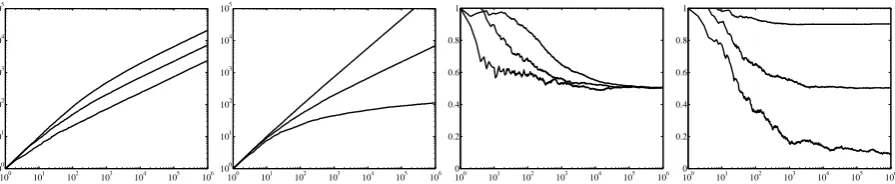
Figure 1: First panel: number of unique words as a function of the number of words drawn on a log-log scale, withd = .5andθ = 1(bottom),10 (middle) and100(top). Second panel: same, withθ = 10 andd= 0(bottom),.5(middle) and.9(top). Third panel: proportion of words appearing only once, as a function of the number of words drawn, withd=.5andθ= 1(bottom),10(middle),100(top). Last panel: same, withθ= 10andd= 0(bottom),.5(middle) and.9(top).
with probability θθ++dtc
· (increment t; set ct = 1; drawyt∼G0; setxc·+1←yt).
The above generative procedure produces a se-quence of words drawn i.i.d. from G, with G marginalized out. It is informative to study the Pitman-Yor process in terms of the behaviour it induces on this sequence of words. Firstly, no-tice the rich-gets-richer clustering property: the more words have been assigned to a draw from G0, the more likely subsequent words will be
as-signed to the draw. Secondly, the more we draw fromG0, the more likely a new word will be
as-signed to a new draw from G0. These two
ef-fects together produce a power-law distribution where many unique words are observed, most of them rarely. In particular, for a vocabulary of un-bounded size and ford >0, the number of unique words scales asO(θTd
)whereT is the total num-ber of words. Ford= 0, we have a Dirichlet dis-tribution and the number of unique words grows more slowly atO(θlogT).
Figure 1 demonstrates the power-law behaviour of the Pitman-Yor process and how this depends on d and θ. In the first two panels we show the average number of unique words among 10 se-quences of T words drawn from G, as a func-tion of T, for various values of θ and d. We see that θ controls the overall number of unique words, while dcontrols the asymptotic growth of the number of unique words. In the last two pan-els, we show the proportion of words appearing only once among the unique words; this gives an indication of the proportion of words that occur rarely. We see that the asymptotic behaviour de-pends ondbut not onθ, with largerd’s producing more rare words.
This procedure for generating words drawn
fromGis often referred to as the Chinese restau-rant process (Pitman, 2002). The metaphor is as follows. Consider a sequence of customers (cor-responding to the words draws fromG) visiting a Chinese restaurant with an unbounded number of tables (corresponding to the draws fromG0), each
of which can accommodate an unbounded number of customers. The first customer sits at the first ta-ble, and each subsequent customer either joins an already occupied table (assign the word to the cor-responding draw from G0), or sits at a new table
(assign the word to a new draw fromG0).
3 Hierarchical Pitman-Yor Language Models
We describe ann-gram language model based on a hierarchical extension of the Pitman-Yor process. An n-gram language model defines probabilities over the current word given various contexts con-sisting of up ton−1words. Given a contextu,
let Gu(w) be the probability of the current word taking on value w. We use a Pitman-Yor process as the prior forGu[Gu(w)]w∈W, in particular,
Gu ∼ PY(d|u|, θ|u|, Gπ(u)) (3)
whereπ(u)is the suffix ofuconsisting of all but
the earliest word. The strength and discount pa-rameters are functions of the length|u|of the
con-text, while the mean vector is Gπ(u), the vector of probabilities of the current word given all but the earliest word in the context. Since we do not know Gπ(u) either, We recursively place a prior over Gπ(u) using (3), but now with parameters θ|π(u)|, d|π(u)| and mean vector Gπ(π(u)) instead. This is repeated until we get to G∅, the vector
empty context∅. Finally we place a prior onG∅:
G∅ ∼ PY(d0, θ0, G0) (4)
whereG0 is the global mean vector, given a
uni-form value ofG0(w) = 1/V for allw ∈ W.
Fi-nally, we place a uniform prior on the discount pa-rameters and aGamma(1,1)prior on the strength parameters. The total number of parameters in the model is2n.
The structure of the prior is that of a suffix tree of depthn, where each node corresponds to a con-text consisting of up ton−1words, and each child corresponds to adding a different word to the be-ginning of the context. This choice of the prior structure expresses our belief that words appearing earlier in a context have (a priori) the least impor-tance in modelling the probability of the current word, which is why they are dropped first at suc-cessively higher levels of the model.
4 Hierarchical Chinese Restaurant Processes
We describe a generative procedure analogous to the Chinese restaurant process of Section 2 for drawing words from the hierarchical Pitman-Yor language model with all Gu’s marginalized out. This gives us an alternative representation of the hierarchical Pitman-Yor language model that is amenable to efficient inference using Markov chain Monte Carlo sampling and easy computa-tion of the predictive probabilities for test words. The correspondence between interpolated Kneser-Ney and the hierarchical Pitman-Yor language model is also apparent in this representation.
Again we may treat each Gu as a distribution over the current word. The basic observation is that since Gu is Pitman-Yor process distributed, we can draw words from it using the Chinese restaurant process given in Section 2. Further, the only operation we need of its parent distribution Gπ(u) is to draw words from it too. SinceGπ(u) is itself distributed according to a Pitman-Yor cess, we can use another Chinese restaurant pro-cess to draw words from that. This is recursively applied until we need draws from the global mean distribution G0, which is easy since it is just
uni-form. We refer to this as the hierarchical Chinese restaurant process.
Let us introduce some notations. For each con-text uwe have a sequence of wordsxu1, xu2, . . . drawn i.i.d. from Gu and another sequence of
words yu1, yu2, . . . drawn i.i.d. from the parent distribution Gπ(u). We use lto index draws from Gu andkto index the draws fromGπ(u). Define tuwk = 1ifyuktakes on valuew, andtuwk = 0 otherwise. Each word xul is assigned to one of the drawsyukfromGπ(u). Ifyuk takes on value wdefinecuwk as the number of wordsxul drawn fromGuassigned toyuk, otherwise letcuwk = 0. Finally we denote marginal counts by dots. For example,cu·kis the number ofxul’s assigned the value of yuk, cuw· is the number of xul’s with value w, andtu·· is the current number of draws yuk fromGπ(u). Notice that we have the follow-ing relationships among thecuw·’s andtuw·:
(
tuw·= 0 ifcuw·= 0; 1≤tuw·≤cuw· ifcuw·>0;
(5)
cuw·=
X
u0:π(u0)=u
tu0w· (6)
Pseudo-code for drawing words using the hier-archical Chinese restaurant process is given as a recursive function DrawWord(u), while
pseudo-code for computing the probability that the next word drawn from Gu will be w is given in
WordProb(u,w). The counts are initialized at all
cuwk =tuwk = 0.
Function DrawWord(u):
Returns a new word drawn fromGu.
Ifu= 0, returnw∈W with probabilityG0(w).
Else with probabilities proportional to:
cuwk−d|u|tuwk: assign the new word toyuk. Incrementcuwk; returnw.
θ|u|+d|u|tu··: assign the new word to a new drawyuknewfromGπ(u).
Letw←DrawWord(π(u));
settuwknew =cuwknew= 1; returnw.
Function WordProb(u,w):
Returns the probability that the next word after contextuwill bew.
Ifu= 0, returnG0(w). Else return
cuw·−d|u|tuw· θ|u|+cu·· +
θ|u|+d|u|tu··
θ|u|+cu·· WordProb(π(
u),w).
Notice the self-reinforcing property of the hi-erarchical Pitman-Yor language model: the more a wordw has been drawn in context u, the more
likely will we drawwagain in contextu. In fact
word wwill be reinforced for other contexts that share a common suffix withu, with the
common suffix increases. This is because wwill be more likely under the context of the common suffix as well.
The hierarchical Chinese restaurant process is equivalent to the hierarchical Pitman-Yor language model insofar as the distribution induced on words drawn from them are exactly equal. However, the probability vectors Gu’s have been marginalized out in the procedure, replaced instead by the as-signments of words xul to draws yuk from the parent distribution, i.e. the seating arrangement of customers around tables in the Chinese restaurant process corresponding toGu. In the next section we derive tractable inference schemes for the hi-erarchical Pitman-Yor language model based on these seating arrangements.
5 Inference Schemes
In this section we give a high level description of a Markov chain Monte Carlo sampling based inference scheme for the hierarchical Pitman-Yor language model. Further details can be ob-tained at (Teh, 2006). We also relate interpolated Kneser-Ney to the hierarchical Pitman-Yor lan-guage model.
Our training dataD consists of the number of occurrences cuw· of each wordwafter each con-text uof length exactlyn−1. This corresponds
to observing word wdrawncuw·times from Gu. Given the training data D, we are interested in the posterior distribution over the latent vectors G = {Gv : all contextsv}and parameters Θ = {θm, dm: 0≤m≤n−1}:
p(G,Θ|D) =p(G,Θ,D)/p(D) (7)
As mentioned previously, the hierarchical Chinese restaurant process marginalizes out each Gu, re-placing it with the seating arrangement in the cor-responding restaurant, which we shall denote by Su. LetS = {Sv : all contextsv}. We are thus interested in the equivalent posterior over seating arrangements instead:
p(S,Θ|D) =p(S,Θ,D)/p(D) (8)
The most important quantities we need for lan-guage modelling are the predictive probabilities: what is the probability of a test wordwafter a con-textu? This is given by
p(w|u,D) = Z
p(w|u,S,Θ)p(S,Θ|D)d(S,Θ)
(9)
where the first probability on the right is the pre-dictive probability under a particular setting of seating arrangementsSand parametersΘ, and the
overall predictive probability is obtained by aver-aging this with respect to the posterior overSand
Θ(second probability on right). We approximate
the integral with samples {S(i)
,Θ(i)}Ii
=1 drawn
fromp(S,Θ|D):
p(w|u,D)≈
I
X
i=1
p(w|u,S(i),Θ(i)) (10)
while p(w|u,S,Θ) is given by the function
WordProb(u,w):
p(w|0,S,Θ) = 1/V (11)
p(w|u,S,Θ) = cuw·−d|u|tuw·
θ|u|+cu··
+ θ|u|+d|u|tu·· θ|u|+cu··
p(w|π(u),S,Θ) (12)
where the counts are obtained from the seating ar-rangement Su in the Chinese restaurant process corresponding toGu.
We use Gibbs sampling to obtain the posterior samples {S,Θ} (Neal, 1993). Gibbs sampling
keeps track of the current state of each variable of interest in the model, and iteratively resamples the state of each variable given the current states of all other variables. It can be shown that the states of variables will converge to the required samples from the posterior distribution after a sufficient number of iterations. Specifically for the hierar-chical Pitman-Yor language model, the variables consist of, for each u and each word xul drawn from Gu, the index kul of the draw from Gπ(u) assignedxul. In the Chinese restaurant metaphor, this is the index of the table which thelth customer sat at in the restaurant corresponding toGu. Ifxul has valuew, it can only be assigned to draws from Gπ(u)that has valuewas well. This can either be a preexisting draw with valuew, or it can be a new draw taking on value w. The relevant probabili-ties are given in the functionsDrawWord(u)and
WordProb(u,w), where we treat xul as the last
word drawn fromGu. This gives:
p(kul=k|S
−ul
,Θ)∝ max(0, c −ul
ux
ulk−d) θ+c−ul
u··
(13)
p(kul=k
new withy
uknew =xul|S
−ul ,Θ)∝
θ+dt−ul
u··
θ+c−ul
u··
p(xul|π(u),S
−ul
where the superscript −ulmeans the
correspond-ing set of variables or counts with xul excluded. The parameters Θare sampled using an auxiliary
variable sampler as detailed in (Teh, 2006). The overall sampling scheme for ann-gram hierarchi-cal Pitman-Yor language model takesO(nT)time and requiresO(M)space per iteration, whereT is the number of words in the training set, andM is the number of uniquen-grams. During test time, the computational cost isO(nI), since the predic-tive probabilities (12) requireO(n)time to calcu-late for each ofIsamples.
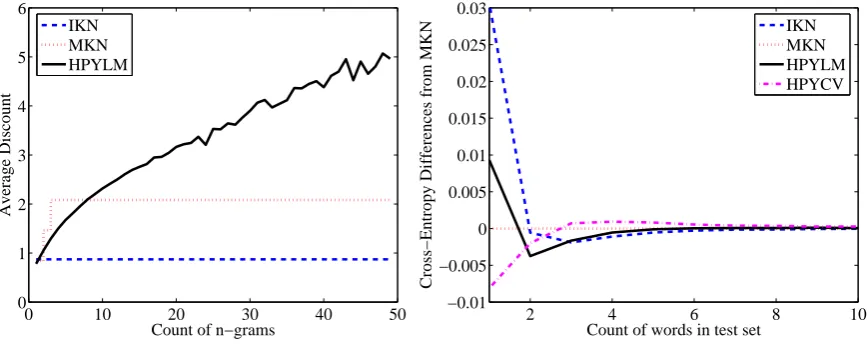
The hierarchical Pitman-Yor language model produces discounts that grow gradually as a func-tion ofn-gram counts. Notice that although each Pitman-Yor processGuonly has one discount
pa-rameter, the predictive probabilities (12) produce
different discount values since tuw· can take on different values for different wordsw. In facttuw· will on average be larger ifcuw·is larger; averaged over the posterior, the actual amount of discount will grow slowly as the count cuw· grows. This is shown in Figure 2 (left), where we see that the growth of discounts is sublinear.
The correspondence to interpolated Kneser-Ney is now straightforward. If we restricttuw·to be at most 1, that is,
tuw·= min(1, cuw·) (15)
cuw·=
X
u0:π(u0)=u
tu0w· (16)
we will get the same discount value so long as cuw· > 0, i.e. absolute discounting. Further sup-posing that the strength parameters are all θ|u| = 0, the predictive probabilities (12) now directly re-duces to the predictive probabilities given by polated Kneser-Ney. Thus we can interpret inter-polated Kneser-Ney as the approximate inference scheme (15,16) in the hierarchical Pitman-Yor lan-guage model.
Modified Kneser-Ney uses the same values for the counts as in (15,16), but uses a different val-ued discount for each value ofcuw·up to a maxi-mum ofc(max). Since the discounts in a
hierarchi-cal Pitman-Yor language model are limited to be-tween 0 and 1, we see that modified Kneser-Ney is not an approximation of the hierarchical Pitman-Yor language model.
6 Experimental Results
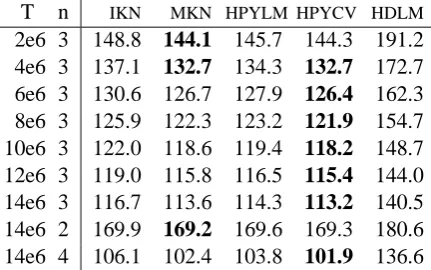
We performed experiments on the hierarchical Pitman-Yor language model on a 16 million word corpus derived from APNews. This is the same dataset as in (Bengio et al., 2003). The training, validation and test sets consist of about 14 mil-lion, 1 million and 1 million words respectively, while the vocabulary size is 17964. For trigrams withn= 3, we varied the training set size between approximately 2 million and 14 million words by six equal increments, while we also experimented withn= 2and4on the full 14 million word train-ing set. We compared the hierarchical Pitman-Yor language model trained using the proposed Gibbs sampler (HPYLM) against interpolated Kneser-Ney (IKN), modified Kneser-Kneser-Ney (MKN) with maximum discount cut-off c(max) = 3 as
recom-mended in (Chen and Goodman, 1998), and the hierarchical Dirichlet language model (HDLM).
For the various variants of Kneser-Ney, we first determined the parameters by conjugate gradient descent in the cross-entropy on the validation set. At the optimal values, we folded the validation set into the training set to obtain the finaln-gram probability estimates. This procedure is as recom-mended in (Chen and Goodman, 1998), and takes approximately 10 minutes on the full training set with n = 3on a 1.4 Ghz PIII. For HPYLM we inferred the posterior distribution over the latent variables and parameters given both the training and validation sets using the proposed Gibbs sam-pler. Since the posterior is well-behaved and the sampler converges quickly, we only used 125 it-erations for burn-in, and 175 itit-erations to collect posterior samples. On the full training set with n= 3this took about 1.5 hours.
param-T n IKN MKN HPYLM HPYCV HDLM
[image:7.595.73.289.64.199.2]2e6 3 148.8 144.1 145.7 144.3 191.2 4e6 3 137.1 132.7 134.3 132.7 172.7 6e6 3 130.6 126.7 127.9 126.4 162.3 8e6 3 125.9 122.3 123.2 121.9 154.7 10e6 3 122.0 118.6 119.4 118.2 148.7 12e6 3 119.0 115.8 116.5 115.4 144.0 14e6 3 116.7 113.6 114.3 113.2 140.5 14e6 2 169.9 169.2 169.6 169.3 180.6 14e6 4 106.1 102.4 103.8 101.9 136.6
Table 1: Perplexities of various methods and for various sizes of training set T and length of n-grams.
eters θ|u|’s are allowed to be positive and opti-mized over along with the discount parameters using cross-validation. Seating arrangements are Gibbs sampled as in Section 5 with the parame-ter values fixed. We find that HPYCV performs better than MKN (except marginally worse on small problems), and has best performance over-all. Note that the parameter values in HPYCV are still not the optimal ones since they are obtained by cross-validation using IKN, an approximation to a hierarchical Pitman-Yor language model. Un-fortunately cross-validation using a hierarchical Pitman-Yor language model inferred using Gibbs sampling is currently too costly to be practical.
In Figure 2 (right) we broke down the contribu-tions to the cross-entropies in terms of how many times each word appears in the test set. We see that most of the differences between the methods appear as differences among rare words, with the contribution of more common words being neg-ligible. HPYLM performs worse than MKN on words that occurred only once (on average) and better on other words, while HPYCV is reversed and performs better than MKN on words that oc-curred only once or twice and worse on other words.
7 Discussion
We have described using a hierarchical Pitman-Yor process as a language model and shown that it gives performance superior to state-of-the-art methods. In addition, we have shown that the state-of-the-art method of interpolated Kneser-Ney can be interpreted as approximate inference in the hierarchical Pitman-Yor language model.
In the future we plan to study in more detail
the differences between our model and the vari-ants of Kneser-Ney, to consider other approximate inference schemes, and to test the model on larger data sets and on speech recognition. The hierarchi-cal Pitman-Yor language model is a fully Bayesian model, thus we can also reap other benefits of the paradigm, including having a coherent probabilis-tic model, ease of improvements by building in prior knowledge, and ease in using as part of more complex models; we plan to look into these possi-ble improvements and extensions.
The hierarchical Dirichlet language model of (MacKay and Peto, 1994) was an inspiration for our work. Though (MacKay and Peto, 1994) had the right intuition to look at smoothing techniques as the outcome of hierarchical Bayesian models, the use of the Dirichlet distribution as a prior was shown to lead to non-competitive cross-entropy re-sults. Our model is a nontrivial but direct gen-eralization of the hierarchical Dirichlet language model that gives state-of-the-art performance. We have shown that with a suitable choice of priors (namely the Pitman-Yor process), Bayesian meth-ods can be competitive with the best smoothing techniques.
The hierarchical Pitman-Yor process is a natural generalization of the recently proposed hierarchi-cal Dirichlet process (Teh et al., 2006). The hier-archical Dirichlet process was proposed to solve a different problem—that of clustering, and it is interesting to note that such a direct generaliza-tion leads us to a good language model. Both the hierarchical Dirichlet process and the hierarchi-cal Pitman-Yor process are examples of Bayesian nonparametric processes. These have recently re-ceived much attention in the statistics and ma-chine learning communities because they can re-lax previously strong assumptions on the paramet-ric forms of Bayesian models yet retain computa-tional efficiency, and because of the elegant way in which they handle the issues of model selection and structure learning in graphical models.
Acknowledgement
0 10 20 30 40 50 0
1 2 3 4 5 6
Count of n−grams
Average Discount
IKN MKN HPYLM
2 4 6 8 10
−0.01 −0.005 0 0.005 0.01 0.015 0.02 0.025 0.03
Cross−Entropy Differences from MKN
[image:8.595.83.517.65.237.2]Count of words in test set IKN MKN HPYLM HPYCV
Figure 2: Left: Average discounts as a function ofn-gram counts in IKN (bottom line), MKN (middle step function), and HPYLM (top curve). Right: Break down of cross-entropy on test set as a function of the number of occurrences of test words. Plotted is the sum over test words which occurredctimes of cross-entropies of IKN, MKN, HPYLM and HPYCV, wherecis as given on thex-axis and MKN is used as a baseline. Lower is better. Both panels are for the full training set andn= 3.
helpful comments.
References
Y. Bengio, R. Ducharme, P. Vincent, and C. Jauvin. 2003. A neural probabilistic language model.
Jour-nal of Machine Learning Research, 3:1137–1155.
S.F. Chen and J.T Goodman. 1998. An empirical study of smoothing techniques for language model-ing. Technical Report TR-10-98, Computer Science Group, Harvard University.
A. Gelman, J. Carlin, H. Stern, and D. Rubin. 1995.
Bayesian data analysis. Chapman & Hall, London.
Z. Ghahramani. 2005. Nonparametric Bayesian meth-ods. Tutorial presentation at the UAI Conference.
S. Goldwater, T.L. Griffiths, and M. Johnson. 2006. Interpolating between types and tokens by estimat-ing power-law generators. In Advances in Neural
Information Processing Systems, volume 18.
J.T. Goodman. 2001. A bit of progress in language modeling. Technical Report MSR-TR-2001-72, Mi-crosoft Research.
J.T. Goodman. 2004. Exponential priors for maximum entropy models. In Proceedings of the Annual
Meet-ing of the Association for Computational LMeet-inguis- Linguis-tics.
H. Ishwaran and L.F. James. 2001. Gibbs sampling methods for stick-breaking priors. Journal of the
American Statistical Association, 96(453):161–173.
M.I. Jordan. 2005. Dirichlet processes, Chinese restaurant processes and all that. Tutorial presen-tation at the NIPS Conference.
R. Kneser and H. Ney. 1995. Improved backing-off for m-gram language modeling. In Proceedings
of the IEEE International Conference on Acoustics, Speech and Signal Processing, volume 1.
D.J.C. MacKay and L.C.B. Peto. 1994. A hierarchical Dirichlet language model. Natural Language
Engi-neering.
A. Nadas. 1984. Estimation of probabilities in the lan-guage model of the IBM speach recognition system.
IEEE Transaction on Acoustics, Speech and Signal Processing, 32(4):859–861.
R.M. Neal. 1993. Probabilistic inference using Markov chain Monte Carlo methods. Technical Re-port CRG-TR-93-1, Department of Computer Sci-ence, University of Toronto.
J. Pitman and M. Yor. 1997. The two-parameter Poisson-Dirichlet distribution derived from a stable subordinator. Annals of Probability, 25:855–900.
J. Pitman. 2002. Combinatorial stochastic processes. Technical Report 621, Department of Statistics, Uni-versity of California at Berkeley. Lecture notes for St. Flour Summer School.
R. Rosenfeld. 2000. Two decades of statistical lan-guage modeling: Where do we go from here?
Pro-ceedings of the IEEE, 88(8).
Y.W. Teh, M.I. Jordan, M.J. Beal, and D.M. Blei. 2006. Hierarchical Dirichlet processes. To appear in
Jour-nal of the American Statistical Association.