Tuning as Ranking
Mark Hopkins and Jonathan May SDL Language Weaver Los Angeles, CA 90045
{mhopkins,jmay}@sdl.com
Abstract
We offer a simple, effective, and scalable method for statistical machine translation pa-rameter tuning based on the pairwise approach to ranking (Herbrich et al., 1999). Unlike the popular MERT algorithm (Och, 2003), our pairwise ranking optimization (PRO) method is not limited to a handful of parameters and can easily handle systems with thousands of features. Moreover, unlike recent approaches built upon the MIRA algorithm of Crammer and Singer (2003) (Watanabe et al., 2007; Chi-ang et al., 2008b), PRO is easy to imple-ment. It uses off-the-shelf linear binary classi-fier software and can be built on top of an ex-isting MERT framework in a matter of hours. We establish PRO’s scalability and effective-ness by comparing it to MERT and MIRA and demonstrate parity on both phrase-based and syntax-based systems in a variety of language pairs, using large scale data scenarios.
1 Introduction
The MERT algorithm (Och, 2003) is currently the most popular way to tune the parameters of a sta-tistical machine translation (MT) system. MERT is well-understood, easy to implement, and runs quickly, but can behave erratically and does not scale beyond a handful of features. This lack of scalability is a significant weakness, as it inhibits systems from using more than a couple dozen features to discrimi-nate between candidate translations and stymies fea-ture development innovation.
Several researchers have attempted to address this weakness. Recently, Watanabe et al. (2007)
and Chiang et al. (2008b) have developed tuning methods using the MIRA algorithm (Crammer and Singer, 2003) as a nucleus. The MIRA technique of Chiang et al. has been shown to perform well on large-scale tasks with hundreds or thousands of fea-tures (2009). However, the technique is complex and architecturally quite different from MERT. Tellingly, in the entire proceedings of ACL 2010 (Hajiˇc et al., 2010), only one paper describing a statistical MT system cited the use of MIRA for tuning (Chiang, 2010), while 15 used MERT.1
Here we propose a simpler approach to tuning that scales similarly to high-dimensional feature spaces. We cast tuning as a ranking problem (Chen et al., 2009), where the explicit goal is to learn to correctly rank candidate translations. Specifically, we follow the pairwise approach to ranking (Herbrich et al., 1999; Freund et al., 2003; Burges et al., 2005; Cao et al., 2007), in which the ranking problem is reduced to the binary classification task of deciding between candidate translation pairs.
Of primary concern to us is the ease of adoption of our proposed technique. Because of this, we adhere as closely as possible to the established MERT ar-chitecture and use freely available machine learning software. The end result is a technique that scales and performs just as well as MIRA-based tuning, but which can be implemented in a couple of hours by anyone with an existing MERT implementation. Mindful that many would-be enhancements to the
1The remainder either did not specify their tuning method (though a number of these used the Moses toolkit (Koehn et al., 2007), which uses MERT for tuning) or, in one case, set weights by hand.
state-of-the-art are false positives that only show im-provement in a narrowly defined setting or with lim-ited data, we validate our claims on both syntax and phrase-based systems, using multiple language pairs and large data sets.
We describe tuning in abstract and somewhat for-mal terms in Section 2, describe the MERT algo-rithm in the context of those terms and illustrate its scalability issues via a synthetic experiment in Sec-tion 3, introduce our pairwise ranking optimizaSec-tion method in Section 4, present numerous large-scale MT experiments to validate our claims in Section 5, discuss some related work in Section 6, and con-clude in Section 7.
2 Tuning
In Figure 1, we show an examplecandidate space, defined as a tupleh∆, I, J, f, e,xiwhere:
• ∆is a positive integer referred to as the dimen-sionalityof the space
• Iis a (possibly infinite) set of positive integers, referred to assentence indices
• Jmaps each sentence index to a (possibly infi-nite) set of positive integers, referred to as can-didate indices
• f maps each sentence index to a sentence from the source language
• emaps each pair hi, ji ∈ I ×J(i) to the jth target-languagecandidate translationof source sentencef(i)
• x maps each pair hi, ji ∈ I × J(i) to a ∆-dimension feature vector representation of e(i, j)
The example candidate space has two source sen-tences, three candidate translations for each source sentence, and feature vectors of dimension 2. It is an example of a finite candidate space, defined as a candidate space for whichI is finite andJ maps each index ofI to a finite set.
Apolicyof candidate spaceh∆, I, J, f, e,xiis a function that maps each memberi∈I to a member of J(i). A policy corresponds to a choice of one
candidate translation for each source sentence. For
the example in Figure 1, policyp1 = {1 7→2,2 7→
3}corresponds to the choice of “he does not go” for
the first source sentence and “I do not go” for the second source sentence. Obviously some policies are better than others. Policyp2 ={17→3,27→ 1}
corresponds to the inferior translations “she not go” and “I go not.”
We assume the MT system distinguishes between policies using a scoring function for candidate trans-lations of the formhw(i, j) = w·x(i, j), wherew
is a weight vector of the same dimension as feature vector x(i, j). This scoring function extends to a policypby summing the cost of each of the policy’s candidate translations: Hw(p) =Pi∈Ihw(i, p(i)).
As can be seen in Figure 1, using w = [−2,1], Hw(p1) = 9andHw(p2) =−8.
The goal of tuning is to learn a weight vectorw such thatHw(p)assigns a high score to good
poli-cies, and a low score to bad policies.2 To do so,
we need information about which policies are good and which are bad. This information is provided by a “gold” scoring functionG that maps each policy to a real-valued score. Typically this gold function is BLEU (Papineni et al., 2002), though there are
several common alternatives (Lavie and Denkowski, 2009; Melamed et al., 2003; Snover et al., 2006; Chiang et al., 2008a).
We want to find a weight vectorwsuch thatHw
behaves “similarly” to G on a candidate space s. We assume a loss functionls(Hw, G)which returns
the real-valued loss of using scoring function Hw
when the gold scoring function isGand the candi-date space iss. Thus, we may say the goal of tuning is to find the weight vectorwthat minimizes loss.
3 MERT
In general, the candidate space may have infinitely many source sentences, as well as infinitely many candidate translations per source sentence. In prac-tice, tuning optimizes over a finite subset of source sentences3 and a finite subset of candidate
transla-tions as well. The classic tuning architecture used in the dominant MERT approach (Och, 2003) forms the translation subset and learns weight vectorwvia
2Without loss of generality, we assume that a higher score indicates a better translation.
Source Sentence Candidate Translations
i f(i) j e(i, j) x(i, j) hw(i, j) g(i, j)
1 “il ne va pas” 1 “he goes not” [2 4] 0 0.28 2 “he does not go” [3 8] 2 0.42 3 “she not go” [6 1] -11 0.12 2 “je ne vais pas” 1 “I go not” [-3 -3] 3 0.15 2 “we do not go” [1 -5] -7 0.18 3 “I do not go” [-5 -3] 7 0.34
Figure 1: Example candidate space of dimensionality 2. Note:I={1,2},J(1) =J(2) ={1,2,3}. We also show a local scoring functionhw(i, j)(wherew= [−2,1]) and a local gold scoring functiong(i, j).
AlgorithmTUNE(s,G):
1: initialize pool: let s0 = h∆, I0, J0, f, e,xi, whereI0 ⊆I andJ0 =∅
2: forthe desired number of iterationsdo
3: candidate generation: choose index pairs (i, j); for each, addjtoJ0(i)
4: optimization: find vectorwthat minimizes ls0(Hw, G)
[image:3.612.142.473.55.171.2]5: return w
Figure 2: Schema for iterative tuning of base candidate spaces=h∆, I, J, f, e,xiw.r.t. gold functionG.
a feedback loop consisting of two phases. Figure 2 shows the pseudocode. During candidate genera-tion, candidate translations are selected from a base candidate space s and added to a finite candidate spaces0called thecandidate pool. During optimiza-tion, the weight vectorwis optimized to minimize lossls0(Hw, G).
For its candidate generation phase, MERT gener-ates thek-best candidate translations for each source sentence according to hw, where w is the weight
vector from the previous optimization phase (or an arbitrary weight vector for the first iteration).
For its optimization phase, MERT defines the loss function as follows:
ls(Hw, G) = max
p G(p)−G(arg maxp Hw(p))
In other words, it prefers weight vectors w such that the gold functionGscoresHw’s best policy as
highly as possible (ifHw’s best policy is the same
asG’s best policy, then there is zero loss). Typically the optimization phase is implemented using Och’s line optimization algorithm (2003).
MERT has proven itself effective at tuning candi-date spaces with low dimensionality. However, it is often claimed that MERT does not scale well with dimensionality. To test this claim, we devised the following synthetic data experiment:
1. We created a gold scoring function G that is alsoa linear function of the same form asHw,
i.e.,G(p) =Hw∗(p)for some gold weight vec-torw∗. Under this assumption, the role of the optimization phase reduces to learning back the gold weight vectorw∗.
2. We generated a ∆-dimensionality candidate
pool with 500 source “sentences” and 100 can-didate “translations” per sentence. We created the corresponding feature vectors by drawing
∆random real numbers uniformly from the
in-terval[0,500].
3. We ran MERT’s line optimization on this syn-thetic candidate pool and compared the learned weight vectorwto the gold weight vectorw∗ using cosine similarity.
We used line optimization in the standard way, by generating 20 random starting weight vectors and hill-climbing on each independently until no further progress is made, then choosing the final weight vec-tor that minimizes loss. We tried various dimen-sionalities from 10 to 1000. We repeated each set-ting three times, generaset-ting different random data each time. The results in Figure 3 indicate that as the dimensionality of the problem increases MERT rapidly loses the ability to learnw∗. Note that this
MERT cannot scale in this simple scenario, it has lit-tle hope of succeeding in a high-dimensionality de-ployment scenario.
4 Optimization via Pairwise Ranking We would like to modify MERT so that it scales well to high-dimensionality candidate spaces. The most prominent example of a tuning method that per-forms well on high-dimensionality candidate spaces is the MIRA-based approach used by Watanabe et al. (2007) and Chiang et al. (2008b; 2009). Unfortu-nately, this approach requires a complex architecture that diverges significantly from the MERT approach, and consequently has not been widely adopted. Our goal is to achieve the same performance with mini-mal modification to MERT.
With MERT as a starting point, we have a choice: modify candidate generation, optimization, or both. Although alternative candidate generation methods have been proposed (Macherey et al., 2008; Chiang et al., 2008b; Chatterjee and Cancedda, 2010), we will restrict ourselves to MERT-style candidate gen-eration, in order to minimize divergence from the established MERT tuning architecture. Instead, we focus on the optimization phase.
4.1 Basic Approach
While intuitive, the MERT optimization module fo-cuses attention onHw’s best policy, and not on its
overall prowess at ranking policies. We will cre-ate an optimization module that directly addresses Hw’s ability to rank policies in the hope that this
more holistic approach will generalize better to un-seen data.
Assume that the gold scoring functionG decom-poses in the following way:
G(p) =X
i∈I
g(i, p(i)) (1)
whereg(i, j) is a local scoring function that scores
the single candidate translatione(i, j). We show an
examplegin Figure 1. For an arbitrary pair of can-didate translationse(i, j)ande(i, j0), the local gold
function g tells us which is the better translation. Note that this induces a ranking on the candidate translations for each source sentence.
We follow thepairwise approachto ranking (Her-brich et al., 1999; Freund et al., 2003; Burges et al., 2005; Cao et al., 2007). In the pairwise approach, the learning task is framed as the classification of candidate pairs into two categories: correctly or-dered and incorrectly oror-dered. Specifically, for can-didate translation paire(i, j) ande(i, j0), we want: g(i, j) > g(i, j0) ⇔ hw(i, j) > hw(i, j0). We can
re-express this condition:
g(i, j)> g(i, j0)⇔hw(i, j)> hw(i, j0)
⇔hw(i, j)−hw(i, j0)>0
⇔w·x(i, j)−w·x(i, j0)>0
⇔w·(x(i, j)−x(i, j0))>0
Thus optimization reduces to a classic binary clas-sification problem. We create a labeled training in-stance for this problem by computing difference vec-tor x(i, j) −x(i, j0), and labeling it as a positive or negative instance based on whether, respectively, the first or second vector is superior according to gold function g. To ensure balance, we consider both possible difference vectors from a pair. For ex-ample, given the candidate space of Figure 1, since g(1,1) > g(1,3), we would add ([−4,3],+) and ([4,−3],−)to our training set. We can then feed this
training data directly to any off-the-shelf classifica-tion tool that returns a linear classifier, in order to ob-tain a weight vectorwthat optimizes the above con-dition. This weight vector can then be used directly by the MT system in the subsequent candidate gen-eration phase. The exact loss functionls0(Hw, G)
optimized depends on the choice of classifier.4
Typical approaches to pairwise ranking enumer-ate all difference vectors as training data. For tuning however, this meansO(|I| ∗Jmax2 ) vectors, where Jmax is the cardinality of the largest J(i). Since
I and Jmax commonly range in the thousands, a
full enumeration would produce billions of feature vectors. Out of tractability considerations, we sam-ple from the space of difference vectors, using the sampler template in Figure 4. For each source sen-tencei, the sampler generates Γ candidate
transla-tion pairshj, j0i, and accepts each pair with
proba-bilityαi(|g(i, j)−g(i, j0)|). Among the accepted
pairs, it keeps theΞwith greatestgdifferential, and adds their difference vectors to the training data.5
4See (Chen et al., 2009) for a brief survey.
0 0.2 0.4 0.6 0.8 1
0 200 400 600 800 1000
Cosine similarity
of learned parameter weights
Dimensionality Synthetic parameter learning
of MERT and PRO
[image:5.612.78.281.64.207.2]PRO Noisy PRO MERT Noisy MERT
Figure 3: Result of synthetic data learning experiment for MERT and PRO, with and without added noise. As the dimensionality increases MERT is unable to learn the original weights but PRO still performs adequately.
4.2 Scalability
We repeated the scalability study from Section 3, now using our pairwise ranking optimization (here-after, PRO) approach. Throughout all experiments with PRO we choose Γ = 5000, Ξ = 50, and the
following step functionαfor eachαi:6
α(n) =
(
0ifn <0.05 1otherwise
We used MegaM (Daum´e III, 2004) as a binary classifier in our contrasting synthetic experiment and ran it “out of the box,” i.e., with all default settings for binary classification.7 Figure 3 shows that PRO
is able to learnw∗nearly perfectly at all dimension-alities from 10 to 1000.
As noted previously, though, this is a rather sim-ple task. To encourage a disconnect betweeng and hw and make the synthetic scenario look more like
MT reality, we repeated the synthetic experiments
that our primary goal is to ensure good translations are preferred to bad translations, and not to tease apart small differences.
6We obtained these parameters by trial-and-error experi-mentation on a single MT system (Urdu-English SBMT), then held them fixed throughout our experiments. We obtained sim-ilar results usingΓ = Ξ = 100, and for eachαi, a logistic
sig-moid function centered at the meangdifferential of candidate
translation pairs for theithsource sentence. This alternative ap-proach has the advantage of being agnostic about which gold scoring function is used.
7With the sampling settings previously described and MegaM as our classifier we were able to optimize two to three times faster than with MERT’s line optimization.
AlgorithmSAMPLERs,g(Γ,Ξ,i,αi ):
1: V =hi
2: forΓsamplingsdo
3: Choosehj, j0i ∈J(i)×J(i)uniformly at
ran-dom.
4: With probability αi(|g(i, j)-g(i, j0)|), add
(x(i, j),x(i, j0),|g(i, j)-g(i, j0)|)toV. 5: SortV decreasingly by|g(i, j)-g(i, j0)|. 6: return (x(i, j)−x(i, j0),sign(g(i, j)-g(i, j0))
and (x(i, j0)-x(i, j),sign(g(i, j0)-g(i, j))) for
each of the firstΞmembers ofV.
Figure 4: Pseudocode for our sampler. Arguments: s=
h∆, I, J, f, e,xiis a finite candidate space;gis a scoring function;Γ,Ξ,iare nonnegative integers; αi is a func-tion from the nonnegative real numbers to the real interval
[0,1].
but added noise to each feature vector, drawn from a zero-mean Gaussian with a standard deviation of 500. The results of the noisy synthetic experiments, also in Figure 3 (the lines labeled “Noisy”), show that the pairwise ranking approach is less successful than before at learning w∗ at high dimensionality, but still greatly outperforms MERT.
4.3 Discussion
The idea of learning from difference vectors also lies at the heart of the MIRA-based approaches (Watan-abe et al., 2007; Chiang et al., 2008b) and the ap-proach of Roth et al. (2010), which, similar to our method, uses sampling to select vectors. Here, we isolate these aspects of those approaches to create a simpler tuning technique that closely mirrors the ubiquitous MERT architecture. Among other sim-plifications, we abstract away the choice of MIRA as the classification method (our approach can use any classification technique that learns a separating hyperplane), and we eliminate the need for oracle translations.
An important observation is that BLEU does not
satisfy the decomposability assumption of Equa-tion (1). An advantage of MERT is that it can di-rectly optimize for non-decomposable scoring func-tions like BLEU. In our experiments, we use
the BLEU+1 approximation to BLEU (Liang et al.,
PBMT
Language feats method tune testExperiment BLEU
Urdu-English base
MERT 20.5 17.7 MIRA 20.5 17.9 PRO 20.4 18.2 ext MIRAPRO 21.8 17.821.6 18.1
Arabic-English base
MERT 46.8 41.2 MIRA 47.0 41.1 PRO 46.9 41.1 ext MIRAPRO 47.5 41.748.5 41.9
Chinese-English
base MERTMIRA 23.8 22.224.1 22.5 PRO 23.8 22.5 ext MIRAPRO 24.8 22.624.9 22.7
SBMT
Language feats method tune testExperiment BLEU
Urdu-English base
MERT 23.4 21.4 MIRA 23.6 22.3 PRO 23.4 22.2 ext MIRAPRO 25.2 22.824.2 22.8
Arabic-English base
MERT 44.7 39.0 MIRA 44.6 39.0 PRO 44.5 39.0 ext MIRAPRO 45.8 39.845.9 40.3
Chinese-English
[image:6.612.75.541.55.309.2]base MERTMIRA 25.5 22.725.4 22.9 PRO 25.5 22.9 ext MIRAPRO 26.0 23.325.6 23.5
Table 1: Machine translation performance for the experiments listed in this paper. Scores are case-sensitive IBM BLEU. For every choice of system, language pair, and feature set, PRO performs comparably with the other methods.
5 Experiments
We now turn to real machine translation condi-tions to validate our thesis: We can cleanly replace MERT’s line optimization with pairwise ranking op-timization and immediately realize the benefits of high-dimension tuning. We now detail the three language pairs, two feature scenarios, and two MT models used for our experiments. For each language pair and each MT model we used MERT, MIRA, and PRO to tune with a standard set of baseline features, and used the latter two methods to tune with an ex-tended set of features.8 At the end of every
experi-ment we used the final feature weights to decode a held-out test set and evaluated it with case-sensitive BLEU. The results are in Table 1.
5.1 Systems
We used two systems, each based on a different MT model. Our syntax-based system (hereafter, SBMT) follows the model of Galley et al. (2004). Our
8MERT could not run to a satisfactory completion in any extended feature scenario; as implied in the synthetic data ex-periment of Section 3, the algorithm makes poor choices for its weights and this leads to low-qualityk-best lists and dismal performance, near 0 BLEUin every iteration.
phrase-based system (hereafter, PBMT) follows the model of Och and Ney (2004). In both systems we learn alignments with GIZA++ (Och and Ney, 2000) using IBM Model 4; for Urdu-English and Chinese-English we merged alignments with the re-fined method, and for Arabic-English we merged with the union method.
[image:6.612.329.522.556.654.2]5.2 Data
Table 2 notes the sizes of the datasets used in our ex-periments. All tune and test data have four English reference sets for the purposes of scoring.
Data U-E A-E C-E
Train words 2.2M 175M 173Mlines 515K 6.5M 7.9M
Tune lines 923 1994 1615 words 16K 65K 42K Test wordslines 18K938 135747K 135737K
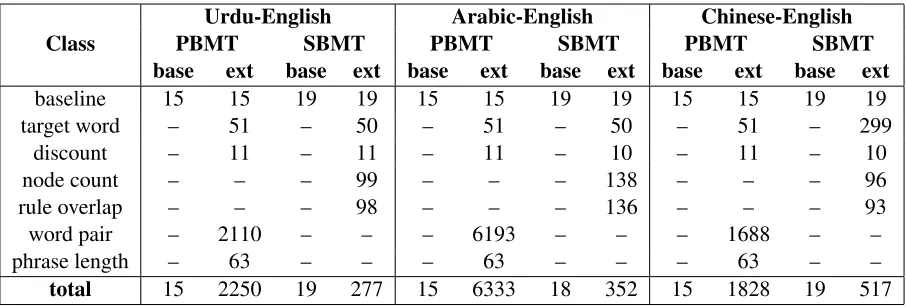
Class PBMTUrdu-EnglishSBMT PBMTArabic-EnglishSBMT PBMTChinese-EnglishSBMT
base ext base ext base ext base ext base ext base ext
baseline 15 15 19 19 15 15 19 19 15 15 19 19
target word – 51 – 50 – 51 – 50 – 51 – 299
discount – 11 – 11 – 11 – 10 – 11 – 10
node count – – – 99 – – – 138 – – – 96
rule overlap – – – 98 – – – 136 – – – 93
word pair – 2110 – – – 6193 – – – 1688 – –
phrase length – 63 – – – 63 – – – 63 – –
[image:7.612.80.533.56.210.2]total 15 2250 19 277 15 6333 18 352 15 1828 19 517
Table 3: Summary of features used in experiments in this paper.
5.2.1 Urdu-English
The training data for Urdu-English is that made available in the constrained track in the NIST 2009 MT evaluation. This includes many lexicon entries and other single-word data, which accounts for the large number of lines relative to word count. The NIST 2008 evaluation set, which contains newswire and web data, is split into two parts; we used roughly half each for tune and test. We trained a 5-gram English language model on the English side of the training data.
5.2.2 Arabic-English
The training data for Arabic English is that made available in the constrained track in the NIST 2008 MT evaluation. The tune set, which contains only newswire data, is a mix from NIST MT evaluation sets from 2003–2006 and from GALE development data. The test set, which contains both web and newswire data, is the evaluation set from the NIST 2008 MT evaluation. We trained a 4-gram English language model on the English side of the training data.
5.2.3 Chinese-English
For Chinese-English we used 173M words of training data from GALE 2008. For SBMT we used a 32M word subset for extracting rules and building a language model, but used the entire training data for alignments, and for all PBMT training. The tune and test sets both contain web and newswire data. The tune set is selected from NIST MT evaluation sets from 2003–2006. The test set is the evaluation set from the NIST 2008 MT evaluation. We trained a
3-gram English language model on the English side of the training data.
5.3 Features
For each of our systems we identify two feature sets: baseline, which correspond to the typical small fea-ture set reported in current MT literafea-ture, and ex-tended, a superset of baseline, which adds hundreds or thousands of features. Specifically, we use 15 baseline features for PBMT, similar to the baseline features described by Watanabe et al. (2007). We use 19 baseline features for SBMT, similar to the baseline features described by Chiang et al. (2008b). We used the following feature classes in SBMT and PBMT extended scenarios:
• Discount features for rule frequency bins (cf. Chiang et al. (2009), Section 4.1)
• Target word insertion features9
We used the following feature classes in SBMT ex-tended scenarios only (cf. Chiang et al. (2009), Sec-tion 4.1):10
• Rule overlap features
• Node count features
9For Chinese-English and Urdu-English SBMT these fea-tures only fired when the inserted target word was unaligned to any source word.
20 21 22 23 24 25 26
0 5 10 15 20 25 30
4-ref BLEU
Iteration
Urdu-English SBMT baseline feature tuning
TUNE
TEST
MERT MIRA PRO
20 21 22 23 24 25 26
0 5 10 15 20 25 30
4-ref BLEU
Iteration
Urdu-English SBMT extended feature tuning
TUNE
TEST
[image:8.612.91.516.59.214.2]MIRA PRO
Figure 5: Comparison of MERT, PRO, and MIRA on tuning Urdu-English SBMT systems, and test results at every iteration. PRO performs comparably to MERT and MIRA.
We used the following feature classes in PBMT extended scenarios only:
• Unigram word pair features for the 80 most fre-quent words in both languages plus tokens for unaligned and all other words (cf. Watanabe et al. (2007), Section 3.2.1)11
• Source, target, and joint phrase length
fea-tures from 1 to 7, e.g. “tgt=4”, “src=2”, and “src/tgt=2,4”
The feature classes and number of features used within those classes for each language pair are sum-marized in Table 3.
5.4 Tuning settings
Each of the three approaches we compare in this study has various details associated with it that may prove useful to those wishing to reproduce our re-sults. We list choices made for the various tuning methods here, and note that all our decisions were made in keeping with best practices for each algo-rithm.
5.4.1 MERT
We used David Chiang’s CMERT implementation of MERT that is available with the Moses system (Koehn et al., 2007). We ran MERT for up to 30 it-erations, usingk = 1500, and stopping early when
11This constitutes 6,723 features in principle (822
−1since “unaligned-unaligned” is not considered) but in practice far fewer co-occurrences were seen. Table 3 shows the number of actual unigram word pair features observed in data.
the accumulatedk-best list does not change in an it-eration. In every tuning iteration we ran MERT once with weights initialized to the last iteration’s chosen weight set and 19 times with random weights, and chose the the best of the 20 ending points according toG on the development set. The G we optimize is tokenized, lower-cased 4-gram BLEU(Papineni et
al., 2002).
5.4.2 MIRA
We for the most part follow the MIRA algorithm for machine translation as described by Chiang et al. (2009)12 but instead of using the 10-best of each of
the besthw, hw +g, andhw-g, we use the 30-best
according tohw.13 We use the same sentence-level
BLEU calculated in the context of previous 1-best
translations as Chiang et al. (2008b; 2009). We ran MIRA for 30 iterations.
5.4.3 PRO
We used the MegaM classifier and sampled as de-scribed in Section 4.2. As previously noted, we used BLEU+1 (Liang et al., 2006) forg. MegaM was easy to set up and ran fairly quickly, however any linear binary classifier that operates on real-valued features can be used, and in fact we obtained similar results
12and acknowledge the use of David Chiang’s code
13This is a more realistic scenario for would-be implementers of MIRA, as obtaining the so-called “hope” and “fear” transla-tions from the lattice or forest is significantly more complicated than simply obtaining ak-best list. Other tests comparing these
using the support vector machine module of WEKA (Hall et al., 2009) as well as the Stanford classifier (Manning and Klein, 2003). We ran for up to 30 iter-ations and used the samekand stopping criterion as was used for MERT, though variability of sampling precluded list convergence.
While MERT and MIRA use each iteration’s final weights as a starting point for hill-climbing the next iteration, the pairwise ranking approach has no ex-plicit tie to previous iterations. To incorporate such stability into our process we interpolated the weights w0 learned by the classifier in iterationtwith those from iteration t − 1 by a factor of Ψ, such that
wt= Ψ·w0+ (1−Ψ)·wt−1. We foundΨ = 0.1
gave good performance across the board.
5.5 Discussion
We implore the reader to avoid the natural tendency to compare results using baseline vs. extended fea-tures or between PBMT and SBMT on the same lan-guage pair. Such discussions are indeed interesting, and could lead to improvements in feature engineer-ing or sartorial choices due to the outcome of wagers (Goodale, 2008), but they distract from our thesis. As can be seen in Table 1, for each of the 12 choices of system, language pair, and feature set, the PRO method performed nearly the same as or better than MIRA and MERT on test data.
In Figure 5 we show the tune and test BLEU
us-ing the weights learned at every iteration for each Urdu-English SBMT experiment. Typical of the rest of the experiments, we can clearly see that PRO ap-pears to proceed more monotonically than the other methods. We quantified PRO’s stability as compared to MERT by repeating the Urdu-English baseline PBMT experiment five times with each configura-tion. The tune and test BLEU at each iteration is
depicted in Figure 6. The standard deviation of the final test BLEU of MERT was 0.13 across the five
experiment instances, while PRO had a standard de-viation of just 0.05.
6 Related Work
Several works (Shen et al., 2004; Cowan et al., 2006; Watanabe et al., 2006) have used discrimina-tive techniques to re-rank k-best lists for MT. Till-mann and Zhang (2005) used a customized form of
17 18 19 20 21
0 5 10 15 20 25 30
4-ref BLEU
Iteration
Urdu-English PBMT tuning stability
TUNE
TEST
[image:9.612.319.519.63.207.2]MERT PRO
Figure 6: Tune and test curves of five repetitions of the same Urdu-English PBMT baseline feature experiment. PRO is more stable than MERT.
multi-class stochastic gradient descent to learn fea-ture weights for an MT model. Och and Ney (2002) used maximum entropy to tune feature weights but did not compare pairs of derivations. Ittycheriah and Roukos (2005) used a maximum entropy classifier to train an alignment model using hand-labeled data. Xiong et al. (2006) also used a maximum entropy classifier, in this case to train the reordering com-ponent of their MT model. Lattice- and hypergraph-based variants of MERT (Macherey et al., 2008; Ku-mar et al., 2009) are more stable than traditional MERT, but also require significant engineering ef-forts.
7 Conclusion
We have described a simple technique for tuning an MT system that is on par with the leading tech-niques, exhibits reliable behavior, scales gracefully to high-dimension feature spaces, and is remark-ably easy to implement. We have demonstrated, via a litany of experiments, that our claims are valid and that this technique is widely applicable. It is our hope that the adoption of PRO tuning leads to fewer headaches during tuning and motivates ad-vanced MT feature engineering research.
Acknowledgments
References
Chris Burges, Tal Shaked, Erin Renshaw, Ari Lazier, Matt Deeds, Nicole Hamilton, and Greg Hullender. 2005. Learning to rank using gradient descent. In Pro-ceedings of the 22nd International Conference on Ma-chine Learning, ICML ’05, pages 89–96, Bonn, Ger-many. ACM.
Zhe Cao, Tao Qin, Tie-Yan Liu, Ming-Feng Tsai, and Hang Li. 2007. Learning to rank: From pairwise approach to listwise approach. InProceedings of the 24th International Conference on Machine Learning, pages 129–136, Corvalis, OR.
Samidh Chatterjee and Nicola Cancedda. 2010. Mini-mum error rate training by sampling the translation lat-tice. InProceedings of the 2010 Conference on Empir-ical Methods in Natural Language Processing, pages 606–615, Cambridge, MA, October. Association for Computational Linguistics.
Wei Chen, Tie-Yan Liu, Yanyan Lan, Zhi-Ming Ma, and Hang Li. 2009. Ranking measures and loss functions in learning to rank. In Y. Bengio, D. Schuurmans, J. Lafferty, C. K. I. Williams, and A. Culotta, editors,
Advances in Neural Information Processing Systems 22, pages 315–323.
David Chiang, Steve DeNeefe, Yee Seng Chan, and Hwee Tou Ng. 2008a. Decomposability of transla-tion metrics for improved evaluatransla-tion and efficient al-gorithms. InProceedings of the 2008 Conference on Empirical Methods in Natural Language Processing, pages 610–619, Honolulu, HI, October. Association for Computational Linguistics.
David Chiang, Yuval Marton, and Philip Resnik. 2008b. Online large-margin training of syntactic and struc-tural translation features. InProceedings of the 2008 Conference on Empirical Methods in Natural Lan-guage Processing, pages 224–233, Honolulu, HI, Oc-tober. Association for Computational Linguistics. David Chiang, Kevin Knight, and Wei Wang. 2009.
11,001 new features for statistical machine transla-tion. InProceedings of Human Language Technolo-gies: The 2009 Annual Conference of the North Ameri-can Chapter of the Association for Computational Lin-guistics, pages 218–226, Boulder, CO, June. Associa-tion for ComputaAssocia-tional Linguistics.
David Chiang. 2010. Learning to translate with source and target syntax. InProceedings of the 48th Annual Meeting of the Association for Computational Linguis-tics, pages 1443–1452, Uppsala, Sweden, July. Asso-ciation for Computational Linguistics.
Brooke Cowan, Ivona Ku˘cerov´a, and Michael Collins. 2006. A discriminative model for tree-to-tree trans-lation. In Proceedings of the 2006 Conference on Empirical Methods in Natural Language Processing,
pages 232–241, Sydney, Australia, July. Association for Computational Linguistics.
Koby Crammer and Yoram Singer. 2003. Ultraconserva-tive online algorithms for multiclass problems. Jour-nal of Machine Learning Research, 3:951–991. Hal Daum´e III. 2004. Notes on CG and LM-BFGS
optimization of logistic regression. Paper available at
http://pub.hal3.name#daume04cg-bfgs, implementation available athttp://hal3.name/ megam/, August.
Yoav Freund, Raj Iyer, Robert E. Schapire, and Yoram Singer. 2003. An efficient boosting algorithm for combining preferences. Journal of Machine Learning Research, 4:933–969.
Michel Galley, Mark Hopkins, Kevin Knight, and Daniel Marcu. 2004. What’s in a translation rule? In HLT-NAACL 2004: Main Proceedings, pages 273–280, Boston, MA, May. Association for Computational Lin-guistics.
Gloria Goodale. 2008. Language Weaver: fast in translation. The Christian Science Monitor, October 1. http://www.csmonitor.com/ Innovation/Tech-Culture/2008/1001/ language-weaver-fast-in-translation. Jan Hajiˇc, Sandra Carberry, Stephen Clark, and Joakim
Nivre, editors. 2010. Proceedings of the 48th Annual Meeting of the Association for Computational Linguis-tics. Association for Computational Linguistics, Upp-sala, Sweden, July.
Mark Hall, Eibe Frank, Geoffrey Holmes, Bernhard Pfahringer, Peter Reutemann, and Ian H. Witten. 2009. The WEKA data mining software: An update.
SIGKDD Explorations, 11(1).
Ralf Herbrich, Thore Graepel, and Klaus Obermayer. 1999. Support vector learning for ordinal regression. In Proceedings of the 1999 International Conference on Artificial Neural Networks, pages 97–102.
Abraham Ittycheriah and Salim Roukos. 2005. A max-imum entropy word aligner for Arabic-English ma-chine translation. InProceedings of Human Language Technology Conference and Conference on Empiri-cal Methods in Natural Language Processing, pages 89–96, Vancouver, Canada, October. Association for Computational Linguistics.
180, Prague, Czech Republic, June. Association for Computational Linguistics.
Shankar Kumar, Wolfgang Macherey, Chris Dyer, and Franz Och. 2009. Efficient minimum error rate train-ing and minimum bayes-risk decodtrain-ing for translation hypergraphs and lattices. InProceedings of the Joint Conference of the 47th Annual Meeting of the ACL and the 4th International Joint Conference on Natural Lan-guage Processing of the AFNLP, pages 163–171, Sun-tec, Singapore, August. Association for Computational Linguistics.
Alon Lavie and Michael J. Denkowski. 2009. The METEOR metric for automatic evaluation of machine translation. Machine Translation, 23(2–3):105–115, September.
Percy Liang, Alexandre Bouchard-Cˆot´e, Dan Klein, and Ben Taskar. 2006. An end-to-end discriminative ap-proach to machine translation. In Proceedings of the 21st International Conference on Computational Lin-guistics and 44th Annual Meeting of the Association for Computational Linguistics, pages 761–768, Syd-ney, Australia, July. Association for Computational Linguistics.
Wolfgang Macherey, Franz Josef Och, Ignacio Thayer, and Jakob Uszkoreit. 2008. Lattice-based minimum error rate training for statistical machine translation. In Proceedings of the 2008 Conference on Empirical Methods in Natural Language Processing, pages 725– 734, Honolulu, HI, October. Association for Compu-tational Linguistics.
Christopher Manning and Dan Klein. 2003. Optimiza-tion, maxent models, and conditional estimation with-out magic. Tutorial at HLT-NAACL 2003 and ACL 2003.
I. Dan Melamed, Ryan Green, and Joseph P. Turian. 2003. Precision and recall of machine translation. In
Companion Volume of the Proceedings of HLT-NAACL 2003 - Short Papers, pages 61–63, Edmonton, Canada, May–June. Association for Computational Linguis-tics.
Franz Och and Hermann Ney. 2000. Improved statistical alignment models. InProceedings of the 38th Annual Meeting of the Association for Computational Linguis-tics, pages 440–447, Hong Kong, October.
Franz Josef Och and Hermann Ney. 2002. Discrimi-native training and maximum entropy models for sta-tistical machine translation. In Proceedings of 40th Annual Meeting of the Association for Computational Linguistics, pages 295–302, Philadelphia, PA, July. Association for Computational Linguistics.
Franz Och and Hermann Ney. 2004. The alignment tem-plate approach to statistical machine translation. Com-putational Linguistics, 30(4):417–449.
Franz Och. 2003. Minimum error rate training in statis-tical machine translation. InProceedings of the 41st Annual Meeting of the Association for Computational Linguistics, pages 160–167, Sapporo, Japan, July. As-sociation for Computational Linguistics.
Kishore Papineni, Salim Roukos, Todd Ward, and Wei-Jing Zhu. 2002. BLEU: a method for automatic evaluation of machine translation. InProceedings of 40th Annual Meeting of the Association for Computa-tional Linguistics, pages 311–318, Philadelphia, PA, July. Association for Computational Linguistics. Benjamin Roth, Andrew McCallum, Marc Dymetman,
and Nicola Cancedda. 2010. Machine translation us-ing overlappus-ing alignments and samplerank. In Pro-ceedings of Association for Machine Translation in the Americas, Denver, CO.
Libin Shen, Anoop Sarkar, and Franz Josef Och. 2004. Discriminative reranking for machine translation. In Daniel Marcu Susan Dumais and Salim Roukos, ed-itors, HLT-NAACL 2004: Main Proceedings, pages 177–184, Boston, MA, May 2 - May 7. Association for Computational Linguistics.
Matthew Snover, Bonnie Dorr, Richard Schwartz, Lin-nea Micciulla, and John Makhoul. 2006. A study of translation edit rate with targeted human annotation. InProceedings of Association for Machine Translation in the Americas, pages 223–231.
Christoph Tillmann and Tong Zhang. 2005. A localized prediction model for statistical machine translation. In
Proceedings of the 43rd Annual Meeting of the ACL, pages 557–564, Ann Arbor, MI, June. Association for Computational Linguistics.
Wei Wang. 2011. Personal communication.
Taro Watanabe, Jun Suzuki, Hajime Tsukada, and Hideki Isozaki. 2006. NTT statistical machine translation for IWSLT 2006. In Proceedings of IWSLT 2006, pages 95–102.
Taro Watanabe, Jun Suzuki, Hajime Tsukada, and Hideki Isozaki. 2007. Online large-margin training for sta-tistical machine translation. In Proceedings of the 2007 Joint Conference on Empirical Methods in Nat-ural Language Processing and Computational Natu-ral Language Learning (EMNLP-CoNLL), pages 764– 773, Prague, Czech Republic, June. Association for Computational Linguistics.