Proceedings of the 2019 Conference on Empirical Methods in Natural Language Processing
3566
Out-of-Domain Detection for Low-Resource Text Classification Tasks
Ming Tan∗† Yang Yu∗† Haoyu Wang∗† Dakuo Wang‡ Saloni Potdar† Shiyu Chang‡ Mo Yu‡
†IBM Watson ‡IBM Research
Abstract
Out-of-domain (OOD) detection for low-resource text classification is a realistic but understudied task. The goal is to detect the OOD cases with limited in-domain (ID) train-ing data, since we observe that traintrain-ing data is often insufficient in machine learning appli-cations. In this work, we propose an OOD-resistant Prototypical Network to tackle this zero-shot OOD detection and few-shot ID classificationtask. Evaluation on real-world datasets show that the proposed solution out-performs state-of-the-art methods in zero-shot OOD detection task, while maintaining a com-petitive performance on ID classification task.
1 Introduction
Text classification tasks in real-world applications often consists of 2 components- In-Doman (ID) classification and Out-of-Domain (OOD) detec-tion components (Liao et al.,2018;Kim and Kim, 2018; Shu et al., 2017; Shamekhi et al., 2018). ID classification refers to classifying a user’s in-put with a label that exists in the training data, and OOD detection refers to designate a special OOD tag to the input when it does not belong to any of the labels in the ID training dataset (Dai et al., 2007). Recent state-of-the-art deep learning (DL) approaches for OOD detection and ID classifica-tion task often require massive amounts of ID or OOD labeled data (Kim and Kim, 2018). In re-ality, many applications have very limited ID la-beled data (i.e., few-shot learning) and no OOD labeled data (i.e., zero-shot learning). Thus, ex-isting methods for OOD detection do not perform well in this setting.
One such application is the intent classification for conversational AI services, such as IBM
Wat-∗
Equal contributions from the corresponding authors:
{mingtan,yu,wanghaoy}@us.ibm.com.
Intent Label Example
Help List List what you can help me with.
Watson, I need your help Schedule Appointment Can you book a cleaning
with my dentist for me? Can you schedule my den-tist’s appointment?
End Meeting You can end the meeting now
Meeting is over
· · · ·
OOD utterances My birthday is coming!
[image:1.595.308.524.212.387.2]blah blah...
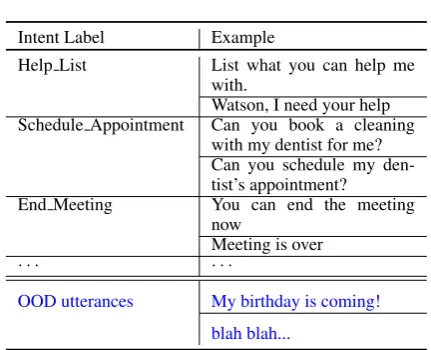
Table 1: A few-shot ID training set for a conversa-tion service for teleconference management, with OOD testing examples.
son Assistant1. For example, Table1shows some of the utterances a chat-bot builder provided for training. Each class may only have less than 20 training utterances, due to the high cost of man-ual labelling by domain experts. Meanwhile, the user also expects the service to effectively reject irrelevant queries (as shown at the bottom of Table 1). The challenge of OOD detection is reflected by the undefined in-domain boundary. Although one can provide a certain amount of OOD sam-ples to build a binary classifier for OOD detec-tion, such samples may not efficiently reflect the infinite OOD space. Recent approaches, such as (Shu et al., 2017), make remarkable progress on OOD detection with only ID examples. However, such condition on ID data cannot be satisfied by the few-shot scenario presented in Table1.
This work aims to build a model that can de-tect OOD inputs with limited ID data and zero OOD training data, while classifying ID inputs with a high accuracy. Learning similarities with
the meta-learning strategy (Vinyals et al., 2016) has been proposed to deal with the problem of limited training examples for each label (few-shot learning). In this line of work, Prototypical
Net-works (Snell et al., 2017), which was originally
introduced for few-shot image classification, has proven to be promising for few-shot ID text clas-sification (Yu et al.,2018). However the usage of prototypical network for OOD detection is unex-plored in this regard.
To the best of our knowledge, this work is the first one to adopt a meta-learning strategy to train an OOD-Resistant Prototypical Network for si-multaneously detecting OOD examples and classi-fying ID examples. The contributions of this work are two-fold: 1) Unified solution using a proto-typical network model which can detect OOD in-stances and classify ID inin-stances in a real-world low-resource scenario. 2) Experiments and analy-sis on two datasets prove that the proposed model outperforms previous work on the OOD detection task, while maintaining a state-of-the-art ID clas-sification performance.
2 Related Work
Out-of-Domain Detection Existing methods often formulate the OOD task as a one-class clas-sification problem, then use appropriate methods to solve it (e.g., one-class SVM (Sch¨olkopf et al., 2001) and one-class DL-based classifiers (Ruff et al.,2018;Manevitz and Yousef,2007). A group of researchers also proposed an auto-encoder-based approach and its variation to tackle OOD tasks (Ryu et al.,2017,2018). Recently, a few pa-pers have investigated ID classification and OOD detection simultaneously (Kim and Kim, 2018; Shu et al., 2017), but they fail in a low resource setting.
Few-Shot Learning While few-shot learning approaches may help with this low-resource set-ting, some recent work is promising in this regard. For example, (Vinyals et al., 2016; Bertinetto et al., 2016; Snell et al., 2017) use metric learn-ing by learnlearn-ing a good similarity metric between input examples; some other methods adapt a meta-learning framework, and train the model to quickly adapt to new tasks with gradients on small samples, e.g., learning the optimization step sizes (Ravi and Larochelle) or model initializa-tion (Finn et al.,2017). Though most of these ap-proaches are explored for computer vision, recent
example-1 example-2 example-3
example-4 example-5
example-6
Random selection Label-1
Label-2
Label-3
Task !" Supporting Sets Prototypical Vectors
ℒ"$, ℒ%&
ℒ''(
I) *+,-./* +""$ 01'- !"
OOD example+2'3& 01'- !2(not shown here)
4$5'(*1 4(7) 9/,:*/;
"$
9/,:*/<
"$
9/,:*/=
"$
[image:2.595.318.515.64.166.2]4$5'(*1 4 7 ,>% − .''/
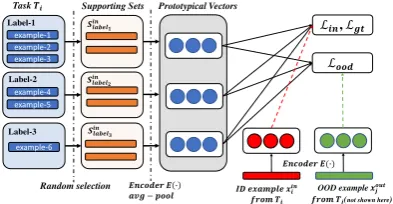
Figure 1: Model overview: the model maximizes likeli-hood of the ground-truth of ID example, minimizes dis-tance between ID example and ground-truth, and max-imizes the distance of OOD example and all ID labels.
studies suggests that few-shot learning is promis-ing in the text domain, includpromis-ing text classifica-tion (Yu et al., 2018;Jiang et al., 2018), relation extraction (Han et al., 2018), link prediction in knowledge bases (Xiong et al., 2018) and fine-grained entity typing (Xiong et al.,2019), and we put it to test with the OOD detection task.
3 Approach
In this paper, we target solving the zero-shot OOD detection problem for a few-shotmeta-testdataset
D = (Dtrain, Dtest) by training a transferable prototypical network model from large-scale in-dependent source datasetsT ={T1, T2, ..., TN} for dynamic construction of the meta-train set. Each task Ti contains labeled training examples (note that a test set is not required in meta-train). D is different from the traditional super-vised close-domain classification dataset from two folds: 1) Dtest contains OOD testing examples, whereas Dtrain only includes labeled examples for the target domain. 2) The training size for each label inDtrainis limited (e.g. less than 100 exam-ples). Such limitations prevent existing methods from efficiently training a model for either ID clas-sification or OOD detection usingDtrainonly.
3.1 General Framework
As in Fig.1, on a large-scale source datasetT with the following steps:
1. Sample a training task Ti from T (e.g., the Book category of Amazon Review in Section 4), and another taskTj fromT −Ti(e.g. the Apps-for-Android category).
2. Sample an ID training examplexini fromTi, and a simulated OOD examplexoutj fromTj. 3. SampleN labels (N=4) fromTi in addition to the label ofxini . For the ground-truth la-bel andN negative labels, we selectK train-ing examples for each label (K-shot learning, we setK=20). If a label has less thanK ex-amples, we replicate the selected example to satisfyK. Therefore,(N+ 1)×Kexamples serve as a supporting setSin={Sin
l }Nl=1. 4. Given a batch of dynamically-constructed
meta-train set (xini , xoutj ,Sin), E(·) encodes
xini , xoutj and the examples in Slin using a deep network (Any DL structure can be used for the encoder, such as LSTM and CNN. Here we use a one-layer CNN with a mean pooling. The detailed CNN hyper-parameters are introduced in Section5).
5. Following (Snell et al.,2017), a Prototypical Vector representation for each label is gen-erated, by averaging all the examples’ repre-sentations of that label.
6. The model is optimized by an objective func-tion, defined byxini ,xoutj andSin. Details in Section 3.2.
7. Repeat these steps for multiple epochs (5k in this paper) to train the model, and select the best model based on an independent meta-valid set Tvalid. Tvalid contains tasks that are homogeneous to the meta-test taskD.
The only trainable parameters of this model are in the encoderE(·). Therefore the trained model can be easily transferred to the few-shot target domain.
3.2 Training Objective and Runtime
Prototypical networks (Snell et al., 2017) mini-mize a cross-entropy loss defined on the distance metrics betweenxini and the supporting sets,
Lin = −log expαF(x
in i , Slini )
P
l0expαF(xini , Slin0 )
(1)
whereli is the ground-truth label ofxi,αis a re-scaling factor. Here we defineF as a cosine sim-ilarity score (mapped to the range between 0 and
1)2 between the E(·)-encoded representations of
x and the prototypical vector of a label. Our ex-periments show this meta-learning approach is ef-ficient for ID classification, but is not good enough for detecting the OOD examples.
We propose two more training losses in addi-tion to theLinfor OOD detection. The rationale behind this addition is to adopt the examples from other tasks as simulated OOD examples for the current meta-train tasks. Specifically, we first de-fine a hinge loss on xoutj and the closest ID sup-porting set inSin, then we push the examples from another task away from the prototypical vectors of ID supporting sets.
Lood=max[0,max
l (F(x out
j , Slin)− M1)] (2)
We expect optimizing only onLin andLood will lead to lower confidences on ID classification, be-cause the system tends to mistakenly reduce the scale ofF in order to minimize the loss for OOD examples. Therefore we add another loss to im-prove the confidence of classifed ID labels.
Lgt = max[0,M2−F(xini , Slini ))] (3)
The model is optimized on the three losses.
L = Lin+βLood+γLgt (4)
whereα,β,γ,M1andM2are hyper-parameters, whose detailed values are shown in Section5.
During inference, the supporting set per label is generated by averaging the encoded representa-tions of all instances of that label inDtrainand the prediction is based onF(x, Slin). OOD detection is decided with aconfidencethreshold.
4 Datasets
Our methods are evaluated on two datasets and each has many tasks and is divided into meta-train, meta-valid and meta-test sets, which are respec-tively used for background model training, evalu-ation and hyper-parameter selection.
Amazon Review3: We follow (Yu et al.,2018) to construct multiple tasks using the Amazon Re-view dataset (He and McAuley,2016) . We con-vert it into a binary classification task of labeling the review sentiment (positive/negative). It has 21
2
Following (Snell et al.,2017), we also tried squared Eu-clidean distance, but did not achieve better results.
3We will release Amazon data and our code at
categories of products, each of which is treated as a task. We randomly picked 13 categories as meta-train, 4 as meta-test and 4 as meta-valid. (an-other 3 original categories are discarded due to not enough examples to make a dataset). We con-struct a 2-way 100-shot problem per meta-test task by sampling 100 reviews per label in a category. For the test examples in meta-test and meta-valid, we sample other categories’ examples as OOD, merged with a equal number of ID instances. We used all available data for meta-train.
Conversation Dataset: An intent classification dataset for a AI conversational system. It has 539 categories/tasks. We allocate 497 tasks as meta-train, and 42 tasks as meta-test. This dataset is different and more difficult than the typical ID few-shot learning data: 1) Both the meta-test and meta-train tasks are not restricted to N-way K -shot classification, and the source dataset is highly imbalanced across labels; 2) Each task has a vari-ety of labels (utterance intents), whereas Amazon data always has two labels. There are 29% OOD testing instances in meta-test, which are human-labeled and not generated from other tasks.
5 Experimental Results
Baselines: We compare our modelO-Protowith 4 baselines: 1)OSVM (Sch¨olkopf et al., 2001): OSVM is trained on meta-test set, and learn a do-main boundary by only examining ID examples. 2)LSTM-AutoEncoder (Ryu et al.,2017): Re-cent work on OOD detection that uses only ID ex-amples to train an autoencoder for OOD detection. 3)Vanilla CNN: A classifier with a typical CNN structure that uses a confidence threshold for OOD detection. 4)Proto. Network (Snell et al.,2017): A native prototypical network trained on T with only the lossLin, which uses a confidence thresh-old for OOD detection. We test the Proto. Net-work with both CNN and bidirectional LSTM as the encoderE(·).
Hyper Parameters: We introduce the hyper-parameters of our model and all baselines below.
We use Python scikit-learn One-Class SVM as the basis of our OSVM implementation. We use Radial Basis Function (RBF) as the kernel and the gamma parameter is set to auto. We use squared hinge loss and L2 regularization.
We follow the same architecture as proposed in (Ryu et al.,2017) for the LSTM-Autoencoder. In
LSTM, we set the input embedding dimension as 100 and hidden as 200. We use RMSprop as the optimizer with a learning rate of 0.001. We train the LSTM with a batch size of 32 and 100 epochs. For Autoencoder, we set the hidden size as 20. We use Adam as the optimizer with a learning rate of 0.001. We train the model with a batch size of 32 for 10 epochs.
For vanilla CNN, we use the most common CNN architecture used in NLP tasks, where the convolutional layer on top of word embedding has 128 filters followed by a ReLU and max pooling layer before the final softmax. We use Adam as the optimizer with a learning rate of 0.001. We train the model with a batch size 64 for 100 epochs.
Our proposed model O-Proto uses the similar CNN architecture, the optimizer and the learn-ing rate in the previous Vanilla CNN. The in-put word embeddings are pre-trained by 1-billion-token Wikipedia corpus. We set the batch size as 10. In Eq. 1,2,3and4,α,β,γ,M1andM2are hyper-parameters, which we fixβ,γas 1.0 by de-fault, and setα,M1andM2 as 10.0, 0.4 and 0.8 according to the meta-valid performance of Ama-zon dataset. The sentence encoder, CNN, has 200 filters, followed by a tanh and mean pooling layer before the final regression layer. The maximum length of tokens per example is 40, and any words out of this range will be discarded. During train-ing, we set the size of sampled negative labels Step 3 (section 3.1) to at most four, so there will be maximum five labels involved in a training step (1 positive, 4 negative). The supporting set size for each label are 20.
To make a fair comparison, we follow the same hyper-parameters as O-Proto in Proto. Network, except that the weight of Lood andLgt,β andγ, are set to zero.
Evaluation Metrics:Following (Ryu et al.,2017; Lane et al.,2007), we use a commonly used OOD detection metric, equal error rate (EER), which is the error rate when the confidence threshold is lo-cated where false acceptance rate (FAR) is equiv-alent to false rejection rate (FRR).
F AR = N umber of accepted OOD sentences N umber of OOD sentences
F RR = N umber of rejected ID sentences N umber of ID sentences
Conversation Amazon Review (%) EER CER Comb. EER CER Comb.
OSVM 63.6 - - 47.6 -
-LSTM AutoEnc. 48.0 78.4 79.5 45.4 29.3 38.6 Vanilla CNN 26.4 76.8 77.6 47.7 34.4 42.8 Proto. Network 26.9 32.5 44.5 46.5 7.3 47.6 O-Proto (Lin+Lgt) 27.6 33.3 46.2 47.8 7.4 48.9 O-Proto (Lin+Lood) 24.5 30.1 41.2 24.7 9.7 30.1 O-Proto (all) 24.1 29.6 40.8 24.0 9.1 29.1
[image:5.595.73.512.64.185.2]Proto. with bilstm 25.0 32.5 42.6 45.1 6.8 46.0 O-Proto with bilstm 22.0 30.5 39.8 21.9 9.0 27.1
Table 2: O-Proto is compared with other baselines for Conversation and Amazon data
0.0 0.1 0.5 1.0 2.0 5.0 10.0 20.0 100.0 0.25
0.30 0.35 0.40 0.45
EER
EER
0.075 0.100 0.125 0.150 0.175 0.200 0.225 0.250
CER
CER
Figure 2:Variousβfor Amazon data
0.0 0.1 0.5 1.0 2.0 5.0 10.0 20.0 100.0 0.24
0.25 0.26 0.27 0.28 0.29 0.30 0.31
EER
EER
0.30 0.32 0.34 0.36 0.38 0.40
CER
CER
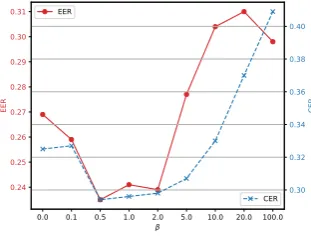
Figure 3: Variousβfor Conversation data
examples are rejected by the OOD detection, as Combined-CER(Comb. in Table2).
Results: Table 2 compares the proposed model and baselines on EER and CER on the two datasets. 4 For prototypical-network related mod-els, we randomly initialize the model parame-ters by 10 times and report the averaged metrics.
OSVM, LSTM-AutoEncoder and Vanilla CNN
per-form poorly on OOD detection as expected, as they require larger number of ID examples which is not a few-shot scenario. Proto.Network has a better performance on ID classification. But it is not designed for OOD, thus it does not per-form well on OOD detection. O-Proto achieves significantly better EERs (2.8% improvement on Conversation, and 22.5% on Amazon), yield-ing competitive results on CER compared to
Proto.Network. These lead to a remarkable
im-provement on Combined-CER.O-Protoimproves less on EER in Conversation than Amazon, be-cause some Conversation tasks actually come from the conversational service providers belong-ing to similar business domains. Our model is bet-ter even when meta-train datasets are from slightly different domains. Moreover, in Table2we show the ablation study by removingLoodandLgtfrom
4No CER reported for
OSVMas it treats ID as one class and does not support ID classification.
EER (%) K=1 =5 =10 =20 =100 Proto. 53.9 46.4 44.5 41.0 46.5 O-Proto. 31.1 25.1 24.0 23.4 24.1
Table 3: Compare our model with Prototype Network on EER when choosing variousK-shot values
O-Proto, respectively.O-ProtowithoutLood
com-pletely loses the ability of OOD detection. Com-pared to the one without Lgt, O-Proto with all losses gives a mild improvement. We also observe a more stable testing performance among epochs during training. Finally, we replace the CNN en-coders with bidirectional LSTMs (the bottom of Table 1), which yields the same dimension of sen-tence representations as CNN. For Conversation data, we achieve the best performance on valida-tion set whenαandγare 0.5. We observe compa-rable performances with respect toProto.Network
andO-Proto, showing that our proposed OOD
ap-proach is not limited to a specific sentence encod-ing architecture.
Improvement in different K-shot settings: On the Amazon data, we construct different K-shot tasks as meta-test (results shown in Table3), and observe consistent improvements on EER. Effect of β: Fig. 2 and 3 show EER and CER with differentβvalues on the two datasets. We ob-serve within a proper range ofβ(between 0.5 and 2.0), the model can provide stable improvement on EER, guaranteeing competitive CER results.
6 Conclusion
[image:5.595.102.258.227.345.2]References
Luca Bertinetto, Jo˜ao F. Henriques, Jack Valmadre, Philip H. S. Torr, and Andrea Vedaldi. 2016. Learn-ing feed-forward one-shot learners. InProceedings of the 30th International Conference on Neural In-formation Processing Systems, NIPS’16, pages 523– 531, USA. Curran Associates Inc.
Wenyuan Dai, Gui-Rong Xue, Qiang Yang, and Yong Yu. 2007. Co-clustering based classification for out-of-domain documents. In Proceedings of the 13th ACM SIGKDD international conference on Knowl-edge discovery and data mining, pages 210–219.
Chelsea Finn, Pieter Abbeel, and Sergey Levine. 2017.
Model-agnostic meta-learning for fast adaptation of deep networks. In Proceedings of the 34th In-ternational Conference on Machine Learning, vol-ume 70 of Proceedings of Machine Learning Re-search, pages 1126–1135, International Convention Centre, Sydney, Australia. PMLR.
Xu Han, Hao Zhu, Pengfei Yu, Ziyun Wang, Yuan Yao, Zhiyuan Liu, and Maosong Sun. 2018. Fewrel: A large-scale supervised few-shot relation classifica-tion dataset with state-of-the-art evaluaclassifica-tion. In Pro-ceedings of the 2018 Conference on Empirical Meth-ods in Natural Language Processing, pages 4803– 4809.
Ruining He and Julian McAuley. 2016. Ups and downs: Modeling the visual evolution of fashion trends with one-class collaborative filtering. In pro-ceedings of the 25th international conference on world wide web, pages 507–517.
Xiang Jiang, Mohammad Havaei, Gabriel Chartrand, Hassan Chouaib, Thomas Vincent, Andrew Jesson, Nicolas Chapados, and Stan Matwin. 2018. At-tentive task-agnostic meta-learning for few-shot text classification. The Second Workshop on Meta-Learning at NeurIPS.
Joo-Kyung Kim and Young-Bum Kim. 2018. Joint learning of domain classification and out-of-domain detection with dynamic class weighting for satis-ficing false acceptance rates. In Proc. Interspeech 2018, pages 556–560.
I. Lane, T. Kawahara, T. Matsui, and S. Nakamura. 2007.Out-of-domain utterance detection using clas-sification confidences of multiple topics. IEEE Transactions on Audio, Speech, and Language Pro-cessing, 15(1):150–161.
Q. Vera Liao, Mas-ud Hussain, Praveen Chandar, Matthew Davis, Yasaman Khazaeni, Marco Patri-cio Crasso, Dakuo Wang, Michael Muller, N. Sadat Shami, and Werner Geyer. 2018. All work and no play? InIn Proceedings of the 2018 CHI Confer-ence on Human Factors in Computing Systems.
Larry Manevitz and Malik Yousef. 2007. One-class document classification via neural networks. Neu-rocomput., 70(7-9):1466–1481.
Sachin Ravi and Hugo Larochelle. Optimization as a model for few-shot learning. International Confer-ence on Learning Representations, 2017.
Lukas Ruff, Robert Vandermeulen, Nico Goernitz, Lu-cas Deecke, Shoaib Ahmed Siddiqui, Alexander Binder, Emmanuel M¨uller, and Marius Kloft. 2018.
Deep one-class classification. InProceedings of the 35th International Conference on Machine Learn-ing, pages 4393–4402, Stockholmsmssan, Stock-holm Sweden. PMLR.
Seonghan Ryu, Seokhwan Kim, Junhwi Choi, Hwanjo Yu, and Gary Lee. 2017. Neural sentence em-bedding using only in-domain sentences for out-of-domain sentence detection in dialog systems. Pat-tern Recognition Letters, 88:26–32.
Seonghan Ryu, Sangjun Koo, Hwanjo Yu, and Gary Geunbae Lee. 2018. Out-of-domain detection based on generative adversarial network. In Pro-ceedings of the 2018 Conference on Empirical Meth-ods in Natural Language Processing, pages 714– 718. Association for Computational Linguistics.
Bernhard Sch¨olkopf, John C. Platt, John C. Shawe-Taylor, Alex J. Smola, and Robert C. Williamson. 2001. Estimating the support of a high-dimensional distribution.Neural Comput., 13(7):1443–1471.
Ameneh Shamekhi, Q Vera Liao, Dakuo Wang, Rachel KE Bellamy, and Thomas Erickson. 2018. Face value? exploring the effects of embodiment for a group facilitation agent. InProceedings of the 2018 CHI Conference on Human Factors in Com-puting Systems, page 391. ACM.
Lei Shu, Hu Xu, and Bing Liu. 2017. Doc: Deep open classification of text documents. In Proceed-ings of the 2017 Conference on Empirical Methods in Natural Language Processing, pages 2911–2916, Copenhagen, Denmark. Association for Computa-tional Linguistics.
Jake Snell, Kevin Swersky, and Richard Zemel. 2017.
Prototypical networks for few-shot learning. In I. Guyon, U. V. Luxburg, S. Bengio, H. Wallach, R. Fergus, S. Vishwanathan, and R. Garnett, editors, Advances in Neural Information Processing Systems 30, pages 4077–4087. Curran Associates, Inc.
Oriol Vinyals, Charles Blundell, Timothy Lillicrap, Koray Kavukcuoglu, and Daan Wierstra. 2016.
Matching networks for one shot learning. In Pro-ceedings of the 30th International Conference on Neural Information Processing Systems, NIPS’16, pages 3637–3645, USA. Curran Associates Inc.
Wenhan Xiong, Mo Yu, Shiyu Chang, Xiaoxiao Guo, and William Yang Wang. 2018. One-shot relational learning for knowledge graphs. InProceedings of the 2018 Conference on Empirical Methods in Nat-ural Language Processing, pages 1980–1990.