Proceedings of the 2019 Conference on Empirical Methods in Natural Language Processing and the 9th International Joint Conference on Natural Language Processing, pages 1520–1526,
1520
Span-based Hierarchical Semantic Parsing for Task-Oriented Dialog
Panupong Pasupat∗ Stanford University
Sonal Gupta Facebook Assistant
Karishma Mandyam∗ University of Washington
Rushin Shah∗ Google
Mike Lewis Facebook AI Research
Luke Zettlemoyer Facebook AI Research
Abstract
We propose a semantic parser for parsing com-positional utterances into Task Oriented Parse (TOP), a tree representation that has intents and slots as labels of nesting tree nodes. Our parser is span-based: it scores labels of the tree nodes covering each token span indepen-dently, but then decodes a valid tree globally. In contrast to previous sequence decoding ap-proaches and other span-based parsers, we (1) improve the training speed by removing the need to run the decoder at training time; and (2) introduce edge scores, which model rela-tions between parent and child labels, to mit-igate the independence assumption between node labels and improve accuracy. Our best parser outperforms previous methods on the TOP dataset of mixed-domain task-oriented utterances in both accuracy and training speed.
1 Introduction
Most commercial conversational AI systems parse task-oriented utterances using intent classification and slot-filling models (He and Young,2003; Ray-mond and Riccardi, 2007; Mesnil et al., 2015), where the intent is the task of the utterance (e.g., IN:GET DIRECTION) and the slots are the parameters needed to complete the task (e.g., SL:DESTINATION). This limited representation typically allows only a single intent per utterance and at most one slot label per token. Dialog sys-tems using such a flat representation would strug-gle to handle compositional tasks that involve in-voking multiple backend services (e.g., “direction to John’s party”: find John’s address, and then find the direction to that address).
To support compositional utterances, the hierar-chical Task Oriented Parsing (TOP) representation has recently been introduced (Gupta et al.,2018). As illustrated in Figure1, the TOP representation
∗
work done while at Facebook Assistant.
IN:GET DIRECTION
SL:DESTINATION
IN:FIND EVENT
SL:CATEGORY
party4
’s3 SL:ORGANIZER
John2
directions0to1
T ={(0,5) : (IN:GET DIRECTION),
(2,5) : (SL:DESTINATION,IN:FIND EVENT),
(2,3) : (SL:ORGANIZER),
(4,5) : (SL:CATEGORY),
(0,1) :∅, (0,2) :∅, (0,3) :∅, . . .}
Figure 1: An example TOP tree and its mapping repre-sentationT. (IN:= intent;SL:= slot)
is a tree where intents and slots are nested alter-natively to model composition. The values inside intent and slot subtrees can then be used by down-stream dialog modules to invoke appropriate ser-vices in a hierarchical fashion.
We propose a span-based semantic parser for parsing utterances into the TOP representation. In its most basic form, the parser embeds each to-ken span (e.g., x2:5 = “John ’s party” in
Fig-ure1) as a vector, and then uses it to predict the labels of the tree nodes covering the span (e.g., SL:DESTINATION and IN:FIND EVENT). While the label prediction is done independently for each span, a CKY decoding algorithm is used to decode a valid tree with the maximum tree score.
computation-ally expensive decoder during training. Second, we introduce edge scores to model the relation-ship between parent and child nodes in the tree. This mitigates the independence assumption and allows the decisions at child nodes to influence the parent node.
We evaluate our models on the TOP dataset (Gupta et al.,2018) of compositional utterances on events and navigation domains. Most utterances have nested intents, with some utterances contain-ing intents from different domains. We demon-strate that our model is fast to train and outper-forms previous models on the dataset.1
2 Related work
Neural tree generation. Previous work on syn-tactic and semantic parsing employs different strategies for generating trees. Approaches such as transition-based parsers (Dyer et al.,2016;Liu and Zhang, 2017) and top-down tree generation (Vinyals et al., 2015; Choe and Charniak, 2016;
Dong and Lapata, 2016; Krishnamurthy et al.,
2017;Yin and Neubig, 2018) frame tree genera-tion as predicting a sequence of acgenera-tions for gen-erating the tree. The decoding processing gener-ally consists of local decisions, and beam search is used to retain uncertainty. In contrast, global decoding methods (Durrett and Klein, 2015;Lee et al.,2016) can incorporate non-local features and decode a tree with the maximum global score.
Span-based models. Span-based models use
the embeddings of token spans to perform pre-diction. By capturing the properties of the whole phrase instead of individual words, span embed-dings can be suitable for tasks where phrases are the basic unit. Indeed, span-based models have re-cently shown great promise by achieving state-of-the-art results for segmentation and tagging (Kong et al., 2016), coreference resolution (Lee et al.,
2017) and semantic role labeling (He et al.,2018). For syntactic parsing, span embeddings have been used to score actions in shift-reduce pars-ing (Cross and Huang,2016), or to score the ex-istence and labels of tree nodes in bottom-up and top-down parsing (Stern et al., 2017; Kitaev and Klein,2018). The analysis byGaddy et al.(2018) shows that the span embeddings can learn to cap-ture various information, such as label correlation
1 The code is available at https://github.com/
ppasupat/factored-span-parsing.
and structural agreement, which was traditionally modeled by grammars or lexical features.
3 Setup
Given an utterance x = (x0, . . . , xn−1) with n
tokens, the task is to predict a TOP parse tree, as illustrated in Figure 1. Each leaf node cor-responds to a token xi, while each non-terminal node covers somespan (i, j) with tokensxi:j =
(xi, xi+1, . . . , xj−1). The label l of each
non-terminal node is either an intent (prefixed with IN:) or a slot (prefixed withSL:). Two type con-straints for TOP trees include: (1) intents can only have slots as children and vice versa, and (2) the tree root covering span(0, n)must be an intent.
For our span-based parser, it is helpful to view the tree as amappingT from each span(i, j)to a
chainc= (l1, . . . , lk)which lists thek≥0labels
in the unary chain covering the span(i, j). For in-stance, the span(2,5)in Figure 1 has T[2,5] = (SL:DESTINATION,IN:FIND EVENT). If no non-terminal node covers the span, we denote the empty chain asc=∅.
Following previous span-based parser work (Cross and Huang, 2016;Stern et al., 2017), we only consider unary chains that appear in the train-ing data to be valid chains. (In our experiments, the training data has 57 distinct labels and 135 dis-tinct chains. Only a single chain in the test data is not covered in training data.)
4 Model
Our parser is based on a joint distribution over the chain at each span. Let the probability of span
(i, j) having chain c be a softmax over the pos-sible chains:
p(T[i, j] =c) = Pexp [fn(xi:j, c)] c0exp [fn(xi:j, c0)]
. (1)
(The conditioning on x is omitted.) Here, the
node score fn(xi:j, c) is a real-valued function
withfn(xi:j,∅)fixed as 0. To compute the node scores for a span xi:j, we embed the span using an LSTM-based span embedder2 from Lee et al.
(2017), and then apply a feedforward network to produce a real-valued score for each chainc6=∅. We now make a simplifying assumption that the values of T[i, j] are independent. The
likelihood of the entire mappingT becomes
logp(T) =X
i<j
logp(T[i, j])
=X
i<j
fn(xi:j, T[i, j]) −logP
c0exp [fn(xi:j, c0)]
.
(2)
The log-sum-exp term logP
c0expfn(xi:j, c0)
does not depend on T. During inference, maxi-mizing the log-likelihoodlogp(T)is thus equiva-lent to maximizing thetree score:
s(T) :=X
i<j
fn(xi:j, T[i, j]). (3)
At test time, we use CKY chart parsing to decode a valid TOP treeT with the maximum scores(T).
Training. The tree scores(T)turns out to be the same scoring function used in previous span-based constituency parsing models (Stern et al., 2017;
Gaddy et al., 2018;Kitaev and Klein, 2018). To train the model, these previous works use margin loss:
max
0,−s(T∗) + max
T [∆(T, T
∗) +s(T)]
(4) where T∗ is the gold tree, T is the predicted tree and ∆ is a distance function. Computing themaxT term requires running a cost-augmented CKY decoder, which is computationally expensive and difficult to parallelize, especially when we add edge scores as described in the next section.
Instead, we propose to directly maximize the log-likelihood in Equation 2 of the gold trees in the training data. Concretely, given a gold tree T∗, our loss function is the negative log-likelihood−logp(T∗), which decomposes into a cross-entropy loss for each span(i, j)according to Equation2. We train our model by directly min-imizing these cross-entropy loss terms; in other words, we treat the model as a multiclass classi-fication model where the input is the spanxi:j and the classes are the possible chains for the span.
Our training method is faster than using mar-gin loss since it does not require running the CPU-bound CKY decoder during training. Moreover, the cross-entropy loss terms can be computed in parallel for all spans ofmultiple examplesat once, which leads to further speed-up.
Class weight for empty chains. In practice, the number of spans(i, j)with gold chainsT∗[i, j] =
∅(i.e., no subtree covering the span) is large com-pared to the total number of spans. To avoid the class imbalance problem, we scale the cross-entropy loss terms for spans withT∗[i, j] = ∅by a hyperparameterα <1.
5 Edge scores
The model so far scores each span independently, which can be sub-optimal. For example, the pre-diction of the top intent only depends on the em-bedding of x0:n, which is equivalent to standard
intent classification or the first decision of a top-down tree generation. Similarly, ontology con-straints (which intents can take which slots) are also not captured by the model.
To allows child nodes to influence the decision of the parent at inference time, we introduceedge
scores. For a span (i, j) with T[i, j] = c =
(l1, . . . , lk), consider the parent node of the top-most non-terminal l1, and define π[i, j] to be its
label. We model the conditional distribution of π[i, j]as a softmax over all possible labels:
p(π[i, j] =l|T[i, j] =c)
= Pexp [fe(xi:j, c, l)] l0exp [fe(xi:j, c, l0)]
(5)
where fe(xi:j, c, l) is the edge score. Similar to node scores, we compute fe(xi:j, c, l) by apply-ing a feed-forward network on the concatenation of the embeddings ofxi:j andc. For convenience of notation, we let π[i, j] = ∅ when the parent does not exist (i.e., whenT[i, j] = ∅or(i, j) =
(0, n)). In those situations, we letfe(xi:j, c, l)be
0forl=∅and−∞otherwise.
We define the joint log-likelihood ofT andπ:
logp(T, π)
=X
i<j h
logp(T[i, j]) + logp(π[i, j]|T[i, j])
i
=X
i<j
fn(xi:j, T[i, j]) −logP
c0exp [fn(xi:j, c0)] +fe(xi:j, T[i, j], π[i, j]) −logP
l0exp [fe(xi:j, T[i, j], l0)]
.
(6)
new tree score is
s(T) :=X
i<j
fn(xi:j, T[i, j])
+ logp(π[i, j]|T[i, j])
(7)
wherep(π[i, j]|T[i, j])is the softmax over edge scores as defined in Equation5. Note that we can-not replace node scoresfn(xi:j, T[i, j])with their log-softmax this way since we want dummy nodes to contribute a score of 0 to the tree score.
To train the model, we again directly minimize the negative log-likelihood of the gold tree T∗. The loss function factors into a cross-entropy loss term for each span(i, j)and for each edge inT∗.
Discussion. The joint modeling of T[i, j] and π[i, j] is closely related to the parent annotation technique in syntactic parsing (Johnson, 1998;
Klein and Manning, 2003; Petrov et al., 2006), where certain non-terminal labels are split into multiple labels based on their parents in the gram-mar rule (e.g., VP with parentSbecomes VP^S). In our framework, we can view the label and edge scores (Equation 7) as a score over parent-annotated labels(T[i, j], π[i, j]):
s(T) =X
i<j
fa(xi:j, T[i, j], π[i, j]) (8)
wherefa(xi:j,∅,∅) = 0. From our preliminary experiments, we found that modelingfaas a
com-bination of label and edge scores, as in Equation7, is empirically better than directly applying a soft-max over possible pairs(T[i, j], π[i, j]).
One analysis inGaddy et al.(2018) shows that the span embedding ofxi:j is powerful enough to identify the parent labelπ[i, j]with high accuracy. However, in TOP semantic trees, parent and child nodes can have span boundaries that are far apart (e.g., the top intent covering span (0,15) might have a child slot covering span(7,9)). As an alter-native to increasing the power of the span embed-der to handle long-range relations, which could lead to overfitting, adding edge scores is a simpler way to model relations between labels.
6 Experiments
We evaluate our models on the TOP dataset (Gupta et al., 2018) of hierarchical intent-slot annota-tions for utterances in navigation and event do-mains.3 We use the dataset version with the noisy
3http://fb.me/semanticparsingdialog
IN:UNSUPPORTED *intents excluded, which con-tains 28410 training, 4032 development, and 8241 test examples. The main evaluation metric is exact match accuracy: the fraction of predicted parses
thatexactlymatch the annotated parses. We also
report the labeled bracket F1 score for the parse tree constituents (Black et al.,1991).
Training details. We highlight crucial modeling decisions of our models and defer other details to Appendix B.
• For a fair comparison, we use the same to-ken and sequence embedders asGupta et al.
(2018): 200-dimensional GloVe embeddings and 2-layer 164-dimensional biLSTMs. We expect contextual embeddings (Peters et al.,
2018;Devlin et al.,2018) and a transformer-based sequence embedder (Kitaev and Klein,
2018) to further improve the results, as ob-served inEinolghozati et al.(2018).
• The class weightαfor empty chains is tuned on the development data: α = 0.4 for the basic model andα = 0.2for the model with edge scores. We will later demonstrate how different choices ofαaffect the results.
Baselines. We compare our method to existing approaches proposed for this task in Gupta et al.
(2018): a shift-reduce parser based on Recur-rent Neural Network Grammars (RNNG) (Dyer et al., 2016), and the best sequence-to-sequence model that produces linearization of the trees based on CNN utterance embeddings (Gehring et al., 2017).4 We also consider the span-based parsers by Stern et al. (2017) with the additional improvements from Gaddy et al. (2018).5 The parsers were designed for constituency parsing, are trained with cost-augmented margin loss, and use either a bottom-up CKY decoder (Stern-chart) or a top-down greedy decoder (Stern-greedy).
Accuracy. Table1shows the exact match accu-racy and bracket scores on the test data. The span-based model without edge scores is comparable to the baseline RNNG model. With edge scores, the span-based model outperforms the baselines in both exact match accuracy and labeled F1 scores.
4
https://github.com/facebookresearch/pytext
5https://github.com/mitchellstern/
Method Acc F1 Time
seq2seq 78.24 90.78 8m
RNNG 80.63 92.61 1h 16m
Stern-chart 80.66 93.03 25m
Stern-greedy 80.79 92.83 22m
ours (nofe) 80.80 93.35 5m
[image:5.595.87.277.63.158.2]ours (+fe) 81.80 93.63 9m
Table 1: The test exact match accuracy, labeled bracket F1, and training time per epoch of different methods.
Error type nofe +fe
wrong top intent 106 99
wrong label except top intent 381 367 wrong non-terminal boundary 133 133
missing a non-terminal 153 154
spurious non-terminal 198 185
joining two gold non-terminals 20 26 splitting a gold non-terminal 27 36
other errors 6 4
Table 2: The error breakdown on the development data of our span-based models. Note that an example can have multiple errors.
Training speed. Our span-based models can be trained in a highly parallelized fashion without having to run the computationally expensive de-coder. Table1shows the average wall-clock time used to train the model for one epoch over the training data.
Error analysis. We compare the errors made by the span-based parsers on the development set. Ta-ble2provides a breakdown of the error counts of the models on development data.
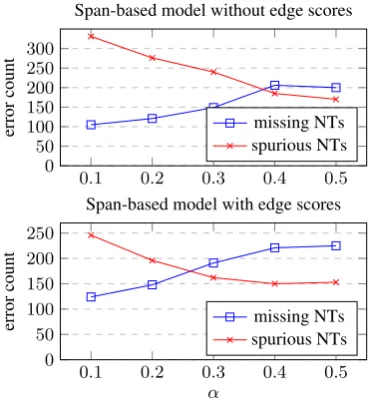
Recall trade-off. As described in Section4, the hyperparameterα controls the weight of the loss terms for the class c = ∅ (i.e., not building a subtree for the span). As such, we can use α to trade off two types of errors: missing non-terminals (over-predicting c = ∅) and spurious non-terminals (under-predicting c = ∅). As shown in Figure2, higherαencourages the model to predict c = ∅ more frequently, leading to more missing non-terminals (intents and slots) and fewer spurious ones. We can also tune α based on the downstream tasks. For instance, getting a higher slot recall using a smallαis arguably better for dialog systems since other downstream mod-ules (e.g., entity linker) can detect and discard spu-rious slots.
0.1 0.2 0.3 0.4 0.5 0
50 100 150 200 250 300
error
count
Span-based model without edge scores
missing NTs spurious NTs
0.1 0.2 0.3 0.4 0.5 0
50 100 150 200 250
α
error
count
Span-based model with edge scores
[image:5.595.325.510.64.266.2]missing NTs spurious NTs
Figure 2: Trade-off between missing and spurious non-terminals with differentα(weight for classc=∅).
When α is low, one common type of errors is when the models incorrectly split a non-terminal. This usually happens when the gold slot consists of two sub-phrases that can be interpreted as slots on their own (e.g., a SL:CATEGORY EVENT slot
“holiday concerts”is split into a SL:DATE TIME
slot “holiday” and a SL:CATEGORY EVENT slot
“concerts”). As the tree score is the sum of span
scores, the parser is biased toward creating two non-terminal nodes instead of one. Luckily, in the context of task-oriented dialogs, this type of er-rors tends to have small effects on the semantic interpretation, and sometimes even provides more useful information for downstream modules.
7 Conclusion
We presented the first span-based parser for pars-ing utterances into the hierarchical intent-slot rep-resentation. The log-likelihood objective allows us to train the model without having to decode a tree in a highly parallelized fashion, while edge scores can explicitly capture the parent-child relationship even when their boundaries are far apart.
References
Ezra Black, Steven P. Abney, D. Flickenger, Clau-dia Gdaniec, Ralph Grishman, P. Harrison, Don-ald Hindle, Robert Ingria, Frederick Jelinek, Ju-dith L. Klavans, Mark Liberman, Mitchell P. Mar-cus, Salim Roukos, Beatrice Santorini, and Tomek Strzalkowski. 1991. A procedure for quantitatively comparing the syntactic coverage of English gram-mars. In Proceedings of the Workshop on Speech and Natural Language.
Do Kook Choe and Eugene Charniak. 2016. Parsing as language modeling. InEmpirical Methods in Natu-ral Language Processing (EMNLP).
James Cross and Liang Huang. 2016. Span-based constituency parsing with a structure-label system and provably optimal dynamic oracles. In Em-pirical Methods in Natural Language Processing (EMNLP).
Jacob Devlin, Ming-Wei Chang, Kenton Lee, and Kristina Toutanova. 2018. Bert: Pre-training of deep bidirectional transformers for language understand-ing. In North American Association for Computa-tional Linguistics: Human Language Technologies (NAACL-HLT).
Li Dong and Mirella Lapata. 2016. Language to log-ical form with neural attention. InAssociation for Computational Linguistics (ACL).
Greg Durrett and Dan Klein. 2015. Neural crf parsing. InAssociation for Computational Linguistics (ACL).
Chris Dyer, Adhiguna Kuncoro, Miguel Ballesteros, and Noah A. Smith. 2016. Recurrent neural network grammars. InNorth American Association for Com-putational Linguistics: Human Language Technolo-gies (NAACL-HLT).
Arash Einolghozati, Panupong Pasupat, Sonal Gupta, Rushin Shah, Mrinal Mohit, Mike Lewis, and Luke Zettlemoyer. 2018. Improving semantic parsing for task oriented dialog. In Conversational AI Work-shop at NeurIPS.
David Gaddy, Mitchell Stern, and Dan Klein. 2018. What’s going on in neural constituency parsers? an analysis. In North American Association for Com-putational Linguistics: Human Language Technolo-gies (NAACL-HLT).
Jonas Gehring, Michael Auli, David Grangier, Denis Yarats, and Yann Dauphin. 2017. Convolutional se-quence to sese-quence learning. InInternational Con-ference on Machine Learning (ICML).
Sonal Gupta, Rushin Shah, Mrinal Mohit, Anuj Ku-mar, and Mike Lewis. 2018. Semantic parsing for task oriented dialog using hierarchical representa-tions. InEmpirical Methods in Natural Language Processing (EMNLP).
Luheng He, Kenton Lee, Omer Levy, and Luke S. Zettlemoyer. 2018. Jointly predicting predicates and arguments in neural semantic role labeling. In Asso-ciation for Computational Linguistics (ACL).
Yulan He and S. Young. 2003. A data-driven spoken language understanding system. InIEEE Workshop on Automatic Speech Recognition and Understand-ing (ASRU).
Mark Johnson. 1998. Pcfg models of linguistic tree representations. Computational Linguistics, 24.
Nikita Kitaev and Dan Klein. 2018. Constituency pars-ing with a self-attentive encoder. InAssociation for Computational Linguistics (ACL).
Dan Klein and Christopher D. Manning. 2003. Accu-rate unlexicalized parsing. InAssociation for Com-putational Linguistics (ACL).
Lingpeng Kong, Chris Dyer, and Noah A. Smith. 2016. Segmental recurrent neural networks. In Inter-national Conference on Learning Representations (ICLR).
Jayant Krishnamurthy, Pradeep Dasigi, and Matt Gard-ner. 2017. Neural semantic parsing with type constraints for semi-structured tables. In Em-pirical Methods in Natural Language Processing (EMNLP).
Kenton Lee, Luheng He, Mike Lewis, and Luke S. Zettlemoyer. 2017. End-to-end neural coreference resolution. InEmpirical Methods in Natural Lan-guage Processing (EMNLP).
Kenton Lee, Mike Lewis, and Luke S. Zettlemoyer. 2016. Global neural ccg parsing with optimality guarantees. InEmpirical Methods in Natural Lan-guage Processing (EMNLP).
Jiangming Liu and Yue Zhang. 2017. Shift-reduce constituent parsing with neural lookahead features.
Transactions of the Association for Computational Linguistics (TACL), 5.
Gr´egoire Mesnil, Yann Dauphin, Kaisheng Yao, Yoshua Bengio, Li Deng, Dilek Z. Hakkani-T¨ur, Xiaodong He, Larry P. Heck, G¨okhan T¨ur, Dong Yu, and Geoffrey Zweig. 2015. Using recurrent neural networks for slot filling in spoken language understanding. IEEE/ACM Transactions on Audio, Speech, and Language Processing, 23.
Matthew E. Peters, Mark Neumann, Mohit Iyyer, Matt Gardner, Christopher Clark, Kenton Lee, and Luke S. Zettlemoyer. 2018. Deep contextualized word representations. In North American Associ-ation for ComputAssoci-ational Linguistics: Human Lan-guage Technologies (NAACL-HLT).
Christian Raymond and Giuseppe Riccardi. 2007. Generative and discriminative algorithms for spoken language understanding. InINTERSPEECH.
Mitchell Stern, Jacob Andreas, and Dan Klein. 2017. A minimal span-based neural constituency parser. In
Association for Computational Linguistics (ACL).
Oriol Vinyals, Lukasz Kaiser, Terry K Koo, Slav Petrov, Ilya Sutskever, and Geoffrey E. Hinton. 2015. Grammar as a foreign language. InAdvances in Neural Information Processing Systems (NIPS).