Abstract—Fuzzy classification rules allow the definition of
readable and interpretable rule bases. In this paper, a novel ACO-Based Local Search procedure has introduced. It presented an evolutionary algorithm for induction of fuzzy classification rules. The proposed algorithm benefits from an ACO based local searcher to enhance the quality of final fuzzy classification system. The presented algorithm is applied on Intrusion Detection as a high-dimensional classification problem. Results show that the implemented evolutionary Ant Colony Optimization Based algorithm is capable of producing a reliable fuzzy rule based classifier for intrusion detection.
Index Terms—Fuzzy Classification Rule (FCR), Learning
Classifier System, Evolutionary Algorithms, Ant Colony Optimization
I. INTRODUCTION
Intrusions into computer systems have caused many quality and reliability problems with those systems.
Furthermore, the number of intrusions into computer systems grows rapidly because new automated hacking tools appear each day, and these tools along with various system vulnerability information are easily available on the web. The problem of intrusion detection is studied extensively in computer security [1] [4], and has received a lot of attention in machine learning and data mining [5, 6]. Intrusion Detection Systems (IDSs) generally takes one of two approaches: anomaly detection, and signature recognition. Signature recognition techniques store patterns of intrusion signatures, and compare those patterns with the observed activities for a match to detect an intrusion. Signature recognition techniques are used in most existing intrusion detection systems, commercial or freeware.
Anomaly detection techniques identify an intrusion when the observed activities in computer systems demonstrate a large deviation from the norm profile built on long term normal activities. The goal of this paper is to evolve a classification system capable of detecting known intrusions into a computer network. Hence, our goal is to develop a
This work is supported by the Department of Computer Engineering of Amirkabir University of Technology
H.Alipour, is with the electrical and computer engineering department of Shahid Beheshti University, Tehran, Iran (email: [email protected])
E.Khosrowshahi Asl is with the department of computer engineering of Amirkabir University of Technology, Tehran, Iran (email:
M.Esmaeili, is with the electrical and computer engineering department of Shahid Beheshti University, Tehran, Iran (email:
M.Nourhosseini, is with the department of computer engineering of Amirkabir University of Technology, Tehran, Iran (email:
signature recognition system. The technique, which we have used to detect intrusion in a computer network, is based on fuzzy genetic learning. Genetic algorithms (GA’s) are search algorithms that use operations found in natural genetic to guide the journey through a search space. GA’s have been theoretically and empirically proven to provide robust search capabilities in complex spaces offering a valid approach to problems requiring efficient and effective searching. One of the interesting applications of GA’s is in pattern classification problems in which our goal is to develop a classifier capable of dealing with different classes of a specific problem. Genetic algorithms [7] have been used as rule generation and optimization tools in the design of fuzzy rule based systems [8-13]. Those GA based studies on the design of fuzzy rule-based systems are usually referred to as fuzzy genetics-based machine learning methods (fuzzy GBML methods), each of which can be classified into the Michigan or Pittsburgh approaches. Some studies are categorized as the Michigan approach [12] [13] where a single fuzzy if–then rule is coded as an individual. Another kind of fuzzy GMBL methods are categorized as the Pittsburgh approach where a set of fuzzy if–then rules is coded as an individual [15]- [17].
In this paper, we have extended the Michigan-based intrusion detection algorithm from a problem with two classes [18] to a five class classification problem. To accomplish this purpose we have used a hybrid genetic algorithm, which is boosted with an ant colony optimization heuristic. This heuristic is capable of increasing the searching power of the main evolutionary algorithm. The ACO heuristic is combined to the evolutionary algorithm in the form of a local search step. In other words, we have improved the global search capability of the evolutionary algorithm by adding a local search step to its main structure. The proposed approach has been tested using the public KDD CUP’99 intrusion detection data set available at the University of California, Irvine web site [19].
The rest of the paper is as follows: Induction of fuzzy rule- based classifiers using a Michigan based evolutionary algorithm is introduced in Section II. Section III describes the presented heuristic local search, which is based on Ant Colony Optimization approach.
Experimental results are reported in Section IV. Section V is conclusions.
II. PROPOSED ALGORITHM
First, let us explain about the method of coding fuzzy rules, which is used in this paper. Each fuzzy if-then rule is coded as a string. The following symbols are used for
ACO-FCR: Applying ACO-Based Algorithms to
Induct FCR
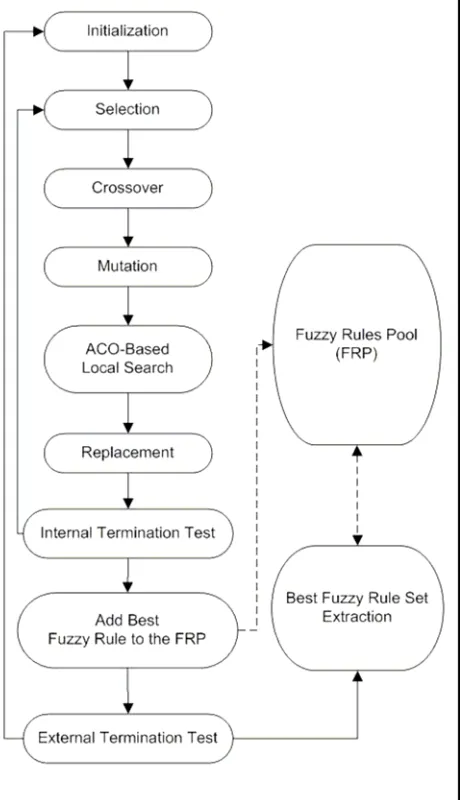
denoting the five linguistic values (Figure 1): small ( A1 ), medium small ( A2 ), medium ( A3 ), medium large ( A4 ) and large ( A5 ). For example, the following fuzzy if-then rule is coded as (A3 , A2 , A5 , A1 ) : If x1 is medium and x2 is medium small and x3 is large and x4 is small then Class Cj with CF = CFj . Outline of the proposed Michigan approach based IDS algorithm is presented in Figure. 2.
Figure 1- Membership functions of five linguistic values (S: small, MS: medium small, M: medium, ML: medium large, L: large)
As it is shown in Figure 2, the algorithm consists of several steps. This section will discuss about each of these steps in detail.
A. Introduction:
Let us denote the number of fuzzy if-then rules in the population by Npop . To produce an initial population, Npop fuzzy if-then rules are generated according to a random pattern in the train dataset [12].
The proposed evolutionary fuzzy system (EFS) in Figure 2 is considered for each of the classes of the classification problem separately. One of the important benefits of this separation is that the learning system can focus on each of the classes of the classification problem. According to this fact, the mentioned random pattern is extracted according to the patterns of the training dataset, which their consequent class is the same as the class that the algorithm works on. Next, for this random pattern, we determine the most compatible combination of antecedent fuzzy sets using only the five linguistic values (Figure.1). The compatibility of antecedent fuzzy rules with the random pattern is calculated by equation (1).
where ji
A
μ
is the membership function of Aji . After generating each fuzzy if-then rule, the consequent class of this rule is determined according to (2).where,
where
β
Class h(
R
j)
is the sum of the compatibility grades of the training patterns in Class h with the fuzzy if–then rule Rj andN
Class his the number of training patterns which their corresponding class is Class h . Each of the fuzzy [image:2.612.100.285.134.233.2]rules in the final classification has a certainty grade, which denotes the strength of that fuzzy rule. This number is calculated according to (4).
Figure 2- Outline of the proposed evolutionary ACOBased algorithm
where,
When a rule set S is given, an input pattern
)
,...,
,
(
p1 p2 pnp
x
x
x
x
=
is classified by a single winnerrule Rj in S , which is determined as follows:
That is, the winner rule has the maximum product of the compatibility and the certainty grade CFj . The classification is rejected if no fuzzy if–then rule is compatible with the input pattern xp (i.e., μj (x p ) = 0 for ∀R j ∈ S) .
pattern class. Otherwise, the generated fuzzy rule is rejected and the rule generation process is repeated.
After generation of Npop fuzzy if-then rules, the fitness value of each rule is evaluated by classifying all the given training patterns using the set of fuzzy if–then rules in the current population. The fitness value of the fuzzy if–then rule is evaluated by the following fitness function:
where, NCP(R j ) denotes the number of correctly classified training patterns by rule Rj . [12]
B. Generation:
A pair of fuzzy if-then rules is selected from the current population to generate new fuzzy if-then rules for the next population. Each fuzzy if then rule in the current population is selected by the tournament selection procedure.
A crossover operation is applied to a selected random pair of fuzzy if–then rules with a pre-specified crossover probability. Note that the selected individuals for crossover operation should be different. In computer simulations of this paper, we used the one-point crossover. After performing the crossover operation, consequent classes of the generated individuals are determined. If these classes are the same as their parent classes then the generated individuals are accepted, otherwise the crossover operation is repeated until a pre-specified iteration number for each individual that its consequent class is not the same as its parents. We call this number X repeat.
With a pre-specified mutation probability, each antecedent fuzzy set of fuzzy if–then rules is randomly replaced with a different antecedent fuzzy set after the crossover operation. After performing the mutation operation, consequent class of the mutated individual is determined. If the result class is the same as the class of the individual before the mutation operation, the mutated individual is accepted; otherwise, the mutation operation is repeated until a pre-specified iteration number. We call this number M repeat.
The above procedure is iterated until a pre-specified number of pairs of fuzzy if-then rules are generated.
C. Local Search:
In order to improve the classification rate of the population, we consider a lifetime for each individual of the current population. We simulate this lifetime using a local search algorithm, which is based on an Ant Colony Optimization heuristic.
Before describing the details of the ACO-based local search procedure, which will be done in section III, it is essential to introduce the concept of age for each individual. An individual can search its neighborhood (or can live) according to its age. The age of each individual depends on its fitness. In other words, fitter individuals have greater age or opportunity to live. This rule is based on the concept of “survival of the fittest” [7]. To accomplish this idea we determine the age of each individual using equation (8).
where, wagedenotes a weight which depends on the CPU speed of the computer that the algorithm runs on (The faster the CPU the lower the wage). Note that the division in the equation is for normalizing the fitness of Rj. According to equation (8), each individual can live and improves its quality (fitness) as much as its age number determines. The unit of age number is in milliseconds.
D. Replacement:
A pre-specified number of fuzzy if–then rules in the current population are replaced with the newly generated rules. In our fuzzy classifier system, PrepRpercent of the worst rules with the smallest fitness values are removed from the current population and
(
100
−
P
repR)
percent of the newly generated fuzzy if–then rules are added.E. Termination Tests:
We can use any stopping condition for terminating the internal cycle of the Michigan based fuzzy classification algorithm. In computer simulations of this paper, we used the total number of generations as a stopping condition.
Fuzzy rules of the final population that their fitness is not zero are stored in the Fuzzy Rule Pool (FRP). This pool is updated until a pre-specified number of iterations for the external cycle of the evolutionary ACO-Based algorithm.
This section presents the parallel genetic local search algorithm which the paper proposes in three subsections. The first subsection briefly explains fuzzy if–then rules and a fuzzy reasoning method for pattern classification problems with continuous attributes. A heuristic procedure is also described to determine the consequent class and the certainty grade of each fuzzy if–then rule from training patterns. This heuristic procedure is a modified version of the one which is discussed in [15].
The next subsection introduces the parallel learning framework of the main algorithm. The genetic local search procedure which is used within the structure of the main parallel algorithm is presented in the third subsection.
III. ACO-BASED LOCAL SEARCH
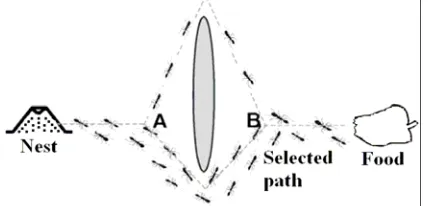
[image:3.612.320.534.627.730.2]ACO was developed by Dorigo et al. [21] based on the fact that ants are able to find the shortest route between their nest and a source of food. This is done using pheromone trails, which ants deposit whenever they travel, as a form of indirect communication. The whole process is as follows:
Each ant leaves the nest to search for a food source. While walking, it deposits pheromone on the ground and follows, in probability, pheromone previously deposited by other ants. Consider this ant arrives at a decision point in which it has to decide whether to turn left or right. Since it has no idea about which is the better choice, it chooses randomly. After finding the food, this ant returns to the nest while depositing pheromone on the ground as before. This process performs by all of the ants in the colony. As it is obvious, after a while the shorter path receives more pheromone than the other path. Since the desirability of ants to amount of pheromone is critical in their decision for turning left or right, the rest of ants (later ants) will choose the shorter path from the nest to the food. The whole process is demonstrated in Figure 3.
[image:4.612.312.547.50.175.2]The main originality of this paper is the introduction of a heuristic local search algorithm, which is inspired from the life of real ants. In other words, we have used ACO as a cooperative learning algorithm in the structure of the main Michigan based evolutionary fuzzy rule learning system. As we have mentioned in the previous section, each individual in the population of the main evolutionary algorithm has an age, which determines its time of living. Since we have mimicked the rule of life in a colony of ants, it is possible to say that the age number indicates the whole colony surviving time for improving the quality of current fuzzy rule. The pseudo-code of the ACO-Based Local Search algorithm is presented in Figure 4. Note that the input of this algorithm is a fuzzy rule and the output is an improved version of that fuzzy rule. The improvement is accomplished by some modifications (local search) to the current (input) fuzzy rule. The algorithm is capable of searching for the best modification according to the lifetime (age) of the current fuzzy rule.
According to Figure 4, in each step the algorithm performs K changes to the current (input) fuzzy rule. For each K value, a complete ACO process is done with a specific number of ants. The desirability of each ants for changing the i th antecedent of current rule RC to Aj is given by (9).
In this equation τ is the pheromone and η is a heuristic probability, which determines according to equations (10) to (12).
According to this heuristic, the most probable linguistic value for a specific antecedent part of the fuzzy rule is computed. Note that this computation is based on the train data of the current class, which the main evolutionary algorithm works on (the evolutionary algorithm performs for each of the classes of the classification problem separately).
After performing any single change, an ant accomplishes a local pheromone updating according to equation (13).
where
0
<
ρ
<
1
is the local pheromone decay parameter, andΔ
τ
(
R
c,
i
,
A
j)
=
τ
owhere τ 0 is the initial pheromone level. [image:4.612.315.547.396.539.2]
TABLE 2- PARAMETER SPECIFICATION IN COMPUTER SPECIFICATIONS
When all of the ants perform their search, the global pheromone updating performs according to equation (14).
where,
1
0
<
α
<
is the global pheromone decay parameter, andRN stands for the new rule which is obtained after modifying ithantecedent part of current rule
R
C toA
j.The result of local search algorithm will be the best change to the current (input) fuzzy rule. Here the best means a fuzzy rule with maximum fitness according to equation (7).
IV. EXPERIMENTAL RESULTS
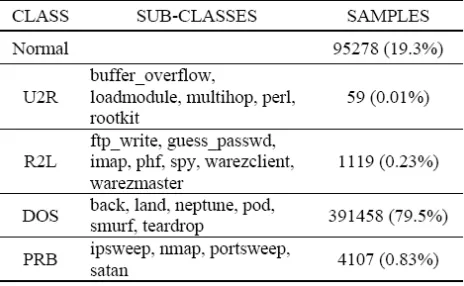
Experiments were carried out on a subset of the database created by DARPA in the framework of the 1998 Intrusion Detection Evaluation Program [21]. We used the subset that was pre-processed by the Columbia University and distributed as part of the UCI KDD Archive [19]. The available database is made up of a large number of network connections related to normal and malicious traffic. Each connection is represented with a 41-dimensional feature vector. Connections are also labeled as belonging to one out of five classes. One of these classes is the normal class and the rest indicates four different intrusion classes. These intrusion classes are a classification of 22 different types of attacks in a computer network. Table 1 presents the classification of different types of attacks in the four different intrusion classes and the distribution of each class in the 10 % of the KDDCup 99 data set [19].
This section will compare the performance of the proposed hybrid evolutionary fuzzy system with other approaches in the intrusion detection case study. Table 2 presents parameter settings for the ACO-Based Evolutionary Fuzzy System, which is used in this paper.
TABLE 3-COMPARISION OF SOME ALGORITHMS
TABLE 4-PERFORMANCE COMPARISON
The classification accuracies of hybrid and simple evolutionary fuzzy systems are shown in Table 3 along with the classification rates achieved by the some other algorithms (EFRID [6], Winner entry [22]). Although the evolutionary fuzzy systems use smaller percent of the original intrusion dataset, the classification accuracies of them are competitive to EFRID and Winner Entry approaches. Moreover the hybrid evolutionary system that uses the proposed ACO-Based Local Search procedure outperforms the simple evolutionary fuzzy system (here simple means without local search step).
The Detection and False Alarm rates for the evolved fuzzy classifier systems are compared with that of EFRID and RIPPER [23] classifiers in Table 4.
According to Table 4, it is clear that using the evolved fuzzy classifiers, resulted in a more reliable Intrusion Detection Systems since the false alarm rate decreases significantly. This feature is so critical for a security system, because false alarms might deteriorate the reliability and performance of the Intrusion Detection System. However, the price of achieving such a low false alarm rate is the decrement of Detection Rate in our proposed genetic fuzzy systems.
V. CONCLUSIONS
In this paper, a novel ACO-Based Local Search procedure is introduced. The proposed local search procedure is used in the structure of a Michigan based evolutionary fuzzy system. The capability of the resulted hybrid fuzzy system is investigated according to the intrusion detection classification problem. Computer simulations on DARPA datasets demonstrate high performance of ACO-Based evolutionary fuzzy system for intrusion detection.
REFERENCES
[1] R. Heady, G. Luger, A. Maccabe, and M. Sevilla (1990). The Architecture of a Network-level Intrusion Detection System. Technical report, CS90-20. Dept. of Computer. Science, University of New Mexico, Albuquerque, NM 87131, August 1990.
[2] E. Amoroso (1999). Intrusion detection. In Intrusion.net Books, January 1999.
[3] J. Allen, A. Christie, W. Fithen, J. McHugh, J. Pickel, and E.Stoner. (1999). State of the practice of intrusion detection technologies. Technical Report CMU/SEI99 -TR-028. ESC-99-028, Carnegie Mellon, Software Engineering Institute, Pittsburgh Pennsylvania, 1999.
[4] S. Axelsson (2000). Intrusion detection systems: A survey and taxonomy. Technical Report No 99-15, Dept. of Computer Engineering, Chalmers University of Technology, Sweden, March 2000.
[5] J. Sundar, J. Garcia-Fernandez, D. Isaco, E. Spafford, and D. Zamboni, “An architecture for intrusion detection using autonomous agents,” Technical report 98/05, Purdue University, 1998.
[6] J. Gomez, and D. Dasgupta, "Evolving Fuzzy Classifies for Intrusion Detection," Proceedings of the 2002 IEEE Information Assurance Workshop, Jun. 2001.
[7] J. H. Holland, Adaptation in Natural and Artificial Systems, University of Michigan Press, Ann Arbor, MI, 1975.
[8] C. L. Karr, and E. J. Gentry, “Fuzzy control of pH using genetic algorithms,” IEEE Trans. on Fuzzy Systems, vol. 1, pp. 46-53, February, 1993.
[9] Herrera, M. Lozano, and J. L. Verdegay, “Tuning fuzzy logic controllers by genetic algorithms,” International J. of Approximate Reasoning, vol. 12, no. 3/4, pp. 299-315, April/May, 1995.
[10] B. Carse, T.C. Fogarty, and A. Muntro, “Evolving fuzzy rule based controllers using genetic algorithms,” Fuzzy Sets and Systems, vol. 80, no. 3, 3, pp. 273-293, June, 1996.
[11] M. Valenzuela-Rendon, “The fuzzy classifier system: A classifier system for continuously varying variables,” Proc. Of 4th
International Conference on Genetic Algorithms, pp. 346-353, University of California, San Diego, CA, July, 1991.
[12] H. Ishibuchi, and T. Nakashima, "Improving the Performance of Fuzzy Classifier Systems for Pattern Classification Problems with Continuous Attributes", IEEE Transactions on Industrial Electronics, vol. 46, no. 6, December 1999.
[13] H. Ishibuchi, T. Nakashima and T. Muratam “Performance evaluation of fuzzy classifier systems for multi-dimensional pattern classification problems,” IEEE Trans. On Systems, Man, and Cybernetics, October, 1999.
[14] H. Ishibuchi, T. Nakashima, and T. Kuroda, “A hybrid fuzzy genetics-based machine learning algorithm: hybridization of Michigan approach and Pittsburgh approach,” In: Proceedings of 1999 IEEE international conference on systems, man, and cybernetics, vol. 1, pp. 296–301, Oct. 1999.
[15] S. F. Smith, “A learning system based on genetic algorithms,” Ph.D. Dissertation, University of Pittsburgh, Pittsburgh, PA, 1980.
[16] Herrera, M. Lozano, and J. L. Verdegay, “Tuning fuzzy logic controllers by genetic algorithms,” International J. of Approximate Reasoning, vol. 12, no. 3/4, pp. 299-315, April/May, 1995.
[17] B. Carse, T.C. Fogarty, and A. Muntro, “Evolving fuzzy rule based controllers using genetic algorithms,” Fuzzy Sets and Systems, vol. 80, no. 3, 3, pp. 273-293, June, 1996.
[18] M. Saniee Abadeh, J. Habibi, and C. Lucas, “Intrusion Detection Using a Fuzzy Genetics-Based Learning Algorithm,” Journal of Network and Computer Applications, In Press, 2005.
[19] KDD-cup data set: http://kdd.ics.uci.edu/databases/kddcup99/
kddcup99.html.
[20] Dorigo M,Maniezzo V,ColorniA.Ant system: optimization by a colony of cooperating agents. IEEE Trans SystMan Cybern 1996;26(1):29–41. [21] http://www.ll.mit.edu. [22] C. Elkan, “Results of the KDD_99
classifier learning,” ACM SIGKDD Explorations 1, pp. 63–64, 2000. [22] W. Fan, W. Lee, M. Miller, S. J. Stolfo, and P. K. Chan, “Using