A Hybrid Markov/Semi-Markov Conditional Random Field
for Sequence Segmentation
Galen Andrew Microsoft Research One Microsoft Way Redmond, WA 98052 [email protected]
Abstract
Markov order-1 conditional random fields (CRFs) and semi-Markov CRFs are two popular models for sequence segmenta-tion and labeling. Both models have ad-vantages in terms of the type of features they most naturally represent. We pro-pose a hybrid model that is capable of rep-resenting both types of features, and de-scribe efficient algorithms for its training and inference. We demonstrate that our hybrid model achieves error reductions of 18% and 25% over a standard order-1 CRF and a semi-Markov CRF (resp.) on the task of Chinese word segmentation. We also propose the use of a powerful fea-ture for the semi-Markov CRF: the log conditional odds that a given token se-quence constitutes a chunk according to a generative model, which reduces error by an additional 13%. Our best system achieves 96.8% F-measure, the highest re-ported score on this test set.
1 Introduction
The problem of segmenting sequence data into chunks arises in many natural language applica-tions, such as named-entity recognition, shallow parsing, and word segmentation in East Asian lan-guages. Two popular discriminative models that have been proposed for these tasks are the condi-tional random field (CRFs) (Lafferty et al., 2001) and the semi-Markov conditional random field (semi-CRF) (Sarawagi and Cohen, 2004).
A CRF in its basic form is a model for label-ing tokens in a sequence; however it can easily be adapted to perform segmentation via labeling
each token asBEGINorCONTINUATION, or accord-ing to some similar scheme. CRFs usaccord-ing this tech-nique have been shown to be very successful at the task of Chinese word segmentation (CWS), start-ing with the model of Peng et al. (2004). In the Second International Chinese Word Segmentation Bakeoff (Emerson, 2005), two of the highest scor-ing systems in the closed track competition were based on a CRF model. (Tseng et al., 2005; Asa-hara et al., 2005)
While the CRF is quite effective compared with other models designed for CWS, one wonders whether it may be limited by its restrictive inde-pendence assumptions on non-adjacent labels: an order-M CRF satisfies the order-M Markov as-sumption that, globally conditioned on the input sequence, each label is independent of all other labels given the M labels to its left and right. Consequently, the model only “sees” word bound-aries within a moving window ofM + 1 charac-ters, which prohibits it from explicitly modeling the tendency of strings longer than that window to form words, or from modeling the lengths of the words. Although the window can in principle be widened by increasingM, this is not a practi-cal solution as the complexity of training and de-coding a linear sequence CRF grows exponentially with the Markov order.
The semi-CRF is a sequence model that is de-signed to address this difficulty via careful relax-ation of the Markov assumption. Rather than re-casting the segmentation problem as a labeling problem, the semi-CRF directly models the dis-tribution of chunk boundaries.1 In terms of
inde-1As it was originally described, the semi-CRF also as-signs labels to each chunk, effectively performing joint seg-mentation and labeling, but in a pure segseg-mentation problem such as CWS, the use of labels is unnecessary.
pendence, using an order-M semi-CRF entails the assumption that, globally conditioned on the input sequence, the position of each chunk boundary is independent of all other boundaries given the po-sitions of the M boundaries to its left and right
regardless of how far away they are. Even with an
order-1 model, this enables several classes of fea-tures that one would expect to be of great utility to the word segmentation task, in particular word
length and word identity.
Despite this, the only work of which we are aware exploring the use of a semi-Markov CRF for Chinese word segmentation did not find signif-icant gains over the standard CRF (Liang, 2005). This is surprising, not only because the additional features a semi-CRF enables are intuitively very useful, but because as we will show, an order-M
semi-CRF is strictly more powerful than an or-der-M CRF, in the sense that any feature that can be used in the latter can also be used in the for-mer, or equivalently, the semi-CRF makes strictly weaker independence assumptions. Given a judi-cious choice of features (or simply enough training data) the semi-CRF should be superior.
We propose that the reason for this discrepancy may be that despite the greater representational power of the semi-CRF, there are some valuable features that are more naturally expressed in a CRF segmentation model, and so they are not typ-ically included in semi-CRFs (indeed, they have not to date been used in any semi-CRF model for any task, to our knowledge). In this paper, we show that semi-CRFs are strictly more expressive, and also demonstrate how CRF-type features can be used in a semi-CRF model for Chinese word segmentation. Our experiments show that a model incorporating both types of features can outper-form models using only one or the other type.
Orthogonally, we explore in this paper the use of a very powerful feature for the semi-CRF de-rived from a generative model.
It is common in statistical NLP to use as fea-tures in a discriminative model the (logarithm of the) estimated probability of some event accord-ing to a generative model. For example, Collins (2000) uses a discriminative classifier for choosing among the topNparse trees output by a generative baseline model, and uses the log-probability of a parse according to the baseline model as a feature in the reranker. Similarly, the machine translation system of Och and Ney uses log-probabilities of
phrasal translations and other events as features in a log-linear model (Och and Ney, 2002; Och and Ney, 2004). There are many reasons for incorpo-rating these types of features, including the desire to combine the higher accuracy of a discriminative model with the simple parameter estimation and inference of a generative one, and also the fact that generative models are more robust in data sparse scenarios (Ng and Jordan, 2001).
For word segmentation, one might want to use as a local feature the log-probability that a segment is a word, given the character sequence it spans. A curious property of this feature is that it induces a counterintuitive asymmetry between the is-word and is-not-word cases: the component generative model can effectively dictate that a certain chunk is not a word, by assigning it a very low probability (driving the feature value to negative infinity), but it cannot dictate that a chunk is a word, because the log-probability is bounded above.2 If instead the log conditional oddslogPiPi(¬(yy|x|x)) is used, the asymmetry disappears. We show that such a log-odds feature provides much greater benefit than the log-probability, and that it is useful to include such a feature even when the model also includes indicator function features for every word in the training corpus.
2 Hybrid Markov/Semi-Markov CRF
The model we describe is formally a type of semi-Markov CRF, distinguished only in that it also in-volves CRF-style features. So we first describe the semi-Markov model in its general form.
2.1 Semi-Markov CRF
An (unlabeled) semi-Markov conditional random field is a log-linear model defining the conditional probability of a segmentation given an observation sequence. The general form of a log-linear model is as follows: given an input x ∈ X, an output
y∈Y, a feature mappingΦ :X×Y 7→Rn, and
a weight vectorw, the conditional probability of
ygivenxis estimated as:
P(y|x) = exp (w·Φ(x,y))
Z(x)
where Z : x 7→ R is a normalizing factor. w
is typically chosen to maximize the conditional likelihood of a labeled training set. In the word
segmentation task, x is an ordered sequence of characters (x1, x2, . . . , xn), and y is a set of
in-dices corresponding to the start of each word:
{y1, y2, . . . , ym}such thaty1 = 1, ym ≤ n, and
for all j, yj < yj+1. A log-linear model in this
space is an order-1 semi-CRF if its feature mapΦ decomposes according to
Φ(x,y) =
m
X
j=1
φS(yj, yj+1,x) (1)
whereφSis a local feature map that only considers one chunk at a time (definingym+1 =n+ 1). This
decomposition is responsible for the characteristic independence assumptions of the semi-CRF.
Hand-in-hand with the feature decomposition and independence assumptions comes the capac-ity for exact decoding using the Viterbi algorithm, and exact computation of the objective gradient using the forward-backward algorithm, both in time quadratic in the lengths of the sentences. Furthermore, if the model is constrained to pro-pose only chunkings with maximum word length
k, then the time for inference and training be-comes linear in the sentence length (and ink). For Chinese word segmentation, choosing a moderate value ofkdoes not pose any significant risk, since the vast majority of Chinese words are only a few characters long: in our training set, 91% of word tokens were one or two characters, and 99% were five characters or less.
Using a semi-CRF as opposed to a traditional Markov CRF allows us to model some aspects of word segmentation that one would expect to be very informative. In particular, it makes pos-sible the use of local indicator function features of the type “the chunk consists of character se-quenceχ1, . . . , χ`,” or “the chunk is of length`.”
It also enables “pseudo-bigram language model” features, firing when a given word occurs in the context of a given character unigram or bigram.3 And crucially, although it is slightly less natural to do so, any feature used in an order-1 Markov CRF can also be represented in a semi-CRF. As Markov CRFs are used in the most competitive Chinese word segmentation models to date, one might expect that incorporating both types of fea-tures could yield a superior model.
3We did not experiment with this type of feature.
2.2 CRF vs. Semi-CRF
In order to compare the two types of linear CRFs, it is convenient to define a representation of the segmentation problem in terms of character labels as opposed to sets of whole words. Denote by
L(y) ∈ {B, C}n(forBEGINvs. CONTINUATION)
the sequence {L1, L2, . . . Ln} of labels such that Li =Bif and only ifyi ∈y. It is clear that if we
constrainL1 = B, the two representations yand
L(y)are equivalent. An order-1 Markov CRF is a log-linear model in which the global feature vector Φdecomposes into a sum over local feature vec-tors that consider bigrams of the label sequence:
Φ(x,y) =
n
X
i=1
φM(Li, Li+1, i,x) (2)
(whereLn+1 is defined asB). The local features
that are most naturally expressed in this context are indicators of some joint event of the label bi-gram(Li, Li+1) and nearby characters in x. For
example, one might use the feature “the current characterxiisχandLi=C”, or “the current and
next characters are identical andLi=Li+1 =B.”
Although we have heretofore disparaged the CRF as being incapable of representing such pow-erful features as word identity, the type of features that it most naturally represents should be help-ful in CWS for generalizing to unseen words. For example, the first feature mentioned above could be valuable to rule out certain word boundaries if
χwere a character that typically occurs only as a suffix but that combines freely with a variety of root forms to create new words. This type of fea-ture (specifically, a feafea-ture indicating the absence as opposed to the presence of a chunk boundary) is a bit less natural in a semi-CRF, since in that case local featuresφS(yj, yj+1,x)are defined on
pairs of adjacent boundaries. Information about which tokens are not on boundaries is only im-plicit, making it a bit more difficult to incorporate that information into the features. Indeed, neither Liang (2005) nor Sarawagi and Cohen (2004) nor any other system using a semi-Markov CRF on any task has included this type of feature to our knowledge. We hypothesize (and our experiments confirm) that the lack of this feature explains the failure of the semi-CRF to outperform the CRF for word segmentation in the past.
the CRF, meaning that any global feature map Φ that decomposes according to (2) also decomposes according to (1). It is sufficient to show that for any feature mapΦM of a Markov CRF, there exists a semi-Markov-type feature mapΦSsuch that for anyx,y,
ΦM(x,y) =
n
X
i=1
φM(Li, Li+1, i,x) (3)
=
m
X
j=1
φS(yj, yj+1,x) = ΦS(x,y)
To this end, note that there are only four possible label bigrams: BB, BC,CB, andCC. As a di-rect result of the definition ofL(y), we have that (Li, Li+1) = (B, B)if and only if some word of
length one begins ati, or equivalently, there exists a wordjsuch thatyj =iandyj+1−yj = 1.
Sim-ilarly, (Li, Li+1) = (B, C) if and only if some
word of length> 1begins ati, etc. Using these conditions, we can defineφS to satisfy equation 3
as follows:
φS(yj, yj+1,x) =φM(B, B, yj,x)
ifyj+1−yj = 1, and
φS(yj, yj+1,x) =φM(B, C, yj,x)
+
yj+1−2 X
k=yj+1
φM(C, C, k,x) (4)
+φM(C, B, yj+1−1,x)
otherwise. Defined thus,Pm
j=1φSwill contain
ex-actlyn φM terms, corresponding to thenlabel bi-grams.4
2.3 Order-1 Markov Features in a Semi-CRF
While it is fairly intuitive that any feature used in a 1-CRF can also be used in a semi-CRF, the above argument reveals an algorithmic difficulty that is likely another reason that such features are not typ-ically used. The problem is essentially an effect of the sum for CC label bigrams in (4): quadratic time training and decoding assumes that the fea-tures of each chunkφS(yj, yj+1,x)can be
multi-plied with the weight vectorwin a number of op-erations that is roughly constant over all chunks,
4We have discussed the case of Markov order-1, but the argument can be generalized to show that an order-M CRF has an equivalent representation as an order-M semi-CRF, for anyM.
procedureComputeScores(x,w) fori= 2. . .(n−1)do
σiCC ←φM(C, C, i,x)·w
end for
fora= 1. . . ndo
CCsum←0
forb= (a+ 1). . .(n+ 1)do ifb−a= 1then
σab←φM(B, B, a,x)·w
else
σab←φM(B, C, a,x)·w+CCsum
+φM(C, B, b−1,x)·w
CCsum←CCsum+σbCC−1
[image:4.595.314.523.63.279.2]end if end for end for
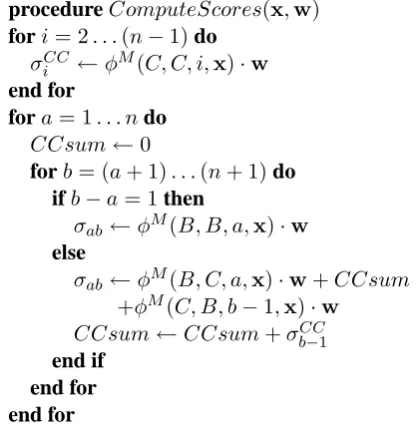
Figure 1: Dynamic program for computing chunk scoresσabwith 1-CRF-type features.
but if one na¨ıvely distributes the product over the sum, longer chunks will take proportionally longer to score, resulting in cubic time algorithms.5
In fact, it is possible to use these features without any asymptotic decrease in efficiency by means of a dynamic program. Both Viterbi and forward-backward involve the scores σab = w· φS(a, b,x). Suppose that before starting those
al-gorithms, we compute and cache the scoreσab of
each chunk, so that remainder the algorithm runs in quadratic time, as usual. This pre-computation can be done quickly if we first compute the values
σiCC =w·φM(C, C, i,x), and use them to fill in the values ofσabas shown in Figure 1.
In addition, computing the gradient of the semi-CRF objective requires that we compute the ex-pected value of each feature. For CRF-type fea-tures, this is tantamount to being able to compute the probability that each label bigram (Li, Li+1)
takes any value. Assume that we have already run standard forward-backward inference so that we have for any(a, b) the probability that the subse-quence(xa,xa+1, . . . ,xb−1)segments as a chunk, P(chunk(a, b)). Computing the probability that (Li, Li+1) takes the values BB, BC or CB is
simple to compute:
P(Li, Li+1 =BB) =P(chunk(i, i+ 1))
and, e.g.,
P(Li, Li+1=BC) =
X
j>i+1
P(chunk(i, j)),
but the same method of summing over chunks can-not be used for the valueCC since for each label bigram there are quadratically many chunks cor-responding to that value. In this case, the solution is deceptively simple: using the fact that for any given label bigram, the sum of the probabilities of the four labels must be one, we can deduce that
P(Li, Li+1=CC) = 1.0−P(Li, Li+1 =BB) −P(Li, Li+1=BC)−P(Li, Li+1 =CB).
One might object that features of theCandCC
labels (the ones presenting algorithmic difficulty) are unnecessary, since under certain conditions, their removal would not in fact change the expres-sivity of the model or the distribution that maxi-mizes training likelihood. This will indeed be the case when the following conditions are fulfilled:
1. All label bigram features are of the form
φM(Li,Li+1, i,x) =
1{(Li, Li+1) =α&pred(i,x)}
for some label bigramαand predicatepred, and any such feature with a given predicate has variants for all four label bigramsα.
2. No regularization is used during training.
A proof of this claim would require too much space for this paper, but the key is that, given a model satisfying the above conditions, one can obtain an equivalent model via adding, for each feature type overpred, some constant to the four weights corresponding to the four label bigrams, such that theCCbigram features all have weight zero.
In practice, however, one or both of these con-ditions is always broken. It is common knowl-edge that regularization of log-linear models with a large number of features is necessary to achieve high performance, and typically in NLP one de-fines feature templates and chooses only those fea-tures that occur in some positive example in the training set. In fact, if both of these conditions are fulfilled, it is very likely that the optimal model will have some weights with infinite values. We conclude that it is not a practical alternative to omit theCandCClabel features.
2.4 Generative Features in a Discriminative Model
When using the output of a generative model as a feature in a discriminative model, Raina et al. (2004) provide a justification for the use of log conditional odds as opposed to log-probability: they show that using log conditional odds as fea-tures in a logistic regression model is equivalent to discriminatively training weights for the fea-tures of a Na¨ıve Bayes classifier to maximize conditional likelihood.6 They demonstrate that the resulting classifier, termed a “hybrid genera-tive/discriminative classifier”, achieves lower test error than either pure Na¨ıve Bayes or pure logistic regression on a text classification task, regardless of training set size.
The hybrid generative/discriminative classifier also uses a unique method for using the same data used to estimate the parameters of the compo-nent generative models for training the discrimina-tive model parameterswwithout introducing bias. A “leave-one-out” strategy is used to choose w, whereby the feature values of thei-th training ex-ample are computed using probabilities estimated with thei-th example held out. The beauty of this approach is that since the probabilities are esti-mated according to (smoothed) relative frequency, it is only necessary during feature computation to maintain sufficient statistics and adjust them as necessary for each example.
In this paper, we experiment with the use of a single “hybrid” local semi-CRF feature, the smoothed log conditional odds that a given sub-sequencexab= (xa, . . . ,xb−1)forms a word:
log wordcount(xab) + 1
nonwordcount(xab) + 1 ,
where wordcount(xab) is the number of times
xab forms a word in the training set, and
nonwordcount(xab) is the number of times xab
occurs, not segmented into a single word. The models we test are not strictly speaking hybrid generative/discriminative models, since we also use indicator features not derived from a genera-tive model. We did however use the leave-one-out approach for computing the log conditional odds feature during training.
3 Experiments
To test the ideas discussed in this paper, we com-pared the performance of semi-CRFs using vari-ous feature sets on a Chinese word segmentation task. The data used was the Microsoft Research Beijing corpus from the Second International Chinese Word Segmentation Bakeoff (Emerson, 2005), and we used the same train/test split used in the competition. The training set consists of 87K sentences of Beijing dialect Chinese, hand seg-mented into 2.37M words. The test set contains 107K words comprising roughly 4K sentences. We used a maximum word lengthk of 15 in our experiments, which accounted for 99.99% of the word tokens in our training set. The 249 train-ing sentences that contained words longer than 15 characters were discarded. We did not discard any test sentences.
In order to be directly comparable to the Bake-off results, we also worked under the very strict “closed test” conditions of the Bakeoff, which re-quire that no information or data outside of the training set be used, not even prior knowledge of which characters represent Arabic numerals, Latin characters or punctuation marks.
3.1 Features Used
We divide our main features into two types accord-ing to whether they are most naturally used in a CRF or a semi-CRF.
The CRF-type features are indicator functions that fire when the character label (or label bigram) takes some value and some predicate of the input at a certain position relative to the label is satis-fied. For each character label unigramL at posi-tioni, we use the same set of predicate templates checking:
• The identity ofxi−1andxi
• The identity of the character bigram starting at positionsi−2,i−1andi
• Whether xj and xj+1 are identical, forj =
(i−2). . . i
• Whether xj and xj+2 are identical, forj =
(i−3). . . i
• Whether the sequence xj. . .xj+3 forms an AABBsequence forj= (i−4). . . i
• Whether the sequence xj. . .xj+3 forms an ABABsequence forj= (i−4). . . i
The latter four feature templates are designed to detect character or word reduplication, a morpho-logical phenomenon that can influence word seg-mentation in Chinese. The first two of these were also used by Tseng et al. (2005).
For label bigrams (Li, Li+1), we use the same
templates, but extending the range of positions by one to the right.7 Each label uni- or bigram also has a “prior” feature that always fires for that label configuration. All configurations con-tain the above features for the label unigram B, since these are easily used in either a CRF or semi-CRF model. To determine the influence of semi- CRF-type features on performance, we also test config-urations in which bothB andClabel features are used, and configurations using all label uni- and bigrams.
In the semi-Markov conditions, we also use as feature templates indicators of the length of a word
`, for`= 1. . . k, and indicators of the identity of the corresponding character sequence.
All feature templates were instantiated with val-ues that occur in positive training examples. We found that excluding CRF-type features that occur only once in the training set consistently improved performance on the development set, so we use a count threshold of two for the experiments. We do not do any thresholding of the semi-CRF features, however.
Finally, we use the single generative feature, log conditional odds that the given string forms a word. We also present results using the more typical log conditional probability instead of the odds, for comparison. In fact, these are both semi-Markov-type features, but we single them out to determine what they contribute over and above the other semi-Markov features.
3.2 Results
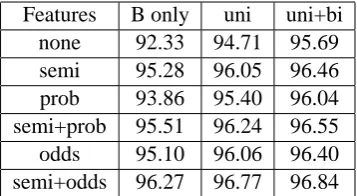
The results of test set runs are summarized in ta-ble 3.2. The columns indicate which CRF-type features were used: features of only the labelB, features of label unigrams B and C, or features of all label unigrams and bigrams. The rows indi-cate which semi-Markov-type features were used:
7
Features B only uni uni+bi
none 92.33 94.71 95.69
semi 95.28 96.05 96.46
prob 93.86 95.40 96.04
semi+prob 95.51 96.24 96.55
odds 95.10 96.06 96.40
[image:7.595.92.271.62.160.2]semi+odds 96.27 96.77 96.84
Table 1: Test F-measure for different model con-figurations.
“semi” means length and word identity features were used, “prob” means the log-probability ture was used, and “odds” means the log-odds fea-ture was used.
To establish the impact of each type of feature (C label unigrams, label bigrams, semi-CRF-type features, and the log-odds feature), we look at the reduction in error brought about by adding each type of feature. First consider the effect of the CRF-type features. Adding the C label features reduces error by 31% if no semi-CRF features are used, by 16% when semi-CRF indicator features are turned on, and by 13% when all semi-CRF fea-tures (including log-odds) are used. Using all label bigrams reduces error by 44%, 25%, and 15% in these three conditions, respectively.
Contrary to previous conclusions, our results show a significant impact due to the use of semi-CRF-type features, when semi-CRF-type features are held constant. Adding semi-CRF indicator fea-tures results in a 38% error reduction without CRF-type features, and 18% with them. Adding semi-CRF indicator features plus the log-odds fea-ture gives 52% and 27% in these two conditions, respectively.
Finally, across configurations, the log tional odds does much better than log condi-tional probability. When the log-odds feature is added to the complete CRF model (uni+bi) as the only semi-CRF-type feature, errors are re-duced by 24%, compared to only 7.6% for the log-probability. Even when the other semi-CRF-type features are present as well, log-odds reduces error by 13% compared to 2.5% for log-probability.
Our best model, combining all features, resulted in an error reduction of 12% over the highest score on this dataset from the 2005 Sighan closed test competition (96.4%), achieved by the pure CRF system of Tseng et al. (2005).
3.3 Discussion
Our results indicate that both Markov-type and semi-Markov-type features are useful for generali-zation to unseen data. This may be because the two types of features are in a sense complemen-tary: semi-Markov-type features such as word-identity are valuable for modeling the tendency of known strings to segment as words, while la-bel based features are valuable for modeling prop-erties of sub-lexical components such as affixes, helping to generalize to words that have not previ-ously been encountered. We did not explicitly test the utility of CRF-type features for improving re-call on out-of-vocabulary items, but we note that in the Bakeoff, the model of Tseng et al. (2005), which was very similar to our CRF-only system (only containing a few more feature templates), was consistently among the best performing sys-tems in terms of test OOV recall (Emerson, 2005). We also found that for this sequence segmenta-tion task, the use of log condisegmenta-tional odds as a fea-ture results in much better performance than the use of the more typical log conditional probabil-ity. It would be interesting to see the log-odds applied in more contexts where log-probabilities are typically used as features. We have presented the intuitive argument that the log-odds may be advantageous because it does not exhibit the 0-1 asymmetry of the log-probability, but it would be satisfying to justify the choice on more theoretical grounds.
4 Relation to Previous Work
There is a significant volume of work explor-ing the use of CRFs for a variety of chunkexplor-ing tasks, including named-entity recognition, gene prediction, shallow parsing and others (Finkel et al., 2005; Culotta et al., 2005; Sha and Pereira, 2003). The current work indicates that these sys-tems might be improved by moving to a semi-CRF model.
Although it has become fairly common in NLP to use the log conditional probabilities of events as features in a discriminative model, we are not aware of any work using the log conditional odds.
5 Conclusion
We have shown that order-1 semi-Markov condi-tional random fields are strictly more expressive than order-1 Markov CRFs, and that the added expressivity enables the use of features that lead to improvements on a segmentation task. On the other hand, Markov CRFs can more naturally in-corporate certain features that may be useful for modeling sub-chunk phenomena and generaliza-tion to unseen chunks. To achieve the best per-formance for segmentation, we propose that both types of features be used, and we show how this can be done efficiently.
Additionally, we have shown that a log condi-tional odds feature estimated from a generative model can be superior to the more common log conditional probability.
6 Acknowledgements
Many thanks to Kristina Toutanova for her thoughtful discussion and feedback, and also to the anonymous reviewers for their suggestions.
References
Masayuki Asahara, Kenta Fukuoka, Ai Azuma, Chooi-Ling Goh, Yotaro Watanabe, Yuji Matsumoto, and Takahashi Tsuzuki. 2005. Combination of machine learning methods for optimum chinese word seg-mentation. In Proc. Fourth SIGHAN Workshop on
Chinese Language Processing, pages 134–137.
Michael Collins. 2000. Discriminative reranking for natural language parsing. In Proc. 14th
Interna-tional Conf. on Machine Learning.
Aron Culotta, David Kulp, and Andrew McCallum. 2005. Gene prediction with conditional random fields. Technical report, University of Massa-chusetts Dept. of Computer Science, April.
Hal Daum´e III and Daniel Marcu. 2005. Learning as search optimization: Approximate large margin methods for structured prediction. In Proc. 19th
In-ternational Conf. on Machine Learning.
Thomas Emerson. 2005. The second international chi-nese word segmentation bakeoff. In Proc. Fourth
SIGHAN Workshop on Chinese Language Process-ing, pages 123–133.
Jenny Finkel, Trond Grenager, and Christopher D. Manning. 2005. Incorporating non-local informa-tion into informainforma-tion extracinforma-tion systems by gibbs sampling. Proc. 41th Annual Meeting of the
Assi-ciation of Computation Linguistics.
John Lafferty, Andrew McCallum, and Fernando Pereira. 2001. Conditional random fields: Prob-abilistic models for segmenting and labeling se-quence data. In Proc. 18th International Conf. on
Machine Learning, pages 282–289. Morgan
Kauf-mann, San Francisco, CA.
Percy Liang. 2005. Semi-supervised learning for nat-ural language. Master’s thesis, Massachusetts Insti-tute of Technology.
Andrew Y. Ng and Michael I. Jordan. 2001. On dis-criminative vs. generative classifiers: A comparison of logistic regression and Na¨ıve Bayes. In Proc.
Ad-vances in Neural Information Processing 14.
Franz Josef Och and Hermann Ney. 2002. Discrim-inative training and maximum entropy models for statistical machine translation. Proc. 38th Annual
Meeting of the Assiciation of Computation Linguis-tics.
Franz Josef Och and Hermann Ney. 2004. The align-ment template approach to statistical machine trans-lation. Computational Linguistics, 30(4):417–449, December.
Fuchun Peng, Fangfang Feng, and Andrew McCallum. 2004. Chinese segmentation and new word detec-tion using condidetec-tional random fields. In Proc. 20th
International Conf. on Computational Linguistics.
Rajat Raina, Yirong Shen, Andrew Y. Ng, and Andrew McCallum. 2004. Classification with hybrid gen-erative/discriminative models. In Proc. Advances in
Neural Information Processing 17.
Brian Roark and Seeger Fisher. 2005. OGI/OHSU baseline multilingual multi-document sumarization system. In Proc. Multilingual Summarization
Eval-uation in ACL Workshop: Intrinsic and Extrinsic Evaluation Measures for MT and/or Summarization.
Sunita Sarawagi and William Cohen. 2004. Semi-markov conditional random fields for information extraction. In Proc. 18th International Conf. on
Ma-chine Learning.
Fei Sha and Fernando Pereira. 2003. Shallow parsing with conditional random fields. Proc. HLT-NAACL.
Huihsin Tseng, Pichuan Chang, Galen Andrew, Daniel Jurafsky, and Christopher Manning. 2005. A condi-tional random field word segmenter for sighan bake-off 2005. In Proc. Fourth SIGHAN Workshop on