Proceedings of NAACL-HLT 2019, pages 122–129 122
Learning When Not to Answer:
A Ternary Reward Structure for Reinforcement
Learning based Question Answering
Fr´ederic Godin Ghent University Ghent, Belgium [email protected]
Anjishnu Kumar Amazon Research Cambridge, United Kingdom
Arpit Mittal Amazon Research Cambridge, United Kingdom
Abstract
In this paper, we investigate the challenges of using reinforcement learning agents for question-answering over knowledge graphs for real-world applications. We examine the performance metrics used by state-of-the-art systems and determine that they are inade-quate for such settings. More specifically, they do not evaluate the systems correctly for situ-ations when there is no answer available and thus agents optimized for these metrics are poor at modeling confidence. We introduce a simple new performance metric for evaluating question-answering agents that is more rep-resentative of practical usage conditions, and optimize for this metric by extending the bi-nary reward structure used in prior work to a ternary reward structure which also rewards an agent for not answering a question rather than giving an incorrect answer. We show that this can drastically improve the precision of answered questions while only not answer-ing a limited number of previously correctly answered questions. Employing a supervised learning strategy using depth-first-search paths to bootstrap the reinforcement learning algo-rithm further improves performance.
1 Introduction
A number of approaches for question answering have been proposed recently that use reinforce-ment learning to reason over a knowledge graph (Das et al., 2018; Lin et al., 2018; Chen et al.,
2018;Zhang et al.,2018). In these methods the in-put question is first parsed into a constituent ques-tion entity and relaques-tion. The answer entity is then identified by sequentially taking a number of steps (or ‘hops’) over the knowledge graph (KG) start-ing from the question entity. The agent receives a positive reward if it arrives at the correct an-swer entity and a negative reward for an incor-rect answer entity. For example, for the question
France
. . .
Paris Macron
. . .
Capital of
[image:1.595.322.508.227.367.2]President of-1 Lives in
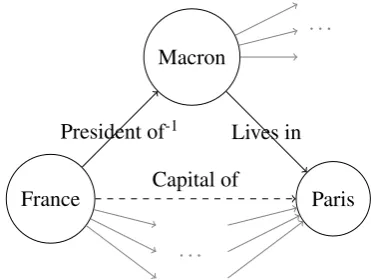
Figure 1: Fictional graph for the the question “What’s the capital of France?”. The relation(Capital of)does not exist in the graph and thus an alternative path needs to be used that leads to the correct answer.
“What is the capital of France?”, the question en-tity is(F rance)and the goal is to find a path in
the KG which connects it to (P aris). The
rela-tion between the answer entity and quesrela-tion entity
in this example is(Capital of)which is missing
from the KG and has to be inferred via alternative paths. This is illustrated in Figure1. A possible two-hop path to find the answer is to use the fact that(M acron) is the president of(F rance) and that he lives in(P aris). However, there are many paths that lead to the entity (P aris) but also to other entities which makes finding the correct an-swer a non-trivial task.
The standard evaluation metrics used for these systems are metrics developed for web search such as Mean Reciprocal Rank (MRR) and hits@k,
wherekranges from 1 to 20. We argue that this is
reached from the question entity in limited num-ber of steps. However this cannot be guaranteed in a large-scale commercial setting and for all KGs. For example, in our proprietary dataset used for the experimentation, for 15.60% of questions the answer entity cannot be reached within the limit of number of steps used by the agent. Hence, we propose a new evaluation criterion, allowing sys-tems to return ‘no answer’ as a response when no answer is available.
We demonstrate that existing state-of-the-art methods are not suited for a practical question-answering setting and perform poorly in our eval-uation setup. The root-cause of poor performance is the reward structure which does not provide any incentive to learn not to answer. The modified re-ward structure we present allows agents to learn not to answer in a principled way. Rather than hav-ing only two rewards, a positive and a negative re-ward, we introduce a ternary reward structure that also rewards agents for not answering a question. A higher reward is given to the agent for correctly answering a question compared to not answering a question. In this setup the agent learns to make a trade-off between these three possibilities to ob-tain the highest total reward over all questions.
Additionally, because the search space of possi-ble paths exponentially grows with the number of hops, we also investigate using Depth-First-Search (DFS) algorithm to collect paths that lead to the correct answer. We use these paths as a supervised signal for training the neural network before the reinforcement learning algorithm is applied. We show that this improves overall performance.
2 Related work
The closest works to ours are the works by Lin
et al. (2018), Zhang et al. (2018) and Das et al.
(2018), which consider the question answering
task in a reinforcement learning setting in which
the agent always chooses to answer.1 Other
ap-proaches consider this as a link prediction problem in which multi-hop reasoning can be used to learn relational paths that link two entities. One line
of work focuses on composing embeddings (
Nee-lakantan et al.,2015;Guu et al.,2015;Toutanova et al., 2016) initially introduced for link predic-tion, e.g., TransE (Bordes et al.,2013), ComplexE
1An initial version of this paper has been presented at
the Relational Representation Learning Workshop at NeurIPS 2018 asGodin et al.(2018).
(Trouillon et al.,2016) or ConvE (Dettmers et al.,
2018). Another line of work focuses on logical
rule learning such as neural logical programming (Yang et al., 2017) and neural theorem proving (Rockt¨aschel and Riedel, 2017). Here, we focus on question answering rather than link prediction or rule mining and use reinforcement learning to circumvent that we do not have ground truth paths leading to the answer entity.
Recently, popular textual QA datasets have been
extended with not-answerable questions (Trischler
et al.,2017;Rajpurkar et al.,2018). Questions that cannot be answered are labeled with ‘no answer’ option which allows for supervised training. This is different from our setup in which there are no ground truth ‘no answer’ labels.
3 Background: Reinforcement learning
We base our work on the recent reinforcement
learning approaches introduced in Das et al.
(2018) andLin et al.(2018). We denote the knowl-edge graph asG, the set of entities as E, the set
of relations asR and the set of directed edgesL
between entities of the form l = (e1, r, e2) with e1, e2 ∈ Eandr ∈ R. The goal is to find an
an-swer entityea given a question entity eq and the
question relation rq, when(eq, rq, ea) is not part of graphG.
We formulate this problem as a Markov
De-cision Problem (MDP) (Sutton and Barto, 1998)
with the following states, actions, transition func-tion and rewards:
States. At every timestept, the statestis defined
by the current entityet, the question entityeq and relationrq, for whichet, eq∈ Eandrq ∈ R. More
formally,st= (et, eq, rq).
Actions. For a given entityet, the set of possible
actions is defined by the outgoing edges fromet.
ThusAt={(r0, e0)|(et, r0, e0)∈ G}.
Transition function. The transition function δ
maps st to a new state st+1 based on the
ac-tion taken by the agent. Consequently, st+1 =
δ(st, At) =δ(et, eq, rq, At).
Rewards. The agent is rewarded based on the
LSTM h1 . . . LSTM . . . LSTM
ht−1 ht hT−1
r0,eq rt,et rT,eT
(a) History LSTM
FFNN (f)
rq,et,ht
rt+1,1et+1,1 . . .
rt+1,|At|et+1,|At|
⊗
π
sof tmax
[image:3.595.89.516.64.194.2](b) Policy network at timestept
Figure 2: Figure2aillustrates the LSTM which encodes history of the path taken. The output at timesteptis used as input to the policy network, illustrated in Figure2b, to determine which action to take next.
3.1 Training
We train a policy network π using the
REIN-FORCE algorithm ofWilliams(1992) which
max-imizes the expected reward:
J(θ) =E(eq,rq,ea)∈GEa1,...,aT∼π[R(sT|eq, rq)]
(1) in whichatis the action selected at timestept
fol-lowing the policyπ, and θ are the parameters of
the network.
The policy network consists of two parts: a Long Short-Term Memory (LSTM) network which encodes the history of the traversed path, and a feed-forward neural network to select an
action (at) out of all possible actions. Each
entity and relation have a corresponding vector
et,rt ∈ Rd. The action at ∈ At is represented
by the vectors of the relation and entity as at =
[rt+1;et+1] ∈ R2d. The LSTM encodes the
his-tory of the traversed path and updates its hidden state each timestep, based on the selected action:
ht=LST M(ht−1,at−1) (2)
This is illustrated in Figure2a.
Finally, the feed-forward neural network (f)
combines the history ht, the current entity
repre-sentationetand the query relationrq. Using
soft-max, we compute the probability for each action by calculating the dot product between the output off and each action vectorat:
π(at|st) =sof tmax(Atf(ht,et,rq)) (3)
in whichAt ∈ R|At|×2dis a matrix consisting of
rows of action vectorsat. This is illustrated in
Fig-ure2b. During training, we sample over this prob-ability distribution to select the actionat, whereas
during inference, we use beam search to select the most probable path.
4 Evaluation
User-facing question answering systems inher-ently face a trade-off between presenting an an-swer to a user that could potentially be incorrect, and choosing not to answer. However, prior work in knowledge graph question-answering (QA) only considers cases in which the answering agent always produces an answer. This setup originates from the link prediction and knowledge base com-pletion tasks in which the evaluation criteria are hits@k and Mean Reciprocal Rank (MRR), where
k ranges from 1 to 20. However, these
met-rics are not an accurate representation of practical question-answering systems in which the goal is to return a single correct answer or not answer at all. Moreover, using these metrics result in the prob-lem of the model learning ‘spurious’ paths since the metrics encourage the models to make wild guesses even if the path is unlikely to lead to the correct answer.
We therefore propose to measure the fraction of questions the system answers (Answer Rate) and the number of correct answers out of all answers (Precision) to measure the system performance. We combine these two metrics by taking the har-monic mean and call this the QA Score. This can be viewed as a variant of the popular F-Score met-ric, with answer rate used as an analogue to recall in the original metric.
5 Proposed method
In this section, we will first introduce the super-vised learning technique we used to pretrain the neural network before applying the reinforcement
learning algorithm. Next we will describe the
5.1 Supervised learning
Typically in reinforcement learning, the search space of possible actions and paths grows expo-nentially with the path length. Our problem is no exception to this. Hence an imitation learning ap-proach could be beneficial here where we provide a number of expert paths to the learning algorithm to bootstrap the learning process. This idea has been explored previously in the context of link and fact prediction in knowledge graphs where
Xiong et al. (2017) proposed to use a Breadth-First-Search (BFS) between the entity pairs to se-lect a set of plausible paths. However BFS favours identification of shorter paths which could bias the learner. We therefore use Depth-First-Search (DFS) to identify paths between question and an-swer entities and sample up to 100 paths to be used for the supervised training. If no path can be found between the entity pair we return a ‘no answer’ la-bel. Following this, we train the network using reinforcement learning algorithm which refines it further. Note that it is not guaranteed that the set of paths found using DFS are all most efficient. How-ever as we show in our experiments, bootstrapping with these paths provide good initialization for the reinforcement learning algorithm.
5.2 Ternary reward structure
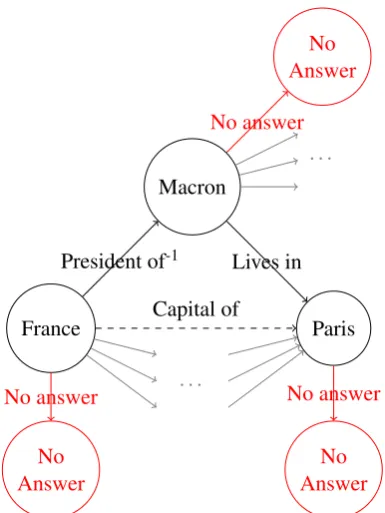
As mentioned previously, we encounter situations when the answer entity cannot be reached in the limited number of steps taken by an agent. In such cases, the system should return a special an-swer ‘no anan-swer’ as the response. We can achieve this by adding a synthetic ‘no answer’ action that leads to a special entityeN OAN SW ER. This is
il-lustrated in Figure 3. In the framework of Das
et al.(2018) a binary reward is used which rewards the learner for the answer being wrong or cor-rect. Following a similar protocol, we could award a score of 1 to return ‘no answer’ when there is no answer available in the KG. However, we can-not achieve reasonable training with such reward structure. This is because there is no specific pat-tern for ‘no answer’ that could be directly learned. Hence, if we reward a system equally for correct or no answer, it learns to always predict ‘no answer’. We therefore propose a ternary reward structure in which a positive reward is given to a correct
an-swer, a neutral reward wheneN OAN SW ER is
se-lected as an answer, and a negative reward for an
France
. . .
No Answer
Paris
No Answer
Macron
. . . No Answer
Capital of
No answer No answer
President of-1 Lives in
[image:4.595.320.513.60.317.2]No answer
Figure 3: Fictional graph for the the question “What’s the capital of France?”. The relation(Capital of)does not exist in the graph and thus an alternative path needs to be used that leads to the correct answer. To avoid that the agent returns an incorrect answer when not finding the correct answer, a ‘no answer’ relation is added be-tween every entity node and a special ‘no answer’ node, to be able to return ‘no answer’.
incorrect answer. More formally:
R(sT) =
rpos ifeT =ea,
0 ifeT =eN OAN SW ER, rneg ifeT 6∈ {ea, eN OAN SW ER}
(4) withrpos>0andrneg<0. The idea is that the agent receives a larger reward for a correct answer com-pared to not answering the question, and a neg-ative reward for incorrectly answering a question compared to not answering the question. In the ex-perimental section, we show that this mechanism provides better performance.
6 Experimental setup
We evaluate our proposed approach on a
pub-licly available dataset, FB15k-237 (Toutanova
Model Hits@1 Hits@10 MRR Precision Answer Rate QA Score
(Das et al.,2018) 0.217 0.456 0.293 0.217 1 0.357 (Lin et al.,2018) 0.329 0.544 0.393 0.329 1 0.495
RL 0.2475 0.4032 0.2983 0.2475 1 0.3968
Supervised 0.2474 0.4929 0.3276 0.2474 1 0.3967
Supervised + RL 0.2736 0.5015 0.3469 0.2736 1 0.4296
No Answer RL 0.2345 0.3845 0.2831 0.4011 0.5847 0.4758
[image:5.595.92.501.229.359.2]All 0.2738 0.4412 0.3286 0.4835 0.5663 0.5216
Table 1: Results on FB15k-237 dataset.
Model Hits@1 Hits@10 MRR Precision Answer Rate QA Score
(Das et al.,2018) 0.1790 0.2772 0.2123 0.1790 1 0.3036 (Lin et al.,2018) 0.1915 0.3184 0.2358 0.1915 1 0.3214
RL 0.1677 0.2716 0.2031 0.1677 1 0.2872
Supervised 0.1471 0.3142 0.203 0.1471 1 0.2565
Supervised + RL 0.1937 0.3045 0.2312 0.1937 1 0.3245
No Answer RL 0.1564 0.2442 0.1858 0.3892 0.4019 0.3955
All 0.1865 0.294 0.2229 0.3454 0.5401 0.4213
Table 2: Results on Alexa69k-378 dataset.
#queries
#ent #rel #facts valid test
FB15k-237
14,505 237 272,115 17,535 20,466
Alexa69k-378
69,098 378 442,591 55,186 55,474
Table 3: Statistics of the datasets.
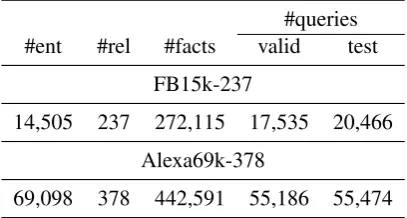
real-world general-purpose knowledge graphs that can be used for question answering. FB15k-237 contains 14,505 different entities and 237 different relations resulting in 272,115 facts. Alexa69k-378 contains 69,098 different entities and 378 differ-ent relations resulting in 442,591 facts. We fol-low the setup ofDas et al.(2018), using the same train/val/test splits for FB15k-237. For Alexa69k-378 we use 10% of the full dataset for validation and test. For both datasets, we add the reverse re-lations of all rere-lations in the training set in order to facilitate backward navigation following the ap-proach of previous work. Similarly, a ‘no op’ rela-tion is added for each entity between the entity and itself, which allows the agent to loop/reason
mul-tiple consecutive steps over the same entity. An overview of both datasets can be found in Table3.
We extend the publicly available implementa-tion ofDas et al.(2018) for our experimentation. We set the size of the entity and relation
repre-sentations d at 100 and the hidden state at 200.
We use a single layer LSTM and train models with path length 3 (tuned using hyper-parameter search). We optimize the neural network using
Adam (Kingma and Ba, 2015) with learning rate
0.001, mini-batches of size 256 with 20 rollouts per example. During the test time, we use beam search with the beam size of 100. UnlikeDas et al.
(2018), we also train entity embeddings after ini-tializing them with random values. Reward values
are set asrpos = 10 andrneg = −0.1 after
per-forming a coarse grid search for various reward values on the validation set. For all experiments, we selected the best model with the highest QA Score on the corresponding validation set.
7 Results
The results of our experiments for FB15k-237 and
Alexa69k-378 are given in Table1and Table2
[image:5.595.78.282.402.511.2]Supervised learning For FB15k-237, we see that the model trained using reinforcement learn-ing (RL) scores as well as the model trained uslearn-ing supervised learning. This makes supervised learn-ing uslearn-ing DFS a strong baseline system for ques-tion answering over knowledge graphs, and for FB15k-237 in particular. On Alexa69k-378, mod-els trained using supervised learning score lower on all metrics compared to RL. When combining supervised learning with RL overall performance increases.
No answer When we train RL system with our
ternary reward structure (No Answer RL), the precision and QA score increase significantly on both datasets. For FB15k-237, our No Answer RL model decided not to answer over 40% of the questions, with an absolute hits@1 reduc-tion of only 1.3% over standard RL. Moreover, of all the answered questions, 40.11% were an-swered correctly compared to 24.75% of the orig-inal question-answering system: an absolute im-provement of over 15%. This resulted in the final QA Score of 47.58%, around 8% higher than
stan-dard RL and 12% higher thanDas et al.(2018).
Similarly, 60% of the questions did not get an-swered on Alexa69k-378. This resulted in hits@1 decrease of roughly 1% but compared to stan-dard RL, the precision increased from 16.77% to 38.92%: an absolute increase of more than 20%. The final QA Score also increased from 28.72% to 39.55%, and also significantly improved over
Das et al. (2018) and Lin et al.(2018). The re-sults indicate that using our method allows us to improve the precision of the question-answering system by choosing the right questions to be an-swered by not answering many questions that were previously answered incorrectly. This comes at the expense of not answering some questions that pre-viously could be answered correctly.
All Finally, all methods were combined in a
sin-gle method. First the model was pretrained in a su-pervised way. Then the model was retrained using RL algorithm with ternary reward structure. This jointly trained model obtained better QA scores than any individually trained model. On FB15k-237, a QA score of 52.16% is obtained which is an absolute improvement of 4.58% over the best individual model and 2.66% overLin et al.(2018). Similarly, on Alexa69k-378, an absolute improve-ment of 2.57% over the best individual result is
0 5 10 15
0% 25% 50% 75% 100%
Positive Reward
Percentage
Precision Answer Rate
[image:6.595.318.511.63.220.2]QA score
Figure 4: Influence of changing the positive reward for FB15k-237. The negative reward is fixed at rneg =
−0.1and the neutral reward is fixed atrneutral= 0.
−0.5 −0.4 −0.3 −0.2 −0.1 0
0% 25% 50% 75% 100%
Negative Reward
Percentage
Precision Answer Rate
QA score
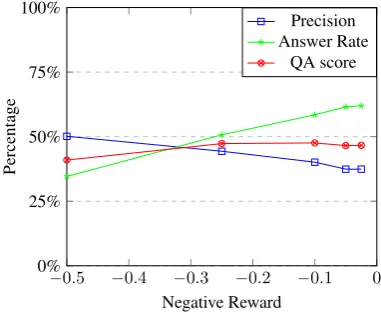
Figure 5: Influence of changing the negative reward for FB15k-237. The positive reward is fixed atrpos = 10 and the neutral reward is fixed atrneutral= 0.
obtained, almost 10% absolute improvement over
Lin et al.(2018). Sample results from our method are given in Table4and Table5.
Reward tuning An important part of increasing
the QA score is to select the right combination of rewards. Therefore, we ran additional experiments where we varied either the positive or negative re-ward, keeping the other rewards fixed. In Figure4, the precision, answer rate and QA score are shown when varying the positive reward and keeping the neutral and negative rewards fixed. When, the pos-itive reward is very small (rpos = 0.625), almost no question is answered. When the positive re-wardrpos is 1.25, roughly 20% of the questions
[image:6.595.320.511.299.455.2]Question:eq= Bruce Broughton,rq= Profession. Answer:ea= Music Composer
Bruce Broughton Award Nominee Oscar Best Music Award Winner Nino Rota Profession Music Composer
Question:eq= Washington nationals,rq= Sports Team Sport. Answer:ea= Baseball
Washington Nationals National League Milwaukee Braves Baseball
[image:7.595.105.498.70.166.2]Sports League-1 Sports League Sports Team Sport
Table 4: Example paths of correctly answered questions on FB15k-237. Note that the fact(eq, rq, ea)is not part of the KG.
Question:eq= Sherlock holmes (movie),rq= Story By. Answer:ea= Conan Doyle
Sherlock holmes (movie) Film Crew Role Wardrobe SupervisorNo opWardrobe Sup. No op Wardrobe Sup.
Sherlock holmes (movie) Film Crew Role Wardrobe SupervisorNo answerNo answer No answer No answer
Table 5: Example question from FB15k-237, incorrectly answered by (Das et al.,2018) and not answered by our system. Note that the fact(eq, rq, ea)is not part of the KG.
starts increasing, resulting in an overall increase in QA score. The QA score plateaus between 5 and 10 and then starts decreasing slowly. In Figure5, the precision, answer rate and QA score are shown when varying the negative reward and keeping the neutral and positive rewards fixed. In this case, the highest QA score is achieved when the nega-tive reward is between -0.25 and -0.1. As long as the negative reward is lower than zero, a wrong an-swer gets penalized and the QA score stays high.
8 Conclusions
In this paper, we addressed the limitations of current approaches for question answering over a knowledge graph that use reinforcement learn-ing. Rather than only returning a correct or in-correct answer, we allowed the model to not an-swer a question when it is not sure about it. Our ternary reward structure gives different rewards for correctly answered, incorrectly answered and
not answered questions. We also introduced a
new evaluation metric which takes these three op-tions into account. We showed that we can signif-icantly improve the precision of answered ques-tions compared to previous approaches, making this a promising direction for the practical usage in knowledge graph-based QA systems.
References
Antoine Bordes, Nicolas Usunier, Alberto Garcia-Duran, Jason Weston, and Oksana Yakhnenko. 2013. Translating embeddings for modeling multi-relational data. InAdvances in Neural Information Processing Systems (NIPS).
Wenhu Chen, Wenhan Xiong, Xifeng Yan, and William Yang Wang. 2018. Variational knowledge graph reasoning. InProceedings of the Conference of the North American Chapter of the Association for Computational Linguistics: Human Language Technologies (NAACL-HTL).
Rajarshi Das, Shehzaad Dhuliawala, Manzil Zaheer, Luke Vilnis, Ishan Durugkar, Akshay Krishna-murthy, Alexander J. Smola, and Andrew McCal-lum. 2018. Go for a walk and arrive at the answer: Reasoning over paths in knowledge bases using re-inforcement learning. International Conference on Learning Representations (ICLR).
Tim Dettmers, Minervini Pasquale, Stenetorp Pon-tus, and Sebastian Riedel. 2018. Convolutional 2d knowledge graph embeddings. In Proceedings of the 32th AAAI Conference on Artificial Intelligence (AAAI).
Fr´ederic Godin, Anjishnu Kumar, and Arpit Mittal. 2018. Using ternary rewards to reason over knowl-edge graphs with deep reinforcement learning. In Workshop on Relational Representation Learning (NeurIPS).
[image:7.595.103.499.216.283.2]Diederik P. Kingma and Jimmy Ba. 2015. Adam: A method for stochastic optimization. In Proceedings of the International Conference on Representation Learning (ICLR).
Xi Victoria Lin, Richard Socher, and Caiming Xiong. 2018. Multi-hop knowledge graph reasoning with reward shaping. In Proceedings of the 2018 Con-ference on Empirical Methods in Natural Language Processing (EMNLP).
Arvind Neelakantan, Benjamin Roth, and Andrew Mc-Callum. 2015. Compositional vector space mod-els for knowledge base completion. InProceedings of the Annual Meeting of the Association for Com-putational Linguistics and the International Joint Conference on Natural Language Processing (ACL-IJCNLP).
Pranav Rajpurkar, Robin Jia, and Percy Liang. 2018. Know what you don’t know: Unanswerable ques-tions for squad. InProceedings of the Annual Meet-ing of the Association for Computational LMeet-inguistics (ACL).
Tim Rockt¨aschel and Sebastian Riedel. 2017. End-to-end differentiable proving. In Advances in Neural Information Processing Systems (NIPS).
Richard S. Sutton and Andrew G. Barto. 1998. In-troduction to Reinforcement Learning, 1st edition. MIT Press, Cambridge, MA, USA.
Kristina Toutanova and Danqi Chen. 2015. Observed versus latent features for knowledge base and text inference. In3rd Workshop on Continuous Vector Space Models and Their Compositionality (ACL).
Kristina Toutanova, Victoria Lin, Wen-tau Yih, Hoi-fung Poon, and Chris Quirk. 2016. Compositional learning of embeddings for relation paths in knowl-edge base and text. In Proceedings of the Annual Meeting of the Association for Computational Lin-guistics (ACL).
Adam Trischler, Tong Wang, Xingdi Yuan, Justin Har-ris, Alessandro Sordoni, Philip Bachman, and Ka-heer Suleman. 2017. Newsqa: A machine compre-hension dataset. In Proceedings of the 2nd Work-shop on Representation Learning for NLP (ACL).
Th´eo Trouillon, Johannes Welbl, Sebastian Riedel, ´Eric Gaussier, and Guillaume Bouchard. 2016. Complex embeddings for simple link prediction. In Proceed-ings of the International Conference on Machine Learning (ICML).
Ronald J. Williams. 1992. Simple statistical gradient-following algorithms for connectionist reinforce-ment learning. Machine Learning.
Wenhan Xiong, Thien Hoang, and William Yang Wang. 2017. Deeppath: A reinforcement learning method for knowledge graph reasoning. In Proceed-ings of the 2017 Conference on Empirical Methods in Natural Language Processing (EMNLP).
Fan Yang, Zhilin Yang, and William W. Cohen. 2017. Differentiable learning of logical rules for knowl-edge base reasoning. InAdvances in Neural Infor-mation Processing Systems (NIPS).