Detecting Hedge Cues and their Scopes with Average Perceptron
Feng Ji, Xipeng Qiu, Xuanjing Huang
Fudan University
{fengji,xpqiu,xjhuang}@fudan.edu.cn
Abstract
In this paper, we proposed a hedge de-tection method with average perceptron, which was used in the closed challenge in CoNLL-2010 Shared Task. There are two subtasks: (1) detecting uncertain sen-tences and (2) identifying the in-sentence scopes of hedge cues. We use the unified learning algorithm for both subtasks since that the hedge score of sentence can be de-composed into scores of the words, espe-cially the hedge words. On the biomedical corpus, our methods achieved F-measure with 77.86% in detecting in-domain un-certain sentences, 77.44% in recognizing hedge cues, and 19.27% in identifying the scopes.
1 Introduction
Detecting hedged information in biomedical lit-eratures has received considerable interest in the biomedical natural language processing (NLP) community recently. Hedge information indicates that authors do not or cannot back up their opin-ions or statements with facts (Szarvas et al., 2008), which exists in many natural language texts, such as webpages or blogs, as well as biomedical liter-atures.
For many NLP applications, such as question answering and information extraction, the infor-mation extracted from hedge sentences would be harmful to their final performances. Therefore, the hedge or speculative information should be detected in advance, and dealt with different ap-proaches or discarded directly.
In CoNLL-2010 Shared Task (Farkas et al., 2010), there are two different level subtasks: de-tecting sentences containing uncertainty and iden-tifying the in-sentence scopes of hedge cues.
For example, in the following sentence:
These resultssuggestthat the IRE motif in the ALAS mRNA is functional and imply that translation of the mRNA is controlled by cellular iron availability during erythropoiesis.
The words suggestandimplyindicate that the statements are not supported with facts.
In the first subtask, the sentence is considered as uncertainty.
In the second subtask, suggest and imply are identified as hedge cues, while the consecutive blocks suggest that the IRE motif in the ALAS mRNA is functional andimply that translation of the mRNA is controlled by cellular iron availabil-ity during erythropoiesis are recognized as their corresponding scopes.
In this paper, we proposed a hedge detec-tion method with average perceptron (Collins, 2002), which was used in the closed challenges in CoNLL-2010 Shared Task (Farkas et al., 2010). Our motivation is to use a unified model to de-tect two level hedge information (word-level and sentence-level) and the model is easily expanded to joint learning of two subtasks. Since that the hedge score of sentence can be decomposed into scores of the words, especially the hedge words, we chosen linear classifier in our method and used average perceptron as the training algorithm.
The rest of the paper is organized as follows. In Section 2, a brief review of related works is pre-sented. Then, we describe our method in Section 3. Experiments and results are presented in the section 4. Finally, the conclusion will be presented in Section 5.
2 Related works
Although the concept of hedge information has been introduced in linguistic community for a long time, researches on automatic hedge detec-tion emerged from machine learning or
tational linguistic perspective in recent years. In this section, we give a brief review on the related works.
For speculative sentences detection, Medlock and Briscoe (2007) report their approach based on weakly supervised learning. In their method, a statistical model is initially derived from a seed corpus, and then iteratively modified by augment-ing the trainaugment-ing dataset with unlabeled samples according the posterior probability. They only employ bag-of-words features. On the public biomedical dataset1, their experiments achieve the
performance of 0.76 in BEP (break even point). Although they also introduced more linguistic fea-tures, such as part-of-speech (POS), lemma and bigram (Medlock, 2008), there are no significant improvements.
In Ganter and Strube (2009), the same task on Wikipedia is presented. In their system, score of a sentence is defined as a normalized tangent value of the sum of scores over all words in the sentence. Shallow linguistic features are introduced in their experiments.
Morante and Daelemans (2009) present their re-search on identifying hedge cues and their scopes. Their system consists of several classifiers and works in two phases, first identifying the hedge cues in a sentence and secondly finding the full scope for each hedge cue. In the first phase, they use IGTREE algorithm to train a classifier with 3 categories. In the second phase, three different classifiers are trained to find the first token and last token of in-sentence scope and finally combined into a meta classifier. The experiments shown that their system achieves an F1 of nearly 0.85 of identifying hedge cues in the abstracts sub cor-pus, while nearly 0.79 of finding the scopes with predicted hedge cues. More experiments could be found in their paper (Morante and Daelemans, 2009). They also provide a detail statistics on hedge cues in BioScope corpus2.
3 Hedge detection with average perceptron
3.1 Detecting uncertain sentences
The first subtask is to identify sentences con-taining uncertainty information. In particular,
1http://www.benmedlock.co.uk/
hedgeclassif.html
2http://www.inf.u-szeged.hu/rgai/
bioscope
this subtask is a binary classification problem at sentence-level.
We define the score of sentence as the confi-dence that the sentence contains uncertainty infor-mation.
The score can be decomposed as the sum of the scores of all words in the sentence,
S(x, y) = X
xi∈x
s(xi, y) =
X
xi∈x
wTφ(x i, y)
where, x denotes a sentence and xi is the i
-th word in -the sentence x, φ(xi, y) is a sparse
high-dimensional binary feature vector of wordxi.
y ∈ {uncertain,certain} is the category of the sentence. For instance, in the example sentence, if current word is suggest while the category of this sentence is uncertain, the following feature is hired,
φn(xi, y) =
(
1, if yx=i=‘‘uncertain’’‘‘suggest’’ ,
0, otherwise
wherenis feature index.
This representation is commonly used in struc-tured learning algorithms. We can combine the features into a sparse feature vector Φ(x, y) = P
iφ(xi, y).
S(x, y) =wTΦ(x, y) = X
xi∈x
wTφ(x i, y)
In the predicting phase, we assignxto the cate-gory with the highest score,
y∗ = arg max
y w
TΦ(x, y)
We learn the parameterswwith online learning framework. The most common online learner is the perceptron (Duda et al., 2001). It adjusts pa-rameters wwhen a misclassification occurs. Al-though this framework is very simple, it has been shown that the algorithm converges in a finite number of iterations if the data is linearly separa-ble. Moreover, much less training time is required in practice than the batch learning methods, such as support vector machine (SVM) or conditional maximum entropy (CME).
Here we employ a variant perceptron algorithm to train the model, which is commonly named average perceptron since it averages parameters
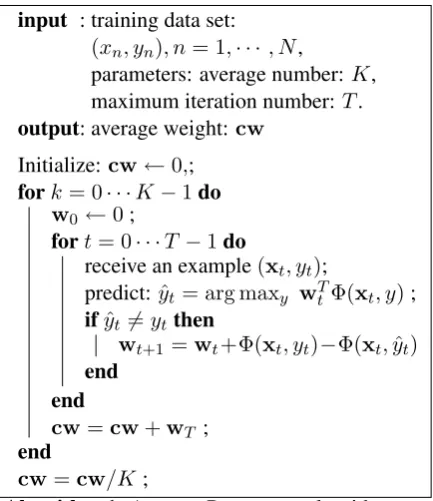
NLP problems demonstrate better generalization performance than non averaged parameters. More theoretical proofs can be found in Collins (2002). Different from the standard average perceptron al-gorithm, we slightly modify the average strategy. The reason to this modification is that the origi-nal algorithm is slow since parameters accumulate across all iterations. In order to keep fast training speed and avoid overfitting at the same time, we make a slight change of the parameters accumu-lation strategy, which occurs only after each iter-ation over the training data finished. Our training algorithm is shown in Algorithm 1.
input : training data set:
(xn, yn), n= 1,· · · , N,
parameters: average number: K, maximum iteration number:T. output: average weight:cw
Initialize:cw←0,; fork= 0· · ·K−1do
w0 ←0;
fort= 0· · ·T−1do
receive an example(xt, yt);
predict:yˆt= arg maxy wtTΦ(xt, y);
ifyˆt6=ytthen
wt+1=wt+Φ(xt, yt)−Φ(xt,yˆt)
end end
cw=cw+wT ; end
cw=cw/K;
Algorithm 1: Average Perceptron algorithm
Binary context features are extracted from 6 predefined patterns, which are shown in Figure 1. By using these patterns, we can easily obtain the complicate features. As in the previous example, if the current word is suggest, then a new com-pound feature could be extracted in the form of w−1=results//w0=suggestby employing the pat-ternw−1w0.// is the separate symbol.
3.2 Identifying hedge cues and their scopes Our approach for the second subtask consists of two phases: (1) identifying hedge cues in a sen-tence, then (2) recognizing their corresponding scopes.
3.2.1 Identifying hedge cues
Hedge cues are the most important clues for de-termining whether a sentence contains uncertain
• unigram:w0,p0
• bigram:w0w1,w0p0,p0p1
[image:3.595.74.291.251.502.2]• trigram:w−1w0w1
Figure 1: Patterns employed in the sentence-level hedge detection. Herewdenotes single word,pis part of speech, and the subscript denotes the rela-tive offset compared with current position.
• unigram:w−2,w−1,w0,w1,w2,p0
• bigram:w−1w0,w0w1,w0p0,p−1p0,p0p1
• trigram:w−1w0w1
Figure 2: Patterns employed in the word-level hedge detection.
information. Therefore in this phase, we treat the problem of identifying hedge cues as a classifica-tion problem. Each word in a sentence would be predicted a category indicating whether this word is a hedge cue word or not. In the previous ex-ample, there are two different hedge cues in the sentence (show in bold manner). Wordssuggest andimplyare assigned with the categoryCUE de-noting hedge cue word, while other words are as-signed with labelOdenoting non hedge cue word. In our system, this module is much similar to the module of detecting uncertain sentences. The only difference is that this phase is word level. So that each training sample in this phase is a word, while in detecting speculative sentences training sample is a sentence. The training algorithm is the same as the algorithm shown in Algorithm 1. 12 predefined patterns of context features are shown in Figure 2.
3.2.2 Recognizing in-sentence scopes
After identifying the hedge cues in the first phase, we need to recognize their corresponding in-sentence scopes, which means the boundary of scope should be found within the same sentence.
word-cue pair in a sentence is in the scope of the hedge cue.
Besides base context features used in the pre-vious phase, we introduce additional syntactic de-pendency features. These features are generated by a first-order projective dependency parser (Mc-Donald et al., 2005), and listed in Figure 3.
The scopes of hedge cues are always covering a consecutive block of words including the hedge cue itself. The ideal method should recognize only one consecutive block for each hedge cue. How-ever, our classifier cannot work so well. Therefore, we apply a simple strategy to process the output of the classifier. The simple strategy is to find a maximum consecutive sequence which covers the hedge cue. If a sentence is considered to contain several hedge cues, we simply combine the con-secutive sequences, which have at least one com-mon word, to a large block and assign it to the relative hedge cues.
4 Experiments
In this section, we report our experiments on datasets of CoNLL-2010 shared tasks, including the official results and our experimental results when developing the system.
Our system architecture is shown in Figure 4, which consists of the following modules.
1. corpus preprocess module, which employs a tokenizer to normalize the corpus;
2. sentence detection module, which uses a bi-nary sentence-level classifier to determine whether a sentence contains uncertainty in-formation;
3. hedge cues detection module, which identi-fies which words in a sentence are the hedge cues, we train a binary word-level classifier;
4. cue scope recognition module, which recog-nizes the corresponding scope for each hedge cue by another word-level classifier.
Our experimental results are obtained on the training datasets by 10-fold cross validation. The maximum iteration number for training the aver-age perceptron is set to 20. Our system is imple-mented with Java3.
3http://code.google.com/p/fudannlp/
biomedical Wikipedia
#sentences 14541 11111
#words 382274 247328
#hedge sentences 2620 2484
%hedge sentences 0.18 0.22
#hedge cues 3378 3133
average number 1.29 1.26
average cue length 1.14 2.45
av. scope length 15.42
-Table 1: Statistical information on annotated cor-pus.
4.1 Datasets
In CoNLL-2010 Shared Task, two different datasets are provided to develop the system: (1) biological abstracts and full articles from the Bio-Scope corpus, (2) paragraphs from Wikipedia. Be-sides manually annotated datasets, three corre-sponding unlabeled datasets are also allowed for the closed challenges. But we have not employed any unlabeled datasets in our system.
A preliminary statistics can be found in Ta-ble 1. We make no distinction between sen-tences from abstracts or full articles in biomedi-cal dataset. From Table 1, most sentences are cer-tainty while about 18% sentences in biomedical dataset and 22% in Wikipedia dataset are spec-ulative. On the average, there exists nearly 1.29 hedge cues per sentence in biomedical dataset and 1.26 in Wikipedia. The average length of hedge cues varies in these two corpus. In biomedical dataset, hedge cues are nearly one word, but more than two words in Wikipedia. On average, the scope of hedge cue covers 15.42 words.
4.2 Corpus preprocess
The sentence are processed with a maximum-entropy part-of-speech tagger4 (Toutanova et al.,
2003), in which a rule-based tokenzier is used to separate punctuations or other symbols from reg-ular words. Moreover, we train a first-order pro-jective dependency parser with MSTParser5
(Mc-Donald et al., 2005) on the standard WSJ training corpus, which is converted from constituent trees to dependency trees by several heuristic rules6.
4http://nlp.stanford.edu/software/
tagger.shtml
5http://www.seas.upenn.edu/˜strctlrn/
MSTParser/MSTParser.html
6http://w3.msi.vxu.se/˜nivre/research/
[image:4.595.307.525.62.189.2]• word-cue pair: current word and the hedge cue word pair,
• word-cue POS pair: POS pair of current word and the hedge cue word,
• path of POS: path of POS from current word to the hedge cue word along dependency
tree,
• path of dependency: relation path of dependency from current word to the hedge cue
word along dependency tree,
• POS of hedge cue word+direction: POS of hedge cue word with the direction to the
current word. Here direction can be “LEFT” if the hedge cue is on the left to the current word, or “RIGHT” on the right,
• tree depth: depth of current in the corresponding dependency tree,
• surface distance: surface distance between current word and the hedge cue word. The
value of this feature is always 10 in the case of surface distance greater than 10,
• surface distance+tree depth: combination of surface distance and tree depth
• number of punctuations: number of punctuations between current word and the hedge
cue word,
• number of punctuations + tree depth: combination of number of punctuations and tree
[image:5.595.319.515.438.551.2]depth
Figure 3: Additional features used in recognizing in-sentence scope
4.3 Uncertain sentences detection
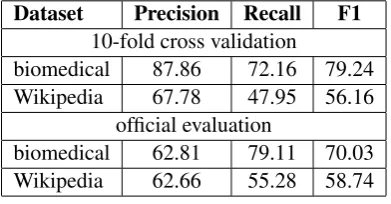
In the first subtask, we carry out the experiments within domain and cross domains. As previously mentioned, we do not use the unlabeled datasets and make no distinction between abstracts and full articles in biomedical dataset. This means we train the models only with the official annotated datasets. The model for cross-domain is trained on the combination of annotated biomedical and Wikipedia datasets.
In this subtask, evaluation is carried out on the sentence level and F-measure of uncertainty sen-tences is employed as the chief metric.
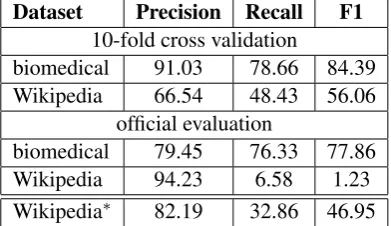
Table 2 shows the results within domain. Af-ter 10-fold cross validation over training dataset, we achieve 84.39% of F1-measure on biomedical while 56.06% on Wikipedia.
We analyzed the low performance of our sub-mission result on Wikipedia. The possible rea-son is our careless work when dealing with the trained model file. Therefore we retrain a model for Wikipedia and the performance is listed on the bottom line (Wikipedia∗) in Table 2.
Dataset Precision Recall F1
10-fold cross validation
biomedical 91.03 78.66 84.39
Wikipedia 66.54 48.43 56.06
official evaluation
biomedical 79.45 76.33 77.86
Wikipedia 94.23 6.58 1.23
Wikipedia∗ 82.19 32.86 46.95
Table 2: Results for in-domain uncertain sentences detection
Figure 4: System architecture of our system
Dataset Precision Recall F1
10-fold cross validation
biomedical 87.86 72.16 79.24
Wikipedia 67.78 47.95 56.16
official evaluation
biomedical 62.81 79.11 70.03
[image:6.595.318.515.263.350.2]Wikipedia 62.66 55.28 58.74
Table 3: Results for across-domain uncertain sen-tences detection
4.3.1 Results analysis
We investigate the weights of internal features and found that the words, which have no uncertainty information, also play the significant roles to pre-dict the uncertainty of the sentence.
Intuitively, the words without uncertainty infor-mation should just have negligible effect and the corresponding features should have low weights. However, this ideal case is difficult to reached by learning algorithm due to the sparsity of data.
In Table 4, we list the top 10 words involved in features with the largest weights for each cate-gory. These words are ranked by the accumulative scores of their related features.
In Table 5, we list the top 10 POS involved in features with the largest weight for each category.
4.4 Hedge cue identification
Hedge cues identification is one module for the second subtask, we also analyze the performance on this module.
Since we treat this problem as a binary classi-fication problem, we evaluate F-measure of hedge cue words. The results are listed in Table 6.
We have to point out that our evaluation is
Dataset Precision Recall F1
10-fold cross validation(word-level)
biomedical 90.15 84.43 87.19
Wikipedia 57.74 39.81 47.13
official evaluation(phrase-level)
[image:6.595.84.280.264.366.2]biomedical 78.7 76.22 77.44
Table 6: Results for in-domain hedge cue identifi-cation
based on word while official evaluation is based on phrase. That means our results would seem to be higher than the official results, especially on Wikipedia dataset because average length of hedge cues in Wikipedia dataset is more than 2 words. 4.4.1 Result Analysis
We classify the results into four categories: false negative, false positive, true positive and true neg-ative. We found that most mistakes are made be-cause of polysemy and collocation.
In Table 7, we list top 10 words for each cate-gory. For the false results, the words are difficult to distinguish without its context in the correspond-ing sentence.
4.5 Scopes recognition
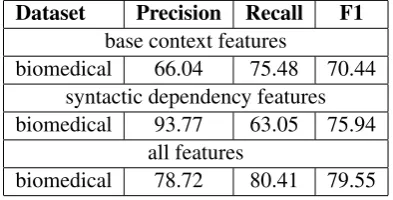
For recognizing the in-sentence scopes, F-measure is also used to evaluate the performance of the word-cue pair classifier. The results using gold hedge cues are shown in Table 8. From the re-sults, F-measure achieves respectively 70.44% and 75.94% when individually using the base context features extracted by 12 predefined patterns (see Figure 1) and syntactic dependency features (see Figure 3), while 79.55% when using all features.
biomedical Wikipedia cross domain
uncertain certain uncertain certain uncertain certain
whether show probably the other suggest show
may demonstrate some often whether used to
suggest will many patients probably was
likely can one of another indicate CFS
indicate role believed days appear demonstrate
possible found possibly CFS putative the other
putative human considered are some of all
appear known to such as any other thought ‘:’
thought report several western possibly people
[image:7.595.123.475.61.233.2]potential evidence said to pop likely could not
Table 4: Top 10 significant words in detecting uncertain sentences
biomedical Wikipedia cross domain
uncertain certain uncertain certain uncertain certain
MD SYM RB VBZ JJS SYM
VBG PRP JJS CD RBS ‘:’
VB NN RBS ‘:’ RB JJR
VBZ CD FW WRB EX WDT
[image:7.595.83.280.406.506.2]IN WDT VBP PRP CC CD
Table 5: Top 5 significant POS in detecting uncertain sentences
Dataset Precision Recall F1
base context features
biomedical 66.04 75.48 70.44
syntactic dependency features
biomedical 93.77 63.05 75.94
all features
biomedical 78.72 80.41 79.55
Table 8: Results for scopes recognizing with gold hedge cues (word-level)
features contribute more benefits to recognize scopes than surface context features.
Official results evaluated at block level are also listed in Table 9.
dataset Precision Recall F1
biomedical 21.87 17.23 19.27
Table 9: Official results for scopes recognizing (block level)
From Table 9 and the official result on hedge cue identification in Table 6, we believe that our post-processing strategy would be responsible for the low performance on recognizing scopes. Our strategy is to find a maximum consecutive block
covering the corresponding hedge cue. This strat-egy cannot do well with the complex scope struc-ture. For example, a scope is covered by another scope. Therefore, our system would generate a block covering all hedge cues if there exists more than one hedge cues in a sentence.
5 Conclusion
We present our implemented system for CoNLL-2010 Shared Task in this paper. We introduce syntactic dependency features when recognizing hedge scopes and employ average perceptron al-gorithm to train the models. On the biomedi-cal corpus, our system achieves F-measure with 77.86% in detecting uncertain sentences, 77.44% in recognizing hedge cues, and 19.27% in identi-fying the scopes.
False Negative False Positive True Positive True Negative
support considered suggesting chemiluminescence
of potential may rhinitis
demonstrate or proposal leukemogenic
a hope might ribosomal
postulate indicates indicating bp
supports expected likely nc82
good can appear intronic/exonic
advocates should possible large
implicated either speculate allele
[image:8.595.136.463.61.219.2]putative idea whether end
Table 7: Top 10 words with the largest scores for each category in hedge cue identification
Acknowledgments
This work was funded by Chinese NSF (Grant No. 60673038), 973 Program (Grant No. 2010CB327906, and Shanghai Committee of Sci-ence and Technology(Grant No. 09511501404).
References
Michael Collins. 2002. Discriminative training meth-ods for hidden markov models: Theory and exper-iments with perceptron algorithms. InProceedings of the ACL-02 conference on Empirical methods in natural language processing, pages 1–8. Associa-tion for ComputaAssocia-tional Linguistics.
Richard O. Duda, Peter E. Hart, and David G. Stork. 2001.Pattern classification. Wiley, New York. Rich´ard Farkas, Veronika Vincze, Gy¨orgy M´ora, J´anos
Csirik, and Gy¨orgy Szarvas. 2010. The CoNLL-2010 Shared Task: Learning to Detect Hedges and their Scope in Natural Language Text. In Proceed-ings of the Fourteenth Conference on Computational Natural Language Learning (CoNLL-2010): Shared Task, pages 1–12, Uppsala, Sweden, July. Associa-tion for ComputaAssocia-tional Linguistics.
Viola Ganter and Michael Strube. 2009. Finding hedges by chasing weasels: hedge detection using Wikipedia tags and shallow linguistic features. In
Proceedings of the ACL-IJCNLP 2009 Conference Short Papers, pages 173–176. Association for Com-putational Linguistics.
Ryan McDonald, Koby Crammer, and Fernando Pereira. 2005. Online large-margin training of de-pendency parsers. InProceedings of the ACL, pages 91–98. Association for Computational Linguistics. Ben Medlock and Ted Briscoe. 2007. Weakly
super-vised learning for hedge classification in scientific literature. InProceedings of the 45th Annual Meet-ing of the Association of Computational LMeet-inguistics, pages 992–999. Association for Computational Lin-guistics.
Ben Medlock. 2008. Exploring hedge identification in biomedical literature. Journal of Biomedical Infor-matics, 41(4):636–654.
Roser Morante and Walter Daelemans. 2009. Learning the scope of hedge cues in biomedical texts. In Pro-ceedings of the Workshop on BioNLP, pages 28–36. Association for Computational Linguistics.
Gy¨orgy Szarvas, Veronika Vincze, Rich´ard Farkas, and J´anos Csirik. 2008. The BioScope corpus: anno-tation for negation, uncertainty and their scope in biomedical texts. In Proceedings of the Workshop on Current Trends in Biomedical Natural Language Processing, pages 38–45. Association for Computa-tional Linguistics.