7
T
RANX: A Transition-based Neural Abstract Syntax Parser for Semantic
Parsing and Code Generation
Pengcheng Yin, Graham Neubig Language Technologies Institute
Carnegie Mellon University
{pcyin,gneubig}@cs.cmu.edu
Abstract
We present TRANX, a transition-based neu-ral semantic parser that maps natuneu-ral language (NL) utterances into formal meaning repre-sentations (MRs). TRANX uses a transition system based on theabstract syntax descrip-tion languagefor the target MR, which gives it two major advantages: (1) it is highly ac-curate, using information from the syntax of the target MR to constrain the output space and model the information flow, and (2) it is highly generalizable, and can easily be applied to new types of MR by just writing a new ab-stract syntax description corresponding to the allowable structures in the MR. Experiments on four different semantic parsing and code generation tasks show that our system is gen-eralizable, extensible, and effective, register-ing strong results compared to existregister-ing neural semantic parsers.1
1 Introduction
Semantic parsing is the task of transducing nat-ural language (NL) utterances into formal mean-ing representations (MRs). The target MRs can be defined according to a wide variety of for-malisms. This include linguistically-motivated se-mantic representations that are designed to cap-ture the meaning of any sentence such as λ -calculus (Zettlemoyer and Collins, 2005) or the abstract meaning representations (Banarescu et al.,
2013). Alternatively, for more task-driven ap-proaches to semantic parsing, it is common for meaning representations to represent executable programs such as SQL queries (Zhong et al.,
2017), robotic commands (Artzi and Zettlemoyer,
2013), smart phone instructions (Quirk et al.,
2015), and even general-purpose programming languages like Python (Yin and Neubig,2017; Ra-binovich et al.,2017) and Java (Ling et al.,2016).
1Available athttps://github.com/pcyin/tranX. An
earilier version is used inYin et al.(2018).
Because of these varying formalisms for MRs, the design of semantic parsers, particularly neu-ral network-based ones has geneneu-rally focused on a small subset of tasks — in order to ensure the syntactic well-formedness of generated MRs, a parser is usually specifically designed to reflect the domain-dependent grammar of MRs in the structure of the model (Zhong et al., 2017; Xu et al., 2017). To alleviate this issue, there have been recent efforts in neural semantic parsing with general-purpose grammar models (Xiao et al.,
2016;Dong and Lapata,2018). Yin and Neubig
(2017) put forward a neural sequence-to-sequence model that generates tree-structured MRs using a series of tree-construction actions, guided by the task-specific context free grammar provided to the model a priori. Rabinovich et al. (2017) pro-pose the abstract syntax networks (ASNs), where domain-specific MRs are represented by abstract syntax trees (ASTs, Fig. 2 Left) specified under the abstract syntax description language (ASDL) framework (Wang et al.,1997). An ASN employs a modular architecture, generating an AST us-ing specifically designed neural networks for each construct in the ASDL grammar.
Inspired by this existing research, we have de-veloped TRANX, a TRANsition-based abstract syntaXparser for semantic parsing and code gen-eration. TRANX is designed with the following principles in mind:
• Generalization abilityTRANXemploys ASTs
as a general-purpose intermediate meaning rep-resentation, and the task-dependent grammar is provided to the system as external knowledge to guide the parsing process, therefore decoupling the semantic parsing procedure with specifici-ties of grammars.
• Extensibility TRANX uses a simple
tree-pandas read top 100 lines in file.csv
ApplyConstr(Expr)
ApplyConstr(Call)
ApplyConstr(Attr.) stmt Expr(expr value)
expr Call(expr func, expr* args,
ASDL Grammar Transition System
. . . s1
s2 s3 s4 s5
GenToken(sorted)
Expr
Call
Attr.
pandas
Name
file.csv Keyword
Abstract Syntax Tree
. . .
pandas.read_csv( keyword* keywords)
Attribute(expr value,
↦ ↦
Name(identifier id)
| |
Meaning Representation
AST_to_MR( )
Input Utterance
(to domain-specific MR) (general-purpose intermediate MR)
(actions to construct AST)
read_csv identifier attr)
Str(string s)
|
[image:2.595.75.526.62.164.2]file.csv, nrows=100)
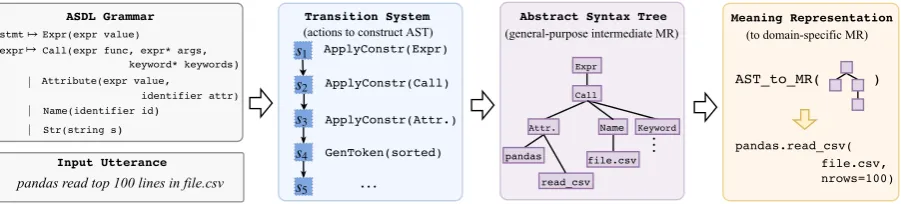
Figure 1: Workflow of TRANX
structured ASTs. The transition system is de-signed to be easy to extend, requiring minimal engineering to adapt to tasks that need to handle extra domain-specific information.
• EffectivenessWe test TRANX on four
seman-tic parsing (ATIS, GEO) and code generation (DJANGO, WIKISQL) tasks, and demonstrate that TRANX is capable of generalizing to dif-ferent domains while registering strong perfor-mance, out-performing existing neural network-based approaches on three of the four datasets (GEO, ATIS, DJANGO).
2 Methodology
Given an NL utterance, TRANXparses the utter-ance into a formal meaning representation, typ-ically represented as λ-calculus logical forms, domain-specific, or general-purpose programming languages (e.g., Python). In the following descrip-tion we use Python code generadescrip-tion as a running example, where a programmer’s natural language intents are mapped to Python source code. Fig. 1
depicts the workflow of TRANX. We will present more use cases of TRANXin§3.
The core of TRANX is a transition system. Given an input NL utterance x, TRANX
em-ploys the transition system to map the utter-ance x into an AST z using a series of tree-construction actions (§ 2.2). TRANX employs
ASTs as the intermediate meaning representa-tion to abstract over domain-specific structure of MRs. This parsing process is guided by the user-defined, domain-specific grammar specified under the ASDL formalism (§ 2.1). Given the gener-ated ASTz, the parser calls the user-defined func-tion, AST to MR(·), to convert the intermediate AST into a domain-specific meaning representa-tion y, completing the parsing process. TRANX
uses a probabilistic modelp(z|x), parameterized by a neural network, to score each hypothesis AST (§2.3).
2.1 Modeling ASTs using ASDL Grammar
TRANXuses ASTs as the general-purpose, inter-mediate semantic representation for MRs. ASTs are commonly used to represent programming lan-guages, and can also be used to represent other tree-structured MRs (e.g.,λ-calculus). The ASDL framework is a grammatical formalism to define ASTs. See Fig. 1 for an excerpt of the Python ASDL grammar. TRANX provides APIs to read such a grammar from human-readable text files.
An ASDL grammar has two basic constructs:
typesand constructors. Acomposite type is de-fined by the set of constructors under that type. For example, thestmtandexprcomposite types in Fig. 1 refer to Python statements and expres-sions, repectively, each defined by a series of structors. A constructor specifies a language con-struct of a particular type using itsfields. For in-stance, the Call constructor under the compos-ite type expr denotes function call expressions, and has three fields: func, args andkeywords. Each field in a constructor is also strongly typed, which specifies the type of value the field can hold. A field with a composite type can be instan-tiated by constructors of the same type. For exam-ple, the func field above can hold a constructor of type expr. There are also fields with primi-tivetypes, which store values. For example, the idfield of Name constructor has a primitive type identifier, and is used to store identifier names. And the fieldsin theStr(string) constructor hold string literals. Finally, each field has a cardinality (single, optional?and sequential∗), denoting the number of values the field holds.
car-Expr
Call
Attribute
Name read_csv
value f1
Str
file.csv
keyword
nrows Num
100
func f2
f5value
pandas
f6attr
id f7
args f3
s f8
keywords f4
args
f9 f10value
n f11 t1
t2
t3
t4
t5
t6
t7
t8 t10
t9
t11
t12
t nft Action
t1 root Expr(expr value)
t2 f1 Call(expr func, expr* args,
keyword* keywords) t3 f2 Attribute(expr value, identifier attr)
t4 f5 Name(identifier id)
t5 f7 GENTOKEN[pandas]
t6 f6 GENTOKEN[read csv]
t7 f3 Str(string s)
t8 f8 GENTOKEN[file.csv]
t9 f8 GENTOKEN[</f>]
t10 f3 REDUCE(close the frontier fieldf3)
t11 f4 keyword(identifier arg, expr value)
t12 f9 GENTOKEN[nrows]
t13 f10 Num(object n)
t14 f11 GENTOKEN[1000]
[image:3.595.76.514.59.214.2]t15 f4 REDUCE(close the frontier fieldf4)
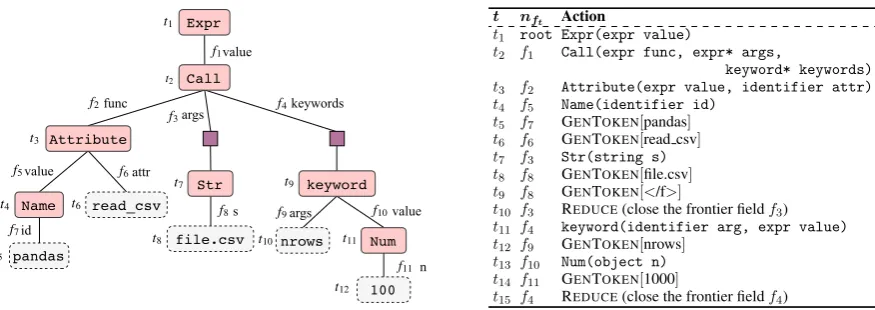
Figure 2:LeftThe ASDL AST for the target Python code inFig. 1. Field names are labeled on upper arcs, and indexed asfi.
Purple squares denote fields withsequentialcardinality. Grey nodes denote primitive identifier fields. Fields are labeled with time steps at which they are generated. RightThe action sequence used to construct the AST. Each action is labeled with its frontier fieldnft. APPLYCONSTRactions are represented by their constructors.
dinality in the ASDL grammar in Fig. 1 is in-stantiated with one Name constructor, while the args field with sequential cardinality have mul-tiple child constructors.
2.2 Transition System
Inspired by Yin and Neubig (2017) (hereafter YN17), we develop a transition system that de-composes the generation procedure of an AST into a sequence of tree-constructingactions. We now explain the transition system using our running ex-ample. Fig. 2Right lists the sequence of actions used to construct the example AST. In high level, the generation process starts from an initial deriva-tion AST with a single root node, and proceeds ac-cording to a top-down, left-to-right order traversal of the AST. At each time step, one of the follow-ing three types of actions is evoked to expand the openingfrontier fieldnft of the derivation:
APPLYCONSTR[c]actions apply a constructor
cto the opening composite frontier field which has the same type asc, populating the opening node using the fields in c. If the frontier field has se-quential cardinality, the action appends the con-structor to the list of concon-structors held by the field.
REDUCE actions mark the completion of the
generation of child values for a field with optional (?) or multiple (∗) cardinalities.
GENTOKEN[v] actions populate a (empty) primitive frontier field with a tokenv. For exam-ple, the field f7 on Fig. 2 has typeidentifier,
and is instantiated using a single GENTOKEN ac-tion. For fields of string type, like f8, whose
value could consists of multiple tokens (only one shown here), it can be filled using a se-quence of GENTOKEN actions, with a special
GENTOKEN[</f>]action to terminate the genera-tion of token values.
The generation completes once there is no fron-tier field on the derivation. TRANX then calls the user specified functionAST to MR(·)to con-vert the generated intermediate AST z into the target domain-specific MR y. TRANX provides various helper functions to ease the process of writing conversion functions. For example, our example conversion function to transform ASTs into Python source code contains only 32 lines of code. TRANXalso ships with several built-in
con-version functions to handle MRs commonly used in semantic parsing and code generation, likeλ -calculus logical forms and SQL queries.
2.3 Computing Action Probabilitiesp(z|x)
Given the transition system, the probability of an
z is decomposed into the probabilities of the se-quence of actions used to generatez
p(z|x) =Y
t
p(at|a<t,x),
Following YN17, we parameterize the transition-based parser p(z|x) using a neural encoder-decoder network with augmented recurrent con-nections to reflect the topology of ASTs.
Encoder The encoder is a standard
bidirec-tional Long Short-term Memory (LSTM) network, which encodes the input utterancexofntokens, {xi}ni=1into vectorial representations{h}ni=1.
Decoder The decoder is also an LSTM network,
with its hidden statestat each time temp given by
st=fLSTM([at−1 :˜st−1:pt],st−1),
em-expr
= Variable(var variable)
| Entity(ent entity)
| Number(num number)
| Apply(pred predicate, expr∗ arguments)
| Argmax(var variable, expr domain, expr body)
| Argmin(var variable, expr domain, expr body)
| Count(var variable, expr body)
| Exists(var variable, expr body)
| Lambda(var variable, var type type, expr body)
| Max(var variable, expr body)
| Min(var variable, expr body)
| Sum(var variable, expr domain, expr body)
| The(var variable, expr body)
| Not(expr argument)
| And(expr∗ arguments)
| Or(expr∗ arguments)
| Compare(cmp op op, expr left, expr right)
[image:4.595.74.294.72.246.2]cmp op = Equal | LessThan | GreaterThan
Figure 3: The λ-calculus ASDL grammar for GEO and ATIS, defined inRabinovich et al.(2017)
bedding of the previous action. We maintain an embedding vector for each action. ˜stis the atten-tional vector defined as inLuong et al.(2015)
˜st= tanh(Wc[ct:st]).
wherectis the context vector retrieved from input encodings{hi}ni=1using attention.
Parent Feeding pt is a vector that encodes the
information of the parent frontier fieldnft on the
derivation, which is a concatenation of two vec-tors: the embedding of the frontier fieldnft, and
spt, the decoder’s state at which the constructor
of nft is generated by the APPLYCONSTR
ac-tion. Parent feeding reflects the topology of tree-structured ASTs, and gives better performance on generating complex MRs like Python code (§3).
Action Probabilities The probability of an AP
-PLYCONSTR[c]action with embeddingacis2
p(at=APPLYCONSTR[c]|a<t,x)
=softmax(a|cW˜st) (1)
For GENTOKEN actions, we employ a hybrid
approach of generation and copying, allowing for out-of-vocabulary variable names and literals (e.g., “file.csv” inFig. 1) inxto be directly copied to the derivation. Specifically, the action probabil-ity is defined to be the marginal probabilprobabil-ity
p(at=GENTOKEN[v]|a<t,x)
=p(gen|at,x)p(v|gen, at,x)+
p(copy|at,x)p(v|copy, at,x)
2R
EDUCEis treated as a special APPLYCONSTRaction.
stmt = Select(agg op? agg, idx column idx,
cond expr∗ conditions)
cond expr = Condition(cmp op op, idx column idx, string value)
agg op = Max | Min | Count | Sum | Avg
cmp op = Equal | GreaterThan | LessThan | Other
Figure 4: The ASDL grammar for WIKISQL
The binary probability p(gen|·) and p(copy|·) is given by softmax(W˜st). The probability of gen-eratingvfrom a closed-set vocabulary,p(v|gen,·)
is defined similarly asEq. (1). The copy probabil-ity of copying thei-th word inxis defined using a pointer network (Vinyals et al.,2015)
p(xi|copy, a<t,x) =softmax(h|iW˜st).
3 Experiments
3.1 Datasets
To demonstrate the generalization and extensibil-ity of TRANX, we deploy our parser on four se-mantic parsing and code generation tasks.
3.1.1 Semantic Parsing
We evaluate on GEO and ATIS datasets. GEO
is a collection of 880 U.S. geographical ques-tions (e.g., “Which states border Texas?”), and ATIS is a set of 5,410 inquiries of flight in-formation (e.g., “Show me flights from Dal-las to Baltimore”). The MRs in the two datasets are defined in λ-calculus logical forms (e.g., “lambda x (and (state x) (next to
x texas))” and “lambda x (and (flight x
dallas) (to x baltimore))”). We use the pre-processed datasets released byDong and La-pata(2016). We use the ASDL grammar defined inRabinovich et al.(2017), as listed inFig. 3.
3.1.2 Code Generation
We evaluate TRANX on both general-purpose
(Python, DJANGO) and domain-specific (SQL, WIKISQL) code generation tasks. The DJANGO
dataset (Oda et al.,2015) consists of 18,805 lines of Python source code extracted from the Django Web framework, with each line paired with an NL description. Code in this dataset covers various real-world use cases of Python, like string manip-ulation, I/O operation, exception handling,etc.
Methods GEO ATIS
ZH15 (Zhao and Huang,2015) 88.9 84.2 ZC07 (Zettlemoyer and Collins,2007) 89.0 84.6 WKZ14 (Wang et al.,2014) 90.4 91.3 Neural Network-based Models
[image:5.595.307.527.60.243.2]SEQ2TREE(Dong and Lapata,2016) 87.1 84.6 ASN (Rabinovich et al.,2017) 85.7 85.3 + supervised attention 87.1 85.9 TRANX(w/o parent feeding) 88.2 86.2 TRANX(w/ parent feeding) 87.7 86.2
Table 1: Semantic parsing accuracies on GEOand ATIS
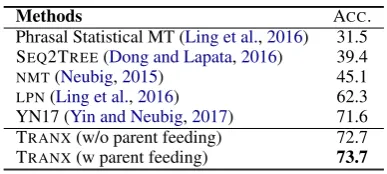
Methods ACC.
Phrasal Statistical MT (Ling et al.,2016) 31.5 SEQ2TREE(Dong and Lapata,2016) 39.4
NMT(Neubig,2015) 45.1
LPN(Ling et al.,2016) 62.3 YN17 (Yin and Neubig,2017) 71.6 TRANX(w/o parent feeding) 72.7
[image:5.595.74.288.61.167.2]TRANX(w parent feeding) 73.7
Table 2: Code generation accuracies on DJANGO
Player = Calvin Mccarty”). Different from other datasets, each example also has a table tracted from Wikipedia, and the SQL query is ex-ecuted against the table to get an answer.
Extending TRANX for WIKISQL In order to
achieve strong results, existing parsers, like most models in Tab. 3, use specifically designed ar-chitectures to reflect the syntactic structure of SQL queries. We show that the transition sys-tem used by TRANX can be easily extended for WIKISQL with minimal engineering, while reg-istering strong performance. First, we use de-fine a simple ASDL grammar following the syn-tax of SQL (Fig. 4). We then augment the tran-sition system with a special GENTOKEN action, SELCOLUMN[k]. A SELCOLUMN[k] action is used to populate a primitive column idxfield in SelectandConditionconstructors in the gram-mar by selecting thek-th column in the table. To compute the probability of SELCOLUMN[k] ac-tions, we use a pointer network over column en-codings, where the column encodings are given by a bidirectional LSTM network over column names in an input table. This can be simply implemented by overriding the base Parser class in TRANX
and modifying the functions that compute action probabilities.
3.2 Results
In this section we discuss our experimental results. All results are averaged over three runs with differ-ent random seeds.
Semantic Parsing Tab. 1 lists the results for
semantic parsing tasks. We test TRANX with
Methods ACCEM ACCEX
Seq2Seq (Zhong et al.,2017) 23.4 35.9 SEQ2TREE(Dong and Lapata,2016) 23.4 35.9 Seq2SQL (Zhong et al.,2017) 48.3 59.4
SQLNet (Xu et al.,2017) – 68.0
PT-MAML (Huang et al.,2018) 62.8 68.0
TypeSQL (Yu et al.,2018) – 73.5
TRANX
w/ parent feeding 62.6 71.6
w/o parent feeding 62.9 71.7
PointSQL (Wang et al.,2017)† 61.5 66.8 TypeSQL+TC (Yu et al.,2018)† – 82.6 STAMP (Sun et al.,2018)† 60.7 74.4 STAMP+RL (Sun et al.,2018)† 61.0 74.6 TRANX
[image:5.595.84.278.189.276.2]w par. feed. + answer pruning† 68.4 78.6 w/o par. feed. + answer pruning† 68.6 78.6
Table 3: Exact match (EM) and execution (EX) accuracies on WIKISQL.†Methods that use the contents of input tables.
two configurations, with or without parent feed-ing (§2.3). Our system outperforms existing neu-ral network-based approaches. This demonstrates the effectiveness of TRANXin closed-domain se-mantic parsing. Interestingly, we found the model without parent feeding achieves slightly better ac-curacy on GEO, probably because that its relative simple grammar does not require extra handling of parent information.
Code Generation Tab. 2 lists the results on
DJANGO. TRANXachieves state-of-the-art results on DJANGO. We also find parent feeding yields +1 point gain in accuracy, suggesting the impor-tance of modeling parental connections in ASTs with complex domain grammars (e.g., Python).
Tab. 3shows the results on WIKISQL. We first discuss our standard model which only uses infor-mation of column names and do not use the con-tents of input tables during inference, as listed in the top two blocks inTab. 3. We find TRANX,
al-though just with simple extensions to adapt to this dataset, achieves impressive results and outper-forms many task-specific methods. This demon-strates that TRANX is easy to extend to incorpo-rate task-specific information, while maintaining its effectiveness. We also extend TRANX with a
de-signed, heavily-engineered neural networks to in-corporate information of table contents.
4 Conclusion
We present TRANX, a transition-based abstract syntax parser. TRANXis generalizable, extensible and effective, achieving strong results on semantic parsing and code generation tasks.
Acknowledgements
This material is based upon work supported by the National Science Foundation under Grant No. 1815287.
References
Yoav Artzi and Luke Zettlemoyer. 2013. Weakly su-pervised learning of semantic parsers for mapping instructions to actions. Transaction of ACL.
Laura Banarescu, Claire Bonial, Shu Cai, Madalina Georgescu, Kira Griffitt, Ulf Hermjakob, Kevin Knight, Philipp Koehn, Martha Palmer, and Nathan Schneider. 2013. Abstract meaning representation for sembanking. InProceedings of LAW-ID@ACL.
Li Dong and Mirella Lapata. 2016. Language to logical form with neural attention. InProceedings of ACL.
Li Dong and Mirella Lapata. 2018. Coarse-to-fine de-coding for neural semantic parsing. InProceedings of ACL.
Po-Sen Huang, Chenglong Wang, Rishabh Singh, Wen tau Yih, and Xiaodong He. 2018. Natural language to structured query generation via meta-learning. In
Proceedings of NAACL-HLT.
Wang Ling, Phil Blunsom, Edward Grefenstette, Karl Moritz Hermann, Tom´as Kocisk´y, Fumin Wang, and Andrew Senior. 2016. Latent predictor networks for code generation. In Proceedings of ACL.
Thang Luong, Hieu Pham, and Christopher D. Man-ning. 2015. Effective approaches to attention-based neural machine translation. In Proceedings of EMNLP.
Graham Neubig. 2015. lamtram: A toolkit for lan-guage and translation modeling using neural net-works. http://www.github.com/neubig/lamtram.
Yusuke Oda, Hiroyuki Fudaba, Graham Neubig, Hideaki Hata, Sakriani Sakti, Tomoki Toda, and Satoshi Nakamura. 2015. Learning to generate pseudo-code from source code using statistical ma-chine translation (T). InProceedings of ASE.
Chris Quirk, Raymond J. Mooney, and Michel Galley. 2015. Language to code: Learning semantic parsers for if-this-then-that recipes. InProceedings of ACL.
Maxim Rabinovich, Mitchell Stern, and Dan Klein. 2017. Abstract syntax networks for code generation and semantic parsing. InProceedings of ACL.
Yibo Sun, Duyu Tang, Nan Duan, Jianshu Ji, Gui-hong Cao, Xiaocheng Feng, Bing Qin, Ting Liu, and Ming Zhou. 2018. Semantic parsing with syntax- and table-aware SQL generation. CoRR, abs/1804.08338.
Oriol Vinyals, Meire Fortunato, and Navdeep Jaitly. 2015. Pointer networks. InProceedings of NIPS.
Adrienne Wang, Tom Kwiatkowski, and Luke Zettle-moyer. 2014. Morpho-syntactic lexical generaliza-tion for CCG semantic parsing. In Proceedings of
EMNLP.
Chenglong Wang, Marc Brockschmidt, and Rishabh Singh. 2017. Pointing out SQL queries from text. Technical report.
Daniel C. Wang, Andrew W. Appel, Jeffrey L. Korn, and Christopher S. Serra. 1997. The Zephyr ab-stract syntax description language. InProceedings of DSL.
Chunyang Xiao, Marc Dymetman, and Claire Gardent. 2016. Sequence-based structured prediction for se-mantic parsing. InProceedings of ACL.
Xiaojun Xu, Chang Liu, and Dawn Song. 2017. SQL-Net: Generating structured queries from natural language without reinforcement learning. arXiv preprint arXiv:1711.04436.
Pengcheng Yin and Graham Neubig. 2017. A syntactic neural model for general-purpose code generation. InProceedings of ACL.
Pengcheng Yin, Chunting Zhou, Junxian He, and Gra-ham Neubig. 2018. StructVAE: Tree-structured la-tent variable models for semi-supervised semantic parsing. InProceedings of ACL.
Tao Yu, Zifan Li, Zilin Zhang, Rui Zhang, and Dragomir R. Radev. 2018. TypeSQL: Knowledge-based type-aware neural text-to-sql generation.
Luke Zettlemoyer and Michael Collins. 2005. Learn-ing to map sentences to logical form structured clas-sification with probabilistic categorial grammars. In
Proceedings of UAI.
Luke S. Zettlemoyer and Michael Collins. 2007. On-line learning of relaxed CCG grammars for parsing to logical form. InProceedings of EMNLP-CoNLL.
Kai Zhao and Liang Huang. 2015. Type-driven in-cremental semantic parsing with polymorphism. In
Proceedings of NAACL-HLT.
Victor Zhong, Caiming Xiong, and Richard Socher. 2017. Seq2SQL: Generating structured queries from natural language using reinforcement learning.