139
OpenKE: An Open Toolkit for Knowledge Embedding
Xu Han1,2,3∗ Shulin Cao2,3,4,5∗ Xin Lv1,4 Yankai Lin1,2,3 Zhiyuan Liu1,2,3† Maosong Sun1,2,3 Juanzi Li1,4
1Department of Computer Science and Technology, Tsinghua University, Beijing, China 2Institute for Artificial Intelligence, Tsinghua University, Beijing, China
3State Key Lab on Intelligent Technology and Systems, Tsinghua University, Beijing, China 4Knowledge Engineering Laboratory, Tsinghua University, Beijing, China
5College of Information Science and Technology, Beijing Normal University, Beijing, China
Abstract
We release an open toolkit for knowledge em-bedding (OpenKE), which provides a unified framework and various fundamental models to embed knowledge graphs into a continu-ous low-dimensional space. OpenKE prior-itizes operational efficiency to support quick model validation and large-scale knowledge representation learning. Meanwhile, OpenKE maintains sufficient modularity and extensibil-ity to easily incorporate new models into the framework. Besides the toolkit, the embed-dings of some existing large-scale knowledge graphs pre-trained by OpenKE are also avail-able, which can be directly applied for many applications including information retrieval, personalized recommendation and question answering. The toolkit, documentation, and pre-trained embeddings are all released on
http://openke.thunlp.org/.
1 Introduction
People construct various large-scale knowledge graphs (KGs) to organize structured knowledge about the world, such as WordNet (Miller,1995), Freebase (Bollacker et al., 2008) and Wikidata
(Vrandeˇci´c and Kr¨otzsch, 2014). Most KGs are
typically organized in the form of triples (h, r, t), with h andtindicating head andtailentities, andrindicating the relation betweenhandt, e.g., (Mark Twain,PlaceOfBirth,Florida). Abun-dant structured information in KGs is widely used to enhance various knowledge-driven NLP appli-cations (e.g., information retrieval, question an-swering and dialogue system) with the ongoing ef-fective construction of KGs.
Limited by the scale and sparsity of KGs, we have to represent KGs with corresponding dis-tributed representations. Therefore, a variety of
∗
indicates equal contribution
†
Corresponding author: Z.Liu([email protected])
knowledge embedding (KE) approaches have been proposed to embed both entities and relations in KGs into a continuous low-dimensional space, such as linear models (Bordes et al.,2011,2012,
2014), latent factor models (Sutskever et al.,2009;
Jenatton et al.,2012;Yang et al.,2015;Liu et al.,
2017), neural models (Socher et al., 2013;Dong
et al.,2014), matrix factorization models (Nickel
et al., 2011, 2012, 2016;Trouillon et al., 2016),
and translation models (Bordes et al.,2013;Wang
et al.,2014;Lin et al.,2015;Ji et al.,2015).
These models have achieved great performance on benchmark datasets. However, there exist two main issues which may lead to difficulty in full utilization and further development. On the one hand, the existing implementations are scattered and unsystematic to some extent. For example, the interfaces of these model implementations are inconsistent with each other. On the other hand, these model implementations mainly focus on model validation and are often time-consuming, which makes it difficult to apply them for real-world applications. Hence, it becomes urgent to develop an efficient and effective open toolkit for KE, which will definitely benefit both the commu-nities in academia and industry. For this purpose, we develop an open KE toolkit named “OpenKE“. The toolkit provides a flexible framework and uni-fied interfaces for developing KE models. While taking in some training and computing optimiza-tion methods, OpenKE makes KE models efficient and capable of embedding large-scale KGs. The features of OpenKE are threefold:
(1) At the data and memory level, the unified framework of OpenKE manages data and mem-ory for KE models. Model developments based on OpenKE no longer require complicated data pro-cessing and memory allocation.
Model Scoring Function Parameters Loss Function
RESCAL (Nickel et al.,2011) h>M
rt Mr∈Rk×k,h∈Rk,t∈Rk margin-based loss
TransE (Bordes et al.,2013) −kh+r−tkL1/L2 r∈R
k,h∈
Rk,t∈Rk margin-based loss
TransH (Wang et al.,2014) −k(h−w>
rhwr) +r−(t−w>rtwr)kL1/L2 wr∈Rk,r∈Rk,h∈Rk,t∈Rk margin-based loss TransR (Lin et al.,2015) −kMrh+r−MrtkL1/L2 Mr∈R
kr×ke,r∈
Rkr,h∈Rke,t∈Rke margin-based loss
TransD (Ji et al.,2015) −k(rph>p+I)h+r−(rpt>p+I)tkL1/L2
rp∈Rkr,hp∈Rke,tp∈Rke,I∈Rkr×ke,
r∈Rkr,h∈Rke,t∈Rke margin-based loss
DistMult (Yang et al.,2015) <h,r,t> r∈Rk,h∈Rk,t∈Rk logistic loss
HolE (Nickel et al.,2016) r>
F−1F(h) F(t)
r∈Rk,h∈Rk,t∈Rk logistic loss
ComplEx (Trouillon et al.,2016) <(<h,r,t>) r∈Ck,h∈Ck,t∈Ck logistic loss
Table 1: The brief introduction of some typical KE models. For most models,kis the dimension of both
entities and relations. For some other models,Keis the dimension of entities andkris the dimension of relations.F denotes the Fourier transform.denotes the element-wise product. < a, b, c >denotes the element-wise multi-linear dot product.
implement them under the unified framework. We also propose a novel negative sampling strategy for further acceleration.
(3) At the computation level, OpenKE can sep-arate a large-scale KG into several parts and adapt KE models for parallel training. Based on the underlying management of data and memory, we also adopt TensorFlow (Abadi et al.,2016) and Py-Torch (Paszke et al., 2017) to build a convenient platform to run models on GPUs.
Besides the toolkit, we also provide the pre-trained embeddings of several well-known large-scale KGs, which can be used directly for other relevant works without repeatedly spending much time for embedding KGs. In this paper, we mainly present the architecture design and implementa-tion of OpenKE, as well as the benchmark eval-uation results of some typical KE models im-plemented with OpenKE. Other related resources and details can be found onhttp://openke.
thunlp.org/.
2 Background
For a typical KGG, it expresses data as a directed graphG ={E,R,T }, whereE,RandT indicate the sets of entities, relations and facts respectively. Each triple (h, r, t) ∈ T indicates there is a re-lationr ∈ Rbetweenh ∈ E andt ∈ E. For the entitiesh, t∈ Eand the relationr ∈ R, we use the bold faceh,t,rto indicate their low-dimensional vectors respectively.
For any entity pair(h, t) ∈E×E and any re-lationr ∈ R, we can determine whether there is a fact(h, r, t)∈ T via their low-dimensional em-beddings learned by KE models. These embed-dings greatly facilitate understanding and mining knowledge in KGs. In practice, the KE models
define a scoring functionS(h, r, t)for each triple
(h, r, t). In most cases, there are only true triples in KGs and non-existing triples can be either false or missing. Local closed world assumption (Dong
et al.,2014) has been proposed to solve this
prob-lem, which requires existing triples to have higher scores than those non-existing ones. Hence, the scoring functionS(h, r, t) returns a higher score if(h, r, t)is true, vice versa.
Based on the above-mentioned scoring func-tions, some KE models formalize a margin-based loss as the training objective to learn embeddings of the entities and relations:
L=X
t∈T X
t0∈T0
γ+S(t0)−S(t)
+. (1)
Here[x]+indicates keeping the positive part ofx andγ >0is a margin. T0 denotes the set of non-existing triples, which is constructed by corrupting entities and relations in existing triples,
T0=E × R × E − T. (2)
Some other KE models cast the training objec-tive as a classification task. The embeddings of the entities and relations can be learned by minimizing the regularized logistic loss,
L=X
t∈T
log(1 + exp(−S(t))) + X t0∈T0
log(1 + exp(S(t0))).
(3)
3 Design Goals
Before introducing the concrete toolkit implemen-tations, we report the design goals and features of OpenKE, including system encapsulation, opera-tional efficiency, and model extensibility.
3.1 Encapsulation
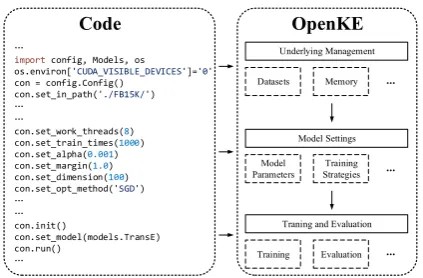
Developers tend to maximize the reuse of code to avoid unnecessary redundant development in prac-tice. For KE, its task is fixed, and its experimen-tal settings and model parameters are also sim-ilar. However, previous model implementations are scattered and lack of necessary interface en-capsulation. Thus, developers have to spend extra time reading obscure open-source code and writ-ing glue code for data processwrit-ing when they con-struct models. In view of this issue, we build a uni-fied underlying platform in OpenKE and encap-sulate various data and memory processing which is independent of model implementations. As is shown in Figure 1, the system encapsulation makes it easy to train and test KE models. Thus, we just need to set hyperparameters via interfaces of the platform to construct KE models.
3.2 Efficiency
Previous model implementations focus on model validation and enhancing experimental results rather than improving time and space efficiency. In fact, as real-world KGs can be very large, train-ing efficiency is an important concern. Hence, OpenKE integrates efficient computing power, training methods, and various acceleration strate-gies to support KE models. We adopt TensorFlow and PyTorch to implement the model training and test modules based on the interfaces of underly-ing platform. These machine learnunderly-ing frameworks enable models to be run on GPU, with just few minutes needed for training and testing models on benchmark datasets. In order to train existing large-scale KGs, we also implement lightweight C/C++ versions for quick deployment and multi-threading acceleration of KE models, in which some models (e.g. TransE) can embed more than
100Mtriples in a few hours on ordinary devices.
3.3 Extensibility
Since different KE models have different design solutions, we make OpenKE fully extensible to future variants. For the underlying platform, we encapsulate data processing and memory
manage-import config, Models, os
os.environ['CUDA_VISIBLE_DEVICES']='0'
con = config.Config() con.set_in_path('./FB15K/')
con.set_work_threads(8) con.set_train_times(1000) con.set_alpha(0.001) con.set_margin(1.0) con.set_dimension(100) con.set_opt_method('SGD')
con.init()
con.set_model(models.TransE) con.run()
Datasets Memory Underlying Management
Model
Parameters StrategiesTraining Model Settings
Training Evaluation Traning and Evaluation
[image:3.595.311.523.59.198.2]Code OpenKE
Figure 1: An example for training a KE model
(TransE) via OpenKE.
import numpy as np
import tensorflow as tf
from Model import * class TransE(Model):
def _calc(self, h, t, r):
return abs(h + r - t)
def embedding_def(self): config = self.get_config()
self.ent_embeddings = tf.get_variable('ent_embeddings', [config.entTotal, config.hidden_size])
self.rel_embeddings = tf.get_variable('rel_embeddings', [config.relTotal, config.hidden_size]) ...
def loss_def(self): config = self.get_config()
pos_h, pos_t, pos_r = self.get_positive_instance(in_batch = True) neg_h, neg_t, neg_r = self.get_negative_instance(in_batch= True) p_h = tf.nn.embedding_lookup(self.ent_embeddings, pos_h) p_t = tf.nn.embedding_lookup(self.ent_embeddings, pos_t) p_r = tf.nn.embedding_lookup(self.rel_embeddings, pos_r) n_h = tf.nn.embedding_lookup(self.ent_embeddings, neg_h) n_t = tf.nn.embedding_lookup(self.ent_embeddings, neg_t) n_r = tf.nn.embedding_lookup(self.rel_embeddings, neg_r) _p_score = self._calc(p_h, p_t, p_r)
_n_score = self._calc(n_h, n_t, n_r)
p_score = tf.reduce_sum(tf.reduce_mean(_p_score, 1, keep_dims= False),
1, keep_dims= True) n_score = tf.reduce_sum(tf.reduce_mean(_n_score, 1, keep_dims= False),
1, keep_dims= True)
self.loss = tf.reduce_sum(tf.maximum(p_score - n_score + config.margin, 0)) ...
Embeddings Model
DistMult TransE
[image:3.595.314.521.243.380.2]Loss DistMult
Figure 2: An example for implementing a KE
model (TransE) via OpenKE.
ment, and then provide various data sampling in-terfaces. For the training modules, we provide enough interfaces for possible training methods. For the construction of KE models, we unify their mathematical forms and encapsulate them into a base class. These framework designs can greatly meet the needs of current and future models, and customized interfaces to meet individual require-ments are also available in OpenKE. As shown in Figure2, all specific models are implemented by inheriting the base class with designing their own scoring functions and loss functions. In addition, models in OpenKE can be placed into the frame-work of TensorFlow and PyTorch to interact with other machine learning models.
4 Implementations
In this section, we mainly present the implemen-tations of acceleration modules and special sam-pling algorithm in OpenKE. OpenKE has been available to the public on GitHub 1 and is open-source under the MIT license.
Algorithm 1Parallel Learning
Require: Entity and relation setsE andR, training triples
T ={(h, r, t)}.
1: Initializeall model embeddings and parameters.
2: fori←1toepochesdo
3: In each thread:
4: forj←1tobatches/threadsdo
5: Samplea positive triple(h, r, t)
6: Samplea corrupted triple(h0, r0, t0)
7: Computethe loss functionL
8: Updatethe gradient∇L
9: end for
10: end for
11: Returnall embeddings and parameters
4.1 GPU Learning
GPUs are widely used in machine learning tasks to speed up model training in recent years. In order to accelerate KE models, we integrate GPU learn-ing mechanisms into OpenKE. We build the GPU learning platform based on TensorFlow (branch master) and PyTorch (branch OpenKE-PyTorch). Both TensorFlow and PyTorch are machine learn-ing libraries, providlearn-ing effective hardware opti-mizations and abundant arithmetic operators for convenient model constructions, especially the stable environments for GPU learning. The auto-grad packages also bring additional convenience. TensorFlow and PyTorch enable us to coustruct models without manual back propagation imple-mentations, further reducing the programming complexity for GPU Learning. We develop nec-essary encapsulation modules aligning to Tensor-Flow and PyTorch so that the development and de-ployment of KE models can be faster and further convenient. Models can be deployed easily on a variety of devices without implementing compli-cated device setting code, even for multiple GPUs.
4.2 Parallel Learning
Abundant computing resources (e.g Servers with multiple GPUs) do not exist all the time. In fact, we often rely on simple personal computers for model validation. Hence, we enable OpenKE to adapt models for parallel learning on CPU 2 be-sides employing GPU learning, which allow users to make full use of all available computing re-sources. The parallel learning method is shown in Algorithm1. The main idea of parallel learning method is based on data parallelism mechanism, which divides training triples into several parts and trains each part of triples with a corresponding
2https://github.com/thunlp/Fast-TransX
(h, r, t1) (h, r, f -1[rand(0, |E| - 3)]) h
t1
t2
t3
r r
r
t1
t 0 |E|
0 t1 |E|-3
f [t] ×
t1-1 t1+1
[image:4.595.318.513.60.153.2]t1-1
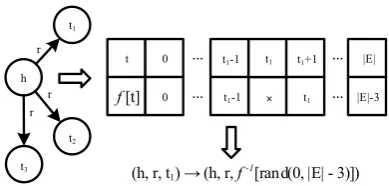
Figure 3: An example for the offset-based negative
sampling algorithm.
thread. In parallel learning, there are two strate-gies implemented to update gradients. One of the methods is the lock-free strategy, which means all threads share the unified embedding space and update embeddings directly without synchronized operations. We also implement a central syn-chronized method, where each thread calculates its own gradient and results will be updated after summing up the gradients from all threads.
4.3 Offset-based Negative Sampling
All KE models learn their parameters by minimiz-ing the margin-based loss function Eq. (1) or the regularized logistic loss Eq. (3). Both of these loss functions need to construct non-existing triples as negative samples. We have empirically found that the corrupted triples have great influence on final performance. Randomly replacing entities or rela-tions with any other ones may make the negative triple set T0 contain some positive triples in T, which would weaken the performance of KE mod-els. The original sampling algorithm will spend much time checking whether generated triples are inT and filtering them out. In OpenKE, we pro-pose an offset-based negative sampling algorithm to generate negative triples. As shown in Figure3, we renumber all entities with new serial numbers. Each entity’s new number is obtained by adding an offset to its original ID, and the offset is the total number of positive entities which have lower IDs. Our algorithm first randomly sample a new num-ber and then map the new numnum-ber back to its corre-sponding entity. This algorithm can directly gen-erate negative triples without any checking. Since the relation set is very small, we still directly re-place positive relations for relation corruption.
5 Evaluations
Dataset Rel Ent Train Valid Test
[image:5.595.344.492.62.140.2]FB15K 1,345 14,951 483,142 50,000 59,071 WN18 18 40,943 141,442 5,000 5,000
Table 2: Statistics of FB15K and WN18.
Datasets FB15K
Models TF PT MT
TransE 75.6(+28.5) 75.4(+28.3) 74.3(+27.2) TransH 72.8(+14.3) 72.7(+14.2) 74.8(+16.3) TransR 74.9(+6.2) 75.7(+7.0) 75.6(+6.9) TransD 74.3(+0.1) 74.2(+0.0) 75.2(+1.0) RESCAL 49.1(+5.0) 57.2(+13.1) -DistMult 73.4(+15.7) 75.4(+17.4)
-HolE 70.4(−3.5) -
-ComplEx 72.3(−11.7) 80.5(−3.5)
-Table 3: Experimental results of link prediction on
FB15K (%).
head entity when given a triple(?, r, t). In order to evaluate OpenKE, we implement various KE mod-els with OpenKE, and compare their performance with previous works on link prediction task.
Some datasets are usually used as benchmarks for link prediction, such as FB15K and WN18. FB15K is the relatively dense subgraph of Free-base; WN18 is the subset of WordNet. These pub-lic datasets are available online3. Following pre-vious works, We adopt them in our experiments. The statistics of FB15K and WN18 are listed in Table 2, including the number of entities, rela-tions, and facts.
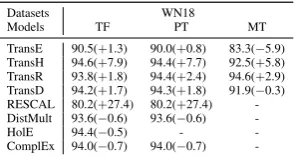
As mentioned above, OpenKE supports mod-els with efficient learning on both CPU and GPU. For CPU, the benchmarks are run on an Intel(R) Core(TM) i7-6700K @ 3.70GHz, with 4 cores and 8 threads. For GPU, the models in both TensorFlow and PyTorch versions are trained by GeForce GTX 1070 (Pascal), with CUDA v.8.0 (driver 384.111) and cuDNN v.6.5. To compare with the previous works, we simply follow the pa-rameter settings used before and traverse all train-ing triples for 1000 rounds. Other detailed pa-rameters and training strategies are shown in our source code. We show these results in Table3and Table 4. In these tables, the difference between our implementations and the paper reported results are listed in the parentheses. To demonstrate the efficiency of OpenKE, we select TransE as a rep-resentative and implement it with both OpenKE and KB2E4, and then compare their training time. KB2E is a widely-used toolkit for KE models on GitHub. These results can be found in Table5.
3
https://everest.hds.utc.fr/doku.php? id=en:transe
4https://github.com/thunlp/KB2E
Datasets WN18
Models TF PT MT
TransE 90.5(+1.3) 90.0(+0.8) 83.3(−5.9) TransH 94.6(+7.9) 94.4(+7.7) 92.5(+5.8) TransR 93.8(+1.8) 94.4(+2.4) 94.6(+2.9) TransD 94.2(+1.7) 94.3(+1.8) 91.9(−0.3) RESCAL 80.2(+27.4) 80.2(+27.4) -DistMult 93.6(−0.6) 93.6(−0.6)
-HolE 94.4(−0.5) -
-ComplEx 94.0(−0.7) 94.0(−0.7)
-Table 4: Experimental results of link prediction on
WN18 (%).
Models Time (s)
TransE (KB2E, CPU) 7124
[image:5.595.103.263.65.92.2]TransE (OpenKE, CPU, 1-Thread) 386 TransE (OpenKE, CPU, 2-Thread ) 206 TransE (OpenKE, CPU, 4-Thread) 118 TransE (OpenKE, CPU, 8-Thread) 76 TransE (OpenKE, GPU, TensorFlow) 178 TransE (OpenKE, GPU, PyTorch) 266
Table 5: Training time of different
implementa-tions of TransE on FB15K.
From the results in Table 3, Table4and Table
5, we observe that: (1) Models implemented with OpenKE have the comparable accuracies com-pared to the values reported in the original pa-pers. These results are compatible with our ex-pectations. For some models, their accuracies are slightly higher due to OpenKE. These results in-dicate our toolkit is effecive. (2) OpenKE signifi-cantly accelerates the training process of the mod-els trained both on CPU and GPU. As compared to the model implemented with KB2E, all models in OpenKE achieve more than10×speedup. These results show that our toolkit is efficient.
[image:5.595.352.484.193.258.2]Metric Hits@10 Hits@20 Hits@50 Hits@100
Head 29.6 36.2 46.7 56.3
Tail 66.8 75.2 84.9 90.6
Table 6: Experimental results of link prediction on
the whole Wikidata.
6 Conclusion
We propose an efficient open toolkit OpenKE for knowledge embedding. OpenKE builds a unified underlying platform to organize data and memory. It also applies GPU learning and parallel learning to speed up training. We also unify mathematical forms for specific models and encapsulate them to maintain enough modularity and extensibility. Ex-perimental results demonstrate that the models im-plemented by OpenKE are efficient and effective. In the future, we will incorporate more knowledge embedding models and maintain the stable embed-dings of some large-scale knowledge graphs.
Acknowledgments
This work is supported by the 973 Program (No. 2014CB340501) and the National Natural Sci-ence Foundation of China (NSFC No. 61572273, 61661146007) and Tsinghua University Initiative Scientific Research Program (20151080406). This research is part of the NExT++ project, supported by the National Research Foundation, Prime Min-isters Office, Singapore under its IRC@Singapore Funding Initiative.
References
Mart´ın Abadi, Paul Barham, Jianmin Chen, Zhifeng Chen, Andy Davis, Jeffrey Dean, Matthieu Devin, Sanjay Ghe-mawat, Geoffrey Irving, Michael Isard, et al. 2016. Ten-sorflow: A system for large-scale machine learning. In
Proceedings of OSDI.
Kurt Bollacker, Colin Evans, Praveen Paritosh, Tim Sturge, and Jamie Taylor. 2008. Freebase: a collaboratively cre-ated graph database for structuring human knowledge. In
Proceedings of KDD.
Antoine Bordes, Xavier Glorot, Jason Weston, and Yoshua Bengio. 2012. Joint learning of words and meaning repre-sentations for open-text semantic parsing. InProceedings of AISTATS.
Antoine Bordes, Xavier Glorot, Jason Weston, and Yoshua Bengio. 2014. A semantic matching energy function for learning with multi-relational data.Proceedings of ML.
Antoine Bordes, Nicolas Usunier, Alberto Garcia-Duran, Ja-son Weston, and Oksana Yakhnenko. 2013. Translating embeddings for modeling multi-relational data. In Pro-ceedings of NIPS.
Antoine Bordes, Jason Weston, Ronan Collobert, Yoshua Bengio, et al. 2011. Learning structured embeddings of knowledge bases. InProceedings of AAAI.
Xin Dong, Evgeniy Gabrilovich, Geremy Heitz, Wilko Horn, Ni Lao, Kevin Murphy, Thomas Strohmann, Shaohua Sun, and Wei Zhang. 2014. Knowledge vault: A web-scale ap-proach to probabilistic knowledge fusion. InProceedings of KDD.
Rodolphe Jenatton, Nicolas L Roux, Antoine Bordes, and Guillaume R Obozinski. 2012. A latent factor model for highly multi-relational data. InProceedings of NIPS.
Guoliang Ji, Shizhu He, Liheng Xu, Kang Liu, and Jun Zhao. 2015. Knowledge graph embedding via dynamic mapping matrix. InProceedings of ACL.
Yankai Lin, Zhiyuan Liu, Maosong Sun, Yang Liu, and Xuan Zhu. 2015. Learning entity and relation embeddings for knowledge graph completion. InProceedings of AAAI.
Hanxiao Liu, Yuexin Wu, and Yiming Yang. 2017. Analog-ical inference for multi-relational embeddings. In Pro-ceedings of ICML.
George A Miller. 1995. Wordnet: a lexical database for en-glish.Communications of the ACM.
Maximilian Nickel, Lorenzo Rosasco, and Tomaso Poggio. 2016. Holographic embeddings of knowledge graphs. In
Proceedings of AAAI.
Maximilian Nickel, Volker Tresp, and Hans-Peter Kriegel. 2011. A three-way model for collective learning on multi-relational data. InProceedings of ICML.
Maximilian Nickel, Volker Tresp, and Hans-Peter Kriegel. 2012. Factorizing yago: scalable machine learning for linked data. InProceedings of WWW.
Adam Paszke, Soumith Chintala, Ronan Collobert, Ko-ray Kavukcuoglu, Clement Farabet, Samy Bengio, Iain Melvin, Jason Weston, and Johnny Mariethoz. 2017. Py-torch: Tensors and dynamic neural networks in python with strong gpu acceleration.
Richard Socher, Danqi Chen, Christopher D Manning, and Andrew Ng. 2013. Reasoning with neural tensor networks for knowledge base completion. InProceedings of NIPS.
Ilya Sutskever, Joshua B Tenenbaum, and Ruslan Salakhutdi-nov. 2009. Modelling relational data using bayesian clus-tered tensor factorization. InProceedings of NIPS.
Th´eo Trouillon, Johannes Welbl, Sebastian Riedel, ´Eric Gaussier, and Guillaume Bouchard. 2016. Complex em-beddings for simple link prediction. In Proceedings of ICML.
Denny Vrandeˇci´c and Markus Kr¨otzsch. 2014. Wikidata: a free collaborative knowledgebase.Communications of the ACM.
Zhen Wang, Jianwen Zhang, Jianlin Feng, and Zheng Chen. 2014. Knowledge graph embedding by translating on hy-perplanes. InProceedings of AAAI.