Proceedings of NAACL-HLT 2019, pages 839–850 839
Improved Lexically Constrained Decoding
for Translation and Monolingual Rewriting
J. Edward Hu Huda Khayrallah Ryan Culkin Patrick Xia Tongfei Chen Matt Post Benjamin Van Durme
Johns Hopkins University
{edward.hu,huda,rculkin,paxia,tongfei}@jhu.edu; {post,vandurme}@cs.jhu.edu
Abstract
Lexically-constrained sequence decoding al-lows for explicit positive or negative phrase-based constraints to be placed on target out-put strings in generation tasks such as machine translation or monolingual text rewriting. We describe vectorized dynamic beam allocation, which extends work in lexically-constrained decoding to work with batching, leading to a five-fold improvement in throughput when working with positive constraints. Faster de-coding enables faster exploration of constraint strategies: we illustrate this via data augmenta-tion experiments with a monolingual rewriter applied to the tasks of natural language infer-ence, question answering and machine transla-tion, showing improvements in all three.
1 Introduction
For many natural language generation tasks, we often know word(s) that should (or should not) be in the output sentence. Examples include ter-minology databases in Machine Translation (MT) (Hokamp and Liu,2017), names (and generic re-sponses) in dialogue generation (Li et al., 2016; Gu et al.,2016), objects in image captioning (An-derson et al.,2017), and facts in abstractive sum-marization (See et al.,2017). One approach to en-force hard lexical constraints in the output is to modify the inference procedure to enforce their presence directly (Hokamp and Liu,2017). These constraints could be either positive(a word must appear in the output) or negative (a word must be avoided). While negative constraints could be easily enforced by preventing hypotheses with prohibited tokens from entering the beam, plac-ing positive constraints in natural and meanplac-ingful ways is less straightforward. We improve upon previous work by vectorizing the dynamic beam allocation (DBA) algorithm from Post and Vi-lar (2018) and by incorporating multi-state tries,
which track a subset of nodes at each decoding timestep. These improvements lead to a five-fold speedup in decoding with positive constraints and in some cases better constraint placements (with respect to BLEU).
Post and Vilar (2018) motivated the util-ity of lexically-constrained decoding in MT for scenarios such as interactive translation and do-main adaptation. Translation applications han-dling large amounts of data will clearly benefit from improvements in speed: the same is true for large-scale data augmentation via rewriting. In this case, a practitioner will ideally explore various task-specific rewriting strategies that may lead to improvements as observed during devel-opment, and then incorporate the best strategy into a test-final model. Recently, sentential para-phrasing gained the ability to enforce lexical con-straints (Hu et al.,2019), but constrained decoding was still too inefficient to be practical (Hokamp and Liu, 2017) at a large scale. Even with the approach described by Post and Vilar, exploring the space of possible rewriting strategies on a task-specific basis may be overly time consuming: our performance improvements to their algorithm low-ers the barrier of entry, where one may more prac-tically experiment with various strategies during development. To illustrate our point, we build an improved monolingual sentential rewriter that can be conditioned on arbitrary positive and negative lexical constraints and use this to augment data for three external NLP tasks with different strategies: Natural Language Inference (NLI), Question An-swering (QA) and MT.
Our main contributions are:
• A more efficient and robust approach to lexically-constrained decoding with vector-ized DBA and trie representations;
lexically-constrained monolingual rewriter1 with im-provements in both human-judged semantic similarity and fluency over the initial PARA -BANKrewriter (Hu et al.,2019);
• Monolingual rewriting constraint heuristics for automatic data augmentation leading to improvements on NLI / QA / MT.
2 Background
Constrained decoding Prior work explored methods to apply lexical constraints to a Neu-ral Machine Translation (NMT) decoder (Hokamp and Liu,2017;Anderson et al.,2017). However, most of these methods are slow and impractical as they change beam sizes at different time steps, which breaks the optimized computation graph. Post and Vilar (2018) proposed a means of dy-namically allocating the slots in a fixed-size beam to ensure that even progress was made in meet-ing an arbitrary number of constraints provided with the input sentence. However, despite it being their motivation, their approach did not scale to batching, instead they sequentially processed con-straints for sentences within the batch.
Paraphrases and Rewriting Many works sought to create paraphrases or paraphrastic ex-pressions through existing corpora. For example, DIRT (Lin and Pantel,2001) extracts paraphrastic expressions from paths in dependency trees. Weisman et al. (2012) explored learning infer-ence relations between verbs in broader scopes (document or corpus level). PPDB (Ganitkevitch et al.,2013) constructs paraphrase pairs by linking words or phrases that share the same translation in another language. PARANMT (Wieting and Gimpel,2018) and PARABANK(Hu et al.,2019) used back-translation to build a large paraphrase collection from bilingual corpora.
For arbitrary sentence rewriting, Napoles et al. (2016) used statistical machine translation in tan-dem with PPDB as a black box monolingual sen-tential rewriter. Mallinson et al. (2017) used a series of NMT model pairs to perform back-translations for monolingual paraphrasing. A sim-ilar approach was adopted by PARANMT to cre-ate a large paraphrase collection, which is used to train a monolingual sentence rewriter for canoni-calization. PARABANK (Hu et al.,2019) extends
1http://nlp.jhu.edu/parabank
PARANMT’s approach and produced a NMT-based rewriter with the ability to apply lexical con-straints to produce multiple paraphrases.
However, Hu et al. (2019) did not: evalu-ate the rewriter’s performance on in-the-wild sen-tences; explore more sophisticated versions of the rewriter; nor demonstrate its utility on NLP tasks.
Data augmentation Data augmentation has been used to improve performance and robustness in deep neural models. In NMT, the most com-mon approach is back-translation, where com- mono-lingual text in the target language is translated to create synthetic source sentences (Sennrich et al., 2016). Variants of back-translation target spe-cific words with high prediction loss (Fadaee and Monz, 2018), employed sampling to increase di-versity (Edunov et al., 2018), replace rare words (Fadaee et al.,2017), or replace at random (Wang et al.,2018).
Automatic data generation has also been suc-cessfully used for community question answering (Chen and Bunescu,2017), semantic parsing (Jia and Liang,2016), and task-oriented dialogue (Hou et al.,2018) by generating new data from the train-ing dataset. In contrast, our model is trained on a much larger external corpus and is fixed, indepen-dent of the task. Kobayashi(2018) utilized a pre-trained language model for automated data aug-mentation, though they only consider word-level rewrites and encourage label-preservation, while we paraphrase whole sentences with lexical con-straints, independent of a gold label.
Most similar to our experiments, Iyyer et al. (2018) explored syntactic paraphrasing for aug-mentation in sentiment and NLI tasks, extending prior work on PARANMT.
3 Improved Constrained Decoding
Lexically-constrained decoding is a modification to beam search that yields decoder outputs hon-oring user-supplied constraints. These constraints can be provided in the form of: positive con-straints, which specify that certain tokens or to-ken sequences must be present in the output; or
negative constraints, which specify token or token sequences that mustnotbe generated. Take posi-tive constraints for example, in translating the sen-tenceDas stimmt einfach nichtto English, the user can specify the constraint “not the case” to (pre-sumably) get the output That’s just not the case
a sm all
bird sm all
cat
c3 c4
a hors e
a cow
met: constraints:
c1 c2
?
[image:3.595.80.527.66.162.2](a) (b)
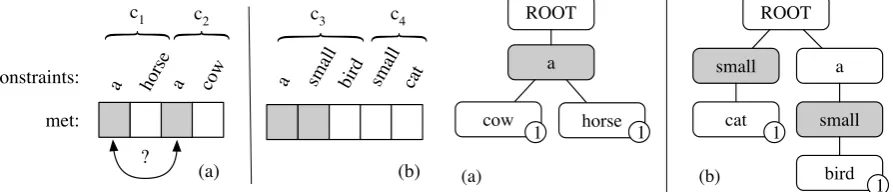
Figure 1: Two corner cases that arise when using an array implementation to track constraints. The gray boxes denote constraints that have been generated by the currently-tracked hypothesis. In (a), the decoder has to guess which constraint it is generating since they share a prefix. In (b), the decoder may start tracking constraintc3only to generatec4without realizing it.
true. While there is no guarantee that the decoder will use the constraints in a sensible way, con-straints are often well-placed empirically.
The implementation of positively constrained decoding comprises two key pieces: tracking which of the supplied constraints each hypothe-sis has already generated, and ensuring progress through the constraints by dynamically allocating the beam to hypotheses that have generated differ-ent numbers of them. We describe an improve-ment to each of these overPost and Vilar(2018), which includes: (1) a vectorized approach to beam allocation that works with batch decoding; and (2) the use of tries for recording constraint state, and thereby offsetting certain corner cases.
These contributions allow the decoder to find much better placement of constraints (as evi-denced by an almost 2 point BLEU score increase) and to increase throughput for batch decoding.
Here, we assume the reader is familiar with beam decoding for NMT, the details of which are provided byPost and Vilar(2018).
3.1 Tracking constraints with tries
The implementation by Post and Vilar used a flat one-dimension array listing the word indexes of all positive constraints (duplicates allowed). A par-allel array was used to mark which words in this list were non-final words in a sequence, so that progress could be tracked through sequences of to-kens. Progress through the constraints was tracked by maintaining, for each slot in the beam, a third array, which marked which of the constraints had already been generated by that hypothesis.
However, this leads to corner cases when two constraints c1 and c2 share a subsequence.
a small
small ROOT
a ROOT
cow
1 horse 1 cat 1
bird 1
(a) (b)
Figure 2: The trie representation solves both problems depicted in Figure1. The constraint tracker no longer has to predict the constraint to track (a), and it can track multiple constraints by using multiple states (b). Coun-ters are added to end nodes to denote how many times each constraint must be generated.
The first case occurs when two constraints have an identical prefix. Consider the constraints in Fig.1(a) when translating the French sentence
une vache et un cheval. The array-based imple-mentation has to choose which constraint to gen-erate when it has only gengen-erated the first word of the English translation,a cow and a horse. Sup-pose it chooses constraintc1,a horse. If the
sub-sequent step generatescowinstead, the constraint tracking for the phrasea horsewill be marked as incomplete and reset, and the decoder will not re-alize that it has satisfied a different constraint.
A second corner case arises when a constraint
c4 is a non-prefix substring of a constraintc3. In
this situation, the decoder may begin generating the longer constraint, only to generate the shorter one, without realizing it. For example, consider a target sentence that should bea small cat saw a small bird, with constraintsa small birdandsmall cat (Figure1b). When generating the first word,
a, the decoder begins trackingc3. It continues by
adding to this hypothesis the second word,small. However, suppose it then extends this hypothesis withcat. It will abort tracking ofc3, and not
real-ize that it completedc4.
A more natural representation that addresses these corner cases is to organize constraints that haven’t yet been generated into a trie. Nodes in the trie that represent the ends of constraints are augmented with a counter that indicates how many times that constraint must be generated.2 Each time a constraint is completed, the number is decremented, and nodes of the trie can be trimmed when they lead only to paths ending in zero counts.
2Because one constraint can be a subsequence of another,
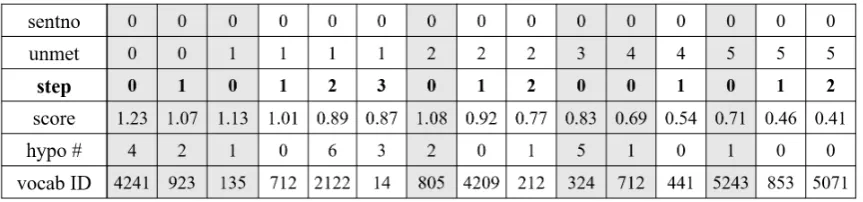
[image:3.595.76.308.69.160.2]Figure 3: The hypothesis matrix during vectorized dynamic beam allocation (VDBA). Each column denotes a can-didate hypothesis, each of which contains sufficient information to identify it. Hypotheses are sorted by sentence number, number of unmet constraints, and sequence scores. The “unmet” row indicates how many constraints each hypothesis has not yet generated. After sorting by sentence ID and “unmet”, we assign monotonically increasing numbers across columns that share (sentno, unmet) values (the “step” row). We can now sort by the “step” row to ensure that the beam for a sentence contains hypotheses having met each number of constraints. We populate the next beam by taking the firstkhypotheses (in gray) after sorting the matrix bystep. Here,k= 7.
Finally, in order to address the second corner case, we track multiple states in each constraint trie.
In summary, we represent all the constraints as a compact trie. Each hypothesis in the decoder beam has its version of the trie. The set of active states in each hypothesis’ trie tracks all suffixes of the target words that match against the constraint trie. When a constraint is generated, its counter is decremented and zero paths are pruned.
3.2 Negative constraints
Negative constraints are used to denote words and phrases that the decoder must not generate. Block-ing sBlock-ingle-word negative constraints can be done by setting their costs to infinity before doing top-k
selection, at each time step. These negative con-straints are also represented in a trie, although it is slightly different, because it does not have a counter and never needs to be pruned. Instead, it records at each node the list of word IDs that end phrases for which the current word is the penulti-mate. We similarly track all suffixes of the current hypothesis’ target word string that match the neg-ative constraint trie. At each time-step, we block the generation of active phrases by setting to in-finity all word IDs marked in the current node (if any). This includes the root node, which handles single-word constraints. Each state is then ex-tended by following outgoing arcs, if present, or else resetting them to the root state.
3.3 Vectorized Dynamic Beam Allocation Post and Vilar (2018) describe an algorithm that divides the beam among hypotheses that have gen-erated different numbers of positive constraints. For a beam of size k and with C positive
con-straint tokens, the algorithm produces a set of can-didate extensions of the k hypotheses from the beam. They assemble these extensions from three sources: (a) the top-kbest-scoring tokens across all hypotheses in the beam (without respect to straints); (b) the set of tokens that advance the con-straint trie for each hypothesis; and (c) the best-scoring extension of each hypothesis.3 After con-structing this candidate list, they whittle it down to a list of sizekand use it to construct the beam at the next time step. This way, the algorithm ensures that portions of the beam are devoted to candidates having met different number of constraints, and thereby that progress is made towards meeting all the constraints as decoding proceeds.
However, their implementation used a proce-dural approach which is incompatible with batch-ing; that is, constraints for input segments within a batch are processed sequentially, so increasing the batch size does not produce any speed gains. We replace the procedural approach with a vectorized one, which uses GPU operations to quickly assem-ble the list of candidates and allocate them to the beam such that we do benefit from batching.
A sketch of our algorithm follows. We assemble candidates from the same three sources described above. Sets (a) and (c) already use fast GPU op-erations. These operations can be done efficiently even batch-wise. Set (b) is less amenable to vec-torization, but can be assembled by querying each hypothesis for its unmet constraints. We now use a sorting-based algorithm to parallelize the divvying
3The difference between (a) and (c) is that the items
Speed (sent/sec) BLEU
Constraints batch size 1 batch size 20
Baseline +MST,VDBA Baseline +MST,VDBA Baseline +MST,VDBA
none 4.78 4.84 17.92 17.51 40.9 40.9
phr4 0.75 0.89 0.93 4.71 47.8 49.2
[image:5.595.84.514.66.168.2]rand3 0.78 0.80 0.87 4.59 43.0 43.2
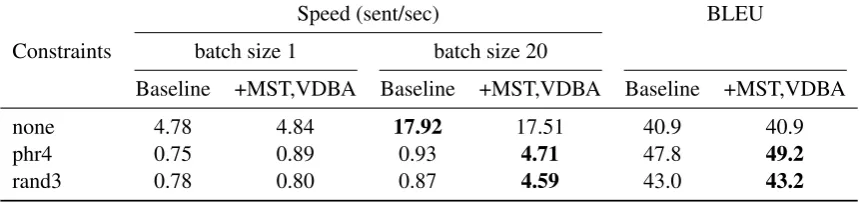
Table 1: Comparison between the baseline implementation (SOCKEYE1.18.57, commit 59180f3) and our approach with multi-state tries (MST) and vectorized Dynamic Beam Allocation (VDBA) in placing different constraints randomly extracted from the reference. All runs use a beam size of 10. The pruning threshold was set to 0 for no constraints (“none”) and 30 for “phr4” and “rand3”. Decoding speed is measured on an NVIDIA GTX 1080 Ti in sentences per second (the higher the better). Output quality is measured using SacreBLEU (the higher the better).
up of the beam to hypotheses having met different numbers of constraints.
We do this by assembling a matrix with all the candidates for all sentences in the batch ( Fig.3). This matrix contains a column for each candidate, including the sentence number, the number of un-met constraints for that hypothesis, its sequence score, the hypothesis it extends, and the next vo-cabulary ID. With this matrix, we can quickly select the k hypothesis extensions for the next timestep using a multi-key sort. The first key is the sentence number. Next, it is the number of un-met constraints in each hypothesis. We then make use of a "step" row, which assigns increasing in-dices within each group of hypotheses with the same number of unmet constraints. Sorting on this row as the third key establishes a round-robin as-signment of thek-sized beam to items having met different numbers of constraints. In the end, we select the topkitems (in the example,k = 7and the selected columns are in gray).
3.4 Evaluation
We use SOCKEYE (Hieber et al., 2017)4 for our evaluations. We trained a 6-layer German–English Transformer using the default settings on the WMT’18 training data and the newstest2018 test set for evaluation (Bojar et al., 2018). Fol-lowingPost and Vilar(2018), we compare decod-ing results in an unconstrained settdecod-ing and with two sets of positive constraints: “rand3”, which selects 3 random words from the reference, and “phr4”, which selects a single 4-word phrase. We report decoding speed (in sentences per second) and BLEU score (Papineni et al., 2002), as mea-sured by SacreBLEU (Post,2018). The results are
4https://github.com/awslabs/sockeye/
shown in Table1.
Our approach is faster than existing approaches when decoding with positive constraints and pro-duces the same or higher BLEU scores, which we take as a sign of more fluent and natural hypothe-ses under constraints. Without batching, there is no speedup, but at a batch size of 20, we see roughly a 5×speedup.
4 Improved Monolingual Rewriter
Inspired by the approach described in PARA-BANK (Hu et al., 2019), we trained a more powerful English monolingual rewriter by using a multi-head self-attention NMT model, Trans-former (Vaswani et al.,2017). We used a 6-layer encoder and decoder with a model size of 512 and 8 attention heads. The encoder and decoder em-beddings share the same weight. Unlike PARA-BANK, which trained a rewriter on a subset of 50M paraphrase pairs out of its collection, we trained on all of the paraphrastic pairs in PARA-BANK originated from CzEng5 that: (1) have a regression score over 0.50; (2) only consist of ASCII characters after punctuation normalization; and (3) have a reference/paraphrase token Jaccard index between 0.25 and 0.65.
We retain 141,381,887 paraphrastic pairs, out of over 220 million, as training data after applying these filters. To ensure output quality, we only use back-translated paraphrases as source.
PARABANKis a real-cased resource. We mark all words that have first-character capitalization and convert them to lowercase. The marking is
5P
used as a source factor (Sennrich and Haddow, 2016) to the encoder. This helps us to decrease the vocabulary size of the the training data.
We learn a shared byte-pair encoding (BPE) over the entire training data with 30,000 BPE op-erations (Sennrich et al., 2016), keeping all vo-cabulary items with a frequency over 50 in the post-BPE data. We followSennrich and Haddow (2016) and use “BIOE" tagging to annotate BPE segmentation and broadcast the casing factor ac-cordingly. The encoder uses both source factors.
The model is trained on 2 NVIDIA GTX 1080Ti’s until convergence (5 days).
Rewriter Evaluation We randomly sampled 100 instances from both MNLI matched and mis-matched development set. Each instance con-sists of 4 sentences: premise, entailed, contra-dicting, and neutral. We use the following 3 different rewriters to rewrite all 800 sentences: (1) an LSTM-based rewriter trained on PARA -BANK alpha; following (Hu et al., 2019); (2) a Transformer-based rewriter trained on PARA -BANKalpha; and (3) a Transformer-based rewriter trained on full PARABANKwith the filters and im-provements described here.
Inspired by the interface of EASL (Sakaguchi and Van Durme,2018), we ask crowd-workers to give each paraphrase a score between 0 and 100 depending its semantically similarity to the orig-inal, reference sentence. Independently, we pro-vide options for flagging ungrammatical or non-sensical sentences. Paraphrases are judged by up to 3 different workers, with 11 workers participat-ing. We randomly include an attention check con-sisting of reference sentence itself.6
The result is shown in Table 2. Switching the rewriter architecture from LSTM to Transformer improves the human-judged semantic similarity by 5.1% and fluency by 6.5%. The improvements described here leads to a gain of 9.6% in semantic similarity and 10.2% in fluency overall.
This improved Transformer-based rewriter is subsequently used for data augmentation.
5 Paraphrastic Data Augmentation
We demonstrate the utility of our improved lexically-constrained decoding via data augmenta-tion with some simple rewriting heuristics and two augmentation strategies. First, the model could be
6Only workers who pass the test at least 90% of the time
and contribute at least 9 judgments are included in the result.
Similarity STD Fluency
LSTM alpha 74.5 25.0 80.7%
Transf. alpha 78.3 22.9 87.2%
Transf. Full 81.7 20.9 90.9%
Table 2: Comparison between three monolingual rewriting systems. Systems will “alpha" are trained on PARABANK alpha, which the other one is trained on the full data. Similarity is the mean human-judged se-mantic similarity score; the higher the better. STD de-scribed the standard deviation of similarity. Fluency is the percentage of paraphrases judged to be both gram-matical and meaningful.
trained on the augmented (training) data. Orthog-onally, predictions can be made on the all of the augmented (evaluation) data, which can then be
aggregated. We show experimental results on nat-ural language inference (NLI, Section5.1), ques-tion answering (QA, Secques-tion5.2), and NMT (Sec-tion5.3) tasks.
These results are merely indicative of the po-tential in data augmentation via constrained para-phrasing, and are by no means a thorough inves-tigation of strategies that yield the best improve-ments. Such an investigation, however, could be enabled by our algorithmic improvements and practitioners’ domain expertise.
5.1 Natural Language Inference
Natural language inference is the task of deter-mining entailment. Two sentences, a premise p
and a hypothesis h, are labelled with ENTAIL-MENT, CONTRADICTION, or NEUTRAL depend-ing on whether p logically entails, contradicts, or does not interact with h. MultiNLI (MNLI) (Williams et al., 2018) is a large, multi-genre dataset for natural language inference. The dataset is also divided intomatchedandmismatched por-tions based on whether the source of the evaluation data matches the source of the training set. Recent models rely on contextual sentence encoders pre-trained on vast amounts of English monolingual text (Peters et al.,2018;Devlin et al.,2018).
Model We use the model described inBowman et al.(2019)7 with the default parameters. They train a sentence representation model (possibly on top of ELMo) on the MNLI training set and subsequently train a clean task-specific model for each task (for this model, MNLI again). The task-specific MNLI model roughly follows BiDAF (Seo et al.,2016), followed by an MLP.
We also train a model without the ELMo con-textual layers to compare concon-textual sentence rep-resentations against data augmentation. Since there is minor variance between different random seeds,8we train each model twice and evaluate the best-performing model on the development set.
Paraphrase Generation We generate para-phrases for our data augmentation experiments by negatively constraining on the most content-bearing token of each input sequence, as deter-mined by inverse document frequency (IDF). For a given input sequences we calculate the IDF of each tokenti ∈saslog|d∈D|D:ti|∈d|whereDis the
set of all English sentences in the train set. This relatively simple lexical constraint tends to force the decoder to rewrite the input sequence using different (but semantically related) words while maintaining fluency. In practice, we observed an average unigram precision of 67.6%; i.e., 32.4% of tokens in paraphrases were not contained in their corresponding inputs.
Additional results using a positively constrained rewriter in AppendixA.
Data Setup We first rewrite all premises P to
P0 and all hypotheses H to H0, then for each
pi ∈ P, hi ∈ H, we include all four exam-ples,(pi, hi),(pi, h0i),(p0i, hi), and(p0i, h0i)into the training set, always preserving the original corre-sponding gold label. We include two copies of the original dataset in training to increase its weight. The original MNLI dataset contains 393K training pairs, and 20K in each dev and test, while the aug-mented dataset consists of 1.96M training pairs, and 79K in dev and test.
At test time, we rewrite the test sentence pairs. A trained model can also make predictions on each of three rewritten sentence pairs. Together with the original prediction, these four can then be aggregated by assigning weights to each predic-tion source. In our experiments, we perform this
7
https://github.com/ jsalt18-sentence-repl/jiant
8Bowman et al.(2019) found the variance to be 0.2
Dev. Test. (m/mm)
Baseline 74.8 74.7 (74.8/74.6)
+Agg. 75.0 74.9 (74.9/74.8)
+Train 75.4 75.2 (75.0/75.3)
+Train+Agg. 75.6 75.4 (75.1/75.7)
+ELMo 75.8 75.0 (75.1/75.0)
+Agg. 75.9 75.2 (75.3/75.1)
+Train 76.4 75.6 (75.6/75.6)
[image:7.595.317.513.63.201.2]+Train+Agg. 76.7 75.8 (75.9/75.7)
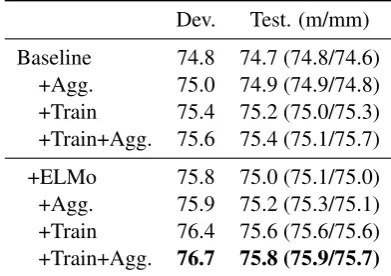
Table 3: F1 scores on MNLI. +Train denotes training on augmented data; +Agg. denotes using a weighted aggregation. Scores on the development set are a weighted average between the matched (m) and mis-matched (mm) portions of the dataset, while the test set scores are additionally broken down into each category.
weighted aggregation (+Agg) for each model, tun-ing on the development set (AppendixB).
Experimental Results We find in Table 3 that data augmentation helps during training and infer-ence. Not only are the total gains from augmenta-tion comparable to those from ELMo, they are ap-parent even in the presence of the contextual sen-tence encoder. This suggests that the gains from data augmentation through rewrites complement recent gains from contextual sentence encoders.
The fairest external comparison is with Bow-man et al.(2019), as our model is identical. Their best models achieve 76.2 F1 on development and 75.4 F1 on test. On the development set, they see a gain of 0.6 points by using multi-task training and external datasets. On that set, we report a total gain of up to 0.9 points purely through data aug-mentation. With respect to absolute test set scores, our best model outperforms theirs by 0.4, show-ing that rewriter-based data augmentation can be a powerful method for NLP tasks.
Analysis NLI systems have been shown to be brittle when the input is perturbed (Alzantot et al., 2018). Even when the premise or hypothesis is changed in a way that preserves the entailment se-mantics, the NLI system may make an incorrect prediction where it was previously correct. We present evidence showing that data augmentation for NLI reduces the brittleness of our model.
P0, H P, H0 P0, H0 +Agg.
No change 88.51 84.23 81.95 96.20
− →+ 4.23 5.33 6.08 1.75 +→ − 5.84 8.44 9.67 1.49 −1 → −2 1.42 2.00 2.30 0.57
No change 88.20 83.26 80.68 96.00
− →+ 4.03 5.45 6.11 1.80
+→ − 6.42 9.22 10.78 1.72
[image:8.595.307.524.61.234.2]−1 → −2 1.35 2.08 2.42 0.47
Table 4: Percentage of changed predictions on the MNLI development set using the baseline model with-out (top) and with (bottom) ELMo.− →+(correct af-ter rewrite),+→ −(originally correct), and−1→ −2
(different incorrect) are changes after rewriting.+Agg. denotes the predictions after weighted aggregation.
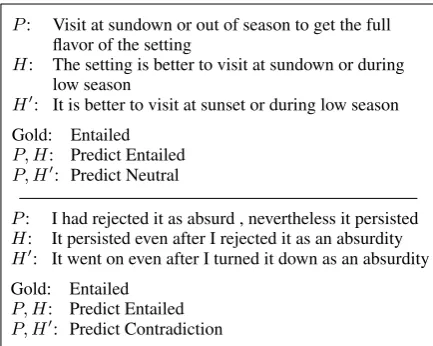
dataset is evaluated on the original development set and each of the rewritten development sets, and we investigate the differences. Table4shows how often original predictions are different from the corresponding predictions on the rewritten devel-opment sets; predictions can be (1) unchanged, (2) newly correct, (3) newly incorrect, or (4) changed but still incorrect, while Figure4shows how even relatively modest, semantically valid paraphrases can cause the NLI model change incorrectly.
Given a perfect rewriter that always generates semantically equivalent paraphrases and a perfect NLI model robust to perturbations, we would ex-pect no change in predictions between the original development set and the rewritten ones. However, this is not what we observe; Table 4 shows that rewriting leads to a greater percentage of newly in-correct predictions than newly in-correct predictions. We believe that the higher percentage of newly incorrect predictions on the rewritten development sets demonstrates the brittleness of the NLI sys-tem rather than semantic dissimilarity that may be introduced by the rewriter. We note that the aggre-gated predictions shows the opposite pattern: we see a higher percentage of newlycorrect predic-tions than incorrect ones. If the paraphrases were largely semantically dissimilar we would not ex-pect any gain by combining predictions.
Given both the numerical boost seen by aggre-gation and the above examples, we hypothesize that the rewriter does not frequently change en-tailment semantics. Because the semantics remain similar, and because the paraphrases were
gener-P: Visit at sundown or out of season to get the full flavor of the setting
H: The setting is better to visit at sundown or during low season
H0: It is better to visit at sunset or during low season
Gold: Entailed
P, H: Predict Entailed
P, H0: Predict Neutral
P: I had rejected it as absurd , nevertheless it persisted
H: It persisted even after I rejected it as an absurdity
H0: It went on even after I turned it down as an absurdity
Gold: Entailed
P, H: Predict Entailed
[image:8.595.72.291.64.203.2]P, H0: Predict Contradiction
Figure 4: Cases where the baseline system changes its prediction on rewritten examples.
ated with constraints designed to introduce lexical diversity, we believe that the label-preserving data augmentation improves the NLI model by making it more tolerant of minor lexical differences, better able to generalize, and less inclined to memorize.
5.2 Question Answering
We apply our paraphrastic rewriter to the task of question answer sentence selection to see if aug-menting with paraphrases leads to improvements. The task is defined as follows: Given a question
qand a set of candidate sentences{ci}, select the candidates which answerq.
Model We adapt a popular neural architecture for NLI, InferSent (Conneau et al.,2017), to our QA sentence selection task. In InferSent, the ques-tions and answers (originally the premises and hy-potheses) are embedded using an uncontextual-ized word embedding (e.g. GloVe), which we also experiment with ELMo (Peters et al., 2018) to incorporate recent advancements in large-scale contextualized pre-training. Bidirectional LSTMs (Graves and Schmidhuber, 2005) are run atop of these contextualized embeddings and a max-pooling layer is used to generate a feature vec-tor for both the question and the answer. Follow-ing various matchFollow-ing methods (Mou et al.,2016) and a multi-layer feed-forward neural network, the model produces a final score.
Paraphrase Generation We augment each an-swer candidate sentence with exactly 1 paraphrase in the dataset using the following heuristics: (1) named entities shared between a specific answer and its corresponding question are retained as positive constraints; (2) correct answer spans are retained as positive constraints; (3) words with the top-k IDFs (inverse document frequencies; hence “important” words) that are not positive constraints are selected as negative constraints to promote the lexical diversity of the paraphrases.9
Data Setup We augment the raw TREC-QA dataset (Wang et al., 2007) under the following orthogonal strategies: (1) augmenting the train-ing set with the paraphrases generated via the ap-proach described above; (2) augmenting the an-swer candidates at evaluation time, and choosing the max score among the paraphrases as the score (aggregation byvoting).
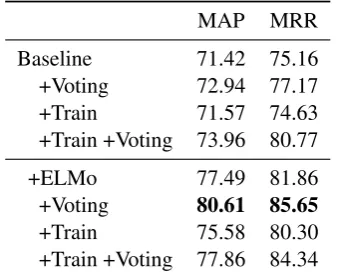
Experimental Results We evaluate our mod-els using average precision (MAP) and mean re-ciprocal rank (MRR). Model selection is done with early stopping to choose the epoch with the maximum MAP score. Note that the “Baseline (+ELMo)” settings below falls back to the stan-dard QA selection task, and our score under ELMo is comparable to earlier state-of-the-art results, e.g. byRao et al.(2016).
MAP MRR
Baseline 71.42 75.16
+Voting 72.94 77.17
+Train 71.57 74.63
+Train +Voting 73.96 80.77
+ELMo 77.49 81.86
+Voting 80.61 85.65
+Train 75.58 80.30
[image:9.595.97.266.470.609.2]+Train +Voting 77.86 84.34
Table 5: Experimental results on QA selection.
It is shown that augmenting at evaluation time (aggregation by voting) result in stable improve-ment (around +2~3% MAP and +2~6% MRR for both scenarios that either augments the training data or not)—this shows that increasing the para-phrastic diversity of the answer candidates could
9 Stopwords and tokens with non-letter characters (e.g.
with,42,n’t) are excluded.k∈ {2,3,4}is a hyperparameter we tune – we found out that generallyk= 2works the best.
potentially make the system more robust. How-ever augmenting the training set does not yield such improvements—we speculate that this may introduce some noise to the training data.
5.3 Machine Translation
We apply our paraphrastic rewriter to the WMT 2016 Turkish-English translation task (Bojar et al., 2016b). We see no improvement in English to Turkish translation, but see a1.1BLEU improve-ment when training an initial NMT system on half paraphrased and half original data, and continued training on the original data. Full details of the ex-periments are inAppendix C. This was the highest concentration of standard data we experimented with, and future work will explore additional ways of data augmentation using paraphrases.
6 Conclusion
Lexically-constrained sequence decoding pro-vides control over whether certain tokens or token sequences appear in the output. Motivated by ap-plications such as large-scale MT, we improved the speed for constrained decoding significantly by proposing a vectorized dynamic beam alloca-tion algorithm. We also added multi-state trie rep-resentations for robustness to corner cases.
Also reliant on the efficiency of constrained de-coding is data augmentation via rewriting, where one might need to explore a variety of strate-gies with task-specific constraints on development data. We trained an improved monolingual sen-tential rewriter and used it to rewrite data for NLP tasks. We experimented with augmenting train-ing data, aggregattrain-ing predictions on rewritten test data, and both. Using a few simple constraint heuristics, we showed improvements additive to ELMo in NLI and QA, and in MT. The rewriter, along with the augmented data files, can be found
at http://nlp.jhu.edu/parabank. We
hope this will enable future exploration of aug-mentation strategies for a variety of NLP tasks.
Acknowledgments
References
Moustafa Alzantot, Yash Sharma, Ahmed Elgohary, Bo-Jhang Ho, Mani Srivastava, and Kai-Wei Chang. 2018. Generating natural language adversarial ex-amples. InProceedings of the 2018 Conference on Empirical Methods in Natural Language Process-ing, pages 2890–2896, Brussels, Belgium. Associ-ation for ComputAssoci-ational Linguistics.
Peter Anderson, Basura Fernando, Mark Johnson, and Stephen Gould. 2017. Guided open vocabulary image captioning with constrained beam search. In Proceedings of EMNLP 2017, pages 936–945, Copenhagen, Denmark. Association for Computa-tional Linguistics.
Ondˇrej Bojar, Ondˇrej Dušek, Tom Kocmi, Jindˇrich Li-bovický, Michal Novák, Martin Popel, Roman Su-darikov, and Dušan Variš. 2016a. CzEng 1.6: En-larged Czech-English Parallel Corpus with Process-ing Tools Dockered. InText, Speech, and Dialogue: 19th International Conference, TSD 2016, number 9924 in Lecture Notes in Computer Science, pages 231–238, Cham / Heidelberg / New York / Dor-drecht / London. Masaryk University, Springer In-ternational Publishing.
Ondˇrej Bojar, Christian Federmann, Mark Fishel, Yvette Graham, Barry Haddow, Philipp Koehn, and Christof Monz. 2018. Findings of the 2018 con-ference on machine translation (WMT18). In Pro-ceedings of the Third Conference on Machine Trans-lation: Shared Task Papers, pages 272–303, Bel-gium, Brussels. Association for Computational Lin-guistics.
Ondˇrej Bojar, Rajen Chatterjee, Christian Federmann, Yvette Graham, Barry Haddow, Matthias Huck, Antonio Jimeno Yepes, Philipp Koehn, Varvara Logacheva, Christof Monz, Matteo Negri, Aure-lie Neveol, Mariana Neves, Martin Popel, Matt Post, Raphael Rubino, Carolina Scarton, Lucia Spe-cia, Marco Turchi, Karin Verspoor, and Marcos Zampieri. 2016b. Findings of the 2016 confer-ence on machine translation. In Proceedings of the First Conference on Machine Translation, pages 131–198, Berlin, Germany. Association for Compu-tational Linguistics.
Samuel R. Bowman, Ellie Pavlick, Edouard Grave, Benjamin Van Durme, Alex Wang, Jan Hula, Patrick Xia, Raghavendra Pappagari, R. Thomas McCoy, Roma Patel, Najoung Kim, Ian Tenney, Yinghui Huang, Katherin Yu, Shuning Jin, and Berlin Chen. 2019. Looking for ELMo’s friends: Sentence-level pretraining beyond language modeling.
Chris Callison-Burch, Philipp Koehn, Christof Monz, and Josh Schroeder. 2009. Findings of the 2009 Workshop on Statistical Machine Translation. In
Proceedings of the Fourth Workshop on Statistical Machine Translation, pages 1–28, Athens, Greece. Association for Computational Linguistics.
Charles Chen and Razvan Bunescu. 2017. An explo-ration of data augmentation and rnn architectures for question ranking in community question answer-ing. InProceedings of the Eighth International Joint Conference on Natural Language Processing (Vol-ume 2: Short Papers), pages 442–447, Taipei, Tai-wan. Asian Federation of Natural Language Pro-cessing.
Alexis Conneau, Douwe Kiela, Holger Schwenk, Loïc Barrault, and Antoine Bordes. 2017. Supervised learning of universal sentence representations from natural language inference data. InProceedings of the 2017 Conference on Empirical Methods in Nat-ural Language Processing, pages 670–680.
Jacob Devlin, Ming-Wei Chang, Kenton Lee, and Kristina Toutanova. 2018. Bert: Pre-training of deep bidirectional transformers for language understand-ing.CoRR, abs/1810.04805.
Sergey Edunov, Myle Ott, Michael Auli, and David Grangier. 2018. Understanding back-translation at scale. InProceedings of EMNLP 2018, pages 489– 500. Association for Computational Linguistics.
Marzieh Fadaee, Arianna Bisazza, and Christof Monz. 2017. Data augmentation for low-resource neural machine translation. InProceedings of the 55th An-nual Meeting of the Association for Computational Linguistics (Volume 2: Short Papers), pages 567– 573, Vancouver, Canada. Association for Computa-tional Linguistics.
Marzieh Fadaee and Christof Monz. 2018. Back-translation sampling by targeting difficult words in neural machine translation. InProceedings of the 2018 Conference on Empirical Methods in Natural Language Processing, pages 436–446. Association for Computational Linguistics.
Juri Ganitkevitch, Benjamin Van Durme, and Chris Callison-Burch. 2013. Ppdb: The paraphrase database. InProceedings NAACL-HLT 2013, pages 758–764.
Alex Graves and Jürgen Schmidhuber. 2005. Frame-wise phoneme classification with bidirectional lstm and other neural network architectures. Neural Net-works, 18(5-6):602–610.
Jiatao Gu, Zhengdong Lu, Hang Li, and Victor O.K. Li. 2016. Incorporating copying mechanism in sequence-to-sequence learning. In Proceedings of the 54th Annual Meeting of the Association for Com-putational Linguistics (Volume 1: Long Papers), pages 1631–1640, Berlin, Germany. Association for Computational Linguistics.
Chris Hokamp and Qun Liu. 2017. Lexically con-strained decoding for sequence generation using grid beam search. InProceedings of ACL, pages 1535– 1546, Vancouver, Canada.
Yutai Hou, Yijia Liu, Wanxiang Che, and Ting Liu. 2018. Sequence-to-sequence data augmentation for dialogue language understanding. InProceedings of the 27th International Conference on Computational Linguistics, pages 1234–1245, Santa Fe, New Mex-ico, USA. Association for Computational Linguis-tics.
J. Edward Hu, Rachel Rudinger, Matt Post, and Ben-jamin Van Durme. 2019. PARABANK: Monolin-gual bitext generation and sentential paraphrasing via lexically-constrained neural machine translation.
AAAI.
Mohit Iyyer, John Wieting, Kevin Gimpel, and Luke Zettlemoyer. 2018. Adversarial example generation with syntactically controlled paraphrase networks. InProceedings of the 2018 Conference of the North American Chapter of the Association for Computa-tional Linguistics: Human Language Technologies, Volume 1 (Long Papers), pages 1875–1885. Associ-ation for ComputAssoci-ational Linguistics.
Robin Jia and Percy Liang. 2016. Data recombination for neural semantic parsing. In Proceedings of the 54th Annual Meeting of the Association for Compu-tational Linguistics (Volume 1: Long Papers), pages 12–22, Berlin, Germany. Association for Computa-tional Linguistics.
Diederik P Kingma and Jimmy Ba. 2014. Adam: A method for stochastic optimization. arXiv preprint arXiv:1412.6980.
Sosuke Kobayashi. 2018. Contextual augmentation: Data augmentation by words with paradigmatic re-lations. In Proceedings of the 2018 Conference of the North American Chapter of the Association for Computational Linguistics: Human Language Tech-nologies, Volume 2 (Short Papers), pages 452–457, New Orleans, Louisiana. Association for Computa-tional Linguistics.
Philipp Koehn, Hieu Hoang, Alexandra Birch, Chris Callison-Burch, Marcello Federico, Nicola Bertoldi, Brooke Cowan, Wade Shen, Christine Moran, Richard Zens, Chris Dyer, Ondrej Bojar, Alexandra Constantin, and Evan Herbst. 2007. Moses: Open Source Toolkit for Statistical Machine Translation. In Proceedings of the 45th Annual Meeting of the Association for Computational Linguistics Compan-ion Volume Proceedings of the Demo and Poster Sessions, Prague, Czech Republic. Association for Computational Linguistics.
Jiwei Li, Michel Galley, Chris Brockett, Jianfeng Gao, and Bill Dolan. 2016. A diversity-promoting ob-jective function for neural conversation models. In
Proceedings of the 2016 Conference of the North American Chapter of the Association for Computa-tional Linguistics: Human Language Technologies,
pages 110–119, San Diego, California. Association for Computational Linguistics.
Dekang Lin and Patrick Pantel. 2001. Dirt @sbt@discovery of inference rules from text. In
Proceedings of the Seventh ACM SIGKDD Inter-national Conference on Knowledge Discovery and Data Mining, KDD ’01, pages 323–328, New York, NY, USA. ACM.
Minh-Thang Luong and Christopher D. Manning. 2015. Stanford Neural Machine Translation Sys-tems for Spoken Language Domain. In Interna-tional Workshop on Spoken Language Translation, Da Nang, Vietnam.
Jonathan Mallinson, Rico Sennrich, and Mirella Lap-ata. 2017. Paraphrasing revisited with neural ma-chine translation. InProceedings of the 15th Con-ference of the European Chapter of the Association for Computational Linguistics: Volume 1, Long Pa-pers, pages 881–893, Valencia, Spain. Association for Computational Linguistics.
Lili Mou, Rui Men, Ge Li, Yan Xu, Lu Zhang, Rui Yan, and Zhi Jin. 2016. Natural language inference by tree-based convolution and heuristic matching. In
Proc. ACL, page 130.
Courtney Napoles, Chris Callison-Burch, and Matt Post. 2016. Sentential paraphrasing as black-box machine translation. InProceedings of the NAACL 2016, pages 62–66, San Diego, California. Associa-tion for ComputaAssocia-tional Linguistics.
Kishore Papineni, Salim Roukos, Todd Ward, and Wei-Jing Zhu. 2002. BLEU: a method for automatic evaluation of machine translation. InProceedings of 40th Annual Meeting of the Association for Com-putational Linguistics, pages 311–318, Philadelphia, Pennsylvania, USA. Association for Computational Linguistics.
Matthew Peters, Mark Neumann, Mohit Iyyer, Matt Gardner, Christopher Clark, Kenton Lee, and Luke Zettlemoyer. 2018. Deep contextualized word rep-resentations. In Proceedings of the 2018 Confer-ence of the North American Chapter of the Associ-ation for ComputAssoci-ational Linguistics: Human Lan-guage Technologies, Volume 1 (Long Papers), pages 2227–2237, New Orleans, Louisiana. Association for Computational Linguistics.
Matt Post. 2018. A call for clarity in reporting BLEU scores. InProceedings of the Third Conference on Machine Translation: Research Papers, pages 186– 191, Belgium, Brussels. Association for Computa-tional Linguistics.
Jinfeng Rao, Hua He, and Jimmy Lin. 2016. Noise-contrastive estimation for answer selection with deep neural networks. In Proceedings of the 25th ACM International on Conference on Information and Knowledge Management, pages 1913–1916. ACM.
Keisuke Sakaguchi and Benjamin Van Durme. 2018.
Efficient online scalar annotation with bounded sup-port. InProceedings of ACL, pages 208–218, Mel-bourne, Australia. ACL.
Abigail See, Peter J. Liu, and Christopher D. Manning. 2017.Get to the point: Summarization with pointer-generator networks. InProceedings of the 55th An-nual Meeting of the Association for Computational Linguistics (Volume 1: Long Papers), pages 1073– 1083, Vancouver, Canada. Association for Compu-tational Linguistics.
Rico Sennrich and Barry Haddow. 2016. Linguistic input features improve neural machine translation. InProceedings of the First Conference on Machine Translation, pages 83–91, Berlin, Germany. Associ-ation for ComputAssoci-ational Linguistics.
Rico Sennrich, Barry Haddow, and Alexandra Birch. 2016. Improving neural machine translation mod-els with monolingual data. In Proceedings of the 54th Annual Meeting of the Association for Compu-tational Linguistics (Volume 1: Long Papers), pages 86–96, Berlin, Germany. Association for Computa-tional Linguistics.
Min Joon Seo, Aniruddha Kembhavi, Ali Farhadi, and Hannaneh Hajishirzi. 2016. Bidirectional at-tention flow for machine comprehension. CoRR, abs/1611.01603.
Ashish Vaswani, Noam Shazeer, Niki Parmar, Jakob Uszkoreit, Llion Jones, Aidan N Gomez, Łukasz Kaiser, and Illia Polosukhin. 2017. Attention is all you need. In I. Guyon, U. V. Luxburg, S. Bengio, H. Wallach, R. Fergus, S. Vishwanathan, and R. Gar-nett, editors, Advances in Neural Information Pro-cessing Systems 30, pages 5998–6008. Curran As-sociates, Inc.
Mengqiu Wang, Noah A Smith, and Teruko Mitamura. 2007. What is the Jeopardy model? A quasi-synchronous grammar for QA. In Proceedings of the 2007 Joint Conference on Empirical Methods in Natural Language Processing and Computational Natural Language Learning (EMNLP-CoNLL).
Xinyi Wang, Hieu Pham, Zihang Dai, and Graham Neubig. 2018. Switchout: an efficient data aug-mentation algorithm for neural machine translation. In Proceedings of the 2018 Conference on Empiri-cal Methods in Natural Language Processing, pages 856–861. Association for Computational Linguis-tics.
Hila Weisman, Jonathan Berant, Idan Szpektor, and Ido Dagan. 2012. Learning verb inference rules from
linguistically-motivated evidence. In Proceedings of the 2012 Joint Conference on Empirical Meth-ods in Natural Language Processing and Computa-tional Natural Language Learning, pages 194–204, Jeju Island, Korea. Association for Computational Linguistics.
Jason Weston and Chris Watkins. 1999. Support vec-tor machines for multi-class pattern recognition. In
ESANN 1999, 7th European Symposium on Artifi-cial Neural Networks, Bruges, Belgium, April 21-23, 1999, Proceedings, pages 219–224.
John Wieting and Kevin Gimpel. 2018. ParaNMT-50M: Pushing the limits of paraphrastic sentence embeddings with millions of machine translations. InProceedings of ACL, pages 451–462. ACL.