inorganic papers
Acta Cryst.(2005). E61, i155–i157 doi:10.1107/S1600536805021343 Belgacemet al. LaMg
2
i155
Acta Crystallographica Section E
Structure Reports Online
ISSN 1600-5368
Lanthanum dimagnesium
Besma Belgacem,aSamia Yahyaoui,aP. Yu. Demchenko,b O. I. Bodak,bMichal Dusekcand Rached Ben Hassena*
aDe´partement de Chimie, Unite´ de Chimie des
Mate´riaux, Faculte´ des Sciences de Sfax BP 802, Sfax 3018, Tunisia,bDepartment of Inorganic
Chemistry, Ivan Franko National University of Lviv, Kyryla i Mefodiya Str. 6, 79005 Lviv, Ukraine, andcInstitute of Physics, Na Slovance
2, Praha 8, Czech Republic
Correspondence e-mail: [email protected]
Key indicators
Single-crystal X-ray study
T= 295 K
Mean(La–Mg) = 0.0008 A˚
Rfactor = 0.008
wRfactor = 0.024
Data-to-parameter ratio = 12.5
For details of how these key indicators were automatically derived from the article, see http://journals.iucr.org/e.
#2005 International Union of Crystallography
Printed in Great Britain – all rights reserved
Single crystals of the LaMg2 cubic Laves phase were
synthesized by arc melting. The binary LaMg2 compound
has been shown to adopt the MgCu2-type structure. The
coordination sphere of the rare earth metal, adopting a site symmetry of 1, consists only of 12 Mg atoms. The site symmetry of the alkaline earth metal is 3m, giving rise to superimposed distorted MgLa6and MgMg6octahedra.
Comment
Binary intermetallics with the general formulaRM2(whereR
is a rare earth and M an alkaline earth metal) have been studied extensively in the past because of their interesting magnetic properties (Leisure et al., 2003). These compounds can adopt a wide variety of crystal structures with different geometrical arrangements for the rare earth atoms and with, therefore, different R—R and R—M interatomic distances (Klaus, 2000). A new family with the general formula LaM2
crystallizes in different structure types (cubic and tetragonal; Liang et al., 2003). AB2-type intermetallic compounds have
been of interest because of their possible use in high-temperature structural applications (Leisureet al., 2003).
The C15 Laves phase compounds have received special
attention for their elastic and magnetic properties and ability to absorb hydrogen (Leisure et al., 2003). Moreover, many investigations have been carried out on MH electrode alloys
[image:1.610.207.457.500.717.2]Received 24 May 2005 Accepted 5 July 2005 Online 9 July 2005
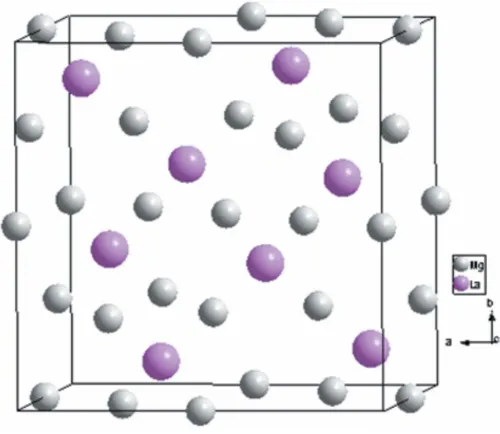
Figure 1
with higher energy density, such as AB2-type Laves phase
alloys (Liaoet al.,2004).
The La–Mg system was critically assessed by means of the calculation of phase diagram (CALPHAD) technique. The solution phases were modeled with the Redlich–Kister equa-tion (Cuiping & Zhenmin, 2004). The intermetallic compounds LaMg, LaMg2and La2Mg17were treated as
stoi-chiometric, while LaMg3 and LaMg12, which have a
homo-geneity range, were treated as (La,Mg)Mg3 and
(La,Mg)-(La,Mg)12, respectively (Cuiping & Zhenmin, 2004). Only
X-ray powder diffraction analysis has previously been undertaken for LaMg2(Kostet al.,1987) and no single-crystal
structural investigation has been carried out.
In the present work, we are interested in the synthesis and determination of the structural arrangement of LaMg2 by
X-ray single-crystal diffraction. The single crystals obtained are not very sensitive to air and moisture.
The structural arrangement of LaMg2at room temperature
seems to be the same as that of the Laves phase structure type of MgCu2. If we consider the arrangement of Mg atoms one
can see that they are disposed at the corners of tetrahedra and that these tetrahedra are linked into a three-dimensional framework by sharing each Mg atom with an adjacent tetra-hedron (Fig. 1); the disposition of the Mg atoms is therefore geometrically the same as that of O atoms in -cristobalite (Evans 1964). The cavities in this framework of Mg atoms are occupied by the larger La atoms, arranged in the same way as the C atoms in diamond.
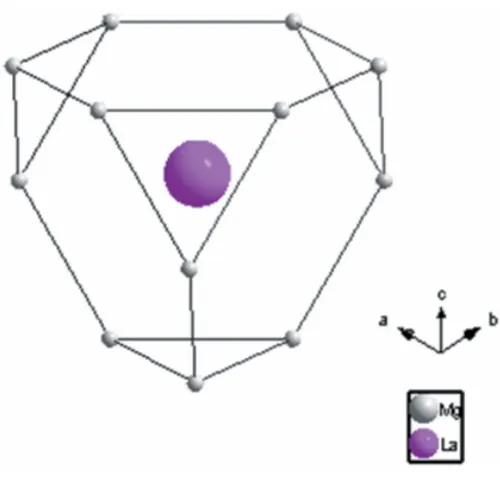
The structure of the title compound contains different coordination polyhedra around the La and Mg atoms. The coordination sphere of lanthanum (site symmetry 1; Fig. 2) consists only of 12 Mg atoms with equal La–Mg distances (Table 1). The polyhedron around lanthanum can be described with four regular triangular faces and four hexagonal faces.
Magnesium (site symmetry 3m) is bonded to six lanthanum and six other magnesium neighbors (Fig. 3), with La—Mg and Mg—Mg distances of 3.6524 (8) and 3.1148 (7) A˚ , respectively, giving rise to distorted MgLa6 and MgMg6 octahedra. The
LaMg12 polyhedra are connected together by sharing
trian-gular faces.
Experimental
During the preparation of alkali/rare earth metal alloys, difficulties arise from the relatively low boiling points of the alkali metals compared with the high melting temperatures of the rare earth metals (Rangeet al.,1989). Essentially, a conventional melting process based on powder metallurgy cannot produce magnesium-based inter-metallics with a specific chemical composition, because magnesium evaporates easily as a result of its high vapor pressure. Thus, a repeated melting process with an additional supply of magnesium is needed to prepare an intermetallic (Liquan et al., 2004). Single crystals were extracted from alloys obtained by arc melting of the initial components (purity better than 99.9%) in an electric arc furnace in an argon atmosphere. A preliminary crystal investigation was performed using Laue and rotation methods (RKV-86 and RGNS-2 chambers, MoKradiation).
Crystal data
LaMg2
Mr= 187.53
Cubic,Fd3m a= 8.810 (2) A˚
V= 683.8 (3) A˚3 Z= 8
Dx= 3.642 Mg m
3
MoKradiation
Cell parameters from 25 reflections
= 2.2–27
= 12.55 mm1
T= 295 K
Elongated tablet, colorless
0.360.10.07 mm
Data collection
Oxford Diffraction Xcalibur point-detector diffractometer
!/2scans
Absorption correction: Gaussian (JANA2000; Petriceket al., 2000)
Tmin= 0.323,Tmax= 0.550
648 measured reflections 50 independent reflections 46 reflections withI> 3(I)
Rint= 0.031
max= 26.6
h=11!11
k=11!11
l= 0!11
3 standard reflections every 100 reflections intensity decay: 1.1%
inorganic papers
i156
Belgacemet al. LaMg [image:2.610.46.296.67.307.2]2 Acta Cryst.(2005). E61, i155–i157
Figure 2
[image:2.610.323.563.72.259.2]Coordination sphere of the La atom in the LaMg2structure.
Figure 3
Refinement
Refinement onF2
R[F2> 2(F2)] = 0.008 wR(F2) = 0.025
S= 1.14
50 reflections
4 parameters
w= 1/[2(I) + 0.0004I2]
(/)max= 0.002
max= 0.11 e A˚
3
min=0.09 e A˚
3
Table 1
Selected geometric parameters (A˚ ,).
La1—Mg1i 3.6524 (8) Mg1—Mg1ii 3.1148 (7)
Mg1i
—La1—Mg1iii
117.036
Mg1i—La1—Mg1iv 95.216
Mg1i
—La1—Mg1 50.479
Mg1i
—La1—Mg1v
144.903 La1vi
—Mg1—La1vii
117.036 La1vi
—Mg1—La1viii
180
La1vi
—Mg1—La1 62.964
La1vi—Mg1—Mg1ii 115.239
La1vi
—Mg1—Mg1 64.761
Mg1ii
—Mg1—Mg1 180
Mg1ii
—Mg1—Mg1v
120 Mg1ii
—Mg1—Mg1 60
Symmetry codes: (i)xþ1;y;z; (ii)yþ1
2;þxþ14;þz14; (iii)þxþ12;y;þzþ12; (iv)
yþ1;þxþ1 4;þzþ
1 4; (v)xþ
1 4;yþ
5
4;z; (vi) x1;y;z; (vii)þx 1 2;y;þz
1 2;
(viii)xþ1;yþ1;z.
Data collection: KM4B8(Galdecki et al., 1996); cell refinement:
KM4B8; data reduction: JANA2000 (Petricek et al., 2000); program(s) used to solve structure:JANA2000; program(s) used to refine structure: JANA2000; molecular graphics: DIAMOND
(Brandenburg, 1999); software used to prepare material for publi-cation:JANA2000.
This work was supported by the Grant Agency of the Czech Republic, grant 202/03/0430.
References
Brandenburg, K. (1999). DIAMOND. Version 2.1c. Crystal Impact GbR,
Bonn, Germany.
Cuiping, G. & Zhenmin, D. (2004).J. Alloys Compd,385, 109–113.
Evans, R. C. (1964).An Introduction to Crystal Chemistry, 2nd ed., pp. 312–
313. Cambridge University Press.
Galdecki, Z., Kowalski, A., Kucharczyk, D. & Uszynski, I. (1996).KM4B8.
Kuma Diffraction Ltd, Wrocław, Poland.
Klaus, S. (2000).J. Solid State Chem.149, 155–166.
Kost, M. E., Kuznetsov, N. T. & Shilov, A. L. (1987).Dokl. Akad. Nauk SSSR,
292, 632–634.
Liao, B., Lei, Y., Chen, L., Pan, H. & Wang, Q. (2004).J. Alloys Compd,376, 186–195.
Liang, J., Xianfeng, M., Jinkui, T., Xuewei, Y., Zhao, W. & Zhao, M. (2003).
Intermetallics,11, 875–878.
Liquan, L., Saita, I., Saito, K. & Akiyama, T. (2004).J. Alloys Compd,372, 218–223.
Leisure, R., Foster, K., Hightower, J. & Agosta, D. (2003).J. Alloys Compd,
356, 283–289.
Petricek, V., Dusek, M. & Palatinus, L. (2000).JANA2000. Institute of Physics, Prague, Czech Republic.
Range, K. J., Klement, U. & Rau, F. (1989).Acta Cryst.C45, 1069–1070.
inorganic papers
Acta Cryst.(2005). E61, i155–i157 Belgacemet al. LaMg
supporting information
sup-1 Acta Cryst. (2005). E61, i155–i157
supporting information
Acta Cryst. (2005). E61, i155–i157 [https://doi.org/10.1107/S1600536805021343]
Lanthanum dimagnesium
Besma Belgacem, Samia Yahyaoui, P. Yu. Demchenko, O. I. Bodak, Michal Dusek and Rached
Ben Hassen
Lanthanum Dimagnesium
Crystal data
LaMg2
Mr = 187.53
Cubic, Fd3m
Hall symbol: -F 4vw 2vw 3
a = 8.810 (2) Å
V = 683.8 (3) Å3
Z = 8
F(000) = 648
Dx = 3.642 Mg m−3
Mo Kα radiation, λ = 0.71069 Å Cell parameters from 25 reflections
θ = 2.2–27°
µ = 12.55 mm−1
T = 295 K
Elongated tablet, colorless 0.36 × 0.1 × 0.07 mm
Data collection
Oxford Diffraction point-detector diffractometer
Radiation source: fine-focus sealed tube Graphite monochromator
ω/2θ scans
Absorption correction: gaussian (JANA2000; Petricek et al., 2000)
Tmin = 0.323, Tmax = 0.550 648 measured reflections
50 independent reflections 46 reflections with I > 3σ(I)
Rint = 0.031
θmax = 26.6°, θmin = 4.0°
h = −11→11
k = −11→11
l = 0→11
3 standard reflections every 100 reflections intensity decay: 1.1%
Refinement
Refinement on F2
R[F > 3σ(F)] = 0.008
wR(F) = 0.025
S = 1.14 50 reflections 4 parameters
Primary atom site location: Patterson
Secondary atom site location: difference Fourier map
Weighting scheme based on measured s.u.'s w = 1/(σ2(I) + 0.0004I2)
(Δ/σ)max = 0.002 Δρmax = 0.11 e Å−3 Δρmin = −0.09 e Å−3
Special details
Geometry. All e.s.d.'s (except the e.s.d. in the dihedral angle between two l.s. planes) are estimated using the full covariance matrix. The cell e.s.d.'s are taken into account individually in the estimation of e.s.d.'s in distances, angles and torsion angles; correlations between e.s.d.'s in cell parameters are only used when they are defined by crystal symmetry. An approximate (isotropic) treatment of cell e.s.d.'s is used for estimating e.s.d.'s involving l.s. planes.
supporting information
sup-2 Acta Cryst. (2005). E61, i155–i157
Fractional atomic coordinates and isotropic or equivalent isotropic displacement parameters (Å2)
x y z Uiso*/Ueq
La1 0.625 0.625 0.125 0.0195 (2) Mg1 0 0.5 0 0.0145 (2)
Atomic displacement parameters (Å2)
U11 U22 U33 U12 U13 U23
La1 0.0195 (2) 0.0195 (2) 0.0195 (2) 0 0 0
Mg1 0.0145 (3) 0.0145 (3) 0.0145 (3) −0.0012 (5) −0.0012 (5) −0.0012 (5)
Geometric parameters (Å, º)
La1—Mg1i 3.6524 (8) La1—Mg1x 3.6524 (8) La1—Mg1ii 3.6524 (8) La1—Mg1xi 3.6524 (8) La1—Mg1iii 3.6524 (8) La1—Mg1xii 3.6524 (8) La1—Mg1iv 3.6524 (8) Mg1—Mg1xiii 3.1148 (7) La1—Mg1v 3.6524 (8) Mg1—Mg1xiv 3.1148 (7) La1—Mg1vi 3.6524 (8) Mg1—Mg1vii 3.1148 (7) La1—Mg1vii 3.6524 (8) Mg1—Mg1xv 3.1148 (7) La1—Mg1viii 3.6524 (8) Mg1—Mg1xvi 3.1148 (7) La1—Mg1ix 3.6524 (8) Mg1—Mg1xii 3.1148 (7)
supporting information
sup-3 Acta Cryst. (2005). E61, i155–i157
supporting information
sup-4 Acta Cryst. (2005). E61, i155–i157
Mg1vii—La1—Mg1viii 117.036 La1xxi—Mg1—Mg1xii 64.761 Mg1vii—La1—Mg1ix 117.036 La1xxii—Mg1—La1xvii 62.964 Mg1vii—La1—Mg1x 95.216 La1xxii—Mg1—La1xviii 62.964 Mg1vii—La1—Mg1xi 95.216 La1xxii—Mg1—La1xix 180 Mg1vii—La1—Mg1xii 50.479 La1xxii—Mg1—La1xx 117.036 Mg1viii—La1—Mg1i 95.216 La1xxii—Mg1—La1xxi 117.036 Mg1viii—La1—Mg1ii 50.479 La1xxii—Mg1—Mg1xiii 115.239 Mg1viii—La1—Mg1iii 95.216 La1xxii—Mg1—Mg1xiv 64.761 Mg1viii—La1—Mg1iv 95.216 La1xxii—Mg1—Mg1vii 64.761 Mg1viii—La1—Mg1v 144.903 La1xxii—Mg1—Mg1xv 115.239 Mg1viii—La1—Mg1vi 50.479 La1xxii—Mg1—Mg1xvi 64.761 Mg1viii—La1—Mg1vii 117.036 La1xxii—Mg1—Mg1xii 115.239 Mg1viii—La1—Mg1ix 117.036 Mg1xiii—Mg1—Mg1xiv 180 Mg1viii—La1—Mg1x 50.479 Mg1xiii—Mg1—Mg1vii 120 Mg1viii—La1—Mg1xi 144.903 Mg1xiii—Mg1—Mg1xv 60 Mg1viii—La1—Mg1xii 95.216 Mg1xiii—Mg1—Mg1xvi 60 Mg1ix—La1—Mg1i 50.479 Mg1xiii—Mg1—Mg1xii 120 Mg1ix—La1—Mg1ii 95.216 Mg1xiv—Mg1—Mg1xiii 180 Mg1ix—La1—Mg1iii 144.903 Mg1xiv—Mg1—Mg1vii 60 Mg1ix—La1—Mg1iv 50.479 Mg1xiv—Mg1—Mg1xv 120 Mg1ix—La1—Mg1v 95.216 Mg1xiv—Mg1—Mg1xvi 120 Mg1ix—La1—Mg1vi 95.216 Mg1xiv—Mg1—Mg1xii 60 Mg1ix—La1—Mg1vii 117.036 Mg1vii—Mg1—Mg1xiii 120 Mg1ix—La1—Mg1viii 117.036 Mg1vii—Mg1—Mg1xiv 60 Mg1ix—La1—Mg1x 144.903 Mg1vii—Mg1—Mg1xv 180 Mg1ix—La1—Mg1xi 50.479 Mg1vii—Mg1—Mg1xvi 120 Mg1ix—La1—Mg1xii 95.216 Mg1vii—Mg1—Mg1xii 60 Mg1x—La1—Mg1i 95.216 Mg1xv—Mg1—Mg1xiii 60 Mg1x—La1—Mg1ii 95.216 Mg1xv—Mg1—Mg1xiv 120 Mg1x—La1—Mg1iii 50.479 Mg1xv—Mg1—Mg1vii 180 Mg1x—La1—Mg1iv 144.903 Mg1xv—Mg1—Mg1xvi 60 Mg1x—La1—Mg1v 95.216 Mg1xv—Mg1—Mg1xii 120 Mg1x—La1—Mg1vi 50.479 Mg1xvi—Mg1—Mg1xiii 60 Mg1x—La1—Mg1vii 95.216 Mg1xvi—Mg1—Mg1xiv 120 Mg1x—La1—Mg1viii 50.479 Mg1xvi—Mg1—Mg1vii 120 Mg1x—La1—Mg1ix 144.903 Mg1xvi—Mg1—Mg1xv 60 Mg1x—La1—Mg1xi 117.036 Mg1xvi—Mg1—Mg1xii 180 Mg1x—La1—Mg1xii 117.036 Mg1xii—Mg1—Mg1xiii 120 Mg1xi—La1—Mg1i 50.479 Mg1xii—Mg1—Mg1xiv 60 Mg1xi—La1—Mg1ii 144.903 Mg1xii—Mg1—Mg1vii 60 Mg1xi—La1—Mg1iii 95.216 Mg1xii—Mg1—Mg1xv 120 Mg1xi—La1—Mg1iv 95.216 Mg1xii—Mg1—Mg1xvi 180
Symmetry codes: (i) x+1, y, z; (ii) x+1/2, y, z+1/2; (iii) x+1/2, y+1/2, z; (iv) −y+1, x+1/4, z+1/4; (v) −y+1, x+3/4, z−1/4; (vi) −y+3/2, x+3/4, z+1/4; (vii) −x+1/4, −y+5/4, z; (viii) −x+3/4, −y+5/4, z+1/2; (ix) −x+3/4, −y+3/4, z; (x) y+1/4, −x+1, z+1/4; (xi) y+1/4, −x+1/2, z−1/4; (xii) y−1/4, −x+1/2, z+1/4; (xiii) −y+1/2, x+1/4, z−1/4; (xiv) −y+1/2, x+3/4, z+1/4; (xv) −x−1/4, −y+3/4, z; (xvi) y−3/4, −x+1/2, z−1/4; (xvii) x−1, y, z; (xviii) x−1/2, y, z−1/2; (xix) x−1/2,