An Evaluation of the Further Mathematics Support
Programme : Research Report
BOYLAN, Mark <http://orcid.org/0000-0002-8581-1886>, DEMACK, Sean <http://orcid.org/0000-0002-2953-1337>, STEVENS, Anna
<http://orcid.org/0000-0002-9450-890X>, COLDWELL, Michael <http://orcid.org/0000-0002-7385-3077> and STIELL, Bernadette <http://orcid.org/0000-0001-8784-6989>
Available from Sheffield Hallam University Research Archive (SHURA) at: http://shura.shu.ac.uk/14897/
This document is the author deposited version. You are advised to consult the publisher's version if you wish to cite from it.
Published version
BOYLAN, Mark, DEMACK, Sean, STEVENS, Anna, COLDWELL, Michael and STIELL, Bernadette (2016). An Evaluation of the Further Mathematics Support Programme : Research Report. Project Report. Sheffield Hallam University.
Copyright and re-use policy
See http://shura.shu.ac.uk/information.html
Sheffield Hallam University Research Archive
An Evaluation of the Further
Mathematics Support
Programme
Research Report
Undertaken 2014-2016 and reported in May 2016
Mark Boylan, Sean Demack, Anna Stevens, Mike Coldwell,
Bernadette Stiell
Acknowledgements
Table of Contents
Executive Summary
1. Introduction 27
2. A level Mathematics and Further Mathematics in England 29
2.1 AS and A level Mathematics and Further Mathematics qualifications in England 29 2.2 Participation in A level Mathematics and Further Mathematics 30
2.3 Patterns of participation 33
3. The Further Mathematics Support Programme 37
3.1 Overview 37
3.2 Components of the FMSP programme 38
3.3 Previous evidence of quality and impact of activities 41
4. Evaluation Methodology 42
4.1 Overview 42
4.2 Design 43
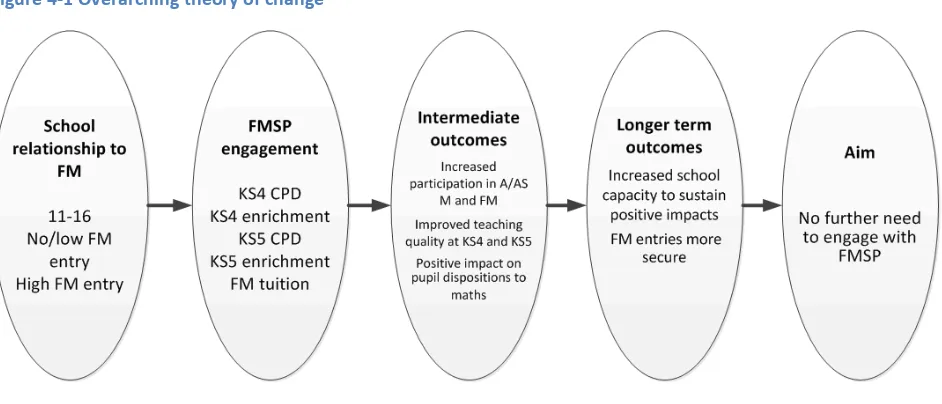
4.3 The initial FMSP theory of change 44
4.4 Analysis of participation and engagement in Further Mathematics and FMSP 44
4.5 Modelling the Further Mathematics landscape 45
4.6 Qualitative evaluation of the FMSP 46
4.7 Synthesis of evaluation data 48
5. Security of school participation in Further Mathematics 50
5.1 State establishments that offer Further Mathematics 50
5.2 Developing the Further Mathematics secure construct 50
5.3 School characteristics and Further Mathematics security 53
5.4 Change in Further Mathematics security status 54
6. Modelling student participation and attainment in A level Mathematics, Further
Mathematics and the FMSP 56
6.1 Measuring participation and attainment in A level Mathematics and Further
Mathematics 56
6.2 Modelling participation and attainment 56
6.3 Modelling FMSP Engagement 62
7. Reviewing participation in the FMSP activity 68
7.1 FMSP enrichment activity 68
7.2 Teacher professional development 70
7.3 FMSP Tuition 71
7.4 Registered users 72
7.5 School level engagement in different components 72
7.6 Engagement with HEI departments 73
8. School engagement and teacher, and student perspectives on the FMSP 74
8.1 School engagement with the FMSP 74
8.2 FMSP engagement and security status 75
8.3 Teacher views of the FMSP 77
8.4 Student views on FMSP activity 82
8.5 View of the FMSP as a whole 85
9. Engagement with Maths Hubs 89
9.1 FMSP engagement with Hubs 89
9.2 Hub and teacher views on priorities 90
9.3 Enablers and Barriers to engagement with the FMSP by Maths Hubs 92
10. Further Mathematics capital and ecologies 93
10.1 Reasons for choosing and not choosing Further mathematics 93
10.2 Further Mathematics capital 95
10.3 Further Mathematics ecologies 101
11. Evaluation, priorities and recommendations for the Further Mathematics Support
Programme 103
12. Conclusion 108
13. References 109
Annexe 1: Detail of the evaluation methodology 111
Annexe 2: Measuring Participation and Attainment in A level Mathematics and Further
Mathematics 124
List of Figures and Tables
Figure (i) Overarching Theory of Change 11
Table (i) Participation in A & AS level Maths & Further Maths 2004-2015 12 Table (ii) State establishments with candidates taking Further Mathematics 13
Table (iii) Construction of the security status 13
Table (iv) Change in security 2013 to 2015 14
Table (v) Sample of interviews by security status (2013/14) 17
Figure 1 Structure of the evaluation report 28
Table 2-1 Participation in A & AS level Mathematics & Further Mathematics 2001-2015 30 Table 2-2 Participation in A & AS level Mathematics & Further Mathematics 2001-2015 (change
over time) 31
Table 2-3 Participation in A level Mathematics & Further Mathematics 2001-2015 by gender 33 Table 2-4 Participation in AS level Mathematics & Further Mathematics 2001-2015 by gender 34
Figure 4-1 Overarching theory of change 44
Table 5-1 State establishments that offer Further Mathematics 50 Table 5-2 Towards a Further Mathematics A level 'secure' scale (state sector only) 52 Table 5-3 Security status of schools for 11/12, 12/13 and 13/14 data (maintained schools only) 52 Figure 5-4 Relationship between school type and security status (school level) 53
Table 5-5 Change in security 2013 to 2015 54
Table 5-6 Frequency of security status 2013, 2014 and 2015 55
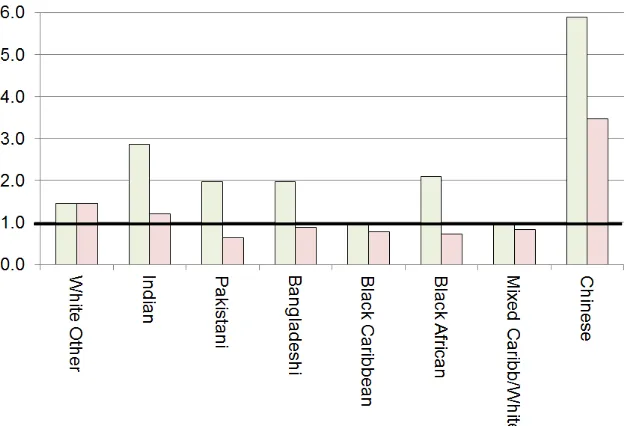
Figure 6-1 Participation in A level Mathematics & Further Mathematics by ethnic group 59
Table 7-1 Maths Feast entries (Year 10 competition) 69
Table 7-2 Senior Mathematics Team Challenge entries (Year 12/13 competition) 70
Table 7-3 Teacher days of CPD 70
Table 7-4 Students involved in tuition 71
Table 7-5 Number of centres registered with FMSP 72
Table 7-6 Summary of numbers participating in different programme component 72 Figure 7-1 Interrelationship of engagement in different programme component 73
Table 8-2 Total number of FMSP activities in which centres are involved 75 Figure 8-1 Relationship between number of FMSP activities involved in and security status 76 Figure 8-2 Relationship between FMSP involvement and security status 76
Table 8-3 Reasons/benefits for accessing tuition 78
Table 8-4 Summary of security status and enrichment activities 80 Table 9-1 How often and in what ways FMSP works with the Hubs 89 Table 9-2 How often and in what ways the Hubs work with FMSP 90
Table 9-3 FMSP co-ordinator 90
Table 9-4 Priorities 90
Figure 10-1 Further mathematics culture 100
Figure 10-2 the FMSP ecology 101
Figure A1-1 Theory of change for 11-16 schools 113
Figure A1-2 Theory of change for no or low FM entry school 114
Figure A1-3 Theory of change for higher further mathematics entry centres 115 Table A1-1 Analyses of Participation and Attainment in A and AS level Mathematics and Further
Mathematics. 119
Glossary
A level: Advanced Level
AEA: Advanced Extension Award in Mathematics offered by Edexcel examination board
AS level: Advanced Subsidiary Level
Centre: School/College
CPD: Continuing Professional Development
EAL: English as an additional language
FM: Further Mathematics
FMSP: Further Mathematics Support Programme
FSM: Free School Meals
GCSE: General Certificate of Secondary Education
HE: Higher Education
HEI: Higher Education Institution
KS3: Key Stage 3 (Years 7 to 9)
KS4: Key Stage 4 (Years 10 to 11)
KS5: Key Stage 5 (Years 12 and 13)
Level 3 mathematics education: a qualification designed for students who have achieved a grade C or above at GCSE
LIL: Live interactive lectures, fortnightly lectures in an online classroom by an FMSP tutor
LPP: Low participation providers
LOT: Live online tuition
MAT: Mathematics Admissions Test developed by Oxford University and used for admission to Oxford’s and Imperial College London's mathematics degrees
MEI: Mathematics in Education and Industry
NCETM: National Centre for Excellence in the Teaching of Mathematics
NPD: National Pupil Database
PD: Professional development
SEN: Special educational needs
SAP: School Action Plus
TAM: Teaching Advanced Mathematics
TFM: Teaching Further Mathematics
1. Executive summary
The Further Mathematics Support Programme
The Further Mathematics Support Programme (FMSP) is managed by the MEI through an extended partnership with the NCETM (Tribal), and the University College London Institute of Education. It was established in 2009, following on from the Further Mathematics Network (2005-2009), which was also managed by MEI. A central team supports a network of Area Coordinators and others to deliver the programme nationally.
It aims to:
• increase participation in AS/A level Mathematics and Further Mathematics, particularly that of girls and those from other under-represented groups
• increase capacity within schools and colleges to provide high quality mathematics teaching
• increase demand from students to study AS/A level Mathematics and Further Mathematics post-16
• support improvements in Level 3 mathematics education
To further these aims, the FMSP programme goes beyond focusing only on AS/A level Further Mathematics and A level Mathematics qualifications. It also seeks to address how to engage KS4 and other learners in developing enthusiasm for and a positive attitude to mathematics, through targeted professional development and other programmes.
The principal components of the FMSP are:
• tuition support for AS/A level Further Mathematics through both face to face and on-line programmes
• continuing Professional Development (CPD) for teachers to support teaching of Further Mathematics and A level Mathematics, as well as professional development focused on GCSE mathematics that fosters teaching approaches for younger students to prepare them for further study and increase their motivation to study more mathematics post-16 • enrichment activities that aim to increase demand from students to study AS/A level
• regional support from Area Coordinators who coordinate regional activity and offer tailored face to face support and advice to teachers and mathematics leaders in relation to FMSP aims and provision
• on-line support including the FMSP website and access to MEI’s Integral Virtual Learning Environment containing online resources
• mathematics competitions
• support for high level mathematical problem solving including support for university entrance exams in mathematics
Evaluation of previous phases of the FMSP programme found that the FMSP’s work is effective and of high quality.
Evaluation methodology
The four key focus areas for the 2014-16 evaluation were to consider:
• capacity and capability building
• reach to schools/colleges, teachers and students • effectiveness of the programme (quality and impact) • sustainability beyond the end of the programme
The evaluation also sought to assess the viability and value of quantitative modelling of Further Mathematics and FMSP activity, including identifying any relevant issues in drawing together disparate databases, to provide a quantitative baseline for future evaluation and to develop tools for future evaluation, including assessing the value of focus group interviews with students as a data collection method.
Figure (i) Overarching Theory of Change
The evaluation used a mixed methods research design comprising:
• quantitative analysis of school and pupil participation and attainment in A and AS level
Further Mathematics and Mathematics
• analysis of School Census data and data from the National Pupil Database, and of internal
data held by the Further Mathematics Support Programme on participation in FMSP
activities
• qualitative analysis of data from telephone and face to face interviews with teachers and
focus groups with A level Mathematics and Further Mathematics students, supported by
a survey of Maths Hub leads
Analysis of the school level census data was used to develop a ‘security of provision’ construct of
A level Further Mathematics entries over a 3 year period as a measure of the extent to which the
programme is effective in developing 'capacity and capability' as well as sustainability. Security of
provision was cross-tabulated with school characteristics to model how A level Further
Mathematics entries vary according to school characteristics. The relationship between security
of provision status and records of centre involvement in FMSP CPD, enrichment and tuition was
analysed.
Student participation and attainment in A level Mathematics and A level Further Mathematics
were modelled using multivariate multilevel regression. Data from the National Pupil Database
(NPD) was retrieved and used for the complete cohort of pupils in England who (a) completed
Key Stage 4 in 2010/11 and (b) are recorded as taking a KS5 assessment between 2011/12 and
2013/14. Engagement with the FMSP was brought in as a school level explanatory variable.
synthesising a number of data sets developed for distinct purposes and so represent a limited range of support and engagement. Therefore this analysis is limited in reflecting the full
relationship between school level involvement with the FMSP and pupil participation in Further Mathematics. Historical data including, if possible, data at pupil level would be needed to fully investigate this relationship.
A total of 42 interviews (37 by telephone and 5 face to face) were conducted with teachers from centres with varying of numbers of Further Mathematics entries and a variety of levels of
involvement in FMSP activities. Five focus groups involving a total of 44 students were conducted in centres from two English regions. To supplement the teacher interviews a short survey,
including some open questions was conducted with Maths Hub leads to gain their views on how the FMSP and the Hubs currently work together and priorities for the coming year.
Further Mathematics security
Since 2004 both the numbers taking AS and A level Mathematics and AS and A level Further Mathematics have increased (Table i).
Table (i) Participation in A & AS level Maths & Further Maths 2004-2015
Total number of A level entries
A level Maths entries as a % of total entries A level Further Maths entries as
a % of total entries
Total number of AS level entries
AS level Maths as a % of total entries
AS level Further Maths as a % of total entries
2004 675,924 6.8% 0.8% 878,794 5.8% 0.3% 2015 758,768 10.8% 1.8% 1,086,702 10.2% 1.5%
Source: Adapted from the Statistical First Release - SFR 38 2015 Table 14 (see www.gov.uk/government/statistics/a-level-and-other-level-3-results-2014-to-2015-provisional)
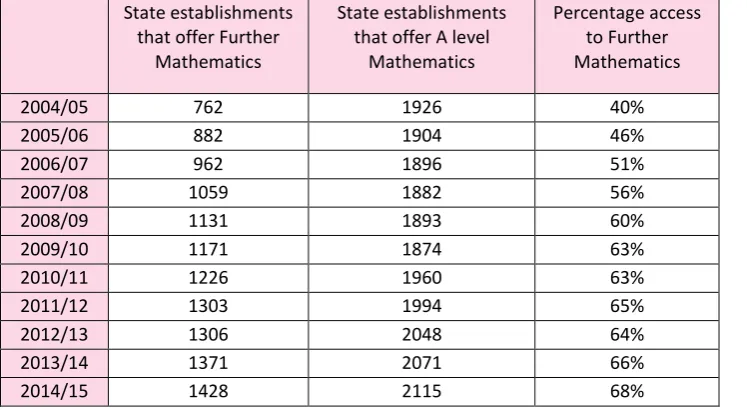
Table (ii) State establishments with candidates taking Further Mathematics
State establishments with candidates taking A level Further
Mathematics
State establishments with candidates taking A
level Mathematics
Percentage access to Further Mathematics
2004/05 762 1926 40%
2009/10 1171 1874 63%
2014/15 1428 2115 68%
Source: DfE/MEI
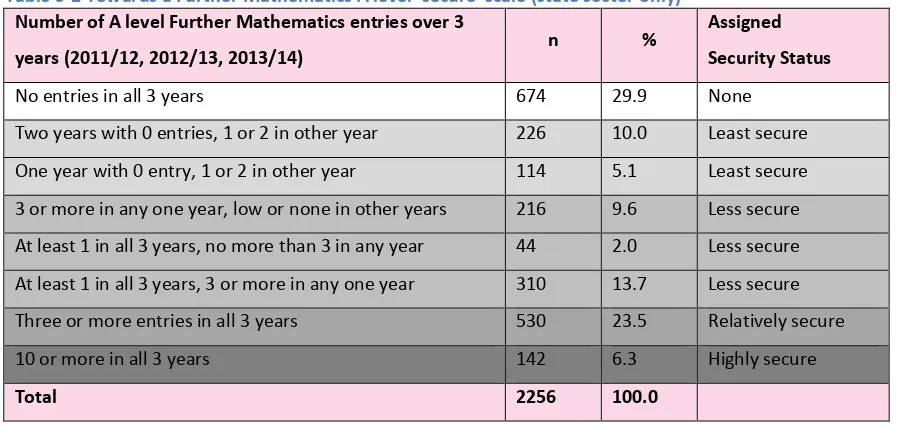
A "security status" for centres was constructed that considered the stability in the number of A level Further Mathematics entries over time. Table (iii) below shows how these security statuses were constructed from the number of A level Further Mathematics entries.
Table (iii) Construction of the security status
Number of A level Further Mathematics entries over 3
years (2011/12, 2012/13, 2013/14) n %
Assigned
Security Status
No entries in all 3 years 674 29.9 None
Two years with 0 entries, 1 or 2 in other year 226 10.0 Least secure
One year with 0 entry, 1 or 2 in other year 114 5.1 Least secure
3 or more in any one year, low or none in other years 216 9.6 Less secure
At least 1 in all 3 years, no more than 3 in any year 44 2.0 Less secure
At least 1 in all 3 years, 3 or more in any one year 310 13.7 Less secure
Three or more entries in all 3 years 530 23.5 Relatively secure
10 or more in all 3 years 142 6.3 Highly secure
Total 2256 100.0
Source: adapted from 16-18 qualification and subject level results http://www.education.gov.uk/schools/performance/download_data.html
Using data from 2013/14, 2012/13 and 2011/12 entries, security status for 2013/14 was considered in relation to school/college characteristics. The following was found:
• selective schools are most likely to have secure numbers of students taking Further Mathematics A level
• schools with higher numbers of Further Mathematics students have lower levels of students eligible for FSM
• there is little difference in Further Mathematics uptake amongst schools with varying proportions of students with EAL
• schools with a male only intake (at KS5) have significantly higher numbers of students taking Further Mathematics compared with female only schools and mixed schools. This is also reflected when looking at the average proportion of males on roll compared with average proportion of females on roll: highly secure schools have an average of 70% of boys on roll and 30% of girls on roll, whereas for relatively secure schools and less secure schools the average percentage of boys on roll and girls on roll is very similar (close to 50/50)
• higher attaining schools at KS4 (based on % attaining 5+ A*- C including English and maths GCSEs) have higher proportions of students doing A level Further Mathematics
• similarly schools with higher average point scores at KS5 have a larger proportion of students doing Further Mathematics
Security status was calculated for a further two periods of 3 years and patterns of change identified. The table below summarises changes from 2012/13 (based on 2010/11, 2011/12, 2012/13 entries) to 2014/15 (based on 2012/13, 2013/14, 2014/15 entries):
Table (iv) Change in security 2013 to 2015
2 0 1 2 /1 3 (2 0 1 0 /1 1 , 2 0 1 1 /1 2 , 2 0 1 2 /1 3 d a ta
) 2014/15 (2012/13, 2013/14, 2014/15 data)
None Least secure Less secure Relatively secure Highly
secure Total
None 487 104 56 0 0 647
Least
secure 76 132 108 0 0 316
Less secure 13 56 334 138 1 542
Relatively
secure 0 0 91 368 35 494
Highly
secure 0 0 0 28 107 135
Total 576 292 589 534 143 2134
• in total 706 centres experienced a change in status (33% of the total)
• 442 centres moved towards a more secure status (63% of those experiencing a change in status)
• of the 647 centres who had no records for A level Further Mathematics in 2010/11, 2011/12 or 2012/13, 160 (25%) moved into the more favourable categories of "least secure" and "less secure"
The general pattern of movement of centres towards a more secure status reflects the general increase in numbers of Further Mathematics students. However, the analysis shows that this increase is not restricted to centres that already had relatively high levels of Further
Mathematics entries. Further, the increase in entries is not merely due to an increase in the number of centres offering Further Mathematics. The analysis also reveals that the number of entries is less stable in less secure centres; there is a continuing fragility of entries in some of these centres. In summary, there has been an increase in both capacity and sustainability of Further Mathematics provision, although there is much potential for further improvements.
Modelling pupil participation in A level Mathematics and Further Mathematics
Data from the National Pupil Database were used to analyse participation in A level Mathematics and Further Mathematics for the pupil cohort in England who completed KS4 / Y11 in 2010/11 (N=637,594) and were recorded as taking at least one KS5 assessment in 2011/12, 2012/13 or 2013/14 (this was the case for 64.7% of the 2010/11 KS4 cohort, N=412,743).
Multivariate, multilevel models of participation and attainment in A level Mathematics and Further Mathematics were developed. The models were used to examine differences and similarities between participation and attainment in A level Mathematics and Further Mathematics by considering the following explanatory variables:
• prior attainment at KS4 (overall and in mathematics) • gender
• whether a pupil was eligible for, and parents claimed for Free School Meals (FSM) in 2010/11 (as a rough proxy for socioeconomic position)
• ethnicity • institution type
• engagement with a subset of FMSP activity for which data was available
and Further Mathematics (between 2011/12 and 2013/14). This may reflect that, for FMSP, 'impact' is more likely to be observed at an institutional or (education) system rather than individual student level.
Reviewing the FMSP’s activity
During the period April 2014 to March 2016 there were over 22,800 occasions on which 11-16 students participated in FMSP enrichment events. Students and teachers judged these to be of high quality and they had a positive impact on student thinking about post 16 mathematics study. Events were varied including focusing on problem solving as well as a range of other events such as mathematical competitions.
The FMSP delivered more than 2000 days of CPD for A level Mathematics and Further
Mathematics across a range of both face to face and on line courses in 2014/15 and in 2015/16. In addition, 670 days of CPD were delivered to KS4 teachers in 2014/15 and over 1400 in
2015/16. The feedback for courses ranged from good to excellent.
The number of students who access FMSP tuition has declined over time as school capacity to offer Further Mathematics in house has increased. In 2014/15 201 students accessed 519 units of tuition, comprising 202 face to face units and 317 units of Live Online Tuition.
Currently 3446 schools/colleges are registered with FMSP consisting of 672 that have students up to KS4, 2585 that have students up to KS5, 177 with KS5 students only, and 12 other.
The FMSP has engaged with HEI departments, encouraging the uptake of AS/A level Mathematics and Further Mathematics. In 2015, meetings/discussions with 99 HE departments took place resulting in 18 indicating a willingness to increase encouragement for Further Mathematics and 4 for Mathematics.
Considering this activity as a whole, it is clear that the FMSP has considerable reach relevant to its aims.
School/college FMSP engagement and student and teacher perspectives on the
FMSP
from the year 2013/14. Note that this does not reflect total involvement of centres with the FMSP since this is restricted to one year and certain activities. Of the 1110 centres that had no records of involvement in 2013/14, only 122 did not appear on the FMSP administrative
database of schools/colleges registered with the FMSP. All centres registered with the FMSP are sent regular updates on activities and opportunities, through electronic communications and hard mailings.
The sample for the teacher interviews was drawn from centres who had varying levels of security of provision, including those who had improved their 'security rating' based on data from the quantitative analysis. The security rating of these centres in 2013/14 is shown below (Table v):
Table (v) Sample of interviews by security status (2013/14)
None
Least secure
Less secure
Relatively secure
Highly
secure Total
Number of centres 7 5 16 10 4 42
Out of the 42 teacher interviews conducted, 18 in total indicated that their centres were involved in some form of tuition. The teachers who were involved in tuition were in general positive about it, typical comments were 'excellent' and 'very valuable for students'. Five out of the ten teachers from those schools classified as low or least Further Mathematics secure using tuition expressed various concerns related generally to their capacity to provide additional support to their
students which they considered necessary to supplement on-line tuition, in particular. This indicates the importance of support through CPD and on-line materials for teachers in centres that are involved in tuition. However, all teachers interviewed in low or least secure centres were generally of the view that tuition was important to allow students in their centres to access Further Mathematics at all. This was important for some to retain their strongest students and so additionally supported A level provision. Teachers at the 8 centres with secure or highly secure Further Mathematics stated that tuition provided an enriched experience for students, two of these also pointed to cost saving implications.
Nearly all teacher interviewees had accessed elements of the FMSP enrichment programme for their students with all aspects of enrichment activities represented in the sample. The
enrichment activities accessed were reported to have improved student motivation; enabled students to explore mathematics in context; engage with problem solving; gain an insight into what careers were possible with mathematics qualifications; provide positive role models for girls. Team challenges had allowed the students to develop their capacity to work together.
In general, teacher interviewees were also positive about Area Coordinators and on-line support. Irrespective of their roles, engagement with the programme or Further Mathematics security, teachers were overwhelmingly positive about the FMSP and the programme continues to be held in high regard by teachers. A teacher at one centre reported that the FMSP support was
important to achieving the current relatively secure status. Four of the interviewees from less secure and least secure categorised centres who engaged with CPD but not tuition suggested that without the FMSP CPD offer Further Mathematics may not be undertaken at all. Thus in total some 57% (12 of 21) of interviewees who were from centres with lower security pointed to the FMSP as essential to offering Further Mathematics.
Students' engagement with, and experience of the FMSP, was explored as part of the five focus groups conducted with 44 students. Students had varying opportunities and experiences of enrichment, depending on the extent to which teachers in their centres had engaged with local opportunities. Students overwhelmingly valued and enjoyed enrichment experiences. Some expressed pride at being selected to take part in junior and senior mathematics challenges, but the extent to which these were offered varied between centres. Some students expressed concern about equity in who was picked to take part in activities.
Overall, enrichment tended to positively influence their enjoyment of mathematics over the years, giving them opportunities to experience problem solving and team based activities that required them to apply and develop their skills in new ways. Their enjoyment of mathematics generally increased as a result, which then impacted on their choice of A levels.
Engagement with Maths Hubs
A short online survey was conducted in January 2016 with Maths Hub leads to gain their
Most respondents (83%) indicated that the FMSP worked with the Hubs as often as needed and in general Hub leads reported that the FMSP and the Hubs worked together effectively on most areas of work. Approximately a quarter of Hub leads considered there could be better
collaboration on planning and publicising joint student and teacher events. In 61% of Hubs that responded, the FMSP Area Coordinator was a member of the strategic group for their Hub, whilst 87% indicated that the FMSP Area Coordinator was a member of one or more working groups. Hub leads were asked in the survey about what the future priorities should be for FMSP. Perhaps unsurprisingly the main priorities identified related to KS5 with activity in KS4 being less of a priority. Hub leads were asked about barriers to engagement with the FMSP and identified the following: time, geography (including mismatch between FMSP areas and Hub areas); capacity in centres to get involved; the need for a shared vision and role clarity.
Reasons for choosing and not choosing A level Mathematics and Further
mathematics
Student focus group interviews, supported by analysis of teacher interviews, identified the following features as positively influencing choice of A level Mathematics and Further Mathematics:
• enjoyment and self-efficacy
• influences of parents/family, and teachers • aspirations
Of these, enjoyment was ranked most highly.
Further Mathematics capital
The concept of Further Mathematics capital is an extension of the concept of science capital - a means to conceptualise the interplay of social, cultural and familial practices, knowledge and relationships that support engagement in science and influence patterns of participation.
Teachers identified the characteristics, context and attainment profile of the school and its student intake as the primary factor that either enabled or in some cases impeded Further Mathematics engagement. Senior leadership support was important, as were personal success stories of students who had excelled in Mathematics/Further Mathematics.
Key aspects of teacher capital found were:
• enjoyment of mathematics
• commitment, energy, accessibility in relation to mathematics
• capacity to teach Further Mathematics (in post 16 settings) or to offer additional support for those taking "Live Interactive Lectures (LiL)" and similar provision
• a Further Mathematics enthusiast/champion (including in 11-16 settings someone who encourages engagement with mathematical problem solving and so on)
Departmental features contributing to organisational capital were:
• cohesive and supportive relationships • specialist mathematics teachers
• contribution to A level teaching being the norm
• commitment to enrichment and a 'love' of mathematics
• investment in students interested/capable of doing Further Mathematics
Impediments to Further Mathematics participation
The following were identified as barriers to participation or success in Further Mathematics:
• lack of confidence was related to less positive previous learning experiences in mathematics
• a lack of 'bridging' qualifications, leading to a significant jump from GCSE to A level Mathematics/Further Mathematics
• school timetabling issues meaning students were not able to take Further Mathematics in combination with non-science subjects (more frequently cited by girls)
• lack of encouragement by universities for those wanting to study medicine or biological/health related courses
• the impact and the availability of Further Mathematics in-house most keenly experienced by centres with lower security ratings
• recruitment and retention of experienced/qualified teachers • distance from or links with enrichment at local universities
Most teachers were unsure what the impact of future changes to qualifications and curricula would be, but a few saw this as a potential barrier to future take up of Further Mathematics as a two year A level course in a challenging subject is likely to be thought of as too risky - particularly for less confident students.
FMSP influence on Further Mathematics capital and ecologies
The FMSP positively impacts on Further Mathematics capital through the following aspects of the programme.
• Enrichment experiences. Positive enrichment experiences through KS3 and KS4 were identifiable as a recurring element across a number of student timelines of their mathematical experience and choices. Enrichment experiences also helped support positive mathematical and so Further Mathematics cultures
• Tuition. Making Further Mathematics more available including supporting high security centres to extend module options
• CPD. Strengthening teaching skills
• On-line resources. For other centres (including those with low/no Further Mathematics security), the MEI Integral resources were identified as providing access to materials that helped less experienced staff develop their skills at an individual level
The FMSP is an important part of school-level Further Mathematics ecologies in contexts where the internal ecologies do not support secure or in some cases any Further Mathematics entries.
Evaluation
1. Capacity and capability
The FMSP continues to enhance the capacity and capability of centres to offer Further Mathematics in the following ways:
• contribution to on-going increases in overall key measures: − participation in A level Further Mathematics
− improvements in Further Mathematics security
• teacher CPD that helps to enhance the organisational mathematics capital of centres as well as, indirectly, of individual students. The CPD offer is being taken up to a greater extent in centres that are likely to have the greatest need
• enrichment and tuition also support capacity and capability. This happens for both centres with higher and lower levels of Further Mathematics security
• the FMSP provides a safety net for the least Further Mathematics secure and less Further Mathematics secure centres, which can be at risk of losing Further Mathematics capacity due to low numbers
2. Reach
The FMSP has considerable reach, but there is scope for developing this in a targeted way:
• overall reach is strong as indicated by:
− the number of centres registered
− the number of centres engaging in one or more FMSP activities − the number of teachers participating in CPD
− the number of students participating in enrichment
• the FMSP also successfully engages centres that are a priority – those centres offering A level Mathematics but not yet offering Further Mathematics. At the same time there are still considerable numbers of centres, particularly 11-16 schools that have not yet
registered with the FMSP who could be targeted
• the evaluation highlights groups of priority students for whom the FMSP may need to make particular efforts to reach. The model presented in this report suggests that Further Mathematics is taken by a less diverse group of students than those that take A level Mathematics
3. Effectiveness (quality and impact)
Views of quality
Activity undertaken by the FMSP is overwhelmingly viewed positively by teacher participants. There is evidence from student focus groups and student feedback that, in general, students also view FMSP support favourably.
Impact
The key measures of impact relate to participation in A level Mathematics and Further
Mathematics more generally. It is notable that the increase in Further Mathematics is faster than the increase in A level Mathematics and for centres with low Further Mathematics entries the FMSP is viewed as essential to continue to offer Further Mathematics. Improvements in 'security' status are also an indicator of success in regard to making these increases sustainable.
Intermediate impact measures reported by teachers included increase confidence in teaching, improved subject knowledge, and strengthened pedagogical approaches.
4. Sustainability
The FMSP's reach, quality, capacity/capability-building and impact mean that the enhancement of Further Mathematics cultures and capital are supporting centres to develop secure and so sustainable levels of Further Mathematics entry.
However, the same analysis shows that increases are not uniform. Whilst the numbers of Further Mathematics secure and highly secure centres have increased overall, there are centres where Further Mathematics has become less secure. The qualitative analysis, particularly of enablers and barriers provides indications of why this is the case.
centres, interventions and enhancements such as the FMSP or similar will be needed on an ongoing basis. The concept of 'sustainability' of Further Mathematics provision as an evaluation criteria for the FMSP may be problematic if this is taken to mean that in the short to medium term all centres will achieve fully sustainable provision.
The need for ongoing support
The FMSP and its programme components have grown organically with different aspects of the programme being developed in relation to particular issues as they emerge. The evaluation suggests that more certainty of long term support for the FMSP would greatly assist in enabling the programme to strategically plan and deliver success against its stated aims. The strength of the programme partly lies in its own longevity, and related to this, the positive regard it is held in, flexibility, and therefore ability to support schools and colleges over time, bearing fruit in the ongoing increases in Further Mathematics participation, and Further Mathematics security.
Wider engagement
The FMSP is actively engaged in Maths Hubs and has also created and stimulated teacher networks. However, the potential for those centres with secure Further Mathematics entries to support others is a possible means to extend the Further Mathematics support that can be provided, and therefore enhance the sustainability of FMSP programme impacts. In addition, whilst the Maths Hub leads are key players in support for improvements in mathematics
education, teaching schools are another potential resource, since they have remit and access to resources to support other schools in improving their teaching, and school improvement more broadly.
Future evaluation
The evaluation has indicated that student focus groups are a potentially useful method for
Recommendations
Based on the evaluation findings, recommendations are made below. These largely relate to programme structure and targeting the programme, with an evaluation recommendation and an overarching recommendation on the need to maintain the FMSP.
Programme structure
Recommendation 1: Consider offering tailored CPD focused on 'supporting Further Mathematics students engaged in tuition' as part of tuition packages, given that some teachers interviewed identified a lack of confidence to support students accessing on-line tuition.
Recommendation 2: The recently developed on-line (LIL) tuition has begun to be used by centres with a variety of Further Mathematics security profiles. The FMSP should consider ways in which this can be further enhanced or encouraged.
Recommendation 3: Consider ways that the 'crossover' benefits for the different components of the FMSP offer, such as tuition and teacher professional development can be enhanced, and how existing promotion of these benefits to centres can be improved.
Recommendation 4: The FMSP should consider enhancing materials and information to address students whose primary motivations are related to the enjoyment of mathematics itself as a reason for studying Further Mathematics, in addition to educational and career aspirations.
Targeting the programme
Recommendation 5: Maintain focus on the centres which are least Further Mathematics secure and use this classification as a means to prioritise support.
Recommendation 6: The FMSP should investigate finding ways to further engage 11-16 centres, including increasing the number registered with the FMSP, in order to influence post-16
participation.
Recommendation 7: The FMSP should consider how to further focus efforts - and future research - on understanding and providing appropriate support for students from backgrounds underrepresented in those taking Further Mathematics.
Recommendation 8: Consider further ways to engage with and influence school leaders directly, since the evaluation has underlined the importance of school leadership to support Further Mathematics participation.
Recommendation 9: The FMSP should consider how to engage further with current developments in the school self-improvement agenda beyond work with Maths Hubs.
Potentially, those centres with high Further Mathematics security are an underused resource to support others.
Evaluation
Recommendation 10: Measuring long term impact of professional development and enrichment activities is, in general, more challenging and attention should be paid to this in future
evaluations, potentially this might be linked to further investigation of change in security status.
Maintaining the programme
Recommendation 11: Given the ongoing risks to Further Mathematics sustainability, especially for centres with less secure provision, but even for more secure centres, the FMSP - and its principal funder, the Department for Education - should continue to make the case for the necessity of the programme to support Further Mathematics, and so the FMSP should consider ways to secure long term and more stable funding. The DfE should consider this
1.
Introduction
The Further Mathematics Support Programme (FMSP) was initiated and is managed by
Mathematics in Education and Industry (MEI) with government funding. It aims to improve both the availability and quality of provision for AS/A Level Further Mathematics1 and promote the study of mathematics to 14-19 year old students. AS/A Level Mathematics and Further
Mathematics are usually taken by students who are 16-18 years old and whilst the qualifications have wider value and purpose, they are most notably pre-university qualifications that are important as a route to study of mathematics and mathematics related subjects at university. The study of AS level Further Mathematics increases the breadth of mathematical study and A level Further Mathematics, the depth of study and so is related to accessing the study of mathematics and related degree courses.
The FMSP offers and supports a range of activities to further these aims, including:
• professional development activities for teachers to support the teaching of Further Mathematics, A level and GCSE Mathematics
• direct support for Further Mathematics study through a range of face to face and on-line provision
• enrichment activities for A level and GCSE students • on-line resources and materials for teachers
Previous evaluations of the FMSP (phases 1-4) have indicated that activities are of a high quality, that the programme is well regarded by teachers and other stakeholders, that the programme has had a positive impact on the number of centres offering Further Mathematics A level and is associated with an increase in the number of students taking Further Mathematics AS and A level (Searle, 2012; 2014).
Phase 5 of the evaluation occurs at a significant moment for the FMSP. Externally, changes in both GCSE and the A level curriculum and assessment have been noted as a potential challenge to the growth in engagement with A level Mathematics (ACME 2013). At the same time, this may
1 A level qualifications are typically but not exclusively taken as pre-university qualifications at 18 years old. AS or
potentially lead to an increased demand for professional development in relation to both KS4 and KS5, as centres and teachers review and develop their practices in response to new demands. Further, the 2014 development of the National Centre for Excellence in Teaching Mathematics (NCETM) led Maths Hub initiative presents new challenges of coordination and partnership for the FMSP as well as significant opportunities to develop its reach, capacity, effectiveness and sustainability. In addition, proposed changes to post-16 funding may impact negatively on numbers taking Further Mathematics as it is generally taken as a fourth A level and there are potentially disincentives for centres to support study of more than three A levels. In addition changes in AS may also be significant.
Phase 5 of the evaluation, reported here, builds and extends previous findings of the evaluation of the FMSP by statistical modelling of patterns of centre and student participation and the relationship of this to activities of the FMSP. Drawing on qualitative data it considers enablers and barriers to participation in Further Mathematics using concepts of Further Mathematics capital, culture and ecology to guide further development in promoting post compulsory
mathematical study at Advanced levels. It considers the extent to which the FMSP is successful in meeting its aims in terms of capacity and capability building, reach, effectiveness and
sustainability and identifies issues to consider both for future evaluation and more importantly for the Further Mathematics Support Programme.
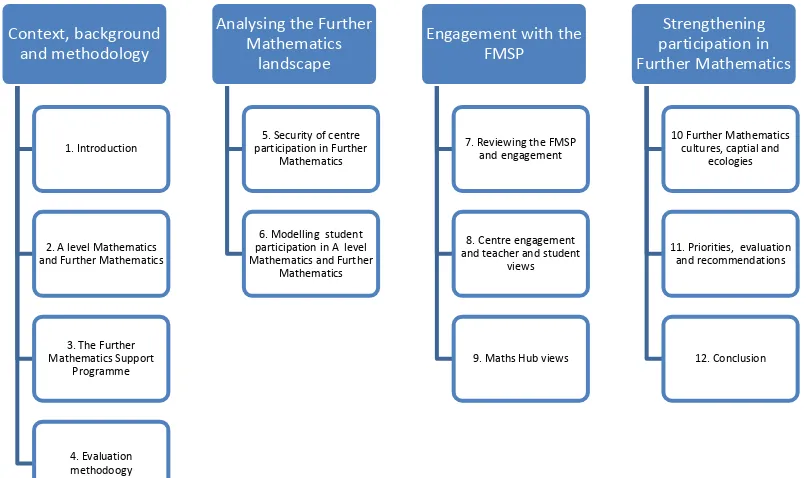
[image:29.595.73.476.522.761.2]The chapters of the report are organised into the sections represented in the figure below.
Figure 1 Structure of the evaluation report
Context, background and methodology
1. Introduction
2. A level Mathematics and Further Mathematics
3. The Further Mathematics Support
Programme
4. Evaluation methodoogy
Analysing the Further Mathematics
landscape
5. Security of centre participation in Further
Mathematics
6. Modelling student participation in A level Mathematics and Further
Mathematics
Engagement with the FMSP
7. Reviewing the FMSP and engagement
8. Centre engagement and teacher and student
views
9. Maths Hub views
Strengthening participation in Further Mathematics
10 Further Mathematics cultures, captial and
ecologies
11. Priorities, evaluation and recommendations
2.
A level Mathematics and Further Mathematics in England
2.1
AS and A level Mathematics and Further Mathematics qualifications in
England
Further Mathematics A level is taken as an additional A level to Mathematics. Students studying Further Mathematics A level have the opportunity to study mathematics in greater depth by studying further and more challenging mathematical content as well as broadening study by additional study of mathematical applications than is possible to choose within single A level Mathematics. Further Mathematics can also be studied as an AS level.
The study of A level Mathematics has been promoted in educational policy in England, in part due to its perceived economic benefits nationally and evidence for an A level Mathematics premium in terms of individual income (Adkins and Noyes, 2016) and concern about the relatively lower proportion of students who study mathematics post-16 compared to other countries (Hodgen, et al., 2013). In addition, arguments for the study and so promotion specifically of Further Mathematics include:
• concern about the content, depth and demand of the main A level syllabi (Jones et al, 2016)
• the value of Further Mathematics qualifications in access to university, particularly to study mathematics and at selective institutions (Searle, 2014)
• the association between the introduction of Further Mathematics and rises in A level participation and outcomes at school level (Searle, 2014; Golding and Smith, 2016) • evidence of wider positive impacts on departments introducing Further Mathematics on
student retention and support for a range of aspirational pathways, teacher retention and development, enhancement of pedagogy and students' mathematical experience (Golding and Smith, 2016)
2.2
Participation in A level Mathematics and Further Mathematics
A level Mathematics and Further Mathematics entries over time
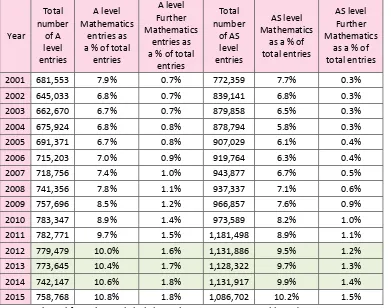
Table 2-1 summarises A and AS level entries in Mathematics and Further Mathematics for
students in England 2001 to 2015 taken from Governmental Statistical First Release publications.
Table 2-1 Participation in A & AS level Mathematics & Further Mathematics 2001-2015
Year Total number of A level entries A level Mathematics entries as a % of total
entries
A level Further Mathematics
entries as a % of total
entries Total number of AS level entries AS level Mathematics
as a % of total entries
AS level Further Mathematics
as a % of total entries
2001 681,553 7.9% 0.7% 772,359 7.7% 0.3% 2002 645,033 6.8% 0.7% 839,141 6.8% 0.3% 2003 662,670 6.7% 0.7% 879,858 6.5% 0.3% 2004 675,924 6.8% 0.8% 878,794 5.8% 0.3%
2005 691,371 6.7% 0.8% 907,029 6.1% 0.4% 2006 715,203 7.0% 0.9% 919,764 6.3% 0.4% 2007 718,756 7.4% 1.0% 943,877 6.7% 0.5% 2008 741,356 7.8% 1.1% 937,337 7.1% 0.6%
2009 757,696 8.5% 1.2% 966,857 7.6% 0.9% 2010 783,347 8.9% 1.4% 973,589 8.2% 1.0% 2011 782,771 9.7% 1.5% 1,181,498 8.9% 1.1% 2012 779,479 10.0% 1.6% 1,131,886 9.5% 1.2%
2013 773,645 10.4% 1.7% 1,128,322 9.7% 1.3% 2014 742,147 10.6% 1.8% 1,131,917 9.9% 1.4% 2015 758,768 10.8% 1.8% 1,086,702 10.2% 1.5%
Source: Adapted from the Statistical First Release - SFR 38 2015 Table 14 (see www.gov.uk/government/statistics/a-level-and-other-level-3-results-2014-to-2015-provisional)
It should be noted that the SFR statistics relate to all A or AS level entrants within a single academic year. This will mean that they will include a wide range of students including those who retake an A / AS level and students returning to study following a break from education.
Our analyses of A and AS level participation take a 'within cohort' perspective similar to that adopted by others (Noyes and Adkins, 2016).
Specifically, for the 'within cohort' perspective we follow a complete cohort of young people who took GCSEs at the end of Y11 in summer 2011 and are recorded as taking at least 1 Key Stage 5 assessment between 2011/12 and 2013/14 (these three years are highlighted in green in Table 2-1 above). Section 5 below provides more detail on how we measured A and AS level participation and compares this with the SFR statistics. In summary, what we found was that the SFR
[image:31.595.56.447.174.482.2]Further Mathematics. For Mathematics we found that 16.7% of the 2011 KS4 cohort who stayed in education are recorded as taking the A level (compared with between 10.0% and 10.6% from the SFRs) and 22.3% are recorded as taking the AS level (compared with between 9.5% and 9.9% from the SFRs). For Further Mathematics we found that 2.7% of the 2011 KS4 cohort who stayed in education are recorded as taking the A level (compared with between 1.6% and 1.8% from the SFRs) and 2.7% are recorded as taking the AS level (compared with between 1.2% and 1.4% from the SFRs).
Therefore arguably our 'within cohort' perspective provides the more accurate perspective on participation in A and AS level Mathematics and Further Mathematics because it reflects a structural reality of the English education system - students are commonly grouped into year groups (or cohorts) as they progress through educational Key Stages. Whilst this cohort grouping will begin to dissipate following Y11, our analyses revealed that it still remained strong in the three years following Y11.
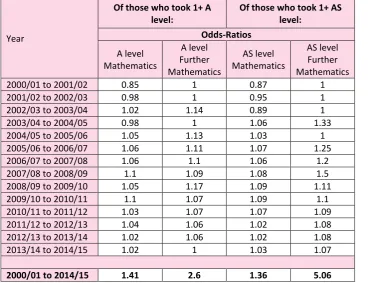
Whether a 'within A / AS level' (SFRs) or a 'within cohort' approach is taken, the trends over time consistently show the growth in popularity of Mathematics and Further Mathematics at A and AS level. Table 2-2 presents the SFR statistics as odds-ratio changes over time.
Table 2-2 Participation in A & AS level Mathematics & Further Mathematics 2001-2015 (change over time)
Year
Of those who took 1+ A level:
Of those who took 1+ AS level: Odds-Ratios A level Mathematics A level Further Mathematics AS level Mathematics AS level Further Mathematics
2000/01 to 2001/02 0.85 1 0.87 1
2001/02 to 2002/03 0.98 1 0.95 1
2002/03 to 2003/04 1.02 1.14 0.89 1
2003/04 to 2004/05 0.98 1 1.06 1.33
2004/05 to 2005/06 1.05 1.13 1.03 1
2005/06 to 2006/07 1.06 1.11 1.07 1.25
2006/07 to 2007/08 1.06 1.1 1.06 1.2
2007/08 to 2008/09 1.1 1.09 1.08 1.5
2008/09 to 2009/10 1.05 1.17 1.09 1.11
2009/10 to 2010/11 1.1 1.07 1.09 1.1
2010/11 to 2011/12 1.03 1.07 1.07 1.09 2011/12 to 2012/13 1.04 1.06 1.02 1.08 2012/13 to 2013/14 1.02 1.06 1.02 1.08
2013/14 to 2014/15 1.02 1 1.03 1.07
2000/01 to 2014/15 1.41 2.6 1.36 5.06
[image:32.595.55.429.454.737.2]In 2014/15 A level students are 1.4 times as likely to have taken A level Mathematics and 2.6 times as likely to take A level Further Mathematics compared to A level students in 2000/01. In 2014/15 AS level students are 1.4 times as likely to have taken AS level Mathematics and 5.1 times as likely to take AS level Further Mathematics compared to A level students in 2000/01.
Noyes and Adkins (2016) found a similar upward trend using a 'within cohort' approach.
Potential reasons for changes in participation rates
Following a revision of A level Mathematics specifications in 2000 there was a drop in participation in A level Mathematics relative to cohort size seen in 2002. Following further revision of the specification, participation in A level Mathematics has increased year on year since 2003 (Matthews and Pepper, 2007, Noyes and Adkins, 2016).
Further Mathematics has historically been taken by a relatively small minority of students taking A level Mathematics. However, Further Mathematics too, has seen a sustained increase in the number of students taking Further Mathematics A level and AS level. The rate of increase has been greater than for A level Mathematics, thus the ratio of FM students to the number of A level Mathematics students has increased
In 2009, MEI undertook a survey of teachers for reasons for increase in A level Mathematics participation. Factors identified were grouped in the following categories: motivations due to university entry and career progression; the enhancement of a conducive learning environment for mathematics; curriculum influences in particular the appropriateness of the A level syllabus; and the reputation and encouragement for take up at school level (ACME, 2009). However, a recent analysis suggests that at least a significant contributory factor since 2009 and possibly the main reason is that more students are achieving the highest GCSE grades - A* and A. Prior
2.3
Patterns of participation
Although there is limited research specifically on reasons for participation in Further
Mathematics there is a substantial body of literature on both mathematics participation beyond 16 and, related to this, participation in science subjects. Notable features about participation and in some cases outcomes in Advanced level Mathematics in England are described below.
Prior attainment
As stated above, the strongest predictive variable is prior attainment (DfE, 2011; Noyes, 2009; Noyes and Adkins, 2016) with the majority of A level participants achieving A* at GCSE. Further, prior-attainment relative to attainment in other subjects is significant (DfE, 2011; Noyes, 2013).
Gender
There are higher rates of participation in Advanced level Mathematics by males than females even when attainment is accounted for (DfE, 2011; Noyes, 2009; Noyes and Adkins, 2016). This is not found in similar cultures, for example the USA, (College Board, 2013). Thus indicating that this can be influenced (Smith, 2016).
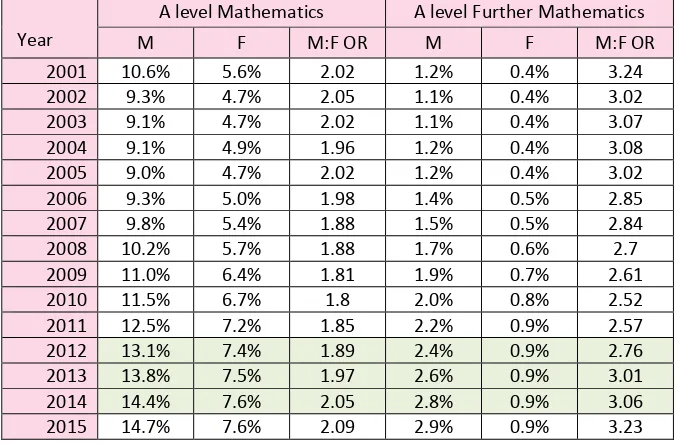
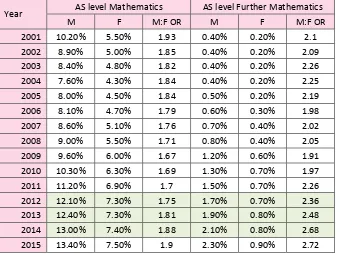
Tables 2-3 and 2-4 summarise A and AS level entries in Mathematics and Further Mathematics for male and female students in England 2001 to 2015 taken from Governmental Statistical First Release publications.
Table 2-3 Participation in A level Mathematics & Further Mathematics 2001-2015 by gender
Year
A level Mathematics A level Further Mathematics
M F M:F OR M F M:F OR
2001 10.6% 5.6% 2.02 1.2% 0.4% 3.24 2002 9.3% 4.7% 2.05 1.1% 0.4% 3.02 2003 9.1% 4.7% 2.02 1.1% 0.4% 3.07 2004 9.1% 4.9% 1.96 1.2% 0.4% 3.08 2005 9.0% 4.7% 2.02 1.2% 0.4% 3.02 2006 9.3% 5.0% 1.98 1.4% 0.5% 2.85 2007 9.8% 5.4% 1.88 1.5% 0.5% 2.84 2008 10.2% 5.7% 1.88 1.7% 0.6% 2.7 2009 11.0% 6.4% 1.81 1.9% 0.7% 2.61 2010 11.5% 6.7% 1.8 2.0% 0.8% 2.52 2011 12.5% 7.2% 1.85 2.2% 0.9% 2.57 2012 13.1% 7.4% 1.89 2.4% 0.9% 2.76 2013 13.8% 7.5% 1.97 2.6% 0.9% 3.01 2014 14.4% 7.6% 2.05 2.8% 0.9% 3.06 2015 14.7% 7.6% 2.09 2.9% 0.9% 3.23
[image:34.595.55.394.494.716.2]Table 2-4 Participation in AS level Mathematics & Further Mathematics 2001-2015 by gender
Year AS level Mathematics AS level Further Mathematics
M F M:F OR M F M:F OR
2001 10.20% 5.50% 1.93 0.40% 0.20% 2.1 2002 8.90% 5.00% 1.85 0.40% 0.20% 2.09 2003 8.40% 4.80% 1.82 0.40% 0.20% 2.26 2004 7.60% 4.30% 1.84 0.40% 0.20% 2.25 2005 8.00% 4.50% 1.84 0.50% 0.20% 2.19 2006 8.10% 4.70% 1.79 0.60% 0.30% 1.98 2007 8.60% 5.10% 1.76 0.70% 0.40% 2.02 2008 9.00% 5.50% 1.71 0.80% 0.40% 2.05 2009 9.60% 6.00% 1.67 1.20% 0.60% 1.91 2010 10.30% 6.30% 1.69 1.30% 0.70% 1.97 2011 11.20% 6.90% 1.7 1.50% 0.70% 2.26 2012 12.10% 7.30% 1.75 1.70% 0.70% 2.36 2013 12.40% 7.30% 1.81 1.90% 0.80% 2.48 2014 13.00% 7.40% 1.88 2.10% 0.80% 2.68 2015 13.40% 7.50% 1.9 2.30% 0.90% 2.72
Source: Adapted from the Statistical First Release - SFR 38 2015 Table 14 (see www.gov.uk/government/statistics/a-level-and-other-level-3-results-2014-to-2015-provisional)
The percentages shown in Table 2-3 and Table 2-4 show the increasing popularity in A and AS level Mathematics and Further Mathematics between 2001 and 2015. In most cases this increase has been similar for males and females. A level (male or female) students in 2015 are 1.4 times as likely to take A level Mathematics and 2.5 times as likely to take A level Further Mathematics compared with A level students in 2001. A similar pattern is observed for AS level mathematics - male or female students in 2015 are 1.4 times as likely to take AS level
Mathematics. For AS level Further Mathematics, the change is sharper for male compared with female students. Male AS students in 2015 are nearly 6 times as likely to take AS level Further Mathematics compared with male AS students in 2001. Female AS students in 2015 are 4.6 times as likely to take AS level Further Mathematics compared with female AS students in 2001.
[image:35.595.57.402.70.324.2]level in 2001 compared with females to males being 2.7 times as likely to take the AS level in 2015 compared with females.
Ethnicity
Differences in patterns of participation by ethnicity: Chinese, Indian, Black African, Bangladeshi and Pakistani students were more likely to enter A level Mathematics than White British
students; of those who do take A level Mathematics Chinese and Indian students are more likely to achieve A and B grades than White British students and other ethnic groups less likely (DfE, 2011; Noyes, 2009).
Socio-economic factors
Those who are socio-economically disadvantaged (using eligibility for Free School Meals - FSM, as a proxy) are less likely to take A level Mathematics. For example in 2009 students eligible for FSM in England were only a quarter as likely to take A level Mathematics as their non-eligible peers (DfE, 2011). However, it appears that this is largely accounted for by differences in GCSE attainment that are also linked to FSM status (Noyes, 2009).
School level effects
Independent schools and selective maintained schools have a disproportionate number of A level entries (DfE, 2011). There is considerable 'between school variation' in participation and
outcomes in A level Mathematics, including when other variables are accounted for. There are also indications that this is at least in part due to departmental level effects which are
independent of success in 11-16 progression (Noyes, 2013). The implication of this is that participation rates and outcomes may be impacted by school and departmental level change.
Factors influencing participation
interplay of these different factors and their influence on patterns of participation (Archer De Witt et al., 2012; Archer, Dawson et al., 2015).
Important too is the influence of the experience of school mathematics with student disaffection from the subject being extensively investigated (see for example, Nardi and Steward, 2003; Brown, Brown and Bibby, 2008). Investigation of student choice of A level Mathematics indicates the positive influence of teachers and varied pedagogies (Golding and Smith, 2016). Important too are availability of A Level Mathematics and programmes and interventions to support participation (Lord & Stripp, 2014; Searle, 2012, 2014).)
Others have focused on the way mathematics itself is constructed both in school and in society. This has been an important area of interest particularly for those investigating gender differences in participation and relationship to mathematics (see for example, Boaler, Alterndorff and Kent, 2011; Mendick, 2006), examining specifically A level participation and gender posit the notion of masculinities of mathematics, identifying different core reasons for choosing A level
3.
The Further Mathematics Support Programme
3.1
Overview
The Further Mathematics Support Programme (FMSP), funded by the DfE and managed by MEI, continues the work of the Further Mathematics Network (2005-2008). FMSP was established in 2009 and addresses the need to increase the participation in Advanced level study of
mathematics post-16, including Further Mathematics. The FMSP programme is based on the principle that all state-educated students should be able to access the mathematics education they need to fulfil their aspirations. It aims to:
• increase participation in AS/A level Mathematics and Further Mathematics, particularly that of girls and those from other under-represented groups • increase capacity within schools to provide high quality mathematics teaching • increase demand from students to study AS/A level Mathematics and Further
Mathematics post-16
• support improvements in Level 3 mathematics education
To further these aims, the FMSP programme goes beyond focusing only on AS/A level Further Mathematics and A level Mathematics qualifications. It also seeks to address how to engage KS4 and other learners in developing an enthusiasm for and positive attitude to the subject, through targeted professional development and other programmes.
The FMSP has developed organically, as funding has grown over time, with specific activities being added to the programme to address identified needs or interim outcomes in relation to programme aims. The relative importance of activities and number participating has changed over time. There has been a refreshed programme in place since April 2014 and this is described below.
3.2
Components of the FMSP programme
Tuition support for AS/A level Further Mathematics
The FMSP provides a variety of direct support for tuition of AS/A level Further Mathematics students. Tuition support is used by centres and students in different ways:
• to study Further Mathematics in centres where Further Mathematics is not offered due to difficulties timetabling or staffing it
• to study Advanced Level modules that are not offered by the students' centres to provide access to a broader A level Further Mathematics curriculum particularly in applied
mathematics
• as a supplementary learning experience
Current forms of tuition are:
• Further Mathematics Tuition: The area coordinator, or an FMSP associate, visiting a centre to teach a small Further Mathematics group from that centre or students from different sites attending a central venue (e.g. a host centre or university)
• Live Interactive Lectures (LIL): A series of 7-12, fortnightly lectures in an online classroom by an FMSP tutor. Designed to enhance in-house provision where there may be limited contact time or limited teacher expertise. Centres support their own students between sessions with study materials supplied by the FMSP. Centres receive access to materials on the Integral Virtual Learning Environment (see below) and other support materials. It is low cost at £50 for the first student and £10 for each additional student per unit
• Live Online Tuition (LOT): A series of between 7-12 LIL sessions and 7-12 online tutorial sessions (groups of 1-6) taught by an FMSP tutor who is responsible for the marking and support of the students
Continuing Professional Development
A level professional development and teacher support
• Live online PD (LOPD): A series of online sessions improving subject knowledge and pedagogy in a particular area of A level Mathematics or Further Mathematics • One day A level PD course: Typically a one day course organised by an Area
Coordinator to improve teacher subject knowledge in Pure Mathematics, Mechanics, Statistics or Decision Mathematics
• Access to Further Mathematics Conferences: These take place annually in March, teachers attend for Friday and Saturday to look at strategies for offering Further Mathematics and the support available
• Teaching Advanced Mathematics (TAM): Year long, funded university accredited CPD courses for teachers wishing to teach A level Mathematics or develop their skills in doing so
• Teaching Further Mathematics (TFM): Year long, CPD courses for teachers wishing to teach Further Mathematics or to improve their capacity to do so (accreditation optional)
• Supporting STEP/AEA/MAT: A one day course for teachers, sharing resources and approaches supporting students preparing for STEP/AEA/MAT2 exams and generally developing problem solving in the sixth form
• FMSP Teacher Networks: Typically a termly twilight meeting for local teachers
focusing on sharing practice or a CPD session, organised by FMSP Area Coordinator or Associate.
GCSE professional development and teacher support
• KS4 Extension and Enrichment: A two day course for teachers, sharing resources and approaches for enhancing the teaching of GCSE
• GCSE Higher Tier: A one day course for teachers, sharing resources for teaching the new content in Higher tier GCSE
2
STEP: Sixth Term Examination Papers in Mathematics are university admissions tests for undergraduate Mathematics courses developed by the University of Cambridge and required or encouraged by a number of Universities. AEA: Advanced Extension Award in Mathematics offered by Edexcel examination board. MAT:
• KS4 problem solving: A one day course for teachers, sharing resources and approaches for enhancing problem solving at GCSE.
Enrichment
The FMSP offers or supports a range of enrichment activities that aim to increase demand from students to study AS/A level Mathematics and Further Mathematics post-16, by enriching the experience of learning mathematics and supporting positive engagement in mathematics.
A level student support and enrichment
• One day events for year 12 and 13 students: Promoting problem solving, STEP/AEA/MAT preparation and sometimes looking at entry to HE
• Senior Team Mathematics Challenge (STMC): A team competition in November for a team of 4 sixth form students answering mathematics problems, run in partnership with United Kingdom Mathematics Trust (UKMT)
• Regular problem solving or STEP classes: Students attending weekly or fortnightly classes at a local university or other institution to get help with preparing for STEP/AEA/MAT exams or problem solving practice more generally
• Revision videos: students can use free revision videos available via the FMSP website and YouTube
• A level Revision event: Students attend a revision day at a university to go over content in A level Mathematics or Further Mathematics modules
KS4 student support and enrichment
• KS4 enrichment events: One day (or half day) events at a university or centre offering workshops, enrichment sessions, challenges and some guidance on careers using mathematics
• Year 10 Maths Feast: A mathematics team competition for year 10 students which takes place in February and March
• Year 10 and 11 enrichment talks: Area Coordinator or Associate visits to centres to talk to students about studying A level Mathematics and Further Mathematics.
Regional support
Area Coordinators coordinate regional activity and offer tailored face to face support and advice to teachers and mathematics leaders in relation to FMSP aims and provision.
On-line support
• Integral virtual learning environment containing online resources: All registered centres can access teaching materials for A level Further Pure Module and Application modules – Mechanics, Statistics and Decision Mathematics
•
FMSP Website: Access to information and resources about teaching and enriching A level Mathematics and Further Mathematics as well as details of events for students and teachers3.3
Previous evidence of quality and impact of activities
Evaluation of previous phases of the FMSP programme provided evidence that:
• participating teachers view both online and face to face professional development as worthwhile and effective
• the various forms of tuition support participation in FM for students who otherwise might not be able to access it
• tuition is flexible and used by centres in a variety of ways to support students
• the FMSP has succeeded in registering most centres which have post-16 provision and more than half of 11-16 centres
• A level participation in Further Mathematics has steadily grown
• more than half of centres who have A level provision now offer Further Mathematics • take up of Further Mathematics is associated with a general increase in A level
Mathematics participation
• the Area Coordinator network provides effective support to centres
• registered users make flexible use of centrally provided materials via the FMSP Integral site
• the FMSP is well regarded by a range of stakeholders
4.
Evaluation Methodology
4.1
Overview
Phase 5 of the evaluation, reported here, builds and extends previous findings of the evaluation of the FMSP by:
• reviewing the A level mathematics and Further Mathematics landscape reporting a quantitative analysis of centre and student participation in Further Mathematics through analysis of School Census data and data from the National Pupil Database supported by qualitative data on student and teacher views on participation in Further Mathematics
• analysing p