A Gauss-Newton-Based Broyden’s Class Algorithm for
Parameters of Regression Analysis
Xiangrong Li, Xupei Zhao
Department of Mathematics and Information Science, Guangxi University, Nanning, China E-mail: xrli68@163.com
Received October 14, 2010; revised November 11, 2010; November 13, 2010
Abstract
In this paper, a Gauss-Newton-based Broyden’s class method for parameters of regression problems is pre-sented. The global convergence of this given method will be established under suitable conditions. Numeri-cal results show that the proposed method is interesting.
Keywords:Global Convergence, Broyden’s Class, Regression Analysis, Nonlinear Equations, Gauss-Newton
1. Introduction
It is well known that the regression analysis often arises in economies, finance, trade, law, meteorology, medicine, biology, chemistry, engineering, physics, education, his-tory, sociology, psychology, and so on (see [1-7]). The classical regression model is defined by
1, 2, , p
Y h X X X ,
where Y is the response variable, Xi is predictor
va-riable i1, 2, , , p p0 is an integer constant, and
is the error. The function h X X
1, 2, , Xp
describe therelation between Y and X
X X1, 2, , Xp
. If h islinear function, then we can get the following linear re-gression model
0 1 1 2 2 p p
Y X X X (1.1)
which is the most simple regression model, where 0, , ,1 p
are regression parameters. On the other hand, the regression model is called nonlinear regression. We all know that there are many nonlinear regression could be linearization [8-13].Then many authors are de-voted to the linear model [14-19]. Now we will concen-trate on the linear model to discuss the following prob-lems. One of the most important work of the regress analy- sis is to estimate the parameters
0, , ,1 p
.The least squares method is an important fitting method to determined the parameters
0, , ,1 p
, whichis defined by
1
2
0 1 1 2 2 1
min ,
p
m
i i i p ip
i
S h X X X
(1.2) where hi is the data valuation of the i th response
variable, Xi1,Xi2, , Xip are p data valuation of the i th predictor variable, and m is the number of the
data. If the dimension p and the number m is small,
then we can obtain the parameters
0, , ,1 p
from extreme value of calculus. From the definition of (1.2), it is not difficult to see that this problem (1.2) is the same as the following unconstrained optimization prob-lem
min
n
x f x
(1.3) For regression problem (1.3), if the dimension n is
large and the function f is complex, then it is difficult
to solve this problem by the method of extreme value of calculus. In order to solve this problem, numerical me- thods are often used, such as steepest descent method, Newton method, and Guass-Newton method (see [5-7]
et al.). Moreover many statical softwares are from this
idea. Numerical method, i.e., the iterative method is to generates a sequence of points { }xk which will
termi-nate or converge to a point x in some sense. The line
search method is one of the most effective numerical method, which is defined by
1 , 0,1, 2, ,
k k k k
x x d k
where k that is determined by a line search is the step-
length, and dk which determines different line search
methods [20-30] is a descent direction of f at xk. We
give a line search method for regression problem and get good results (see [31] in detail).
In order to solve the problem (1.3), one main goal is to find some point x such that
0, ng x x (1.4)
where g x
f x
is the gradient of f x( ) In thispaper, we will concentrate on this equations problem (1.4) where : n 2
g is continuously differentiable (linear
or nonlinear). Assume that the Jacobian g x
of gis symmetric for all n
x . Let be the norm func-
tion defined by
1
22
x g x
.Then the nonlinear
equations problem (1.4) is equivalent to the following global optimization problem
min x ,xn. (1.5)
Similar to (1.3), the following iterative formula is of-ten used to solve the problem (1.4) or (1.5)
1 ,
k k k k
x x d (1.6)
where dk is a search direction, k is a steplength
along dk and xk is the k th iterative point. For (1.4),
Griewank [32] first established a global convergence theorem for quasi-Newton method with a suitable line search. One nonmonotone backtracking inexact quasi- Newton algorithm [33] and the trust region algorithms [34,35] were presented. A Gauss-Newton-based BFGS (Broyden, Fletcher, Goldfar, and Shanno, 1970) method is proposed by Li and Fukushima [36] for solving sym-metric nonlinear equations. Inspired by their ideas, Wei [37] and Yuan [38,39] made a further study. Recently, Yuan and Lu [40-45] got some new methods for symme-tric nonlinear equations.
The authors [36] only discussed that the updated ma-trices were generated by the BFGS formula. Whether the updated matrices could be produced by the more exten-sive Broyden's class? This paper gives a positive answer, moreover, the presented method is used to regression analysis. The major contribution of this paper is an ex-tension of the method in [36] to Broyden’s class, moreo-ver, to solving the regression problems. Numerical re-sults of practically statistical problems show that this given method is effective. Throughout this paper, these notations are used: is the Euclidean norm, g x
kand g x
k1
are replaced by gkand gk1, respect- tively.In the next section, the method of Li and Fukushima [36] is stated. Our algorithm is proposed in Section 3. Under some reasonable conditions, the global conver-gence of the given algorithm is established in Section 4. In the Section 5, numerical results are reported. In the last section, a conclusion is stated.
2. A Gauss-Newton-Based BFGS Method
[36]
Li and Fukushima [36] proposed a new BFGS update formula defined by:
/ /
/ /
1 / ,
T T
k k k k k k
k k T T
k k k k
B s s B
B B
s B s s
(2.1)
Where sk xk1x yk, k gk1gk,
, 1k g xk yk gk xk
is the next iteration,
k k
g g x , gk1g x
k1
, and B0/ is an initialsymmetric positive definite matrix. By the secant equa-tion /
1
K k k
B s and gk is symmetric, they had
ap-proximately
/
1 1 1 1
T
k k k k k k k
Bs g y gg s ,
which implies that / 1 k
B approximates gTk1gk1
along direction sk By solving the following linear
equ-ation to get the search direction dk.
1
1
0.
k k k k
k k
k
g x g g B d
(2.2)
If k1gk is sufficiently small and Bk is positive
definite, then they have the following approximate rela-tion
1
1
.
k k k k
k k k k
k
g x g g
B d g g
Therefore,
11 T
k k k k k k k k
d Bg g g g g g .
So, the solution of (2.2) is an approximate Gauss- Newton direction. Then the methods (2.1) and (2.2) are called Gauss-Newton-based BFGS method. In order to get the steplength k by means of a backtracking
process, a new line search technique is defined by
2 22 2 2
1 2 ,
k k k
k k k k
g x d g
g d g
(2.3)
where 1, 2 0 are constants, and the positive se-quence { }k such that
0 k
k
. (2.4)3. Algorithm
Now we give our algorithm as follows.
Algorithm 1 (Gauss-Newton-based Broyden’s Class Algorithm)
Step 0: Choose an initial point 0 n
x R ,an initial
symmetric positive definite matrix 0 n n
B R , a positive
sequence { }k satisfying (2.4), and constants
0,1 , ,1 2 0, 1 0r , let: k0.
Step 1: Stop if gk 0. Otherwise solve the linear
(2.2) to get the search direction dk.
Step 2: Let ikbe the smallest nonnegative integer
i
such that Equation (2.3) holds for i r
. Let i
k r
. Step 3: Let the next iterative be xk1xk kdk.
Step 4: Put sk xk1xk kdk,k gk1gkand
k k k k
y g x g x . If s yTk k 0 and
2 11
, , ,
1
T T
k k k k k k
c
k k k k k
T
k k k
s B s y H y
u H B
u s y
(3.1) then update Bk by the Broyden’s class formula
1 ,
0,1, 2, ,
T T
T T
k k k k k k
k k T T k k k k k k
k k k k k
B s s B y y
B B s B s v v
s B s s y
k
(3.2)
Where k k k
k T T
k k k k k
y B s
v
s y s B s
Otherwise let Bk1Bk.
Step 5: Let k: k 1 Go to step 1.
4. Global Convergence
In this paper, we will establish the global convergence of Algorithm 1 under the condition about k such that
1
c,1 , ,
0,1k v k v
(4.1) Let be the level set defined by
2
0 |
x g x e g x
, where is a positive con- stant such that k 0k
.Similar to [33,36-39], the following Assumptions are needed.
Assumption A 1) g is continuously differentiable
on an open convex set 1 containing .
2) The Jaconbian of g is symmetric, bounded, and
uniformly nonsingular on 1, i.e., there exist positive constants M m 0 such that
1g x M x
(4.2) and
, ,1 .n
m d g x d x dR (4.3)
Assumption A 2) implies that
, 1, ,n
m d g x d M d x dR (4.4)
, , 1.m xy g x g y M xy x y (4.5)
By Assumption A, similar to Lemma 2.2 in [36], it is not difficult to get the following lemma. So we only state it as follows but omit the proof.
Lemma 4.2 Let Assumption A be satisfied.
Consid-er Equation (2.3), if sk 0, then there is a constant 1 0
m such that forall k sufficiently large
2
1 .
T
k k k
y s m s (4.6)
Denote
1
1 1
1
0 ,
k k k k
k
k
k k k k k k
g x g g q
g x g d g T g
(4.7)
where Tk
01 g x
kk1gk
d . Consider Equation(2.2), then we have
0
k k k k k k k
B d q B d T g . (4.8)
Lemma 4.3 Let Assumption A be satisfied. Then we have
2lim 0.
T
k k k
T k
k k
s q
s y
(4.9)
Proof. Consider the line search (2.3), by Lemma 4.1
and Equation (2.4), we can get the following inequalities immediately
2 2
0 0
,
k k k k
k k
g d
. (4.10)By Equations (4.5)-(4.7), we have
22
2 2
2
1 1
1
0 ,
T k k k
k k k k
T k k
s q M
q g
m m
s y
By Equation (4.10), we obtain Equation (4.9). The proof is complete.□
Lemma 4.4
1
det det T T 1 1
K k k k k k k k k
B B y s s B s u
where det
Bk denotes the determinant of Bk.Proof. Omitted. For the proof can be seen from [21].□
Let us denote
cos
. T
k k k
k
k k k
s B s B s s
The proof of the following lemma is motivated by the methods in [46,47].
Lemma 4.5 Let Assumption A hold and
k, , ,dk x gk k
be generated by Algorithm 1. Thenthere exist a positive integer k/ and positive constants
1, 2, 3 0
such that, for any t0
0,1 and kk/ the relations3
1 2 3 2
1
cos , T ,
i s B si i i si B si i
(4.12)
hold for at least t k0 values of i
0,k .Proof. By Equation (4.5), we get 2
k k k
y M M s .
Using this and Equation (4.6), we obtain
2 4 2 4 4
1 1 2 1 1 1 , . k k T
k k k
y M s M M
M M
m m
s y m s
(4.13)
From Equation (3.2), we have
1
22 1
1 2 ,
k k
k k k T
k k k
T T
k
k k k k k k
k T T k T
k k k k k k
B s
Tr B Tr B
s B s
y
s B s s B y
s y s y s y
(4.14)
where Tr B
k denote the trace of Bk By Lemma 4.2,we know there exists a positive integer /
k , when
/
kk , Equation (4.6) holds. Let us now define Nk by
| /
k
N k kk holds
Denote
1 | 0 k 1 , k ,
I k kN
2 1 | 1 0, .
c
k k k k
I N I k v kN
Consider the following two cases. 1) kI1. Equation (4.13) indicates that
22 2
1 2
T T
k k k
k k k k k k
T T T T
k k k k k k k k k k k
s B s y s B s B s
M
s y s y s B s s y B s
(4.15)
and
2
1
T T T
k k k k k k k k k k k k
T T T T
k k k k k k k k k k k k k
s B y B s y s B s s B s
M
s y s B s s y B s s y B s
(4.16) Using Bkis positive definite, Equations (4.1), (4.14)-
(4.16), we have
1
2 12
k k
k k T
k k k B s
Tr B Tr B M
s B s
(4.17)
holds for all kI1.
2) kI2. According to Equations (4.1), (4.13), and (4.14), it is easy to get
1
2 1k k
k k T
k k k B s
Tr B Tr B M
s B s
,
this means that Equation (4.17) also holds in this case. So the relation Equation (4.17) holds for these two cases. Define the Rayleigh quotient
,
T k k k
T k k s B s p
s s
(4.18)
and the function
B Tr B
ln det
B
, (4.19)
Where ln denotes the logarithm, and B is any
pos-itive definite matrix.
By Equations (3.1), (4.1) and Lemma 4.4, we can de-duce that
1det det 1 1
det .
T k k
k k T k k
k k k T k k
k T
k k k y s
B B u
s B s
y s
B v
s B s
(4.20)
From Equations (4.17), (4.19), (4.20), the definitions (4.11) and (4.18), we have
2 1 1 2 1 1 2 1 ln 2 2 ln ln ln 2 cos 2ln 1 ln
ln co
T
k k k k
k k T T
k k k k k k
T
k k k k k k
k T T
k k k k k
T T
k k k k
T T
k k k k k
T
k k k
k T k
k k k
T k k
k T
k k
B s s y
B B M v
s B s s B s
B s s s B s
B
s B s s s
s y s s
M v
s s s B s
s y p
B M v p
s s
s y
B M v
s s 2 2 2
s 1 ln .
2cos 2cos
k k k k k p p (4.21)
Combining this and Equation (4.6), we get
'
'
1 1 1
2
2 2
2
ln 1 ln 1
ln cos 1 ln
2 cos 2 cos
k k
k
i i
i
i k i i
B B M vm k k
p p
2
2 2
ln cos 1 ln .
2cos 2cos
i i
i i
i i
p p
(4.22)
Since
Bk1
0 [or see [46]] we have
' 1 1
' '
1 2
ln 1 ln .
1 1
k
k i
j k
B
M vm
k k k k
(4.23) Let us define i to be a set consisting of
'
0
t k k
indices corresponding to the t0
kk'
smallest values of i for'
k i k, and let max de-note the largest of the i for iJk Then we get
' max '
' '
,
max 0
1 1
.
1 1
1 .
k
k k
i i
j k i k i J
k k k k
t
Therefore, by Equation (4.23), we have, for all iJk
1 1 00
1 2
ln 1 ln 1
i Bk M vm
t
(4.24)
Since the term inside the brackets in Equation (4.22) is less than or equal to zero, we conclude from Equations (4.22) and (4.24) that for all iJk
2 0
ln cos i
Thus, we get
02 1
cos t
i e
(4.25) According to Equations (4.22) and (4.24), for all
k
J
i
we have,0
2 2
1 ln .
2 cos 2 cos
i i
i i
p p
Note the function
1 lnw t t t, (4.26)
is nonpositive for all t0, achiexes its maximum value at t0, and satisfies w t
both as t and t0. Then it follows that for all iJk
' 3 cos2 2 0
i i p
,
For some constants ' 2
and 3. By Equation (4.25), we get
2 '
2 1 2 pi 3
Using
cos
i i i
i i
B s p
s , we obtain for all iJk,
3 2
1 i i
i B s
s
.
Since '
k is a fixed integer and Bi are positive
defi-nite, we can take smaller 1, 2 and larger 3 if nece- ssary so that this lemma holds for all '
ik Therefore
Equation (4.12) holds for at least t k0 indices
0,i k . The proof is complete.□
Let N
i| 4.12
holds
.Similar to [36], it is not difficult to get the global con-vergence theorem of Algorithm 1. So we only state as follows but omit the proof.
Theorem 4.1 Let Assumption A and Equation (4.1)
hold. Then the sequence
xk generated by theGauss-Newton- based Broyden’s class Algorithm. Then
lim inf k 0
k g . (4.27)
5. Numerical Results
In this section, we report results of some numerical ex-periments with the proposed method. We will test two practically statistical problems to show the efficiency of Algorithm 1.
Problem 1. In Table 1, there is data of the age x
and the average height H of a pine tree:
Our objective is to find out the approximate function between the demand and the price, namely, we need to find the regression equation of x to the h.It is easy to
see that the age x and the average height H are
pa-rabola relations. Denote the regression function by
2
0 1 2
h x x where 0, 1, and 2 are the re-
gression parameters. Using least squares method, we need to solve the following problem
22
0 1 2
0
min
n
i i i
i
Q h x x
and obtain 0, 1, and 2, where n10. Then the
corresponding unconstrained optimization problem is defined by
3
2 2 1
min n i 1, ,i i T .
i
f h x x
(5.1)where Y is overall appraisal to supervisor, X1
de-notes to processes employee's complaining, X2 refer to do not permit the privilege, X3 is the opportunity about study, X4 is promoted based on the work achievement,
5
X refer to too nitpick to the bad performance, and X6
is the speed of promoting to the better work.
In the experiment, all codes were written in MATLAB 7.5 and run on PC with 2.60 GHz CPU processor and 480 MB memory and Windows XP operation system. In
the experiments, the parameters in Algorithm 1 were chosen as r0.1, 0.85, 12 104, 1 =
0.0001 and 2
k k
, where
ration. The initial matrix B0 was always set to be the unit matrix. We will stop the program if the condition
5g le is satisfied.
In order to show the efficiency of these algorithms, the residuals of sum of squares is defined by
2
1
, n
p i i
i
SSE y y
Where yi 0 1Xi1 nXin,i 1, 2, , ,n
and
0, 1 ,
i n
y
are the parameters when the program is stopped or the solution is obtained from one way. Let
p
p
SSE RMS
n p
,
where n is the number of terms in problems, and p is
the number of parameters, if RMSp is smaller, then the
corresponding method is better [48]. In Table 2, DFP
stands for the Formula (3.2) in Algorithm 1 where
1 k
, and BFGS stands for the Formula (3.2) in
Al-gorithm 1 where k 0.
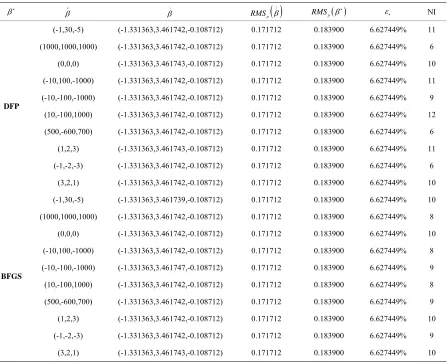
The columns of the Table 2 have the following
mean-ing:
: the approximate solution from the method of
ex-treme value of calculus or some software. \
: the solution as the program is terminated. : the initial point. NI: the total number of iterations. : the relative error between RMSp
and
\p
RMS
defined by
Table 1. The data of pine tree.
i
x 2 3 4 5 6 7 8 9 10 11
i
[image:6.595.78.526.358.721.2]h 5.6 8 10.4 12.8 15.3 17.8 19.9 21.4 22.4 23.2
Table 2. Test result for problem 1.
\ RMSp
\ RMSp
NI
DFP
(-1,30,-5) (-1.331363,3.461742,-0.108712) 0.171712 0.183900 6.627449% 11
(1000,1000,1000) (-1.331363,3.461742,-0.108712) 0.171712 0.183900 6.627449% 6
(0,0,0) (-1.331363,3.461743,-0.108712) 0.171712 0.183900 6.627449% 10
(-10,100,-1000) (-1.331363,3.461742,-0.108712) 0.171712 0.183900 6.627449% 11
(-10,-100,-1000) (-1.331363,3.461742,-0.108712) 0.171712 0.183900 6.627449% 9
(10,-100,1000) (-1.331363,3.461742,-0.108712) 0.171712 0.183900 6.627449% 12
(500,-600,700) (-1.331363,3.461742,-0.108712) 0.171712 0.183900 6.627449% 6
(1,2,3) (-1.331363,3.461743,-0.108712) 0.171712 0.183900 6.627449% 11
(-1,-2,-3) (-1.331363,3.461742,-0.108712) 0.171712 0.183900 6.627449% 6
(3,2,1) (-1.331363,3.461742,-0.108712) 0.171712 0.183900 6.627449% 10
BFGS
(-1,30,-5) (-1.331363,3.461739,-0.108712) 0.171712 0.183900 6.627449% 10
(1000,1000,1000) (-1.331363,3.461742,-0.108712) 0.171712 0.183900 6.627449% 8
(0,0,0) (-1.331363,3.461742,-0.108712) 0.171712 0.183900 6.627449% 10
(-10,100,-1000) (-1.331363,3.461742,-0.108712) 0.171712 0.183900 6.627449% 8
(-10,-100,-1000) (-1.331363,3.461747,-0.108712) 0.171712 0.183900 6.627449% 9
(10,-100,1000) (-1.331363,3.461742,-0.108712) 0.171712 0.183900 6.627449% 8
(500,-600,700) (-1.331363,3.461742,-0.108712) 0.171712 0.183900 6.627449% 9
(1,2,3) (-1.331363,3.461742,-0.108712) 0.171712 0.183900 6.627449% 10
(-1,-2,-3) (-1.331363,3.461742,-0.108712) 0.171712 0.183900 6.627449% 9
(3,2,1) (-1.331363,3.461743,-0.108712) 0.171712 0.183900 6.627449% 10
\
p P
p
RMS RMS RMS
.
For Problem 1, the above problems (5.2) can be solved by extreme value of calculus. Then we get
1.33,3.46, 0.11
in
Table 2. Here we also solve
these two problems by Algorithm 1. These numerical results of Table 2 indicate that Algorithm 1 is better than
those of these methods from extreme value of calculus or some software. Then we can conclude that the numerical method will outperform the method of extreme value of calculus in some sense, and some software for regression analysis could be further improved in the future. Moreo-ver, the initial points don not influence that the sequence
xk converges to one solution x our proposedme-thod.
6. References
[1] D. M. Bates and D. G. Watts, “Nonlinear Regression Analysis and Its Applications,” John Wiley & Sons, New York, 1988. doi:10.1002/9780470316757
[2] S. Chatterjee and M. Machler, “Robust Regression: A Weighted Least Squares Approach, Communications in Statistics,” Theorey and Methods, Vol. 26, No. 6, 1997, pp. 1381-1394. doi:10.1080/03610929708831988 [3] R. Christensen, “Analysis of Variance, Design and
Re-gression: Applied Statistical Methods,” Chapman and Hall, New York, 1996.
[4] N. R. Draper and H. Smith, “Applied Regression Analy-sis,” 3rd Edtion, John Wiley & Sons, New York, 1998. [5] F. A. Graybill and H. K. Iyer, “Regression Analysis:
Concepts and Applications,” Duxbury Press, Belmont, 1994.
[6] R. F. Gunst and R. L. Mason, “Regression Analysis and Its Application: A Data-Oriented Approach,” Marcel Dekker, New York, 1980.
[7] R. H. Myers, “Classical and Modern Regression with Applications,” 2nd Edtion, PWS-Kent Publishing Com-pany, Boston, 1990.
[8] R. C. Rao, “Linear Statistical Inference and Its Applica-tions,” John Wiley & Sons, New York, 1973. doi:10.1002/9780470316436
[9] D. A. Ratkowsky, “Nonlinear Regression Modeling: A Unified Practical Approach,” Marcel Dekker, New York, 1983.
[10] D. A. Ratkowsky, “Handbook of Nonlinear Regression Modeling,” Marcel Dekker, New York, 1990.
[11] A. C. Rencher, “Methods of Multivariate Analysis,” John Wiley & Sons, New York, 1995.
[12] G. A. F. Seber and C. J. Wild, “Nonlinear Regression,” John Wiley & Sons, New York, 1989. doi:10.1002/ 0471725315
[13] A. Sen and M. Srivastava, “Regression Analysis: Theory, Methods, and Applications,” Springer-Verlag, New York, 1990.
[14] J. Fox, “Linear Statistical Models and Related Methods,” John Wiley & Sons, New York, 1984.
[15] S. Haberman and A. E. Renshaw, “Generalized Linear Models and Actuarial Science,” The Statistician, Vol. 45, No. 4, 1996, pp. 407-436. doi:10.2307/2988543
[16] S. Haberman and A. E. Renshaw, “Generalized Linear Models and Excess Mortality from Peptic Ulcers,” In-surance: Mathematics and Economics, Vol. 9, No. 1, 1990, pp. 147-154. doi:10.1016/0167-6687(90)90012-3 [17] R. R. Hocking, “The Analysis and Selection of Variables
in Linear Regression,” Biometrics, Vol. 32, No. 1, 1976, pp. 1-49. doi:10.2307/2529336
[18] P. McCullagh and J. A. Nelder, “Generalized Linear Models,” Chapman and Hall, London, 1989.
[19] J. A. Nelder and R. J. Verral, “Credibility Theory and Generalized Linear Models.” ASTIN Bulletin, Vol. 27, No. 1, 1997, pp. 71-82. doi:10.2143/AST.27.1.563206 [20] M. Raydan, “The Barzilai and Borwein Gradient Method
for the Large Scale Unconstrained Minimization Prob-lem,” SIAM Journal on Optimization, Vol. 7, No. 1, 1997, pp. 26-33. doi:10.1137/S1052623494266365
[21] J. Schropp, “A Note on Minimization Problems and Mul-tistep Methods,” Numerical Mathematics, Vol. 78, 1997, pp. 87-101. doi:10.1007/s002110050305
[22] J. Schropp, “One-Step and Multistep Procedures for Con-strained Minimization Problems,” IMA Journal of Nu-merical Analysis, Vol. 20, No. 1, 2000, pp. 135-152. doi:10.1093/imanum/20.1.135
[23] D. J. Van Wyk, “Differential Optimization Techniques,” Applied Mathematical Modelling, Vol. 8, 1984, pp. 419-424. doi:10.1016/0307-904X(84)90048-9
[24] M. N. Vrahatis, G. S. Androulakis, J. N. Lambrinos and G. D. Magolas, “A Class of Gradient Unconstrained Mi-nimization Algorithms with Adaptive Stepsize,” Journal of Computational and Applied Mathematics, Vol. 114, No. 2, 2000, pp. 367-386. doi:10.1016/S0377-0427(99) 00276-9
[25] G. Yuan and X. Lu, “A New Line Search Method with Trust Region for Unconstrained Optimization,” Commu-nications on Applied Nonlinear Analysis, Vol. 15, 2008, No. 2, pp. 35-49.
[26] G. Yuan and Z. Wei, “New Line Search Methods for Unconstrained Optimization,” Journal of the Korean Sta-tistical Society, Vol. 38, No. 1, 2009, pp. 29-39. doi: 10.1016/j.jkss.2008.05.004
[27] G. Yuan and X. Lu, “A Modified PRP Conjugate Gra-dient Method,” Annals of Operations Research, Vol. 166, No. 1, 2009, pp. 73-90. doi:10.1007/s10479-008-0420-4 [28] G. Yuan, “Modified Nonlinear Conjugate Gradient
Me-thod with Descent Direction for Unconstrained Optimiza-tion,” Journal of Computational and Applied Mathemat-ics, Vol. 233, No. 2, 2009, pp. 519-530. doi:10.1016/ j.cam.2009.08.001
[30] G. Yuan, “A Conjugate Gradient Method for Uncon-strained Optimization Problems,” International Journal of Mathematics and Mathematical Sciences, Vol. 2009, 2009, pp. 1-14. doi:10.1155/2009/329623
[31] G. Yuan and Z. Wei, “A Nonmonotone Line Search Me-thod for Regression Analysis,” Journal of Service Science and Management, Vol. 2, No. 1, 2009, pp. 36-42. doi: 10.4236/jssm.2009.21005
[32] A. Griewank, “The ‘Global’ Convergence of Broy-den-Like Methods with a Suitable Line Search,” Journal of the Australian Mathematical Society. Series B, Vol. 28, No. 1, 1986, pp. 75-92. doi:10.1017/S0334270000005208 [33] D. T. Zhu, “Nonmonotone Backtracking Inexact Quasi-
Newton Algorithms for Solving Smooth Nonlinear Equa-tions,” Applied Mathematics and Computation, Vol. 161, No. 3, 2005, pp. 875-895. doi:10.1016/j.amc.2003.12.074 [34] J. Y. Fan, “A Modified Levenberg-Marquardt Algorithm
for Singular System of Nonlinear Equations,” Journal of Computational Mathematics, Vol. 21, No. 5, 2003, pp. 625-636.
[35] Y. Yuan, “Trust Region Algorithm for Nonlinear Equa-tions,” Information, Vol. 1, 1998, pp. 7-21.
[36] D. Li and M. Fukushima, “A Global and Superlinear Convergent Gauss-Newton-Based BFGS Method for Symmetric Nonlinear Equations,” SIAM Journal on Nu-merical Analysis, Vol. 37, No. 1, 1999, pp. 152-172. doi: 10.1137/S0036142998335704
[37] Z. Wei, G. Yuan and Z. Lian, “An Approximate Gauss-Newton-Based BFGS Method for Solving Sym-metric Nonlinear Equations,” Guangxi Sciences, Vol. 11, No. 2, 2004, pp. 91-99.
[38] G. Yuan and X. Li, “An Approximate Gauss-Newton- Based BFGS Method with Descent Directions for Solving Symmetric Nonlinear Equations,” OR Transactions, Vol. 8, No. 4, 2004, pp. 10-26.
[39] G. Yuan and X. Lu, “A Nonmonotone Gauss-Newton- Based BFGS Method for Solving Symmetric Nonlinear
Equations,” Journal of Lanzhou University, Vol. 41, 2005, pp. 851-855.
[40] G. Yuan abd X. Lu, “A New Backtracking Inexact BFGS Method for Symmetric Nonlinear Equations,” Computer and Mathematics with Application,” Vol. 55, No. 1, 2008, pp. 116-129. doi:10.1016/j.camwa.2006.12.081
[41] G. Yuan, X. Lu and Z. Wei, “BFGS Trust-Region Me-thod for Symmetric Nonlinear Equations,” Journal of Computational and Applied Mathematics, Vol. 230, No. 1, 2009, pp. 44-58. doi:10.1016/j.cam.2008.10.062
[42] G. Yuan, Z. Wang and Z. Wei, “A Rank-One Fitting Me-thod with Descent Direction for Solving Symmetric Non-linear Equations,” International Journal of Communica-tions, Network and System Sciences, Vol. 2, No. 6, 2009, pp. 555-561. doi:10.4236/ijcns.2009.26061
[43] G. Yuan, S. Meng and Z. Wei, “A Trust-Region-Based BFGS Method with Line Search Technique for Symme-tric Nonlinear Equations,” Advances in Operations Re-search, Vol. 2009, 2009, pp. 1-20. doi:10.1155/2009/ 909753
[44] G. Yuan and X. Li, “A Rank-One Fitting Method for Solving Symmetric Nonlinear Equations,” Journal of Ap-plied Functional Analysis, Vol. 5, No. 4, 2010, pp. 389-407.
[45] G. Yuan, Z. Wei and X. Lu, “A Nonmonotone Trust Re-gion Method for Solving Symmetric Nonlinear Equa-tions,” Chinese Quarterly Journal of Mathematics, Vol. 24, No. 4, 2009, pp. 574-584.
[46] R. Byrd and J. Nocedal, “A Tool for the Analysis of Qua-si-Newton Methods with Application to Unconstrained Minimization,” SIAM Journal on Numerical Analysis, Vol. 26, No. 3, 1989, pp. 727-739. doi:10.1137/0726042 [47] D. Xu, “Global Convergence of the Broyden’s Class of
Quasi-Newton Methods with Nonomonotone Line-search,” ACTA Mathematicae Applicatae Sinica, English Series, Vol. 19, No. 1, 2003, pp.19-24. doi:10.1007/ s10255-003-0076-4